RSS
 

Archive for January, 2016

Opinion: Pour one out for Samsung cameras

06 Jan
I attended the Samsung press conference at CES in eager anticipation of new developments in Samsung’s NX line, but there was no mention of mirrorless cameras at all. Fridges though. Fridges have become a lot more advanced since the last time I was in a Sears. 

CES press conferences can be a bit overwhelming, especially when they’re presented by companies that make lots of different things. Take Samsung for instance: a company with an incredibly diversified portfolio of consumer electronic products. Their press conference draws an enormous crowd of technology journalists and industry folks from vastly different fields. Compared to the Nikon press conference I attended earlier this morning, the Samsung one easily had 20x the number of attendees, eager to hear about everything from fridges to virtual reality headsets. Of course, DPReview was there in the hope of reporting on new photography-related products. Silly us. 

The one-hour event opened with talk of Samsung’s wide range of products and went on to detail developments in everything from 8K televisions to smartwatches with Jean-Michel Basquiat’s artwork plastered on the face.

Somewhere in the middle of a presentation on space-age refrigerators with inward facing video cameras (so you can see just how moldy that peach you forgot about is?), I realized that Samsung’s line of mirrorless cameras had yet to come up. Hmmm. Looking at my non-smart watch with a mere 20 minutes to go, I figured there was still time for cameras to be at least mentioned. Even if only in terms of how they might work with other freshly-announced Samsung products. After all, Samsung impressed us enormously in 2015 with the ambitious, 4K-capable NX1 and NX500 and the company’s camera division seemed to have built up a lot of momentum in the middle of last year.

The Samsung NX1 is one of our favorite mirrorless cameras ever. But will there be an NX2?

But sadly I was wrong. Aside from the space-age fridge with the video camera inside it, the closest thing to photography that was mentioned was Project Beyond, a 360-degree VR camera, which was announced a few months earlier. The press conference concluded without dedicated stills cameras being mentioned once. 

Of course all of this is building up to the inevitable question: Is Samsung pulling out of digital cameras altogether? With the news back in November that Samsung was yanking the NX1 from European markets, the complete omission of digital cameras from a press conference at the world’s largest consumer tradeshow doesn’t bode well.

As the press conference wrapped up, and high-tech washing machines and smartphone-connected stoves appeared on stage via floating platforms (no kidding), I wondered whether the lack of photography news was a blip, or whether Samsung has indeed decided to place its bets on the connected home and device being the future of consumer technologies, not digital cameras. 

If so (and trust us, we know no more than you do) that’s a real shame. The NX1 raised the bar for mirrorless camera technology considerably, and the two ‘S’ lenses released alongside it are outstanding. Some of this technology may live on in some form or another in other Samsung products of course, but we were really looking forward to seeing how the NX system evolved.

At the end of the day, the last thing I want to see in the world of digital imaging is a lack of competition, and the loss of even one player is a mighty blow. Still, business is business, and maybe – just maybe – consumer mirrorless cameras are no longer part of Samsung’s long-term planning. We’ll continue to ask that question and we’ll let you know if we get a clear answer.

For now, pop open that Internet-connected Samsung fridge (you know, the one with the giant tablet built right into the door), grab an ice cold one and pour it on out for Samsung NX, because at this point, I would not be surprised if it’s a thing of the past. 

Hopefully I’m wrong.  

Articles: Digital Photography Review (dpreview.com)

 
Comments Off on Opinion: Pour one out for Samsung cameras

Posted in Uncategorized


Nikon fills in the blanks on professional grade D5 DSLR

06 Jan

$ (document).ready(function() { SampleGalleryV2({“targetContainerClass”:”sampleGalleryImageViewerContainer”,”galleryId”:”2689685510″,”isEmbeddedWidget”:true,”selectedImageIndex”:0,”startInCommentsView”:false,”isMobile”:false}) });

Nikon has formally announced its D5 professional DSLR, a 20.8MP full frame capable of shooting at up to 12fps with AF and 14fps without. The camera features an all-new autofocus module with 153 points, 99 of which are cross-type, sensitive to both horizontal and vertical detail. The RGB metering sensor has also been doubled in resolution: up from a 91,000-pixel to a 180,000-pixel sensor. This should ensure more accurate metering and better precision in object tracking with continuous AF. It’s also Nikon’s first DSLR to be capable of 4K video capture and its first high-end camera to include a touchscreen. 

The D5 is based around a new processor, which Nikon is referring to as EXPEED 5. It will offer a conventional ISO range stretching from 100 to 102,400, with low settings down to ISO 50 and extended high ISOs of up to 3,280,000. According to Nikon, the higher ISOs benefit from improved light transmission of the color filter array to get more light to the sensor. A 3.2″ 2.36K dot XGA LCD with touchscreen functionality is included. Unfortunately, it doesn’t offer direct access to AF point selection with your thumb in OVF shooting like the D500 or D5500.

The upgrade to the AF system is significant: combined with Nikon’s industry leading object tracking (‘3D tracking’), we’d expect phenomenal ability of this camera to follow your subject and keep it in focus no matter where it moves to within the frame. Whether you’re shooting sports, weddings, or candid portraiture, the higher density of points should provide higher precision in tracking your subjects with pinpoint accuracy, an area in which Nikon already leads the industry. More cross-type points means better AF performance in tough lighting situations with challenging subjects, such as in low light or backlit scenarios. Freelance sports photographer Matthias Hangst is already claiming that ‘the D5 has the best AF system. Tracking of erratic moves is brilliant.’ 

Freelance sports photographer Matthias Hangst claims that AF object tracking performance of the D5 is brilliant, able to track erratically moving subjects in even challenging light, such as the backlit scenario pictured here.

The AF module also includes its own dedicated processor, presumably to deal with the vast information coming from the 153 AF points and 180K-pixel RGB metering sensor for tracking. Combining this AF prowess with minimal mirror blackout times during continuous bursts should translate to enhanced ability to follow moving subjects at high frame rates – which Nikon correctly emphasizes is difficult to do with mirrorless cameras. 

Low light sensitivity of the AF points have also been improved: the central point is sensitive down to -4 EV, with all other points sensitive to -3 EV. These ratings would suggest the D5 is the leader in low light focus ability at this time. Nikon hasn’t made any claims yet about increased focus precision with faster lenses (a la Canon), though. 

Nikon is emphasizing the 4K video capabilities of this camera, and while it includes options such as flat picture profile, Nikon has given no details yet of whether the camera has support tools such as focus peaking or zebra highlight warnings. 4K is recorded using the H.264 codec, but no bitrate information is provided as of yet. Historically, Nikon cameras have had low bitrates in video, yielding somewhat hard-to-grade footage.

We’ll be publishing more detailed analysis of the D5 and the co-announced D500 soon, and for more information, see the press release below.

Jump to:

  • Press release
  • Specs

Press Release:

In Addition to the D5, Nikon Releases Imaging Accessories Including Powerful New SB-5000 Speedlight and WT-6A Wireless Transmitter

LAS VEGAS, NV (January 5, 2016) – Today, Nikon Inc. announced the latest in the acclaimed series of flagship FX-format professional DSLR cameras, the Nikon D5. Far surpassing mere evolution, the D5 boasts a myriad of powerful new imaging innovations, including a Nikon-developed 20.8-megapixel CMOS sensor, an all-new 153-point AF system, 4K UHD video capture and EXPEED 5 image processing to give photographers the best balance of performance, precision and low-light ability. Nikon has also announced additional products, including the WT-6A Wireless Transmitter and the exciting new SB-5000 Speedlight, Nikon’s first radio frequency (RF) controlled flash.

“The D5 doesn’t simply get the shot that others might miss– it helps get the shot that others just simply cannot,” said Masahiro Horie, Director of Marketing and Planning, Nikon Inc. “With these new products, it becomes evident that photographers who choose Nikon cameras and NIKKOR lenses are equipped with an unrivaled system to surpass even the most demanding imaging expectations.”

The Nikon D5 once again redefines what a DSLR is capable of capturing, and is engineered with the ideal balance of resolution, low-light ability, system speed and processing power. The resulting camera body is truly worthy of the flagship moniker, giving professional photographers and multimedia content creators an indispensable tool to make their creative vision a reality with superior image quality. The D5 introduces many technological firsts for Nikon and offers many new features that share a common goal: to get the shot, no matter what.

New Features Include:

  • Astounding Low-Light Performance – The Nikon D5 offers an unprecedented native ISO range, from 100 to 102,400, reinforcing the D-series reputation as the leader of low-light image capture. A veritable new world of shooting opportunities awaits, as advancements in noise reduction and processing help capture low-noise images with fantastic fidelity that were previously impossible. The D5 tames the shadows, whether shooting a newlywed couple’s candle-lit first dance or sports with minimal lighting. The D5 also realizes unprecedented image quality in the high-sensitivity range between ISO 3200 and 12800 — the range favored by sports photographers. In addition, the D5 affords the ability to use higher shutter speeds with minimal illumination, letting photographers capture stunning images that are sharper, clearer and more colorful than ever before. As an added benefit, the next generation autofocus system performs in near darkness, acquiring focus in as little as EV-4 illumination. For extreme low-light ability, the ISO range is expandable from 50 (Lo-1) to a staggering ISO 3,280,000 (Hi-5), offering near-night vision capability that’s well beyond the visibility of the human eye. This extreme sensitivity is a benefit to photojournalists as well as for surveillance and security applications, letting users get shots others cannot see without a flash. This vast ISO range is also available to those capturing 4K UHD video, opening up new possibilities for multimedia and spot-news capture.
  • Exhilarating Image Quality – The Nikon D5 delivers on the promise of stunning image quality with the adoption of a new, Nikon-developed 20.8-megapixel FX-format CMOS sensor. The camera is designed to achieve the optimized balance between the large full-frame sensor size, resolution and the new EXPEED 5 image processing engine. Users can be confident that images will have enhanced sharpness and clarity, faithful skin tones and the unequaled dynamic range that Nikon pros have come to love. EXPEED 5 also helps to enhance noise reduction, letting photographers take full advantage of the D5’s immense ISO range. When paired with legendary NIKKOR optics, the D5 is truly a tool to help photographers capture the sharpest images possible with astounding clarity and radiant colors.
  • Powerful Performance – Nikon’s EXPEED 5 engine also serves to dramatically enhance camera performance, delivering low noise, high-speed image processing and offers the additional processing power needed for 4K UHD video. For professional sports and wildlife photographers, the D5 is capable of capturing images at 12 frames-per-second (fps) with full AE and AF, helping to ensure that the decisive moment is caught in crystal clarity and absolute sharpness. Users can also shoot at up to 14 fps with fixed focus and exposure and the mirror locked up, ideal for remote capture. Because the action won’t take a break, the extended buffer lets users shoot for up to 200 frames of 14-bit lossless RAW/NEF files + JPG fine*. The new processor is also 25% more efficient with up to 3780 shots per charge.
  • Fast Acquisition, with Precision – An exciting addition to the D5 is an all-new AF system with Nikon’s first dedicated AF processor. The Multi-CAM 20K AF sensor module offers superior AF performance with 153 AF points, including 99 cross-type sensors – triple the AF points from Nikon’s previous flagship, the D4S. Of these 153 points, 55 AF points/35 cross-type points are selectable by photographers to quickly and easily frame any shot. The system is configurable in 153, 72 and 25-point coverage when used with Continuous AF, allowing for stellar AF tracking performance of even the most rapidly moving subjects throughout the frame. Fifteen of the AF points are also functional up to f/8, further aiding those who require extreme telephoto capabilities, including wildlife photographers. This all-new AF system is coupled with a new 180K pixel RGB metering system and Advanced Scene Recognition System, helping to achieve optimally balanced exposures and accurate white balance in even the most challenging light. 
  • Rugged Reliability and Unsurpassed Usability – Downtime is never an option, so professionals need a camera that is going to be reliable and augment a demanding workflow. The Nikon D5 delivers with rugged construction and robust weather sealing, coupled with a familiar yet enhanced Nikon interface. A new 3.2” 2359K dot XGA LCD adds touchscreen functionality, allowing the user to easily pinch, zoom, swipe and scrub in playback, and also enter text faster than ever before. Being the champion of low-light, it is only natural that additional buttons and dials illuminate for enhanced visibility, while two additional Function buttons have been added for increased customization. The camera also features a Quick Release Mode setting for rapid access to release mode settings. Additionally, a new shutter and mirror sequencing mechanism nearly eliminates blackout time and mirror slap for bright, consistent views during high-speed shooting– realizing truly confident tracking of fast, erratically moving subjects that were previously difficult to achieve. The D5’s shutter itself is tested to 400K actuations for maximum durability. When paired with the WR-R10 wireless remote controller (transceiver) and WR-A10 Wireless Remote Adapter, the D5 is also able to interface with Nikon’s newest Speedlight, the RF controlled SB-5000, for new possibilities in lighting control. **
  • Rapid and Flexible Workflow – Further enhancing speed, the D5 is able to utilize the superior read and write speed of XQD memory cards, which are up to 35% faster than CF cards. To appeal to a wide variety of photographers, the D5 will be available in two versions; with either dual XQD card slots or with dual CF card capability. For maximum efficiency the camera is also capable of shooting smaller RAW Size S or M file types (12-bit, uncompressed), for greater flexibility when transferring batches of files from the field, while retaining image integrity. Photographers can also use the built in 1000 Base-T 400MBps Ethernet connection for image transfer, with speeds up to 1.5x faster than D4S.
  • Multimedia Powerhouse with 4K/UHD Video – The Nikon D5 is the first Nikon DSLR capable of capturing 4K UHD video (3840×2160 at 30p), letting users create stunning ultra-high definition video with beautiful clarity and color. Multimedia content creators can also use the D5 to create 4K time-lapse videos in-camera using the Time-lapse Movie function, and can create 8-megapixel still images from frame grabs. A great addition to any production environment, the D5 includes all of the most popular pro-level features of the Nikon D810, including Full HD 1080p video at a variety of frame rates, uncompressed HDMI out, simultaneous live view and headphone/microphone connections. Additionally, the D5 adds a feature to smooth exposure transitions using the Auto ISO function as well as exposure compensation to create natural-looking exposure transitions in video.

New Radio Controlled SB-5000 Speedlight: Lighting with No Limits

The Nikon D5 is optimized to work with the newest flagship Speedlight, the SB-5000, illuminating new possibilities in creative lighting. A first for Nikon, the flash operates via radio frequency and will operate without a direct line of sight for a range of up to approx. 98 feet (30 meters). This new-found flexibility lets photographers place lights in different rooms, around corners and work seamlessly in bright ambient light with maximum efficiency. When paired with the WR-R10 and the D5 or the D500, this Speedlight can control up to six groups (A-F) or 18 Speedlights for truly advanced wireless lighting. It is also possible to perform Advanced Wireless Lighting using either radio-controlled (up to three groups) and/or optical-controlled units (up to three groups) by simply attaching a conventional, optical-control Nikon Speedlight or the SU-800 Commander (as a master or commander unit) and a WR-R10 (as a commander) onto the D5.

The new smaller SB-5000 Speedlight also has a radically new design that includes its own internal cooling system, which prevents overheating of the flash panel from consecutive firings. As a result, the SB-5000 can fire consecutively for longer than conventional models, without flash cool-down time between bursts, and can fire up to 120 continuous shots at 5 second intervals. Controls have also been streamlined and refined, with the addition of an “i” button for access to frequently used settings. The design also integrates versatile bounce ability, with the flash head capable of tilting down to -7° or up to 90°, and rotate horizontally 180° to the left and right. 

New WT-6A Wireless Transmitter

Nikon has also announced the WT-6A Wireless Transmitter for use with the D5. An ideal solution for professional image transfer, the WT-6A can transfer with speeds of up to 130 mbps wirelessly and supports the fast IEEE802.11ac standard. The connectivity distance has been extended to approximately 656 ft. and can be used to transfer images to an FTP server or to a computer. When in HTTP mode, the unit can be used to operate camera controls, begin Live View shooting or start/stop HD video recording.

Price and Availability:

The Nikon D5 DSLR will be available in March for a suggested retail price (SRP) of $ 6,499.95***. The Nikon SB-5000 AF Speedlight will be available in March for the SRP of $ 599.95. The WT-6A Wireless Transmitter will also be available in March, with the SRP of $ 749.95. For more information on these new Nikon products, please visit www.nikonusa.com.

About Nikon

Nikon, At the Heart of the Image™. Nikon Inc. is a world leader in digital imaging, precision optics and photo imaging technology; globally recognized for setting new standards in product design and performance for an award-winning array of equipment that enables users to tell their stories through amazing photos and videos. Nikon Inc. distributes consumer and professional digital SLR cameras, NIKKOR optics, Speedlights and system accessories; Nikon COOLPIX® compact digital cameras; 35mm film SLR cameras; Nikon software products and Nikon sports and recreational optics as well as the Nikon 1 compact interchangeable lens camera system. Nikon Corporation, the parent company of Nikon Inc., recently announced the production of 95 million NIKKOR lenses in 2015, creating a new milestone in Nikon’s heritage of superior optics. For more information, dial (800) NIKON-US or visit http://www.nikonusa.com, which links all levels of photographers to the Web’s most comprehensive photo learning and sharing communities. Connect with Nikon and other photographers on Facebook, Google+, Twitter, YouTube, Instagram, Vimeo and Flickr.

 *When using approved XQD cards.
 **Wireless Remote Controller WR-R10 and WR Adapter WR-A10 (both available separately) required. WR-R10 firmware must be updated to enable support for radio-controlled Advanced Wireless Lighting (see Nikon’s website).
 ***SRP (Suggested Retail Price) listed only as a suggestion. Actual prices are set by dealers and are subject to change at any time.


Nikon D5 specifications

Price
MSRP $ 6499
Body type
Body type Large SLR
Body material Magnesium alloy
Sensor
Max resolution 5588 x 3712
Image ratio w:h 1:1, 5:4, 4:3, 3:2
Effective pixels 21 megapixels
Sensor photo detectors 21 megapixels
Sensor size Full frame (35.9 x 23.9 mm)
Sensor type CMOS
Processor EXPEED 5
Color space sRGB, Adobe RGB
Color filter array Primary color filter
Image
ISO Auto, 100-102400 (expandable to 50-3280000)
White balance presets 12
Custom white balance Yes (6 slots)
Image stabilization No
Uncompressed format RAW
JPEG quality levels Fine, normal, basic
File format
  • JPEG (Exif v2.3)
  • Raw (NEF, 12 or 14 bit, lossless compressed, compressed, uncompressed)
Optics & Focus
Autofocus
  • Contrast Detect (sensor)
  • Phase Detect
  • Multi-area
  • Center
  • Selective single-point
  • Tracking
  • Single
  • Continuous
  • Touch
  • Face Detection
  • Live View
Autofocus assist lamp No
Number of focus points 153
Lens mount Nikon F
Focal length multiplier 1×
Screen / viewfinder
Articulated LCD Fixed
Screen size 3.2
Screen dots 2,359,000
Touch screen Yes
Screen type TFT LCD
Live view Yes
Viewfinder type Optical (tunnel)
Viewfinder coverage 100%
Viewfinder magnification 0.72×
Photography features
Minimum shutter speed 30 sec
Maximum shutter speed 1/8000 sec
Exposure modes
  • Program
  • Aperture priority
  • Shutter priority
  • Manual
Scene modes
  • Single-frame
  • Continuous low
  • Continuous high
  • Mirror-up
Built-in flash No
External flash Yes (via hot shoe and flash sync port)
Flash X sync speed 1/250 sec
Drive modes
  • Single-frame
  • Continuous low
  • Continuous high
  • Mirror-up
  • Quiet shutter
  • Self-timer
Continuous drive 14.0 fps
Self-timer Yes (2, 5, 10, 20 secs)
Metering modes
  • Multi
  • Center-weighted
  • Highlight-weighted
  • Spot
Exposure compensation ±5 (at 1/3 EV, 2/3 EV, 1 EV steps)
AE Bracketing ±5 (2, 3, 5, 7 frames at 1/3 EV, 2/3 EV, 1 EV steps)
WB Bracketing Yes
Videography features
Resolutions 3840 x 2160 (30p/25p/24p), 1920 x 1080 (60p/50p/30p/25p/24p), 1280 x 720 (60p/50p)
Format MPEG-4, H.264
Videography notes 1.5X crop mode with DX lenses
Microphone Stereo
Speaker Mono
Storage
Storage types Dual CompactFlash or dual XQD
Connectivity
USB USB 3.0 (5 GBit/sec)
HDMI Yes (mini-HDMI)
Microphone port Yes
Headphone port Yes
Wireless Optional
Wireless notes Requires WT-5A or WT-6A
Remote control Yes (wired, wireless, smartphone)
Physical
Environmentally sealed Yes
Battery Battery Pack
Battery description EN-EL18a lithium-ion battery & charger
Weight (inc. batteries) 1415 g (3.12 lb / 49.91 oz)
Dimensions 160 x 459 x 92 mm (6.3 x 18.07 x 3.62)
Other features
Orientation sensor Yes
Timelapse recording Yes
GPS Optional
GPS notes GP-1A

Articles: Digital Photography Review (dpreview.com)

 
Comments Off on Nikon fills in the blanks on professional grade D5 DSLR

Posted in Uncategorized


All Roads Really Lead to Rome: City-Centric Arterial Renderings

06 Jan

[ By WebUrbanist in Art & Drawing & Digital. ]

all roads lead rome

During the lead up to the invasion of Iraq, a German newspaper published step-by-step driving directions from Berlin to Baghdad, highlighting the interconnectivity of contiguous European and Middle Eastern land masses.

roads to rome map

This series of maps from Moovel Lab highlights similar phenomena, starting with a map that shows the truth of an old aphorism about all roads leading to Rome. Ancient Romans created an estimated 50,000 miles of road across Europe, Asia and Africa, with their coastal Italian capital as the origin point.

all roads 10 cities

Next, they moved on to 10 major cities in the United States, analyzing how regional traffic flowed into each, before going through a full analysis of fastest routes to state capitals. The results were surprisingly varied: “Remarkable are the different road networks throughout the States. While the east coast seems to rely on roads parallel to the coast. The rockies and appalachian mountains reveal their topography with their curvy roads containing some blank spots not reached by any road. While the mid west of the USA show long straight road networks in rectangular alignment.”

roads us capitals map

Their process is relatively intuitive. The mapmakers overlaid a grid on existing open-source maps, then added a query: how would one get from here to Rome (or other cities)? The results have been turned into maps that look almost like a study of the human vascular system, with small veins feeding larger arteries along the path to the hub point. “The outcome of this project is somewhere between information visualisation and data art, unveiling mobility and a very large scale. View and interactively explore all roads to rome and other cities.”

Share on Facebook


[ By WebUrbanist in Art & Drawing & Digital. ]

[ WebUrbanist | Archives | Galleries | Privacy | TOS ]


WebUrbanist

 
Comments Off on All Roads Really Lead to Rome: City-Centric Arterial Renderings

Posted in Creativity


How to Make a Little Planet Using Photoshop

06 Jan

Photography doesn’t always have to be serious, sometimes it is nice to do something just for fun. Making a landscape look like it is a little planet is one of those things. There aren’t any uses for it, and you wouldn’t spend your photography career doing this. It is, however, one of those photography tricks that a lot of people like to try.

LeanneCole-landscape-sphere-done-0033-dps717px

A Landscape turned into a sphere or little planet.

Landscape images work best. The photo should have a foreground, a horizon, and a sky. If you have trees or buidings in the image that go out the top of the image it may not work as well. It is all experimental, so you should try images like that, but it does seem to work best with images that look like the one below.

LeanneCole-landscape-sphere-done-0035-dps717px

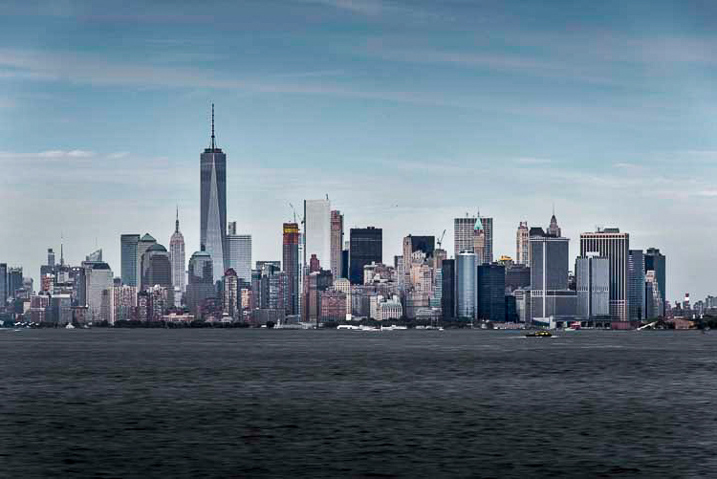
This image was chosen because it has all of those elements; the river is in the foreground, there are buildings along the horizon, and there is a sky. There is also nothing going out the top of the image. As the photo is going to connect from one end to another, it has to be an image that has similar ends.

How to create a Little Planet

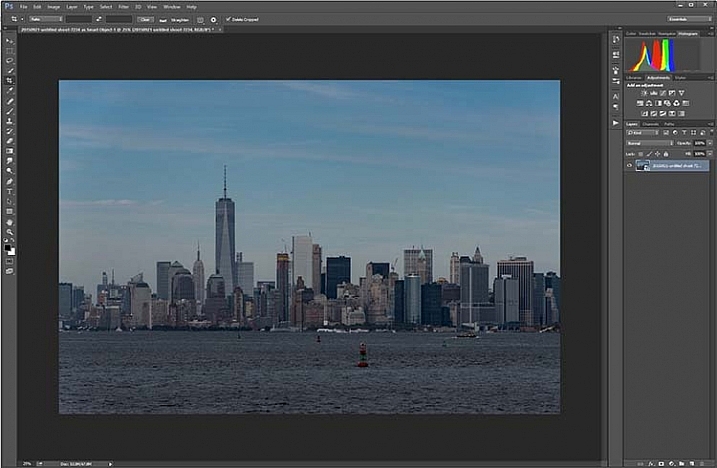
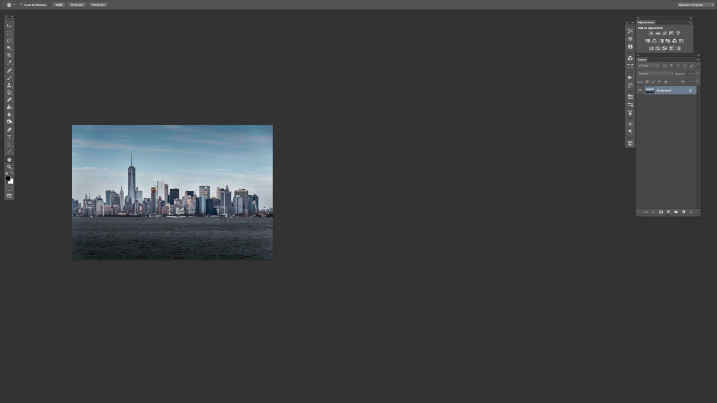
Open the photo you want to use in Photoshop.

1-leannecole-tutoria-photo-sphere

Open photo in Photoshop.

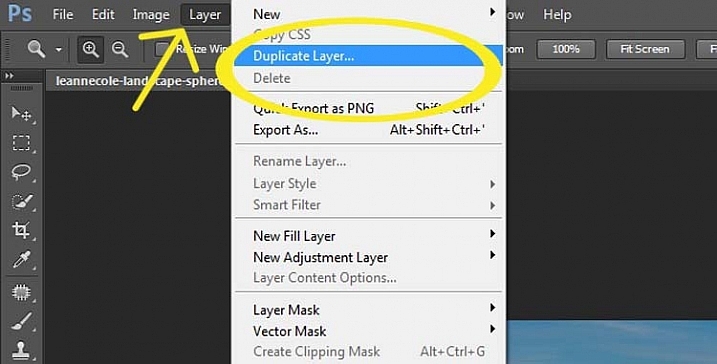
The first thing to do is to duplicate the layer by pressing Ctrl+J (CMD+J on Mac). It can also be done by going up the main menu, clicking Layers > Duplicate Layer.

16-leannecole-tutoria-photo-sphere

Duplicate Layer

You may need to make the image smaller on the screen using the magnifying tool. Make it small enough to only fill part of your current view, like so:

Screen Shot 2015-12-21 at 1.18.59 PM (2)

Turn on your rulers (Cmd+R on Mac, or Control+R on PC). Once they appear, right click on one and select percent to display on the rulers.

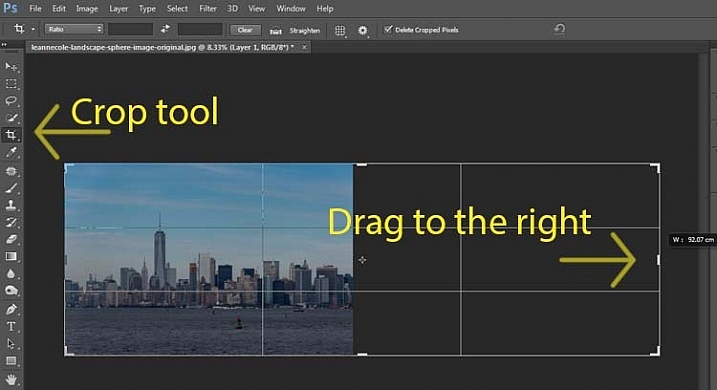
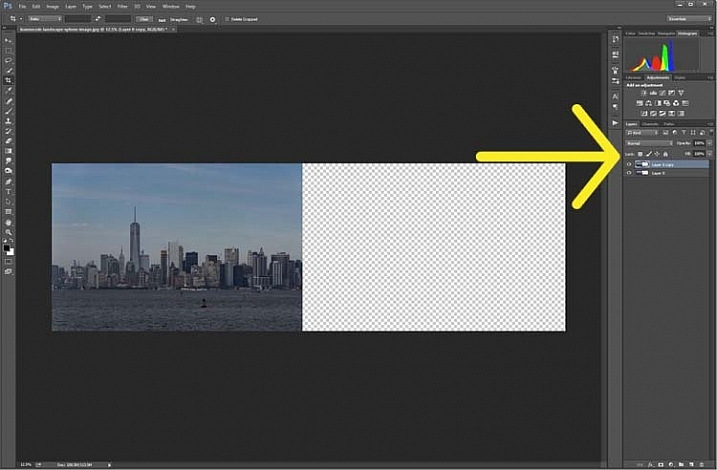
Make sure you are on the Background Layer, and select the crop tool (keyboard shortcut is C). Click on the image to bring up the cropping frame. Grab the right edge marker, and drag it it to the right to enlarge the frame to twice the size of the image (watch the number as you drag, go until you get to 200%). Look at the following image.

17-leannecole-tutoria-photo-sphere

Extending the Image

Next, highlight the duplicated layer in the Layers panel, by clicking on that layer.

4-leannecole-tutoria-photo-sphere

Select the duplicate layer

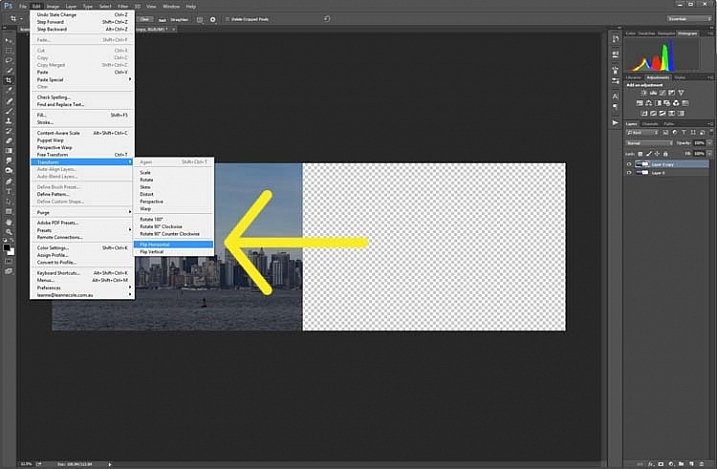
This duplicated layer needs to be flipped horizontally. Go to: Edit > Transform > Flip Horizontal.

5-leannecole-tutoria-photo-sphere

Use Transform to flip the duplicate layer.

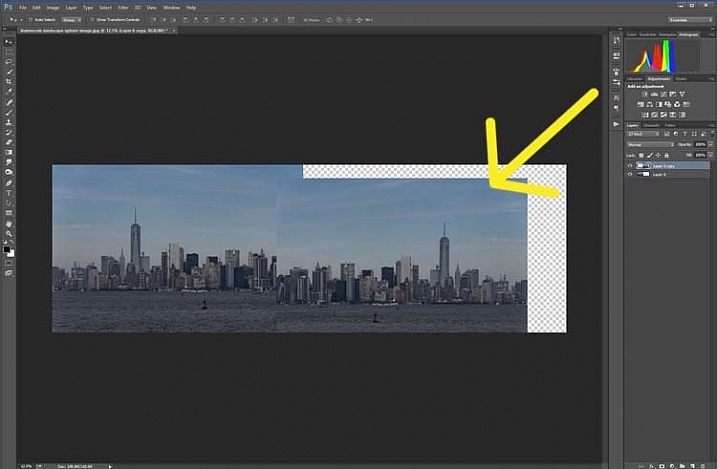
Select the move tool (keyboard shortcut is: V) and move the duplicated image over to the right side until you have the two images touching in the middle.

6-leannecole-tutoria-photo-sphere

Use the move tool to put the duplicated, flipped image, into place.

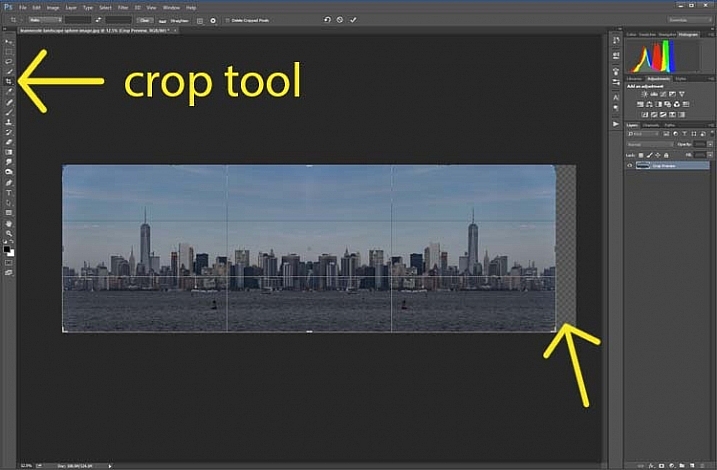
Figure out where you want the images to meet in the middle. Sometimes overlapping them can make it look a little better. You will need to crop the image to remove some of the extra area that you created earlier.

7-leannecole-tutoria-photo-sphere

Crop the image to the edges of the image.

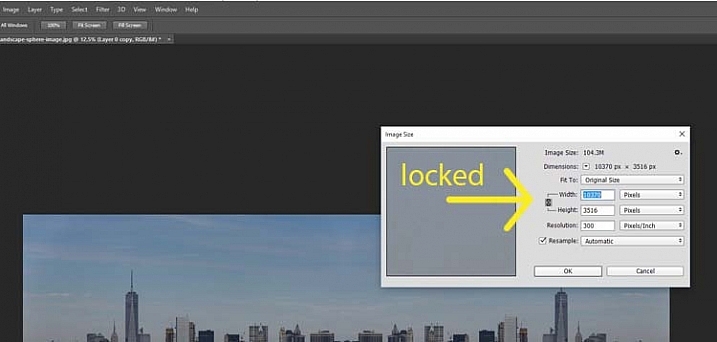
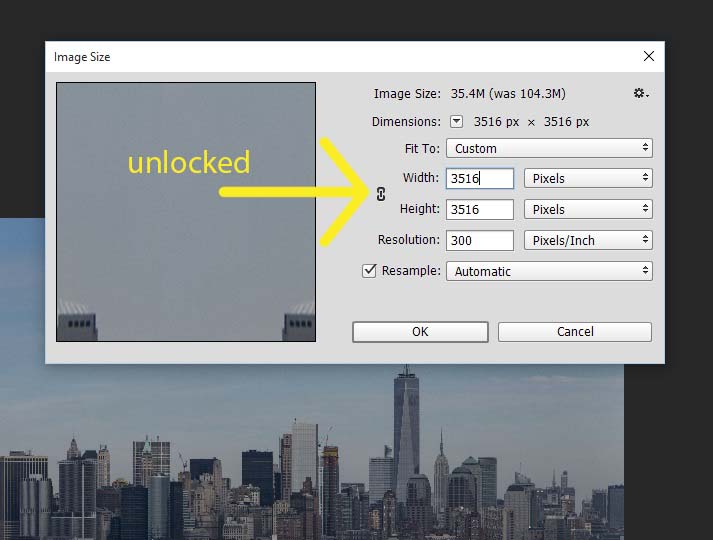
To make the sphere, the image needs to be square, so go to the top menu and click Image > Image Size. When the window pops up, you need to unlock the part that automatically changes the height when you change the width (maintains the proportions). Click the lock (chain) icon to unlock it. Make the width the same as the height, and press okay.

8-leannecole-tutoria-photo-sphere

In the Image Size window the height and width are locked.

9-leannecole-tutoria-photo-sphere

Click on the lock to unlock image to make width the same as height.

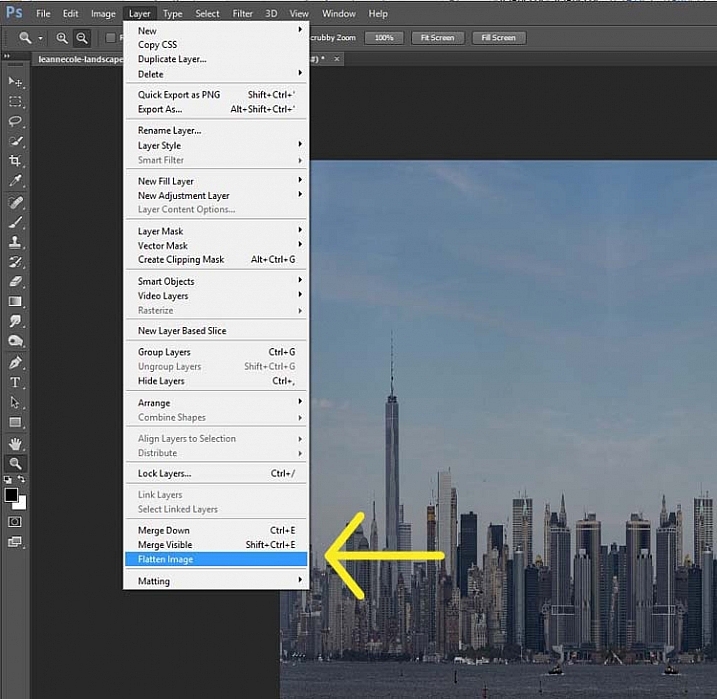
Before you can make the sphere you should combine the layers. Go up to: Layers > Flatten Image. An easier way is to press Shift+Ctrl+E (Shift+Cmd+E on Mac), this will make them one layer (it merges all visible layers).

10-leannecole-tutoria-photo-sphere

Combine the layers.

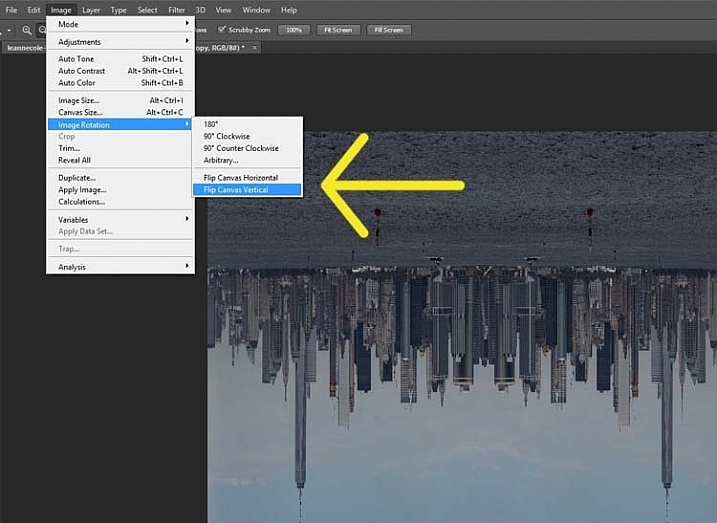
You will also need to flip the image vertically. Go back to the main menu, select Image > Image Rotation > Flip Canvas Vertical.

12-leannecole-tutoria-photo-sphere

Flip image vertically.

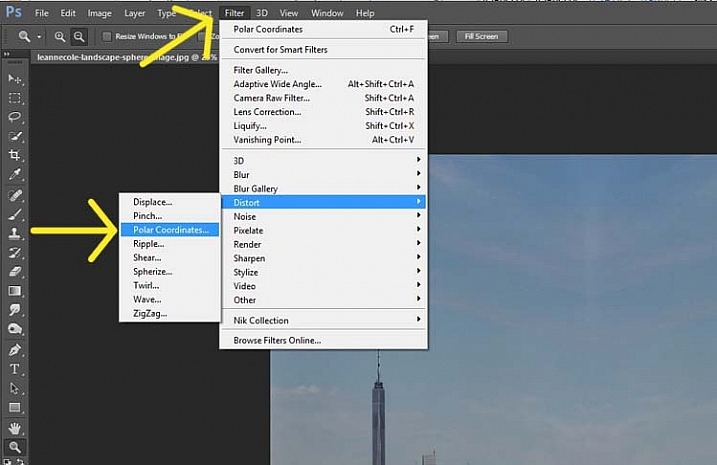
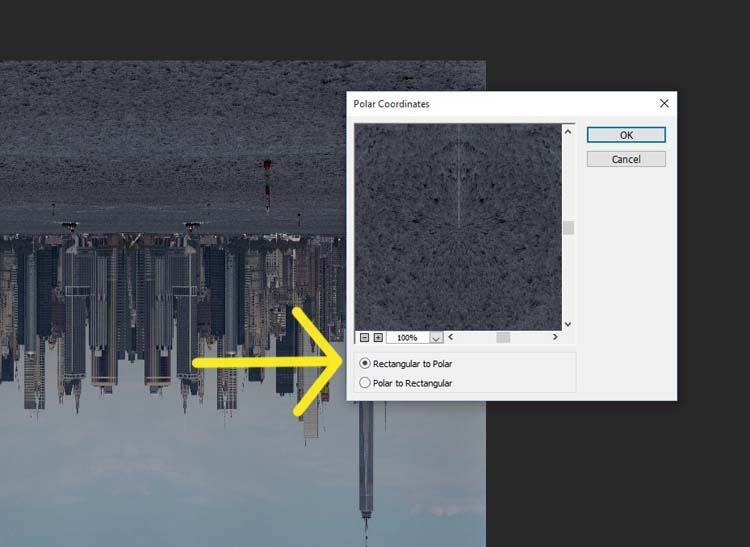
Next, go to Filter >Distort > Polar Coordinates….

11-leannecole-tutoria-photo-sphere

Select Polar Coordinates in the Filter, Distort menu.

When the popup window appears, select the option: Rectangular to Polar. Press OK.

13-leannecole-tutoria-photo-sphere

Choose rectangular to polar.

Voila, your landscape sphere, which now looks like a little planet.

14-leannecole-tutoria-photo-sphere-dps717px

The world turned around.

But, there is a gap where the images meet. This can easily be fixed with the Spot Healing Brush Tool. It is in the toolbox on the left side of the windows panel. Run the tool along where the images don’t quite connect.

LeanneCole-landscape-sphere-done-0033-dps717px

Landscape turned into a sphere or little planet.

There you have your landscape sphere, or little planet image.

You may want to crop it a little to make the planet bigger in the image, and to remove any things that have happened in the corners. You may also want to rotate it to get the view you want.

You can do this with other types of images as well. You could try it with a panorama, then you don’t have to do the part where you copy the layer. However, you need to be aware that it may not come out as you expect, it can come out distorted.

If you don’t flip the image vertically before applying the filter it will do the image in reverse. The image that I used for this article would then have the river on the outside, and the sky in the center (see image below).

LeanneCole-landscape-sphere-done-0034-dps717px

Result done the other way.

As you can see there are no real uses for this except as a fun project. Try it and see what you can come up with, and please share your images in the comments below.

googletag.cmd.push(function() {
tablet_slots.push( googletag.defineSlot( “/1005424/_dPSv4_tab-all-article-bottom_(300×250)”, [300, 250], “pb-ad-78623” ).addService( googletag.pubads() ) ); } );

googletag.cmd.push(function() {
mobile_slots.push( googletag.defineSlot( “/1005424/_dPSv4_mob-all-article-bottom_(300×250)”, [300, 250], “pb-ad-78158” ).addService( googletag.pubads() ) ); } );

The post How to Make a Little Planet Using Photoshop by Leanne Cole appeared first on Digital Photography School.


Digital Photography School

 
Comments Off on How to Make a Little Planet Using Photoshop

Posted in Photography


Nikon brings stepping motors to its DSLRs with two 18-55mm AF-P lenses

05 Jan

Nikon is bringing stepping motors to its DSLR lens lineup for the first time with a pair of ‘AF-P’ lenses, both of which are collapsable 18-55mm zooms (one with vibration reduction, the other without). Nikon says that its stepping motor lenses are both faster and quieter than their predecessors, making them quite appealing for video recording. These lenses have two aspherical elements as well as a Super Integrated Coating, with the VR model reducing shake by 4 stops (using the CIPA standard).

These aren’t the company’s first lenses to use this type of AF motor – they can be found on most, if not all, of the lenses for the Nikon 1 system.

Nikon has not disclosed pricing or availability information for either lens.


Press release:

AF-P DX NIKKOR 18-55mm f/3.5-5.6G VR / AF-P DX NIKKOR 18-55mm f/3.5-5.6G

Fast and quiet AF with adoption of a stepping motor
Compact and lightweight normal zoom lenses covering the 18-55mm range of focal lengths with a maximum aperture of f/3.5-5.6

TOKYO – Nikon Corporation is pleased to announce the release of the AF-P DX NIKKOR 18-55mm f/3.5-5.6G VR and AF-P DX NIKKOR 18-55mm f/3.5-5.6G, two normal zoom lenses compatible with Nikon DX-format digital SLR cameras.

The AF-P DX NIKKOR 18-55mm f/3.5-5.6G VR and AF-P DX NIKKOR 18-55mm f/3.5-5.6G are 3.1x normal zoom lenses covering the 18-55mm range of focal lengths (effective angles of view equivalent to those of a lens with 27-82.5mm focal lengths in FX and 35mm [135] formats). They are the first “AF-P” lenses for Nikon digital SLR cameras, utilizing stepping motors to drive AF for fast and quiet autofocusing. In addition, they have a compact and lightweight design for which retractable barrels were adopted for excellent portability, and the use of two aspherical lens elements has resulted in superior optical performance with which various types of aberration, including distortion and spherical aberration, are effectively suppressed. The AF-P DX NIKKOR 18-55mm f/3.5-5.6G VR is also equipped with a vibration reduction (VR) mechanism offering camera shake compensation equivalent to a 4.0-stop* (with testing in accordance with CIPA standards) increase in shutter speed.

The combination of superior AF performance and excellent agility afforded by these lenses makes them perfect for those ready to try their hand at full-scale photography with a digital SLR camera.

AF-P DX NIKKOR 18-55mm f/3.5-5.6G VR and AF-P DX NIKKOR 18-55mm f/3.5-5.6G Primary Features

  • “AF-P” lenses that achieve fast and quiet AF with adoption of a stepping motor for AF drive operation
  • Compact and lightweight 3.1x 18-55mm (effective angles of view equivalent to those of a lens with 27-82.5mm focal lengths in 35mm [135] format) normal zoom lenses utilizing a retractable barrel and compatible with the Nikon DX format
  • Adoption of aspherical lens elements (2) achieves superior optical performance with which various types of aberration are effectively suppressed
  • Equipped with a vibration reduction (VR) mechanism offering camera shake compensation equivalent to a 4.0-stop* (with testing in accordance with CIPA standards) increase in shutter speed (AF-P DX NIKKOR 18-55mm f/3.5-5.6G VR)

*At the maximum telephoto position when a digital SLR camera equipped with an APS-C size image sensor is used.


Nikon AF-P DX NIKKOR 18-55mm f/3.5-5.6G VR / AF-P DX NIKKOR 18-55mm f/3.5-5.6G specifications

  Nikon AF-P DX NIKKOR 18-55mm F3.5-5.6G VR Nikon AF-P DX NIKKOR 18-55mm F3.5-5.6G
Principal specifications
Lens type Zoom lens
Max Format size APS-C / DX
Focal length 18–55 mm
Image stabilisation Yes (4 stops) No
Lens mount Nikon F (DX)
Aperture
Maximum aperture F3.5 – F5.6
Minimum aperture F22.0 – F38.0
Aperture ring No
Number of diaphragm blades 7
Optics
Elements 12
Groups 9
Special elements / coatings Two aspherical elements + super integrated coating
Focus
Minimum focus 0.25 m (9.84)
Maximum magnification 0.38×
Autofocus Yes
Motor type Stepper motor
Full time manual Yes
Focus method Internal
Distance scale No
DoF scale No
Physical
Weight 205 g (0.45 lb) 195 g (0.43 lb)
Diameter 65 mm (2.54)
Length 63 mm (2.46)
Materials Composite
Sealing No
Colour Black
Zoom method Rotary (extending)
Power zoom No
Zoom lock No
Filter thread 55.0 mm
Hood supplied No
Hood product code HB-N106
Tripod collar No

Articles: Digital Photography Review (dpreview.com)

 
Comments Off on Nikon brings stepping motors to its DSLRs with two 18-55mm AF-P lenses

Posted in Uncategorized


Seascraper: Lush 3D-Printed Self-Sustaining Floating Cities

05 Jan

[ By Steph in Architecture & Cities & Urbanism. ]

seascraper 1

In the not-so-distant future, once we land-dwelling humans have exhausted all of our resources and trashed the climate-change-ravaged continents we live on, a new civilization will inhabit a floating 7th continent made up of self-sustaining 3D-printed cities. Architect Vincent Callebaut has unveiled a new vision encapsulating his hope for humanity’s kinder, gentler post-disaster future in the form of ‘Aequorea,’ an underwater farm recycling ocean pollution into building materials.

seascraper 9

seascraper 6

seascraper 3

Taking inspiration from a variety of sea creatures, the structure self-builds its own exoskeleton via natural calcification like sea shells, and is named for a bioluminescent jellyfish. Shaped like a Klein bottle, each structure is largely made up of petroleum-based waste recovered from the ocean gyres, mixed with a gelling algae and extruded by 3D printers. These ‘sea scrapers’ would recycle all of their own waste, generate energy through ocean turbines, filter sea water into freshwater and grow their own food. Each one houses 20,000 so-called ‘aquanauts.’

seascraper 2

seascraper 4

seascraper 5

In classic Vincent Callebaut fashion, the architect released information about the design by way of a dramatized letter from the future, addressed to ‘People of the Land’ and written by a fictional resident of Aequorea: “My name is Océane. I’m 15 years old. I’m an aquanaut teen. I was born in immersion in 2050 in an underwater farm called ‘Aequorea’ off the coast of Rio de Janeiro… When my grandfather tells me about his terrestrial way of life of the time, it seems totally preposterous today. The People of the Land, those supposedly, self-proclaimed Homo Sapiens, took two centuries to understand that they were living on finite territory with limited natural resources. They were consuming the city like a commodity, rather than a common good that should be nurtured in symbiosis with nature.”

seascraper 7

seascraper 8

“They were suffocating from inhaling urban smogs, the infamous photochemical clouds caused by pollution. Without knowing it, they were ingesting plastic infesting the food chain. And because of overfishing, they had almost emptied the supply of fish in the oceans. In this December month of 2065, it’s still hard for me to believe how carelessly the Pople of the Land mortgaged the fate of future generations.”

seascraper 10

seascraper 11

“…faced with climate change and the rise of water levels, a new civilization emerged: the People of the Seas. Once their lands and islands were underwater and salinize, a large portion of the 250 million climate refugees got involved with interdependent NGOs like the ones my grandparents created. Together, they invented new underwater urbanization processes that were energy self-sufficient, recycled all waste, and fought ocean acidification.”

Share on Facebook


[ By Steph in Architecture & Cities & Urbanism. ]

[ WebUrbanist | Archives | Galleries | Privacy | TOS ]


WebUrbanist

 
Comments Off on Seascraper: Lush 3D-Printed Self-Sustaining Floating Cities

Posted in Creativity


PaintShop Pro launches faster brush tools, in-app guide and tutorials with version X8.1

05 Jan

Software provider Corel has updated its PaintShop Pro X8 image manipulation program to include more help and guidance to enable users to find their way around the tools and features of the application. A new welcome screen has been added to version X8.1 that offers links to tutorials and inspirational features, as well as to partner paid-for content from the online training site Udemy. The idea is to help photographers get more from the program by making it clear what tools are available and how they should be used. 

The application features links to on-line training company Udemy

The update also brings what Corel describes as ‘performance enhancements’ across the application, but especially faster brush speeds. The company claims nine brushes, including Paintbrush, dodge/burn and clone, are now on average twice as fast, while the Wet Paint brush is four times faster than it was previously. There are also over 100 additional enhancements that the company has made based on feedback from its user community. 

On the download page of the Corel website there is a list of ten issues that the new version addresses, including color problems with Raw files from the Nikon D810. 

Issues addressed

  • Burn Brush: Fixed edge result (previously showed darker result along brush edges)
  • Color Replacer: No color bleed when using the Round brush to fill shapes
  • Text wrapping: Left and Center alignment results fixed. Stability improved when saving layered text wrapping files to a .pspimage format compatible with legacy versions of PaintShop Pro.
  • Nikon D810: Fixed raw image color issue
  • Resize dialog box: Now retains settings last used for Based on One Side
  • Magic Move in scripts: Fixed reported issues related to accurate rendering of script commands
  • Material Properties palette: Improved stability when adding custom swatches
  • Organizer palette: Restored drag-and-drop functionality between the palette and the workspace
  • Script selection: Fixed script selection issue in the Batch Process dialog box
  • Adjust workspace: Restored ability to set Save As option once per session (dialog box does not open for each photo edited)

The update is free to download and install for current users of PaintShop Pro X8 and X8 Ultimate. Suggested retail pricing (SRP) for PaintShop Pro X8 is $ 79.99 (USD/CAN) / EUR 69.99 / £59.99 / $ 99.95 AUD. Qualifying registered users can purchase for the upgrade price of $ 59.99 (USD/CAN) / EUR 49.99 / £44.99 / $ 69.95 AUD. 

SRP for PaintShop Pro X8 Ultimate is $ 99.99 (USD/CAN) / EUR 89.99 / £79.99/ $ 129.95 AUD. Qualifying registered users can purchase for the upgrade price of $ 79.99 (USD/CAN) / EUR 69.99 / £64.99 / $ 89.95 AUD.

For more information visit the PaintShop Pro website. 


Press release: 

Free PaintShop Pro X8 Update Adds In-App Learning With New Ways to Access Complementary Tools & Content, Plus Increased Performance

X8.1 brings dramatic brush acceleration and performance enhancements app-wide

Today, Corel announced the latest update to its photo-editing and graphic design software, PaintShop® Pro X8.1. This release introduces the Welcome Guide, an all-new in-app learning tool that makes it easier than ever to access helpful tips and tricks. Users will also find new ways to discover content to enrich the PaintShop Pro experience, plus significant performance enhancements app-wide, including major improvements to brush speeds. The X8.1 update is available now and is free to all registered users of PaintShop Pro X8. 

New Welcome Guide & Add-on Content 

Continuing PaintShop Pro’s drive to make photo editing and graphic design more accessible, the new Welcome Guide makes getting started quick and easy. Fire up X8.1 and you are presented with a dedicated window linking to several tutorials and new project ideas. 

Users can now discover additional brushes, plug-ins, complementary programs, and plenty more to extend PaintShop Pro’s already strong photo and design toolkit, with new tools and content to be added on an ongoing basis. The new features in X8.1 come as part of Corel’s commitment to deliver continuous updates and improvements to PaintShop Pro without requiring a subscription. 

“A lot of people get intimidated when using a full-fledged photo-editor, often because they don’t know where to start,” says Greg Wood, Senior Product Director for Photo at Corel. “We want everyone to feel comfortable when they open PaintShop Pro, even if it’s their first time. The new Welcome Guide provides users with video and training content to help them explore PaintShop Pro’s many features, as well as direct access to a brand new learning series from our friends at Udemy.” 

Faster Brushes & Performance Enhancements 

PaintShop Pro X8.1 also delivers major performance improvements, including dramatically accelerated brush speeds when working with larger images. Nine brushes, including the Paintbrush, Dodge/Burn, Clone and others have seen an average improvement of 2x faster than before, with the Paintbrush’s Wet Paint look getting a boost of up to 4x faster! 

Building on PaintShop Pro’s performance, this latest update also includes more than 100 enhancements based on feedback from the PaintShop Pro user community. For more details on the latest improvements to PaintShop Pro X8, please visit our updates page for additional info. 

Articles: Digital Photography Review (dpreview.com)

 
Comments Off on PaintShop Pro launches faster brush tools, in-app guide and tutorials with version X8.1

Posted in Uncategorized


Vote now for Best Product of 2015!

05 Jan

Vote now for Best Product of 2015!

Late last year we asked you to vote on the outstanding products of 2015. We created four polls, covering lenses and cameras, including more than 50 products in total. With thousands of votes cast, and plenty of ‘discussion’ in the comments, we’re ready to announce the winners! Click through this slideshow to see the results, and read a little about the products that you voted for. 

And the fun isn’t over just yet – now is your chance to vote on the winners and runners-up from each of the four categories, to determine the readers’ choice award for best overall product of 2015.

Runner-up – Best High-end Compact: Sony Cyber-shot RX1R II

The Sony RX1R II features the same high resolution 42.4 MP sensor and BIONZ X processor from the a7R II along with a large aperture, fixed focal length ZEISS Sonnar T* 35mm F2 lens, which have been fine-tuned to optimize performance together. The camera’s sensor features 399 phase-detection AF points that cover about 45% of the image area, and a retractable high-resolution electronic viewfinder.

We’ve really enjoyed using the RX1R II, and obviously it’s impressed you too, taking runner-up spot in our poll for best high-end compact.

Winner – Best High-end Compact: Sony Cyber-shot RX100 IV

The RX1R II just missed out on the top spot to another Sony high-achiever, the Cyber-shot RX100 IV. The DSC-RX100 IV is the fourth generation of a popular and critically-acclaimed series of enthusiast compacts. This iteration brings with it a new 1″ type 20MP stacked CMOS Exmor RS sensor. Its stacked design frees up more space for high speed circuitry allowing for more sophisticated functions, and is a next generation of the familiar backside illuminated (BSI) design.

The RX100 IV is capable of 4K video recording (with clips limited to a 5 minute maximum), slow motion 40x video recording with 960 fps capture and up to 16 fps continuous shooting. Like its predecessor the RX100 IV offers a 24-70mm equivalent F1.8-2.8 lens and continues the tradition of a pop-up electronic viewfinder, upgrading the OLED panel to a 2.35 million dot resolution.

Runner-up – Best Consumer ILC: Nikon D7200

Taking the runner-up spot in our poll for best consumer ILC was the Nikon D7200. This poll covered a pretty broad range of products but you were obviously impressed by the D7200, which proved itself very capable in our testing. An updated version of the venerable D7100 the D7200’s design and build quality remains the same but it gains a faster processor, much larger buffer for continuous shooting, improved low light autofocus performance, and Wi-Fi with NFC.

The D7200 is built around a 24.2MP CMOS sensor with no optical low-pass filter, which maximizes resolution. It has an ISO range of 100-25600 that expands up to 102400 in black & white only. The autofocus system remains 51-points with 15 cross-type sensors but all of those points can focus down to -3EV. 

Winner – Best Consumer ILC: Olympus OM-D E-M5 II

Your vote for the best consumer ILC of 2015 went to Olympus’s very capable OM-D E-M5 II. Compared to the original E-M5, the control points of the Mark II have been reworked allowing for quick, direct access to exposure settings and the construction made impressively solid. 

One stand-out feature on the Olympus is a 40 megapixel option for stills shooters, which uses the sensor-shift stabilization system to combine multiple exposures into one higher-resolution image. The camera can also capture up to 1080/60p and 5-axis IS makes it a pleasure to use hand-held. We greatly enjoyed using the OM-D E-M5 II in 2015 and we’re glad that clearly you did too.

Runner-up – Best High-end ILC: Canon EOS 5DS/R

Your choice for runner-up in our Best High-end ILC category was Canon’s enthusiast flagship the EOS 5DS / R. We bundled both the 5DS and 5DSR in together since they’re so similar, and we enjoyed shooting with both in 2015. The Canon EOS 5DS and 5DS R are the highest resolution DSLRs currently on the market, boasting 50MP stills. With more than double the resolution of the 5D Mark III, the 5DS has an optical low pass filter, while the 5DS R has a self-canceling filter.

The autofocus system has a total of 61 points (in a ‘high density reticular array’), 41 of which are cross-type. It uses the same 150,000 pixel RGB+IR metering system as the EOS 7D II with a scene detection system. The metering system also has an anti-flicker function for shooting under sodium vapor lights. The ISO range on the camera is 100-6400, expandable to 12800.

Winner – Best High-end ILC: Sony a7R II

Sony was on a winning streak throughout 2015 it seemed, and this is reflected in your votes across all of our end-of-year polls. The clear winner in our poll to find your favorite high-end ILC of last year was the a7R II – also one of our all-time standout cameras. We’re not going to lie – the a7R II was a huge pain to review, but that’s because of the sheer amount of technology that Sony packed into it, all of which required careful testing. 

The Sony a7R II is the world’s first camera to use a full-frame Backside Illuminated (BSI) sensor (which is stabilized) boasting 399 phase detect AF points. Electronic first curtain and fully electronic (silent) shutter modes ensure wonderfully detailed files with no risk of the shutter shock issues that plagued the original a7R, while internal 4K/30p recording is newly available in both full sensor and APS-C (Super35) modes. Impressive stuff indeed, and it obviously impressed you too.

Runner-up – Best Lens: Canon EF 11-24mm F4 L

Easy to dismiss as an expensive ‘stunt’ lens at first sight, Canon’s ambitious 11-24mm F4 L turned out to be an exceptionally capable piece of glass, and quickly became one of our favorite lenses last year on both Canon and Sony A-mount bodies. The 11-24mm offers the widest angle of view of any rectilinear full-frame Digital SLR lens, and has a close-focus distance of just 11 inches. An absolute pleasure to use for shooting landscapes, weddings, concerts and photojournalism, this lens is sharp across the entire frame and well-constructed.

Winner – Best Lens: Zeiss Batis 85mm F1.8

The clear winner in our poll to find your favorite lens of 2015 was the very lovely Zeiss Batis 85mm F1.8. Zeiss is well-known for making some excellent glass and the Zeiss Batis 85mm F1.8 is no exception. Available in Sony E-mount, this lens is weather and dust sealed, image stabilized and coated in Zeiss’ T* anti-reflective coating. It features a digital OLED focus depth display, making it incredibly easy to manually focus.

Linear motors ensure fast and silent AF, while pairing with an a7R II’s AF system guarantees the most accurate focus you’ll ever experience from any 85mm prime, period. If that’s not enough, a floating element design helps to reduce chromatic aberration and ghosting. It took the winning spot by a considerable margin – thanks to everyone that voted!

So there you have it. Four category winners, and four runners-up. But which of these winning products is the overall best product of last year? Vote now in our final readers’ poll and remember that as before, you can rank up to three choices. Voting will run through the end of this month and winners will be announced in the first week of February. 

.


Have your say
$ (document).ready(function() { Poll({“pollId”:”0391113666″,”openForVoting”:true,”mainElementId”:”poll0″,”slot”:null,”isSingleChoicePoll”:false,”minNumberOfChoices”:1,”maxNumberOfChoices”:3}); })

Have Your Say: Best Product of 2015
Your answers
1. Required
2. Optional
3. Optional
You need to login to vote

Sony Cyber-shot RX1R II

Sony Cyber-shot RX100 IV

Nikon D7200

Olympus OM-D E-M5 II

Canon EOS 5DS / R

Sony a7R II

Canon EF 11-24mm F4 L

Zeiss Batis 85mm F1.8

Articles: Digital Photography Review (dpreview.com)

 
Comments Off on Vote now for Best Product of 2015!

Posted in Uncategorized


CamFi is an alternative wireless controller for your Nikon or Canon DSLR

05 Jan

CamFi is a new option for those photographers looking to control their Nikon or Canon DSLR wirelessly. The device mounts on the hot shoe of compatible DSLRs and creates a Wi-Fi network that you can connect to using a PC or Mac as well as Android and iOS mobile devices. At $ 130 CamFi is priced well below manufacturer-provided options for high-end DSLRs. Read more

Articles: Digital Photography Review (dpreview.com)

 
Comments Off on CamFi is an alternative wireless controller for your Nikon or Canon DSLR

Posted in Uncategorized


Brutalist Wonders or Blunders? Architecture by Marcel Breuer

05 Jan

[ By Steph in Architecture & Public & Institutional. ]

breuer main crop

A master of Modernism whose architectural legacy includes a range of monumental concrete structures around the world, Marcel Breuer remains divisive among Brutalism’s admirers and detractors decades after his death. From the Whitney Museum of American Art in New York to the vaguely dystopian IBM headquarters in Paris, Breuer’s work is alternately described as majestic and depressing; cold and clinical to some, and peacefully minimalist to others. Regardless of how you feel about concrete architecture in general and Brutalism in particular, Breuer’s buildings are emblematic of this architectural style. Here are 14 of his most notable creations, as preserved by Syracuse University’s Marcel Breuer Digital Archive.

St. John’s Abbey, Minnesota

breuer st johns 1

breuer st johns 3

breuer st johns 2

breuer st johns prep

After completing a series of modernist residential projects in the 1930s and ‘40s, Breuer moved on to work on a far more ambitious and awe-inspiring scale, starting with the stunning St. John’s Abbey and University in Minnesota. The cast-in-place concrete wonder features a towering bell banner shielding the church’s honeycombed facade. Breuer also designed a number of buildings on the St. John’s University campus, including a dormitory hall (bottom photo.)

Whitney Art Museum, New York City

breuer whitney 3

breuer whitney

breuer whitney 2

One critic of Breuer’s 1966 building on the genteel Upper East Side of Manhattan called it “one of the most aggressive, arrogant buildings in New York.” An inverted ziggurat, the structure is undeniably bold. The Hungarian-born, Bauhaus-trained architect “believed that modern architecture needed to reintroduce monumentality and symbolism, age-old characteristics that had been disregarded by modernists earlier in the 20th century.”

UNESCO Headquarters, Paris
breuer UNESCO

breuer unesco stairs

breuer unesco paris 3

breuer unesco interior

breuer unesco paris

As far as surviving Brutalist structures go, the UNESCO headquarters are nothing short of spectacular. Completed in 1958, the Y-shaped administrative building features a sculptural canopy and spiraling fire escape stairs that reach all the way to the roof. The whole building stands on 72 concrete piles.

The Lost El Parador Ariston, Argentina

breuer ariston 1

breuer ariston 2

Among Breuer’s classics is the Ariston Hotel in Argentina, a curving clover-shaped building that has been abandoned and left to deteriorate despite its status as one of Argentina’s modern architectural landmarks. Architecture faculty and students at the University of Buenos Aires are currently flighting to preserve and restore it.

The Pirelli Tire Building, New Haven, Connecticut

breuer tire building

breuer pirelli 2

breuer armstrong rubber

Originally built as the headquarters for Armstrong Rubber, what’s now known as the Pirelli Tire Building in New Haven, Connecticut stands out as one of America’s foremost surviving Brutalist structures. Testing of the tires on the ground floor research and development facility would be noisy, so Breuer elevated the administrative spaces. The result is imposing and authoritative; it’s easy to imagine it standing in as the headquarters of a villainous corporation or classified government agency in a movie.

Next Page – Click Below to Read More:
Brutalist Wonders Or Blunders Architecture By Marcel Breuer

Share on Facebook


[ By Steph in Architecture & Public & Institutional. ]

[ WebUrbanist | Archives | Galleries | Privacy | TOS ]


WebUrbanist

 
Comments Off on Brutalist Wonders or Blunders? Architecture by Marcel Breuer

Posted in Creativity