Miggo, maker of non-traditional camera straps that convert into wraps, announced in April that it would launch its new ‘storm-proof’ camera bag Agua on Kickstarter in early June. That crowd-funding campaign is now live. The Miggo Agua bag has an IPX3-standard rating, which means it can protect gear from pouring rain and similar types of water exposure. Read more
Month: June 2015
-
3 Downsides to Scouting New Photography Locations Online
Do you scout for potential photography locations online through sites like Flickr, Panoramio or 500px?
Of course you do! It’s easy, you get hundreds of photographs to look at of any given location, and you might even get some great ideas that you hadn’t thought about for subject matter or composition. So why am I asking you this question?
Well here’s another question for you…
Have you ever thought about the downsides of online photo scouting?
I’m going to venture a guess that it probably hasn’t even crossed your mind before today. What downsides could there possibility be with these rich resources, filled with information about where, and how a photograph was taken? Read on to find out.
1. You’re seeing hundreds, if not thousands of photographs
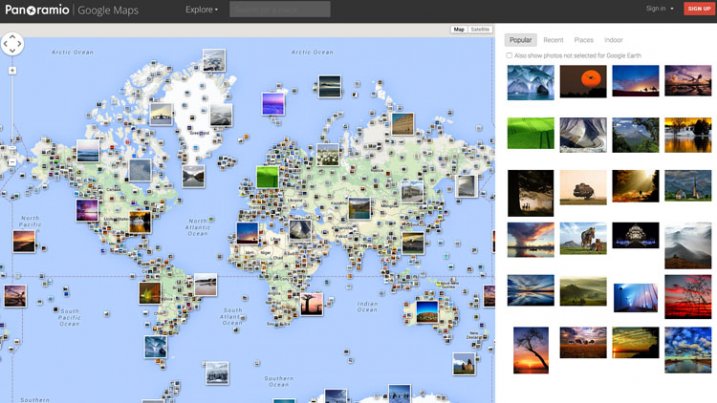
When it comes to sites like Flickr or Panoramio, or even apps like Stuck on Earth (which pulls its photographs from these sites) you’re able to see many years worth of photographs taken by dozens, if not hundreds, or even thousands of photographers. At first glance this might seem like a great resource, and to some extent it is, but there’s also a downside – namely you might get lost trying to mimic and forget to create.
Because you’re able to see so many photographs of a given location you may become so focused on a specific angle or idea from these photographs, that you forget to look for your own unique way to express the scene in question – and as a result your image may lose some originality.
2. The things a photo can’t tell you
A photograph on a website will give you some great ideas and insight into a location, but at the same time, it doesn’t tell you a lot of important things too. For example, you’ll have no idea how many attempts it took the photographer to find the right lighting conditions. You won’t know much about how difficult the location is to reach, or if that particular image required camping out to achieve the desired result.
3. You’re drawn to the best photography

Not only are you naturally going to be drawn to the best photography on these sites, but they tend to push the best photography higher in searches and ranking, making it even more likely that’s what you’re going to see. Again, on the surface this might sound like a great thing because you’re able to see all the great possibilities that a given location has to offer – but there may be a downside here as well.
Think about this… how likely is it that these great photographs you’re seeing are from people who have visited a location just once? Most great photographs are planned, iterated upon, and purposefully shot. When you find a photograph on a site like this you’re looking at the best of the best, and as a result you’re seeing the best possible lighting conditions a scene might offer, which might not occur while your there.
In an article I’ve previously written for DPS titled Start feeling GOOD about YOUR photography I noted that it’s important that you don’t compare your work to someone else’s. This is particularly true for those who have more experience behind a camera than you, as it will only lead to disappointment.
I think that this advice can be extended to scouting for locations and inspiration as well. Setting the bar too high will only lead to stress and anxiety if you’re unable to produce results that live up to your expectations. This experience could leave you disappointed about your trip to a fantastic location – which had you gone in blind, may not have happened.
Final thoughts
I don’t want you to completely write off these resources, after all they do provide you with great inspiration and ideas. This isn’t an article designed to get you to stop using these sites, or even this technique for finding locations, but rather, to use it smarter. I hope this has given you something to think about. Please feel free to share your own thoughts in the comments section below.
googletag.cmd.push(function() {
tablet_slots.push( googletag.defineSlot( “/1005424/_dPSv4_tab-all-article-bottom_(300×250)”, [300, 250], “pb-ad-78623” ).addService( googletag.pubads() ) ); } );googletag.cmd.push(function() {
mobile_slots.push( googletag.defineSlot( “/1005424/_dPSv4_mob-all-article-bottom_(300×250)”, [300, 250], “pb-ad-78158” ).addService( googletag.pubads() ) ); } );The post 3 Downsides to Scouting New Photography Locations Online by John Davenport appeared first on Digital Photography School.
-
4. Juni 2015
Das Bild des Tages von: edelstoff.de

Im Ausblick: Zwei neue Mitglieder des VII-Kollektivs, Google Unlimited und Manipulation.
kwerfeldein – Fotografie Magazin | Fotocommunity -
Relentless Residents: 10 More Households That Refuse to Move
[ By Delana in Architecture & Cities & Urbanism. ]

When real estate developers come knocking, it seems that the majority of homeowners are willing to move out for the right price – but then there are some who take a stand and refuse to give up their homes no matter what. Called “holdouts” in some parts of the world and “nail houses” in others, these strong-willed folks decided that they weren’t going to move…so the developers had no choice but to build around them.
Dog Fight: Portland, Oregon

In 2005, attorney Randal Acker purchased a small Queen Anne Victorian home in downtown Portland, Oregon from which to operate his practice. The very next year, developers started buying up all of the property around the building. When they knocked on Acker’s door, they could never have guessed what was in store for them.

Acker calls the building The Figo House, named after his dog who is in turn named after Portuguese soccer player Luis Figo. Although the lawyer’s specialty is in commercial litigation, he resolved to commit as much time as necessary to eminent domain law to save this little piece of Portland history. In 2008, the developer resolved to leave Acker and the Figo house alone – but that didn’t mean they would scrap their construction project. They built a huge Portland State University residence hall around the Figo house – and amazingly, there seem to be no hard feelings on either side.

The construction of the hall to the west of the Figo house was limited to two stories so it would not block the view of the sunset, and a large courtyard lies behind the house, giving the law office plenty of natural light. PSU officials and representatives from the construction company building the residence hall even stopped by with cookies for Acker on the day they broke ground on the project. In 2011, as a nod to the situation’s similarity to the movie Up, Acker proudly flew 400 helium balloons from his chimney, adding a cheery note to this charming story which could only happen in Portland.
Middle-of-the-Motorway Nail Houses: Guangzhou, China

When city planners wanted to connect the road network to a new tunnel under the Pearl River, they needed to make space by clearing some residences from the area. What those planners failed to plan for, however, were the three families who would refuse to leave their homes.

As reported by China Daily, the plans for the four-lane flyover went ahead anyway – with the holdout households right in the middle. While we can’t imagine it’s pleasant for those families to live right in the middle of all that traffic noise, we definitely appreciate the gumption that it takes to stand your ground, even when bulldozers are right outside of your door.
The Little Jeweler That Wouldn’t Give Up: London

Anyone who has passed the former Wickhams Department Store in London’s East End has probably noticed a rather odd feature: a tiny building that seems to be stuck into the big store’s facade. That little store has a fascinating past and might be one of the greatest real estate holdout stories ever. It was formerly Spiegelhalters Jewellers, a family business dating back to the early 19th century.

In 1892, Spiegelhalters acquiesced to Wickhams when the larger store wanted to expand; the jewelers moved their shop down the street. When Wickhams wanted to expand again in the 1920s and again asked Spiegelhalters to move, the store owners refused. Wickhams, not to be thwarted in their quest for domination of Mile End Road, adjusted the architecture of their gigantic building so that it would wrap around the little jeweler’s shop.

The result was somewhat humorous – the “central” tower had to be moved to one side of the little shop, and the hole in the facade threw off the symmetry of the building. But Spiegelhalters held tight and managed to outlast the Goliath that had overshadowed them for decades. Wickhams closed in the 1960s and Spiegelhalters remained in business until 1982. In early 2015, developers again wanted to knock down the little building but were thwarted by thousands of signatures on a petition to save the shop. Sadly, all that remained of it at that point is the facade – but even that little piece of the original Spiegelhalters is a cherished landmark that Londoners won’t soon let go of.
Next Page – Click Below to Read More:
Relentless Residents 10 More Households That Refuse To Move
Want More? Click for Great Related Content on WebUrbanist:

Nail House: Holdout Building Had Highway Built Around It
China is full of strange stories of so-called ‘nail houses’ – homes of people who refuse to move to make way for a large development project.
Click Here to Read More »»

Holdout Houses: 10 Stubborn Structures That Won’t Make Way
Despite the emergence of highways, shopping malls, frighteningly deep pits and even moats around them, the tenacious owners of these older structures refused …
Click Here to Read More »»

Paradigm-Shifting Printable House Buildable in Just 4 Weeks
Building a home with traditional methods is a long and drawn-out process often full of delays, disappointments and stress.
Click Here to Read More »»


[ By Delana in Architecture & Cities & Urbanism. ]
[ WebUrbanist | Archives | Galleries | Privacy | TOS ]
-
Sony rides wave of US Mirrorless sales surge
Mirrorless sales in the USA are rising, with sales values up 16.5% over the past year, says market researcher NPD Group. Sony highlighted the figures while celebrating its own success: with the success of the a7 series helping it generate 66% more income from mirrorless sales over the last twelve months. Sony also points out that the Consumer Electronics Association has recently chosen ‘Mirrorless’ as its approved term for the class of cameras. Read more
-
Make 3D Wiggle GifsIn 3 Simple Steps!

Worms wiggle. Your toes wiggle. And hey, gifs wiggle, too!
Or at least they can. And when they do, they look three-dimensional. How cool is that?
Now that Facebook is allowing gifs (whee!), we wanna use that new found power to post lots of 3D photos in the form of fun wiggle gifs! And we’re gonna show you how easy it to make ‘em in just three steps.
This fun spin on the classic stereograph will have you fondly remembering the old days of photography, while also marveling at just how far we’ve come!
Give Your Gifs the Gift of Dance
(…)
Read the rest of Make 3D Wiggle Gifs
In 3 Simple Steps! (702 words)
© Taylor for Photojojo, 2015. |
Permalink |
No comment |
Add to
In 3 Simple Steps!”>del.icio.us
Post tags:
-
Split Personality: Chaos vs Calm in Half-Painted Hotel Room
[ By Steph in Art & Installation & Sound. ]

This hotel room is a little bit minimalist, a little bit rock n’ roll, and if you’re too much of the former persuasion, the chaos of the latter half might irritate your less-is-more sensibilities. Seen straight-on, the installation by Kiev artist Pavel Vetrov looks like a Photoshopped illusion, or perhaps a split view of a before-and-after design project. Which side is the before and which the after depends on your aesthetic preferences.


A razor-sharp line divides the two halves of the room, beginning at the top of the back wall, traveling right through the center of the bed and across the floor to the other wall. Everything from the duvet and TV cabinet to the books and a canvas propped against the brick gets the half-painted treatment.


On the minimalist side, nearly everything is colorless, save for a few pops of vibrancy in the wall art. The other side is a creative explosion of paint and prints, with designs scrawled all over nearly every surface.

The installation is inspired by a 2012 project called ‘Panic Room’ by French graffiti artist TILT, who took one half of a monochromatic hotel room and completely obliterated every hint of white. The original state of the room reflects a feeling of calmness, while the other half is utterly chaotic, hence the project’s name.
Want More? Click for Great Related Content on WebUrbanist:

Street-Chic Boutique: Stunning Half-Graffitied Hotel Room
Dubbed “The Panic Room” this daring dwelling space is more designed to make you panic than as a place to flee during a (real or panic) attack.
Click Here to Read More »»
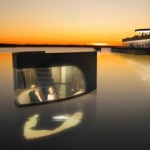
Botel: Floating Hotel with Modular Detachable Room Boats
Instead of static spaces, the unique sleeping areas in this hotel are dynamic vehicles you can use to depart the core structure in which you are staying.
Click Here to Read More »»

Transformer Hotel: Tiny Room Showcases Convertible Furniture
Deploying three novel pieces of multipurpose furniture, this 240-square-foot space manages to pack in all kinds of secrets, surprises and amenities for guests …
Click Here to Read More »»
[ By Steph in Art & Installation & Sound. ]
[ WebUrbanist | Archives | Galleries | Privacy | TOS ]
-
Shortlisted images from Environmental Photographer of the Year 2015 to go on display
London’s Royal Geographical Society is set to play host to an exhibition of the shortlisted entries of the 2015 Environmental Photographer of the Year competition. The exhibition, which opens for three weeks on June 22nd, will feature 111 of the best images as selected by the competition’s five judges. The ultimate winners will be announced at a ceremony on 25th June. Read more
-
4 Photography “Tricks” That Should Be Quietly Retired
If you’ve ever felt the temptation to “improve” some of your photos with some special tricks, then you’re not alone. Many people with a passing interest in photography employ all manner of “extras” to give their photo some added visual interest. Most of these tricks, however, are ham-fisted affectations that can not only ruin your photos, but mark you as Continue Reading
The post 4 Photography “Tricks” That Should Be Quietly Retired appeared first on Photodoto.
-
SLR Magic unveils HyperPrime Cine 50mm T0.95 lens and Magic-Rangefinder Cine Adapter
SLR Magic has introduced its HyperPrime Cine 50mm T0.95 standard lens for Micro Four Thirds cameras. The HyperPrime Lens gives a 100mm equivalent focal length and offers a T0.95 maximum aperture, black anodized finish and weighs 620g/1.4lb. Also introduced is the SLR Magic-Rangefinder Cine Adapter with an integrated focus ring. Read more