RSS
 

Archive for February, 2015

CreativeLive kicks off Photoshop Week 2015

24 Feb

Starting today, the folks at CreativeLive are hosting a week of educational programs designed to help photographers and designers get the most out of Adobe Photoshop. Classes range from tips for beginners to more specialized sessions in landscape, architecture and portrait photography, to name a few. All classes are streaming live for free over the next six days, and will be available for purchase after the event. Read more

Articles: Digital Photography Review (dpreview.com)

 
Comments Off on CreativeLive kicks off Photoshop Week 2015

Posted in Uncategorized


23. Februar 2015

24 Feb

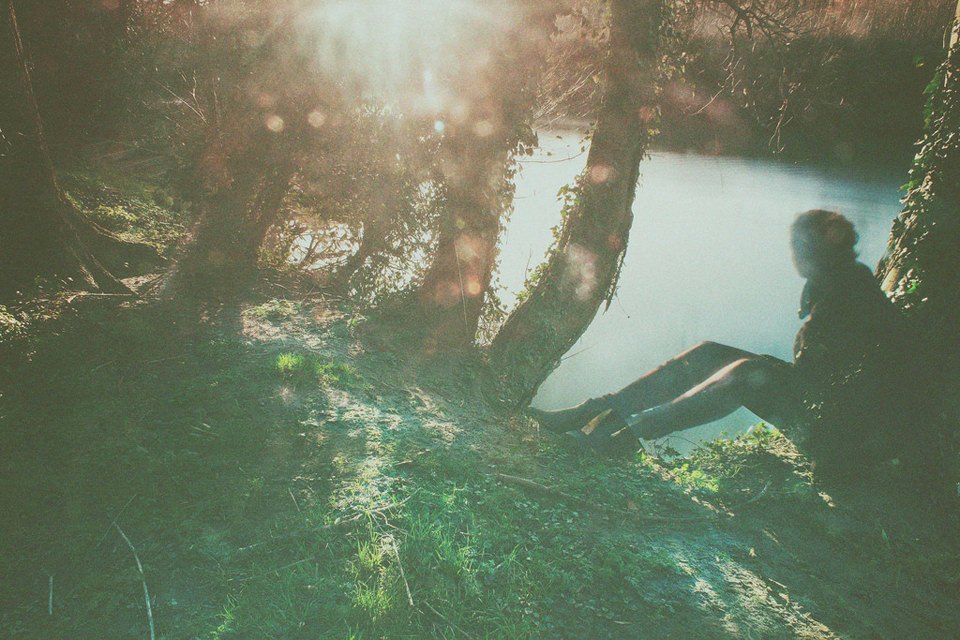
Das Bild des Tages von: karkadé

Jemand sitzt am Fluss und schaut raus.

Im Ausblick: Bildmanipulation, Schönheiten und preisgekrönte Nachrichtenbilder.
kwerfeldein – Fotografie Magazin | Fotocommunity

 
Comments Off on 23. Februar 2015

Posted in Equipment


Writer’s Favorite Wildlife Lens – Tamron 150-600mm

24 Feb
Writer with Tamron 150-600 on his Nikon D7100 in Le Claire Iowa. Photo by: J. Todd Polling

Writer Bruce Wunderlich with Tamron 150-600mm on his Nikon D7100 in Le Claire, Iowa. Photo by: J. Todd Poling

One of my favorite subjects to photograph is wildlife. In the past, great wildlife images were very difficult for me to shoot because my close presence usually meant disturbing the wild creature I had my eye on. I began looking for a longer lens with plenty of reach that wasn’t going to break my piggy bank. So, after much patient and thorough research, I purchased the Tamron 150-600mm SP F/5-6.3 Di VC USD zoom lens for my Nikon D7100.

The reach of this lens gave me some great results right out of the box, but I will have to admit that it takes some practice to photograph moving subjects, such as birds in flight, with this lens. Tamron 150-600mm does have some limitations, but one thing you will find with any telephoto lens is that no matter how much you have, you will always want more.

Technical Specifications:

  • Focal length: 150-600mm (equivalent to 225-900mm on a cropped sensor)
  • Maximum aperture: f/5- f/6.3
  • Available mounts: Nikon, Canon and Sony
  • Minimum focus distance: 8.86′ (2.7 m)
  • Weight: 4.3 lb (1.95 kg)

Compared to Prime lens

Of course, this lens I purchased doesn’t match the quality of a prime lens like the Nikon 6oomm f/4. But besides costing around $ 8000 less then the Nikon lens, it has a few other advantages over its prime equivalent. Besides the heftier price tag, the Nikon prime weighs in at over 11 pounds compared to just over 4 pounds  (1.95 kg) for the Tamron. Unless you are a body builder, hand-holding the prime for an extended period of time is nearly impossible. The Tamron 150-600mm can easily be hand-held, though I recommend using a Gimbal head on your tripod for smoother panning. While the Nikon Prime is a fixed 600mm focal length, the Tamron zooms from 150-600mm, great for those opportunities when you unexpectly get very close to the wildlife, and you can quickly adjust and zoom back.

Be Prepared

The best way to get great wildlife images is to always be prepared. This lens is small enough that I leave it on my camera all the time in my camera bag, so if I happen onto a sudden wildlife encounter I don’t lose time switching out my original lens to the Tamron and miss the opportunity to get the image.

Eagle Shoot in Iowa

Recently, I had the opportunity to take a road trip with friends to Le Claire, Iowa, to photograph bald eagles on the Mississippi River. This was the perfect chance for me to put my Tamron 150-600mm to good use. Here are a few of my favorite images captured with the Tamron on the trip.

Flying into the Sunset  Focal Length: 600mm 1/1000 of second, f/6.3 with ISO 400

Flying into the Sunset
Focal length: 600mm, 1/1000th of second, f/6.3, ISO 400
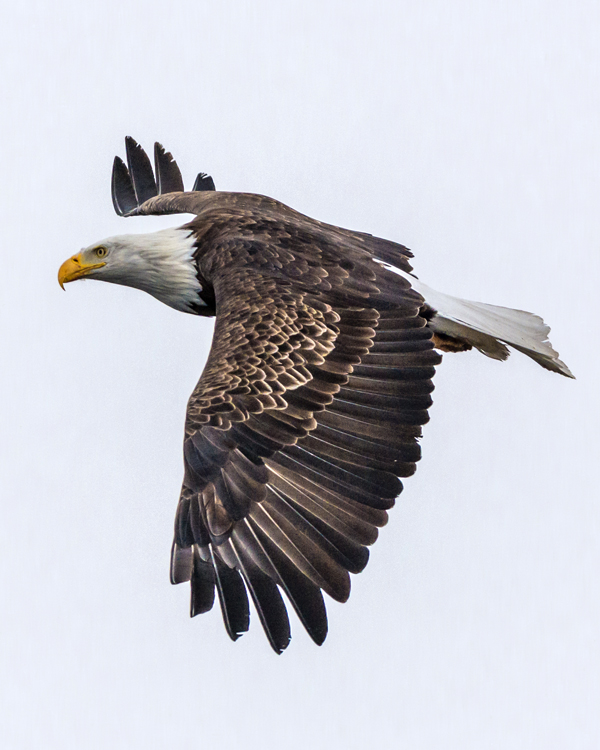
Focal Length 360mm 1/2500 of a second, f/6.3, ISO 1000 im Aperture priority mode.

Focal length 360mm, 1/2500th of a second, f/6.3, ISO 1000 in aperture priority mode.

Sweet Spot

From 150-450 mm, images shot with this lens are really sharp. From 450-600 mm, the results are a little softer, but in most cases it still captures very useable images. In good light the autofocus performs quickly and accurately, while in low light it is some what slower. But for the price, this is a very nice lens.

Image of Eagle on left was captured at 600mm and image on right was captured at 450mm. Image on right has a little more detail in the feathers.
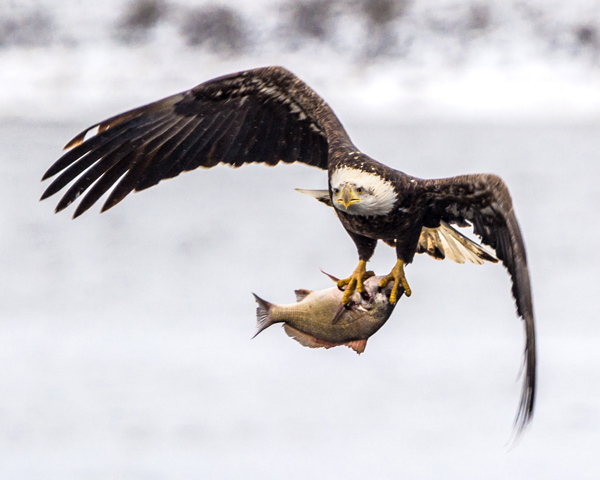
Image of the eagle on left was captured at 600mm and image on right was captured at 450mm. Image on right has a little more detail in the feathers.

Focal Length: 600mm. 1/800th of a second, f/6.3, ISO 320

Focal length: 600mm, 1/800th of a second, f/6.3, ISO 320

This juvenile Bald Eagle was captured in bright mid day light. Focal Length: 450mm, 1/1000th of a second, f/6.3, ISO 320

This juvenile bald eagle was captured in bright midday light. Focal length: 450mm, 1/1000th of a second, f/6.3, ISO 320

 Conclusion

In my opinion, if you are in the market for a versatile wildlife lens and are on a budget, the Tamron 150-600mm would be a very good choice. I’ve been pleased with the wildlife images I’ve captured with mine, and am looking forward to getting even better ones with practice. That’s why it’s my favorite wildlife lens.

What is your favorite wildlife lens?

googletag.cmd.push(function() {
tablet_slots.push( googletag.defineSlot( “/1005424/_dPSv4_tab-all-article-bottom_(300×250)”, [300, 250], “pb-ad-78623” ).addService( googletag.pubads() ) ); } );

googletag.cmd.push(function() {
mobile_slots.push( googletag.defineSlot( “/1005424/_dPSv4_mob-all-article-bottom_(300×250)”, [300, 250], “pb-ad-78158” ).addService( googletag.pubads() ) ); } );

The post Writer’s Favorite Wildlife Lens – Tamron 150-600mm by Bruce Wunderlich appeared first on Digital Photography School.


Digital Photography School
 
Comments Off on Writer’s Favorite Wildlife Lens – Tamron 150-600mm

Posted in Photography


Panasonic introduces Lumix G 30mm macro and new 42.5mm portrait prime

23 Feb

Panasonic has announced two new additions to its Micro Four Thirds lens lineup, a 30mm F2.8 macro and 42.5mm F1.7 portrait lens. The company had previously hinted that the 30mm was in the works, and as promised it offers Mega O.I.S stabilization along with 240 fps drive AF. The 42.5mm F1.7 isn’t quite as fast (or presumably as expensive) as the existing Leica Nocticron 42.5mm F1.2. Both lenses will be available in May. Read more

Articles: Digital Photography Review (dpreview.com)

 
Comments Off on Panasonic introduces Lumix G 30mm macro and new 42.5mm portrait prime

Posted in Uncategorized


You’ve Got the Talent, Now Get the Gear!

23 Feb

You’ve been honing your skills, now it’s time to pick up some gear and elevate your phoneography talent to top-status.

See Our Mobile Photography Tools Roundup!
(…)
Read the rest of You’ve Got the Talent, Now Get the Gear! (0 words)


© Erin for Photojojo, 2015. |
Permalink |
No comment |
Add to
del.icio.us

Post tags:


Photojojo

 
Comments Off on You’ve Got the Talent, Now Get the Gear!

Posted in Equipment


30 Ways to Become a Better Photographer in 30 Days

23 Feb

So you want to be a better photographer, and fast, right? Here are thirty things that you can do in 30 days to make your work a LOT better. Remember that while there are rules, the most important thing is to experiment and see what looks great to you. Day 1. Read your camera’s manual. Test every single little button Continue Reading

The post 30 Ways to Become a Better Photographer in 30 Days appeared first on Photodoto.


Photodoto

 
Comments Off on 30 Ways to Become a Better Photographer in 30 Days

Posted in Photography


Smartphone-Apps im Kurzreview

23 Feb

Ein Tor auf einer Wiese.

Ein Beitrag von: Samuel Kümmel

Smartphones, also Handys mit Touchscreen und der Möglichkeit, Apps (kleine Programme) zu nutzen, sind aus dem täglichen Leben von vielen Menschen nicht mehr wegzudenken. Auch viele Fotografen – ich eingeschlossen – nutzen sie bei ihrer Arbeit und in ihrer Freizeit.
kwerfeldein – Fotografie Magazin | Fotocommunity

 
Comments Off on Smartphone-Apps im Kurzreview

Posted in Equipment


Tips for Setting up a File Management System

23 Feb

As much as we love the art of photography, the organization of it is just as important. Yes, organization. It’s important that you have a system in place to access your photos when you need them. A few key things to consider are: date, genre, occasion, and subject. You also want to be careful of the locations that you are storing your images.

Save location

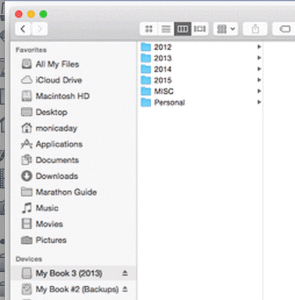
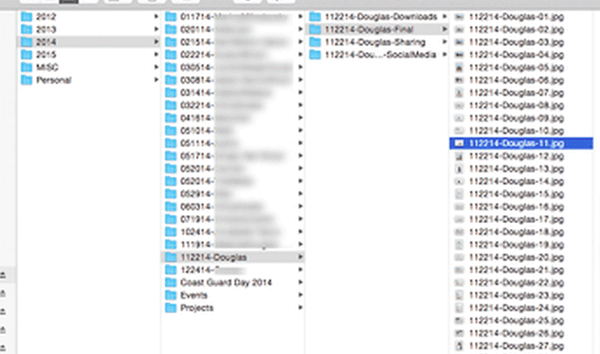
This is an example of a way to organize your photos. This is an external drive with various years. There is also a folder for miscellaneous photos and a folder for personal photos. Your system may not have as many years or may include different folders. It’s important to develop a system that works for you.

This is an example of a way to organize your photos. This is an external drive with various years. There is also a folder for miscellaneous photos and a folder for personal photos. Your system may not have as many years or may include different folders. It’s important to develop a system that works for you.

MDFileManagement-02 DayFileManagement-02

This is an example of a way to organize your photos. This is an external drive with various years. There is also a folder for miscellaneous photos and a folder for personal photos. Your system may not have as many years or may include different folders. It’s important to develop a system that works for you.

It’s important to have your image files saved in a safe place. You should consider using an external drive of some sort. External drives are ones that sit outside of your computer (some are portable for travelling), on which can store various amounts of data. Some people choose to store a backup of their files on their external drive, and a working copy on their computer hard drive. Either way is fine, just make sure you have your final copies saved and backed up in a safe place.

DayFileManagement-03

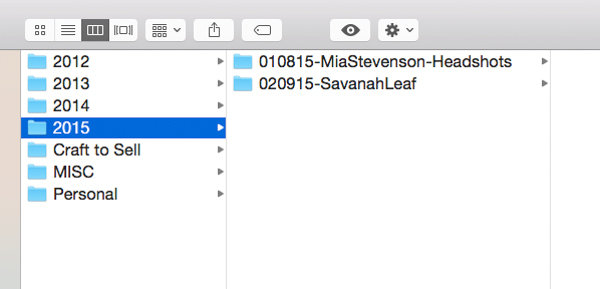
You’ll want to create a folder, or series of folders to save your photos. Your organization system should work for your specific needs. Start with a top level that describes your contents. For example, if you shoot fine art as well as portrait work, you might want to create two folders; one for your fine art work and another for your client work would be an option. Within those folders you could then sort your photos by year, then by project or client name. You’ll also want to create folders that represent the different states of your process. An example is to have a downloads folder, a retouched folder, a final images folder, and a blog folder.

File Naming

DayFileManagement-06

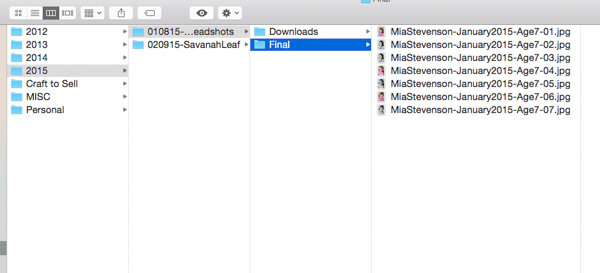
This is what the file structure looks like when open. This set of photos was shot in 2015. The date comes before the client name. There is also a designation that these are headshots. This makes it easy to find when looking at the folders. The term headshots was also used as a keyword during import. These images were being used to submit to a casting agency so the file name includes the description of the subject.

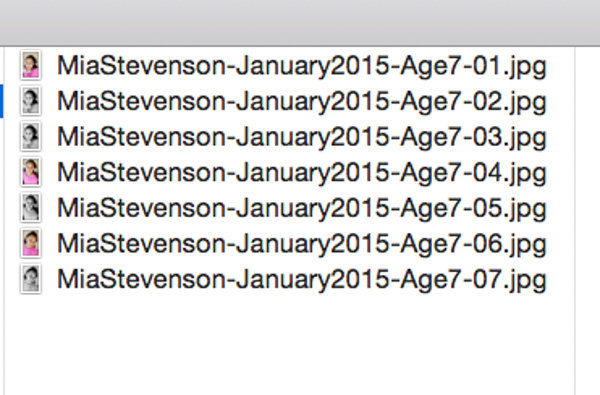
Your file names should be descriptive and concise. You want your filenames to be easy to read. A great file structure should include the name of your project, and the date it was shot. You can add any additional descriptive information if you think it’s needed. An example would be Wedding-Johnson-May2014.jpg or Johnson-51414.jpg (inside the Weddings folder). These are just examples. Take into consideration the order you like to view your files. Having the date at the front might be a better option for you if you like to see them in numerical order.

DayFileManagement-05

Keywording

You want to make sure to keyword your photos. This is usually done at import. Both Adobe Bridge and Lightroom have the option to keyword. Most file organization systems have a keyword feature, so familiarize yourself with that. This is an important part of the file organization process that is often overlooked. Your keywords should describe your images and any details you might want to reference later. Think about the types of photos you might be asked to submit, or even want to blog about. An example is using the keyword “sunshine” as part of your family portrait import. You might not immediately think that this is something you even care about, but it will be helpful when you’re ready to submit to a call for photos that show sunshine.

MDFileManagement-03

Here is an example of a complete set. Notice there are folders for the original images, final images, sharing, and social media. Each of these folders leads with the date and client name. The image filenames continue this pattern and are numbered.

File organization can be as simple or as complex as you want it. The important thing is to just have a system in place. You may not have a lot of shoots to sort through, but in time they will add up. Your system will make it easier to find what you’re looking for in the future.

googletag.cmd.push(function() {
tablet_slots.push( googletag.defineSlot( “/1005424/_dPSv4_tab-all-article-bottom_(300×250)”, [300, 250], “pb-ad-78623” ).addService( googletag.pubads() ) ); } );

googletag.cmd.push(function() {
mobile_slots.push( googletag.defineSlot( “/1005424/_dPSv4_mob-all-article-bottom_(300×250)”, [300, 250], “pb-ad-78158” ).addService( googletag.pubads() ) ); } );

The post Tips for Setting up a File Management System by Monica Day appeared first on Digital Photography School.


Digital Photography School

 
Comments Off on Tips for Setting up a File Management System

Posted in Photography


POLL: What do you wish you understood better when you started photography?

23 Feb

Let’s get a discussion going on what you wish you understood better when you first got in to photography. Please fill in the poll below, you can check off up to three choices, and add your comments below.

If it’s not listed check off “other” and add a comment.

What was your biggest obstacle? What did you struggle most to understand?

Note: There is a poll embedded within this post, please visit the site to participate in this post’s poll.

googletag.cmd.push(function() {
tablet_slots.push( googletag.defineSlot( “/1005424/_dPSv4_tab-all-article-bottom_(300×250)”, [300, 250], “pb-ad-78623” ).addService( googletag.pubads() ) ); } );

googletag.cmd.push(function() {
mobile_slots.push( googletag.defineSlot( “/1005424/_dPSv4_mob-all-article-bottom_(300×250)”, [300, 250], “pb-ad-78158” ).addService( googletag.pubads() ) ); } );

The post POLL: What do you wish you understood better when you started photography? by Darlene Hildebrandt appeared first on Digital Photography School.


Digital Photography School

 
Comments Off on POLL: What do you wish you understood better when you started photography?

Posted in Photography


Inevitably Graffitied: White Canvas-Like SoHo Facade Defaced

23 Feb

[ By WebUrbanist in Art & Street Art & Graffiti. ]

storefront studio front entry

While its creators anticipated this stretched plastic surface appealing to local graffiti artists, they were apparently hoping for a higher grade of street art to adorn the Storefront for Art and Architecture gallery facade in New York City.

soho storefront white wall

storefront graffiti art vandalism

Architecture studio SO-IL created this temporary surface as an extension of an exhibition going on within the gallery space, but its creators remain somewhat disappointed: “We knew this would happen. Unrestrained, Storefront pushes itself into the public domain. By wrapping it in a white canvas it further provokes a response from the city. It was anticipated, but what a poor quality of the graffiti… We had hoped for something better.”

storefront installation art facade

storefront lit at night

So far, tags like “ugly kids” and other scrawled messages have been mainly black spray on the white background – nothing layered or time-consuming. Of course, now that the memo is out, perhaps a different kind of artist will take a try at the surface – that, or the statements may backfire, with artists wondering why they should add value to someone else’s surface.

storefront studio interior view

soho storefront graffiti defaced

Illuminated and pressed outward by walls and objects from within the gallery, part of the idea was to draw people into the exhibit by creating visual interest along the street and sidewalk – a novel trick for attracting attention. Still, if this kind of impromptu artistic addition was expected, why not simply invite a group of graffiti artists to contribute in the first place? In the end, once one concedes a surface will be defaced, either it will unfold naturally and unpredictably or will have to be controlled by the property owners – there is no real middle ground.

Share on Facebook


[ By WebUrbanist in Art & Street Art & Graffiti. ]

[ WebUrbanist | Archives | Galleries | Privacy | TOS ]


WebUrbanist

 
Comments Off on Inevitably Graffitied: White Canvas-Like SoHo Facade Defaced

Posted in Creativity