RSS
 

Archive for January, 2015

23. Januar 2015

24 Jan

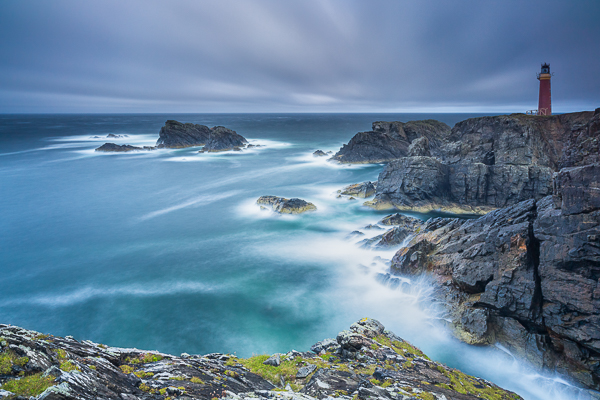
Das Bild des Tages von: Thomas Graichen

© Thomas Graichen

Fotolinks des Tages

1. Ein produktives Syndrom

Alleine das Wort „Gear Avoidance Syndrome“ (Ausrüstungs-Vermeidungs-Syndrom) ist heute einen Eintrag wert. Die Prämisse der Autoren Vieth und Dietrich ist, dass eine große Masse an Objektiven, Kameras und Kram dazu führt, dass man sich bei einem Shooting zu viele Gedanken um die Technik macht – und deshalb das eigentlich Wichtige vergisst. Sie behaupten: Je länger man das Ausrüstungs-Vemeidungs-Syndrom hat, desto mehr Fortschritte kann man als Fotograf machen. → ansehen

2. 22 mal Fortschritt

Einer der großen Vorteile der Fotografie ist, dass man mittels ihrer Hilfe die „Zeit anhalten“ kann. Tut man dies öfter, beispielsweise einmal pro Jahr von ein und demselben Objekt, beispielsweise eine junge Familie mit Kind, kann eine wunderbare Serie entstehen. Der Fotograf Zed Nelson setzte dieses Vorhaben 22 Jahre lang um und das erstaunliche Ergebnis dürfen wir auf Huffington Post betrachten. → ansehen

3. Düster und traurig: Rumänien

Joseph Rodriguez fotografierte zwischen 1990 und 1996 ein Land, das sich vom Kommunismus gelöst hatte und der Armut verfiel: Rumänien. Dort lenkte er seine Aufmerksamkeit auf die Probleme des Landes, dokumentierte Waisenhäuser und Psychiatrien, setzte aber auch positive Akzente mit Portraits von Bauern und Landsleuten. Die New York Times berichtet. → ansehen

+ Das frisch erschienene Ebook „Romania“ ist für alle iOS-Geräte und Macs jetzt zu erwerben. Dringende Empfehlung.


kwerfeldein – Fotografie Magazin | Fotocommunity

 
Comments Off on 23. Januar 2015

Posted in Equipment


Samsung NX1 firmware v1.2 now available

24 Jan

Samsung has released a major firmware update for the NX1. Announced earlier this month, firmware v1.2 bring additional features, increased customization and several menu refinements. DPReview was one of the organizations that provided Samsung with feedback on the camera and shooting with the new firmware over the past couple of weeks has shown us that several of the requests we made have been incorporated. Read more

Articles: Digital Photography Review (dpreview.com)

 
Comments Off on Samsung NX1 firmware v1.2 now available

Posted in Uncategorized


Weekly Photography Challenge – Dance

24 Jan

Earlier I shared a bunch of elegant images of the world of dance.

Dance is an art form just like photography. It take discipline and endurance to be a dancer. Can you relate as a photographer? Each is a passion, something which needs practice to perfect. Dance is picturesque and often is partnered with photography as the are symbiotic – they work well together.

Michael Dunn

By Michael Dunn

Weekly photography challenge – dance

Now it’s your turn. Do you know a dancer? Can you approach the local dance school to offer to take some photos for them? Maybe even something less formal like your own children dancing just for the fun of it?

Here are a few ideas:

Garry Wilmore

By Garry Wilmore

Stefanos Papachristou

By stefanos papachristou

Tiziano L. U. Caviglia

By Tiziano L. U. Caviglia

Paul Cox

By Paul Cox

Felix Padrosa Photography

By Felix Padrosa Photography

Chris JL

By Chris JL

Dixie Lawrence

By Dixie Lawrence

John Curley

By john curley

Share your dance images here:

Simply upload your shot into the comment field (look for the little camera icon in the Disqus comments section) and they’ll get embedded for us all to see or if you’d prefer upload them to your favourite photo sharing site and leave the link to them. Show me your best images in this week’s challenge. Sometimes it takes a while for an image to appear so be patient and try not to post the same image twice.

googletag.cmd.push(function() {
tablet_slots.push( googletag.defineSlot( “/1005424/_dPSv4_tab-all-article-bottom_(300×250)”, [300, 250], “pb-ad-78623” ).addService( googletag.pubads() ) ); } );

googletag.cmd.push(function() {
mobile_slots.push( googletag.defineSlot( “/1005424/_dPSv4_mob-all-article-bottom_(300×250)”, [300, 250], “pb-ad-78158” ).addService( googletag.pubads() ) ); } );

The post Weekly Photography Challenge – Dance by Darlene Hildebrandt appeared first on Digital Photography School.


Digital Photography School

 
Comments Off on Weekly Photography Challenge – Dance

Posted in Photography


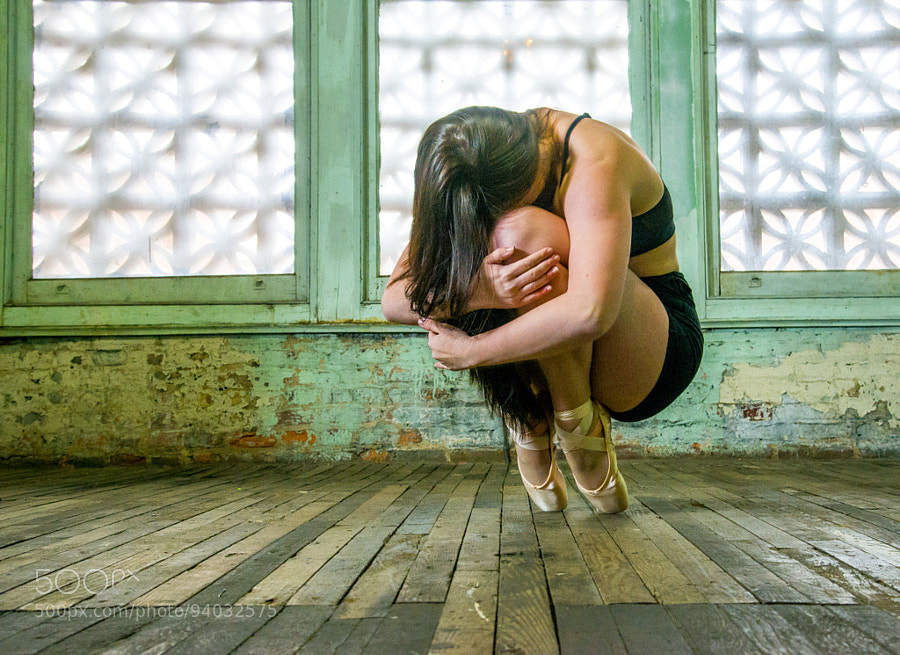
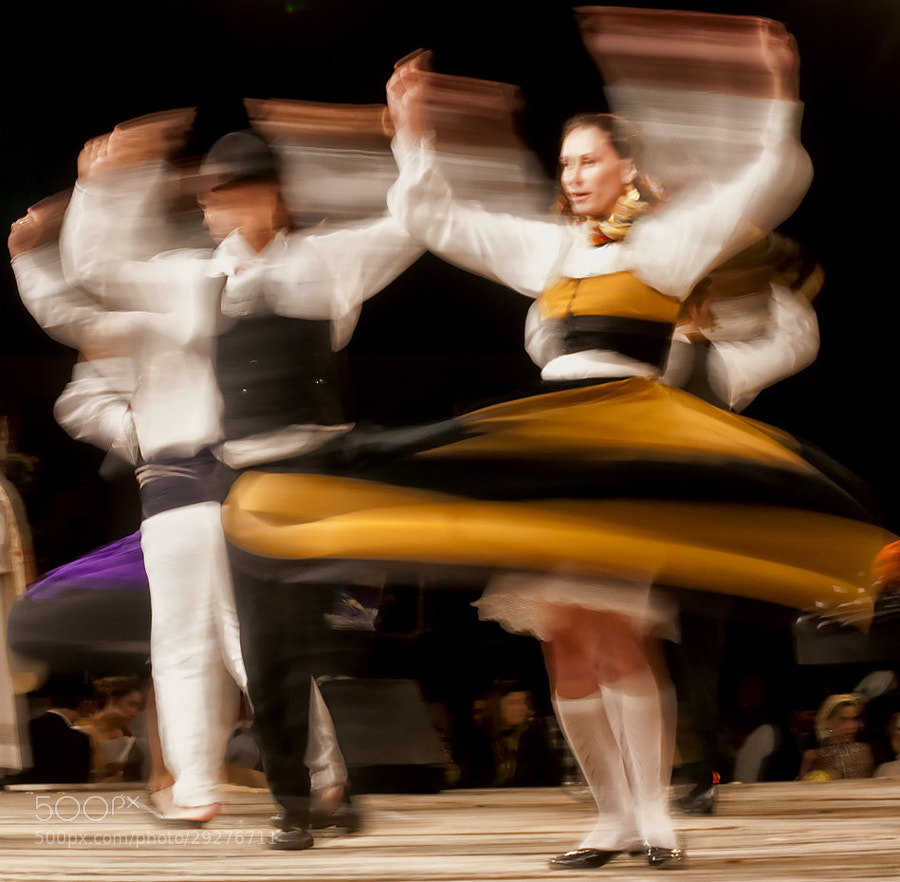
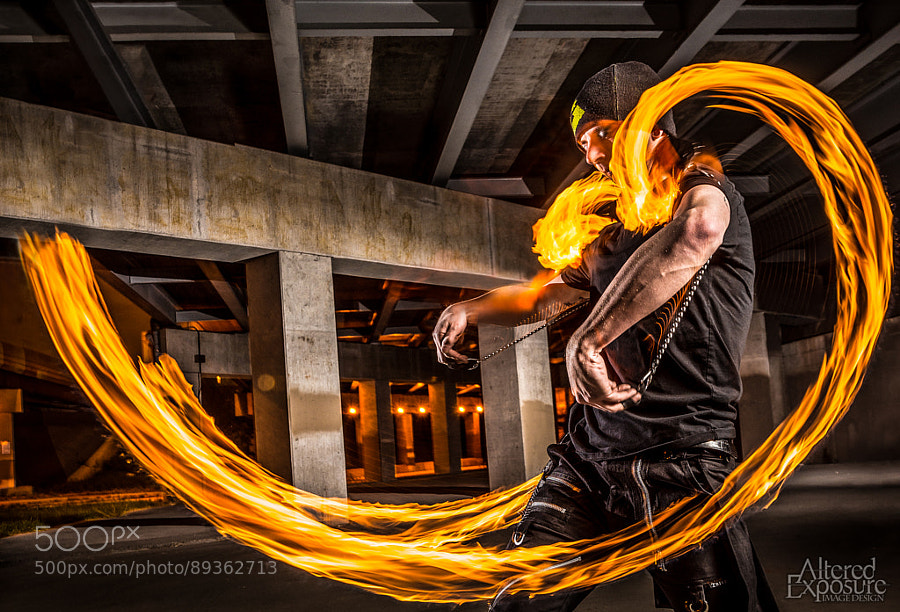
27 Elegant Images of the World of Dance

23 Jan

Last week we looked at magical images of music, this week let’s explore the world of dance!

Dancers have a lot of passion and determination. It takes a lot of work and practice to be a good dancer, even more to be great. Hmm, sound familiar? Just like anything – the more you do it, the better chance you have of improvement.

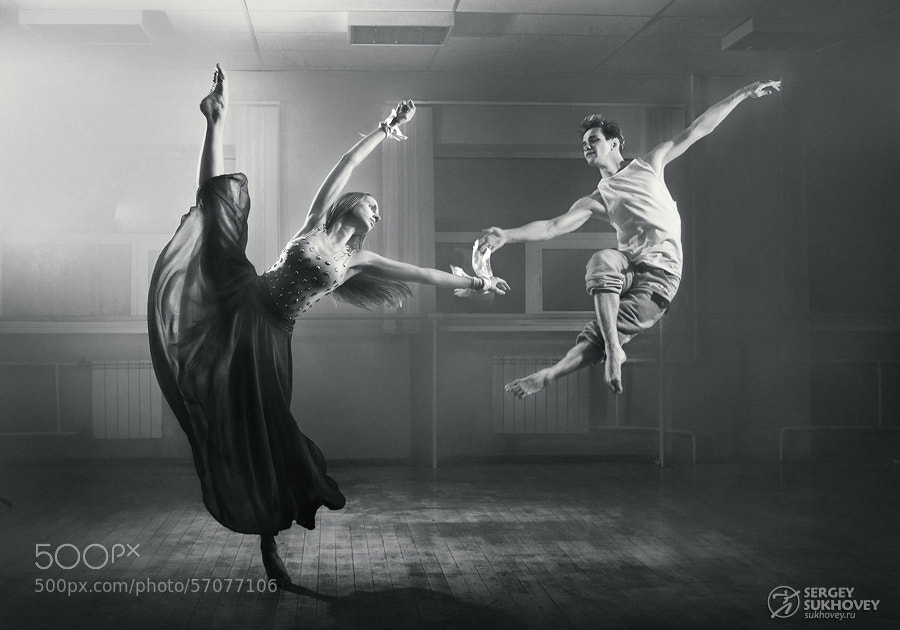
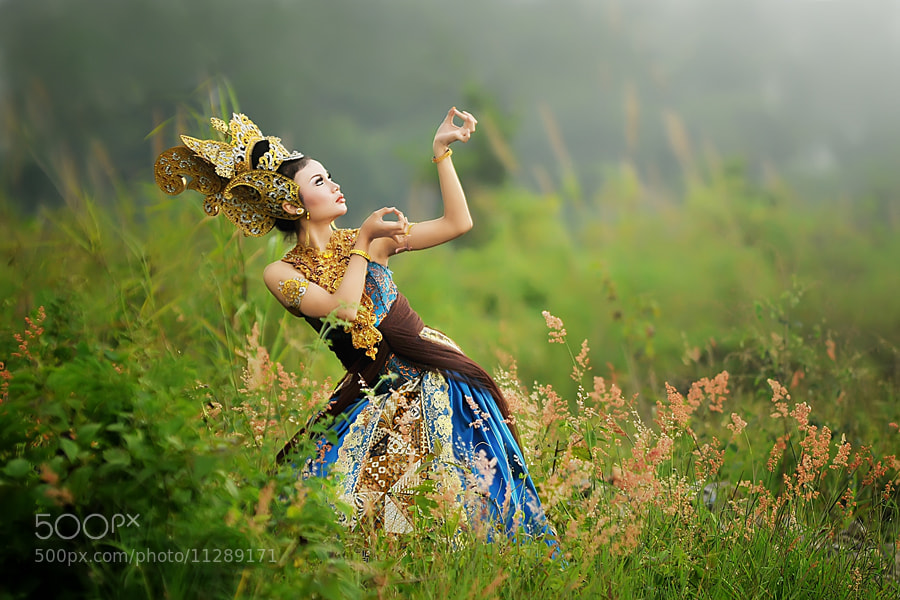
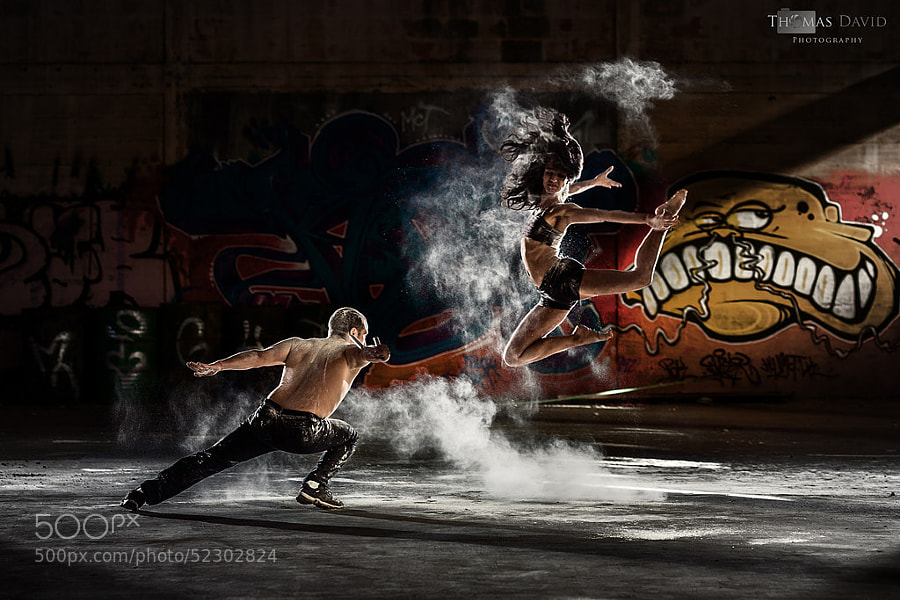
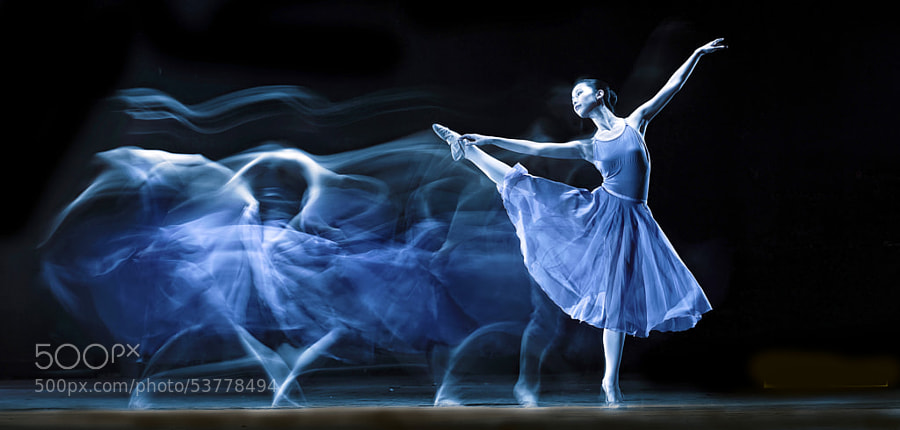
I’ve always silently envied dancers. They move with such grace, flow, elegance. Not to mention how fit and strong they always look. Photography of dancers is the same – when done well! This set of images of dancers spoke to me on both levels – the power of the dancer, and the skill and artistry of the photographer.

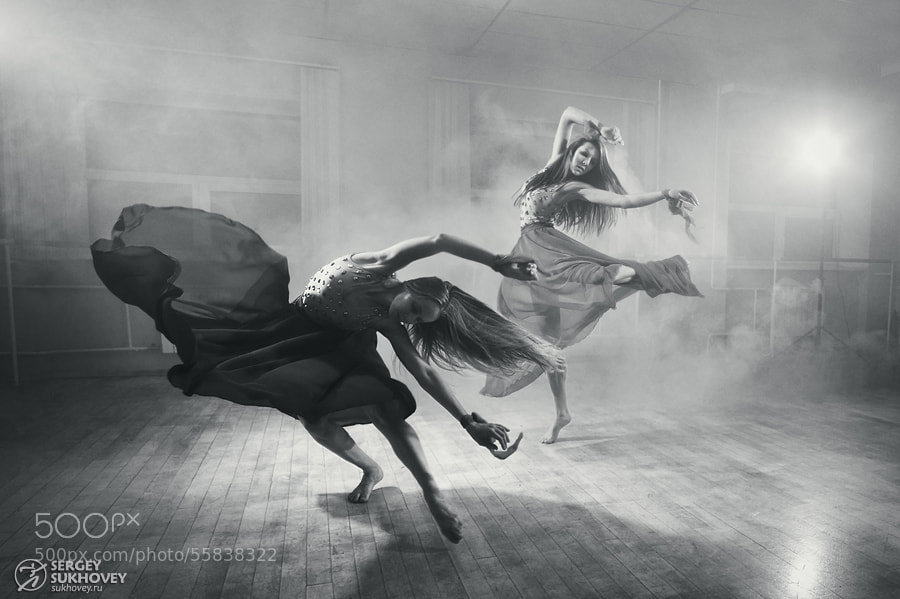
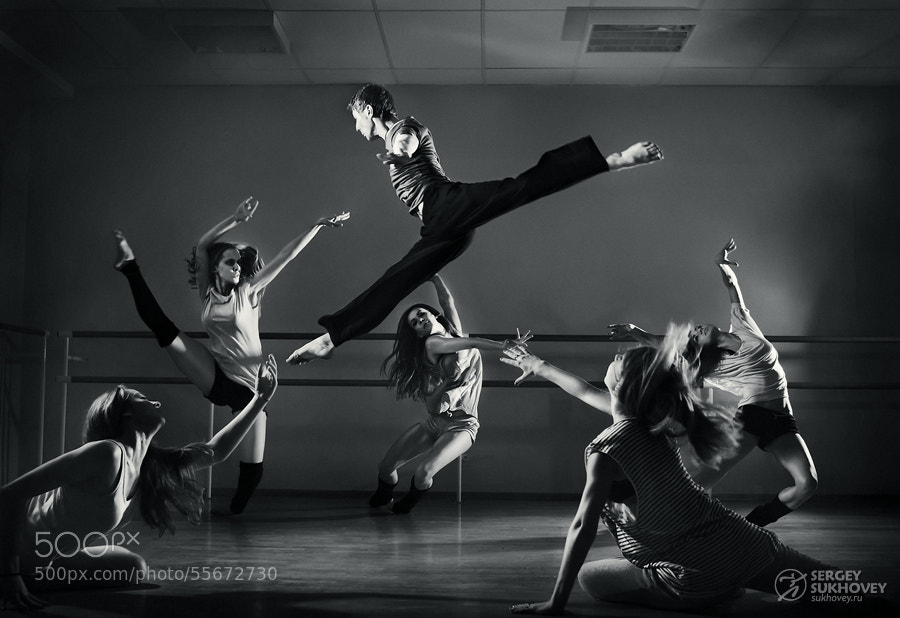
Photograph ACTION by Sergey Sukhovey on 500px

ACTION by Sergey Sukhovey on 500px

Photograph Civetta by Mark Crislip on 500px

Civetta by Mark Crislip on 500px

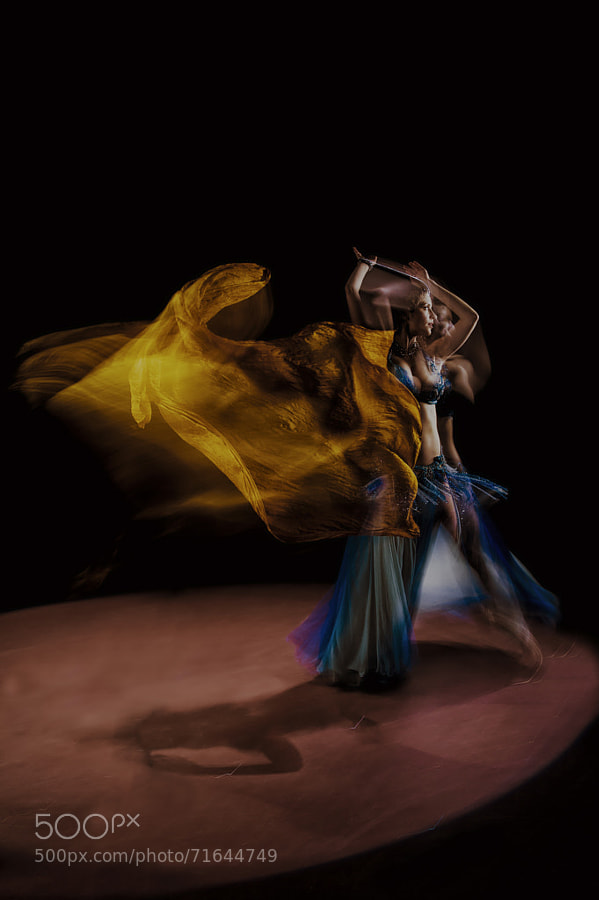
Photograph Bellydancer by Carlos Esteban Solís Fallas on 500px

Bellydancer by Carlos Esteban Solís Fallas on 500px

Photograph Style contemporer Dance by iwan kristiana on 500px

Style contemporer Dance by iwan kristiana on 500px

Photograph Dust and Dance by Thomas David on 500px

Dust and Dance by Thomas David on 500px

Photograph Ballerina by Yongki RS on 500px

Ballerina by Yongki RS on 500px

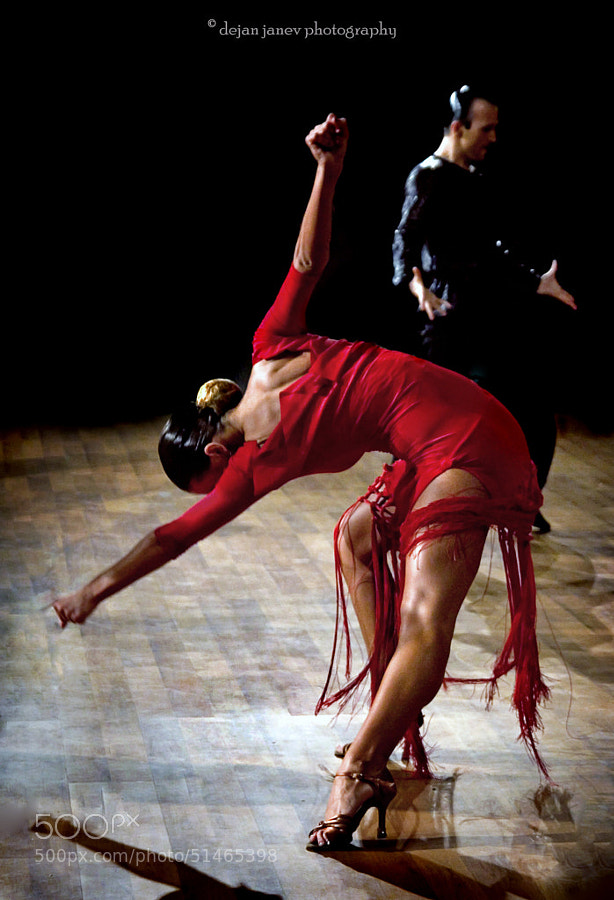
Photograph The end of tango by Dejan Janev on 500px

The end of tango by Dejan Janev on 500px

Photograph ACTION by Sergey Sukhovey on 500px

ACTION by Sergey Sukhovey on 500px

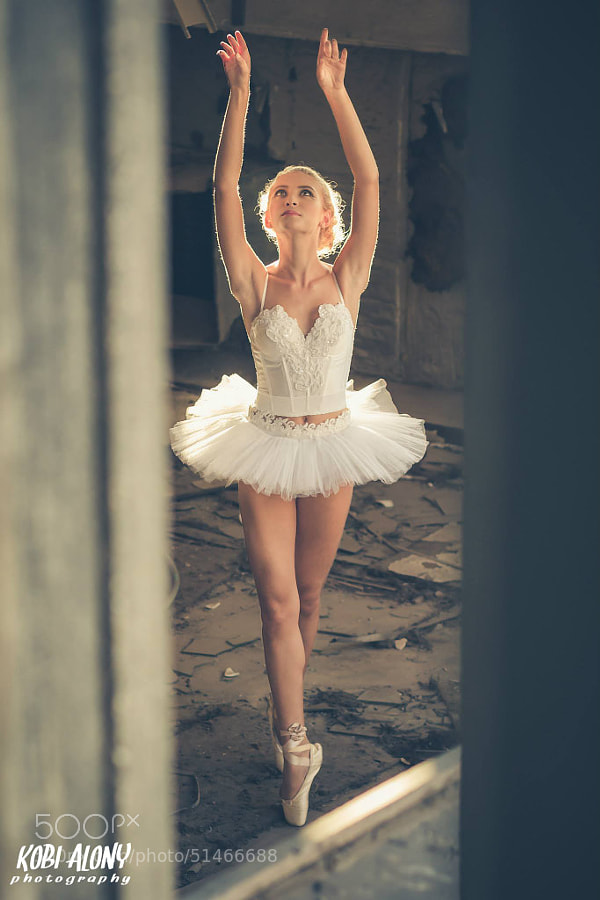
Photograph White Swan by Kobi Alony on 500px

White Swan by Kobi Alony on 500px

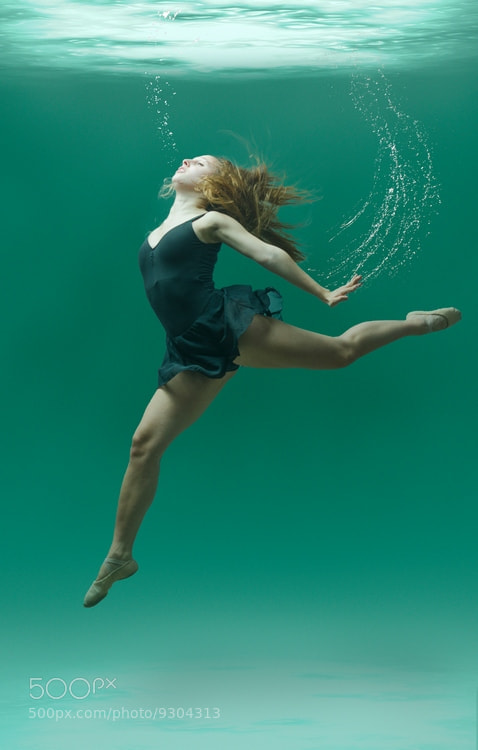
Photograph Out of the green by Tomer Jacobson on 500px

Out of the green by Tomer Jacobson on 500px

Photograph the curvature of spacetime by Aufik (A) on 500px

the curvature of spacetime by Aufik (A) on 500px

Photograph Light As A Feather - Artistic Looks At Dance Through Photography by scottgserio on 500px

Light As A Feather – Artistic Looks At Dance Through Photography by scottgserio on 500px

Photograph Turn turn by Jeronimo Lomba on 500px

Turn turn by Jeronimo Lomba on 500px

Photograph Gujarat Tribal Dance by Ivon Murugesan on 500px

Gujarat Tribal Dance by Ivon Murugesan on 500px

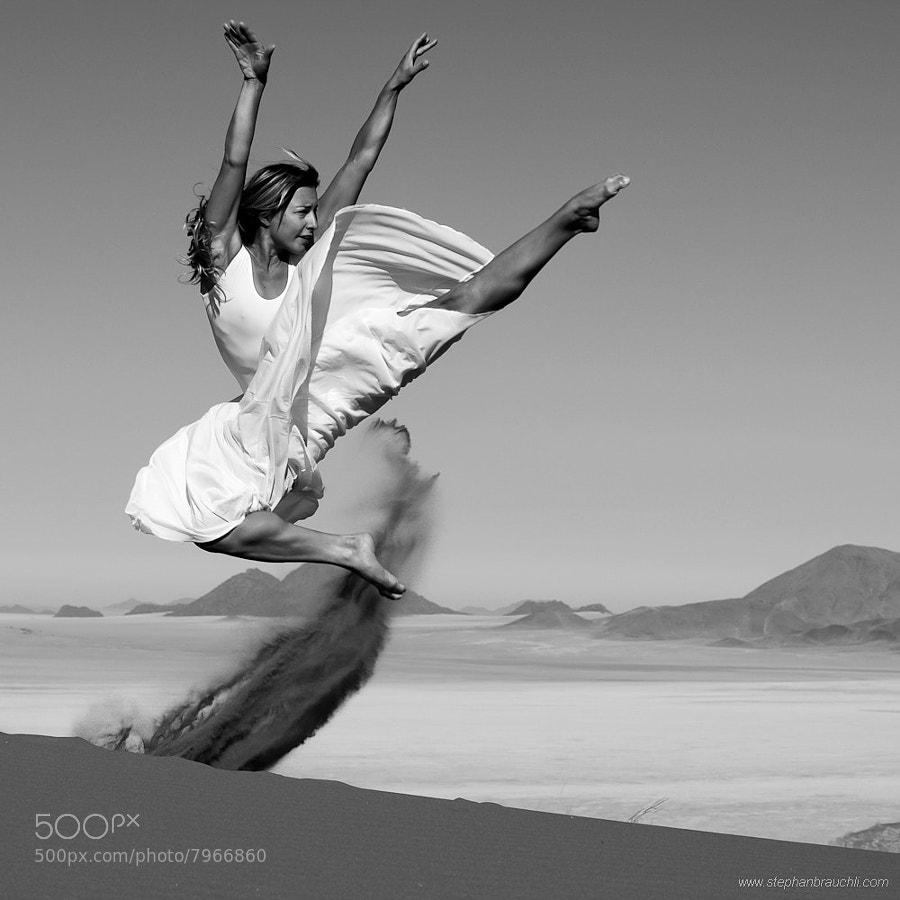
Photograph Dune Danse - Flight by Stephan Brauchli on 500px

Dune Danse – Flight by Stephan Brauchli on 500px

Photograph New Year Celebration by Richard Snyder on 500px

New Year Celebration by Richard Snyder on 500px

Photograph Bouba Jallow by Rafa? Bojar on 500px

Bouba Jallow by Rafa? Bojar on 500px

Photograph TANGO by Peter Marosi on 500px

TANGO by Peter Marosi on 500px

Photograph Steve, the fire-meister Crop by Jesse Mount on 500px

Steve, the fire-meister Crop by Jesse Mount on 500px

Photograph Fire Dancer by David Benard on 500px

Fire Dancer by David Benard on 500px

Photograph Fire Staff by Jenny Zhang on 500px

Fire Staff by Jenny Zhang on 500px

Photograph Belly Dancer by gunes demir on 500px

Belly Dancer by gunes demir on 500px

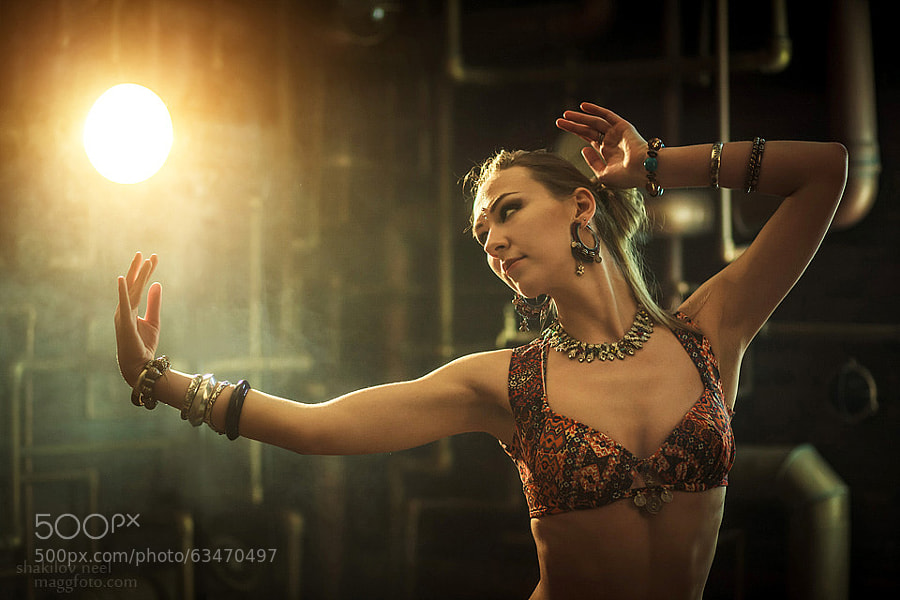
Photograph Dancing with light by Shakilov Neel on 500px

Dancing with light by Shakilov Neel on 500px

Photograph ACTION by Sergey Sukhovey on 500px

ACTION by Sergey Sukhovey on 500px

Photograph Ballet by Lorena Gellini on 500px

Ballet by Lorena Gellini on 500px

Photograph Body Of Art by Dave Brosha on 500px

Body Of Art by Dave Brosha on 500px

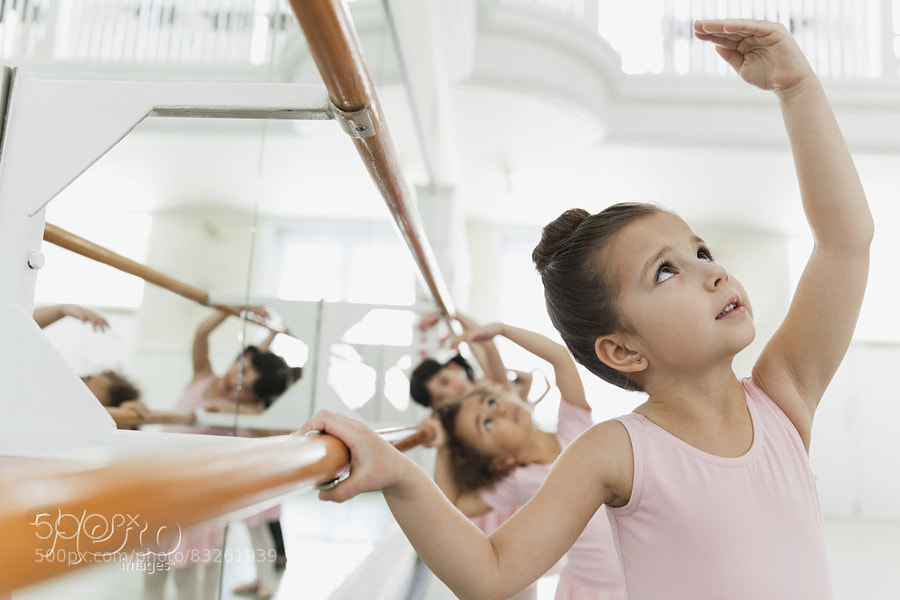
Photograph Children practicing ballet poses in ballet studio by Hero Images  on 500px

Children practicing ballet poses in ballet studio by Hero Images on 500px

googletag.cmd.push(function() {
tablet_slots.push( googletag.defineSlot( “/1005424/_dPSv4_tab-all-article-bottom_(300×250)”, [300, 250], “pb-ad-78623” ).addService( googletag.pubads() ) ); } );

googletag.cmd.push(function() {
mobile_slots.push( googletag.defineSlot( “/1005424/_dPSv4_mob-all-article-bottom_(300×250)”, [300, 250], “pb-ad-78158” ).addService( googletag.pubads() ) ); } );

The post 27 Elegant Images of the World of Dance by Darlene Hildebrandt appeared first on Digital Photography School.


Digital Photography School

 
Comments Off on 27 Elegant Images of the World of Dance

Posted in Photography


A Beginner’s Guide to Working With Flash Off-Camera

23 Jan

FF HeroBW

I spent the first three years of my photography career avoiding the use of speedlights off-camera because I couldn’t wrap my head around the concepts and science behind them. I tried to cover it up saying things like “I’m a natural light photographer.” or “I really don’t like the aesthetics of flash photography.”

But then, I reluctantly invested in a flash for my first Nikon. This was the 90s, pre-digital, pre-autofocus, and pre-TTL. I had to calculate how much flash to use via a chart on the top of the flash. The formula was complicated, but if you knew how to split an atom, you were pretty much set.

Each shoot I went on that required flash was preceded by a sleepless night filled with anxious dreams about turning up to the shoot naked. And the thought of having to use flash also had a mild to moderate laxative effect on me.

Luckily those days are long gone and shooting flash has never been easier. In this tutorial, I’ll show you the quick and easy steps I take to shoot portraits using off-camera speedlights.

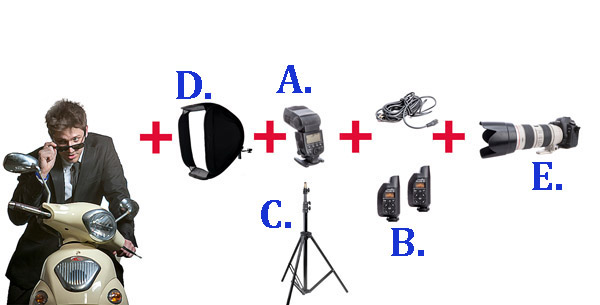
The Gear Essentials

A. Speedlights:

I use speedlights most often when I’m travelling and need light portable flashes, when I’m working on location without access to power, or when I’m working in small, confined locations where studio flashes would be too powerful or cramped.

I work with two Canon 580EX IIs. A great alternative if you are looking to save a few bucks is the Yongnuo YN-560 II. It has a very similar look to the Canon 580EX II and Nikon’s SB speedlight series.

B. Remote Triggers:

Remote triggers allow you to fire speedlights when they’re not mounted on your camera and are essential when using flash off-camera.

The cheapest and most reliable way to fire your speedlight off-camera is using a sync cord — basically you connect your speedlight to your camera via a long cable. The drawbacks of using a cable are that it reduces the distance you can be away from your flash, and can create a tripping hazard. Having said that, I still carry a couple of spare sync cables in my kit because remote triggers do fail from time to time, and the cords have saved my butt on a few occasions.

The next option is cheaper infrared triggers. They do the job of setting your flash off remotely, but they’re sensitive to bright sunlight and external factors such as alert lights on emergency vehicles and forklifts, etc., so they can go off without warning. I started out with a $ 30 set of triggers and used them for a couple of years before trading up to PocketWizards, which I’ve been using for the last eight years. A good entry level flash trigger is the YONGNUO RF-602 (approximatel $ 30).
Fill Flash Diagram 1W

C. Light Stands:

There are three options when it comes to mounting speedlights off-camera:

  1. First, you can use a light stand. Light stands vary in price from $ 20 to $ 200+ dollars, depending on the make and construction.
  2. Second, you can use a GorillaPod and mount your speedlight to a door or place it on top of something near your model.
  3. Third, you can mount your speedlight to an extension pole (or monopod) and have someone hold the light above your model. I like to do this because it gives me more options when shooting, and it also means there aren’t any light stands in the way of my shot.

D. Light Shapers:

Using a speedlight as a bare light source creates a very hard style of lighting similar to harsh sunlight. This looks great in certain situations, but I prefer to soften and control the light source by using a small or medium soft box over the flash unit. This creates a much softer, more flattering and realistic-looking light source.

A good one to start with is the LumiQuest Mini Softbox. It attaches to your speedlight with Velcro and folds flat for easy storage.

E. Camera with Hot Shoe Mount:

You will need a Camera that works in manual mode with a hot shoe mount.  The hot shoe mount is just a sexier way of saying that little square bit of metal on top of the camera that an external flash or wireless trigger slides into.

The Way

I used to believe that great portraits needed artificial lighting regardless of the environment. I often added two or three lights to my portrait shoots because I thought anything less was lazy or unprofessional. I actually felt guilty when I shot with natural light because I thought it was cheating.

Fortunately, I’ve gotten over that false notion and now understand that finding great light and being able to use it are learned skills, so is knowing when to use fill-flash in a portrait.

Nowadays, whenever I set up portrait shoots, I always look for opportunities to use great natural lighting first. It’s the most beautiful and flattering light for portraits, so if it ain’t broke, no need to fix it.

Having said that, there are many occasions when natural lighting is only just okay or even complete caca — and sometimes a portrait needs more mood or drama than the available light can provide.

The following is an example of how I used flash off-camera to light a heavily backlit image. My objective was to create an image that looked naturally lit. This technique can be used for any portrait that requires fill-flash using off-camera flash.

Daylight 001 Daylight 800ISO 001

Flash on camera 002

A. Here you can see that my model was heavily backlit, which makes a great silhouette, but not such a great portrait.

B. I attempted to correct the lighting by increasing my ISO, which overexposed the background and brings more detail to the motorbike, but leaves the model’s skin tone flat, dull and underexposed. It also added extra noise in the blacks. At this stage, I could also have used a reflector to bounce light back onto the model to help create a better skin tone.

C. A quick fix to this problem would be to shoot flash on-camera using TTL, which uses the camera’s metering system to calculate the correct amount of light needed to create the portrait.

As you can see in my example, the Canon 580EX II did an okay job of lighting my model, given I was about five meters (16′) away using a 200mm lens.

The thing I don’t like about using flash on-camera for portraits is that it tends to make them look unnatural and have flat, lit look. By using my flash off-camera, I can control the direction and amount of light going onto my model to achieve a more natural look.
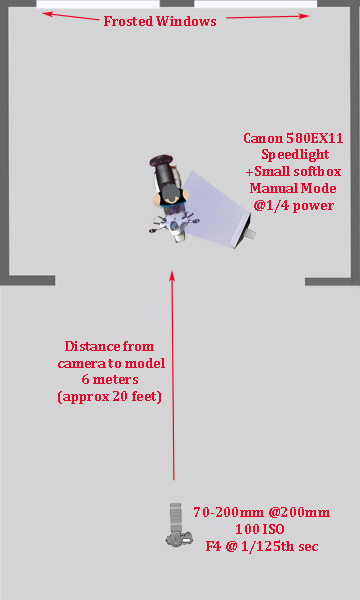
FF Diagram

Here’s a bird’s eye view of my setup

My speedlight was positioned approximately one meter (three feet) from the model. I set it at a 45 degree angle because I wanted to make my model look like he was lit from the side.

I was working with a 70-200mm zoom lens set at a focal length of 200mm because I wanted to blur all the details in the background and work within a narrow focal range.

My camera was approximately six meters (twenty feet) from my model.

My ISO was set at 100 at f/4. I was working at f/4 rather than wide open at f/2.8 because I find it very difficult to make the eyes look sharp at f/2.8, at that distance, and in that extreme lighting condition.

Setting up the Gear
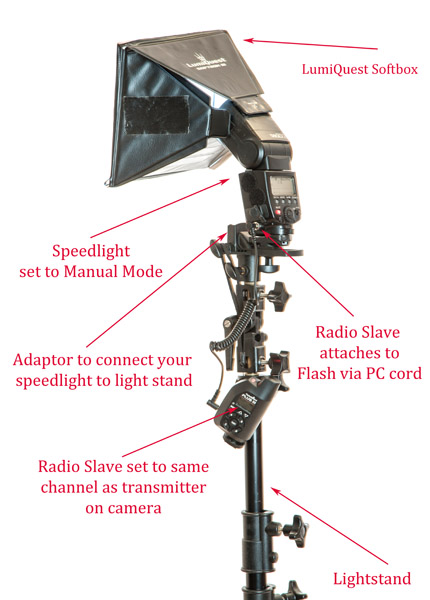
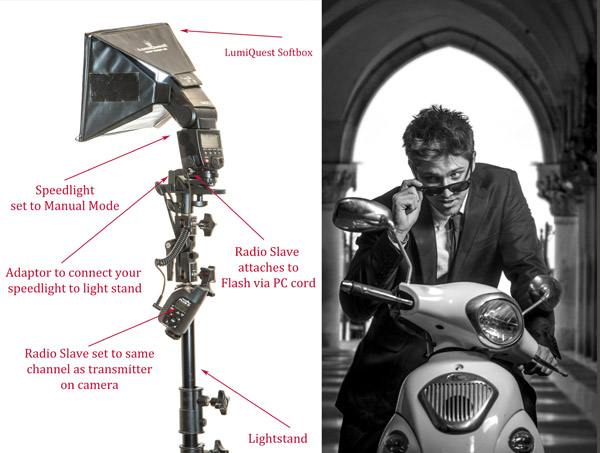
580EX+Lumiquest+stand 1

Setting up speedlights and radio slaves

For this motorbike model shoot, I mounted my speedlight to a light stand via an adaptor and used a small LumiQuest Softbox to soften and shape my light.
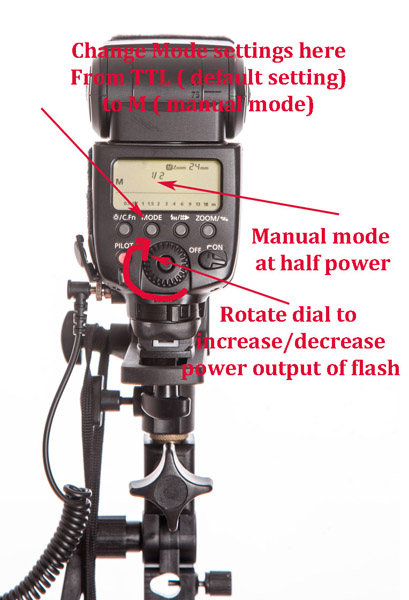
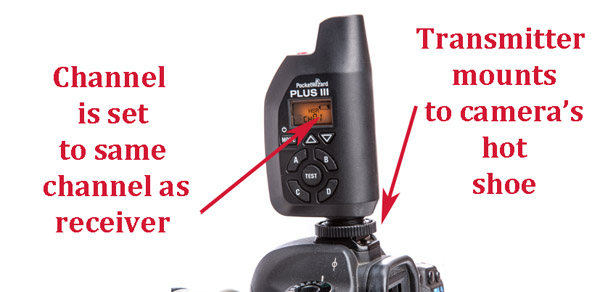
580EX+Power

PocketWizard+camera 1

To manually adjust the flash output of your speedlight, first switch the setting from its default of TTL to M (manual mode). As a general guide, I start with the following settings:

  • Full sun: 1/1 (full)
  • I would use a power setting of 1/1 (full) if you are shooting in full sun and need f/16 or higher.
  • If you are shooting wide open at f/2.8 or f/4, start at around 1/16th-1/32 power.

The above diagram is based on Canon’s 580EX II. For any other camera, check your manual for instructions on how to increase and decrease power. It should be very similar.
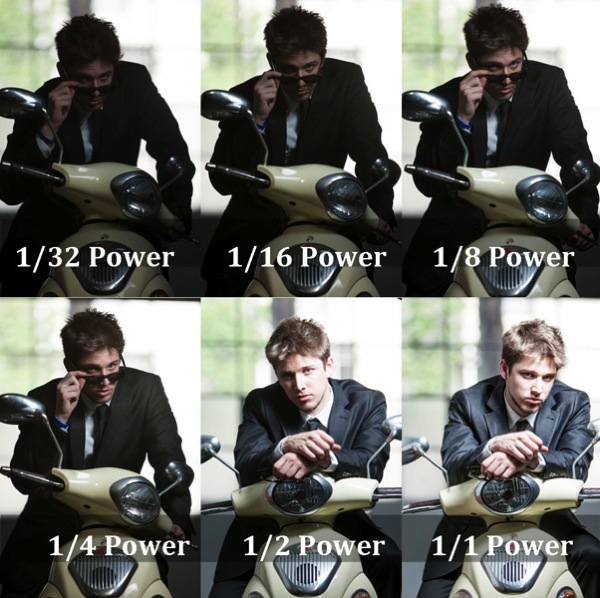
Fill Flash  001

  • Flash at 1/32 power is underexposed, skin tone looks muddy and there’s no detail in the blacks.
  • Flash set at 1/16th power is starting to look better.
  • Flash set at 1/8th power is looking good, but I prefer a slightly brighter skin tone.
  • Flash set at ¼ power is the correct reading for the look I was going for.
  • Flash set at ½ power gives a slightly overexposed skin tone, which is perfect for most portraits as it is a very flattering light (no model will ever tell you they love seeing all the detail in their pores and skin tone).
  • Flash set at full power is overexposed—there’s very little detail in the skin tone and the blacks are too light (gray).

A Step-by-Step Guide to How I Lit This Shot:

Daylight 001

Caption: My ambient reading was 4 at 1/125th second.

  1. Take an ambient reading to determine correct exposure for the background. In this case, my ambient reading was f/4 at 1/125th and ISO 100. This exposure will now remain fixed. I will next add light to create a nice skin tone.
  2. I ask myself if adding flash will improve or detract from the shot. In this case, the answer is a definite yes, it will improve my shot.
  3. I bring in my flash and set it up as per the diagrams above.
  4. The quickest and easiest way to figure out the best settings is to use a light meter (If you don’t have a light meter, you can still work with off-camera flash. It will just take a bit longer to work out your exposure). I believe the light meter is an essential tool in good portrait photography and would never leave home without one. When you use a light meter you know you have most accurate readings, and lighting becomes really easy.
    I suggest you set up your lights per the diagram, start at a power setting of 1/32, and gradually increase your power in small increments (1/32, 1/16, 1/8, ¼, etc.) until you get the desired results.
  5. Set your light meter to non-sync and press the button on the side of the meter. The non-sync button will flash on and off indicating it’s ready. If you don’t have an assistant, I suggest taking a radio slave off-camera and using it to test fire your flash so you can take a reading. Hold the meter in front of your subject’s face and point the sensor dome towards the camera.
  6. Keep increasing or decreasing the amount of light until you have it a half stop, to one stop over the ambient setting.
  7. If you want a clean, beauty-style shot with lots of shadow detail, add +1 stop of fill-flash and shoot at your ambient meter settings.

This is something I strongly urge you to practice with as many patient friends, family, and pets as possible so you can build up your confidence and really get to know your equipment.

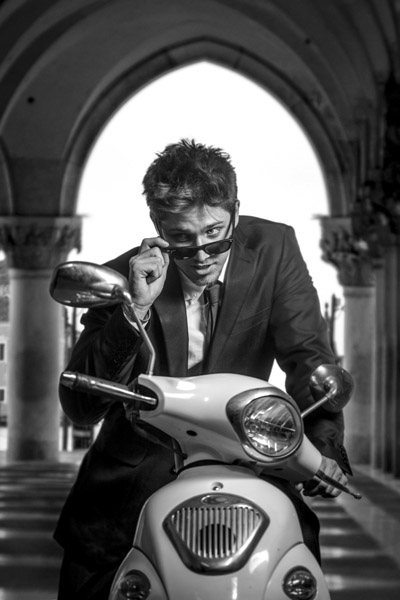
Here’s the final image, the new background is from a shoot I did in St Marks Square, Venice last year. I merged the two images together using Photoshop.
FF FINAL BW

Glauco Junior Solleri, Vespa courtesy Glow Studios

What are your experiences of working with off-camera flash? I’m keen to hear about the flashes, modifiers and flash triggers you rate highly and anything you’d like to add to the discussion.

googletag.cmd.push(function() {
tablet_slots.push( googletag.defineSlot( “/1005424/_dPSv4_tab-all-article-bottom_(300×250)”, [300, 250], “pb-ad-78623” ).addService( googletag.pubads() ) ); } );

googletag.cmd.push(function() {
mobile_slots.push( googletag.defineSlot( “/1005424/_dPSv4_mob-all-article-bottom_(300×250)”, [300, 250], “pb-ad-78158” ).addService( googletag.pubads() ) ); } );

The post A Beginner’s Guide to Working With Flash Off-Camera by Gina Milicia appeared first on Digital Photography School.


Digital Photography School

 
Comments Off on A Beginner’s Guide to Working With Flash Off-Camera

Posted in Photography


How to Use Triangles to Improve Your Portraits Composition

23 Jan

Do you ever look at a picture and absolutely love it, but you don’t know why? There are a lot of elements that can go into a great shot, but the hardest thing to see/ easiest thing to pick up on are triangles, which are leading lines that frame your subject, drawing your eye deeper into their inner lives. The Continue Reading

The post How to Use Triangles to Improve Your Portraits Composition appeared first on Photodoto.


Photodoto

 
Comments Off on How to Use Triangles to Improve Your Portraits Composition

Posted in Photography


Die Dörfer der Yi

23 Jan

Ein Kind mit einer Decke über dem Kopf steht in einem Feld.

Hart arbeitende Menschen auf ihren Feldern, traditionell gekleidete Kinder, eine karge Landschaft, Alltagsmomente in den Bergen Chinas – Methadone Guo dokumentiert Szenen des einfachen Lebens in den kleinen Dörfern des Yi-Volkes.

Der chinesische Fotograf, der Malerei studiert hat und eigentlich Video-Künstler ist, kommt oft im Winter in die Hochgebirge der südwestlichen Provinz Sichuan. 48 Stunden reist er dafür von Beijing aus mit dem Zug, um dann zu Fuß den Rest der Strecke zu den kleinen Dörfern zu wandern.

Die Yi kleiden sich einfach, aber doch individuell und alle singen und tanzen gern. In jeder Region haben sie unterschiedliche Kleidung und Bräuche. Die Männer tragen Filz, die Frauen Faltenrocke. Durchschnittlich leben sie in 2000 Metern Höhe, die Lebensbedingungen sind dementsprechend sehr hart. Dennoch sind die Yi ein lebensfrohes Volk, fleißig, herzlich und gastfreundlich.

Über 3000 Jahre ist die Kultur der Yi alt, sie haben eine eigene Sprache, Schrift und sogar eine eigene Zeitrechnung. Sie sind eine der vielen Minderheiten Chinas und obwohl sie knapp acht Millionen Menschen zählen, schenkt ihnen die Volksrepublik kaum Beachtung und ebenso wenig Förderung. Die meisten Dörfer sind nicht ans Stromnetz angeschlossen, Menschen und Tiere leben zusammen unter einem Dach und immer noch sterben hier Kinder aufgrund mangelnder Hygiene.

Chinesisches Kind schaut in den Himmel.

Eine chinesische Yi-Familie sitzt vor ihrer Hütte.

ein Bauer trägt ein riesiges Paket Reisig auf dem Rücken.

Zwei kleine Mädchen, eines schneidet eine Grimasse.

Ein chinesischer Bauer hütet Schweine.

Drei Generationen von Männern stehen zusammen.

Ein kleiner Junge lacht, hinter ihm steht ein Hund.

Eine einsame Person auf einem nebeligen Acker.

Zwei Fotos chinesischer Menschen.

Eine einfache Feuerstelle umringt von einer Familie.

Ein einsames Kind steht auf einem schlammigen Dorfplatz.

Menschen des Yi-Volkes sitzen zusammen.

Ein chinesischer Mann hüllt sich in einen Decke.

Ein Huhn im Vordergrund, im Hintergrund laufen zwei Menschen.

Mit seiner Mamiya RB67 hält Methadone Guo alle Eindrücke auf Schwarzweißfilmen fest, die er auf seinen Reisen einsammeln konnte. Die Einfachheit der Menschen, das Leben in den kargen Höhen, in denen meist nur Kartoffen und Hirse wachsen – Guo dokumentiert, ohne dabei werten zu wollen. Er betont, seine Bilder seien unpolitisch und haben keinen erhobenen Zeigefinger.

Ich fotografiere einfach nur all die Dinge, die ich sehe. Politik mag ich nicht.

Dennoch schwingen neben all der Tristesse auch Stolz und Zusammenhalt in seinen Bildern mit. Das Leben in mehreren Generationen und lachende Kindergesichter – es fühlt sich nach ehrlicher und authentischer Dokumentation an. Dennoch besteht dieser harte Kontrast zu unserer Überflussgesellschaft. Ich kann Guos Bilder nur immer und immer wieder ansehen und sie doch nicht ganz begreifen.


kwerfeldein – Fotografie Magazin | Fotocommunity

 
Comments Off on Die Dörfer der Yi

Posted in Equipment


Tips for Better Composition of Seascape Photographs

23 Jan

I do not believe that in photography there are absolute rules of composition, but it is undeniable that certain compositions work better than others.

Why? Probably because our brain is the result of millions of years of evolution, and as in two dots and a line we recognize a face (you don’t believe me? Have a look here.), in the same way we recognize some images as more pleasant to look at than others.

So let’s look at a few tricks to keep in mind during your next visit to the seaside.

Start following rules

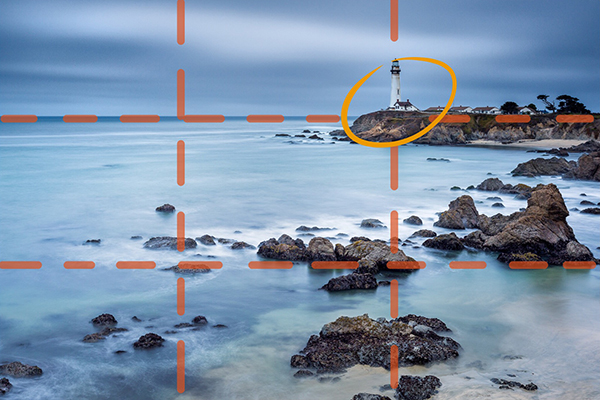
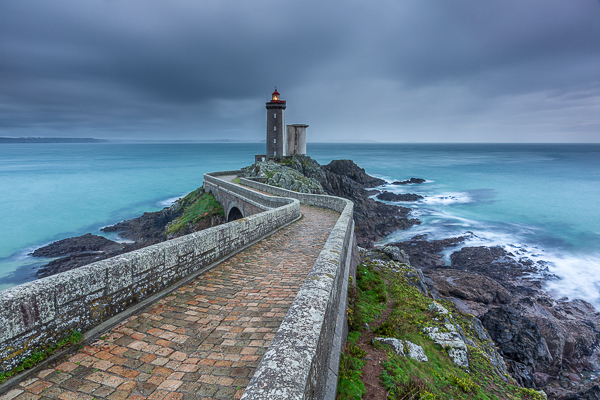
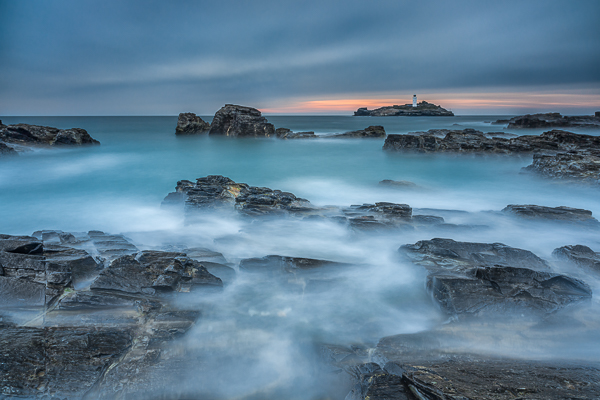
Before trying to break rules, try to follow them. Start with the Rule of Thirds: divide your image into nine equal parts by two equally spaced horizontal lines and two equally spaced vertical lines. Then place important compositional elements along these lines or their intersections. The result will be that your photo becomes more balanced. In a seascape shot, for example try to put a Lighthouse on one of the vertical lines and the horizon on one of the horizontal ones.

1 post

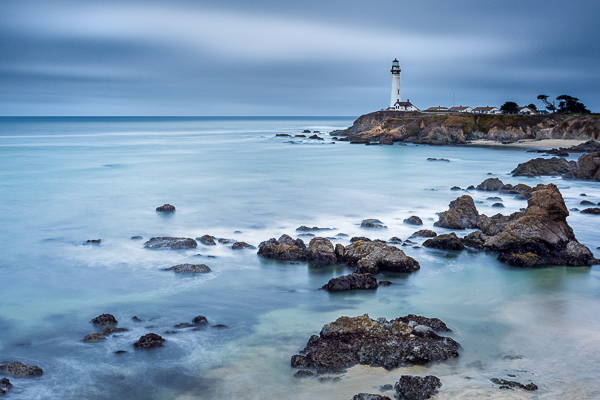
Important elements (the lighthouse and the horizon) are positioned along the lines and at the intersections

1 ante

Choose the leading actor

If you follow the Rule of Thirds, you’ll never again put the horizon in the middle of your image, and that’s a great thing unless you have a perfect symmetrical reflection.

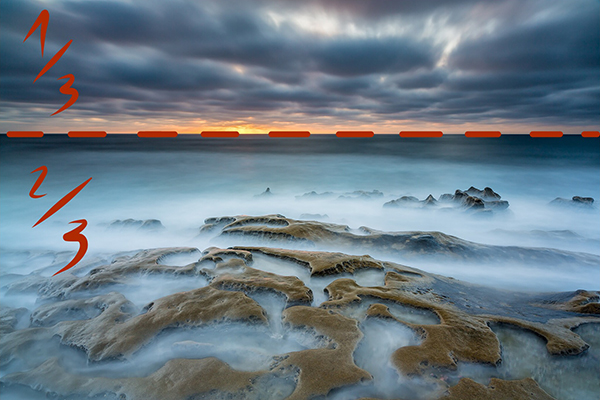
Decide next if the leading actor of your seascape is the sky or the sea, and place the horizon line accordingly. For example if the leading actor is the sea, the image portion under the horizon line will be 2/3 of the whole image.

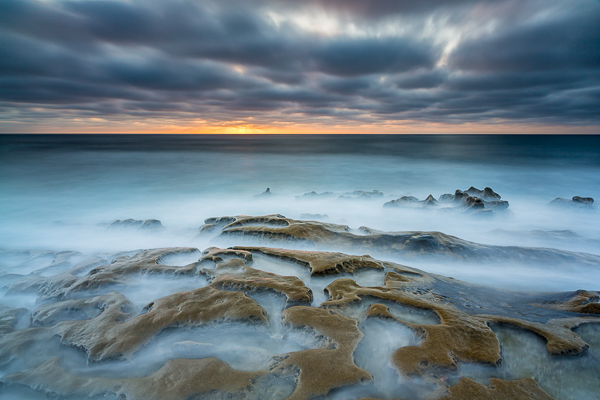
2 post

The rock formation in the foreground is really interesting with this tide. I wanted to emphasize it and so I give ? o the image to the sea in this the image.

2 ante

Check the horizon

There is nothing more annoying than seeing a crooked horizon. Use the built-in level of your camera, or for few cents buy an external hot shoe level (the yellow one with an air bubble inside). Why? Because every time you fix the horizon in post-production you will lose a portion of the image. Finally, remember that if you publish an image with a crooked horizon, the horizon will be the leading actor of your image.

Choose your focal length wisely

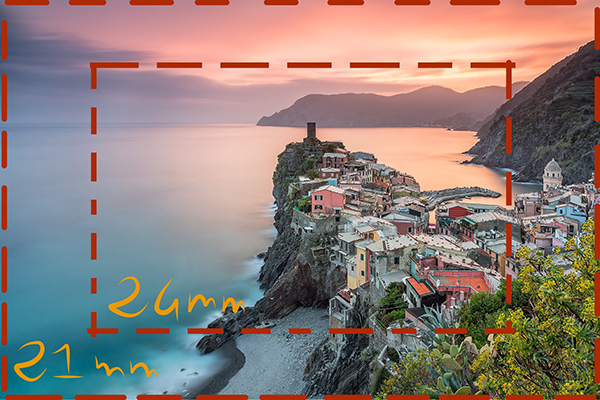
Sometimes you might believe that a certain focal length is perfect for the scene you have in front of your eyes. Think wider! If you’re using a 24mm lens, try with an 18mm or a 21mm lens – don’t be lazy. Remember that in post-production you can always crop your 21mm image to a 24mm image, but you’ll never be able to do the opposite.

3 post

A 21mm lens was perfect here as it let me put inside the frame the spring flowered plant on the bottom right.

3 ante

Use leading lines

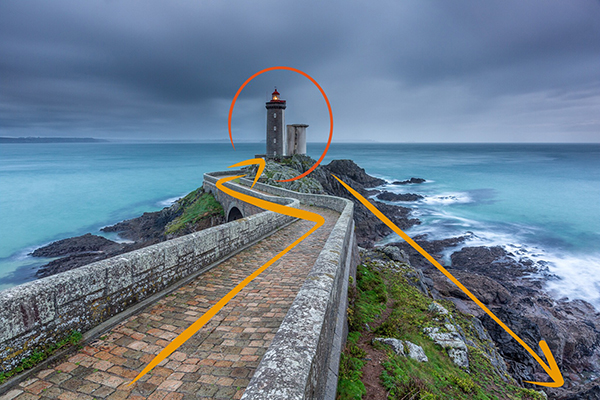
An image is like a book, and to really enjoy it you should be able to read it from the begin to the end. To do that, try to use lines and curves to guide the eyes through a path. You can use a road or the natural line of the coast for example. Keep in mind that you should avoid interrupting that path because it’s like skipping a line in a book; you lose the sense of the story that you’re telling. Also try to avoid lines that guide the eyes of the reader outside the image. You want attention given to what is inside the image, not to what is outside.

4 post

I used the road to drive the eye of the viewer from the margin of the image to the main character.

4 ante

Avoid straight objects in the margin

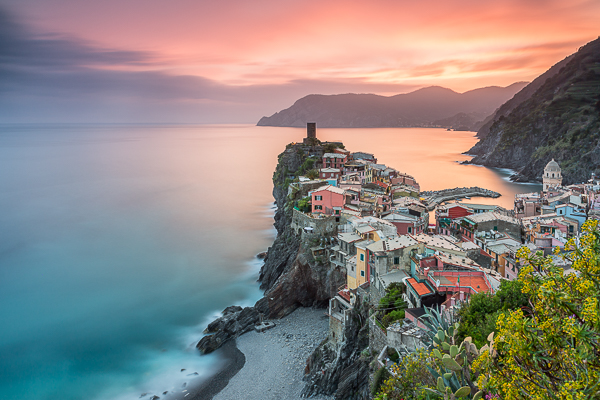
One common problem of wide angle lenses is the perspective distortion when the camera is not aligned perpendicularly to the subject. In other words buildings like lighthouses appear to be falling if you (correctly) place one according to the rule of thirds. Well, the bad news is that there is no an universal solution. The best one is obviously to buy a lens with excellent optical quality, but they are very expensive and in any case the perfect lens does not exist. So we need to correct the distortion in post-production. There are a thousand ways to do that, but most of them require an image crop. For that reason, if you have a straight object in your frame, don’t put it exactly on a vertical line of the Rule of Thirds, but slightly closer to the image center. In that way, after correcting the distortion, your lighthouse will be nearer the vertical line of the third.

5 post

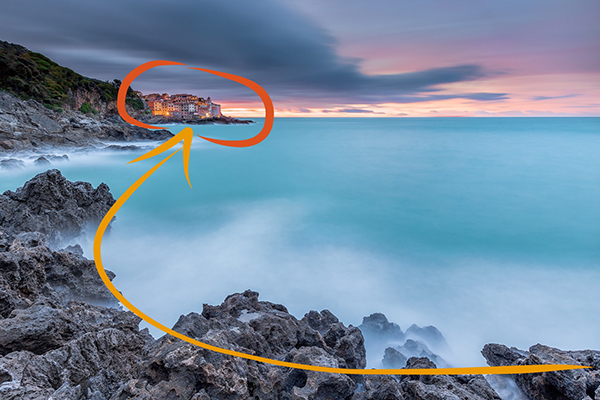
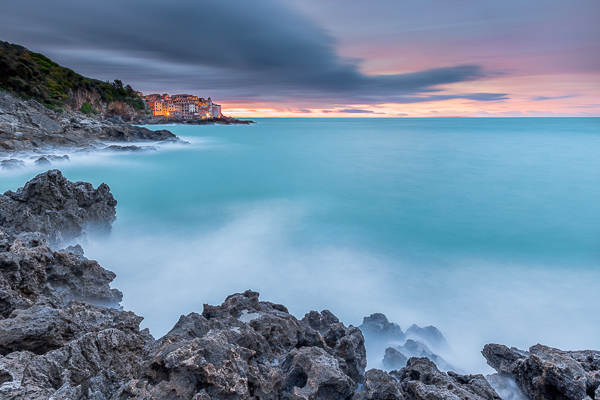
If I had put the small village too close to the frame edge, it would be affected by perspective distortion and to correct it in post production probably I would have lost the nice leading line with a crop.

5 ante

Add dimension and scale

When I started taking seascape pictures, I was a purist: no humans or human artifacts were allowed inside my frame. If humans are still not allowed to join, sometimes I think it’s a good idea to put some artifacts in my composition. The main reason is that even if you exactly the dimensions of the rock formations in front of you, viewers of your image may have no idea if they have never visited that place. When you look at a image, your brain tries immediately to define the dimensions comparing the unknown to something known – help it and use something like a lighthouse, bridge, church to give an idea of scale. A reef is even more beautiful if it is perceived as high and massive.

6 New
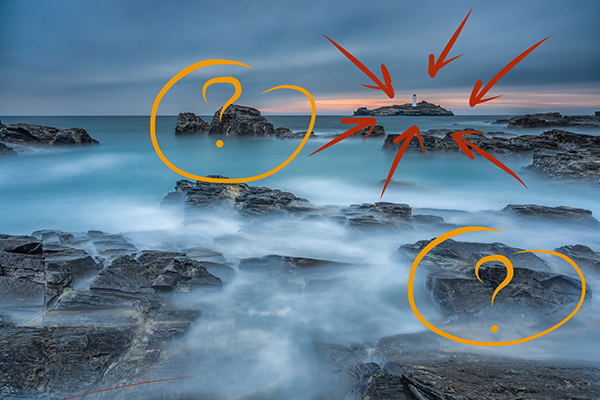
The lighthouse give a dimension to the other rocks in the image (try to cover the lighthouse with your finger.)

6 ante

Use negative space

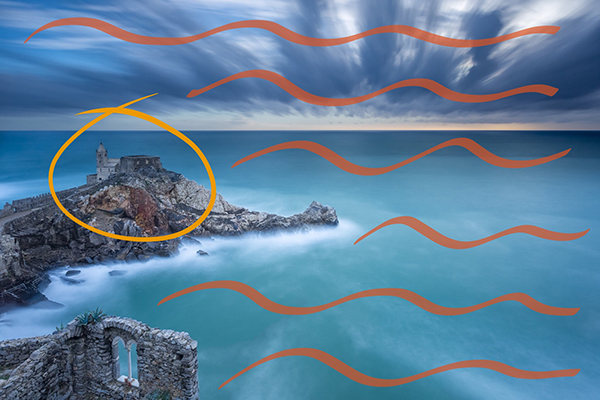
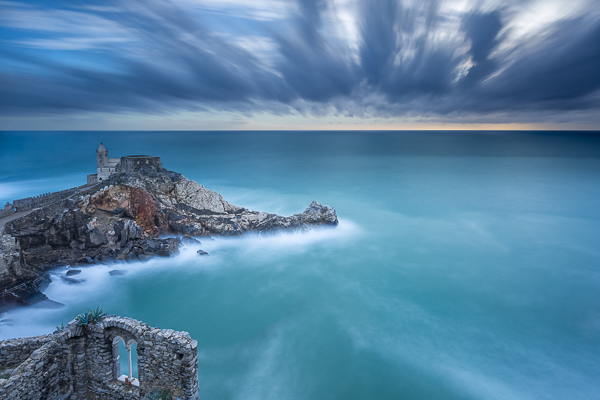
I’m a big fan of using negative space. But what exactly is that? Easy – it is nothing but the space around, and between, the subject of an image. Yes, basically they are “the” nothing. So, how can that be useful? Negative space is perfect to emphasize the subject. A lonely church on the top of a cliff is even more brave if it seems that it challenges the vastness of the sea.

7 post

This old church reminded me a solitary sentinel who scrutinizes the sea.

7 ante

Have fun

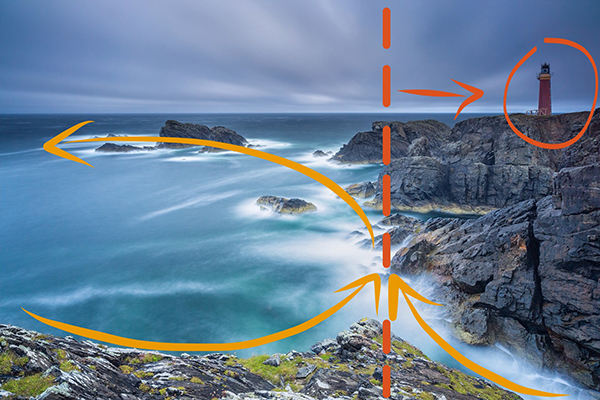
Finally, remember that every rule is made to be broken. If the horizon is not perfectly in one third because the sky lacks of clouds, put it above the upper horizontal line of rule of thirds. If you need to put a lighthouse near the margin of the frame to use leading lines, just do it.

The real goal of a picture is not to follow the rules, but to arouse emotions in the viewer. Keep this in mind and there is no composition that can overcome you.

8 post

The lighthouse is on the right vertical line of rule of thirds. Unfortunately I didn’t have a wider lens with me and I had to put it there in order to use leading lines in the foreground and not to cut the nice wave trails in the upper left side of the image.

8 ante

googletag.cmd.push(function() {
tablet_slots.push( googletag.defineSlot( “/1005424/_dPSv4_tab-all-article-bottom_(300×250)”, [300, 250], “pb-ad-78623” ).addService( googletag.pubads() ) ); } );

googletag.cmd.push(function() {
mobile_slots.push( googletag.defineSlot( “/1005424/_dPSv4_mob-all-article-bottom_(300×250)”, [300, 250], “pb-ad-78158” ).addService( googletag.pubads() ) ); } );

The post Tips for Better Composition of Seascape Photographs by Francesco Gola appeared first on Digital Photography School.


Digital Photography School

 
Comments Off on Tips for Better Composition of Seascape Photographs

Posted in Photography


2014 Readers’ Polls: The results are in!

23 Jan

Late last year we asked you to vote for your favorite products of the 2014 in four categories: best lens, best high-end compact camera, best enthusiast ILC and best high-end ILC. Voting ran through January 20th and the results are in! Click through to see the results of our 2014 readers’ polls, and for a chance to vote on the overall winner, which we’ll announce next month. 
Articles: Digital Photography Review (dpreview.com)

 
Comments Off on 2014 Readers’ Polls: The results are in!

Posted in Uncategorized


Lost & Found: Underwater Ghost Town Resurfaces 30 Years Later

23 Jan

[ By WebUrbanist in Abandoned Places & Architecture. ]

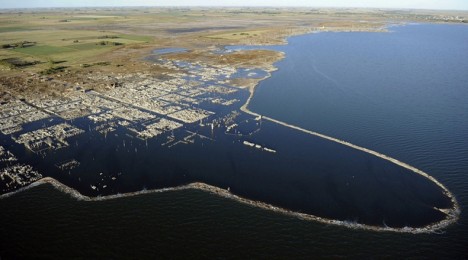
abandoned village from above

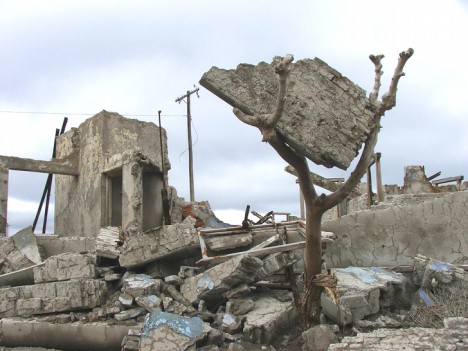
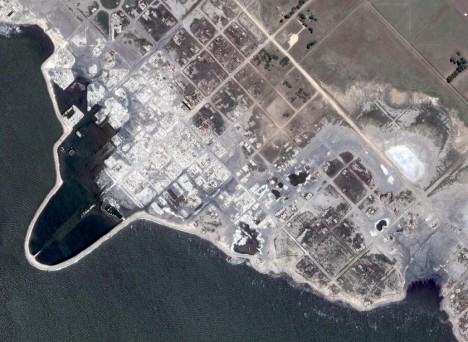
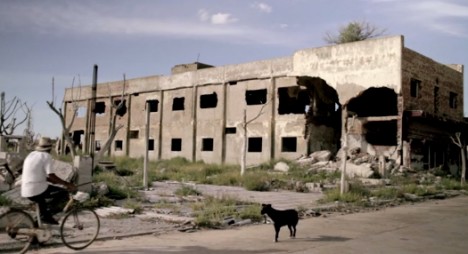
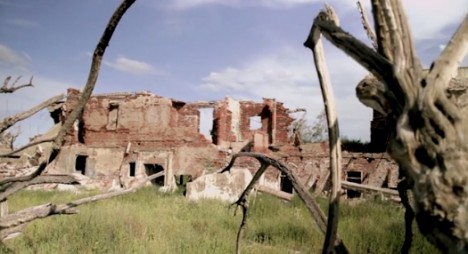
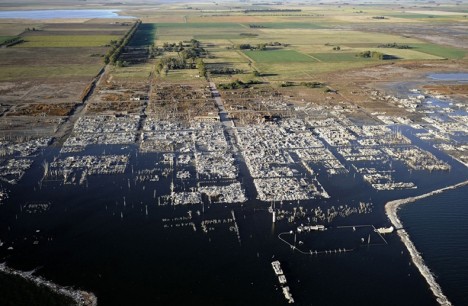
Like a corroded time capsule, this submerged village has risen from the depths after being flooded decades ago when the local lake broke its banks and left Epecuen under dozens of feet of water. In 1985, a rare weather pattern broke a nearby dam first, then the dike protecting the town, quickly making most of it uninhabitable. Today, long-term changes in the regional climate have brought down the overall level of the lake, resurfacing the town.

sunken village resurfaced underwater

Giving a tour of his devastated hometown, the man in the award-winning video above , Pablo Novak, claims his father predicted the return of water to the areas of land on which people were building back in the 1980s – at its peak, the place drew in over 25,000 tourists a year. Today, Pablo is the only remaining resident, slowly exploring the remnants now revealed as waters around the lake have lowered.

villa epecun from above

underwater village before after

Located near Buenos Aires, it is hard to imagine that this place – with a permanent population of 5,000  at one point – was once a busy destination from tourists around the country and even the world, renowned for its high-salinity lake in which people came to bathe. This salt content is largely responsible for the high levels of damage done to the town’s buildings and infrastructure during its years underwater.

underwater deserted abandoned buildings

underwater village ruins

slaughterhouse abandoned town

First, the fields began to flood, driving our narrator’s cows, horses, pigs sheep and goats back further onto land and forcing Pablo to buy a family home in a neighboring village. Now 85 years old, he always assumed the town would be rebuilt, but that has never come to pass.

sunken town ruins

sunken village washed roots

abandoned underwater town resufraced

Since the waters have receded, Pablo now tries to appreciate the solitude left in its wake and gives tours to those who come these days not to soak but to see the once-sunken village now risen once again to the surface. Images by Sam Verhaert, Jonathan Evans and Pablo Gonzales via Inhabitat.

Share on Facebook


[ By WebUrbanist in Abandoned Places & Architecture. ]

[ WebUrbanist | Archives | Galleries | Privacy | TOS ]


WebUrbanist

 
Comments Off on Lost & Found: Underwater Ghost Town Resurfaces 30 Years Later

Posted in Creativity