RSS
 

Archive for January, 2015

Olympus Stylus 1 firmware update adds wide angle converter compatibility and interval shooting

16 Jan

Olympus has released v2.0 firmware for its OM-D styled premium compact camera, the Stylus 1, which will enable users to fit a wide angle converter to the lens. The update also introduces useful features like focus peaking, 35mm equiv. step zoom, interval shooting and time lapse modes. Read more

Articles: Digital Photography Review (dpreview.com)

 
Comments Off on Olympus Stylus 1 firmware update adds wide angle converter compatibility and interval shooting

Posted in Uncategorized


Die Kraft des Meeres und die Stille des Waldes

16 Jan

Tosende Wellen unter stürmischem Himmel

Ein Beitrag von: David Baker

In den vergangenen drei Jahren habe ich zwei Projekte entwickelt: „Sea Fever“ und „Ridge Trees“.
Das erste konzentriert sich auf die Kraft und Gewalt des Meeres. Menschen fühlten sich schon immer zur See hingezogen, was möglicherweise an der Kraft liegt, die sie ausstrahlt und an ihrem hypnotischen Klang.

Tosende Meereswellen unter heiterem Himmel

Das Projekt streift diese Kraft und ist meine Interpretation der engen Verbundenheit zwischen Himmel und Meer. Im März 2012 hielt ich mich auf den Äußeren Hebriden im Nordwesten Schottlands auf. Während meiner vorherigen Reise dorthin, im Februar 2008, hatte ich überwiegend Aufnahmen in Langzeitbelichtung erstellt.

Doch während meines zweiten Aufenthalts machte ich keine einzige. Da ich zum Ende hin deshalb etwas unruhig wurde, begann ich einige Aufnahmen, um die Kraft der See in einer Art einzufangen, wie ich es nie zuvor getan hatte.

Tosende Meereswellen unter dramatischem Himmel

Das erste Bild, Hebridean Sea III, lud ich Ende April 2012 auf meinen Fotoblog hoch und das war es dann auch vorerst. Das Projekt entwickelte sich bis in den August hinein nicht weiter, bis ich dann ein zweites Bild bearbeitete.

Noch hatte ich nicht bemerkt, dass ich da ein potenzielles Projekt am Wickel hatte. Doch von März 2013 an begann ich, mit weiteren Aufnahmen zu experimentieren, um „Hebridean Sea III“ eine würdige Ergänzung zu geben.

Tosende Meereswellen unter bewölktem Himmel

Ich experimentiere vor Ort immer mit einer Reihe von Verschlusszeiten und Brennweiten und verwende Filter, wobei ich versuchte, auf die Beziehungen zwischen Wellen und Wolken zu achten, die sich ergaben. Ich legte es darauf an, immer mindestens eine Linie in den Vordergrund oder eine zentrale Welle in das gesamte Bild zu bekommen.

Ich versuche mich der Sache mit einem malerischen Ansatz zu nähern, wenn man so will, denn ich möchte, dass die Bilder transportieren, wie es sich anfühlt, bei stürmischem Wind, mit dem Salz in der Luft, in der Gischt und dem dumpfen Schlagen der Wellen am Ufer zu stehen und einen Sinn von der eigenen Verletzlichkeit zu bekommen.

Tosende Meereswellen unter heiterem Himmel

Tosende Seewellen

Die meisten Belichtungen sind nur zwischen 0,3 und 0,6 Sekunden lang, da längere Zeiten dazu tendieren, der See die Struktur und Bewegung zu nehmen. Ich betrachte das Meer kaum vor dem Hintergrund einer statischen Momentaufnahme und für diese Serie war mir wichtig, den ständigen Strom und die Gewalt des Meeres wiederzugeben.

Tosende Wellen treffen auf eine steinerne Küste

Ich hatte Glück und durfte im Juli 2013 an der Ausstellung „Masters of Vision“ teilnehmen. Dort traf ich am ersten Wochenende David Breen von Triplekite Publishing und Dav Thomas. Ich kannte bereits einige von Davids fotografischen Arbeiten und natürlich auch Davs Buch „With Trees“*, das kurz zuvor bei Triplekite erschienen war.

Eine tosende Welle trifft auf den Strand.

Anfang August schlug mir David dann vor, ein Buch zu veröffentlichen, das auf auf mein „Sea Fever“-Projekt aufbauen sollte und das er zuvor in der „Masters of Vision“-Ausstellung gesehen hatte. Welch ein großartiger Tag! Das Buch „Sea Fever“* kam schließlich im Dezember 2013 heraus.

Ein Pferd steht neben einem Baum auf einer nebligen Wiese.

Mein zweites Projekt „Ridge Trees“ konzentriert sich auf den New Forest Nationalpark in der Grafschaft Hampshire. Es wird durch drei Dinge charakterisiert: Dämmerung, Nebel und die Besonderheit des Ortes. Der New Forest Nationalpark ist das ganze Jahr über und besonders bei Tageslicht ein bei Touristen überaus beliebter Ort.

Zartes Morgenlicht stößt durch den Morgennebel in einem Kiefernwald.

Ich möchte zeigen, wie der Wald bei Dämmerung aussieht, im Herbst, im Winter und bei Nebel. Damit hoffe ich, andere Fotografen zu motivieren, ihren eigenen Zugang zum Wald zu finden. Der New Forest wirkt bei Nebel besonders dann wie verwandelt, wenn man auf eine Schonung wunderbar gerader Kiefern blickt, die frei von hohem Dickicht und Unterholz ist.

Neblige Schonung in einem Kiefernwald.

Der Nebel zeichnet das Licht so weich, so dass es gut ist, zuerst einmal nur über mögliche Perspektiven nachzudenken, denn gelegentlich fällt noch Schnee und der Wald verwandelt sich erneut.

Bis Mai 2013 konnte man fast alle meine Werke bis auf einige Ausstellungsdrucke nur digital anschauen. Ich war mit einem Freund auf Fototour und er machte mich darauf aufmerksam, dass ich meine gesamte Bildverarbeitung in Eigenregie durchführte, nicht aber den Druck. Er hatte recht, das ließ ich bis dahin immer andere machen.

Von Raureif bedecktes Unterholz an einer Birkenwaldschonung.

Warum versuchte ich das mit dem Drucken nicht auch einmal selbst? Infolge dieser Überlegungen erwarb ich einen Epson 3880*, kaufte mir etwas Cotton Rag Paper (Fotospeed SC300 und NST Bright White 315g/m²) und begann, meine Kunstdrucke selbst herzustellen.

Die Herstellung von Kunstdrucken bedarf eines langen Lernprozesses, aber es gefällt mir sehr. Ein DIN-A2-Druck auf Cotton Rag Paper von 315 g/m² Gewicht hat eine wunderbar taktile Qualität.

Herbstliche Sonnenstrahlen dringen durch die Wipfel eines Nadelwalds auf einen Weg durch das Unterholz.

Immer wenn ich gefragt werde, wie man ein gutes Fotoprojekt entwickelt, sage ich immer: Glaube an den Wert Deiner Bilder und Dein Talent. Experimentiere und habe Spaß dabei. Wenn Du über ein Projekt nachdenkst, vergewissere Dich, dass es einen persönlichen Bezug zu Dir hat und suche Dir ein Thema, das Dir ermöglicht, die Bilder aufzunehmen, die Du haben willst.

Schlammiger Waldpfad

Und denke nicht zuletzt auch daran, was Du dazu zu erzählen hast und wie die Arbeit einmal präsentiert werden könnte – sei es im eigenen Blog, in einer Ausstellung oder gar in Form eines Buches.

* Das ist ein Affiliate-Link zu Amazon. Wenn Ihr darüber etwas bestellt, erhält kwerfeldein eine kleine Provision, Ihr bezahlt aber keinen Cent mehr.

Dieser Gastartikel wurde von Robert Herrmann für Euch aus dem Englischen ins Deutsche übersetzt.


kwerfeldein – Fotografie Magazin | Fotocommunity

 
Comments Off on Die Kraft des Meeres und die Stille des Waldes

Posted in Equipment


Celestial Cityscapes: Photographing Dubai from Above the Fog

16 Jan

[ By WebUrbanist in Art & Photography & Video. ]

dubai skyscrapers above fog

Home to the tallest building in the world, Dubai is a city rich in skyscrapers that seem almost otherworldly when seen piercing through seasonal layers of urban fog.

dubai city aerial view

dubai sunrise cloud city

Photographer Daniel Cheong resides in this surreal desert city and has taken to capturing images of it from above, particularly during times when the weather is transitioning from warm to cool and producing the effects seen in these shots.

dubai cryogenic marina

dubai dawn cloud city

In some cases the viewer can see glimpses of the streets, buildings and marina below, but in others the entire built landscape appears perched on a layer of clouds.

dubai fluidity urban photo

dubai landing planet

While his photographs do represent reality, they also employ digital blending techniques that combine multiple exposures to make them seem almost more real than reality (but without the stretched effects sometimes seen in overly-processed HDR).

dubai fog blues

In doing so, he emphasizes “this slight element of the surreal, or hyper-reality often found in painting.” A world traveler, Cheong was “born in Mauritius, originally of Chinese descent, and French by nationality.” Of his picture-taking prowess, he writes: “I’ve always loved photography, but only became serious about it when I bought my first DSLR in Singapore, back in 2006.”

dubai cryogenic sunrise

“I then aimed to perfect the technique of Digital Blending, which consists of manually blending multiple bracketed exposures in order to obtain the maximum dynamic range, while trying to keep a very natural look and avoiding the common mistake of many ‘overcooked’ HDR images. This slight element of the surreal, or hyper reality often found in painting is what I am trying to achieve”

Share on Facebook


[ By WebUrbanist in Art & Photography & Video. ]

[ WebUrbanist | Archives | Galleries | Privacy | TOS ]


WebUrbanist

 
Comments Off on Celestial Cityscapes: Photographing Dubai from Above the Fog

Posted in Creativity


Non-Stop Rail: 2 Future Trains Pick Up Passengers in Motion

16 Jan

[ By WebUrbanist in Conceptual & Futuristic & Technology. ]

bullet train moving alongside

Saving time, energy and bridging the gap between high-speed rail and local-only service, these proposed solutions (each in their own unique way) let people board and disembark at their leisure while the main train speeds along. In on case, passengers wait inside an ancillary car that hooks into a passing bullet train – in the other, they step seamlessly across a dock when changing between slower and faster trains.

gif rail

First, the overhead-car approach (illustrated above) from China, a country that has long been on the cutting-edge of record-fast rail travel, pioneering magnetic levitation trains and incredibly fast cross-country routes with few stops in between. One simply steps into the upper cabin and then walks down into the main train once the two sync up.  A second approach, proposed by PriestmanGoode and shown below, involves synchronizing two trains alongside one another then allowing each to dock with the other in transit.

transfer train passenger idea

Aside from being more energy-efficient, a lot of other standard frustrations of train travel are rendered obsolete by one or both approaches, like queuing up, pushing and shoving for quick entrances and exits at the right stop (an issue you will know is serious if you have ever ridden Chinese trains or subways). In the case of Moving Platforms from PG, train transfers in general could be made faster and smoother without requiring stops along the way.

parallel docking bullet train

At this stage, the concepts look promising but some technical questions still need to be resolved, including whether using wheels makes the most sense (in the Chinese variant) and the speed reduction required on the part of the passing train to make the two meet smoothly (in either case). Both, however, address a huge pain point in transportation as well as energy efficiency: slowing, stopping and waiting for and between public transit rides. Eventually, one could imagine an omni-directional maglev system taking people directly from buildings to their trains without needing to stop or transfer along the way.

Share on Facebook


[ By WebUrbanist in Conceptual & Futuristic & Technology. ]

[ WebUrbanist | Archives | Galleries | Privacy | TOS ]


WebUrbanist

 
Comments Off on Non-Stop Rail: 2 Future Trains Pick Up Passengers in Motion

Posted in Creativity


15. Januar 2015

16 Jan

Das Bild des Tages von: Karin Daninger

Ein Mann steht vor einer Landschaft und genießt den Ausblick.

Fotolinks des Tages

1. Äthiopien im Portrait

Man muss die bunten und teilweise romantisierenden Fotos des Magnum-Fotografen Steve McCurry nicht mögen. Doch eines ist ihm zugutezuhalten: Er hat einen unvergleichbaren Eifer, die Menschen ferner Länder zu portraitieren. Heute veröffentlichte McCurry eine Bildstrecke über die Farben des Landes Äthiopien. Und wenn McCurry eines kann, dann ist es der Umgang mit fotografischen Farben. Besonders schade finden wir jedoch, dass sich McCurry nicht die Mühe gemacht hat, außer ein paar Zitaten auch etwas über die Einzigartigkeit des Landes zu schreiben. → ansehen

2. Das Märchen von den erleuchteten Pilzen

Nein, die Makro-Fotografie ist nicht tot. Selten, aber nicht zu übersehen gibt es Lichtpunkte am Ende des Tunnels eines Genres, das kleine Dinge groß macht. Ein Beispiel dafür ist Martin Pfister aus Bayern. Dieser überspringt locker die üblichen Maxime der Makrofotografie und erzeugt mit LED-Lichtern eine fabelhafte Stimmung, die seinen Nahaufnahmen von Pilzen beinahe märchenhaften Charakter verleiht. → ansehen

+ Martin Pfister ist nicht sonderlich aktiv im Netz, aber auf 500px hat er ein Profil mit aktuellen Fotos.

3. Augen auf, Ihr Künste!

Fotografisch keine Meisterleistung, aber die Idee ist genial: Ein neuer Tumblr mit dem Namen „What They See“ beschäftigt sich mit der Frage, was Kunstwerke sehen würden, wären sie dazu in der Lage. Was man daraus lernen kann? Manchmal reicht ein schlichtes Konzept aus, um eine in ihrer Wirkung verblüffende Serie zu gestalten. → ansehen


kwerfeldein – Fotografie Magazin | Fotocommunity

 
Comments Off on 15. Januar 2015

Posted in Equipment


Fujifilm releases XQ2 premium compact

16 Jan

Fujifilm has announced the XQ2 premium compact camera which is the same as the XQ1, save for the addition of the Classic Chrome film simulation mode. As with its predecessor, the XQ2 features a 12 megapixel 2/3″ X-Trans CMOS sensor, 25-100mm equiv. F1.8-4.9 lens, 1080/60p video, and built-in Wi-Fi. The XQ2 also has a customizable control ring around the lens for quickly adjusting your favorite settings. Read more.

Articles: Digital Photography Review (dpreview.com)

 
Comments Off on Fujifilm releases XQ2 premium compact

Posted in Uncategorized


Telling a Story in a Single Image – Tips from a Photojournalist

16 Jan

Photography is visual communication medium. You can follow and use some rules, through composition and technique – but photojournalism takes it a step farther and states facts and gives information that is true and real. You need to follow two basic pillars to be an ethical photojournalist. Those principles are: you do not manipulate your scene, and the information you are photographing must be real.

The best recipe you can use for getting a good photo that tells a story is by combining good composition, action, and emotions. If you are able to engage with your subject mixing those three elements you will be able to get a good photograph.

As photojournalist you can display facts and affairs but you will level up your work if you are able to evolve those facts in something emotional and touching. Then is when you photo stars to tell a story.

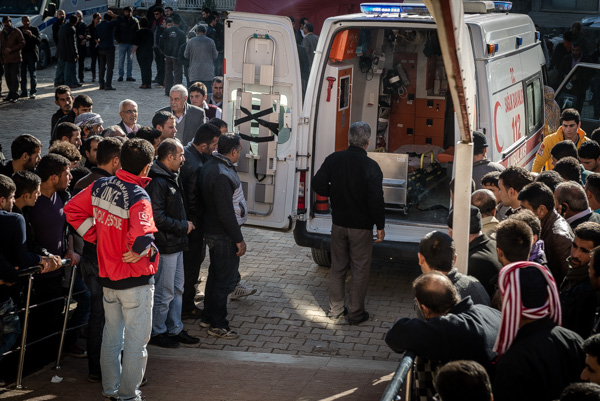
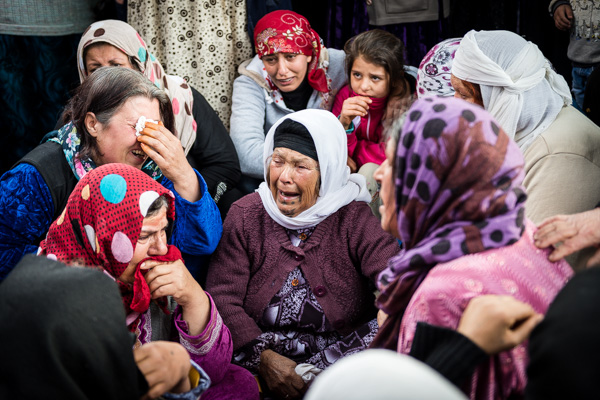
FPC2841

Suruç hospital receives Kurdish fighters from Syria.

FPC1936

Kurdish women cry for the wounded, treated in Suruç hospital.

Both photos describe real facts, something that is going on. In the first one you see some action, and some mood in the people waiting for the wounded fighters. But in the second one, the emotion is stronger and you see the action coming out from the other women crying around them.

“If you want emotions in your photos you need people around”

Include people in your frame. Look for the faces, not for the backs, but understand that body language in human beings is another way of communication so a full body can also express emotions.

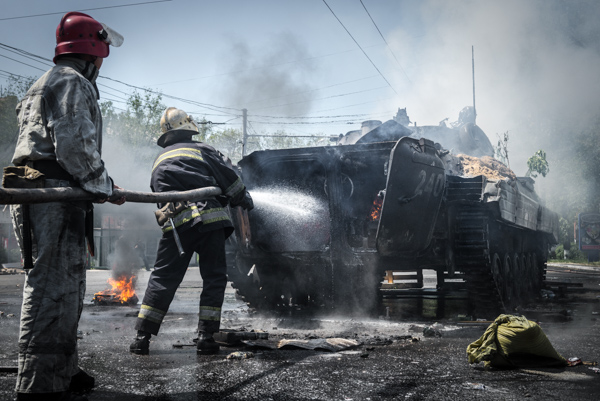
FPC3700

Ukrainian army enters the eastern city of Mariupol leaving civilians casualties as result of the attack.

Firefighters are in action, the fire inside the personal armoured carrier is action too and the whole scene makes the tension of a probable incoming explosion. You need to make the action evident, so you need to get close. The action needs a bigger space in your frame. For that, use your feet – they are your best zoom. You could step back ant shoot the armoured vehicle on fire from the distance, but the main characters of the photo will be lost and the man handling the water and the fire in the foreground is pure action.

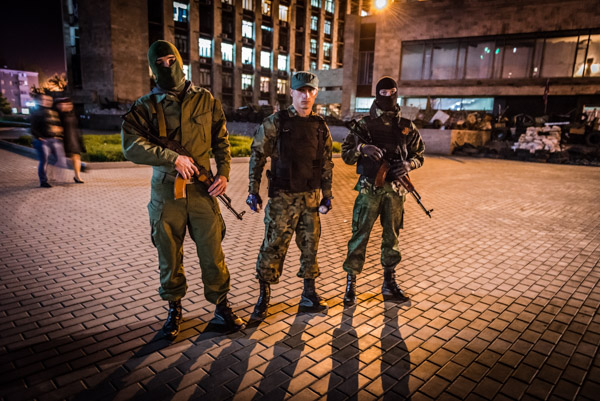
You can get a story going on in your photos too, if you are able to engage with your subject. A close portrait with the right attitude is it always good. In these photos you can see a little bit of action in the background but not much. However, you can replace that making a strong engagement with your subject. You can feel in these photos they are arrogant, they are proud of what they are, they stand up not ashamed, and look forward and straight into the camera and their body languages speaks for itself.

FPC4340

Pro-Russian sniper guards a checkpoint in Slaviansk, eastern Ukraine.

FPC3371

Pro-Russian militias patrol the main administrative building in Donetsk, eastern Ukraine.

When you look for a story in your photos try different angles, do not be afraid of watching things from a different perspective. Get low, as a photographer you need to change your point of view. When photographing kids and animals you always need to get to their level, at the same level you make them to stand up and you give them the major role in frame.

FPC3564

Pro-Russian militia Vostock Battalion celebrates the independency of the Donetsk People’s Republic.

As you can see in these examples the action and emotions are the key. There is no better way to find those emotions than looking forward and getting close to the principal characters of the events.

A good indicator of whether your photography is good is if you do not need to explain anything. A photograph telling a story does not need to be explained. If you want to make the story more complicated you will need to put more elements in harmony in your frame, it is more complicated but is a challenging experience.

How do you tell stories with your images? What can you learn from these tips that you can use in your own photography, even if you do not do true photojournalism?

googletag.cmd.push(function() {
tablet_slots.push( googletag.defineSlot( “/1005424/_dPSv4_tab-all-article-bottom_(300×250)”, [300, 250], “pb-ad-78623” ).addService( googletag.pubads() ) ); } );

googletag.cmd.push(function() {
mobile_slots.push( googletag.defineSlot( “/1005424/_dPSv4_mob-all-article-bottom_(300×250)”, [300, 250], “pb-ad-78158” ).addService( googletag.pubads() ) ); } );

The post Telling a Story in a Single Image – Tips from a Photojournalist by Felipe Passolas appeared first on Digital Photography School.


Digital Photography School

 
Comments Off on Telling a Story in a Single Image – Tips from a Photojournalist

Posted in Photography


Nikon USA addresses disappearance of D750 from retailers

16 Jan

Nikon USA has released a statement regarding the sudden disappearance of its D750 DSLR from US retailers. Just last week the company offered to repair D750’s that have flare issues caused by the position of their AF sensors. The statement reads ‘Nikon is working with retailers to replenish stock with cameras to which measures to address this issue have been applied. In late January, Nikon will announce details to service cameras from users, free of charge’.

Articles: Digital Photography Review (dpreview.com)

 
Comments Off on Nikon USA addresses disappearance of D750 from retailers

Posted in Uncategorized


Budget X: Hands-on with Fujifilm’s new X-A2

16 Jan

Fujifilm has announced the X-A2, a new version of its X-A1 budget X-series mirrorless interchangeable lens camera, which incorporates mostly minor changes compared to its predecessor. Like the X-A1, the X-A2 uses a conventional Bayer-pattern CMOS sensor and offers virtually identical ergonomics but now comes with an LCD screen which tilts upwards to 175-degrees for selfies. Other improvements include the addition of Fujifilm’s new ‘Classic Chrome’ film simulation mode. Click through for some images

Articles: Digital Photography Review (dpreview.com)

 
Comments Off on Budget X: Hands-on with Fujifilm’s new X-A2

Posted in Uncategorized


Beginnings Of A Model With Sarah DeAnna

15 Jan


Hi FashionPhotograhyBlog.com readers, 

Today, we have top fashion model, speaker & author of the book “Supermodel YOU“, Sarah DeAnna, joining us on FPBlog. Sarah shares her story of how she first started out in the modeling industry and the reasons why she is glad that she started her career late after finishing school. Let’s get started shall we? Here is our interview with Sarah DeAnna…

 Sarah DeAnna Interview with FashionPhotographyBlog.com


FPBlog: Hi, I’m here with top fashion model, Sarah DeAnna and we’re going to talk about modeling and working with photographers. Sarah is somebody that has worked in the industry for a while, has risen to the top but started out testing. How old were you when you started modeling?


Sarah DeAnna: I didn’t start until I was 19 actually, I went to  school. I started later, but I’m so grateful that I did… I don’t know what would have happened if I was younger and more susceptible to those opinions on me. I mean I still was, of course, but it helped being more mature I guess. Having more experience and an education helped me a lot with being healthy and with not taking things to heart. 


FPBlog: With a stronger self esteem and not being part of the bigger scandals?


Sarah DeAnna: Yeah, (all of that), so it’s great that Vogue did an issue of mine where they won’t use younger models or unhealthy models. I definitely think that’s why I’ve been successful… I think it’s because of starting later.


FPBlog: And did you start in LA? Or did you start in the small market?


Sarah DeAnna: I started in LA, I went there to go to UCLA. I was going to get my business degree actually and I was so glad that I started modeling because I love it. Modeling is not my passion but I do love modeling but I would have never went to business school nowadays, so I’m really glad. If I would go back I probably would have studied something like bio-chemistry or something nerdy, something tech. 


FPBlog: Right. So how was it when you started? You didn’t have any pictures and you started testing?


Sarah DeAnna: Actually, I was found by a photographer at Starbucks. I was approached before but I never really trusted anyone. And there was a photographer at Starbucks, and I was with a guy (at the time), a guy friend of mine, and he (the photographer) keep looking at me and stopping me, and then he came and talked to the guy (my friend). He was like “I have to shoot her” and “I just love her face”.


He was talking to the guy (friend) to make me feel comfortable. He wasn’t trying to hit on me, or something like that, he was totally legit. He sent me right away to a commercial agent; I wasn’t even doing anything in that industry at all. The first agent was like, “oh my God, we’d love to rep you”, and then the next day we ended up shooting. He did everything; he styled the whole thing, did my makeup, he shot it.


He paid for everything, I didn’t have to pay for anything. Then he tricked me, he said “let’s go”, he wanted to show me the proofs because he loved it (the shoot). He was showing me what I looked like and I didn’t know anything, like there were all these (contact) sheets with all these pictures and then he’s like, “oh let’s go pick up the negatives” and he tricked me. We went into an agency, Photogenics, my mother agent, and they signed me right away. The first official shoot that I did, after that, was for Photogenics, for the agency and that became a Cover Girl magazine.


It was just a promo for the agency and that became a cover of this magazine called Picture Magazine, and then, it ran in Zink Magazine as well, then I went to New York, and then to Milan and Paris, but yeah, I didn’t know anything (at the start). I was so insecure still so I just learned.


FPBlog: How do you think you learned? Just by experience and being in front of the camera a lot?


Sarah DeAnna: Definitely experience, but I’m telling you that this first photographer, he was so good. That was my first time and he told me like how to be with your eyes and gave me this thing in my head to think about. So I always channeled that because that was all I knew (at the time). He liked it strong and fierce and so I think that’s why I’m known to be the strong and edgy girl as opposed to the happy, smiley, beachy girl – I’m working on that one.


FPBlog: It’s funny because in person you have that California girl, beachy appearance, but whenever I thought about you, it’s always edgy and crazy hair and fierce looks.


Did you find this interview with Sarah DeAnna interesting? Leave your comments below in the comment section. We would like to know what you thought about the post. If you enjoyed this post, stay tuned as Sarah DeAnna has more insights to share on FashionPhotograhyBlog.com – If you are interested in grabbing a copy of Sarah’s book, “Supermodel YOU” you can find it here.


IMAGE SOURCE: 

Feature image & image 1: courtesy of Melissa Rodwell


Fashion Photography Blog

 
Comments Off on Beginnings Of A Model With Sarah DeAnna

Posted in Uncategorized