Ein Beitrag von: Sebastian

[ By WebUrbanist in Architecture & Cities & Urbanism. ]

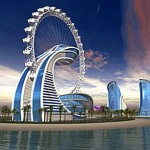
Always pushing the limits of posh possibility, this latest endeavor aims to put an entire urban center in a temperature-controlled bubble of indoor spaces, centered around a vast Mall of the World.

Everything one can imagine will be found inside the complex, including 100 apartment and hotel buildings, various medical services, a huge shopping mall and the world’s largest indoor amusement park.

Its designers have unabashedly drawn from sources of inspiration around the world, including culturally central parts of New York, London and other historic metropolises.

Like some surreal voluntary version of Stephen King’s Under the Dome, the whole thing can be experienced without stepping outside, particularly in hot summer months.

In cooler winter months, some pedestrian street roofs and park domes will be retracted to allow for natural air circulation.


The goal, as expressed by Sheik Mohammed bin Rashid al-Maktoum (and envisioned by Dubai Holding), is to create a beacon for year-round tourism both from local visitors and those coming from abroad, transforming the UAE from a seasonal vacation spot to a place people can come at any time.


Its architects also claim the system will be eco-friendly, in part because the active and passive systems integrated throughout will work in concert with one another. Whether such a vast system in the desert can be green in the end (or willed be added to the growing list of failed abandonments in Dubai) remains to be seen .
Lavish wealth and a willing-to-do-anything attitude has brought fame to Dubai. With these awesome projects in the works, Dubai’s fame is well-deserved.
Click Here to Read More »»

A stunning new underwater hotel is planned for Dubai, complete with glass-walled guest rooms that give guests unparalleled views of marine life from their beds.
Click Here to Read More »»

Night never comes to this massive complex newly constructed in China. Complete with its own artificial sun (as well as beaches and waves), the world’s …
Click Here to Read More »»


[ By WebUrbanist in Architecture & Cities & Urbanism. ]
[ WebUrbanist | Archives | Galleries | Privacy | TOS ]
Software maker DxO Labs has announced the release of DxO Optics Pro 9.5.1 for Mac, which includes support for five additional cameras. Now supported by DxO Optics Pro (Elite Edition only) are the Sony A7S, as well as (both Standard and Elite Editions) Sony Cyber-shot DSC-RX100 III and SLT-A77 II, the Nikon 1 J4, and the Samsung NX30. Read more
Photographing from the hip is, quite literally, having your camera near or resting on your hip and pressing the shutter button. This photography method is typically used in street photography when the photographer wants to take candid, incognito photos. But, sometimes, trying this as a deliberate photography method is just as fun. It forces you to change your perspective, your vision and your creative eye. You start to look at the scene as a bigger picture rather than as a tunnel vision through your viewfinder. Plus, if your family is anything like mine, where they turn away and run the opposite direction when you bring out the camera, this technique is a great way to get candid pictures of difficult, and uncooperative subjects.
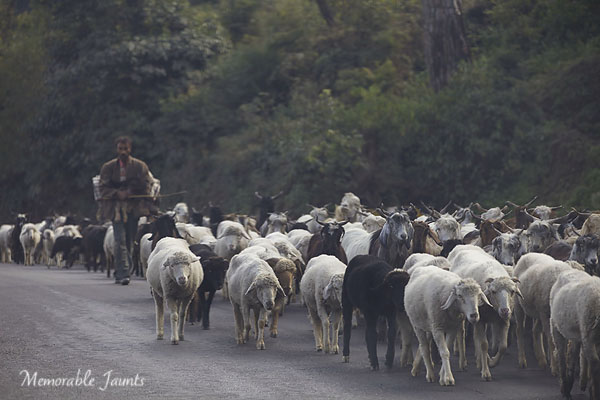
When you put your eye to the viewfinder, often times you lose focus of all the other elements and entities beyond your line of vision. Photographing from the hip gives you, the artist, freedom to shift your perspective and opens up opportunities for alternative compositions for your images. Use it for personal projects or client sessions where you view the scene in front of you quite differently than what you actually capture in your camera. Travel photography is another great place to use this method of photography for an alternative perspective.
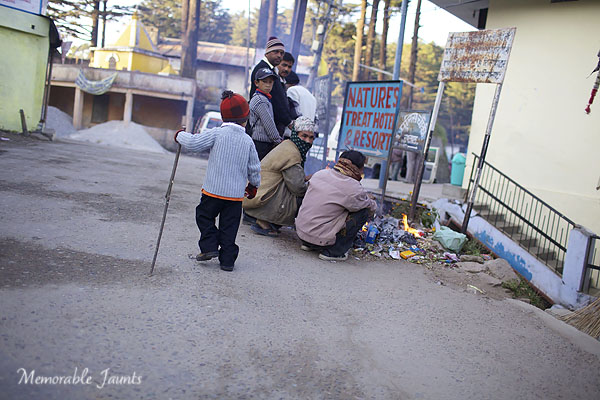
There are some tips and tricks you may want to consider to get the best images from this angle of doing photography from the hip.
Since you cannot really change your settings based on what you see through the viewfinder, it is best to preset your exposure ahead of time. If you are a 100% manual shooter, this might be the one time you give yourself the luxury to go into full auto mode of your camera. Additionally, use evaluative metering instead of spot metering to assist with the exposure for this type of photography. In terms of aperture, the general rule of thumb is to have a smaller aperture for photographing from the hip (anywhere from f/8 to f/16). This improves the likelihood that more of the elements will be in focus especially if your subjects are moving. Having a larger aperture is also okay if you want to go for a more artistic image.
Having a higher shutter speed gives you a better probability that your subject will be sharp especially if you are moving or clicking in continuous mode and don’t have the luxury of a steady hand. Try to stay at least 1/250th of a second, or higher. Do not pay too much attention to ISO in this genre of photography, just embrace the noise as part of the creative element of the image. If you had to choose, give more priority to shutter speed. Things like exposure and noise (grain) can always be adjusted in post-processing as long as you have a sharp image.
This is probably the one time where having a back button focus might be inconvenient. Try auto focus and then throw MF switch on the lens so that the focus point is locked. You can also use center focus point and just move your camera slightly as a way to recompose with the focus locked.
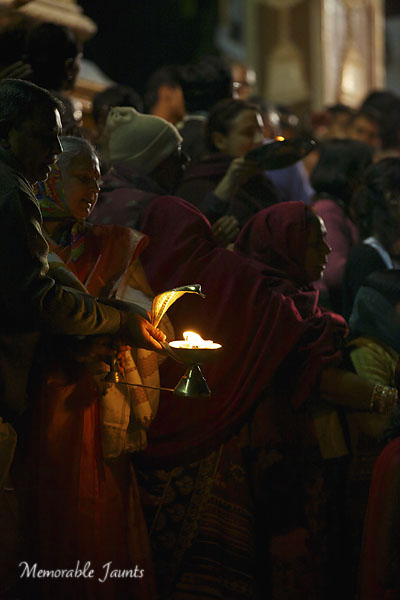
If you really want to go incognito, use the silent drive mode in your camera. Some of the newer DSLRs have this feature. It suppress the sound of the shutter being pressed and you can get some really candid images of the scene in front of you.
Prime lenses work better for this type of photography since you really don’t want to recompose with every movement of the scene in front of you. Just move your feet instead. You can also change the angle by holding the camera at a slight upward or downward angle depending on your relative height in relation to the scene in front of you.
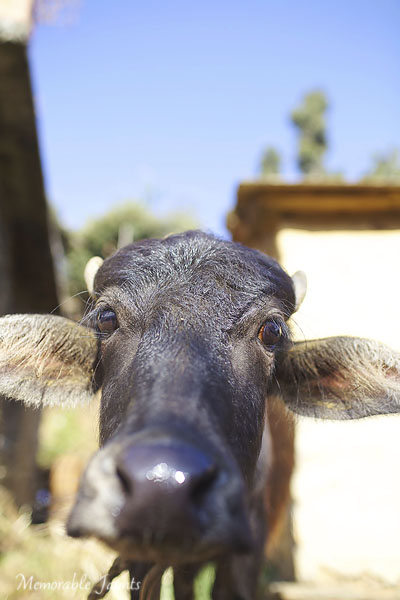
Remember to get creative with this type of photography. You may be tempted to bring the camera to your face every once in a while to make sure you are getting some “decent” shots. That’s okay, but resist the urge to chimp every time the shutter is clicked. Try doing this for five to ten minutes at first. Once you get comfortable, take this method out for a spin for longer periods of time. Make a mental note of your settings so that you can reevaluate and reassess what worked, and what did not work, at the end of your shooting exercise.
Remember to have fun and don’t get too hung up on the technicalities. In a worse case scenario, if you take enough shots, there is a chance you will have a few good images that are artistic and technically correct. If nothing else, it gives you the opportunity to view the scene through your eyes rather than your viewfinder. So get out, put the camera around your neck using your camera strap and get clicking.
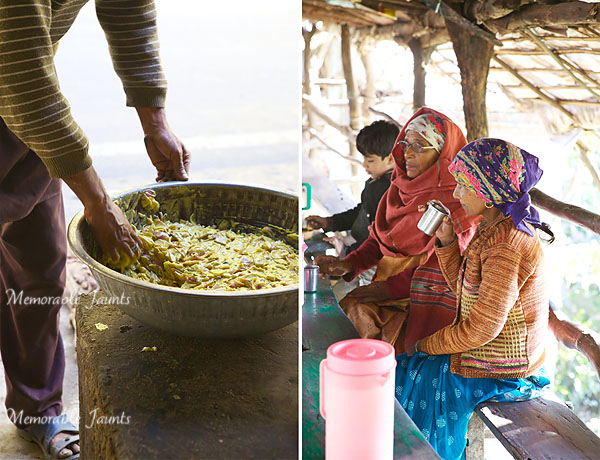
The post 5 Tips for Doing Photography from the Hip by Karthika Gupta appeared first on Digital Photography School.
DxO has released updates for its FilmPack film emulation and ViewPoint perspective correction software, enabling them to be fully integrated with Adobe Photoshop CC 2014. Both are available as standalone applications or as a plugin for Lightroom and Photoshop. FilmPack v4.5.2 and Viewpoint v2.1.7 are available for download now. Read more
The Cooperative of Photography received a lot of attention recently for a video featuring seven easy photographic hacks using household items. Now they’ve released a follow up video with seven more neat tips and tricks. It might just help you kick of a fun weekend photo project. Learn more
Die Kinderbilder des japanischen Fotografen Hideaki Hamada haben mich schon länger in ihren Bann gezogen. Er fängt die Momente mit seinen beiden Kindern Haru und Mina auf eine so wundervoll natürliche Weise ein, das ich unweigerlich ins Lächeln komme. Dazu nutzt er so wunderschön weiche Farben, was die Bilder jedoch nicht kitschig werden lässt.
Kinder handeln immer anders, als man es erwartet. Die Inspiration für meine Fotos kommt vor allem aus diesem Verhalten. Auch, wenn ich einige meiner Fotos anleite, entstehen die meisten doch sehr spontan aus dem Geschehen heraus, ganz so wie meine Kinder sind.
Wenn ich Fotos von meinen Kindern mache, ist das Wichtigste, eine objektive Perspektive zu behalten. Nicht zu nah, aber auch nicht zu weit weg, als würde ich ihnen von hinten zusehen. Etwas mehr als bloße Beobachtung, denke ich. Wenn ich diese Regel befolge, gibt es den Bildern eine universelle Qualität. Ich denke, dass diese Universalität nötig ist, um ihre Lebensart anderen mitzuteilen.


Hideaki Hamada wurde 1977 in Aawaji Island, Hyogo, in Japan geboren und lebt und arbeitet heute in Osaka. Nach einigen Ausstellungen in Asien und Europa veröffentlicht er sein Fotobuch im Oktober. Wenn Ihr mehr von Hideaki sehen möchtet, folgt doch seinem Instagram-Account oder besucht seine Webseite.
[ By Steph in Art & Street Art & Graffiti. ]
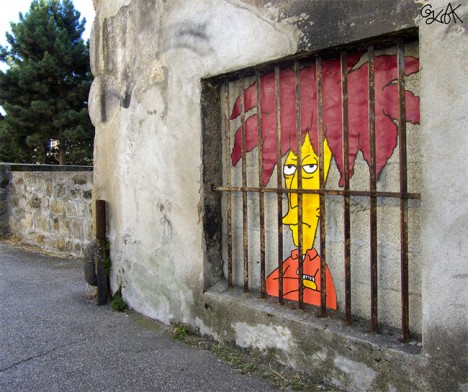
Anything from a crooked cinder block to an ephemeral beam of light falling across the street can inspire a playful interactive scene by French street artist OakOak, making passersby stop and smile. Whether by temporary paper cut-outs or more permanent graffiti, the artist transforms ordinary urban settings in fun and unexpected ways.
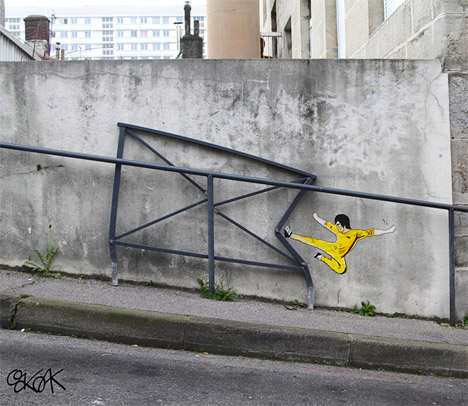
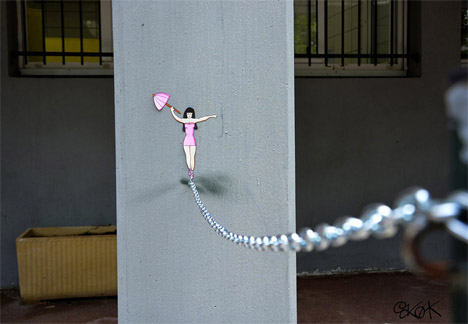
OakOak wanders the streets seeing creative possibilities in virtually every quirk and imperfection, turning what could be seen by others as urban blight into playful works of art that might only stick around for a day or so, but still manage to brighten people’s day.
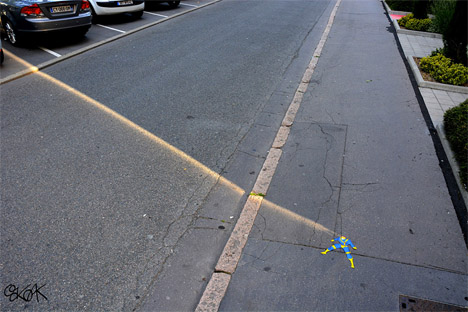
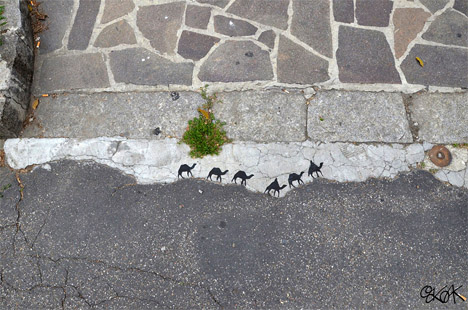
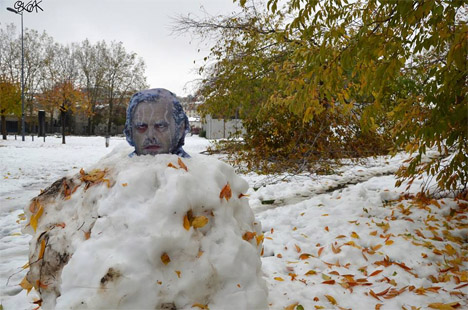
Little Bruce Lee figures bend metal poles or break through concrete and trapeze artists prepare to tightrope across chains. A stain on a wall might become a stream of genie-producing smoke emitted from a magic lamp, or a sewer grate could become a snail shell.
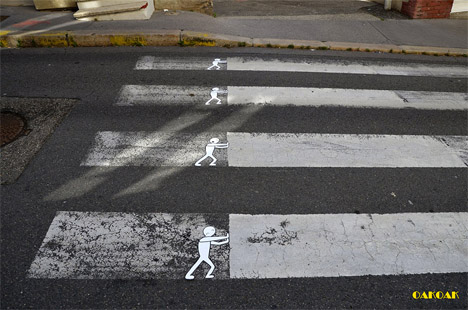
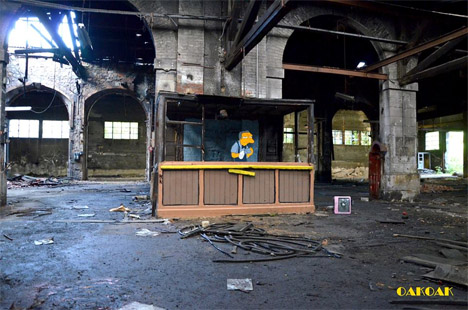
Says OakOak of his hometown of St. Etienne, “I like this city, her atmosphere, and I wanted it to look nicer. It was an industrial city with many coal mines; now it’s in regeneration and still quite poor. But it’s easily travelled by foot with awkward aspects ideal for art. I saw shapes everywhere, and wanted to realize them.”
Art installations that invite or even dare passersby to join in on a fun activity transform even the most stiff and boring urban environments into public …
Click Here to Read More »»
It’s impossible to give names to all of the lettering styles graffiti artists use. But there are a few well-known alphabets that are seen over and over.
Click Here to Read More »»
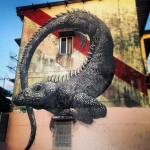
Street artist ROA brings bold black-and-white animals measuring three stories in height to the gritty streets of Panama City in a new series of work.
Click Here to Read More »»
[ By Steph in Art & Street Art & Graffiti. ]
[ WebUrbanist | Archives | Galleries | Privacy | TOS ]
Earlier today I shared a bunch of jaw-dropping images of beaches. As you may have guessed, this week’s photography challenge is one in the same.
Even if you aren’t near the ocean you can get out and find a body of water somewhere near you – perhaps a lake, pond, stream or even the reflecting pool at your local town hall. The idea is to get out and photograph the stuff near the water including:
You get the idea. Need some more examples?

By @Doug88888

By C/N N/G

By Pete

By Dan Queiroz

By Mike Pratt

By Peter Gorges

By John Turnbull

By kristos_b

By Moyan Brenn
Simply upload your shot into the comment field (look for the little camera icon in the Disqus comments section as pictured below) and they’ll get embedded for us all to see or if you’d prefer upload them to your favourite photo sharing site and leave the link to them. Okay, ready to impress us?
The post Weekly Photography Challenge Things at the Beach by Darlene Hildebrandt appeared first on Digital Photography School.
Adobe’s latest Lightroom update has made it possible for subscribers to continue accessing their images and edits, as well as some limited functions of Lightroom once a license for it has ended. Key functions, including the ability to use the Develop module, do go away once the subscription is out of date, but users retain the ability to view, organize and export images. Read more