RSS
 

Archive for June, 2014

Adobe teases new ‘Focus masks’ feature

12 Jun

creativecloud.jpg

Adobe has released a video sneak-peek of a new feature due to be introduced into Creative Cloud which the company is calling ‘Focus masks’. In the video, Zorana Gee, senior Photoshop product manager explains that with focus masks, Adobe is ‘adding a new way to make an automatic selection based [on] pixels that are in focus versus out of focus’. Click through to watch the video and learn more. 

News: Digital Photography Review (dpreview.com)

 
Comments Off on Adobe teases new ‘Focus masks’ feature

Posted in Uncategorized


How to Relax Your Photography Subjects

12 Jun

Do you ever pull out your camera and point it towards your friends, just for the thrill of watching them tense up? Or is that just this pseudo-sadistic guy? 🙂 There’s something about the dark depths of a camera lens pointing in your direction that can intimidate even the most seasoned, confident individuals. If you’re a photographer trying to capture their essence Continue Reading

The post How to Relax Your Photography Subjects appeared first on Photodoto.


Photodoto

 
Comments Off on How to Relax Your Photography Subjects

Posted in Photography


Dream Boats: 15 Insanely Luxurious Super-Yacht Designs

12 Jun

[ By Steph in Technology & Vehicles & Mods. ]

Fantasy Yachts Main

If you have a few hundred million in the bank (or just like to fantasize about it,) you’ll want to peruse this selection of superyachts decked out with retractible swimming pools, underwater karaoke suites, personal submarines and even supercars included as a ‘free gift.’ Or perhaps a massive yacht that doubles as a private artificial island complete with a water desalination system is more your speed.

ORSOS Island Yacht
Fantasy Yachts Orsos

If you’ve got $ 6.5 million to spare, you can have your very own floating artificial island that can be anchored anywhere in the world. The ORSOS is a superyacht with 1,000 square meters of living space, including room to sleep 12, an underwater karaoke suite, a jacuzzi, sun loungers, a dining room and an aquarium. While it has two small diesel engines for cruising short distances, it has to be towed for long journeys.

Superyacht that Comes with a Free Supercar
Fantasy Yachts Free Supercar

When you’re paying $ 25 million for a state-of-the-art superyacht powered by twin Rolls Royce engines, maybe it’s not so crazy to expect a free handcrafted supercar as a bonus. The Strand Craft 122 by Gray Design features an Art Deco interior, four double rooms, four large staterooms, a reception area and crew cabins and can go up to 50 knots, while the unnamed supercar achieves a top speed of 230 mph.

Submarine Yacht
Fantasy Yachts Undersea
Fantasy Yachts Undersea 2

The U-101 Undersea Yacht is a submarine for pleasure cruising, with two levels of sun decks and an enormous interior, not to mention both a single-person jet ski and a smaller submarine for underwater exploration.

Infinitas by Schöpfer Yachts
Fantasy Yachts Infinitas

With its carved-out stern, the Infinitas by luxury boat designer Schöpfer Yachts looks like a bird skull skimming along the surface of the sea. The design inspiration actually comes from the symbol for infinity, which can be seen in the two large ‘eye’ openings from above. The 300-foot yacht has a pool deck, on-board elevator, helipad and glass-floored ‘sky bridge.’

Adastra Trimaran Yacht
Fantasy Yachts Adastra
Fantasy Yachts Adastra 2

Designed for an experienced ocean voyaging billionaire couple and their family, the Adastra Yacht uses extraordinarily small amounts of fuel for a range of 4,000 miles. The three-hulled trimaran yacht reminiscent of a spaceship can be controlled remotely at the touch of an iPad and cost $ 15 million.

Next Page – Click Below to Read More:
Dream Boats 15 Insanely Luxurious Super Yacht Designs

Share on Facebook


[ By Steph in Technology & Vehicles & Mods. ]

[ WebUrbanist | Archives | Galleries | Privacy | TOS ]


WebUrbanist

 
Comments Off on Dream Boats: 15 Insanely Luxurious Super-Yacht Designs

Posted in Creativity


Alien Skin Software’s Exposure 6 now available

11 Jun

Exposure6-BoxShot-1024x1024.jpg

Alien Skin Software has launched an update to its popular photography effects software, Exposure. Announced in April, Exposure 6 has a new processing engine for instant image effect previews, a new user interface for a faster workflow and tools for ‘Bokeh.’ It’s available for download now at $ 149 for new users and as a $ 69 upgrade for existing users. Read more

News: Digital Photography Review (dpreview.com)

 
Comments Off on Alien Skin Software’s Exposure 6 now available

Posted in Uncategorized


11. Juni 2014

11 Jun

Ein Beitrag von: Christian Deppisch

Roter Milan vor sturmdunklem Himmel


kwerfeldein – Fotografie Magazin | Fotocommunity

 
Comments Off on 11. Juni 2014

Posted in Equipment


Ricoh WG-4 real-world samples gallery

11 Jun

ricoh_wg4.jpg

The Ricoh WG-4 offers a 16 megapixel sensor and a 25-100mm equivalent F2.0-4.9 lens. Identical to its WG-4 GPS sibling in almost every way except for the obvious (one has GPS and a front-facing display, one doesn’t) the WG-4 is waterproof to 14m/45 feet, freezeproof to -10° C/14° F and shockproof to 2m/6.6 feet. Take a look at our real-world samples. See gallery

News: Digital Photography Review (dpreview.com)

 
Comments Off on Ricoh WG-4 real-world samples gallery

Posted in Uncategorized


Lens Review Canon 300mm f4 Lens for Sports Photography

11 Jun

Recently I went to a Little League baseball game and shot with my Canon 5D Mark III and my newly purchased, 300mm f/4 L IS. It was the first time shooting sports with my new camera, so I was eager to see how the body would perform as well as the lens.

300mm lens sports 01

The 300mm is touted as one of Canon’s best sports lenses, so I was counting on it to deliver some quality images. The 5D Mark III, while not specifically a sports camera, is often considered a viable option by sports photographers because of its new autofocus system. I was eager to try it out, and see if I could handle shooting sports on a full-frame camera.

But this post is about the 300mm, not the 5D Mark III. So let’s get to the good stuff  – review Canon 300mm f4 lens.

300mm f/4L IS – weight and handling

When I first purchased the 300mm f/4L IS, I was surprised by how small and light it was. Bigger than my 70-200 f/4, yes – by a large margin. But it wasn’t a beast like I was expecting. If you’re familiar with the 70-200 f/2.8 IS, the 300mm is similar to that lens in size and weight. But it’s certainly not overwhelming, like the 300mm f/2.8. It’s actually comfortably hand-holdable.

300mm lens sports 02

I brought my monopod to the game, thinking I would use it with the 300mm, but I never needed it. I handheld the 300mm comfortably the whole game, and I’m not super strong. I was pleasantly surprised by how easy it was to handle the lens. It fits perfectly in my camera bag’s long-lens compartment, and I can carry it over my shoulder when I’m walking around. During the game, I ended up sitting on the ground (I explain why here), holding the camera and lens up to my eye, for most of the game.

runnerTip: If your arms get tired from holding your camera up so much, a monopod will be your best friend.

The feel of this lens is like all Canon L-series lenses – solid. It’s all metal construction, and feels substantial in your hand. It features a built-in lens hood that you can expand and twist to lock. The lens hood doesn’t come off – when you’re not using it, unscrew and slide it back onto the lens.

Summary: Pleasantly surprised by the 300mm’s relatively light weight and easy handling.

Reach

300mm turned out to be the perfect focal length for the game I was shooting. As I mentioned above, reach was not a problem. I had anticipated wanting more reach than my full-frame sensor offered, so I brought along a Canon Rebel T3i too, but didn’t use it. For youth sports, 300mm was perfect. Of course, it depends on the sport you’re shooting – if you’re at a big soccer field, maybe you’d want to use 300mm on a crop sensor camera, while you might want a 70-200 if you’re doing something close like basketball. Could I have gotten lots of great shots with the 300mm on a crop sensor camera at this game? Of course. But many of the players were perfectly framed with 300mm on the full-frame.

300mm lens sports 03

Now, if you have a crop sensor (APS-C) camera, I would still recommend the 300mm f/4L IS, but it depends greatly on your sport. If you’re not sure, I might start out with a cheaper 70-300 zoom lens and see what focal lengths you use most. If you find yourself always using the long end of the zoom, then that’s a pretty good indication that the 300mm f/4L might be a great choice for you.

At my game, I think 300mm on crop (480mm) would have been a bit long, but I could have always shot the farther action. If I had been using a crop sensor, a 70-200mm would probably have worked better. But the bokeh at 300mm f/4 was so nice compared to my 70-200 f/4, I don’t know if I could have gone back. The reach, power, and feel of the 300mm felt so far ahead of my 70-200 f/4L. I felt like a beast using it all night.

Summary: 300mm on full-frame was perfect for closer subjects. It also definitely works if you have a crop sensor. Think about the sport you’re shooting and how far away you’ll be from the action.

batter

Autofocus

The 300mm f/4L IS is an L-series lens, so it should come as no surprise that the autofocus is fast and snappy. The lens has USM, which stands for Ultra Sonic Motor – Canon’s fast autofocus motor. The USM autofocus on the 300mm is excellent, quiet and instant. Tracking is fast and it keeps up with the action.

The fast autofocus at 300mm is sort of a luxury to me. I have a bad habit of setting up for a specific shot (like the pitcher throwing the ball), getting the shot, then putting my camera down to look for the next shot. When a play happens, my instinct is to put my camera down and watch (bad, I know). But during the game, when I realized this was happening, I made a point to try to shoot spontaneously during plays. There was one play where I put my camera down but then saw a shot about to appear. Thanks to the fast autofocus, I simply framed the shot, focused, and snapped the photo in a few moments. I came out with this shot:

300mm lens sports 04

Summary: I love the fast autofocus on the 300mm f/4. It responds to my every command, instantly.

Image Stabilization

I don’t have much to say on Image Stabilization (IS). I used it throughout the game, but I don’t think it was necessary. I was using a fast enough shutter speed to freeze the action. There’s really no need for IS when shooting action, because IS only helps with camera shake from your hands. You still need a fast shutter speed to freeze action, which means camera shake isn’t a problem at that point either.

Summary: Next time I’ll leave IS off. It’s not a necessary feature for sports shooters.

pitcher

Final Thoughts

Honestly, the 5D Mark III and 300mm f/4L IS was an amazing combination for shooting sports. The camera was nice and the lens performed flawlessly. It made sports photography a lot easier for me than previously, when I shot with the 70-200 f/4.

Overall, I highly recommend the 300mm f/4L IS as a sports lens. It’s the perfect focal length for medium to far distances. The autofocus is snappy and reliable, and the lens is easy to handhold. If you need a new telephoto lens for sports photography, I can wholeheartedly recommend the Canon 300mm f/4L IS.

The post Lens Review Canon 300mm f4 Lens for Sports Photography by James Trent appeared first on Digital Photography School.


Digital Photography School

 
Comments Off on Lens Review Canon 300mm f4 Lens for Sports Photography

Posted in Photography


11 June, 2014 – Sony RX100 MKIII Hands On Review

11 Jun

Sony has just started shipping its third-generation RX100, the Mark III. This pocket sized camera builds on the strengths of its two predecessors with a unique pop-up OLED EVF, a more articulated rear LCD, a faster and wider lens, and an enhanced video codec.

After two weeks of working with the RX100 MKIII Michael Reichmann’s hands-on report is now available.


The Luminous Landscape – What’s New

 
Comments Off on 11 June, 2014 – Sony RX100 MKIII Hands On Review

Posted in News


Olympus Tough TG-3 real-world samples gallery

11 Jun

tg3.jpg

The Olympus Tough TG-3 is a slightly more enthusiast-focused rugged compact, offering a 25-100mm equiv. F2.0-4.9 lens, 16 megapixel sensor, built-in GPS and Wi-Fi. It’s waterproof to 15m/50 ft, shockproof to 2.1m/7 ft and freezeproof to -10° C/14° F. Like its peers it records 1080p HD video. We put its waterproof claims to the test – find out how it did in the real-world. See gallery

News: Digital Photography Review (dpreview.com)

 
Comments Off on Olympus Tough TG-3 real-world samples gallery

Posted in Uncategorized


Single Image Star Trails – a Powerful Technique to Create Star Trails in Minutes Using Phototoshop

11 Jun

10258929_1466264890276738_7906982947618430010_o

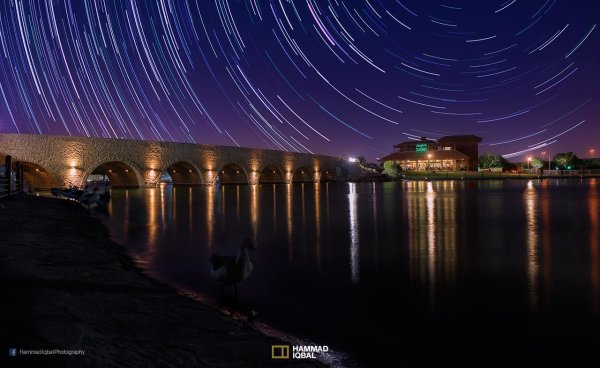
If you are reading this, you must be among those who have a special place in their hearts for stars, galaxies and the wonders of the universe. With recent advancements in camera technology, many photographers have captured the beauty of the night sky in spectacular ways. The truth is that every photographer is fascinated by the glittering stars, and captivating night skies, that have the power to instantly teleport us to a world beyond our wildest imaginations. From a photographic perspective, star trails can add another dimension to an otherwise average shot and that is likely the primary reason for many photographers desire to learn how to capture star trails. If you are struggling to find out and learn about this rewarding effect, get your camera and computer ready. But before that, let me introduce you to star trails.
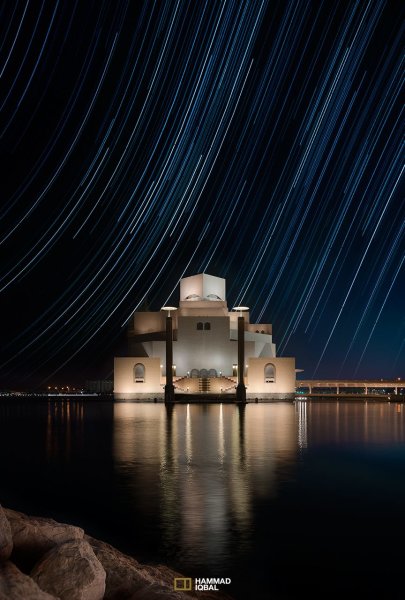
10373061_1472036406366253_4127720884282225109_oWhat are Star Trails?

Star trails is a photographic effect that gives an illusion of motion to the stars along a circular or an elliptical path. Technically, stars do not move when we observe them. They are quite stationary very much like our Sun. In reality, the circular motion of the stars we see in star trail images is a result of rotation of the Earth along its axis. For better understanding, please refer to the ‘equatorial grid’ figure under “Understanding Star Trails” section below.

How are Star Trails captured?

Traditionally, star trails are captured by taking multiple shots of the sky in succession over a period of many hours. Modern DSLR cameras also allow you to take a single exposure of an extended length of 30 minutes or more but many photographers prefer to take multiple shots at 30 seconds each and stack them together. Doing it this way eliminates any chances of shaky exposures that can occur due to wind or bumping into the setup while the shutter is open. If you are attempting to make almost a full circle star trails, then the number of shots required to create it can go in hundreds. Later, all those shots are stacked together in Photoshop or a free software such as StarStax to create a single image that shows the circular paths of the stars.

Photographers have been using this method for years with great results. But if you do not have the option to return to the same location again, then the conventional method would feel limited, as it requires you to stay in one spot for hours, thereby limiting your options to take multiple shots and capture a variety of angles on location in one night.

Understanding Star Trails
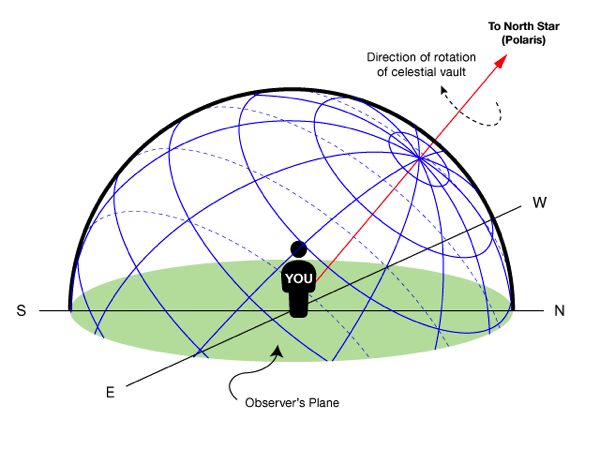
Equatorial grid

Equatorial grid from observer’s point of view

Imagine that ‘YOU’ are inside a giant sphere (see above diagram). Now, depending on the direction you look at, the effect of the star trails will be as follows:

Facing North: Star trails effect will appear to be circular with some stretching of the circular lines at the far edges of the frame.

Facing East: The trails will appear to be straight in the middle moving diagonally in an upward direction from bottom center to top center. They will also appear to be converging at both top left and bottom right at the far sides of your frame. See image below:
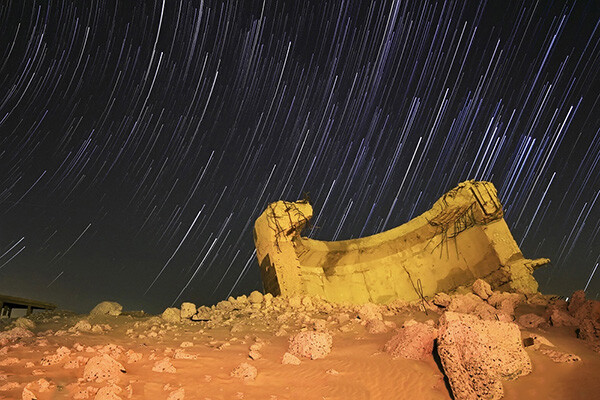
East West Trails Umm ul Aish Kuwait

Umm-ul-Aish, Kuwait – image shows the upward motion of East star trails

Facing West: In this direction, the trails will appear to be the exact opposite of what you see when looking towards the South. Moving downwards and to the right from top to bottom in a diagonal line, they will also appear to be converging at both bottom left and top right at the far edges of your frame.

Facing South: If you are facing South head-on, the star trails will appear to be moving from left to right in an upward curve.

One-shot Star Trails – the Technique

I have been developing a new method to create star trails in Photoshop. Unlike the ‘Star Trails’ Photoshop action that you might already be familiar with, this technique is much more than that. It eliminates all limitations associated with the traditional method of capturing star trails. Unlike the conventional method, this technique only requires a single shot, that’s right, only ONE shot of the night sky to create realistic star trails. Since this technique is a result of a joint effort between me and my friend Mobeen Mazhar, who is a great landscape photographer from Pakistan, we have named it the “HM technique” or “HM star trails”.

When implemented correctly, this technique will open endless possibilities for you in your star trail adventures and is sure to spark new hope among photographers for all levels of expertise. Now, let’s take a look at different types of star trails and how you can use this new technique to create them in Photoshop with just one shot.

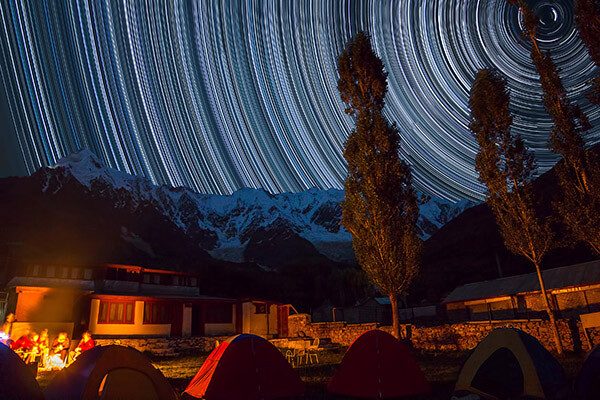
Creating North Star Trails
North Star Trails Nanga Parbat

Nanga Parbat-Trashing, Pakistan – North Star trails created with HM technique

This is the most common and simplest type of star trails. Traditionally, it can be achieved by pointing your camera towards North with the focus set to infinity and then taking consecutive long exposure shots (30 seconds) at high ISO settings. Since the North Star remains almost stationary, the final effect is circular with the stars seeming to revolve around a pivot point, which is the North Star. Then at the time of post-processing, all shots are stacked using Photoshop or StarStaX.

The downside to this approach is that it can take as many as 700 shots over a period of five to eight hours to get a full circle trail. Now watch the video below to learn to create North Star trails within minutes using just a single shot of the night sky.

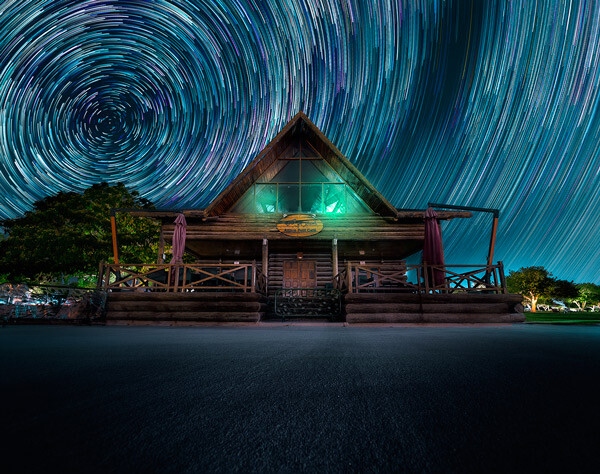
Creating Meteor Shower Trails
Meteor shower AspirePark

Aspire Park, Doha – meteor shower trails created with HM technique

Meteor shower trails is by no means an official name. This is fundamentally a beautiful variation of the North Star trails. Instead of a long continuous streak of light, the trails seem to disappear at the origin which gives it depth and dimension. There is also another variation of the meteor shower trails in which the tip of the trail is thicker, brighter and looks like a blob or droplet.

The underlying technique of the meteor shower trails is the same as shooting the North Star trails. The only difference is in post-processing. The meteor or comet effect is achieved by using the ‘Comet mode’ in StarStaX as shown below.

‘Comet Mode’ feature in StarStax

But regardless, the traditional method still requires that you spend hours on a single spot to take hundreds of consecutive shots. Now watch the video below to see how you can create amazing meteor shower trails in minutes, and once again, all you need is a single shot of the night sky.

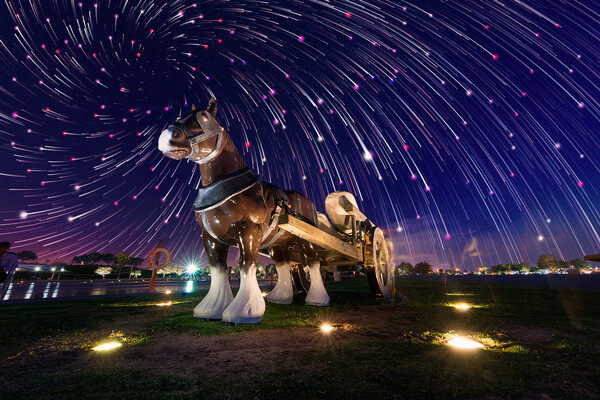
Creating Vortex Star Trails
Vortex Aspire Park Doha

Aspire park, Doha – Vortex star trails created with HM technique

This is by far my favorite kind of star trails and is quite complex to achieve. Unlike the previous two types of trails, vortex star trails require special equipment which can be costly and may prevent most photographers from trying it. The vortex effect is achieved by zooming in or out on the lens during the long exposure. It may sound simple at first but the trick is to avoid vibrations as you zoom during the 30-second long exposure. Hence it makes it extremely difficult, if not impossible, to do it with bare hands without shaking the whole setup.

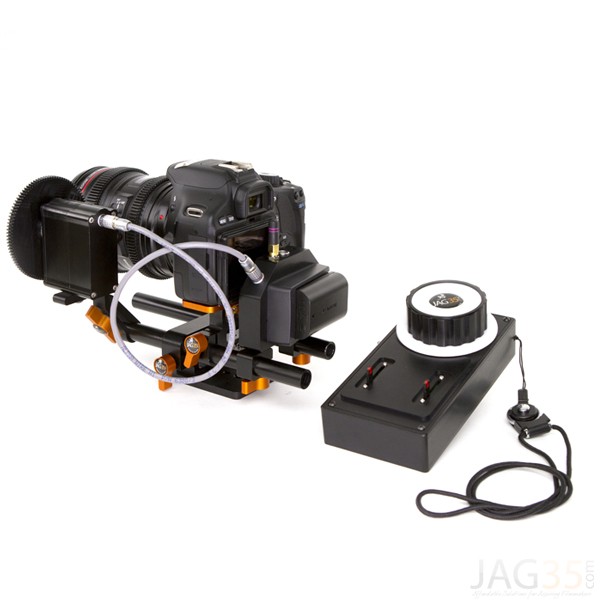
But if you have plenty of free cash to burn, you can get the tools which would include a geared ring that goes on the zoom ring of your lens, a motor and a wireless remote for controlling the motor. The setup is basically what DSLR filmmakers use for focus racking, that is a motorized follow focus system as shown below. The system is very useful if you shoot professional video with your DSLR but for photographers, the cost might not be justifiable.
Electronic follow focus

Wireless electronic follow focus kit v2 by Jag35

Do not worry because the following video will show you how to create vortex star trails in Photoshop. No cash required.

Conclusion

With the help of this powerful new technique, you will be able to maneuver on location, shift your focus towards making a variety of compositions, save countless hours, battery power and thousands of shutter actuations on your DSLR. Would you have thought that a single shot could give you such incredible flexibility in your star trail photography?

Tip: Just make a note of the direction your camera is facing to help you create star trails in relation to the reference direction.

I am sure that this tutorial will add a new skill to your photography arsenal. If you have any questions, post them in the comments below. Thank you.

Technique developed by Hammad Iqbal and Mobeen Mazhar

Mobeen Mazhar is a passionate traveler and has spent more than a decade exploring Pakistan and its natural beauty. Photography gives him a mode to express his love for nature and a medium to document his travel experiences. He is a landscape specialist, regular travelogue writer and travel expert for Pakistan. You can find his photographic work at Facebook, 500px and Flickr.

The post Single Image Star Trails – a Powerful Technique to Create Star Trails in Minutes Using Phototoshop by Hammad Iqbal appeared first on Digital Photography School.


Digital Photography School

 
Comments Off on Single Image Star Trails – a Powerful Technique to Create Star Trails in Minutes Using Phototoshop

Posted in Photography