RSS
 

Archive for June, 2014

Creative Reasons to use Intentional Camera Movement

14 Jun

One of the earliest lessons you likely learned as a photographer was the importance of keeping your camera steady and stable. You wanted tack-sharp focus, so you learned to tuck in your elbows and support your camera properly. But why limit yourself when there are so many creative reasons to move your camera?

intentional camera movement, ICM, blur, motion blur, how to, sunrise

Try Intentional Camera Movement or ICM

ICM is the abbreviation for Intentional Camera Movement, a term that covers a wide range of photography situations. What brings these different situations together is the fact that rather than remaining still, the camera itself is moving while the photograph is being taken. This creates a wide-range of creative effects and abstract images, like the sunrise image above.

In order to capture recognizable blur, you need to shoot at a slow enough shutter speed to capture significant motion. A quarter to a half-second or longer is a good place to start. Shooting in Shutter Priority mode allows you to set a longer shutter speed, and your camera will choose an appropriate aperture. If the picture is too light or too dark, you may want to consider dialing in all of the settings in Manual mode. You can also achieve ICM style shots with a point-and-shoot camera in darker situations, where your camera will select for a longer shutter speed. (Both of the panning shots, below, were taken with a point-and-shoot camera in Program mode.)

Try Panning

Panning is one specific type of intentional camera movement. Rather than being random movement when panning, the movement of the camera mimics the relative movement of the subject. This results in an unusual composition where a moving subject appears frozen and the background of the image becomes blurred and conveys the sense of motion.
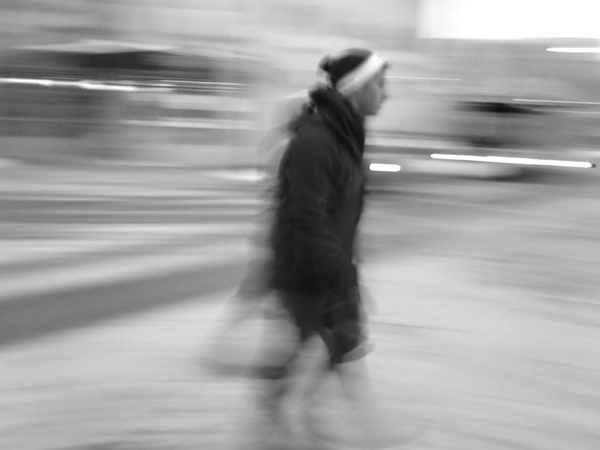
intentional camera movement, ICM, panning, people, motion, blur, blackandwhite

Panned at 1/4 of a second – if you want less blur use a slightly faster shutter speed like 1/30th

The tricks behind panning are in the focus and the follow-through. A moving subject and a moving camera can confuse your camera’s autofocus, so you will get better results if you use back-button focus or pre-focus the camera to the right distance and then switch it into manual focus mode. Either technique will keep the camera focused at the right distance, and you will not waste time waiting for your autofocus to lock on to your subject.

The second trick for panning is in the follow-through: both before and after you take the shot. Just like in golf or baseball, the smoothness of the swing comes from continuing the motion before and after the point of contact (hitting the ball or hitting the shutter). If you want smooth motion blur in your panning image, you need to be moving and following your subject both before and after hitting the shutter.

intentional camera movement, ICM, panning, motion, blur, car, vehicle

Panned at 1/8th of a second

The best way to get a feel for the mechanics of panning is to practice the movement without actually hitting the shutter and taking a photograph. Practice keeping your subject in approximately the same place within your viewfinder as it moves past you. For example, if you are trying to capture a panning shot of a car, begin by locating the car in your viewfinder when it is a short distance away from you. Swing the camera to follow the motion of the car as it approaches, passes, and zooms away from you. Once you have been able to successfully track a few cars and keep them in the frame, try repeating the same process but press the shutter button midway through the motion. Continue to follow the car with the camera as the shutter closes, and you will find you have a much smoother feel and flow to the final image.

Shooting a few successive frames using High Speed or Burst mode can help get a successful panning image also.

Try a Zoom Burst

A zoom burst is another specific type of intentional camera movement. Rather than moving the entire camera, during a zoom burst shot you move the lens and zoom it in or out while the photograph is being taken. The more focal lengths covered by your camera lens, the greater the zoom effect will appear to be.

intentional camera movement, ICM, zoomburst, zoom, motion, blur, christmas lights, abstract

18-270mm lens, 4 seconds at f/13, ISO 100 on a tripod

The bright points of light on a Christmas tree provide an excellent subject for a zoom burst shot, as each individual light renders as a bright streak across the image, making for a feeling of achieving warp speed and rocketing forward into the photograph. This shot had a shutter speed of four seconds and was taken hand-held, with one hand holding the camera and the other rotating the zoom lens during the shot. The slight bumps and jumps in the lights are a result of the movement of the camera body due to camera shake and the added motion from zooming the lens.

intentional camera movement, ICM, zoomburst, zoom, autumn, leaves, abstract, motion, blur

10-24mm zoom lens, ISO 100, 1/25th at f/22

Zoom burst shots can be of any subject, not just bright points of light. Here, the variations in color of the fallen leaves provide a colorful backdrop for the motion and lines of the zoom burst effect. This shot also demonstrates that you can achieve a zoom burst effect with a smaller range, as this image was shot hand-held using a 10-24mm lens.

Conclusion: try Intentional Camera Movement

There are many, many ways to use Intentional Camera Movement to capture creative and unusual shots, and these different techniques are just the tip of the iceberg. Don’t let yourself be locked in to only stable, tack-sharp photographs.

intentional camera movement, ICM, blur, motion, abstract, sunrise

ISO 100, 0.6 seconds at f/11 done hand-held by rotating the whole camera when shooting (took several tries to get that smooth)

Experiment with intentional camera movement, and you might surprise yourself! Share your results in the comments below.

The post Creative Reasons to use Intentional Camera Movement by Katie McEnaney appeared first on Digital Photography School.


Digital Photography School

 
Comments Off on Creative Reasons to use Intentional Camera Movement

Posted in Photography


In Photos: Sebastian Luczywo’s unconventional family portraits

14 Jun

children-family-photography-rural-sebastian-luczywo-14.jpg

Polish photographer Sebastian Luczywo takes an unusual approach to family photos. His clever and mood-filled photos depict his wife, their two children and family pets in the countryside, often with a touch of the surreal. The resulting images are anything but your standard family portraits. Take a look at his work. See gallery

News: Digital Photography Review (dpreview.com)

 
Comments Off on In Photos: Sebastian Luczywo’s unconventional family portraits

Posted in Uncategorized


14 June, 2014 – Symphony In Stone

14 Jun


Landscape photography is something that for many of soothes the soul.  It’s our passion.  Sometimes we like shooting the large sky vistas and sometimes it is the forrest and for others it is a shoreline.  Nigel Turner turns his camera to the stone.  In his essay Symphony In Stone, Nigel shares what it takes to get his beautiful images.

Luminous Landscape’s Publisher and CEO Kevin Raber was recently interviewed on Rick Sammon’s Digital Photo Experience Podcast.  Kevin’s interview starts at the 29:07 mark. Learn about Kevin’s photography and Luminous-Landscape. Direct LINK to the MP3.


The Luminous Landscape – What’s New

 
Comments Off on 14 June, 2014 – Symphony In Stone

Posted in News


Bahia, Brasilien

14 Jun

Was macht eigentlich ein Berufsfotograf im Urlaub? Genau: Fotos! Fabian Stürtz war Anfang des Jahres an einem der seiner Meinung nach schönsten Flecken der Erde. In Bahia in Brasilien machte er Urlaub.

Im Gepäck seine Leica monochrom mit einem 35er Objektiv. Samstags ging er auf den Markt und hat mit den Einheimischen gesprochen, die ihm alle sehr nett und offen begegnet sind. Natürlich besuchte Fabian auch den Strand und erkundete den Ort und die Umgebung.

An sich war das Fotografieren in der Zeit vollkommen nebensächlich und grad deshalb wieder so schön. Die Fotos bedeuten mir viel, weil sie eben nur aus Leidenschaft entstanden sind.

Ich mag Fabians Schwarzweiß-Bilder sehr und glaube, diese neue Leichtigkeit in seinen Fotos sehen zu können. Auf jeden Fall machen mir die Bilder Lust aufs Reisen und darauf, neue Orte kennenzulernen. Mit Kamera, aber ganz ohne Zwang.

Ein Weg zwischen Bäumen und Sträuchern.

Eine Frau sitzt auf einem Plastikstuhl in einem Imbiss.

Ein Mann bei der Arbeit.

Hühner sitzen auf dem Boden vor einem Plastikkorb.

Eine Gruppe Menschen in einem Hof sitzen und stehen beieinander.

Ein Mann trinkt aus einem Glas. Vor ihm stehen Bierflaschen.

Eine alte Hauswand mit verblichenem Schriftzug.

Ein Esel ist an einem Baum vor einer Kirche angebunden.

Hausruinen vor einigen Palmen.

Eine Strandszene.

Zwei Männer spielen ein Brettspiel auf dem Bürgersteig.

Eine Hütte steht auf Stelzen im Wasser.

Ein Boot auf dem Wasser.

Ein sehr voll gepacktes Motorrad.

Ein Mann bei der Arbeit.

Ein Mann sitzt mit verschränkten Armen auf einer Mauer.

Eine Nachtszene: Mehrere Menschen auf einem geschmückten Platz.

Fabian Stürtz lebt und arbeitet in Köln. Für kwerfeldein hat er bereits einen Gastartiel zu seinen Auftragsportraits geschrieben. Weitere Arbeiten von Fabian könnt Ihr auf seiner Webseite oder auf Facebook finden.


kwerfeldein – Fotografie Magazin | Fotocommunity

 
Comments Off on Bahia, Brasilien

Posted in Equipment


Leseraktion: Mein geliebtes ungeliebtes Bild

14 Jun

Kennt Ihr das? Ihr habt ein Bild gemacht und seid total begeistert davon. Ihr seid völlig überzeugt, dass dieses Foto Eure Freunde, Bekannte, den Fotoclub, die Follower auf Facebook und viele mehr umhauen wird. Und dann sind die Reaktionen wider Erwarten minimal bis negativ.

Aber nach wie vor hängt Ihr an dem Bild. Vielleicht passt es einfach nicht zum Rest Eures Portfolios, vielleicht ist es wirklich nicht so gut, aber dahinter stehen Emotionen, die es für Euch zu einem der besten Bilder machen, die Ihr bisher aufgenommen habt. Egal warum, egal wie. Heute soll es um diese verschmähten Bilder gehen.

Zeigt uns Euer liebstes ungeliebtes Bild als Link in einem Kommentar.

Teilnahmebedingungen

  • Suche Dein geliebtes ungeliebtes Foto heraus.
  • Poste den Link dazu in einem Kommentar.
  • Beschreibe in ein paar Sätzen, warum Dir dieses Bild wichtig ist, wie es entstanden ist und wenn Du es ahnst, warum es wenig Beachtung findet. Achtung: Fotos ohne Beschreibung werden nicht berücksichtigt.
  • Mit dem Kommentar stimmst Du einer möglichen Veröffentlichung auf kwerfeldein zu.
  • Einsendeschluss ist am Montag, den 16. Juni um 20 Uhr.

Wir werden anschließend gemeinsam alle Bilder ansehen, ihre Geschichten lesen und unsere Favoriten in einem eigenen Artikel zeigen. Wir werden Euren Fotos also Raum und die erneute Chance geben, gesehen und entdeckt zu werden. Vielleicht verliebt sich ja doch der eine oder andere in sie. Unsere Auswahl wird natrürlich subjektiv sein und stellt keine Wertung dar.

Das Titelbild zeigt meine persönliche Auswahl. Ein Bild, das nicht zu meinen restlichen Fotos passen will, aber ich liebe es. Die Wolken haben sich an einem warmen Sonnentag wunderschön im Kinderpool gespiegelt und als ich meine Hand in das Wasser streckte, war es, als könnte ich den Himmel fühlen.

Vielen Dank an Jonas Hafner für die schöne Idee.


kwerfeldein – Fotografie Magazin | Fotocommunity

 
Comments Off on Leseraktion: Mein geliebtes ungeliebtes Bild

Posted in Equipment


Samsung reveals super-thin and high-resolution Galaxy S tablets

14 Jun

Galaxy_Tab_S_10.5_inch_Titanium_Bronze_6.jpg

Samsung has launched two new high-end tablets. The Galaxy Tab S 8.4 and 10.5 have very similar specifications and mainly differ in screen size. Both devices offer high-resolution SuperAMOLED displays with 2560×1600 pixels. Samsung’s earlier Tab Pro models came with the same resolution, but this is the first time Samsung combines such dense displays with SuperAMOLED technology. Learn more at connect.dpreview.com

News: Digital Photography Review (dpreview.com)

 
Comments Off on Samsung reveals super-thin and high-resolution Galaxy S tablets

Posted in Uncategorized


Weekly Photography Challenge – Black and White

14 Jun

Earlier today I professed my love of black and white photography and shared a collection of some powerful B&W images and some articles on tips for making your own B&W images.

So now it’s your turn to show us your images. The weekly photography challenge this time around is black and white.

A few images to inspire you

By Marco Calabrese

By Yasin Hassan – ????? ???

By Chris JL

By { pranav }

By Simon & His Camera

By gato-gato-gato

By gato-gato-gato

By Greg McMullin

By i k o

By i k o

Need help converting to Black and White?

  • How to Convert Photos to Black and White in Lightroom
  • 3 Tips for Better Black and White Conversion using Lightroom
  • Converting Images to Black and White Properly
  • Tips for Shooting and Processing Better Black and White Photographs
  • An Adjustable Black and White Conversion in Photoshop Elements
  • How to Create a Black and White High Contrast Sky from a Colour Image

Show use your Black and White images

Simply upload your shot into the comment field (look for the little camera icon in the Disqus comments section as pictured below) and they’ll get embedded for us all to see or if you’d prefer upload them to your favourite photo sharing site and leave the link to them. Okay, ready to impress us?

The post Weekly Photography Challenge – Black and White by Darlene Hildebrandt appeared first on Digital Photography School.


Digital Photography School

 
Comments Off on Weekly Photography Challenge – Black and White

Posted in Photography


Nikon AF-S Nikkor 35mm f/1.8G lab test report

14 Jun

lensreview-thingsmall1.png

The AF-S Nikkor 35mm f/1.8G is Nikon’s latest moderate wideangle prime, designed for full frame SLRs like the D610. It sits in the lineup between the budget, DX-only AF-S Nikkor 35mm f/1.8G and the premium, half-stop faster AF-S Nikkor 35mm f/1.4G. It also faces stiff competition from the highly-regarded Sigma 35mm F1.4 DG HSM. So how does it measure up in terms of optical quality? See the lens test data and our analysis

News: Digital Photography Review (dpreview.com)

 
Comments Off on Nikon AF-S Nikkor 35mm f/1.8G lab test report

Posted in Uncategorized


On Traveling With Your Camera

14 Jun

In January Strobist was restructured from a standard, 2x/week blog into a core knowledge archive. Rather than publishing all of the time, we made the 2,000-post archive more organized and accessible. Now, Strobist only updates when there is something meaningful to say.

I did this to flip the signal to noise ratio (seriously, who needs to read that many photoblog posts every day) and to create some time for two significant projects. The first of which, The Traveling Photographer, has just dropped.

Read more »
Strobist

 
Comments Off on On Traveling With Your Camera

Posted in Photography


Leica T Unboxing! (you won’t believe what happens at the end…)

14 Jun

silverbox.jpg

With the T (Typ 701) Leica debuted a brand new mirrorless lens mount. Built around a 16MP APS-C CMOS sensor, the T has an ISO range of 100-12500 and offers 5fps continuous shooting and Full HD movie recording with stereo sound. We’ve been waiting for a Leica T to arrive in the dpreview office since it was announced back in April, and today our wish finally came true. To mark the grand occasion (and to immortalize the characteristically lavish packaging) we’ve created an unboxing slideshow. Click through to feast your eyes. And yes – since you ask, it is a slow news day.

News: Digital Photography Review (dpreview.com)

 
Comments Off on Leica T Unboxing! (you won’t believe what happens at the end…)

Posted in Uncategorized