Ein Beitrag von: Hanna König

kwerfeldein – Fotografie Magazin | Fotocommunity
[ By WebUrbanist in Architecture & Cities & Urbanism. ]
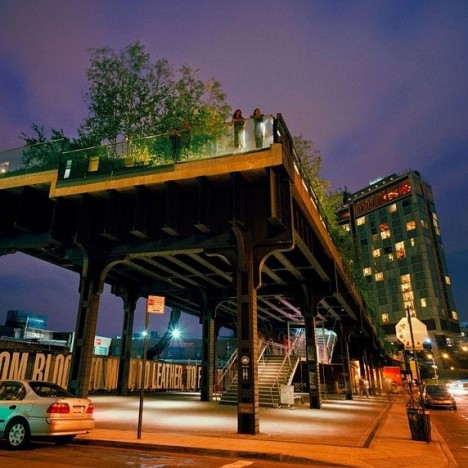
Following in the footsteps of the United States’ largest urban center, 2nd and 3rd most populous cities in the country are each (respectively) developing and building extensive elevated parks, inspired in part by the success of The High Line in NYC.
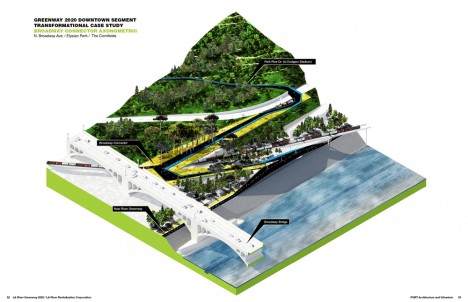
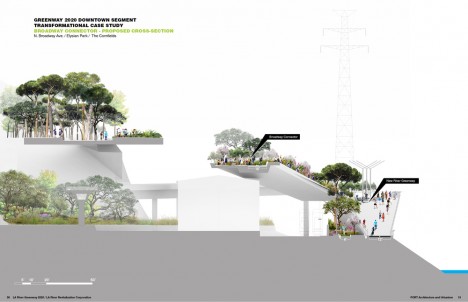
On the West Coast, Los Angeles has a plan to connect and create 50 miles of continuous bike and walking paths through the city. Over half of these segments are completed but the whole is not yet contiguous, forcing cyclists and pedestrians through dangerous crossings and other workarounds.
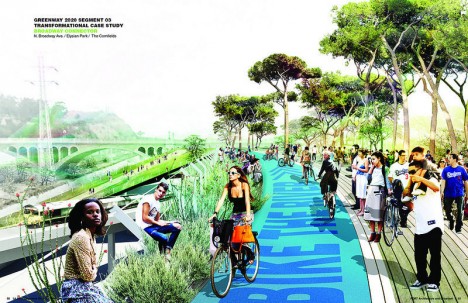
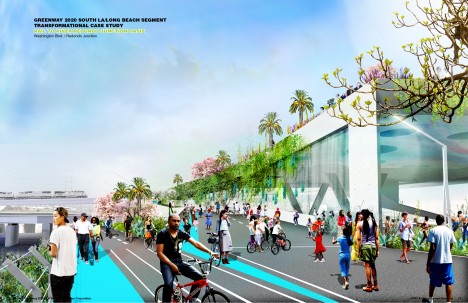
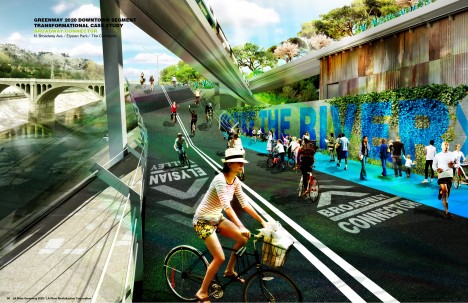
Ramping up support for the last few years, the LA River Greenway 2020 project includes provisions for public space as well as private enterprise, with everything from gathering and performance areas to dining venues, yoga classes and bike-in movie theaters in mind.
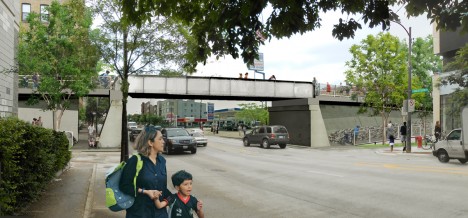
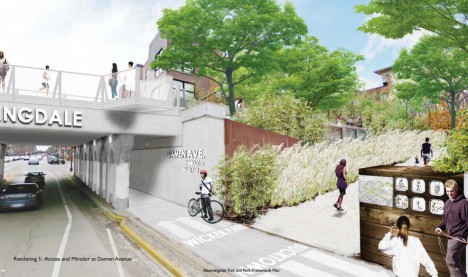
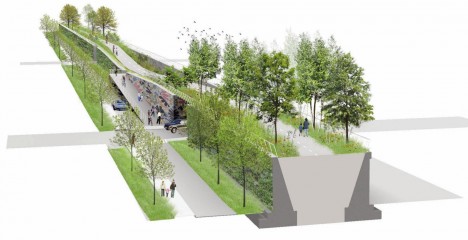
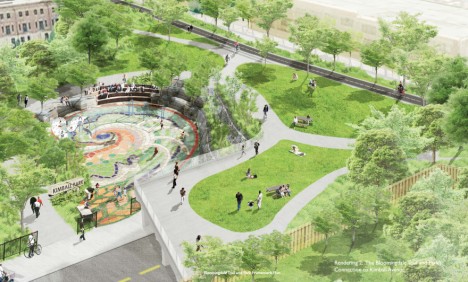
Meanwhile, in the Midwest, Chicago’s Bloomingdale Trail is the centerpiece of a larger plan dubbed The 606. Already midway through construction, much of the multiple-mile trail follows existing east-and-west-running railroad tracks set a story above street level.
In cities where highways and high-rises have taken up virtually every square foot of real estate there is to be had, lush parks, pedestrian walkways and bike …
Click Here to Read More »»
New York’s elevated park is expanding in new directions both physically and proverbially, its new addition a stark circular shift from the overall linear …
Click Here to Read More »»
A unique green retreat and pedestrian pathway is set to rival elevated parks around the world, including New York’s own High Line, right in the heart of …
Click Here to Read More »»


[ By WebUrbanist in Architecture & Cities & Urbanism. ]
[ WebUrbanist | Archives | Galleries | Privacy | TOS ]
If you’ve never shot light trails before, start with Darren Rowse’s excellent article How to Shoot Light Trails. Once you’re comfortable with the basics, here are five advanced tips for creating your own unique light trail photography.
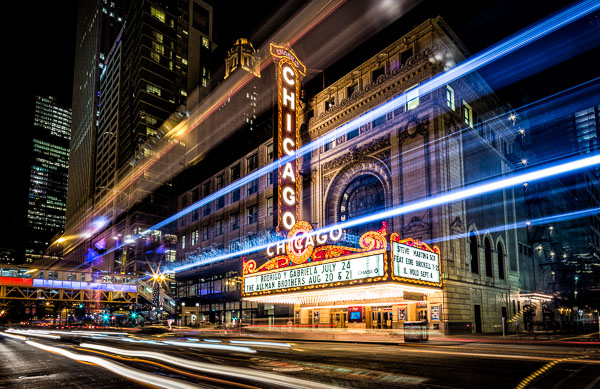
You don’t want an image with tiny light trails. You want big, Texas-sized, light trails streaking across the photo. As with any subject, if you want the subject to appear large, get close to it. Exaggerate the effect by using a wide-angle lens. Another way to add a sense of size to a subject is to shoot it from below. Shooting a person from a low point of view makes the person appear larger and more powerful. The same is true with light trails.
Get as low as you can, and as close as you can safely, to the traffic. If you’re shooting along a busy street, place two of your tripod legs barely into the street so that they are resting against the curb. Lower your tripod as far as you can and point it up. By getting as low and close as I could in the Chicago Theatre image (above), the top trails of the bus appear taller than the theatre marquee.
Look at any of the images in this article and picture them without the light trails. You’re left with a boring composition that doesn’t work. When photographing light trails, you need to visualize how the trails will look in the image and compose your image with them in mind.
Treat light trails as if they were a river meandering through your image. You wouldn’t compose the shot so that the river moved straight across your frame, so don’t do it with light trails either. Pay attention to where the trails enter and leave the frame. Your eye will be drawn to the spot in the frame where the cars are beginning as it will have some of the densest and brightest trails. Place this location as you would place a main subject using the rule of thirds. The trails should move across your image and end at either the corners of the frame, or a vanishing point. Place this vanishing point in the opposite third of the frame. If the light trails enter in the lower left, have them end in the upper right. This lends a sense of movement to your composition.
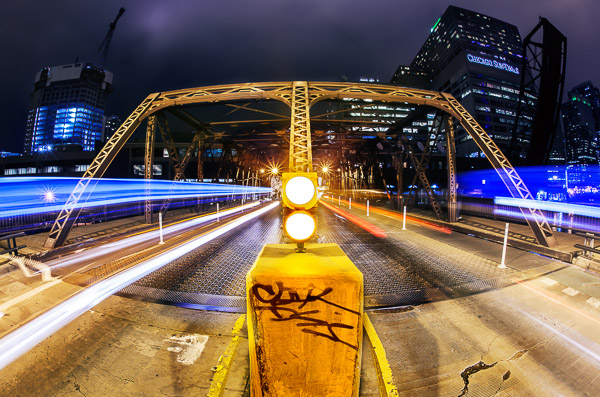
If you can get to the middle of the road with traffic on either side of you, consider going for a perfectly symmetrical shot. You’ll need an interesting subject to go along with the trails, so look for a bridge or interesting buildings on the side of the road. Wait to hit the shutter until you have traffic on both sides of you to create a balanced composition. More importantly, make sure that you’re in a safe position. Stand in the median, or off the street. Never set up in the middle of a busy street.
To create an interesting abstract image of light trails, put yourself in a position where the lights from the cars are the only light source. An expressway overpass is an ideal location. You don’t want any buildings or other light sources in the frame. Find a location where the road takes an interesting path and underexpose the scene so that the only things that appear are the light trails and streetlights.
When you open the photo on your computer, increase the exposure of the light trails while keeping the black areas black. You can increase the exposure of just the trails by increasing the whites slider in Lightroom, lowering the white point, or making an adjustment to the tone curve in Lightroom or Photoshop. You’ll be left with an image that shows only the path of the trails that makes for a unique abstract image.
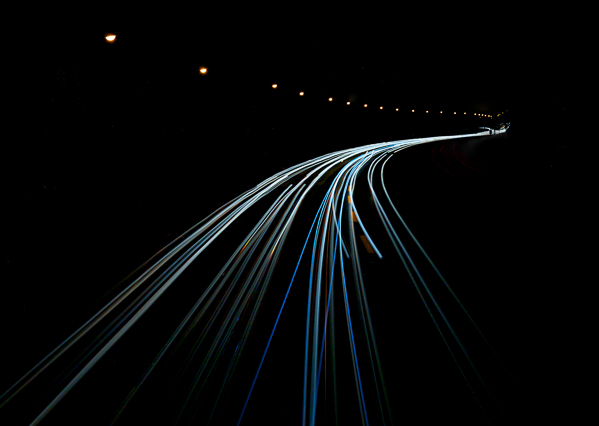
4
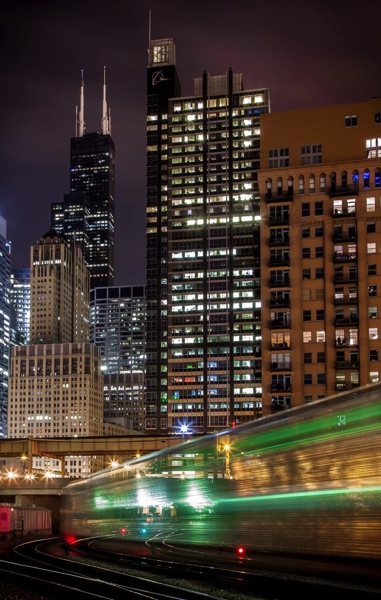
You can create light trail images at night by shooting anything that is moving and emitting light. If you’re photographing a city like Chicago, you’ll mostly shoot cars and buses, but don’t forget about trains, bikes, horse-drawn carriages, or even a bunch of kids walking by swinging glow sticks. The rules for photographing any of these is the same as with cars, but you’ll be able to shoot them in locations that cars don’t drive, and the trails that they leave are different than your standard cars.
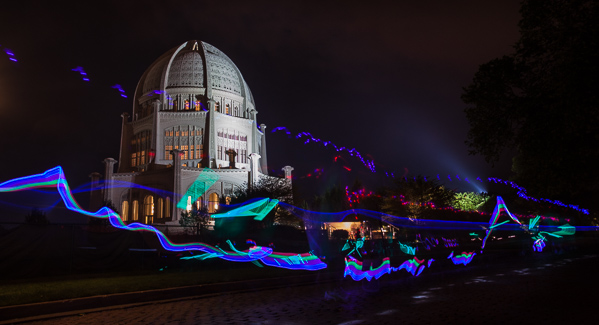
Who says that you need to stand around and wait for something to drive by? If you’re in a more remote location, set up your tripod, set up a long exposure, use the 10-second delay feature in your camera, jump in the car, and drive around in front of your camera. You can drive in any path that you think might be interesting. Experiment until you find something you like. You’re essentially light painting with your car lights. This technique works even better with a friend. One person drives while the other shoots! Find an empty parking lot or a winding road and make your own light trails.

What do you do to spice up your light trail shots? Have you tried any of these techniques? Tell us in the comments below.
The post 5 Advanced Tips for Light Trail Photography by Chris Smith appeared first on Digital Photography School.

FashionPhotographyBlog.com was able to catch up with our first Photo of The Week winner, Amanda Lim to find out what she is up to now after taking her winning photo and we were pleased to hear about her recent successes.
So where did it Amanda’s photographic journey all began, she kindly shared it with us “Growing up I was always curious and creative. I drew, I painted, and I was lucky to have some beautiful friends to photograph and won some photography awards. Shortly after, I followed a conventional path to university, got bored studying something that wasn’t interesting to me. I bought a camera, started shooting again and that’s when I had this epiphany, this was what I was meant to do, it made me happy. I instantly fell in this loop of love and obsession.”

That was how it all started but where on her journey is she currently now as a fashion photographer, Amanda reveals that “At this present moment I am simply doing what I love and longed to do my whole life – I’m exploring and travelling the world. I am travelling to as many destinations around the world. I was travelling and working in China with an agent for various clients, a highlight there has been shooting for Vogue China. During my travels, I am working to capture and indulge in the beauty of nature. I am becoming more interested in portraiture, and dreaming up a list of people I would love to photograph.”

I had been receiving a lot of comments about the original story behind Amanda’s winning photo so I had to ask, she replied that “I was going through a difficult time and that was my fuel for inspiration. That shoot was from 6 years ago during my earliest beginnings when I was experimenting with different things.”
And what about the inspiration for her present work such as her “Roser” series showcased in this article that displays such serenity, she says “I love strong, defiant women – it’s a quality I wish to define in all my subjects…. I love my women strong yet delicate and I like to portray them intimately and vulnerable to the lens… I muse over face. Music also plays a huge inspiration.” From her inspiring ideas, she needs a team to her execute them and Amanda likes to keep her team manageable, “I like to work in small teams, the energy keeps harmonious.”

To create her amazing shoots Amanda explains that “I work mostly on medium format, Hasselblad H3D and a couple of prime lenses. I also have a Fuji Xe-1 that is inseparable to me. With lighting, I use what is available to me: whether it is natural daylight, flash, tungsten, LED.
To find out more about Amanda Lim and to find more about her shoots you can find her or ask her questions on Tumblr (www.amandalimphotographs.tumblr.com)

Photo Credits:
Photographs from Amanda Lim (amandalim.com.au) From her “Roser” series.
Do you like Amanda’s new work now compared to her previous entry? Please comment below.
 Extra photos for bloggers: 1, 2, 3 |
|||
Engineer Prints are big big big (big) photo prints made on large format printers normally used for architecture and engineering plans.
The unique, lo-fi characteristics of the Engineer printing process has made it a favorite amongst the creative community, and us!
Streaked, striated and wacky black and gray tones combine to create a super unique look that’s no ordinary photo print.
Our Engineer Prints are inked on 4-feet wide (!) 20lb bond paper that’s so light it’s easy to pin or tape anywhere, no frames or nails!
We’ve made it a cinch for you to have one of your very own. No printer proofs, resolution wrangling or printer research required!
Make Your Own Engineer Print
$ 25 flat w/ free shipping, at the Photojojo Shop
© laurel for Photojojo, 2014. |
Permalink |
No comment |
Add to
Incredibly Large Black & White Prints”>del.icio.us
Post tags:

Leica has updated the firmware for its T (Typ 701) mirrorless camera to Version 1.1. In one of the stranger descriptions we’ve seen, Leica hasn’t given any specific details of what’s changed, saying instead that “you will get the complete scope of functions and performance as described in the manual of your camera”. The firmware is available to download now – click through for the link.
News: Digital Photography Review (dpreview.com)
Ich weiß, zugegeben, sehr wenig über Afghanistan. Den Krieg, das Taliban-Regime, das alles kenne ich nur aus dem Fernsehen. Aber wie sieht es heute in Afghanistan aus? Die französische Fotografin Delphine Renou gibt einen Einblick in das aktuelle Leben von Frauen in der Hauptsdtadt Kabul.
Ihre Portraits zeigen starke Frauen, die selbstbewusst und voller Stolz in die Kamera schauen. Politikerinnen, Rapperinnen, Jornalistinnen – sie alle formen ein neues Gesicht Afghanistans und streben nach Unabhängigkeit und Freiheit.
Die Portraitserie „Kabul Women“ gehört zu einem Dokumentarfilm, der diese modernen Frauen seit 2013 begeleitet und noch in der Entstehung ist.
Dank einer NGO kam ich 2012 das erste Mal nach Afghanistan. Die Entdeckung des Landes war eine Offenbarung. Ich sah Hoffnung in den Augen der Menschen. Dies ist eine Nation, die versucht, trotz einer schmerzhaften Vergangenheit und einer ungewissen Zukunft, einen Neuanfang zu schaffen.
Wie der Journalist Lyse Doucet sagte: „Niemand geht nur einmal nach Afghanistan, man kommt immer wieder zurück oder hofft es. Wir scherzen oft, dass es wie eine Krankheit ist: Afghanitis. Es ist wie eine unheilbare Krankheit und niemand ist auf der Suche nach einem Heilmittel.“

Fahima, 19 Jahre alt, trainiert drei Mal pro Woche im Olympiastadion Ghazi in Kabul. Dieses Stadion wurde berühmt durch die Steinigung von Frauen während des Talibanregimes. „Ich will mein Land stolz auf mich machen. Ich träume davon, Champion zu sein.“

Paradise Sorouri, 25 Jahre alt, ist eine der ersten weiblichen Rapperinnen in Afghanistan. Paradise tritt provokativ auf in einer sehr konservativen Gesellschaft, was nicht ohne Risiko ist. „Viele Menschen akzeptieren nicht, dass eine Frau rappt. Ich erfahre oft Beleidigungen und manchmal auch Bedrohungen.“

Zohra, 21 Jahre alt, lernt Autofahren bei der Mamozai Fahrschule. „Autofahren ist eine große Chance für Frauen, um unabhängiger zu werden. Aber ein Auto zu kaufen ist immer noch teuer.“

Massouda Habib, 30 Jahre alt, ist Kandidatin bei der Landeswahl für die Provinz Kabul. Nach der Wahl zeigt sie stolz ihren mit blauer Tinte gefärbten Finger. „Ich bin stolz darauf, für was ich mich verpflichte, ich will kämpfen, um diesen Teil meines Landes zu verändern, wie er es verdient. Auch wenn ich nicht gewinne, werde ich weiterhin aktiv bleiben.“ Während des Krieges unter dem Taliban-Regime hat Massouda Afghanistan nie verlassen. „Ich habe das Leid meines Volkes gesehen.“

Aisha Ilyad, 21 Jahre alt, ist Moderatorin des Senders 1TV. Sie floh nach Pakistan während des Taliban-Regimes. Aisha träumt davon, im Rampenlicht zu stehen. Allerdings bedeutet vor der Kamera zu stehen für einige Familien noch eine Schande. „Die Leute denken, dass der Journalismus kein Beruf für Frauen ist. Es braucht Zeit, gegen die Vorstellung anzukämpfen.“

Eine Filmemacherin während Nouruz, dem persischen Neujahrsfest.

Shamsia Hassani, 25 Jahre alt, ist eine Graffiti-Künstlerin. „Als ich anfing mit Graffiti, wollte ich für die Gleichstellung der Frauen kämpfen. Ich dachte, durch Kunst könnte ich die Wunden des Krieges reinigen.“

Eine Frau auf einem Pferd in der Nähe des Qargha See, wenige Kilometer von Kabul entfernt. Es ist noch sehr selten, dass eine Frau auf einem Pferd reitet.

Shabnam, 21 Jahre alt, ist ein Studentin an der Universität Kabul.

Ein freiwillige Helferin während der ersten Runde der Präsidentschaftswahl in Afghanistan. 5. April 2014 – Es ist ein historischer Tag für das Land.

In einem Haar-Salon in Aria City, dem neuen Wohnviertel von Kabul.

Picknick in den Babur Gärten. Diese Familie aus Kandahar kam ein paar Tage nach Kabul, um hier Zeit zu verbringen.
Die Fotografin Delphine Renou hat ein unabhängiges Kollektiv von Dokumentarfotografen und Filmemachern für soziale und humanitäre Fragen rund um die Welt geschaffen: Digitalmill. Mehr über die Reportage „Kabul Women“ findet Ihr auf der Webseite des Projektes.
kwerfeldein – Fotografie Magazin | Fotocommunity
Ein Beitrag von: Daniel Ernst
Vor fünf Jahren hielt ich meine erste Spiegelreflexkamera in der Hand und war sofort im Bann der Fotografie. Anfänglich über die Portraitschiene kam ich zur Reise- und Landschaftsfotografie, die heute den Großteil meiner Fotos darstellt.
Die größte Begeisterung gilt dabei den Bergen und den unnatürlich, abstrakt erscheinenden Gipfeln und Geröllfeldern. Ich möchte mit meinen Bildern die Leute dazu motivieren raus zu gehen, in diese Welt einzutauchen und einfach nur die Natur zu genießen.
Meine Ausrüstung besteht derzeit aus einer digitalen Kleinbildkamera mit Objektiven, die den Bereich von 24 bis 85 mm abdecken. Meine Lieblingsobjektive sind dabei lichtstarke 24-mm- und 35-mm-Objektive. Hinzu kommen ein stabiles Stativ, ein Polarisationsfilter und mehrere Graufilter mit Verlängerungsfaktoren von 8 bis 1000.

Bevor ich verreise, picke ich mir in Google Earth interessante Positionen heraus und schaue im Internet, ob es zu diesen Punkten eventuell Tourenberichte, Videos oder sogar Aufnahmen gibt. Der Vorteil davon ist, dass man direkt einen Einblick in die Schwierigkeit der Wanderung bekommt und durch die Bilder abschätzen kann, ob sich der Aufwand lohnen wird.
Ist ein interessantes Motiv gefunden, baue ich mein Stativ auf, berechne gegebenenfalls die Belichtungszeit bei einer Langzeitbelichtung und drücke den (Fern-)Auslöser.

Um die Bilder bereits bei der Aufnahme etwas von der Masse abzuheben, versuche ich meist, zu ungewöhnlichen Zeiten an den Orten zu sein. Gerade Berchtesgaden und der Königssee sind überlaufen von Touristen und man sieht mehr oder weniger immer die gleichen Motive.
Meine Bilder unterscheiden sich von den Motiven her auch nicht dermaßen, sind aber zu Zeitpunkten aufgenommen, an denen der Großteil der Menschen noch im Bett liegt.
Beispielweise war ich bereits zu Sonnenaufgang am Jenner, statt mit der ersten Gondel voller Touristen hochzufahren oder nehme das erste Boot über den Königssee, statt dem zweiten oder dritten. Bisher hat es sich immer gelohnt.
Diese Aufnahme aus Südtirol entstand auf diese Weise. Nachdem die letzte Gondel von der Zallinger Alm hinunter gefahren war, war es plötzlich besonders ruhig und idyllisch. Wir saßen zu zweit auf der Terasse der Hütte, auf der es vor zehn Minuten kaum einen freien Platz gegeben hatte.
So hatte ich die Möglichkeit, diesen schönen Sonnenuntergang zu fotografieren. In die Hütte hatte ich mich auch gleich für ein paar Nächte eingebucht und hatte so schöne Motive bereits zu Sonnenaufgang.

Nun zum schwierigsten Teil: Welche Bilder bearbeite ich? Mir fällt die Auswahl höllisch schwer, da ich sehr selbstkritisch bin. Deswegen liegt sicherlich noch das eine oder andere Schätzchen im Raw-Format in den Tiefen meiner Festplatte.
Habe ich ein interessantes Motiv gefunden, bearbeite ich die Datei mit Camera Raw und Photoshop. Als erstes passe ich den Weißabgleich an und bestimmte den Schnitt. Die Bearbeitung an sich ist dann kein großes Geheimnis, da ich meist nur Farb- und Kontrastanpassungen vornehme.

Seit etwa einem Jahr nutze ich für alle meiner Fotos VSCO Film. Ich suche mir ein passendes Preset aus, das meine gewünschte Farbdarstellung liefert und passe dieses dann jedem Bild entsprechend an.
In Camera Raw nutze ich oft die lokalen Anpassungen und digitale Grauverlaufsfilter, um die Lichter entweder zurückzugewinnen oder sie teilweise auch überstrahlen zu lassen, wie etwa in diesem Bild:

Durch die Aufnahme mit teilweise zwei Graufiltern leiden alle meine Bilder unter massiven Farbverschiebungen und sind teilweise etwas unterbelichtet. Deswegen ist es umso wichtiger, dass ich immer im Raw-Format fotografiere.
Bei den Nachtaufnahmen steckt dagegen deutlich mehr Nachbearbeitung drin, da diese aus mehreren Aufnahmen bestehen. Um die Technik einmal ganz allgemein zu erläutern, bestehen die Bilder meist aus zwei bis drei Aufnahmen:
Die Aufnahmen passe ich anschließend in Camera Raw an und setze sie in Photoshop über Ebenen zusammen. So auch geschehen bei folgendem Bild. Entstanden aus drei Aufnahmen, zeigt es die Langkofelscharte bei Nacht und wunderbarem Sternenhimmel. Das Bild wurde nahe der Langkofelhütte aufgenommen, die auch meine Unterkunft war.

Ab September wird mein Blog richtig befüllt, denn es geht über Hong Kong nach Neuseeland, wo ich mehrere Monate leben werde. Über Australien und eventuell die USA reise ich dann nach einem Jahr zurück in die Heimat – soweit zumindest der Plan.
Wenn noch Fragen offen sind oder Ihr Euch für ein bestimmtes Bild und die dahinter steckende Technik interessiert, dann fragt gern nach.
kwerfeldein – Fotografie Magazin | Fotocommunity
FashionPhotographyBlog.com was able to catch up with our first Photo of The Week winner, Amanda Lim to find out what she is up to now after taking her winning photo and we were pleased to hear about her recent successes.
So where did it Amanda’s photographic journey all began, she kindly shared it with us “Growing up I was always curious and creative. I drew, I painted, and I was lucky to have some beautiful friends to photograph and won some photography awards. Shortly after, I followed a conventional path to university, got bored studying something that wasn’t interesting to me. I bought a camera, started shooting again and that’s when I had this epiphany, this was what I was meant to do, it made me happy. I instantly fell in this loop of love and obsession.”
That was how it all started but where on her journey is she currently now as a fashion photographer, Amanda reveals that “At this present moment I am simply doing what I love and longed to do my whole life – I’m exploring and travelling the world. I am travelling to as many destinations around the world. I was travelling and working in China with an agent for various clients, a highlight there has been shooting for Vogue China. During my travels, I am working to capture and indulge in the beauty of nature. I am becoming more interested in portraiture, and dreaming up a list of people I would love to photograph.”
I had been receiving a lot of comments about the original story behind Amanda’s winning photo so I had to ask, she replied that “I was going through a difficult time and that was my fuel for inspiration. That shoot was from 6 years ago during my earliest beginnings when I was experimenting with different things.”
And what about the inspiration for her present work such as her “Roser” series showcased in this article that displays such serenity, she says “I love strong, defiant women – it’s a quality I wish to define in all my subjects…. I love my women strong yet delicate and I like to portray them intimately and vulnerable to the lens… I muse over face. Music also plays a huge inspiration.” From her inspiring ideas, she needs a team to her execute them and Amanda likes to keep her team manageable, “I like to work in small teams, the energy keeps harmonious.”
To create her amazing shoots Amanda explains that “I work mostly on medium format, Hasselblad H3D and a couple of prime lenses. I also have a Fuji Xe-1 that is inseparable to me. With lighting, I use what is available to me: whether it is natural daylight, flash, tungsten, LED.
To find out more about Amanda Lim and to find more about her shoots you can find her or ask her questions on Tumblr (www.amandalimphotographs.tumblr.com)
Photo Credits:
Photographs from Amanda Lim (amandalim.com.au) From her “Roser” series.
Do you like Amanda’s new work now compared to her previous entry? Please comment below.
[ By Steph in Art & Street Art & Graffiti. ]

You might think you see a stone turret, a bunch of celebrities hanging out on a balcony, construction in progress or a man precariously dangling from a clock, but what you’re actually looking at is a clever trompe l’oeil work of trickery in paint. Artist Patrick Commecy heads up a team of muralists that transform facades throughout France from blank walls to wacky scenes full of life.


The most dramatic example is a Montpelier building, the back of which is within view of a nearby park (pictured top). Worn and neglected, the structure was a bit of an eyesore as-is. Commecy’s team A-Fresco transformed it with a full faux facade including a tiled roof, windows with balconies and a small tower. The figures seen in the outdoor spaces are famous and influential Montpelier residents throughout history.

Another project involved painting 20 pioneers of mountaineering on the side of the first Guides Office within view of Mont Blanc. The painted-on windows and balconies so closely resemble the real ones on the front of the building, it takes a minute to realize they’re not three-dimensional.

See more of these murals, each tailored to its unique location, at the A-Fresco website (in French.)
Is there something strange about the exterior of that building? This Paris facade and others like it around the world are actually hiding ugly infrastructure.
Click Here to Read More »»
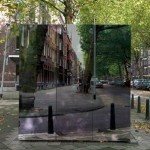
You might have passed right by train tunnels, communications towers or even entirely empty buildings and never realized you were being duped – until now.
Click Here to Read More »»
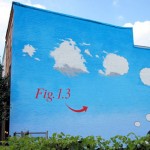
Exceptionally talented street artists to create murals so awesome, they could easily hang in a gallery, but so large that they hang on it, instead.
Click Here to Read More »»
[ By Steph in Art & Street Art & Graffiti. ]
[ WebUrbanist | Archives | Galleries | Privacy | TOS ]
You must be logged in to post a comment.