RSS
 

Archive for April, 2014

Adobe Camera Raw 8.4 and Lightroom 5.4 now available

09 Apr

shared:AdobeLogo.png

Camera Raw 8.4 is now available as a final release for Photoshop CS6 and Photoshop CC. Lightroom 5.4 is also now on Adobe.com and available through the update mechanism in the application. The updates include bug fixes, new features and support for a number of new cameras such as the Nikon D4s and D3300, Canon PowerShot G1 X Mark II, Olympus OM-D E-M10 and Fujifilm X-T1. Learn more

News: Digital Photography Review (dpreview.com)

 
Comments Off on Adobe Camera Raw 8.4 and Lightroom 5.4 now available

Posted in Uncategorized


8. April 2014

09 Apr

Ein Beitrag von: Petra Holländer

individual © Petra Holländer


kwerfeldein – Fotografie Magazin | Fotocommunity

 
Comments Off on 8. April 2014

Posted in Equipment


How to Avoid Blurry Photos by Choosing the Right Autofocus Mode

09 Apr

Sometimes the light is perfect, the moment is right, but when you get home you find out that your photo is blurry. Arrgh!

Why are your pictures blurry? One obvious reason might be that your camera isn’t focused properly. Today’s cameras and autofocus lenses can help you quickly take sharp images in a wide variety of situations, provided you choose the right autofocus mode.

Here are some questions to help you diagnose any situation and choose the correct auto focus setting

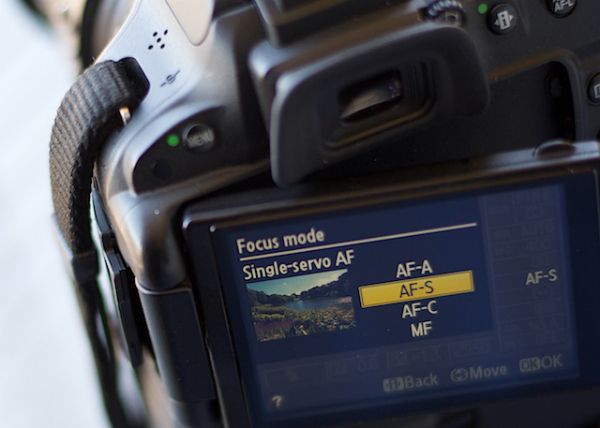
autofocus modes

Photo by Lynford Morton

Are you using the Auto-area autofocus or Single-point autofocus selection?

Who gets to decide your focus point? That’s the question you are deciding with this option. In an Auto-area autofocus, your camera decides what it should use as your focal point. It usually decides based on what looks most prominent in the viewfinder or closest to the camera. This might work when your subject is obvious and there are no potential distractions.

For more control, choose a Single-point autofocus setting. That mode allows you to choose your specific auto focus point (check your camera’s manual if you aren’t sure how to do this). After all, only you, not your camera, knows where you want to place your subject.

Is your subject moving?

Most DSLR cameras give you four basic options for autofocus settings: single, continuous, auto or manual. To help you choose the right option, ask yourself, “Is my subject moving?”

No, my subject is not moving

autofocus modes

Photo by Lynford Morton

If your subject is not moving, choose “AF-S” for Nikon or “One Shot” for Canon. This mode locks in your focus based on the distance to your subject. As long as your subject stays at that distance, your photo will be in focus. Your subject has to be stationary for this mode to work. In fact, your camera will not take the photo if your subject is moving (or it cannot lock focus).

This mode also allows you to recompose. Let’s say the autofocus point is in the center of the frame, but you want your subject on one side or the other. Keep depressing your shutter button slightly, and focus remains sharp on your subject. Then you can move the camera slightly left or right, recomposing with your subject out of the center of the frame.

Yes, my subject is moving

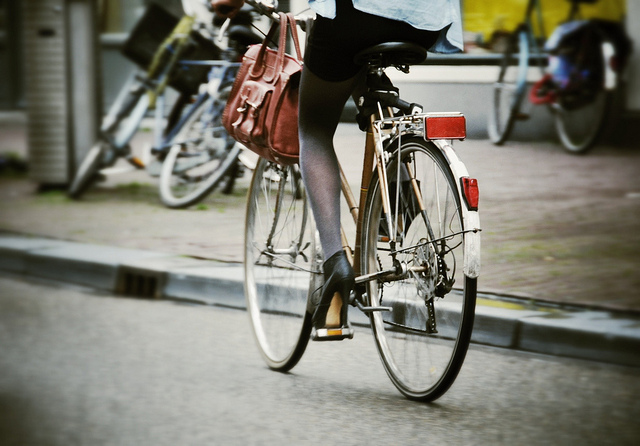
By Amsterdamized

If your subject is moving, use continuous autofocus (AF-C for Nikon or AI Servo for Canon). In this mode, you place your autofocus point over your subject, and focus continues to adjust while you hold down the shutter button, keeping your subject in focus as it moves.

For example, if someone is riding a bicycle, place the AF point on your subject and slightly depress the shutter. As long as you are pressing the shutter, the autofocus will continually adjust to your subject, keeping them in focus as they move. When you are ready to take the photo, depress the shutter completely, and the camera will focus on your subject for a sharp image.

No, my subject isn’t moving, but it might

A third option merges the functionality of the single autofocus and continuous autofocus. This hybrid mode, (AF-A for Nikon or AI Focus for Canon), starts out as a single auto focus. Your camera won’t focus until you lock in on a stationary subject. Once you have your subject in focus, you can take the photo as you would in a traditional single auto focus mode.

If your subject starts moving, however, the autofocus releases and continues to track your moving subject. It gives you the best of both worlds. One note of caution, I have noticed at times, if you recompose a stationary object quickly in AF-A mode, the camera can be fooled into thinking the subject is moving and release the autofocus.

My autofocus just isn’t getting it right

You always have the option of turning off the autofocus function and choosing the Manual setting. If your camera is having trouble detecting your focus point, it might be more efficient to focus the camera yourself.

How about the opposite situation? You turned off your autofocus by accident? Every now and then, when your camera can’t seem to focus, and you don’t hear the motor searching back and forth, check to see if you selected Manual autofocus by accident. This can happen more frequently than you might think.

Other issues to consider

What if you set up your autofocus properly, and the lens still won’t focus? Try these considerations:

  • You might be too close. Try backing away. If you are too near the subject, it might prevent the camera from focusing properly.
  • Your subject might not have enough contrast. Your image needs to have some contrast for many autofocus systems to work. If you try to photograph a solid sheet of white or any single color, most autofocus systems will struggle. Why? The camera compares adjacent pixels and when one is different, it uses that point to determine its focus. If it can’t find any contrast, it can’t focus.
  • You might have an extremely shallow depth of field. In this case, your autofocus is working, but the depth of field is so shallow, it is hard to tell that your subject is in focus.
  • You have camera shake. When you depress the shutter, you move the camera. If the shutter speed is too slow, the camera picks up that movement, and it looks like a blurry photo. Make sure your shutter speed is faster than the equivalent of your focal length. For instance, if you are zoomed to 100mm, your shutter speed should be 1/100th of a second or faster to avoid camera shake.

Why is your picture blurry? If the answer is in your autofocus, your fix could be as simple as choosing the right setting.

Do you have any other autofocus tips or comments you’d like to share? Please do so below.

More tips on sharper images and focus modes:

  • 5 Tips for Getting Sharper Images
  • Understand Exposure in Under 10 Minutes
  • Making Sharper Wildlife Photographs – [Part 1 of 2]
  • Making Sharper Wildlife Photographs – [Part 2 of 2]

The post How to Avoid Blurry Photos by Choosing the Right Autofocus Mode by Lynford Morton appeared first on Digital Photography School.


Digital Photography School

 
Comments Off on How to Avoid Blurry Photos by Choosing the Right Autofocus Mode

Posted in Photography


Modular Retrofit: Bamboo Micro-Homes in Deserted Factories

09 Apr

[ By WebUrbanist in Architecture & Houses & Residential. ]

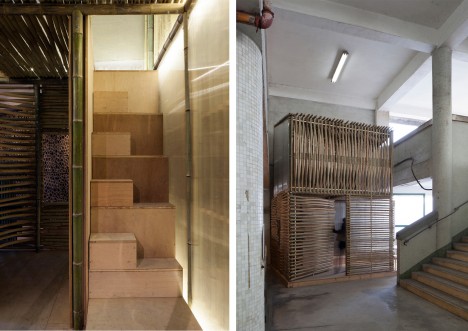
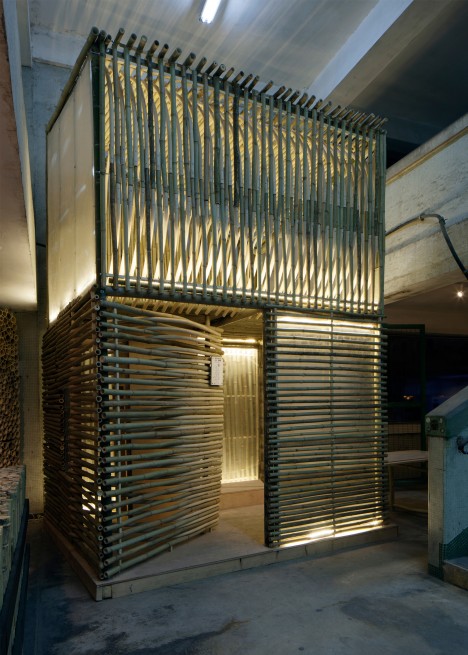
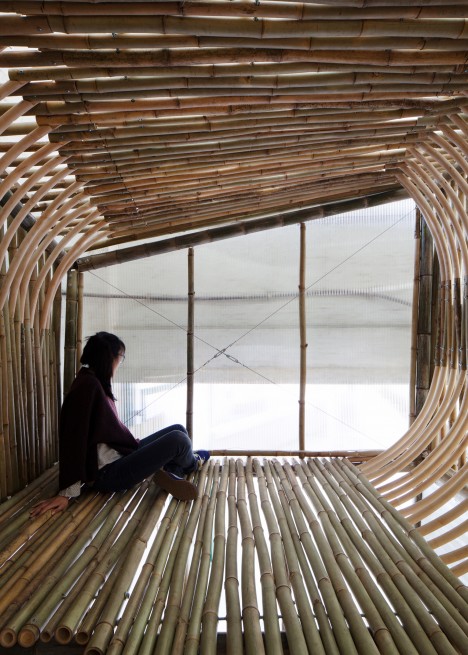
bamboo example demo unit

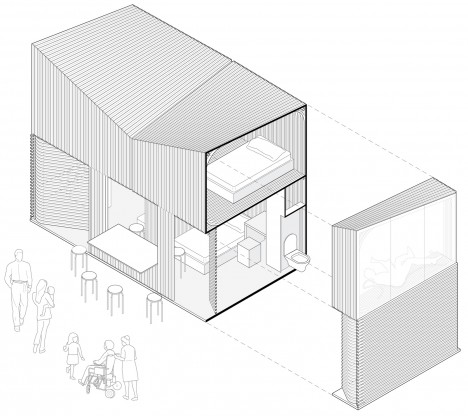
A pragmatic twist on visionary plug-and-play architecture, this project combines a cheap and fast-growing material with existing (abandoned) infrastructure to address the extensive needs of existing informal communities of Hong Kong.

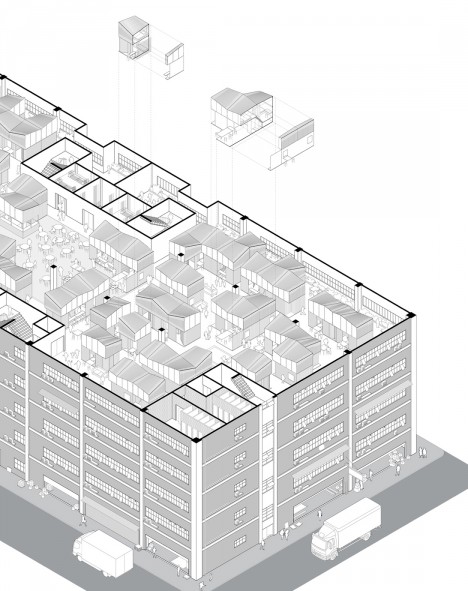
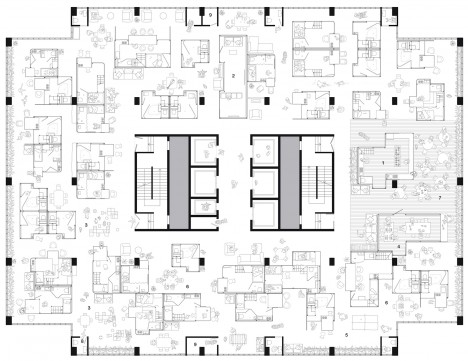
bamboo dwelling infill plan

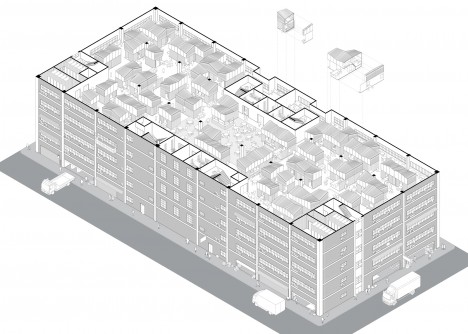
Putting buildings within buildings, the Bamboo Micro-Dwelling plan was born of both practical realities and city-in-the-sky ideas of Utopian Modernists like Le Corbusier.

bamboo micro dwelling factory

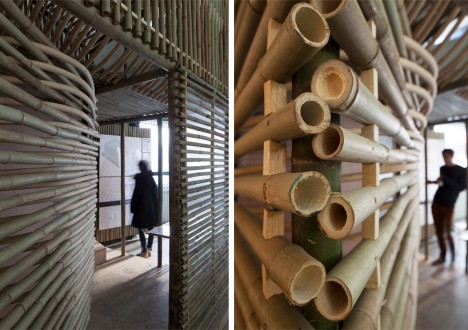
Designed by AFFECT-T, each basic micro-dwelling starts out at  just a few meters in length, width and height, with essential cooking, sleeping and sitting areas. Thanks to their placement inside a larger deserted structure, these units have fewer active-system, insulation and cladding demands than autonomous exterior equivalents would.

bamboo temporary home wall

bamboo factory deserted plan

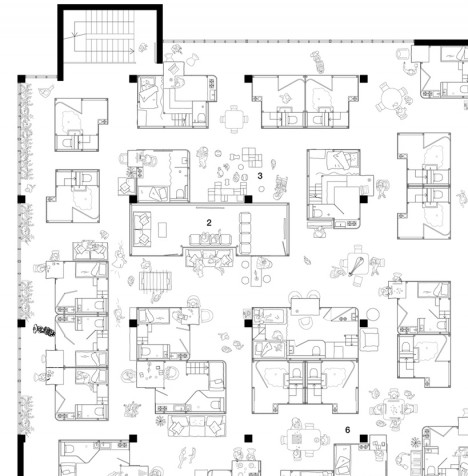
Like a more formalized (less-dystopian) version of Kowloon Walled City, the design calls for community and education spaces to be built into the open spaces of the factory floors and voids between individual dwellings.

modular housing solution proposal

Within the bigger building around them, this group of “homes will be serviced through a singular backbone providing water and electricity to individual units and disposing of waste, while cooling, heating, structure, and enclosure are provided” at scale by their surroundings.

bamboo retrfofit temporary home

At the individual-unit level, flexibility “aids in the overall adaptability of the larger community as units can be joined and easily separated and altered as the population changes. “

bamboo interior dwelling configuration

The demand for such a solution definitely exists: in total, an estimated 280,000 Hong Kong residents are without permanent, stable and legal structures to call home.

bamboo loft room interior

However, these micro-dwelling deployments are conceived of not as a permanent state but, rather, a transitional set of spaces. They simply make maximum use of available materials and existing buildings to create effective temporary communities for a population that needs to be shifted off the streets and out of shacks toward sustainable long-term housing.

Share on Facebook


[ By WebUrbanist in Architecture & Houses & Residential. ]

[ WebUrbanist | Archives | Galleries | Privacy | TOS ]


WebUrbanist

 
Comments Off on Modular Retrofit: Bamboo Micro-Homes in Deserted Factories

Posted in Creativity


DxOMark Mobile report: Sony Xperia Z2 takes top spot

08 Apr

Sony_Xperia_Z2_.jpg

The Xperia Z2 is Sony’s latest flagship smartphone and replaces the Z1. The full-HD display measures 5.2 inches and offers better viewing angles than its predecessor’s 5-inch equivalent. While a new Snapdragon 801 processor and 3GB of RAM offer plenty of power, the camera specification is nearly identical to the Z1’s. Images are captured by a 20.7MP 1/2.3-inch CMOS sensor on a F2.0 lens. Nevertheless, Sony has managed to improve the image quality of its new flagship. Learn more

News: Digital Photography Review (dpreview.com)

 
Comments Off on DxOMark Mobile report: Sony Xperia Z2 takes top spot

Posted in Uncategorized


Blackmagic Design launches Blackmagic Studio Camera

08 Apr

blackmagicstudiocamerahdmftlens.jpg

Touted as ‘the world’s smallest broadcast camera with the world’s largest viewfinder’, Blackmagic Design has announced its new Studio Camera. The Studio Camera employs a 12.48mm x 7.02mm sensor and a Micro Four Thirds lens mount. It also has a 10-inch viewfinder and a four-hour built-in battery. Learn more

News: Digital Photography Review (dpreview.com)

 
Comments Off on Blackmagic Design launches Blackmagic Studio Camera

Posted in Uncategorized


To be or not to be a Street Photographer

08 Apr

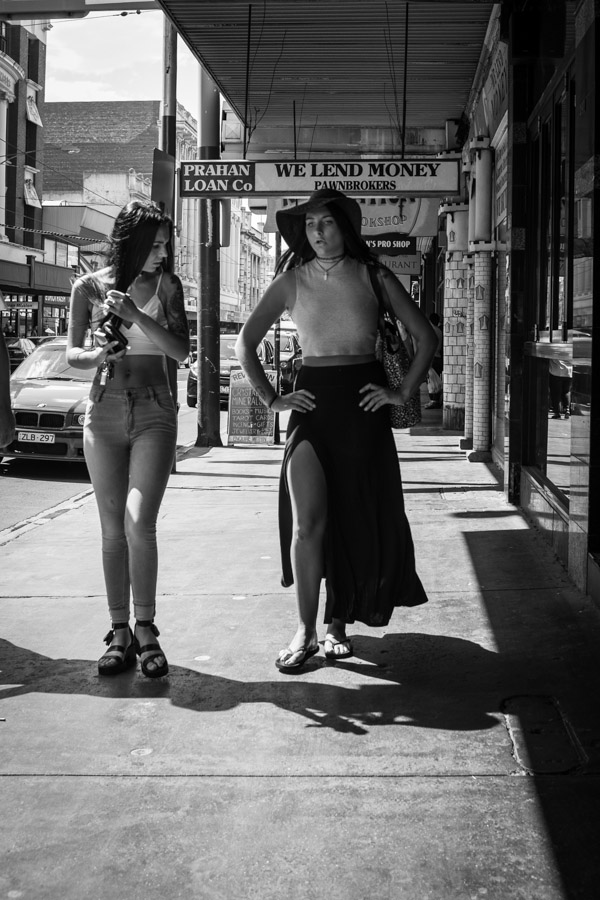
Top 6 Reasons NOT to do Street Photography:

1 – Your pics won’t get many ‘likes’

Most people on social media don’t appreciate the art of street photography. Cats and flowers do get more ‘likes’.

2 – Your prints won’t sell

People usually don’t buy prints of street images unless the photographer is somewhat famous.

©Valérie Jardin

©Valérie Jardin

3 – You won’t make any money doing it

No one is going to pay you to walk for hours with your camera to take pictures of strangers. Period.

4 – It’s intimidating

It can be scary to photograph strangers in the street or to ask a stranger to make a portrait. It’s not for the faint-of heart! You will get rejections and some people may even get angry and confrontational.

©Valérie Jardin

©Valérie Jardin

5 – It requires a lot of patience and a lot of walking

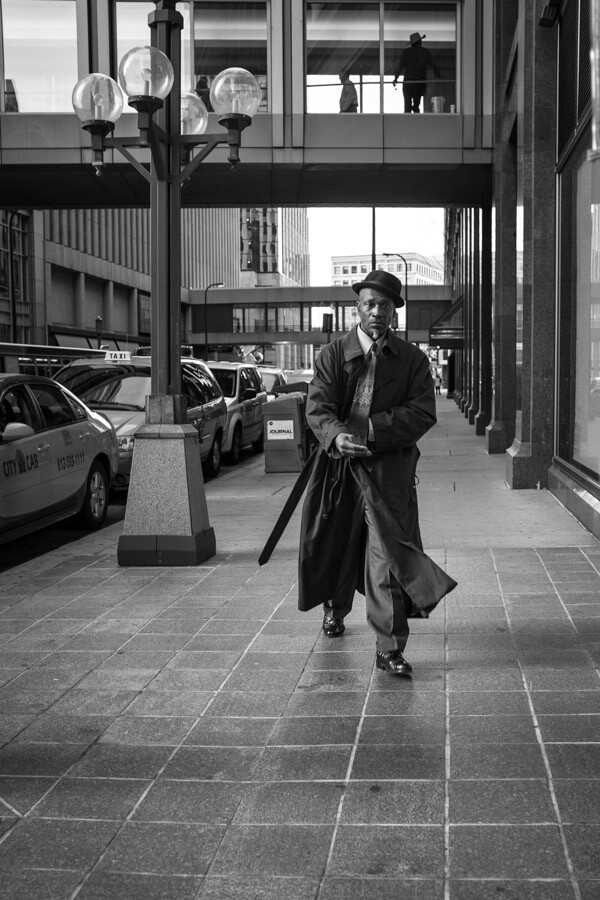
You can be out for hours and go home with an empty memory card. The hunt for the story, the right gesture or expression can take you many miles. You have to learn to be satisfied with just one good shot for the day, if any!

6 – A technically perfect shot does not mean it’s a good street photograph

You only have one shot at getting the shot. That fraction of a second that will never happen again. As a result, many of your best shots will have motion blur and noise. When you have to compromise between the technically perfect shot and the story, the story always wins!

You only get one shot! ©Valérie Jardin

©Valérie Jardin

Top 6 Reasons TO do Street Photography

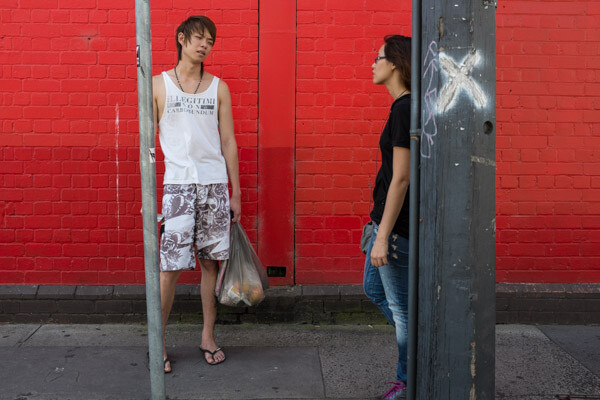
1 – You will be part of a very cool community

Only people who truly appreciate the art of street photography will like your work and it will be a lot more meaningful and gratifying than any ‘likes’ you’d get for a pretty picture. The street photography community is awesome. They are so passionate because they are doing it for the pure love of it, not to please anyone or get recognition on social media.

©Valérie Jardin

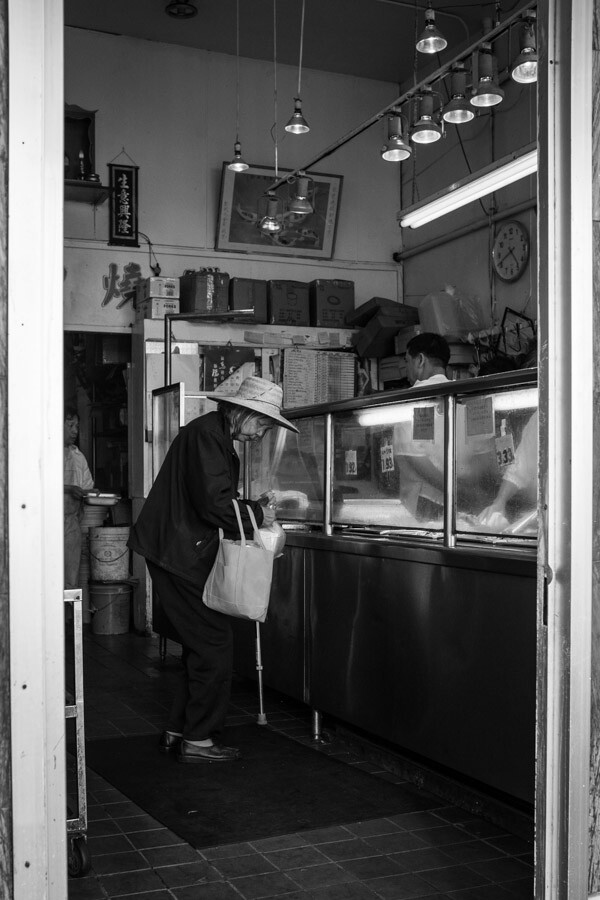
You are documenting life around you.
©Valérie Jardin

2 – You are documenting life around you

Street photography is not a hot seller in the fine art world. As a street photographer, you have to look at the bigger picture (no pun intended). You are creating images that reflect a moment in time that will provide some valuable insight for future generations. Just look at the work of street photographers from 50 years ago, and how much we learn from it. That said, you never know when someone is going to connect with one of your images and want to buy a print. Be open to the idea of an occasional sale but don’t bet the farm on it. 

3 – You shoot street photography for yourself

You won’t get paid to walk the streets with your camera but, on the bright side, you won’t have to compromise with a client either! Make money doing paid gigs on the side, and get out on the streets for YOU!

©Valérie Jardin

The technical aspect of the resulting image is not what street photography is all about.
©Valérie Jardin

4 – It’s addicting

Street photography never really stops being intimidating. But the rush you get is just as powerful as the rush the wildlife photographer gets when she gets that perfect shot of a wolf in the wild. Street photography is thrilling, exhilarating and addicting. 

5 – Walking is good for you!

Street photography will make you appreciate the world around you so much more. You will never be bored again, anywhere! Get a good pair of shoes and get out there, practicing your street photography is one fun way to get your exercise!

Valerie Jardin Photography -Melbourne-2

©Valérie Jardin

6 – You won’t waste too much time in post processing

Street photographers don’t care about noise, they embrace it! Documentary street photography doesn’t require any fancy post processing. A quick exposure adjustment, an occasional crop, a custom black and white conversion if that’s what you like… Et voilà! That’s about the extend of the time you’d ever spend on a picture.  You are capturing a slice of life that will never happen again. It’s not going to be perfect, life on the streets is not perfect! No Photoshop action is going to turn a boring picture into a story. You need to know your camera and be ready to get the best possible shot. With practice you learn to anticipate and be ready without attracting too much attention to yourself. Those rare moments, when the story, the light and the composition all come together, are what keep us roaming those streets tirelessly with our camera.

Street photography is something you can do almost anywhere. As long as there are people. No matter where you are, the number one rule of street photography is respect. As a bonus you will make friends along the way, and that’s a beautiful thing! I will leave you with a quote that, in my opinion, best represents what street photography is all about:

“Get a good pair of walking shoes and… fall in love.” Abbas ~

Those rare moments, when the story, the light and the composition all come together, are what keep us roaming those streets tirelessly with our camera. ©Valérie Jardin

Those rare moments, when the story, the light and the composition all come together, are what keep us roaming those streets tirelessly with our camera.
©Valérie Jardin

Why are you a street photographer? Please share with our readers in the comment section below!

 Need a few tips on practicing your street photography? Check out some of these articles:

  • Practical Tips To Build Your Street Photography Confidence
  • Tips for Taking Street Portraits – Lessons Learned in India
  • In the Dark: 10 Tips for Street Night Photography
  • Using Street Photography to See Beyond the Ordinary
  • How to Approach Street Photography in 12 Easy Steps
  • Street Photography: Exploitative vs Respect

The post To be or not to be a Street Photographer by Valerie Jardin appeared first on Digital Photography School.


Digital Photography School

 
Comments Off on To be or not to be a Street Photographer

Posted in Photography


Südtirol

08 Apr

Lukas Furlan ist 23 Jahre jung, kommt aus Südtirol und studiert zur Zeit in Wien Medieninformatik. Zur Fotografie ist er eher zufällig gekommen, sie hat sich jedoch schnell zu einer großen Leidenschaft entwickelt.

Seine Heimat Südtirol ist dabei das Zentrum seiner Fotos und sieht man sich seine Bilder an, möchte man zu gern zu ihm ziehen oder zumindest mit ihm in die Berge wandern, um diese großartigen Orte einmal mit eigenen Augen zu sehen.

Auch Nachtaufnahmen begeistern Lukas sehr. Oft bezieht er Menschen mit in seine Bilder ein, die so verletzlich klein in diesen gewaltigen Naturaufnahmen wirken. Lasst Euch begeistern und entdeckt das wunderschöne Südtirol.

© Lukas Furlan

© Lukas Furlan

© Lukas Furlan

© Lukas Furlan

© Lukas Furlan

© Lukas Furlan

© Lukas Furlan

© Lukas Furlan

© Lukas Furlan

© Lukas Furlan

© Lukas Furlan

© Lukas Furlan

© Lukas Furlan

© Lukas Furlan

© Lukas Furlan

Haben Euch die Bilder genau so fasziniert wie uns? Dann folgt Lukas doch auf Facebook oder Behance.


kwerfeldein – Fotografie Magazin | Fotocommunity

 
Comments Off on Südtirol

Posted in Equipment


Get the story behind the photograph

08 Apr

12894623965_c2d95f47ef_o.jpg

Most photographs – especially photojournalistic work – exist in a void with little insight from the photographer that captured the image and what they were trying to achieve. ‘The Image, Deconstructed’ looks to turn this around. The website provides interviews with photographers, asking them about their techniques, their gear, their preparation, and their mindsets when they photograph. Learn more

News: Digital Photography Review (dpreview.com)

 
Comments Off on Get the story behind the photograph

Posted in Uncategorized


Vom Davonfliegen und Zweifeln

08 Apr

Ich war noch nie vom Typ Künstler, der viel skizziert hat und wenn ich überhaupt mal etwas skizziere, dann eigentlich nur, weil meine Vorstellungskraft nicht ausreicht, es mir gedanklich auszumalen. Und wenn Skizze, dann ist das bitte auch die direkt Vorstufe zu einem Endprodukt.

Ich experimentiere nicht so viel, nehme nur selten einfach mal so die Kamera in die Hand. Was andere tun, indem sie skizzieren und experimentieren, läuft bei mir im Kopf ab. Ideen kommen, wollen Aufmerksamkeit in Form von Ausarbeitung und Konzeptfindung. Ich überlege mir genau, wie alles aussehen und funktionieren soll, bevor ich einen Finger dafür krumm mache.

© Aileen Wessely; Modell: Luna Leung© Aileen Wessely; Modell: Luna Leung

Dementsprechend habe ich das letzte Jahr, in dem es irgendwie immer zu wenig Zeit zum Fotografieren gab, nicht mit vielen kleinen Versuchen gefüllt, die mich auf dem Weg der Stilfindung voranbringen könnten, sondern mit Nachdenken. Was möchte ich fotografieren, was sollen meine Bilder transportieren und vor allem welche formalen Rahmenbedingungen verwende ich?

Die Antworten auf diese Fragen: Ich möchte weiterhin Portraits in oder mit Natur machen, aber ihr Konzept soll weniger austauschbar sein als bisher, also nicht nur wechselnde Gesichter in wechselnden Gebüschen, festgehalten in den altbewährten Bildschnitten. Aber weiterhin Offenblende und mittlere Festbrennweiten.

© Aileen Wessely; Modell: Luna Leung

Die Stimmung gern düster, seltsam, surreal, aber bitte nicht offensichtlich in den bekannten Schubladen wie etwa Gothic, verletzliches Mädchen in Wald und Wind oder „Conceptual“ mit irgendwelchen schwebenden Gegenständen, wahlweise der Protagonistin. Eher fantastisch, mit der Andeutung einer eigenen Welt. Skizzen von Träumen der letzten Nacht, die nur noch halb fassbar sind.

Diese Wirkung möchte ich mit Effekten unterstreichen, die sich gern an allen verfügbaren Möglichkeiten bedienen: Linseneffekte, Spiegelungen, Entwicklungsfehler, analoge oder digitale Mehrfachbelichtungen, Collagen, gezeichnete Elemente, Animation. Mein Kopf sprudelt ohnehin über, wenn ich diese Büchse nur einmal öffne.

© Aileen Wessely; Modell: Luna Leung

Ich merkte, es ist gar nicht so leicht, Rahmenbedingungen für meine Bilder festzulegen, wenn der Prozess der Stilfindung im Wesentlichen darin besteht, alle anderen Fotos auf der Welt in die Kategorien „Finde ich blöd“, „Finde ich toll, macht aber schon jemand anders“ und „Falsches Genre“ einzuordnen.

Am Ende inspirieren mich ja zum größten Teil doch die Bilder aus der zweiten Kategorie. Es gilt also, diese in ihre Bestandteile zu zerlegen und die Stückchen von verschiedenen Urhebern zu meinen eigenen Präferenzen neu zusammenzusetzen. Ohne aber in das Fettnäpfchen zu treten, dass schon jemand in etwa diese Kombination bedient.

© Aileen Wessely; Modell: Luna Leung

Anfang März hatte ich dann die nötige Motivation, viele Pläne, ein vielversprechendes Modell sowie Katja als Assistentin beisammen. Ich sammelte Stöcker im Wald, baute daraus Papierflügel sowie einen etwas seltsamen Schild. Letzteres für meine Bilder, erstere eigentlich nur für Katjas Bilder, weil mir Flügel schon zu oft gebraucht wurden. Jeder kennt Fotos mit Flügeln.

Vor Ort musste ich aber feststellen, was ich nicht gut kann, egal wie viele Gedanken ich mir mache: Meine Pläne auch konsequent umsetzen, selbst wenn sie vielleicht die Modelle auch mal an ihre Grenzen bringen. Ich lege sogar Ideen vorauseilend ad acta, selbst wenn zum Beispiel noch niemand über die Kälte gejammert hat.
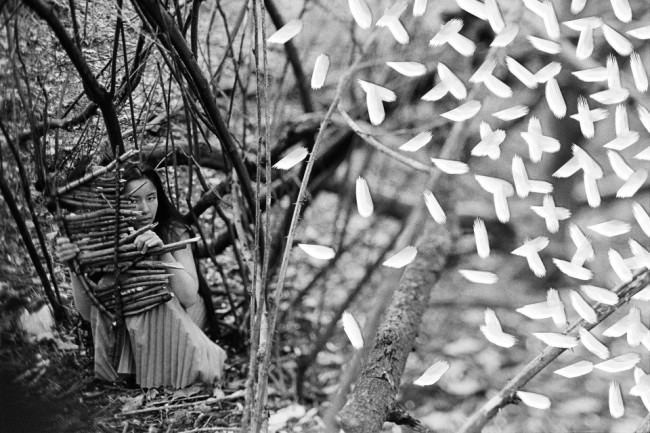
© Aileen Wessely; Modell: Luna Leung

So gibt es lediglich einen Hauch von Seltsamkeit, die üblichen Gesichtsausdrücke und drei von vier Kameras sind die ganze Zeit über im Rucksack geblieben. Kein Kurzfilm, keine Polaroids, kein digitales Material für experimentelle Collagen. Kaum Mehrwert zu den bekannten verträumten Portraits in der Natur.

Das ärgert mich und vergällt mir die fertigen Bilder, obwohl sie – mit abgehakter Checkliste betrachtet – schon ein ganzes Stück weiter an meinem definierten Ziel liegen als die älteren Serien. Es fällt mir schwer zu akzeptieren, dass sie ein legitimer Schritt auf einem Weg sind, den ich nicht mit einem großen Sprung gehen kann, weil er zu weit ist.

© Aileen Wessely; Modell: Luna Leung

Ich überlege mir also, wie ich die nächste Etappe zurücklegen kann und nehme mir ein paar Dinge vor: Das nächste Modell mit dem Ziel suchen, zu experimentieren, Material für Versuche zu sammeln und keine gefälligen Bilder versprechen. Die Effekte, die erst hinterher dazu kommen können, gezielt mitdenken, ihnen beim Komponieren Raum geben.

Zum Fotografieren eine genaue Liste machen: Mit welcher Kamera und ggf. welchem Film möchte ich arbeiten? Welche Accessoires und welche Kleidung werden dabei eingesetzt? Welchen Ablauf gebe ich dem Modell für die Szene vor und welchen Anteil fremder Ideen erwarte ich? Welche Effekte kommen hinterher dazu? An eine vollkommen freie Session denken, um Material für offene Experimente zu sammeln.

© Aileen Wessely; Modell: Luna Leung

Planen ist ja meine Stärke, wie gesagt. Solche Listen erstellen kann ich im Schlaf. Aber die Umsetzung wird jetzt wieder spannend. Vielleicht scheitere ich an einem anderen psychischen Stolperstein, der mich davon abhält. Solange denke ich weiter nach, statt Skizzen zu machen.


kwerfeldein – Fotografie Magazin | Fotocommunity

 
Comments Off on Vom Davonfliegen und Zweifeln

Posted in Equipment