Ein Beitrag von: Bastian Kalous

[ By WebUrbanist in Architecture & Cities & Urbanism. ]

No hoax, it is happening – 20,000 occupants of Kiruna, Sweden, are being forced to pull up stakes and relocate their entire urban center to avoid having it fall off the face of the Earth.


The existing settlement is situated alongside a vast mine that fuels the local economy, but which also responsible for the huge fissures snaking their way toward the heart of the city. As the miners dig deeper, an increasing area of ground is threatened with collapse – at least 3,000 buildings are not expected to survive. Starting immediately, a multi-year effort is underway to shift everything away from the danger zone.


Relocating a whole urban populace is no small feat. As reported by the BBC, “The number of people involved in a project of this scale exceeds the thousands and includes city planners, architects, landscape designers, biologists, urban designers, civil engineers, demolition and construction experts and builders, as well as social anthropologists.” In some cases, whole buildings (like a century-old church) will be deconstructed, moved and reassembled on new sites.

The pressure has been building for some time with citizens having to make difficult decisions about buying real estate and building businesses with this growing threat looming in the backs of their minds. In a way, the definitive decision to break ground on a new town center is a relief to the population, who can now plan their lives around a new known reality. In some ways, too, it is a chance to start over – to build a city from scratch with lessons learned from the existing layout.


Still, there are many questions without clear answers, including: how does the city evaluate the parcels held by existing landowners who have to move, be they residents or business owners? “The Stockholm-based architects White Arkitekter AB, which won the contract to design the new Kiruna, envisages a denser city centre with a greater focus on sustainability, pedestrians and public transport than automobiles.” With a freshly-constructed center, one thing is certain: everything will change – the focal point for the entire built environment of the region is shifting and the future of the city remains uncertain.

It took 1 year, over 1000 photographs and extensive archival research to construct The City of Ruins, a digital stereoscopic reconstruction of Warsaw, Poland …
Click Here to Read More »»
Germany may be known for its green political party and sustainable energy focus, but this daring plan to eliminate the need for automobiles entirely across the …
Click Here to Read More »»

Playful yet thought-provoking, this project asks: what do we do with small leftover spaces in cities … particularly in urban areas where even a few …
Click Here to Read More »»


[ By WebUrbanist in Architecture & Cities & Urbanism. ]
[ WebUrbanist | Archives | Galleries | Privacy | TOS ]
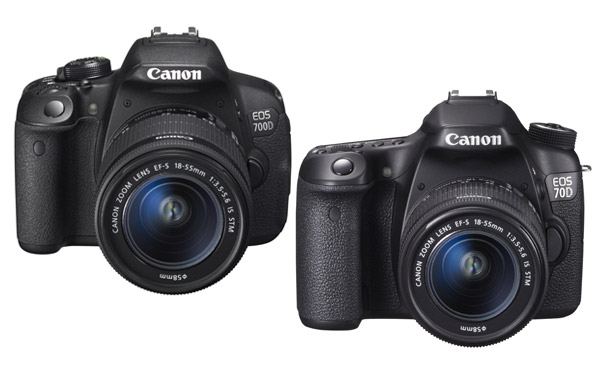
Earlier in the year I compared the EOS 5D Mark III and 6D, Canon’s least expensive full-frame cameras. Today I’m going to look at two other models that cause confusion: the Canon EOS 70D vs Canon 700D (Rebel T5i).
Note: North America readers will know the EOS 700D as the Digital Rebel T5i. EOS 700D is the European name for the same camera. It is called the Kiss X7i in Japan.
The confusion arises because many photographers, when buying a new camera, start by searching online for information. While there are lots of websites that list the differences between the two cameras, it isn’t always easy to understand which of these matter to you.
I’m going to start by looking at the major points of differentiation between the two models. It’s impossible to list them all, but these are the ones most likely to influence a buying decision:
Budget is an important part of the buying decision, and there is a sizeable difference in price between the two models. At the moment you can buy the EOS 700D (Rebel T5i) body only for around $ 700 and the EOS 70D for about $ 1100 (body only prices, excluding tax). The difference isn’t really surprising considering the difference in specifications between the two models.
Bottom line: If you’re on a tight budget then the EOS 700D (Rebel T5i) is the model for you, but not before considering the benefits of the 70D.
Not really a big deal in today’s world of high megapixel digital cameras, but it may matter to some. The EOS 70D has a 20.2 megapixel sensor compared to the EOS 700D’s (Rebel T5i) 18.0 megapixels.

The sensor of the EOS 70D. Both cameras have an APS-C size sensor with a similar megapixel count.
Bottom line: The difference between the two models is negligible, and shouldn’t greatly influence your decision.
This is a big difference. Minor differences aside (and excluding AF in Live View or movie mode), the autofocus of the 70D is the same as that found in the more advanced Canon EOS 7D camera. It has 19 cross-type AF points (the more reactive ones) plus a transmissive LCD screen in the viewfinder that lets you configure different display options.
By contrast the EOS 700D (Rebel T5i) has 9 cross-type AF points and a fixed viewfinder display. This diagram shows the difference between the two:
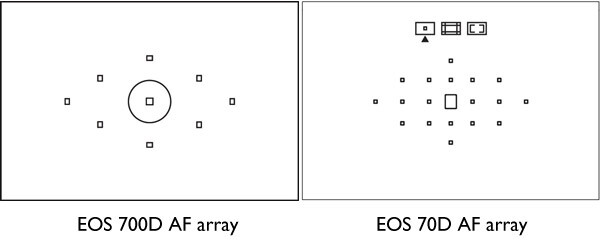
The autofocus arrays of the EOS 700D (Rebel T5i) and 70D compared
The higher AF point count of the EOS 70D makes it better for shooting moving subjects, as there are more AF points to measure the focusing distance to the subject. It is also more likely that you can find a well placed AF point to use when photographing still subjects, without having to focus and recompose. This is useful when using prime lenses at wide apertures, where the margin of error for focusing is small.
The autofocus of the EOS 70D also excels when using the camera in Live View or movie mode. It uses new technology called Dual Pixel CMOS Autofocus, the only EOS digital SLR to do so. This is mainly of interest to people who want to use the camera to shoot movies.
You can read about the autofocus performance of the EOS 70D in more detail in my article Understanding EOS Autofocus: The EOS 70D.
Bottom line: The autofocus performance of the EOS 70D is much better than that of the EOS 700D (Rebel T5i). If you want to buy an EOS digital SLR to shoot movies, the 70D currently has the best AF performance in movie mode.
The EOS 70D allows you to calibrate your lenses so they focus as accurately as possible. This is a feature found only on higher end Canon cameras and will appeal in particular to photographers who use prime lenses at wide aperture settings, where AF performance is critical. The EOS 700D (Rebel T5i) doesn’t have this feature.
Bottom line: Autofocus micro-adjustment complements the more advanced autofocus of the EOS 70D. It is Canon’s least expensive camera with this feature.
The Quick Control dial is one of the features that differentiates mid-range EOS cameras such as the EOS 70D from enthusiast level models like the 700D (Rebel T5i). It is located on the back of the camera where it is easily moved by your thumb when holding the camera. The benefit of the Quick Control dial is that it lets you adjust exposure compensation and focus point selection easily while looking through the viewfinder. This speeds up the photo taking process and may make the difference between getting a shot and missing it. The cross keys on the EOS 700D (Rebel T5i) can be used while looking through the viewfinder, but are much harder to do so.
This diagram shows the difference between the two:
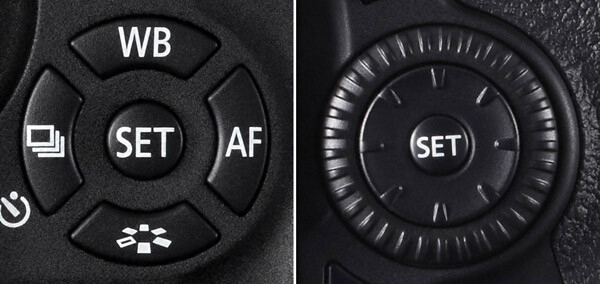
These photos show you how the Quick Control Dial (700D/T5i – left image) and (70D – right image above) cross keys influence the design of the back of the camera:
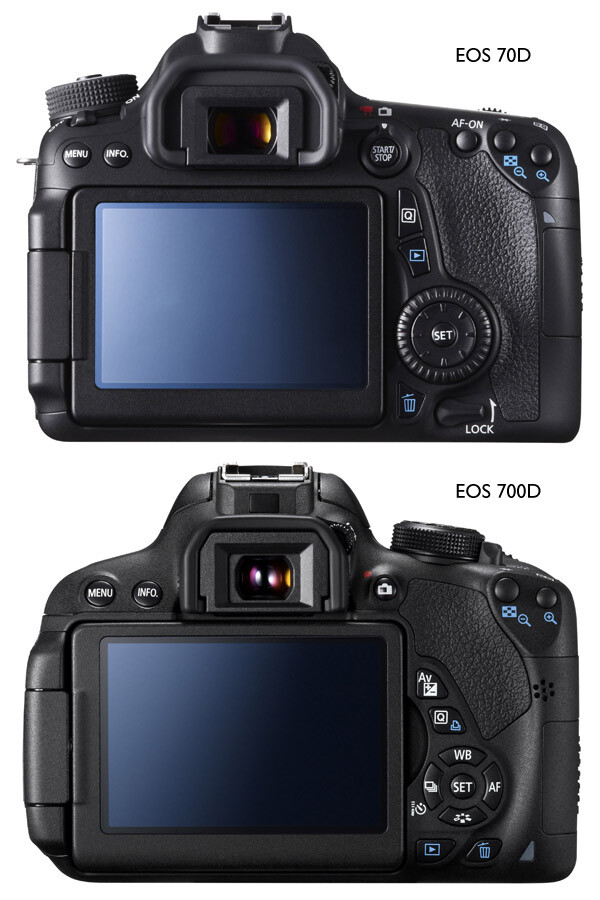
Another advantage of the Quick Control dial is that it lets you scroll very quickly through your images when playing them back on the camera’s LCD screen.
For me, the Quick Control dial is so useful that I never want to use another camera without it.
Bottom line: The Quick Control dial on the EOS 70D makes it easier and quicker to use in many situations. This is something you can only appreciate by trying the camera out, so make sure you do so before making a buying decision.
The EOS 70D isn’t a great deal bigger than the 700D/T5i, but it is heavier (755 grams/1.6 lbs. compared to 580 grams/1.3 lbs.). If you are intending to carry the camera around all day, then the lighter 700D/T5i may have more appeal. But it really is subjective, and this is where the hands-on comparison comes in again. I cannot stress the importance of trying out both models to see which one you prefer to handle.
Bottom line: Try before you buy, as preferences when it comes to size and weight are personal.
The EOS 70D has built-in Wi-fi, the EOS 700D/T5i doesn’t. The Wi-fi feature lets you:
You can’t do any of those things with an EOS 700D/T5i, nor can you buy a Wi-fi unit for the camera.
Bottom line: If Wi-fi is important to you, then buy the EOS 70D. If you shoot tethered in a studio, remember you can transfer images to a computer using an extra long USB cable if your camera doesn’t have Wi-fi.
The EOS 70D has an electronic level display that you can view on the LCD screen. It is useful for taking photos with a level horizon when you have the camera mounted on a tripod. There is also an electronic level display in the viewfinder to help you keep the camera level when shooting hand-held. The EOS 700D/T5i doesn’t have this feature.
Bottom line: The electronic level is a useful feature, especially for landscape photographers. However, if your budget doesn’t stretch to the EOS 70D, remember you can buy an inexpensive spirit level that fits in the EOS 700D/T5i’s hotshoe for landscape photography.
The EOS 70D can shoot at 7 frames per second (fps), the 700D/T5i is a little slower at 5 fps. How important this is depends on the subjects you shoot – it is more likely to be of interest to those of you into sports and wildlife photography.
Bottom line: The more advanced autofocus and higher shooting speed of the EOS 70D makes it the better model for sports and wildlife photography.
There are lots of minor differences between the two cameras, so I’ve provided some links to in-depth reviews so that you can get more information before making a purchasing decision. You’ll also see some photos taken with both models. In the meantime, if you own or have used either of these cameras, why not tell us what you think in the comments. Why did you choose one or the other, and do you think you made the best choice?
Finally, if you want to ask owners of these cameras what they think, a good place to do so is the EOS magazine forum. It’s a high quality forum with lots of helpful members. You should also take a look at EOS magazine – the most in-depth magazine for Canon EOS users you can buy.
For more reviews and discussion on cameras and equipment see our Cameras section!
Understanding EOS – a new ebook
 My ebook Understanding EOS is written for photographers who want to learn to get the best from their EOS cameras. It teaches you everything you need to know to take control of your camera and start creating beautiful photos. Click the link to learn more.
The post Review Comparison of the Canon EOS 70D vs Canon 700D / Rebel T5i by Andrew S. Gibson appeared first on Digital Photography School.
[ By WebUrbanist in Design & Fixtures & Interiors. ]
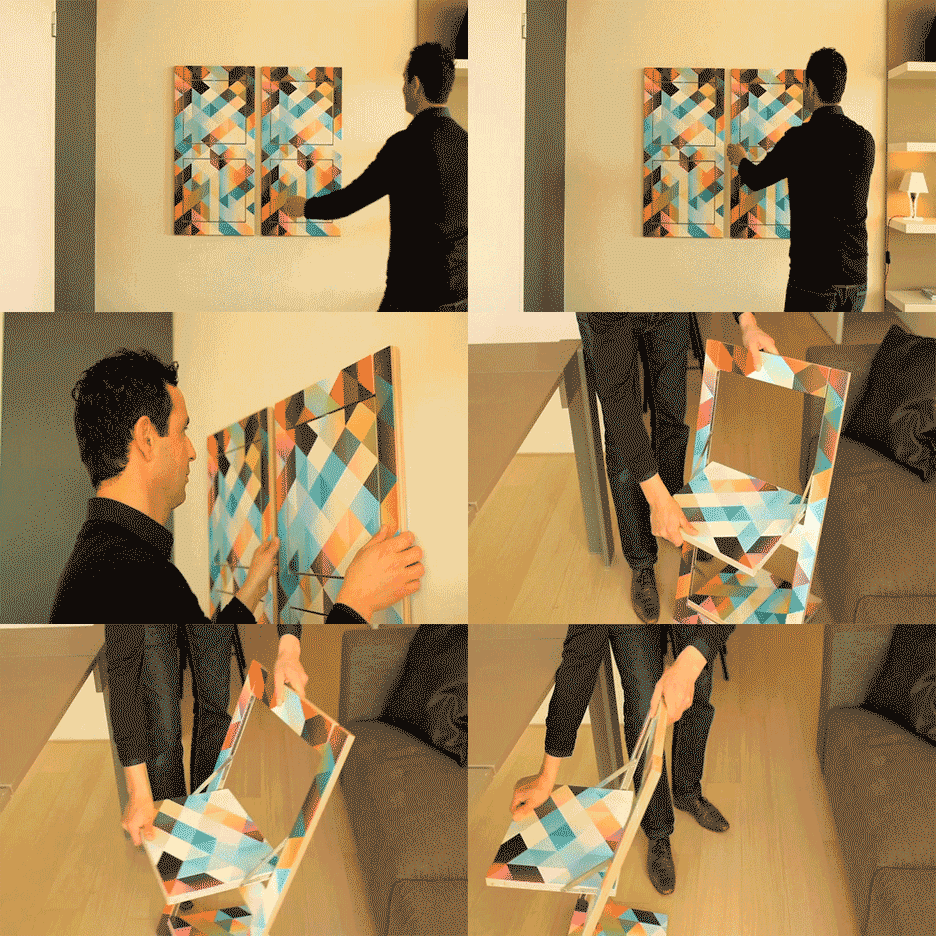
With a mostly-open floor plan tucked into 60 square meters of space, the design challenge was to effectively fit the functionality of five rooms into the footprint of two.
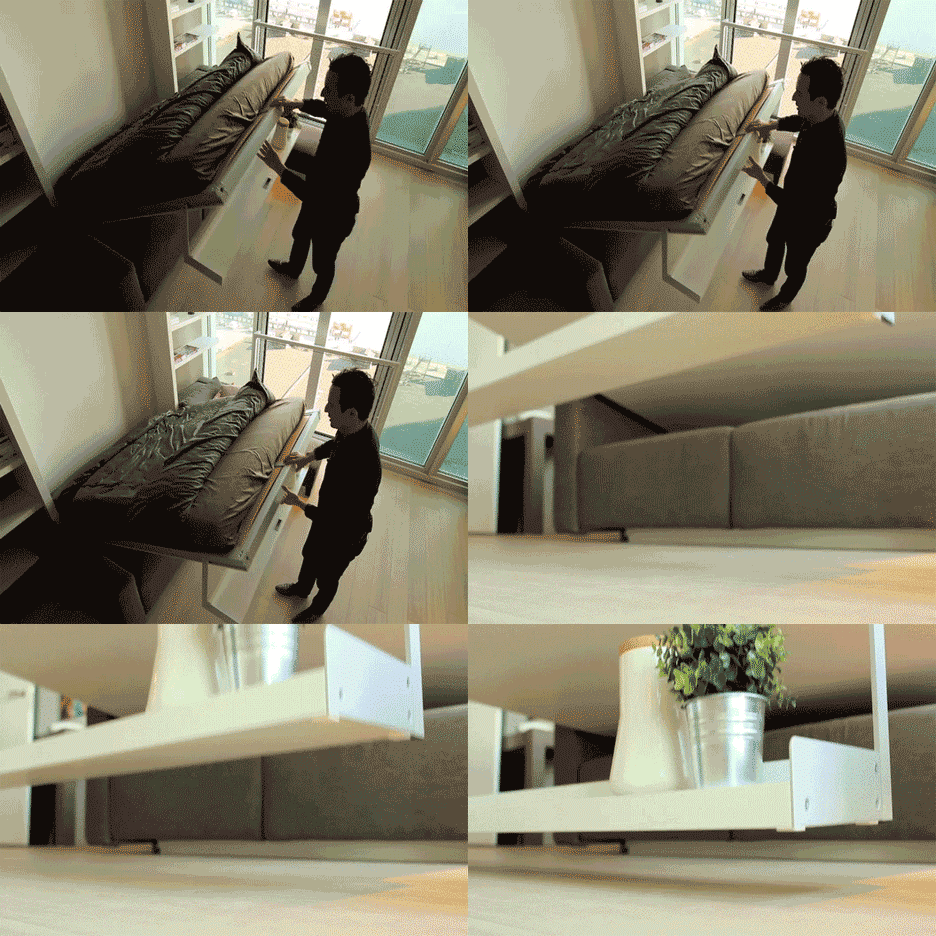
The De Rotterdam project by star architect Rem Koolhaas, a Netherlands native and head of OMA, is the biggest building in the country but, being all about density, sports some of its smallest apartments as well.
A series of convertible furniture designs by Clei Italia makes it possible to expand side surfaces into dining tables, hang spare chairs on the wall and turn both desks and sofas into beds on demand.

The project’s developer, Wim De Lathauwer, explains that the Dutch are used to thinking in multi-functional terms – making the most of every inch (or rather: centimeter) of available area.
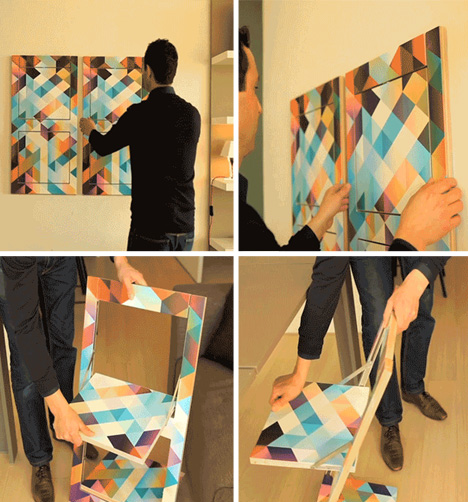
The approach not only to makes these small apartments livable for singles or couples, but also to allow the units to support surprisingly large gatherings and overnight guests as well. The living room and kitchen combination becomes a bedroom, dining room or office as needed.

Beyond merely extending solid ground like most downtown-on-the-water expansions, this project creates new mobile infrastructure right out on the waves.
Click Here to Read More »»

Combining ancient earthen-architecture approaches and cutting-edge robotic technologies, this contour crafting process promises a revolution in how we address …
Click Here to Read More »»

From tetris tables to sofa beds on steroids, shelves that fold down into seats or that double as decor and much much more.
Click Here to Read More »»
[ By WebUrbanist in Design & Fixtures & Interiors. ]
[ WebUrbanist | Archives | Galleries | Privacy | TOS ]

The Wall Street Journal has discovered a patent filing with the Korean Intellectual Property Rights Information Service that seems to indicate Samsung is experimenting with transparent displays for digital cameras. The idea behind the concept is that the photographer and their subject can maintain eye-contact while the image is being framed. Learn more

The Sony Cyber-shot DSC-RX10 looks at first glance a bit like a high-end superzoom with its 24-200mm equivalent F2.8 lens. That’s a fairly modest range by modern standards, but then the camera’s 1″ sensor is very large compared to conventional superzooms. Sony has put a lot of effort into the camera’s video capabilities and tools, making it more than just a stills shooter, but are the sum of these parts enough to make the whole worth $ 1300? Find out in our review
 Extra photos for bloggers: 1, 2, 3 Extra photos for bloggers: 1, 2, 3 |
|||
The secret behind the very best pix on Instagram is that they’re not exactly “insta.”
Most wow-worthy shots have had some work done.
It takes a few edits to transform a good photo into a holy-smokes-wow photo.
Today, we’re bringing you a step-by-step look at one such transformation.
Watch one photo go from neat to woah-woah-wow and pick up some editing hacks and app recommendations along the way.
Learn to Edit like An Instagram Master, All On Your Phone!
(…)
Read the rest of Apps and Hacks for Editing On Your Phone (466 words)
© laurel for Photojojo, 2014. |
Permalink |
No comment |
Add to
del.icio.us
Post tags:
There’s really no question that wedding photography is one of the most common forms of professional photography and if you’ve recently become the owner of a DSLR odds are sooner or later someone you know might ask you to photograph their wedding. Though this might be a tempting offer, I want you to think long and hard before saying yes, because photographing a wedding is a lot more than pointing a camera and capturing the moments. To help drive home this point I’m telling a bit of a story today.
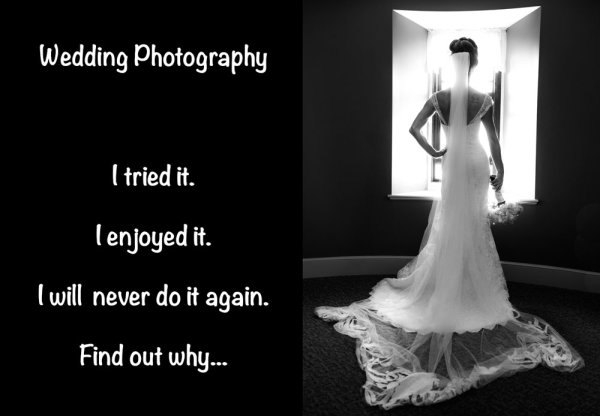
My story is about why, even though photographing this wedding was the best experience of my photography life, I more than likely won’t be photographing another wedding anytime soon.
I don’t want you to think that I’m here to tell you that it’s a bad idea to get into wedding photography, or even that my first (and last) time as a wedding photographer was a bad experience. Neither of these are the case – in fact I quite enjoyed photographing this wedding, but there are some things that I learned about myself which would make me hesitate if I were asked to do it again.
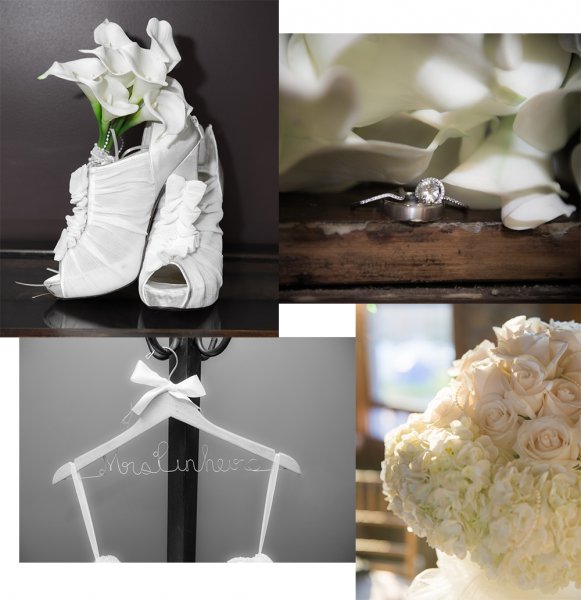
Like most new photographers these days I created a website, set up a Facebook page, and started sharing my photos on a daily basis. Over time I noticed that my page was growing with not only my immediate friends, but friends of friends, and even people I didn’t know – I guess you could say I started attracting a following.
After a couple of years of sharing landscape and wildlife shots from around the New England area, one of my sister’s friends reached out to me and asked if I’d photograph her wedding.
My first instinct was to say “I’m not a wedding photographer – why are you asking me?”. So I sort of brushed it off as a random thing, but she insisted that she liked my style and wanted to work with someone she knew and trusted. If there’s anything to my credit – I’ve always been a hard worker. So, as this post requires that I photograph a wedding, you probably won’t be surprised to hear that I eventually did commit to the job.
And I mean months!
The bride-to-be was extremely organized and prepared, having everything booked months in advance – in fact – the photographer was one of her last jobs to tackle. After accepting the job I had nearly a full year to learn as much as I could about photographing weddings and that’s exactly what I did. This three part series here on dPS: Wedding Photography 101 (Part 1), Wedding Photography 101 (Part 2), Wedding Photography 101 (Part 3) should be on every prospective wedding photographer’s reading list. But a quick search for “wedding photography” on dPS will yield dozens of other great reads.
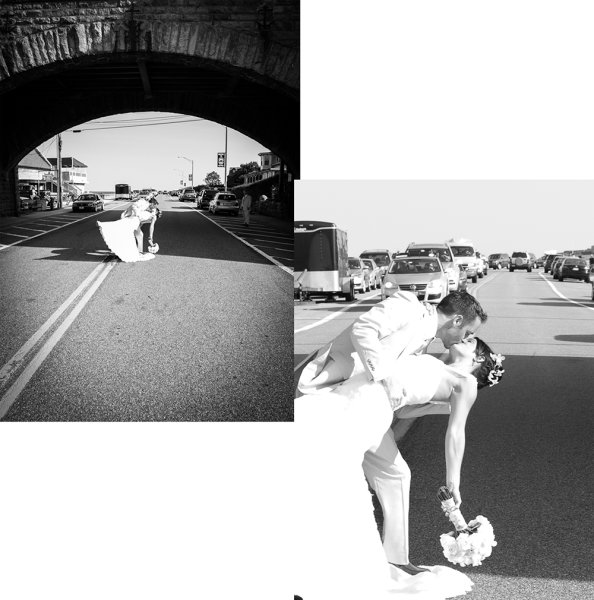
However, all the reading that I was doing, really couldn’t prepare me for the real thing. Emotions, stress, time crunch, uncontrollable problems, and anything else that you can pack into the ten hour day – you simply can’t read that, so I enlisted the help of a professional. I reached out to a local photographer, who worked closely with a friend of mine, and he was kind enough to allow me to shadow him, and even second shoot for him on a couple of occasions.
This experience gave me a huge boost of confidence going into the event, and I highly recommend reaching out to your own local wedding photographers prior to photographing a wedding on your own for the first time. The experience is priceless.
The final bit of preparation was gear related – I was being paid for this shoot and as a landscape/wildlife photographer my ultra-wide angle and telephoto zooms were not ideal for the task at hand. So I spent a little of the money that I was paid for the wedding to rent a second camera (you can never be too prepared) and a 24-70mm f/2.8 lens which would be my workhorse for the night.
Due to my preparation and my commitment to wanting to provide the best possible photographs that my ability would allow, I’d say the wedding was a success. The bride and groom got photos that they will enjoy for the rest of their lives and I learned more than I could ever have imagined in a very short amount of time.
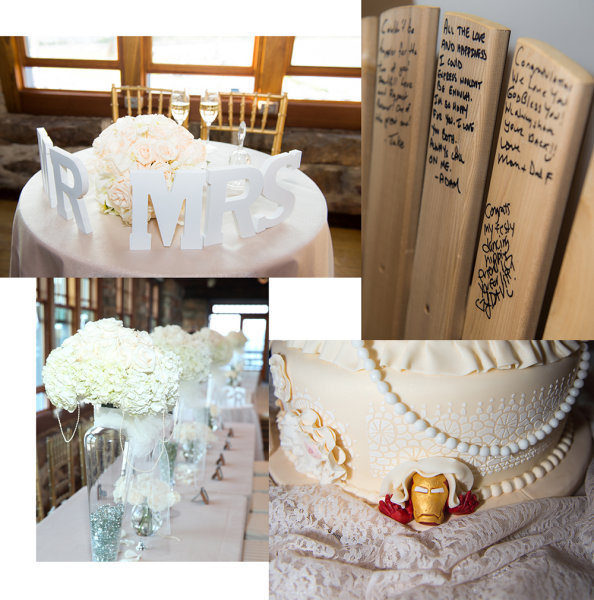
The day of the wedding I was at my wits end, running on pretty much pure adrenaline at that point. I had a list of ‘must have shots’ which I was able to check off throughout the day and night. It’s hard to imagine that the event lasted as long as it did, as it all went by so quickly, with barely a break for food or drink. All said and done, I left the reception after the last dance feeling confident that I had done the best that I could. So why never again?
There’s no question that this was a valuable experience. I learned more about myself as a photographer photographing this wedding than I had in the nearly 3 years of photographing landscapes, but I’d also learned that it wasn’t for me. I enjoy the peace and quite of nature and the ability to go back to the same location to fine tune the shot over a period of time and lighting conditions. Weddings are a one shot deal – you get the light you get – you get the weather you get, and you get one shot to make it happen.
You have to be a people person – something I am not. Going around to get various people that I didn’t know together for photographs was hard enough when there were actually a handful of people that I did know at this wedding (sister’s friend remember?). I don’t think that I could do this on my own, without help, and without a lot more practice. So I urge anyone who’s thinking about photographing a wedding to not take it lightly. It’s an important day for a lot of people – not just the bride and groom – but their parents, extended family, and friends will want to remember this day as well so you MUST get it right.
The moral of this story is that wedding photography can be a very rewarding experience, but you have got to put the work into it. If you are thinking to yourself that it will be an easy job – think again. Oh and please – don’t ever do this for free – being paid to shoot this wedding was what motivated me to find help, rent gear, drive to their location and process hundreds of photos – the experience was a bonus.
Editors note:
Having done somewhere in the neighbourhood of 250 weddings in my time, I can concur that everything John has said is absolutely true, and some of the same advice I give people considering doing one for the first time. Being prepared is the number one thing I can say also. I remember wanting to throw up the entire first year I did weddings, the pressure is THAT intense. These are people’s memories and not something to take lightly. I too, like John’s mentor did carry such an emergency kit and can tell you I’ve used deodorant, men’s black socks, nylons, clear nail polish to stop runs in nylons, safety pins, After Bite for bug bites, Visine, allergy meds, Stain remover (get the stick, takes grease right out of a wedding gown), nail glue, bug spray, sunscreen, and more. John gives great advice from his experience – heed it well.
The post The Story of Photographing my First Wedding also Likely my Last by John Davenport appeared first on Digital Photography School.
Ein Beitrag von: Wolfwendy
Hier liegt die Welt so blank vor mir, kalt und klar unterm Nebelschweif; ein Stück glatten Steins, grau und weichgewaschen vom Algenwasser, dessen Zügel das Tosen längst fernab getrieben hat, hin, wo auch die Wolken wiegen müssten.

Warum fallen diese Wolken nicht runter, warum fallen sie nicht runter, warum fallen sie nicht auf mich drauf, in mich rein? Die weißen Adern zeichnen einen Wald, der sich in Blau erstreckt, das dann als ein Hauch zerfließt, beim letzten Versuch, es zu ergreifen.

Klar ist hinter dem Bild: Der Zugriff. Das Geiststörende im Dauerzustand der Befreiung. Weiteres verschüttet sich, gräbt sich rein und rum im nassen Sand. Wenn man so will.
Die Transformation zum Feuerbach‘schen Blumenstillleben. Hier leuchtet die Ohnmacht, wie in meinen Augen alsbald die reflektierten Wellen-Teilchenwellen, alsbald die reflektierten Wellen-Teilchenwellen nicht, und wieder, und so weiter. Das Veritable im Dauerzustand der Befreiung.

Die Verwehung treibt sich an, hin fort zum Horizont. In meiner Brust ein Mondfischlicht, solang wir ein Caspar David Friedrich sind.
Und ich widme das Glitzern der See nicht ernsthaft der großartigen Relativierung, die uns doch bitte jetzt beistehen möge.
Eine schwache Hand hängt fahl an meiner Seite und die äußerste Regung starrt in der Ahnung, dass sich irgendwo ein Wind auftat, der dieses Bild hier nur kurz ablegte.

Es wird Zeit zu glauben, dass die Vögel zu mir sprechen. Ich stopfe mir das ganze Laub in den Brustkorb, um den Herbst zu retten.
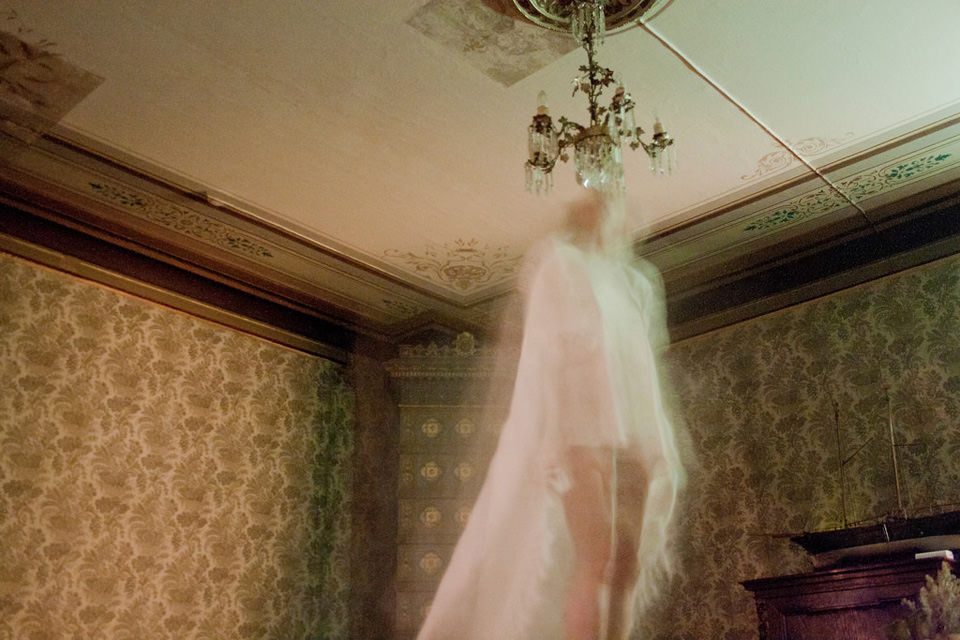
Meine Freunde träumen, ich würde ihre Wohnung unter Wasser setzen, damit ich mein eigenes Meer habe. Der Mondfisch: Nur noch fahle Schuppen und Knochen. So liegt er da. Gute Nacht, gutes Alles, immer.

Hier liegt eine Welt so blank vor mir, kalt und klar als ein Traum unter einem Traum und der Traum ist nichts als diese Welt und die Welt bleibt der Wind und kalt und rot werden die Wangen von den Eissplittern, die aufs Gesicht gejagt werden.

Und blau sind die Ränder unter den Augen, die bangend um die letzten Meter den weitesten Punkt fixieren, der nur erreichbar ist, indem unsere Blicke uns hin tragen. Das ist die Kunst.
I’m excited to announce today two new books of my photography to be published over the next few months. The first is a new 72 page soft-cover Monograph titled "Mexico: The Light and The Warmth" published by LensWork. The second is titled "Michael Reichmann – a 20 Year Photography Retrospective". Designed by Arturo Chapa, one of the world’s top book designers, this large format, cloth bound, hard-cover book will have 400 pages, containing 380 images. It will be available in two editions; a signed limited-edition in a clam-shell style slip-case, and also in an open edition without slip-case.
I am also making an initial announcement today of The Luminous Endowment for Photographers, a not-for-profit entity which will provide scholarships, grants and awards to photographers world-wide.