RSS
 

Archive for February, 2014

Blossoming Technology: World’s First Inflatable 3D Print

04 Feb

[ By Steph in Gadgets & Geekery & Technology. ]

Worlds First Inflatable 3D Print 1

3D printers are now making it possible to quickly and economically ‘print’ everything from haute couture to full-scale architecture, medical prostheses to cars. Now, the technology has advanced enough to blend two different materials in a single print to make them stronger and more functional. ‘Blossom,’ a project by designer Richard Clarkson, not only produced 3D-printed flowers made from two materials with properties ranging from flexible to rigid, he also made them inflatable.

RichardClarkson-Blossom

Believed to be the world’s first inflatable 3D print, Blossom is a series of flexible artificial flowers that can be inflated with air so they ‘bloom’ like real flowers. Completed in 2013 but just now released to the public, the project incorporates a rubbery black material called Tango Black for the petals and a clear, solid substance called Fullcure 720 for the center and stem.

World's First Inflatable 3D Print 3

While this project may not be as immediately practical as many other 3D printing demonstrations, it gives us an intriguing look at what might be possible in the future, pushing past limitations that have held innovation back in this field.

Worlds First Inflatable 3D Print 5

“As in nature, materials can be distributed seamlessly within objects for structural and functional advantage,” says Clarkson. “The variation offers an opportunity to generate complex forms and dynamic structures that are impossible to make by any other means.”

Share on Facebook


[ By Steph in Gadgets & Geekery & Technology. ]

[ WebUrbanist | Archives | Galleries | Privacy | TOS ]


WebUrbanist

 
Comments Off on Blossoming Technology: World’s First Inflatable 3D Print

Posted in Creativity


15 Tips for More Powerful Portraits

04 Feb

15 tips every portrait photographer must know for making more powerful portraits!

Powerful portrait tips 01

Here are 15 tips on getting powerful portraits

1. Have respect

This is my number one rule. It doesn’t matter if I am photographing a poor boy in Laos or the CEO of a large company in New York-I always respect the people I photograph. I live by the motto: “you should never get close to people in order to take their photo; you should take their photo in order to get closer to them”. Act as if your camera is a bridge and not a weapon. I have friends who are amazing street photographers, who manage to work with such discretion that they can get the portrait without the person realizing he was photographed. Certainly, there are some exceptions, but I believe that people are not zebras and we are not hunters. To summarize the point, I photograph old people in same manner I would like someone to take pictures of my grandmother.

Powerful portrait tips 04

2. Ask yourself – Do I understand what a portrait is?

“A Portrait is painting, photograph, sculpture, or other artistic representation of a person […] the intent is to display the likeness, personality, and even the mood of the person” (from Wikipedia)

While this is a very basic definition of the concept, it can help us to understand the true nature of good portrait photography. A portrait must tell a story. What kind of story? A story about the person in the image. How can you tell a story of a person in one image? You can’t! You can never capture the whole story, because human beings are too complex. You can either choose to focus on a specific emotion expressed by the subject or by yourself. I call the first method “highlighting”, in which you zero in on a specific story, at a specific time.

Powerful portrait tips 02

For example: when I took the photo of the Japanese girl (above) I was trying to highlight this specific moment, when she held her mother’s hand, when she has not yet decided – whether to leave or hold on tight. Sometimes the best stories don’t reveal the whole story at once. Like in this image from China (below). Do you think this girl is waiting for someone who should be coming soon, or is she watching someone leave?

Powerful portrait tips 03

The second method, in which you imprint your on feeling onto the story, can start with answering the following question: How did you feel when you met this person? Because a good image is told by two people – the one in the image, and the one behind the camera.

3. Look for emotion

Someone’s exotic face from some remote tribe is nice to look at, but for it to be a true visual storytelling portrait, this face must evoke emotion. Steve McCurry called this the “unguarded moment”, the essential soul peeking out. It can be happiness, fear or excitement. Emotion is the best way to create a bond between the image and your viewers.

The best way to “catch” emotion on your camera’s sensor is by choosing the right moment to click the shutter. Be on the lookout for a specific powerful moment that can evoke the story on the person’s face.

Powerful portrait tips 05b

4. Start with your comport zone

Going out to the streets to shoot portraits of strangers is not an easy task to start with. The best way to hone your craft is by starting with a person you already know. By skipping the need to “break the ice”, it will be easier for you to think about other important elements in your portrait, such as: the light, composition, posing and color. You don’t have to travel far for an interesting face; you can start with friends and family.

Powerful portrait tips 11b

5. Get out from your comfort zone

A day without learning something new is a wasted one. One of the most important things to note when dealing with portrait photography is that usually, the problem is with ourselves. “I do not want to hurt or offend”, and “I do not want to invade someone’s privacy” are all excuses which we tell ourselves on why we photograph people with a telephoto lens from a distance. So, if you truly want to take your portrait photography to the next level and be able to evoke emotion in your work, you must, as my mother says: “fake it till you makes it”. It is not as complicated as it seems in your head. Get out to the streets, find an interesting person and just go for it by saying: “Hello, I am a photography enthusiastic and I would like to take your photo…I would love to send you a copy as well”. You might be surprised with the results. By using this technique, the worst thing that can happen is that you will get a refusal and then just move on to the next person.

Powerful portrait tips 08

6. Choice the right focal length

“What is the best lens for portraits?” is a very common question among my students, and the answer is simple – there is no one best lens for portrait photography. You should adjust the focal length to your working style. When considering your next lens, you should take into account the following elements:

  • The distance from which you usually like to photograph people
  • The weight you are willing to carry around
  • What is the maximum aperture for low light photography and for shallow depth of field?
  • And of course, price

For me, most of my portraits are done with an 85mm or 24-70mm lens.

7. Choice the wrong focal length

Try this creative exercise. Go outside and take a portrait with a lens you are not used to working with. If you always work with a telephoto lens, try using a wide angle one. If you prefer to get close to your subject, take a step back and wait for the decisive moment. A good photographer is a flexible one.

Powerful portrait tips 10b

8. Study the great masters of portrait photography

Whenever I need inspiration, I turn to the portfolios of this great photography masters:

  • Dorothea Lange – one of the first photographers of Social realism
  • Steve McCurry – probably the best color portrait maker in history
  • Richard Avedon – unique fashion and portrait photography
  • Sebastião Salgado- outstanding B&W documentary portraits
  • Annie Leibovitz- Editorial portraits

(Please add your own in the comments section)

Powerful portrait tips 19c

9. Experience variable depth of field

We all love portraits with that sweet low depth of field, which makes everything blurry in the background. In portraits, shallow depth of field is usually good because it leads the viewer’s eyes directly to the subject by making it sharper than the rest of the image. YET, please note that there is such a thing as a too shallow depth of field. In this case, the sharpness by the AutoFocus may be on the eyebrows or eyelashes instead of the eyes. Practice in order to understand the elements that affect the depth of field: the distance to the subject, focal length and aperture.

Powerful portrait tips 13

10. Leave the flash behind

The more gear you have with you, the less available you are to give attention to the person you are photographing. If we are dealing with studio photography, then the person knows what to expect. There is no need take your flash to India or China when there is so much beautiful available light. Craft your skill while working with natural light only BEFORE jumping to the next step of using reflectors, flashes or any other extra gear.

Powerful portrait tips 14

11. Don’t follow the crowd

Try this little exercise: type “woman with cigar in Cuba” into Google and see what happens. The same woman appears in almost all the images right? Those are images of many different photographers. I do not mean to hurt anyone, but how come with 3 million people visiting the country each year and with a population of 5,612,165 women, the same woman comes up in almost every image? Here’s a tip for you, before heading somewhere, anywhere, near or far, you should understand the place, culture and the “story” of the person in front of you. By doing your homework you will not fall into the trap of the “fake authenticity”

Powerful portrait tips 15

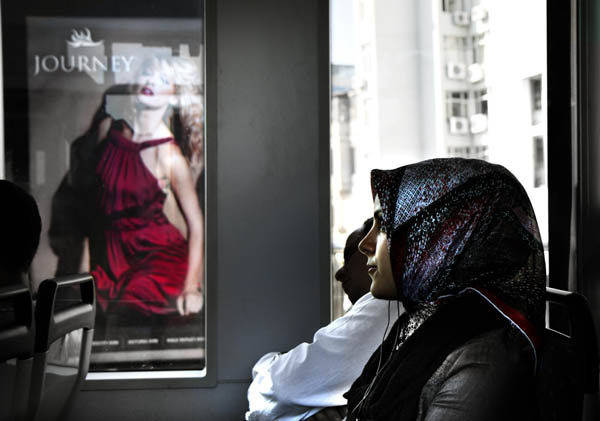
12. Think about the background

Many elements are required to create an interesting portrait: light, composition, angle, etc.., but one element is so important that I sometimes give it my pure attention: the background. You can think of the background in two levels. First, as an aesthetic element. Make sure there are no distracting elements, such as bright colors or moving objects in the background. Secondly, another level of using the background, is as an element to bring your story to life.
Powerful portrait tips 16

13. Keep it fun

If you are dealing with subjects who are not paid models, you should give something back as well as taking the photo. I do not want to discuss paying the person (maybe in another post) but you should make it easy and fun for your subject: telling a joke, showing the image on the back of the camera and making sure they are not in the sun are good points to start with.

Powerful portrait tips 17

14. Always ask for the person’s name

It doesn’t matter if you do travel portraits of strangers or work as a wedding photographer; always ask for the person’s name and if promised, send the photo. Don’t make excuses about the language barrier. If I don’t work with a fixer (a local man or woman, who can help with the translation) I will always have a phrasebook or try to use drawings and images that can help me to communicate.

15. Add depth to your images by the a 45 degrees light

Think carefully about the direction of light. By placing the subject at an angle of 45 degrees from the light source, you can create a wonderful effect of volume. As I made this picture (below), which was taken at a grocery store Georgia, using only natural light by a window on the right.

Powerful portrait tips 18

And one more…

ENJOY

It does not matter if you’re photographing people as a hobby or to pay your rent. Teach yourself to enjoy to process and not just the outcome (the finale image). Enjoy getting closer, getting to know each other and overcoming cultural barriers. If you do what you do with passion, your viewers will see it right away.

I would like to thank Linda Burnette for her help in writing this article.

The post 15 Tips for More Powerful Portraits by Oded Wagenstein appeared first on Digital Photography School.


Digital Photography School

 
Comments Off on 15 Tips for More Powerful Portraits

Posted in Photography


Blickfang: Röntgenaufnahme eines Rochens

04 Feb

Wir haben uns daran gewöhnt, mit technischen Gerätschaften unsere Sinne zu erweitern. Röntgenbilder, Magnetfelder und Satellitenkarten sind Teil des Alltags geworden. Wie in der Geschichte der Fotografie neues, wissenschaftliches Sehen reflektiert und verarbeitet wurde, zeigt der Bildband „Fotografie und das Unsichtbare 1840-1900“*.

Die Aufnahme „Röntenfotografie eines Rochens“ von Victor Chabaud aus dem Jahr 1898 kann stellvertretend für den ganzen Band stehen, der auf 240 Seiten unzählige Fotografien und Essays aus den Bereichen Mikroskop, Teleskop, Bewegungsstudien, Elektrizität und Magnetismus, Röntgenstrahlen, Geisterfotografie und Farbfotografie versammelt.

Dennoch illustriert die Aufnahme wohl am eindrucksvollsten die Aussage: Dass mit den anderen, aus der Wissenschaft kommenden Möglichkeiten des Sehens hinter der vom menschlichen Auge wahrgenommenen Realität noch viele andere Schichten der Beschaffenheit der Welt sichtbar gemacht werden können.

© Victor Chabaud

Der im Wasser so majestätisch wirkende Rochen mit seinen breiten, flügelartigen Flossen verschwindet auf der Aufnahme und hevor tritt etwas Tieferes, Ursprünglicheres, das eine völlig andere Ästhetik hat: Ein schlangenartiges Skelett mit einem überdimensionierten Kopf.

Die Erfindung von Wilhelm Conrad Röntgen im Jahr 1895 machte schnell außerhalb der Medizin und in der Fotografie Karriere: Ausgelöst wurde gar ein kurzer Boom von „Röntgenstrahlen-Portraits“ und Bausätzen für Röntgenapparate für Privatleute, der die enorme Wirkung der Erfindung am Ende des 19. Jahrhunderts zeigt. Die Vorstellungswelt der Menschen wurde um das Innere, ein bis dahin unsichtbarer Baustein, erweitert.

Der Band „Fotografie und das Unsichtbare“* erinnert mit sehr vielen eindrucksvollen Aufnahmen daran, wie ungewöhnlich die uns inzwischen sehr vertrauten, wissenschaftlichen Techniken der Abbildung des für das Auge nicht Erkennbaren zur Zeit ihrer Erfindung einmal waren.

Man darf bei alledem aber nicht vergessen, dass auch die gewöhnliche Fotografie mit dem Festhalten von Momenten ein erweitertes Sehen schafft, das erst durch wissenschaftliche Verfahren ermöglicht wurde.

* Das ist ein Affiliate-Link zu Amazon. Wenn Ihr darüber etwas bestellt, erhalten wir eine kleine Provision, Ihr zahlt aber keinen Cent mehr.


kwerfeldein – Fotografie Magazin

 
Comments Off on Blickfang: Röntgenaufnahme eines Rochens

Posted in Equipment


Fujifilm X-T1 real-world samples gallery

04 Feb

DSCF0228_1.JPG

A factory-fresh Fujifilm X-T1 arrived in our office last week, and editor Barnaby Britton spent the weekend trying it out, taking a range of sample images in different environments, with several lenses. Highlights of the X-T1’s specification include a 16MP X-Trans CMOS II sensor with on-chip phase detection, high-resolution EVF and 8 fps continuous shooting with AF tracking. See our gallery and detailed first-impressions review

News: Digital Photography Review (dpreview.com)

 
Comments Off on Fujifilm X-T1 real-world samples gallery

Posted in Uncategorized


10 Most Common Mistakes in Landscape Photography – and How to Overcome Them

04 Feb

If you’re serious about landscape photography, it won’t take you very long to realize the fundamental problem of the craft: not every landscape that catches your eye will easily translate into a compelling photograph.

When we experience a place, the smells, sounds, the warmth or chill in the air, and our own emotions combine to give us an overall impression. Our job as photographers is translate that overall impression into a photograph.

Every landscape photo needs to be carefully crafted with the final image in mind.

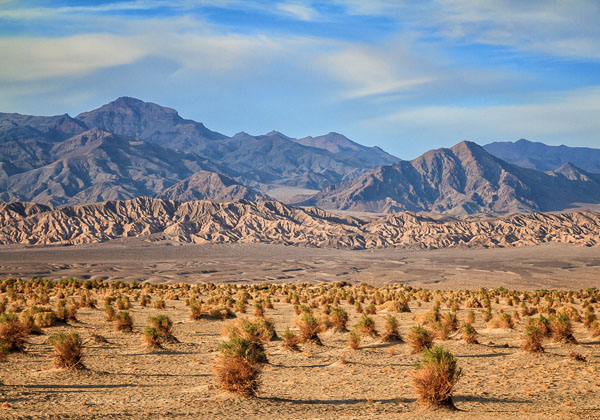
Devil's Cornfield, Death Valley National Park, California, by Anne McKinnell

There are many problems we run into along the way that can prevent our overall impression of a scene from shining through in the final image. The following are the most common traps to expect, and how you can avoid them.

1. Crooked Horizons

Most landscape photos will feature the horizon – a dead giveaway to the picture’s overall perspective. That means that if the line dividing land and sky is not perfectly straight across, the whole picture looks totally out of whack. There are a few ways to make sure your horizon squares up right:

  • Grid Overlay
    On most DSLRs (and some compact cameras), you can overlay a grid on either your viewfinder, your live view screen, or both. Align your horizon with one of these lines.
  • Electronic Horizon
    Newer, higher-end cameras often have a built-in electronic level. When turned on, it will gauge the camera’s position in space and tell you when it is evenly aligned.
  • Bubble Levels
    Some cameras have a bubble level attached and some tripods will have one as well. If you don’t have one built into your gear, you can purchase one that affixes onto the camera’s hot shoe. Just like a spirit level in construction, this will help you straighten your camera out.
  • Post-Processing
    If all else fails, every major photo editing software will feature a “straighten” tool which allows you to draw a line tracing the horizon. Using this, the program will automatically crop the image on an angle to make sure that the line is perfectly horizontal.

2. Eye-level Perspective

Most people photograph from an eye-level standing position producing photos that look as you would expect to see things if you were there. For a more interesting composition, try climbing on top of something, or getting close to the ground to achieve a different point of view.

3. Empty Skies

Without clouds, birds, or some other interesting feature, empty skies can turn out pretty flat and boring in a photo. Try to compose your picture with something interesting in the sky. If there is nothing interesting to show, raise your horizon line to the top third of the image to minimize how much space the sky occupies in the frame.

Pine Glades Lake, Everglades National Park, Florida, by Anne McKinnell

4. Hand Shake Blur

A blurry photograph loses almost all of its impact. Either use a tripod or use a fast shutter speed combined with image stabilization.

When it comes to landscapes, securing your camera onto a sturdy tripod will always yield better results. Even if you’re using short exposures, a tripod will allow you to compose your shot more precisely and lock its position into place while you shoot.

5. No Focal Point

Skies and mountains are lovely, but a picture can’t be all background. Your photo needs a focal point to hold the viewer’s interest. This can be anything – an interesting tree, a boat, a pier, a log – but no landscape photo is complete without a main subject.

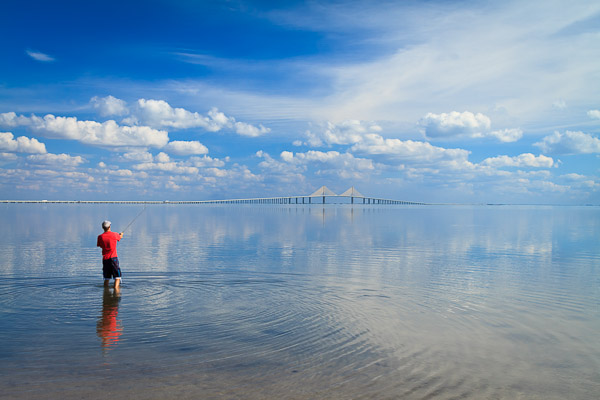
Fisherman at Fort DeSoto, Florida, by Anne McKinnell

6. Cluttered Backgrounds

The opposite also applies – be careful not to focus too much on the subject and forget about how the background comes together. Pay attention to what is behind your main subject. If the background elements don’t add to the composition remove them if possible. Be careful that you have separation between each element, and don’t let them visually blend together (ie. two or more trees merging into a greenish blob). This is especially problematic when the objects are backlit or silhouetted.

7. Poor Lighting

When you rely on the sun to light your shots, you’ll find that some days the weather just doesn’t cooperate. Grey, cloudy days will give you muted, washed-out colours and not much in the way of shadows or contrast. Extremely sunny days might do just the opposite. Carefully consider the lighting conditions on your scene before you decide how to approach it.

  • If the sun is out, position it to one side of the camera to take advantage of the shadows and textures created by sidelight.
  • If the sun is in front of the lens, your scene will be backlit and you can make some dramatic silhouettes.
  • If the sun is behind you photographing the scene will be more difficult because the direct light will make the scene appear flat. Consider changing direction.
  • If there is no sun and the sky is white, use the soft lighting conditions to make close-ups.

Rainbow Rock, Valley of Fire, Nevada, by Anne McKinnell

8. Underexposing

If the sky is overly bright (say, in the middle of the day), it can confuse the camera’s light meter, which will try to compensate by underexposing the rest of the image, resulting in a dark foreground. If this happens, use the exposure compensation to turn up the brightness, but not so much that the sky becomes blown out (turns white).

If you’re having this problem, try re-composing your image to include a darker area of the sky. This type of scene is a good time to use a graduated neutral density filter. These filters are dark on the top and clear on the bottom. You place it in front of your lens to darken the top half of the image and even out the exposure.

9. Hot Spots and Blown Out Highlights

It’s not just the sky that can blow out, though – a hot sun can cause glare on many surfaces. Watch your scene for bright spots caused by reflections or excess sunlight. Most cameras have a “highlight warning” viewing mode on the image preview which will show any pixels that have turned pure white. If you have blown out highlights, use the exposure compensation to reduce the exposure slightly until they are gone.

10. Lack of Dimension

Even though a photo is a two-dimensional image, a strong landscape composition gives the illusion of depth. When you’re setting up your shot, make sure to populate the frame in the foreground, mid-ground, and background.

Lake McDonald, Glacier National Park, Montana, by Anne McKinnell

When you are learning photography it can be hard to critique your own work and understand how to improve. After your next photo shoot, examine your images for these problems so you can avoid them next time. Looking at each of your images with a critical eye and considering how they could be improved will quickly improve your artistic eye and make you a better photographer.

The post 10 Most Common Mistakes in Landscape Photography – and How to Overcome Them by Anne McKinnell appeared first on Digital Photography School.


Digital Photography School

 
Comments Off on 10 Most Common Mistakes in Landscape Photography – and How to Overcome Them

Posted in Photography


Ostrich Pillows & Energy Pods: 15 Nap-Worthy Inventions

03 Feb

[ By Steph in Design & Furniture & Decor. ]

Napping Furniture Main

Everybody knows that there’s no better place to take a nap than a hammock hung in a scenic location, but what about when you’re stuck at home, or at the office, or on a city bus? Instead of making do with an upright chair, the hard surface of your desk or a stranger’s shoulder, try these 15 nap-worthy (and sometimes ridiculous) loungers, sleep suits and head-supporting pillows.

Energy Pod

Napping Furniture EnergyPod

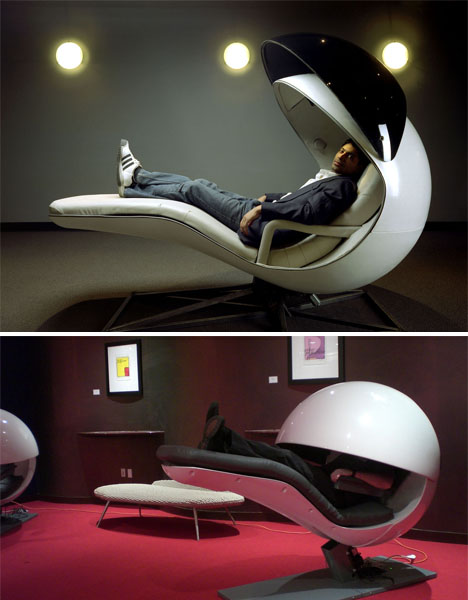
Among the perks of working at Google is escaping every now and then to take a nap in one of these bizarre-looking EnergyPods, which cost about $ 8K each. Reclined at just the right angle for optimal blood flow throughout the body, the pod has a visor that flips down to envelop the user in a private, soundproof space, and it even has built-in Bose speakers if you’d like to drift off to music.

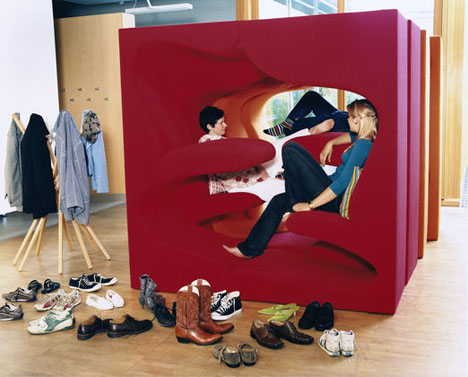
Vitrea Living Tower

Napping Furniture Vitrea 1

Napping Furniture Vitrea 2

This classic design, first introduced in 1969, is an organically shaped seating tower that allows you to recline in a variety of positions. The unit can be used alone – either freestanding or pushed up against a wall – or put together to create a sort of seating cave.

Human Burrito

Napping Furniture Blandito

Turn yourself into a human burrito with the Blandito, a transformable pad for lounging in virtually any position you can think of. The pad can be rolled, bunched and scrunched in all sorts of different ways. The idea was to make the simplest possible product – essentially a sofa with no arms, legs, back or any real structure whatsoever – as multi-purpose as it can be. That’s achieved with just a little bit of fabric, foam and some elastic connectors.

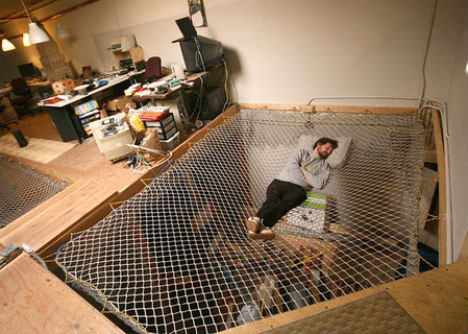
DIY Hammock Bed

Napping Furniture Hammock bed

A fun twist on the conventional hammock design, this DIY creation is simply some net strung across an open space leading from one level of an office to another. Would you be able to get any work done if this thing was installed right next to your desk?

FEEL Seating System

Napping Furniture Feel Seating System

Over 120 soft foam balls make up the ‘Feel Seating System‘, which can be bunched up in any number of configurations to reflect “the ever changing emotional state of the body.” Sit on it, lay on it, or wrap it around you like a cocoon.

Next Page – Click Below to Read More:
Luxe Lounge 15 Tempting Places To Take A Nap

Share on Facebook


[ By Steph in Design & Furniture & Decor. ]

[ WebUrbanist | Archives | Galleries | Privacy | TOS ]


WebUrbanist

 
Comments Off on Ostrich Pillows & Energy Pods: 15 Nap-Worthy Inventions

Posted in Creativity


3. Februar 2014

03 Feb

Ein Beitrag von: Christian Greller

© Christian Greller


kwerfeldein – Fotografie Magazin

 
Comments Off on 3. Februar 2014

Posted in Equipment


3 February, 2014 – Back From Antarctica

03 Feb

We are back in Chile after a very successful and incredible adventure to Antarctica.  The Luminous-Landscape team of Michael, Kevin and Chris as well William Neil lead a group of 63 photographers on a non-stop adventure.  We had the most incredible weather making every day perfect for photography.  We couldn’t have asked for a better group of participants and the Antarctica XXI Expedition team was absolutely the best.  We are now working our way back north and to home over the coming days. Once we get our feet on the ground we will have a lot more about this trip as well as a lot of other news. There are only a few berths left for the second Antarctica Trip in 2015.  After experiencing this this trip I would highly recommend that you sign up now as we are sure once we start publishing images and the trip log that these remaining spots will go fast.


The Luminous Landscape – What’s New

 
Comments Off on 3 February, 2014 – Back From Antarctica

Posted in News


Poppy: Your Viewmaster, All Grown Up

03 Feb

Extra photos for bloggers: 1, 2, 3

Poppy is one part Viewmaster, one part iPhone, all parts amazing.

It lets you create 3D photos, videos and wiggle gifs! Just slip your iPhone into a Poppy and shoot away.

Pass the Poppy to a pal to let them see your trip photos as if they were there.

Or make a wiggle gif to share your three dimensional adventures, on the web!

Learn More About the Poppy
$ 59 at the Photojojo Shop


© laurel for Photojojo, 2014. |
Permalink |
No comment |
Add to
del.icio.us

Post tags:


Photojojo

 
Comments Off on Poppy: Your Viewmaster, All Grown Up

Posted in Equipment


Readers’ Choice: Best Gear of 2013 Awards

03 Feb

awardsrosette.jpg

Before Christmas, we asked you to vote for your favorite cameras and lenses in five categories. We announced the category winners earlier this year and created a final poll to find what – in your opinion – was the single standout product of 2013. Click through for a reminder of the category winners and to find out which of the winning products was your choice for 2013 product of the year!

News: Digital Photography Review (dpreview.com)

 
Comments Off on Readers’ Choice: Best Gear of 2013 Awards

Posted in Uncategorized