RSS
 

Archive for January, 2014

8 Types of Pictures so Amazing That All Photographers Should Master Them

17 Jan

What is your next step in photography? If you feel you are retaking the same picture over and over, a good idea is to take a break and look the other way. In photography, this is easy: We can change memory cards, try a different lens and shoot something new! Most importantly, cover your basics. Go over all the controls Continue Reading

The post 8 Types of Pictures so Amazing That All Photographers Should Master Them appeared first on Photodoto.


Photodoto

 
Comments Off on 8 Types of Pictures so Amazing That All Photographers Should Master Them

Posted in Photography


Kaliforniens Wüsten aus der Luft

17 Jan

Ein Beitrag von: Tanja Ghirardini

Fliegen fasziniert mich. Die Welt von oben betrachten zu können, ist etwas ganz Besonderes. Schon mein Vater hatte einen Flugschein und seit meiner Kindheit bin ich dieser Faszination erlegen. Wie aufregend war es jedes Mal, wenn ich mit ihm in der Cesna eine Runde über meine Heimat drehen konnte.

Und diese Begeisterung hat nie nachgelassen. Ich habe mich in der Luft immer wohl gefühlt, viel wohler als zum Beispiel auf dem Wasser. Und wie es der Zufall oder das Schicksal so wollte, habe ich auch einen Piloten geheiratet.

Gemeinsam haben wir viel Zeit in der Luft verbracht. Und da die Fotografie seit einigen Jahren einen sehr großen Teil meines Lebens einnimmt, war meine Kamera natürlich auch bei unseren gemeinsamen Flügen dabei.

Und so haben wir zunächst meine Heimat, den Chiemgau, immer wieder überflogen und fotografiert und sind so zu einem richtig guten Team geworden.

California Aerials © Tanja Ghirardini

California Aerials © Tanja Ghirardini

Meine nächste Leidenschaft ist das Reisen und durch den Beruf meines Mannes habe ich das große Glück, dieser Leidenschaft intensiv nachgehen zu können. Viele atemberaubende Landschaften durfte ich bereits sehen, aber was mir bei meiner letzten USA-Reise im Herbst vergönnt war, lässt mich immer noch staunen.

Wir haben uns in Los Angeles eine Cesna gemietet und sind gemeinsam über die Wüsten Kaliforniens geflogen. Der ganze Flug war ein unbeschreibliches Erlebnis. Aber als wir über das Death Valley und das Owens Valley flogen, hatte ich vermutlich einen Puls von 200 und Schnappatmung.

Ich konnte es nicht fassen, was die Natur hier zu bieten hatte. Die Farben, Formen und geologischen Formationen änderten sich im Minutentakt: Sanddünen, Felsen, Salzseen, Flussläufe, Herbstbäume, Krater, farbige Gesteinsschichten. Dinge, die man in dieser Form nur aus der Luft zu sehen bekommt. Mal unwirklich wie eine Mondlandschaft, dann wieder unglaublich farbintensiv. Mal scheinbar komplett vegetationslos und karg und dann erscheint wieder eine Oase mit unfassbarer Pflanzen- und Farbenpracht.

California Aerials © Tanja Ghirardini

California Aerials © Tanja Ghirardini

Das Fotografieren gestaltete sich jedoch schwierig, da die Cesna kein Fenster hatte, das sich weit genug öffnen ließ. Auch die Tragflächen mit ihren Streben waren immer irgendwie im Weg. Es hat eine Weile gedauert, bis ich herausfand, wie ich fotografieren musste, um nicht die Spiegelung des Fensters oder Teile des Flugzeugs auf dem Foto zu haben: Nach hinten unten.

Mein Rücken hat sich nicht gerade für diese Verrenkungen bedankt. Und mein Mann musste immer genau so fliegen, dass ich aus dieser Position auch an die potentiellen Motive heran kam. Gut, dass wir so ein eingespieltes Team sind.

California Aerials © Tanja Ghirardini

California Aerials © Tanja Ghirardini

Die nächste Schwierigkeit lag darin, dass wir an einigen Stellen ziemlich nahe an militärischem Sperrgebiet vorbeiflogen und jedes unserer Flugmanöver genau beobachtet wurde. Sobald wir eine Kurve flogen, die irgendwie von der vorgegebenen Route abwich, wurden wir binnen Sekunden angefunkt und nach unseren Absichten gefragt.

Da verstehen die Amerikaner keinen Spaß. Und wir wollten dann doch nicht riskieren, plötzlich in Begleitung einer F16 zu sein. Trotzdem konnte ich viele Farben und Formen der Natur fotografieren.

California Aerials © Tanja Ghirardini

California Aerials © Tanja Ghirardini

Die Bilder sind alle aus einer Höhe von etwa 2.000 bis 2.500 Metern entstanden. Ein Größenvergleich ist schwer, da aus dieser Höhe Bäume oder Menschen nur noch sehr klein zu erkennen sind, besonders in der kleinen Internetauflösung.

Auf dem ersten Sanddünenfoto zum Beispiel ist ziemlich genau in der Mitte des Bildes ein Mensch abgebildet, der in der 100%-Ansicht auf dem Original gut zu erkennen ist. In der hier gezeigten verkleinerten Version wird es da schon schwierig, da die Dünen bis zu 100 m hoch sind. Wer ihn trotzdem findet, darf ihn behalten.

Auf manchen Bilder kann man auch Bäume und Josua-Palmlilien in Form von kleinen dunklen oder farbigen Punkten erkennen.

California Aerials © Tanja Ghirardini

California Aerials © Tanja Ghirardini

Auch, wenn ich schon oft geflogen bin, war dieser Flug für mich eines der schönsten und aufregendsten Erlebnisse. Es hat mir wieder gezeigt, dass die Natur die größte Künstlerin ist.


kwerfeldein – Fotografie Magazin

 
Comments Off on Kaliforniens Wüsten aus der Luft

Posted in Equipment


Open source Lux camera is a DIY project for ambitious photographers

17 Jan

11554619543_d263eb6afc_b.jpg

Kevin Kadooka’s Lux is an experiment in DIY camera building. With a waist-level viewfinder, it accepts 120 roll film. Rather than borrowing parts from old cameras as he’s done in previous projects, Kevin’s Lux camera is comprised of off-the shelf parts. All of its construction specifications are available to enterprising individuals looking to build their own. Click through to learn more

News: Digital Photography Review (dpreview.com)

 
Comments Off on Open source Lux camera is a DIY project for ambitious photographers

Posted in Uncategorized


Lenstag: a World Without Camera Theft

17 Jan

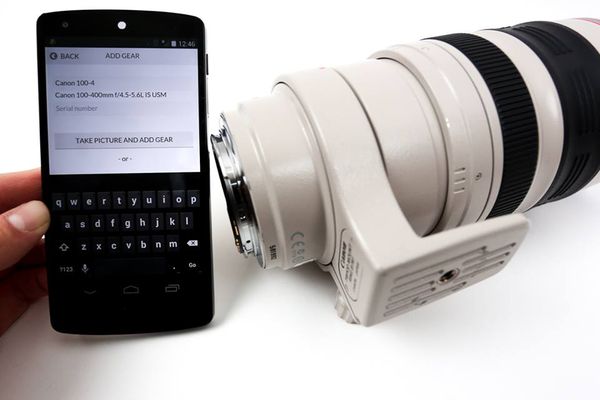
Lenstag is a recently-launched, free online service for iOS, Android, and the web that records the serial numbers of your lenses, cameras, flashes, laptops and anything else in a secure, private registry before they are stolen.

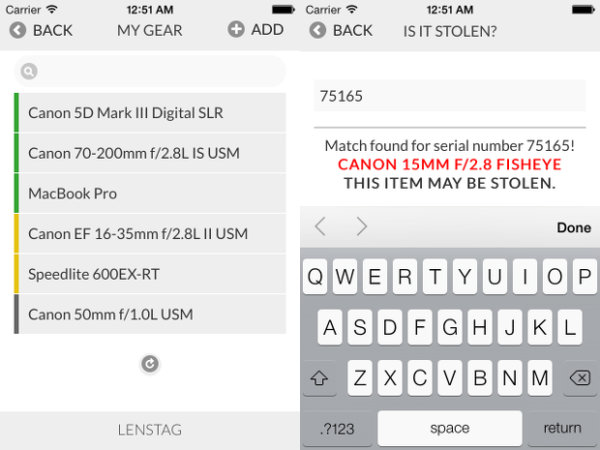
If one or more of your items disappear, you can immediately flag the missing items as stolen which creates a public web page, quickly indexed by search engines. The serial number is then discoverable by a single Google search (example: ’75165 lenstag’) or by checking the Lenstag apps. Thanks to Lenstag’s growing relationships with the pawn shop industry and law enforcement, the exchange of money for that stolen item becomes much more difficult akin to trying to sell a stolen vehicle. The idea behind this service is that if everyone gets into the habit of checking serials numbers online before purchasing used equipment, it will become harder and harder over time to peddle hot items and thieves will get arrested when they try to pawn them. Think of it like a DMV for camera equipment.  The more people who register their gear, the more effective the registry system becomes.

By locking down a particular serial as belonging to you, the reselling and pawning of that stolen item becomes discouraged. Serials on Lenstag marked as stolen are indexed online.

By locking down a particular serial number as belonging to you, the reselling and pawning of that stolen item becomes discouraged. Serial #s on Lenstag, marked as stolen, are indexed online.

There is currently no foolproof way to prevent potentially having all of your gear stolen, even if your equipment never leaves your home. Insurance can protect you financially, but you permanently lose your original items and any images or video stored on them. There is no guarantee Lenstag can get your original items back either, but with Lenstag there is a chance that only increases with time.

The more serials that get checked prior to purchase on the used market, the safer everyone’s gear becomes.

The more serial numbers that get checked prior to purchase on the used market, the safer everyone’s gear becomes.

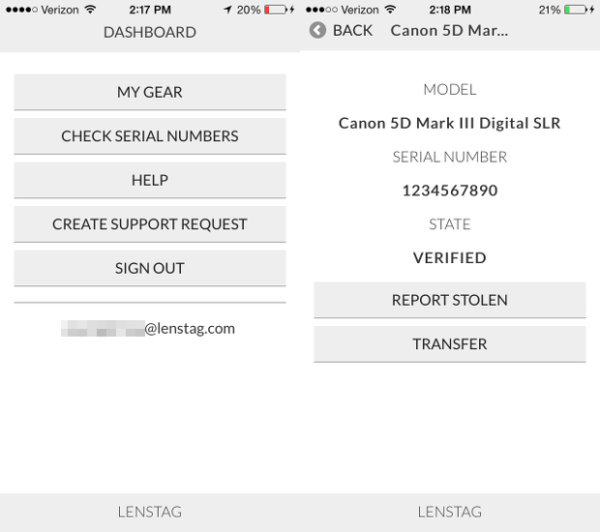
With Lenstag, you have a centrally-located place to store all of your serial numbers. They can be easily transferred to another Lenstag user if you decide to sell your gear. Your serial logs are date marked. This is handy if you ever need, for whatever reason, to prove that you have owned a certain piece of gear for at least as long as it has been registered. You can make your gear lists public as well. This is handy for showing clients what you own or for resource planning with collaborators.

Transfer serials, share gear lists with others, or prove what you own via an clear-cut dashboard.

Transfer serials, share gear lists with others, or prove what you own via an clear-cut dashboard.

You should use Lenstag if?

  • You don’t have any insurance. This service is free and is better than having absolutely no protection at all.
  • You already have insurance but want just a little extra peace of mind.
  • You collaborate with other photographers a lot or work with clients who need to know what equipment you are using.
  • You, for whatever reason, need to prove you own something without having to carry around a bunch of receipts or registration cards.
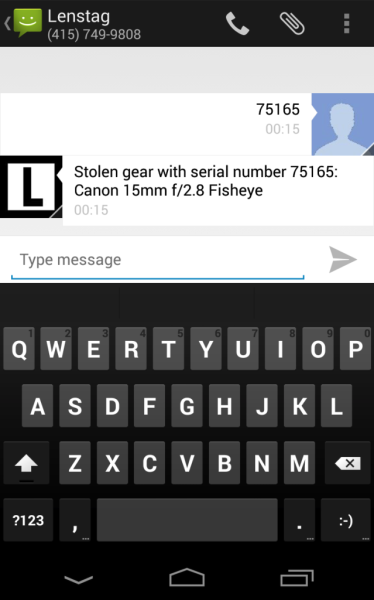
  • You buy a lot of used gear. You don’t have to be a Lenstag user to check a serial # but having the app on-hand for checking makes the process very easy. You can also use Lenstag’s text-to-check feature by texting the serial number in question to +1-415-749-9808. This works regardless of whether or not you’re registered on Lenstag.
Text to check a serial in question, regardless of whether or not you are registered on Lenstag.

Text to check a serial in question, regardless of whether or not you are registered on Lenstag.

Lenstag is used by all three of the major rental houses in the United States: BorrowLenses.com, LensRentals.com, and LensProToGo.com. It is currently being used in over 150 countries worldwide. Uploading an image of your item is quick and helps discourage theft one indexed serial at a time. Be sure your serial # is visible on your item when taking its picture for inclusion in your personal registry.

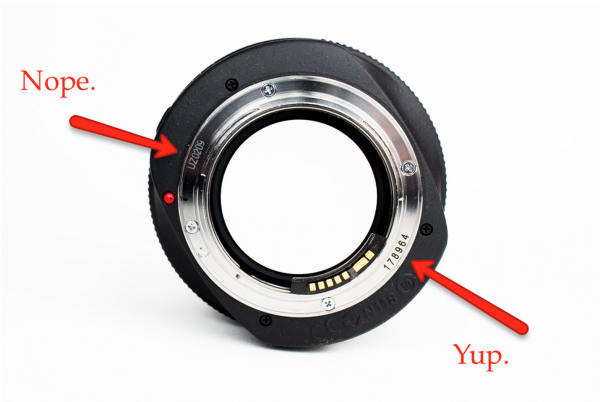
Not every number on your lens is a serial. Be sure you are reading the right thing.

Not every number on your lens is a serial. Be sure you are reading the right thing.

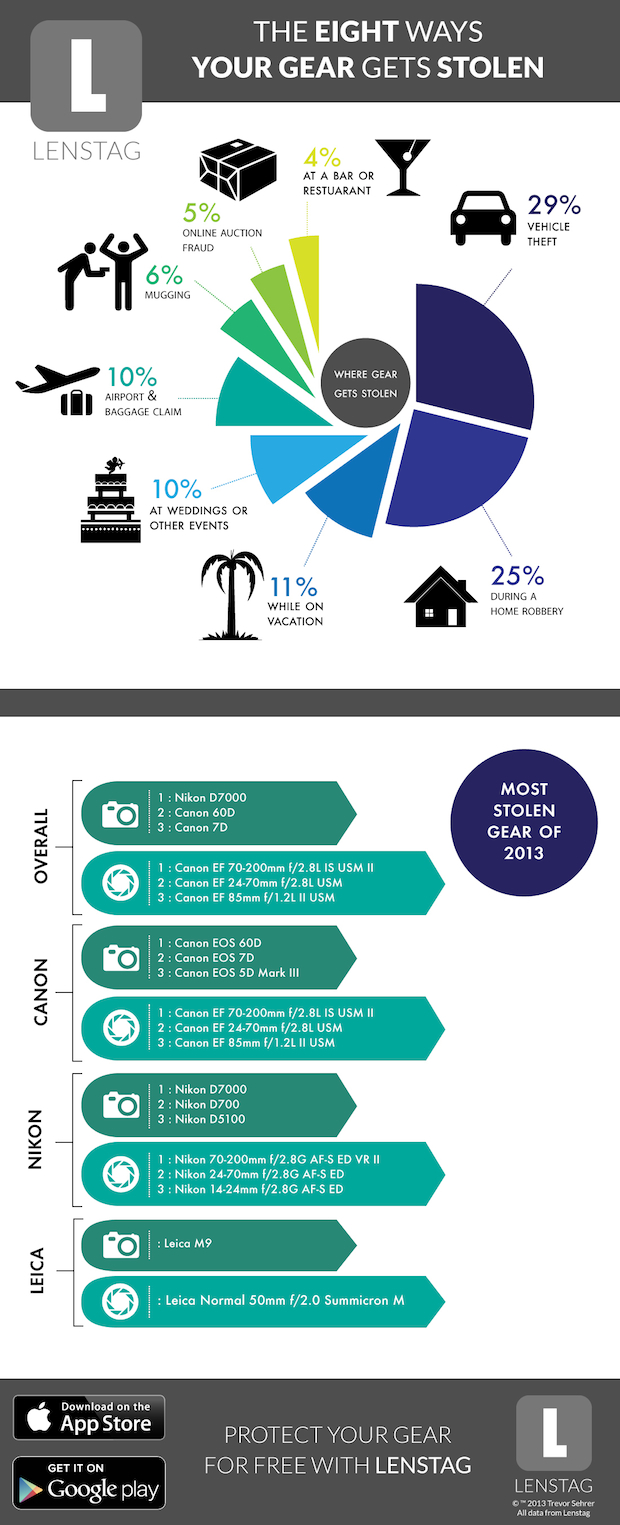
Want to know how gear gets stolen the most? The results may surprise you. Lenstag took the stats of its reported serials to learn the most common ways gear got stolen in 2013, along with the most commonly stolen models.

Don’t leave it behind! You’re most likely to have items taken from your car.

Don’t leave it behind! You’re most likely to have items taken from your car.

How to use & find Lenstag
Lenstag can be download for iOS and Android. You can also use their service via their desktop site.

The post Lenstag: a World Without Camera Theft by Jim Goldstein appeared first on Digital Photography School.


Digital Photography School

 
Comments Off on Lenstag: a World Without Camera Theft

Posted in Photography


Lucky Rainbow: Time Lapse Pics of Traffic Light Piercing Fog

17 Jan

[ By WebUrbanist in Art & Photography & Video. ]

time lapse light

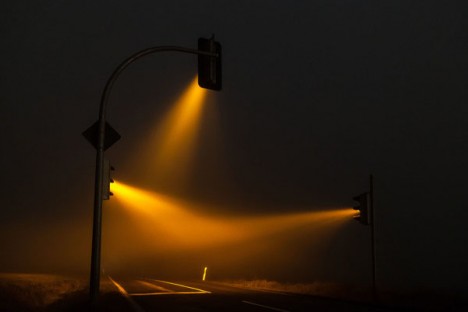
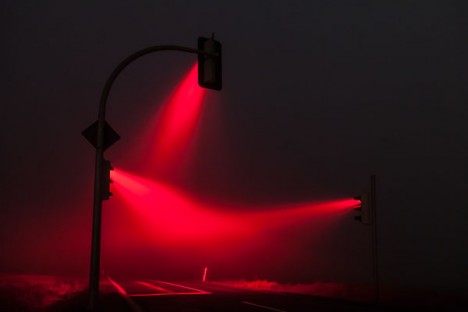
The right place, proper timing and a keen eye conspired to help a photographer capture this eerie nighttime phenomena at a crossroads outside of Weimar, Germany.

rainbow night light green

rainbow night light yellow

rainbow night light red

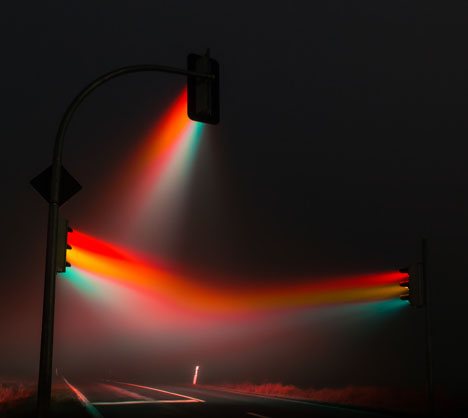
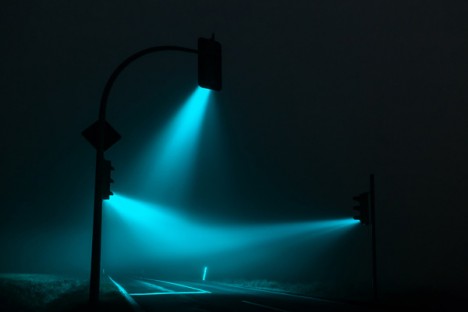
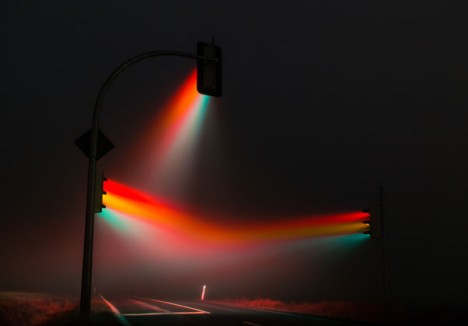
German photographer Lucas Zimmermann found and shot this intersection at each stage of the its cyclical change, capturing green, yellow and red.

rainbow light full spectrume

He also went a step beyond the sequential with one particularly impressive shot spanning the entire cycle, creating a rainbow in the mist.

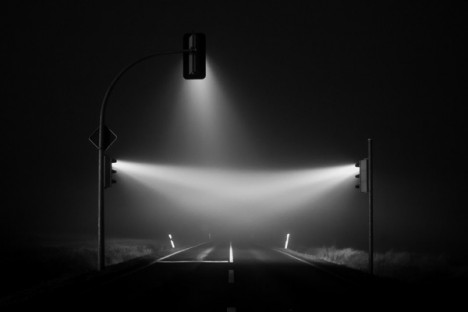
rainbow light black white

His other work spans from the rural United States to the streets of Beijing, but usually focuses on people over places – this set, however, proved a worthy exception.

Share on Facebook


[ By WebUrbanist in Art & Photography & Video. ]

[ WebUrbanist | Archives | Galleries | Privacy | TOS ]


WebUrbanist

 
Comments Off on Lucky Rainbow: Time Lapse Pics of Traffic Light Piercing Fog

Posted in Creativity


3D Cat Furniture Set: Modular Hangouts for Walls & Ceilings

17 Jan

[ By WebUrbanist in Design & Fixtures & Interiors. ]

cat interior room design

Furnishings for felines are nothing new, but this one-stop shop provides modular bridges, beds, posts and platforms designed as a kit-of-parts solution to turn any room into a cat’s personalized paradise.

cat lounge furniture system

cat ceiling hung bed

Goldtatze boasts ground-up scratching posts but also wall-hanging walkways and ceiling-mounted spaces to allow cats full access both horizontally and vertically, while conveniently leaving room below and between for human companions (especially useful in small-space urban dwellings).

cat furniture various designs

cat interactive furnishing set

cat ceiling snuggle basket

Designer and craftsman Stefan Hofmann set about to solve a problem for his own domestic best friend (an indoor-only cat) and went on to create solutions that could be deployed beyond his own home.

cat sky suspension bridge

cat hanging aerial walkways

By breaking the system down into a series of individual pieces, the effect is much like that of visiting an IKEA store – the parts are made to be structurally and functionally autonomous, but also to mix and match in custom configurations.

cat wall mounted platforms

cat scratch tree post

From scratching posts to snuggle bowls, the resulting furnishings and fixtures play on feline favorites like boxes and baskets, providing all kinds of places to explore or simply curl up and observe surroundings (from a safe, secure and self-selected distance, of course).

Share on Facebook


[ By WebUrbanist in Design & Fixtures & Interiors. ]

[ WebUrbanist | Archives | Galleries | Privacy | TOS ]


WebUrbanist

 
Comments Off on 3D Cat Furniture Set: Modular Hangouts for Walls & Ceilings

Posted in Creativity


16 January, 2014 – The Rangefinder ? A New Video

17 Jan


The Rangefinder
‘Truths’, ‘Mystique’ & Practice with the Leica M240

We have just published our newest video titled "The Rangefinder: Truth, Mystique & Practice – Leica M240"

In our Our Store, do a search for ‘Rangefinder‘. For those wishing to purchase it individually, the price is $ 12.50. It is without extra charge for our annual subscribers, and should appear in customers’ subscriptions within 24 hours (01/17/2014)

The video is made up of a three segment discussion on Rangefinders between Michael Reichmann, Sean Reid of reidreviews.com, and Mark Dubovoy. It was shot on location in Ithaca, N.Y. in the Spring of 2013.

At an hour and twenty minutes, this wide-ranging discussion looks in detail at the Leica M240, the Fuji X-Pro1, focussing techniques, Window Viewfinders and Electronic Viewfinders, a comparison to DSLRs, the use of R lenses on an M Leica, the suitability of Rangefinders for new photographers, the cost of Leica and others, a recent history of Rangefinders since the advent of SLRs, Rangefinders use for ‘quiet’ or ‘stealth’ photography, a look at what’s new in the M240 over the M9, the shortcomings of the M240 – in the varied opinions of the three participants, Leica lenses, their ‘mystique’ and finally, the use of Leica M mount lenses on other cameras.


Sean Reid of reidreviews.com, a widely recognized writer about rangefinder and window finder cameras, was a participant in our new video. You should know that Sean has just published a review of the Sony A7R and will be publishing follow-up articles that look carefully at side by tests of the A7R and M-240 with various rangefinder lenses. Reidreviews is a subscription site.


The Luminous Landscape – What’s New

 
Comments Off on 16 January, 2014 – The Rangefinder ? A New Video

Posted in News


Über analoge Ehrlichkeit und Blumen im Haar

17 Jan

Ein Beitrag von: Lisa Licht

Angefangen hat alles vor fünf Jahren als ich noch zur Schule gegangen bin und mir das Wahlfach Fotografie verglichen mit allen anderen ziemlich sympathisch war. Ich habe zu dieser Zeit eine alte analoge Canon von meinem Opa bekommen und hatte einen unglaublich beeindruckenden Lehrer. Kennt Ihr das, wenn man merkt, dass jemand seine Arbeit wirklich liebt? Das passiert in meiner Welt leider gar nicht so oft.

Mich beeindruckt so etwas aber ungemein. Mein Fotografie-Lehrer ist so jemand. Ein Fotograf der alten Schule mit dicker Hornbrille und Bart. Er hat damals etwas ziemlich Gutes gemacht: Er hat mich komplett angesteckt mit seiner Liebe und Hingabe zur Fotografie.

Nina © Lisa Licht

LenaPola © Lisa Licht

Ich werde niemals den Geruch der Chemikalien in unserer kleinen Schuldunkelkammer vergessen, die Spannung beim Entwickeln, das Geschrei, wenn ein Schüler mal aus Versehen auf den Lichtschalter am und dann alle tierisch lachen mussten.

Ich liebe die Analogfotografie, weil sie rein und ursprünglich ist und eine unglaubliche Tiefe besitzt. Sie zeigt, dass man in der Kunst an keiner Stelle etwas vortäuschen muss, um etwas Schönes zu erschaffen.

Elisa © Lisa Licht

Maria © Lisa Licht

Für mich ist das der wichtigste Grundsatz in meinen Fotos: Natürlichkeit. Den Menschen so zeigen wie er ist oder es zumindest so gut es geht versuchen. Diese Art des Fotografierens in der digitalen Fotografie behalten.

Das heißt nicht, ohne Bildbearbeitung auszukommen. Aber es heißt, besondere Züge, die zu Individuen dazugehören, zu behalten, egal ob diese jetzt der Mehrheit gefallen oder nicht.

Mir geht es mit meiner Fotografie immer um den Menschen – auch, wenn ich mich immer noch nicht entscheiden könnte, welcher Bereich mir dabei am meisten Freude macht.

Lisa © Lisa Licht

LenaKleid © Lisa Licht

Was zum Beispiel in der Welt der Mode wirklich großartig ist, ist, dass man in andere Welten schlüpfen kann. Dass man gestalten kann. Dass das Thema Mode eigentlich, wenn man genau hinsieht, kein oberflächliches Thema ist, sondern die Kleidung eines Menschen unglaublich viel über ihren Träger aussagt.

Ich weiß aber nicht, ob ich in der Fashion/Beauty-Fotografie zurecht kommen würde, weil ich wirklich kein oberflächlicher Mensch bin und manche Konventionen in diesem Bereich sicher nicht einfach hinnehmen könnte.

Auf der anderen Seite würde mir sicher sehr viel Farbe fehlen, wenn ich mich jetzt entschließen würde, nur noch journalistisch, ehrlich und dokumentarisch zu fotografieren und ich keinem, der vor meiner Kamera steht, mehr eine Blume ins Haar stecken dürfte.

Lisa&Nemo © Lisa Licht

Christina © Lisa Licht

Ich glaube, wir Fotografen arbeiten am produktivsten und inspiriertesten, wenn wir ein starkes Gefühl haben. Egal ob es ein positives oder ein negatives Gefühl ist. Ich merke, dass mir besondere Ideen kommen, wenn ich besonders glücklich bin. Dann sind die Motive in meinen Fotos Menschen oder Dinge, die ich liebe. Ballerinas, Federgestalten oder Sternenmädchen zum Beispiel.

Aber genauso sprudelt es nur so an Ideen, wenn mich etwas wirklich ärgert. Beides kann total beeindruckend sein. Wenn jemand mir mit einem Foto zeigt, wie schön die Welt doch ist, aber genauso, wenn man Schmerz oder Ärger mit einem Foto verarbeiten kann. Das ist es, was ich am meisten an der Fotografie liebe.


kwerfeldein – Fotografie Magazin

 
Comments Off on Über analoge Ehrlichkeit und Blumen im Haar

Posted in Equipment


Tips for Indoor Sports Photography – Part 1

17 Jan
Shooting indoor sports isn't always easy, but you can get professional-quality results by following these tried and true tips/

Shooting indoor sports isn’t always easy, but you can get professional quality results by following a few tried and true tips.  1/180, f/4, 80mm, ISO 1250, flash.

A few weeks ago, we asked our dPS Facebook followers what topics they’d like to see covered here on the blog, and a few of you were in search of tips for indoor sports photography. For purposes of this article, I’m going to concentrate heavily on high school basketball, because it brings all of the challenges of shooting indoor sports together; bad lighting, fast action, ornery coaches, inconsistent referees, and–of course–the unpredictability of sports.

The Right Gear for the Job

I’m not going to spend a lot of time here discussing camera bodies. As long as you are photographing with a reliable DSLR, your bigger concern should be the glass. Fast glass. That doesn’t mean I advocate running out and spending all of your money on the most expensive lenses that you either can ,or can’t afford, but a long zoom with a large aperture is going to be a must.

Unfortunately, while many gyms may be well-lit for sports, most are poorly lit for photography.  Adding to the challenge, many high school sports have a prohibition against using flash. You have to do your homework. In my experience, I’ve never had a problem using flash for basketball. As long as you are shooting from an off-center angle, you should be fine. You have to be careful, though, because you don’t want to blast a player in the face with flash full, and possibly change the outcome of the game. That’s the best way to make sure they never let you in with your camera again. Flashing action on the floor? Shouldn’t be a problem. Flashing a player on the free throw line before the ball leaves his hands? Not so much.  As with any type of shoot, make sure you have all of the necessary backups: batteries, memory cards, etc., as well as a backup body if possible.
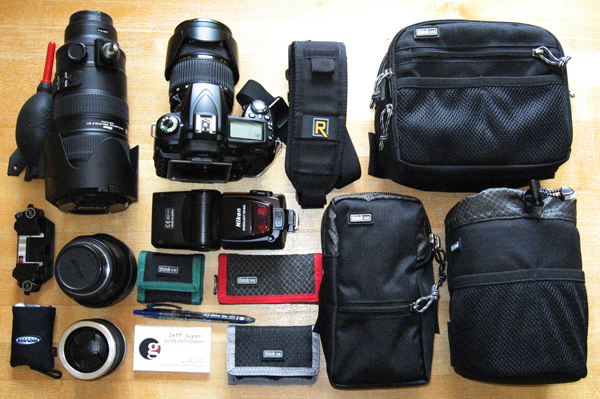
Contrary to popular belief, it is possible to travel light while shooting sports.

Contrary to popular belief, it is possible to travel light while shooting sports. Shown: Nikon D90, 24-70mm f/2.8, 70-200mm f/2.8, SB800 speedlight, plus spare batteries, memory cards, etc., that all pack into modular components shown for the Think Tank Pro Speed Belt.

Get There Early

Trust me when I tell you that you are going to want to get there early.  Pre-game  warm-ups offer some of best opportunities for quality shots of individual players.  For starters, players tend to move a little more slowly in warm-ups than in the actual game.  You’ll have an easier time capturing motion, and more of an opportunity to isolate individual players in the frame.  You can get a little closer to the action during warm-ups, but PLEASE BE CAREFUL!  Each half of the court is going to be filled with players, coaches, managers, officials, and other personnel. The players are big, fast, and not paying attention to you.  Their job is to play basketball–not give you the best photo op.

Know the Sport
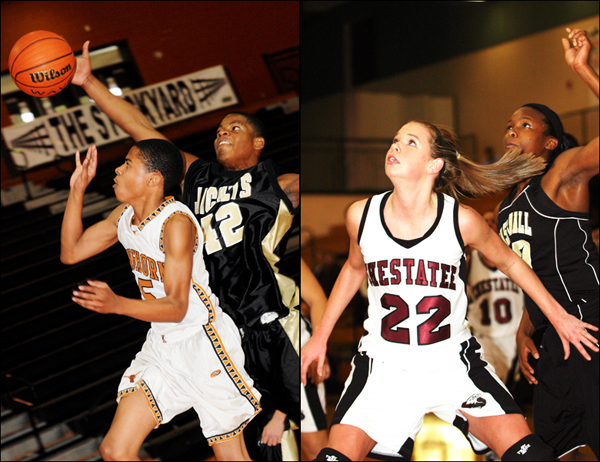
The most compelling shots will have offense, defense, and the ball. You can get good shots without the ball, but they will be better with it.

The most compelling shots will have offense, defense, and the ball. You can get good shots without the ball, but they will be better with it.  LEFT: 1/250, f/5, 80mm, ISO 2000, flash.  RIGHT: 1/320, f/2.8, 80mm, ISO 1250, flash.

The biggest key to getting quality photos of any sport is to have a solid understanding of the game and how it is played.  Every sport has a rhythm all its own. Are they playing a zone defense or man-to-man? Is it a run-and-gun, or are they burning the clock? Can #33 sink the three with impunity, or is he dishing it off to the open center for a lay-up? Do you need to be on the sidelines or under the bucket? Which side is best: the home side of the stands or the visitors’?

Remember that there is a big difference between shooting as a media photographer and shooting as a parent.  As a reporter or school photographer, you are there for “the big picture.”  As a parent, you are mostly concerned with getting photos of your son or daughter, and they’ll be easy to track with the number on their back.  In either case, the more you understand the subtleties of the game the better prepared you will be.

Focus

When I say “focus” I’m not just talking about your photography.  I tell this story a lot because I think it’s important. You have to be aware of your surroundings. I once saw a photographer stand his ground on the sidelines at a football game, despite the fact that a player was being pushed out of bounds right at him.  I watched as his camera, lens, and monopod all went flying in three different directions–as he flew in a fourth.  He was wheeled off the field with cuts to his face, and a leg that had been broken in two places. He was out of commission for six months. No photograph is worth that. Be safe. Focus on where you are and what is going on around you.

Now let’s talk about the other kind of focus.  Obviously, it’s an action sport and you want action photos.  Some of the best sports photos are those that capture the eyes. Things move fast, though, and your subjects are not always going to be standing still long enough for you to focus on their eyes. Your camera’s auto focus works by looking for contrast. Uniforms usually have a lot of contrast between the color of the jersey and the color of the numbers.  If you can get the eyes, great.  If not, your best bet is to try locking on either those numbers or the ball once players start moving.
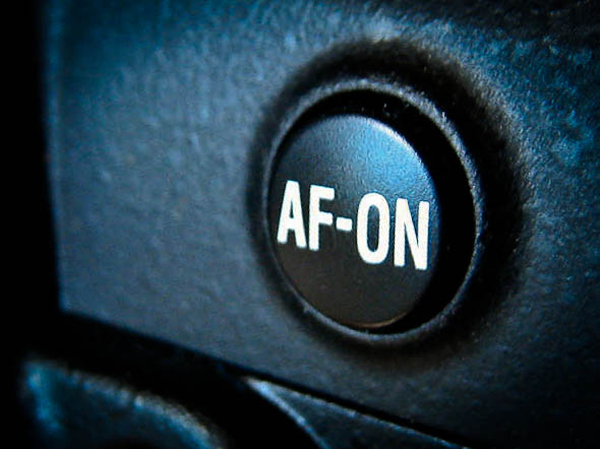
Most professional sports photographers use back-button focus. Check your manual if you aren't sure where to find this feature in your camera's menus.

Most professional sports photographers use back-button focus.
Check your manual if you aren’t sure where to find this feature in your camera’s menus.

Try Back Button Focus

Another focus option you might wish to try is back button focus. Most DSLRs have an option that allows you to assign auto focus functions to a button on the back of the camera. When AF is linked to the shutter button, the camera continuously maintains focus as long as the shutter button is pressed halfway.

When a player passes between you and the player you’d been focusing on, your focus will be shifted to the new player in the frame. Pressing the shutter button halfway down to regain focus on your original target starts the process over again and probably means missing the intended shot. With back-button focus, however, all you have to do is remove your finger from the button when another player enters the frame. Pressing the back button again when the distracting player leaves the frame resumes your original focus.

Continuous Focus Mode

Part of the secret to shooting sports is using AI Servo (AF-C on Nikon) auto focus mode. With “one shot” AF (AF-S on Nikon) focus locks on a point and cannot move until you release and reengage the auto focus. In AI Servo (AF-C), however, the camera continuously focuses whenever you are pushing the AF button (or shutter button halfway if you haven’t reassigned it). It not only helps you lock focus, but also keep it when trying to photograph bodies in motion.

Camera Settings

As with any type of photography, there is not necessarily a “right” or “wrong” exposure.  But this is a sport, after all, and if you come home with 300 blurry photos you aren’t going to be happy–nor will your editor, or your daughter, the MVP.  Remember that since shutter speed controls ambient exposure, the faster your shutter speed is the better your chances will be of freezing the action.  I generally like to start with a shutter speed of 1/500 and adjust my settings accordingly until I get the look I want.  Since this is an indoor sport, your lighting will probably be consistent over the course of the game, unless the gym has windows. Don’t forget, though, that “consistent” can also be “consistently bad.”

If you are using flash, it’s going to be important for you to determine the maximum shutter speed your flash will allow (usually 1/250, check your manual for “flash sync speed”). Start with that and adjust your aperture and ISO accordingly. This is going to take some practice, so  be prepared for some trial and error. The good news is that cameras are getting better at capturing action in low light.
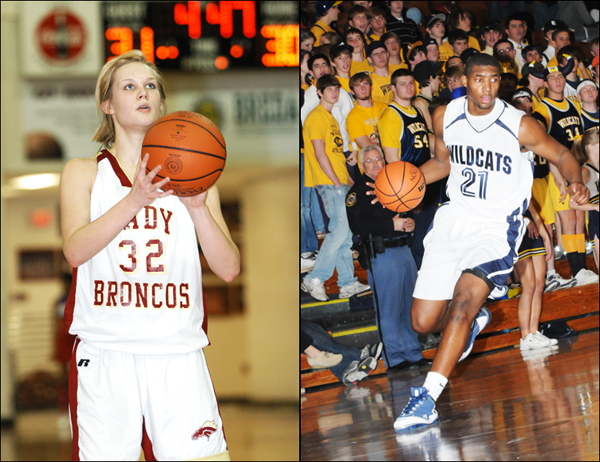
Look for interesting backgrounds, like the game clock or opposing fans.

Look for interesting or dramatic backgrounds, like the game clock or crowded bleachers.  LEFT: 1/180, f/3.5, 135mm, ISO 800, flash.  RIGHT: 1/200, f/8, 80mm, ISO 1600, flash.

Vantage Points and Camera Angles

Obviously, the closer you are to the action the better your photos .  Unlike some sports, you’re going to be a bit more confined to certain areas. You really only have access to one sideline in basketball because the player benches and scorer’s table take up one complete side of the court. The end zones are often the domain of the cheerleaders, so your time there might be sporadic at best. As noted earlier, a solid understanding of the game will definitely help you decide where to be and when.  This is one reason why veteran sports photographers are hardly ever in one place for very long.
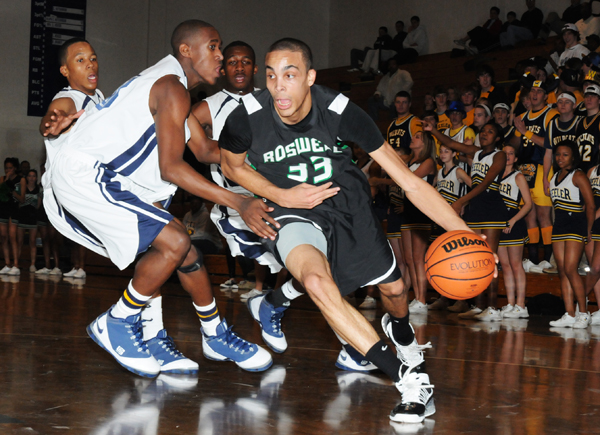
Basketball is a very vertical sport, but don't forget to get some horizontal shots as well.

Basketball is a very vertical sport, but don’t forget to get some horizontal shots as well.  50mm, 1/250, f/8, ISO 1600, flash.

The entire length of the court opposite the player benches offers some great angles. It gives you great vantage points not only for the action on the court, but also for coach and player reaction shots on the bench. Be sure to also take advantage of higher angles from the bleachers (timeout huddles) and the track above the court (players jostling under the net), as well as getting down low for those dramatic larger-than-life shots.

Be Creative: the Action’s Not Just Between the Lines

It’s sports. They go one direction. Then they go the other direction. Four quarters of back and forth. That doesn’t mean, though, that you can’t be creative with your angles and composition. Look for interesting or dramatic backgrounds. In the set below, including the game clock over the coach’s shoulder as it ran down provided interesting contrast to his calm demeanor.
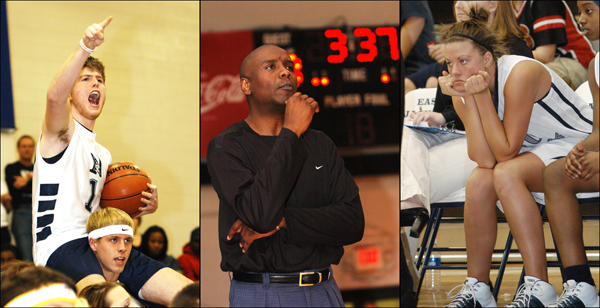
Keep your head on a swivel. Don't miss the fans, coaches, and player reactions.

Keep your head on a swivel. Don’t miss the fans, coaches, and player reactions.

Don’t fall into the trap, though, of assuming that everything worth photographing is right there on the court in front of you. Spend some time in the stands. Shoot the crowd reactions.  Photograph the band and the cheerleaders. Capture the traditions. There is so much more going on in that gym than just a basketball game. Turn your back on the action once in a while and take a look around. There are stories everywhere. Use your camera to tell them.

Get Your Motor Running?

Welcome to photography, where five photographers will give you five different answers for everything, and tell you why the other four are wrong. When I first started shooting high school sports I had a slow camera with an even slower buffer that couldn’t handle me just leaning on the motor drive and hoping for the best. I hated it at the time, but it was probably a good thing. I learned to compose my shots and choose my moments more carefully. I developed a pretty fast shutter finger, and, I think, a better eye for the action. Even now, with better equipment, I still tend to leave my camera set for single clicks. That may put me in the minority, but it’s what works for me.

Etiquette

If you are covering a particular school or team over the course of a season, introduce yourself to the coaches. Your job will be easier if they know who you are and why you are there game-after-game. These kids may be big and strong, but they are still kids and it’s a coach’s job to look out for them. If a coach or official tells you something, listen to them. If they ask you to move, you move. You’re in their house and you have to play by their rules.

If one of those rules is no flash, then it’s no flash. It may sound silly to you, but you have no idea what the consequences might be. There may be college scouts in the stands, and you momentarily blinding the point guard with your flash might have an impact on whether that kid gets a scholarship, or if he’s even recruited at all.

If play stops for an injury, show some respect and PUT YOUR CAMERA DOWN.  While it might make for compelling photography, it is entirely possible that you just witnessed the end of a kid’s dream or their only chance of going to college.  You don’t want them or their parents seeing you clicking away while everyone else in the gym is holding their breath. This is high school, not the NBA. Be sensitive and keep it in perspective.

Any seasoned photographer will tell you that photographing sports is not easy– particularly indoors. We can debate endlessly on which sport is the hardest to shoot, but with practice, preparation, and the right gear, you’ll see your images start to improve quickly and steadily.

Stay tuned for Part 2, where we take a closer look at some of the other indoor sports you may find yourself shooting.

The post Tips for Indoor Sports Photography – Part 1 by Jeff Guyer appeared first on Digital Photography School.


Digital Photography School

 
Comments Off on Tips for Indoor Sports Photography – Part 1

Posted in Photography


Adobe adds Perspective Warp and 3D printing to Photoshop CC

16 Jan

shared:AdobeLogo.png

Adobe has released a major update to Photoshop for Creative Cloud subscribers. The most notable new features are Perspective Warp, Linked Smart Objects and 3D printing capability. Other improvements include enhancements to Scripted Patterns and fills, performance boosts for Smart Sharpen, Adobe Generator improvements for rescaling Smart Objects and adding padding, and font transformations and shape selections. Learn more

News: Digital Photography Review (dpreview.com)

 
Comments Off on Adobe adds Perspective Warp and 3D printing to Photoshop CC

Posted in Uncategorized