Month: October 2013

  • Die Redaktion stellt sich vor: Sebastian Baumer

    Mein Name ist Sebastian und mein einziges Hobby ist das Erfinden. Ich erfinde permanent irgendwelche Dinge und will eigentlich nie wieder damit aufhören. Denn auch wenn wir Menschen alle nur winzige Ameisen im Universum sind, sollten wir unsere Zeit auf der Welt produktiv nutzen.

    Bei mir sind es mal ganz kurze Miniaturtexte, mal lange Artikel, oft Dinge im Designbereich (was ich auch zu meinem Hauptberuf gemacht habe) und seitdem ich vor zehn Jahren die Fotografie entdeckte, sind es auch Fotos, die aus verschiedenen Kameras kommen. Ich glaube fest daran, dass das Erschaffen immer glücklicher macht als das bloße Konsumieren oder Kommentieren, völlig egal, um welchen Bereich es sich handelt.

    Außen bin ich 31 Jahre alt, vor vier Jahren nach Hamburg gezogen, gebürtig in einem kleinen Dorf im tiefsten Bayern, mit einem Magisterabschluss in Literaturwissenschaft, Lingustik und Soziologie, seit drei Jahren tätig als Creative Director in einer kleinen Agentur. Ein Mensch, der in seiner Freizeit gern fotografiert, schreibt und andere künstlerische Tätigkeiten ausübt. Innen derjenige, den Ideen, Träume und Projekte schon immer mehr interessiert haben als Personen.

    Natures Awakening © Sebastian Baumer

    Im Bereich der Fotografie beschäftige ich mich seit einigen Jahren vor allem mit: Makros, Menschen, Manipulationen. Das sind die drei Bereiche, in denen ich gelandet bin, ohne es geplant zu haben.

    Ich habe am Anfang meiner ernsthafteren Beschäftigung mit der Fotografie ohne Rücksicht auf die Tauglichkeit des Motivs einfach alles abgelichtet, was mir vor die Linse kam, von den Gewürzen in der eigenen Küche bis zum überfahrenen Tier auf der Straße, bis sich langsam, aber sicher diese drei Genres als diejenigen herauskristallisierten, für die ich mich immer wieder begeistern kann.

    Prometheus © Sebastian Baumer

    Makros waren meine erste fotografische Leidenschaft. Ich liebe es sehr, durch die Welt zu laufen und meine Umgebung ganz genau zu beobachten, vor allem die kleinen Dinge in der Natur und im Wald, auf die sonst niemand achtet. Diese Dinge festzuhalten, in Szene zu setzen, beeindruckend und groß wirken zu lassen.

    Es bereitet mir sehr große Freude, ein seltenes Insekt, eine abstrakt geformte Pflanze oder sonstiges Kleinstleben auf meine Weise abzubilden und damit meinen Blick auf diese Welt anderen Menschen zu zeigen. Man muss nur genau hingucken, dann findet man selbst auf einer ekligen, alten Parkbank ein ganzes Universum.

    Two of us © Sebastian Baumer

    Im Laufe der Zeit kam über meinen Hauptberuf, der vor allem Design und Text betrifft, noch die Arbeit mit Photoshop auch im Fotobereich hinzu. Es reichte mir nicht mehr, nur zu dokumentieren, ich wollte Welten erschaffen.

    Dieses Erschaffen von Welten setzte sich dann konsequent in meiner Fotografie fort. Dort begann ich, auch mit Menschen zu arbeiten. Zusammen mit einer Freundin gründete ich das Projekt Findelkinder, bei dem wir ganz normale Menschen in surrealen Portraits abbilden. Und ich fing damit an, auch Straßenfotografie in unterschiedlichen Projekten regelmäßiger zu betreiben.

    Fischgeschichten © Sebastian Baumer

    Auf kwerfeldein bin ich vorwiegend über die sozialen Netzwerke, das Bloggen und andere Fotografen aufmerksam geworden. Martins Artikel und Bilder verfolge ich schon seit der Zeit, in der kwerfeldein noch ein ganz normales Blog war und ich fand es immer konstruktiver, künstlerische Projekte und Ideen in den Fokus zu rücken als auf seinem Blog vor allem um sich selbst zu kreisen und über das Bloggen und das Internet selbst zu schreiben.

    Ich möchte auf kwerfeldein Fotografen und Künstler vorstellen, deren Arbeit ich für außergewöhnlich halte, mich an Diskussionen beteiligen, über Fotografie nachdenken und natürlich auch eigene fotografische Projekte präsentieren und erklären.

    © Sebastian Baumer

    Mein Lieblingsgenre bleibt: Das Experiment. Ich ertappe mich immer wieder dabei, mich bei den Dingen nach und nach zu langweilen, die ich schon mehr als drei Mal getan habe und ganz andere Wege gehen zu wollen, egal, wohin sie mich führen werden. Das hat mich neben diversen Genres aus Fotografie und Design schon zur Malerei, zum Schreiben und zur bildenden Kunst geführt.

    Und auch wenn es immer wieder sehr schade ist, wenn man aus Zeitgründen Bereiche des eigenen Tuns wieder zurücklassen muss, so ist für mich Kreativität doch vor allem: Niemals stehenbleiben. Es gibt immer noch so viel unerforschtes Gebiet. Also: Kamera über die Schulter, rausgehen und irgendetwas versuchen, das man nicht jeden Tag sieht.


    kwerfeldein – Fotografie Magazin

  • Picture Pumpkins: Give Your Halloween Memories a Gourdy Glow

    Extra photos for bloggers: 1, 2, 3

    We’ve all been there.

    You’ve braved the pumpkin’s innards and spent hours etching its Titian-hued flesh.

    Then, the neighbor’s cat dashes by the window (or was that a ghost?) and suddenly you’ve lopped the smirk right off of Jack O. Lantern’s face.

    It’s time to defy the exacting standards of our annual October undertaking and replace them with a more photo-realistic (because we’re using a real picture!) and totally classy (because we’re framing it!) pumpkin.

    It’s a gourd revolution!

    Make a Simple Picture Pumpkin

    WHY IT’S COOL

    Our pumpkin art isn’t merely more simple than the traditional Jack O’Lantern. It looks fantastic, too!

    By day, the frame makes your pumpkin look like a doyenne of decor. By night? The flickering light from the faux-candle makes the photo dance around like a still from an old-timey movie, which is both cool and a little creepy.

    Just how we like our All Hallows’ Eve decor.

    INGREDIENTS:

    • A pumpkin with one relatively flat side
    • Your favorite seasonal photo
    • Tracing paper
    • Tape
    • A printer
    • A knife or pumpkin-carving tools
    • A flat frame (we found one at on the unfinished-wood aisle at our local craft store)
    • 2 Nails
    • A hammer
    • A flameless candle (safety first!)

    STEP 1: PICTURE PERFECT

    Dig through your mom’s albums for a Halloween photo of yore.

    Bonus points if it involves: a Teenage Mutant Ninja Turtle; a Renaissance poet; DJ Jazzy Jeff and/or the Fresh Prince; or all of the above.

    Scan your photo and edit as needed. We found that over-saturating a bit really help the final product pop.

    STEP 2: ENTER THE PRINTER

    Tape your tracing paper to a piece of printer paper to make it sturdy enough to run through the printer.

    Print the picture, then set it aside to dry.

    STEP 3: GET GRUESOME

    Slice off the top of your gourd and pull out its guts. Don’t forget to make a notch in the lid so it goes back on easy-peasy in the dark.

    (Never carved a pumpkin? Our girl MStew shows you how it’s done.)

    STEP 4: YOU CUT A HOLE IN THE … PUMPKIN

    Grab a buddy to hold the frame in place on the pumpkin’s relatively flat side. Use your carving tools to mark your cutting lines; you’ll want the hole in the pumpkin to be just a bit larger than the frame’s photo opening.

    Complete the carving and pop out the excess pumpkin.

    STEP 5: GET ATTACHED

    Trim the photo, tape it to the frame, and then nail the frame into place. We recommend a nice scroll-y frame so you don’t have to nail through the wood.

    STEP 6: LIGHT IT UP

    Wait until dark. Insert a flameless candle and gasp with delight. (Or lug the pumpkin to the darkest part of the basement and bask in your handiwork’s glory right away!)

    TAKING IT FURTHER

    • Don’t toss all of those innards! Save the pumpkin seeds and roast ‘em up.
    • Dig up a bunch of photos to create a multi-pumpkin trip down memory lane!
    • Amp up the spooky: Put a ghost in your pic!

    Related posts:

    1. Photojojo’s Guide to Scary Photo Pumpkins Live in NYC or San Francisco? Come to our Photo…
    2. Glow-in-the-Dark Photograms: Turn Your Photos into Spooky Glow-in-the-Dark Wonders Extra photos for bloggers: 1, 2, 3 All Hallow’s Eve:…
    3. Turn an Etch-a-Sketch into a Kitschy Picture Frame in Just a Few Minutes With just two dials and some aluminum powder, George Vlosich…


    Photojojo

  • Can cheap filters damage your lens? A cautionary tale from Roger Cicala

    front2.jpg

    Can cheap filters damage your expensive lenses? LensRentals’ Roger Cicala decided to look into the possibility, after seeing a number of lenses returned with odd circular scratches on the front element. His investigations provide a cautionary tale against skimping on buying a new protective filter after buying an expensive lens. Click through for a link to his full article.

    News: Digital Photography Review (dpreview.com)

  • McCurry’s famous ‘Afghan girl’ portrait almost never published

    Afghan-Girl-McCurry.jpg

    Nearly everyone has seen photographer Steve McCurry’s striking 1985 National Geographic cover portrait of Afghan refugee Sharbat Gula, but it was nearly left on the cutting room floor. He revels the story behind the picture in his new book, “Untold: The Stories Behind the Photographs.” McCurry only took a handful of frames before the young girl got up. Editors at National Geographic came close to picking a different image for their cover, but made a change at the last minute.

    News: Digital Photography Review (dpreview.com)

  • Lomography announces ‘Experimental Lens Kit’ for Micro Four Thirds

    fisheye.png

    Forget the Zeiss Otus 55mm F1.4, Sony Alpha 7R and RX10, Nikon 58mm F1.4 or the tiny Panasonic GM1 – last week’s real news was Lomography’s introduction of an ‘Experimental Lens Kit’ for Micro Four Thirds. Comprising a 24mm F8 standard lens, a 12mm F8 wideangle and a 160° F8 fisheye, the kit costs £79 / €89. Each of the lenses even has a built-in shutter with speeds of 1/100sec and Bulb, allowing in-camera multiple exposures, plus a T mode to hold the shutter open for normal live view. In addition all three have a slot for colour gel filters. Click through for full details.

    News: Digital Photography Review (dpreview.com)

  • Stellar Photo Projects Showcase: Alexandre Bordereau’s “Oh, My Head!”

    All photographers, with no exceptions, have their own photo projects that show the personal layer of their being, bring some new ideas to life and provide attitude to particular things. However, a huge number of such projects went unnoticed by an audience. Thus, here on Photodoto, we decided to launch a series of articles that is aimed to showcase little-known, Continue Reading

    The post Stellar Photo Projects Showcase: Alexandre Bordereau’s “Oh, My Head!” appeared first on Photodoto.


    Photodoto

  • What just happened?! Looking back on last week

    tenthings.jpg

    Last week was incredibly busy here at dpreview, with major new cameras from Sony, Nikon, Fujifilm and Panasonic as well as new lenses from Samyang, Sony and Sigma. It was a week of late nights and early mornings, and now that the dust has settled and we’ve had some time to breathe, we’ve prepared a quick look back to last week for some highlights of what what you might have missed. Click through for a recap. 

    News: Digital Photography Review (dpreview.com)

  • Destroying Landmarks: The Majority or Exception to the Rule

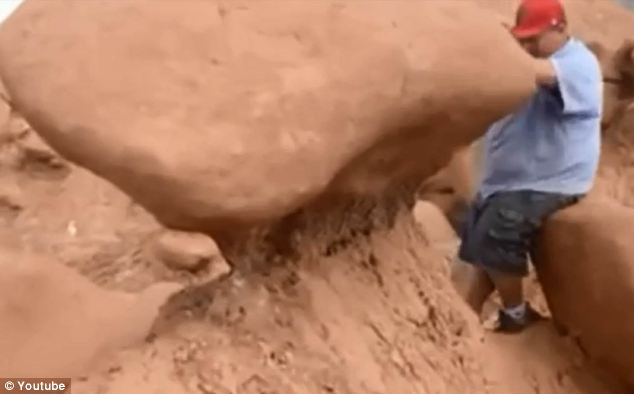
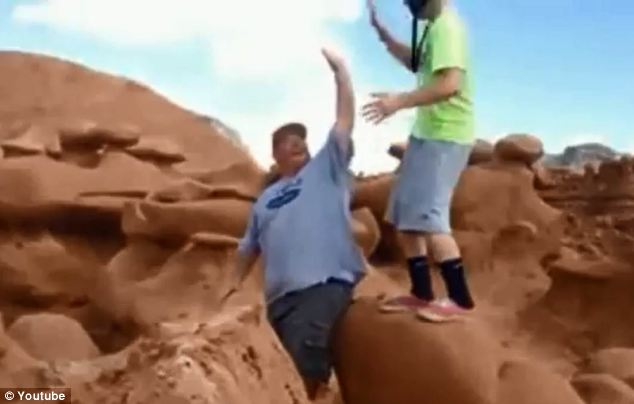
    In news recently was the utterly astonishing video posted by Boy Scout leaders who purposely destroyed an 20-million-year-old  rock formation in Goblin Valley State Park, Utah. Since their video surfaced (see below) they’ve been subject to death threats and its come to light one of the suspects, the one toppling the formation, is in a law suit for disability. This is astonishing for numerous reasons. Their disregard for leave no trace, their stupidity for recording and sharing their law breaking actions on YouTube, their continued denial they’ve done something wrong and the utter disregard for nature. While these individuals are easy to vilify because of their stupidity it leaves me wondering are they really the exception or do the majority of people actually harm these types of locations just in a non-public fashion? This question comes to mind both because of this event and a recent trip of mine to a very sensitive place (photo to come tomorrow) where photographers, in the name of preservation, hold its location secret.

    One could take a hardline interpretation to my question and state that everyone stepping foot on a protected area is technically destroying it, albeit slowly. The term “loving to death” comes to mind in these situations because it is the volume of people doing the damage, even if they are nature loving and respectful. As to the number of people who blatantly damage protected areas, I get the vibe the numbers are far higher than most would estimate. Those who are preservation minded often assume more people are like them than not, but the more I read about articles of vandalism & theft in state and national parks/monuments the more I think preservationists are the minority. Even with in the photography community I’ve seen people put their photo efforts first as they tread over protected areas.

    This brings me back to my recent photo shoot where photographers keep a sensitive location secret. I was ultimately successful on my photo shoot in finding a hidden and very sensitive location, but to do so I had to piece clues together through research and spend a couple hours hiking/searching. How far should photographers go to keep sensitive locations secret?

    The answer to that question likely depends on whether you consider yourself a conservation photographer, or at a minimum preservation minded photographer. I’ve gone back and forth on this with other photographers in private conversation and I always side on keeping the most sensitive locations secret. While I normally feel sharing information is the way to go, some locations are just too easily destroyed even by photographers. The problem with secrets of course is that it drives some to find it at all costs and those individuals aren’t always guaranteed to be preservationist minded. Ultimately its a real pickle of an ethics question. The right answer is ultimately the one that allows you to sleep at night.

    As to the Goblin Valley incident This is beyond my comprehension that anyone could be this stupid. Given their role as Boy Scout leaders they really need to be made an example of when prosecuted.

    The underlying disrespect and ignorance people have for nature is what irks me the most. While this flaw in our society is highlighted in this horrible situation, I find some solace knowing that it generates an uproar among those that know better. It creates an opportunity to education people. It’s just unfortunate it comes at such a cost.

    Related Reading

    • Men may face felony charges after toppling Goblin Valley formation
    • Scout leader who filmed himself lifting and destroying ancient rock formation sued a motorist claiming car crash had left him with ‘debilitating and disabling’ back injury only LAST MONT
    • Professional Climber Cuts Down Juniper Trees to Enable New Route
    • Petroglyph thefts near Bishop stun federal authorities, Paiutes

    Copyright Jim M. Goldstein, All Rights Reserved

    Destroying Landmarks: The Majority or Exception to the Rule

    The post Destroying Landmarks: The Majority or Exception to the Rule appeared first on JMG-Galleries – Landscape, Nature & Travel Photography.


    Related Stories

    • Destroying Landmarks: The Majority or Exception to the Rule – Enclosure
    • Hunter’s Moon Rising
    • Hunter’s Moon Rising – Enclosure
    Feed Ads by FeedBlitz
    powered by ad choices


    JMG-Galleries

  • Urban Niche: Townhouse & Courtyard Fill Thin Lot in Hanoi

    [ By WebUrbanist in Architecture & Houses & Residential. ]

    niche urban house hanoi

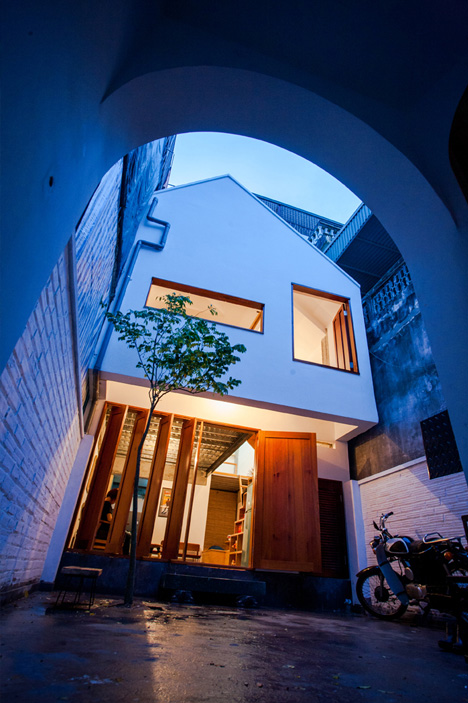
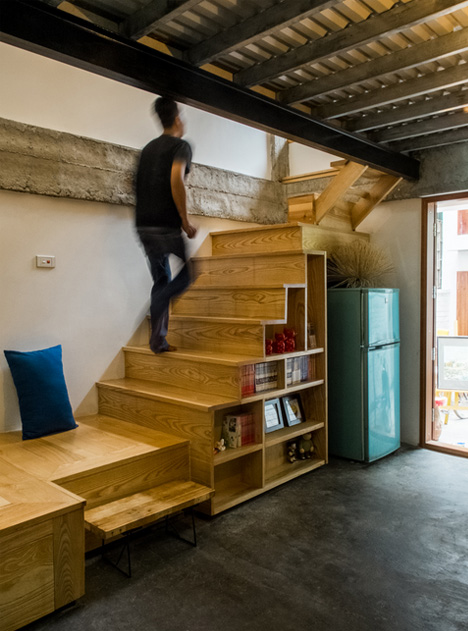
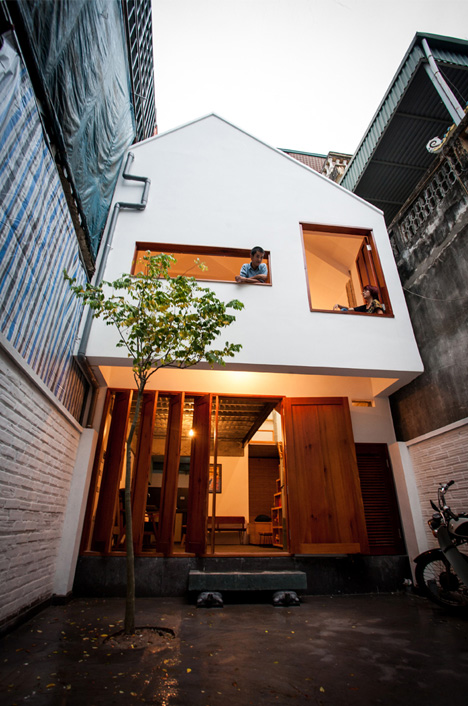
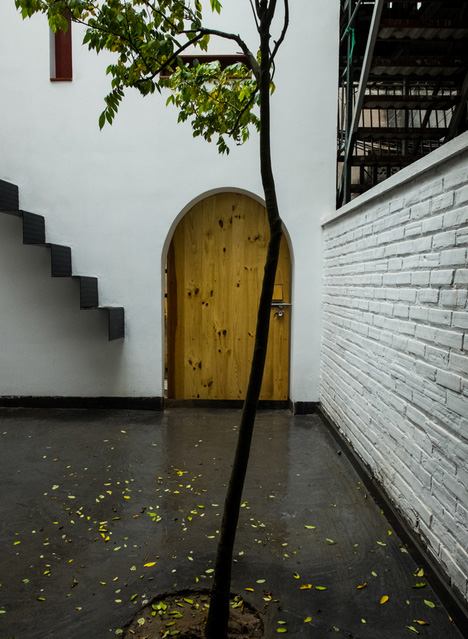
    In some situations there is simply no way to add windows to the side of a home – this design rises to the challenge, stretching and reshaping a small urban lot to fit a cozy and low-cost solution in the capital of Vietnam.

    niche exterior entry details

    niche finishes wood concrete

    With a limited budget (around $ 15,000), the client (a musician with a family) sought a space that would feel cozy and private, yet open and close to nature … all difficult propositions to reconcile in a house touching walls with both its residential neighbors.

    niche courtyard home design

    niche house floor plans

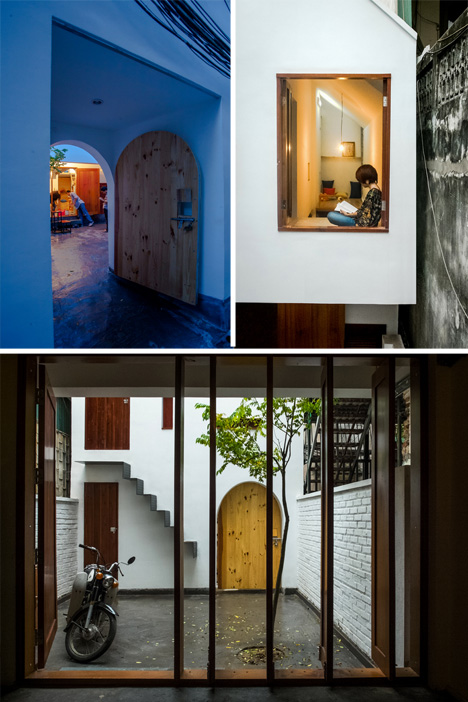
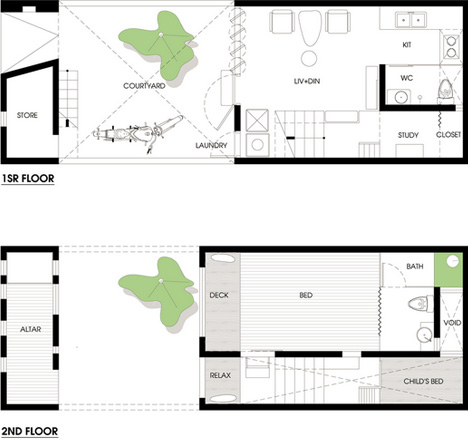
    The main structure, designed by Adrei-Studio Architecture, was set back from the street to create an open courtyard between a small entry volume and the primary residence.

    niche home room details

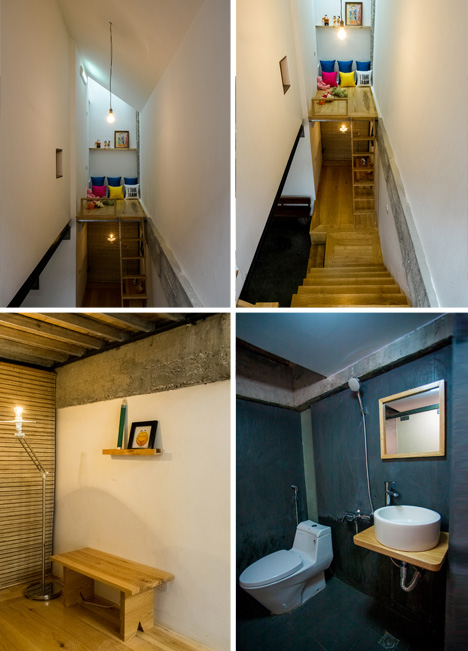
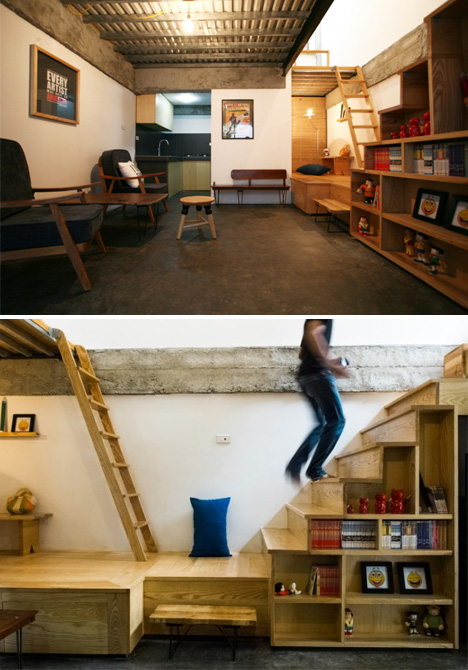
    Asymmetrical elements create a sense of movement as one circulates the site, while traditional Vietnamese detailing and warm materials make it feel like a home. Window seats, platform lofts, under-stair storage and other small touches are found throughout.

    niche home exterior space

    niche main living room

    Those seemingly minor touches, in fact, are what make the project: little moves that together go a long way toward creating a sense of place, including various niches, nooks, crooks and crannies created to enliven the interior and connect back to the exterior as well.

    Share on Facebook


    [ By WebUrbanist in Architecture & Houses & Residential. ]

    [ WebUrbanist | Archives | Galleries | Privacy | TOS ]


    WebUrbanist

  • DISCUSS: What Would It Take to Get You To Swap to a New Camera System/Brand?

    switch camera system brandThis last week Sony released a couple of cameras that caused a big stir around the online photography community – the Sony A7 and A7R cameras (pictured right). These full frame, interchangeable cameras come in a compact body with lots of features and the initial hands on reviews being published from around the web say that they are going to be really popular.

    I’ve seen a lot of DSLR owners say that they’re pre-ordering these cameras already and it has made me wonder – what would it take for me to switch from one camera system to another?

    The thing that stops most DSLR owners from switching brands is their investment in lenses and accessories that tie them into a brand. But increasingly we’re seeing adapters released that allow using lenses with one lens mount on other brands. For example these new Sony cameras can be fitted with an adapter that allows for my Canon lenses to be used.

    The barriers to switching are slowly being removed.

    I’m not yet ready to make a switch but I’m seeing more and more people do so. For some reason I’m particularly seeing disillusioned Canon DSLR users make the switch – maybe its just that there are more of them but quite a few feel frustrated by the lack of development by Canon of late.

    So here’s my Question

    What would it take for you to switch from one camera system to another?

    Are you tempted to do so by some of the new cameras announced in the last year?

    Or have you already made the switch and do you have any regrets?

    Post originally from: Digital Photography Tips.

    Check out our more Photography Tips at Photography Tips for Beginners, Portrait Photography Tips and Wedding Photography Tips.

    DISCUSS: What Would It Take to Get You To Swap to a New Camera System/Brand?

    The post DISCUSS: What Would It Take to Get You To Swap to a New Camera System/Brand? by Darren Rowse appeared first on Digital Photography School.


    Digital Photography School