RSS
 

Archive for August, 2013

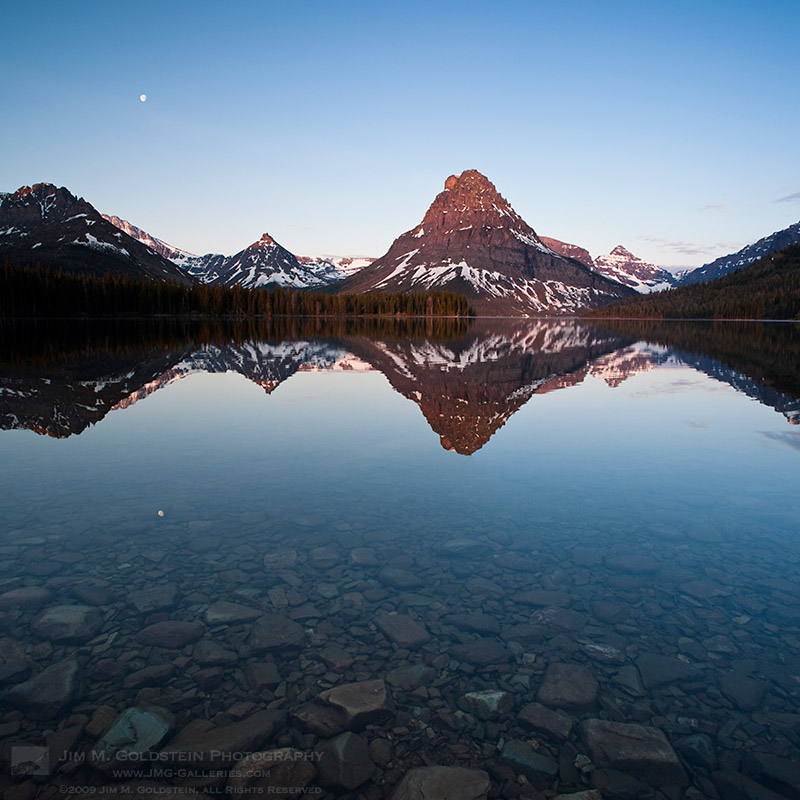
Sinopah Mountain Reflected in Two Medicine Lake at Sunrise II

07 Aug
Sinopah Mountain Reflected in Two Medicine Lake at Sunrise II

Sunrise at Two Medicine Lake with Sinopah Mountain reflected in the calm water – Glacier National Park

Glacier National Park has always been a special place for me. I’ve been guilty of driving far out of my way to visit, in some instances with 19 hour stretches of driving. The park’s amazing views and glacially carved valleys are mesmerizing. One of my favorite locations in the park is Two Medicine Lake with its crystal clear water, majestic peaks and amazing morning light. This is one of a few locations I visit that the longer I stand taking in the scene the more rejuvenated and healed I feel. All from taking in the view which makes me think of the following quote:

“Nature spontaneously keeps us well. Do not resist her!”

Henry David Thoreau

Copyright Jim M. Goldstein, All Rights Reserved

Sinopah Mountain Reflected in Two Medicine Lake at Sunrise II

The post Sinopah Mountain Reflected in Two Medicine Lake at Sunrise II appeared first on JMG-Galleries – Landscape, Nature & Travel Photography.


Related Stories

  • Sinopah Mountain Reflected in Two Medicine Lake at Sunrise II – Enclosure
  • Morning Mist – Glacier National Park
  • Morning Mist – Glacier National Park – Enclosure
Feed Ads by FeedBlitz
powered by ad choices


JMG-Galleries

 
Comments Off on Sinopah Mountain Reflected in Two Medicine Lake at Sunrise II

Posted in Equipment


7 Tips That Will Take Your Vacation Photography To A Whole New Level

07 Aug

It’s summertime…and the living is easy! This is the time of year for spending more time outside, soaking up those blessed, golden rays of sunshine and hitting the beach. Of course, it’s also the time of year when you’re likely going on vacation, meaning vacation photography takes center stage after many months of you working hard and keeping your nose Continue Reading

The post 7 Tips That Will Take Your Vacation Photography To A Whole New Level appeared first on Photodoto.


Photodoto

 
Comments Off on 7 Tips That Will Take Your Vacation Photography To A Whole New Level

Posted in Photography


No compromise? Zeiss blogs about its new lens line and the 55mm F1.4

07 Aug

1_4_55_ZEISS_detail.jpg

Zeiss has posted a blog article that talks about the inception and development of its latest line of lenses, led by the 55mm F1.4 that was first shown at Photokina last year. Titled ‘No Compromise’, it explains how the company is aiming to meet the demands of the latest high resolution sensors, to satisfy the needs of both professional photographers and ambitious hobbyists. Click through to read more, and the link to the original article.

News: Digital Photography Review (dpreview.com)

 
Comments Off on No compromise? Zeiss blogs about its new lens line and the 55mm F1.4

Posted in Uncategorized


Virtual Interior Design: Augmented Reality IKEA 2014 Catalog

07 Aug

[ By WebUrbanist in Design & Furniture & Decor. ]

augmented reality ikea catalog

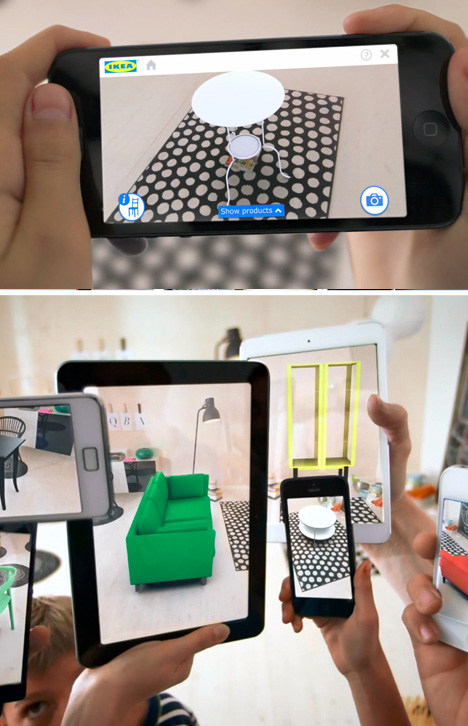
Imagine no more: now you can scan items right out of a physical catalog and watch them pop up in your own bedroom, kitchen, living or dining room at home, on-screen and in real-time before your eyes.

Watch as couches, sofas, chairs, beds, bookcases and more are picked off the page and planted in place, letting you see how that piece you like would really look context, automatically scaled to size on the spot from the digital source object.

augmented virtual interior design

IKEA notes that its European customers in particular have small spaces and need to know before they buy just how much room something will take up and where it will go – and its shoppers more broadly rarely know their home dimensions by heart.

ikea new catalog revealed

From IKEA: “The 2014 IKEA catalogue gives you the ability to place virtual furniture in your own home with the help of augmented reality. Unlock the feature by scanning selected pages in the 2014 printed IKEA catalogue with the IKEA catalogue application (available for iOS and Android) or by browsing the pages in the digital 2014 IKEA catalogue on your smartphone or tablet. Then simply place the printed IKEA catalogue where you want to put the furniture in your room, choose a product from a selection of the IKEA range and see how it will look in your home!”

augmented furniture product placement

How it works: “Customers can put the physical Ikea Catalogue into their room in the space where they want to test a product. The Ikea Catalogue App picks up the catalogue and uses it to gauge the correct scale for products that will be shown on-screen. The product then appears on the customer’s mobile phone camera within the Ikea Catalogue App so it can be tested for colour and size. Customers can then test different products to find the right one for their home – finding the perfect fit.”

Share on Facebook


[ By WebUrbanist in Design & Furniture & Decor. ]

[ WebUrbanist | Archives | Galleries | Privacy | TOS ]


WebUrbanist

 
Comments Off on Virtual Interior Design: Augmented Reality IKEA 2014 Catalog

Posted in Creativity


Canon EOS 70D preview updated with studio & real-world samples

07 Aug

impressions.jpg

One of the hottest cameras of the year so far, the Canon EOS 70D won’t be in stores for a few more weeks but we’ve got hold of an early beta sample, and Canon has let us post pictures from it. Not wanting to waste any time, we’ve been busily shooting with it for the past few days both in the studio and out in the real world, and we’ve added a lot to our previously-published preview. Click through for a link to the expanded preview, now including studio comparison pages and a large gallery of sample images.

News: Digital Photography Review (dpreview.com)

 
Comments Off on Canon EOS 70D preview updated with studio & real-world samples

Posted in Uncategorized


Why are my Buildings Falling Over? A Short Guide to Perspective Distortion and Correction in Photography

07 Aug

A guest contribution by Misho Baranovic, co-developer of the Perspective Correct app and author of the iPhone Photography DPS eBook .

Perspective Photo1

I’ve read a lot of perspective correction articles over the past few days and my head is spinning from the technical explanations, illustrations and equations.   In this article, I’m going to keep it simple and talk about the role that perspective plays in photography.  

What is Perspective?

Perspective is one of the many ways that the human eye can judge depth within a scene.  Perspective is something that we can see with one eye (monocular) rather than two (binocular).  It refers to the angle and location of parallel lines within a scene.  The eye registers depth when parallel lines start moving towards each other (converging).  An example would be standing on a straight road, looking down the road, and noticing how the road narrows as it gets further away from you.
Perspective Photo2

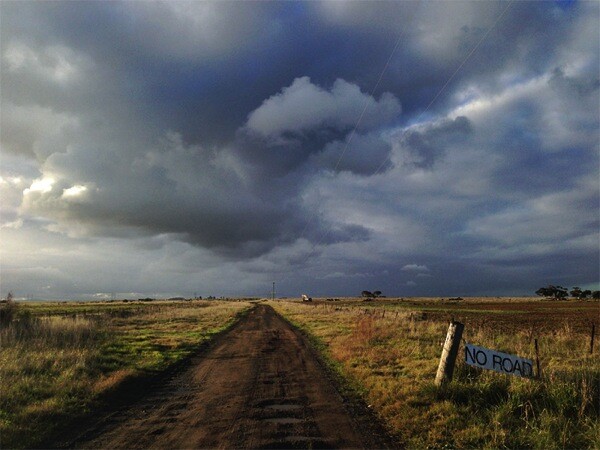
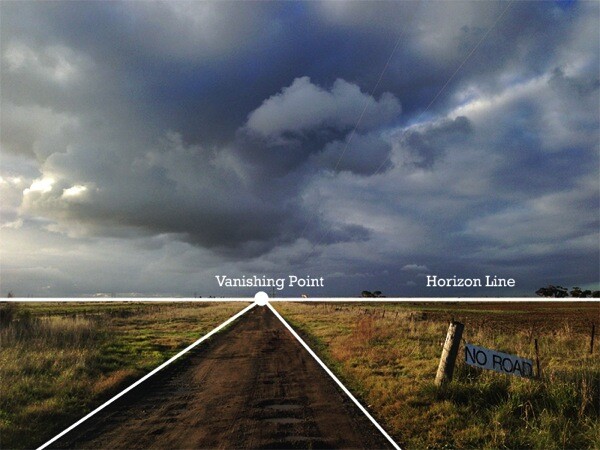
In art and photography, Linear Perspective refers to the way lines are drawn and captured to show an objects perceived size within space. In short, how we translate real world depth into a flat picture. Linear Perspective is made up of two basic concepts, the horizon line and vanishing point.  The horizon line represents the viewing angle of the observer.  Vanishing points are the point (on a horizon line) where parallel lines meet (converge). For example, the point where the two sides of the straight road meet (as shown below).
Perspective Photo3

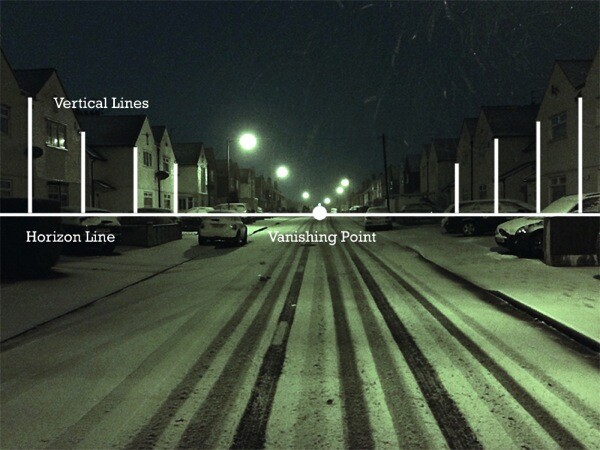
One of the key visual cues in Linear Perspective is that vertical lines and edges remain vertical in the scene. The only time you would have vertical lines coming together is if you are trying to show a triangular or pyramid shape within the scene, like the angle of a building’s roof or the shape of the Eiffel Tower.
Perspective Photo4

Since the start of photography, camera and lens makers have focused on replicating the visual cues of Linear Perspective in order to make photos look as ‘true to life’ as possible. Nearly all modern lenses are rectilinear – they capture straight lines in a scene as straight lines in a photograph.  Whether wide angle or zoom, DSLR or iPhone, lenses are designed to keep lines straight, which helps the eye judge depth within a two dimensional scene. The fisheye is the most popular non rectilinear lens as straight lines are shown as curved from the extreme field of view.

Perspective Distortion

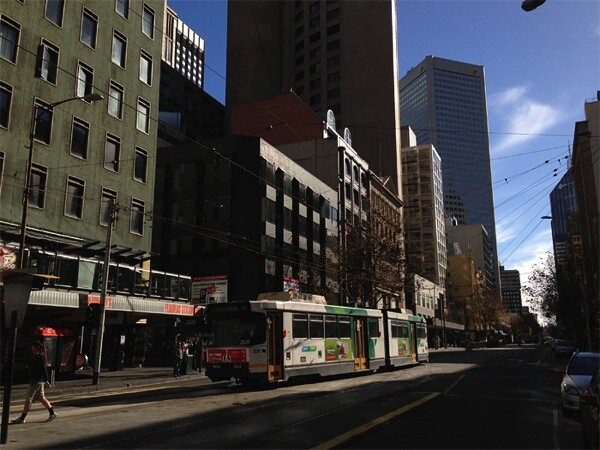
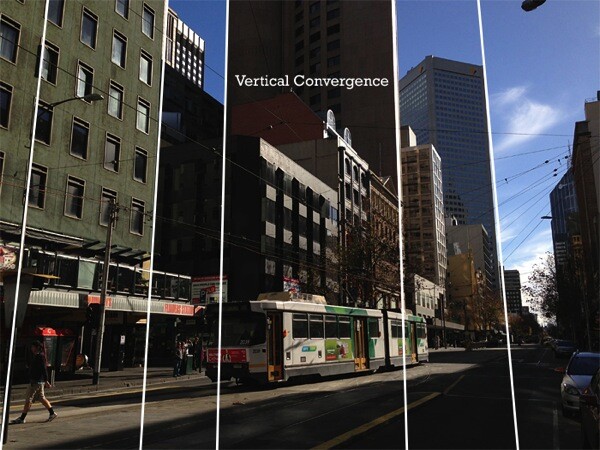
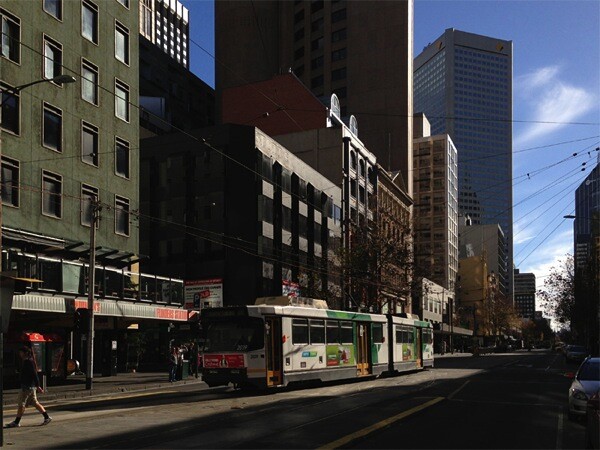
For this article I’m going to focus on only one form of photographic perspective distortion – perspective convergence or keystoning.  This form of distortion is very common across architectural, street and travel photography.  It’s most often seen when tall buildings ‘fall’ or ‘lean’ within a picture. This distortion has become so common that most people have stopped noticing it within their pictures or just think it has something to do with the focal length of their lens. For example, you can see the extent of the vertical convergence below when the verticals are outlined in white.
Perspective Photo5

Perspective Photo6

For a number of photographers, vertical convergence and distortion are unpleasant and unwanted because they don’t conform to Linear Perspective cues where vertical lines remain vertical.  This makes the scene look different to how we think it should look.  While this distortion can be used creatively, corrected photos often look ‘right’ to the viewer (see below).
Perspective Photo7

Why does Distortion Happen?

It’s actually pretty simple.  As mentioned, modern lenses are designed to show straight lines.  However, this only works when we the camera is pointed straight at (in line) with the object that is being photographed. This is because the distance between the camera and object remains the same.  As soon as the camera is titled then the distance changes.  Let me explain, if I’m trying to capture a tall building straight on with my camera I can only get the bottom section – vertical lines are straight but I’m missing the rest of the building. Now if I angle the camera higher I can get the whole building into the frame but now the vertical lines (sides of the building) are converging.  Why?  It’s because the top of the building is now further away from the lens than the bottom – just like the road receding into the distance.

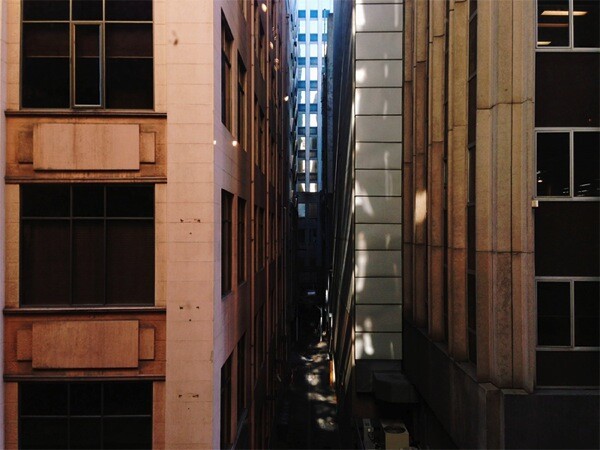
So how do you take a photograph of a tall building without this happening?  There are a few ways.  The most obvious is by changing your viewpoint.  You need to get higher to shoot more of the building front on, with the mid-point being the best place to capture the maximum amount of the structure.  You could shoot out the window of a neighbouring building, or if there is nothing around you could spend some money on a crane!
Perspective Photo8

This photo was taken from the third floor of a neighbouring block. You can see that all the verticals in the photo are straight.

If you can’t physically get higher then you can change your viewpoint in two other ways.  One is with the help of shift lenses the other is through perspective correction software.

Shift Lenses

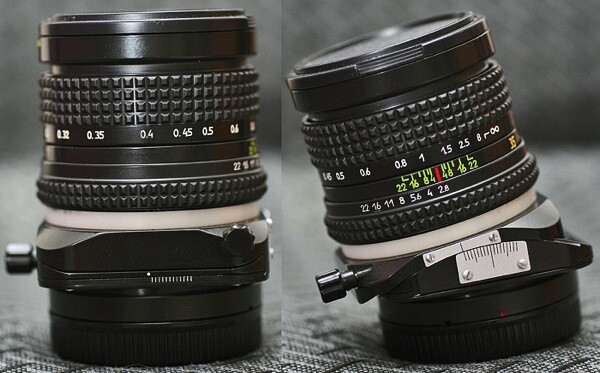
The ability to shift the position of the lens has been around since the beginning of photography.  The original view cameras (created in the 1840s) used a bellows system which let photographers change the position (shift) the lens in relation to the film. The shifting mechanism acted like a mini elevator, moving the photographer’s viewpoint higher and lower. Historically, shifting in order to correct perspective convergence was seen as an important part of the capture process, just like focus, shutter speed and aperture. Shifting was possible because the lens captured a much larger (circular) field of view than the film. The same way that modern shift lenses work.  Modern shift lenses are commonly used by architecture photographers to limit vertical convergence on large buildings. However, these lenses can only be used on DSLR or medium format cameras and can also be very expensive (upwards of $ 1,000).
Perspective Photo9

Here you can see the mechanical shift mechanism on an SLR lens – Photos by Bengt-Re

Software Correction

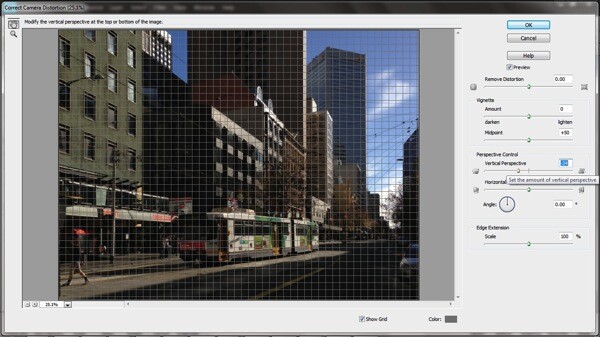
In recent years, digital technology has been able to replicate this shifting process, artificially changing the photographer’s viewpoint.  Software like Photoshop, Lightroom or Gimp reworks the pixels in an image in order to straighten vertical lines in turn reducing distortion.  Most of these programs allow you force the image back into a ‘correct’ position through either sliders or by selecting and dragging a corner.  One of the downsides of the software is that significant adjustments require resampling of the image, often reducing sharpness in parts of the photograph.  
Perspective Photo10

Camera Distortion Correction with Photoshop Elements 11

For photographers that either shoot or edit photos on their mobile phones, the Perspective Correct app for iPhone uses the touch interface to adjust both vertical and horizontal convergence within an image.  For example, an up/down swipe on the screen represents the same movement as the shift mechanism on a lens. 
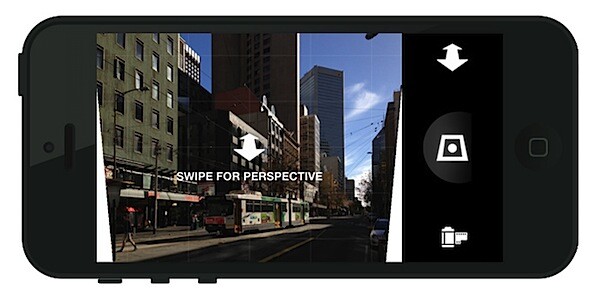
201308011644.jpg
While it’s easy to overlook, small perspective adjustments can often be the difference between good and great urban and architectural photographs.

…………………………………….

Perspective Correct is the first app to offer live perspective adjustment of your photos and is available for download from the Apple App Store for US $ 1.99

Post originally from: Digital Photography Tips.

Check out our more Photography Tips at Photography Tips for Beginners, Portrait Photography Tips and Wedding Photography Tips.

Why are my Buildings Falling Over? A Short Guide to Perspective Distortion and Correction in Photography


Digital Photography School
 
Comments Off on Why are my Buildings Falling Over? A Short Guide to Perspective Distortion and Correction in Photography

Posted in Photography


Canadian Travelogue – Nova Scotia – Peggy’s Cove

07 Aug

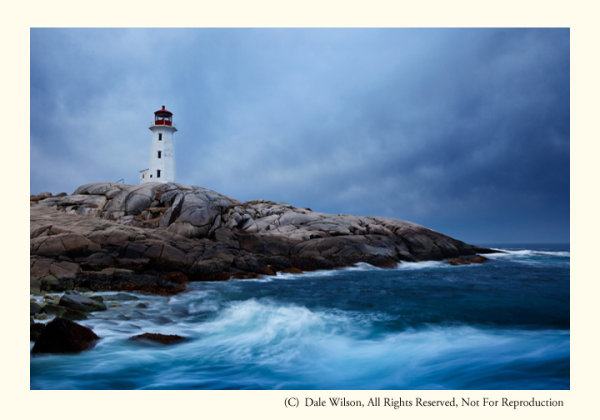
No location in Canada’s Ocean Playground is more quintessentially Nova Scotian than Peggy’s Cove. It’s all there: a lighthouse, pounding surf on large granite outcroppings and a tranquil working fishing community. And it’s only 50 kilometres from Halifax, the largest city in Atlantic Canada.

Early spring is a great time to photograph one of the most photographed lighthouses in the world, should you want images without people in the picture

Early spring is a great time to photograph one of the most photographed lighthouses in the world, should you want images without people in the picture

The only land route to Peggy’s Cove is Highway 333, starting at Armdale, and then routes along to coast and eventually joins Highway 103 at Upper Tantallon to the west. You then turn right onto Highway 103 and drive east back to the western reaches of Halifax at Bayers Lake. The coastal drive from Armdale to Peggy’s Cove along Route 333 is by far the most scenic and interesting, offering may little side trips to the not too distant shoreline and coastal communities.  You will have no difficulty locating Peggy’s Cove itself: it’s one of the top tourist destinations in all of Canada, so road signage is abundant.

Photographers who desire images of the lighthouse without people milling about will have their patience taxed to the limit. The task will be almost impossible in the peak tourist season of July and August, and just plain difficult at any other time of the year … except maybe the coldest days of winter. I find April is a good time as most of the snow will have melted and it is still too early for people to be thinking about visiting this Atlantic sentinel. Additionally, what little foliage there is will still be brown and this is typically a good month for storm clouds that create interesting and supportive notions of why a lighthouse is there in the first place.

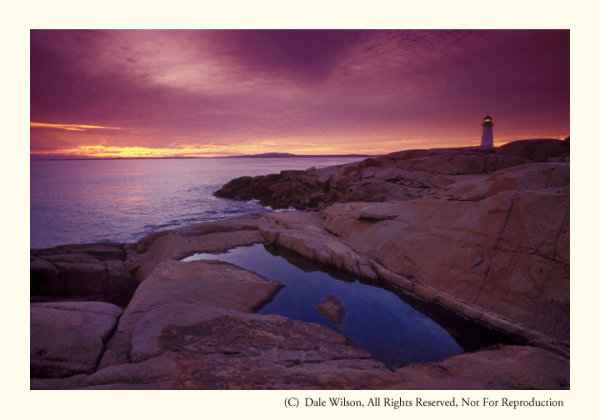
The best approach to photograph the village and the lighthouse is to arrive in early morning and “play tourist,” making pictures as you meander around the harbour. You can easily spend several hours just following your nose, and there is a large restaurant on site for that moment when the light gets too harsh. Make sure to re-visit in the evening –after a noon-day nap, of course—and leave yourself lots of time to find the perfect location to get the classic lighthouse-against-the-sunset photograph.  Should you stake out a vantage point on the south side of the lighthouse there is a better chance you will be able to eliminate people from the image with creative camera positioning and sight angles. From a low elevation the camera’s line of sight will be just over the heads of the tourists who sit on the rocks enjoying the last rays of the day.  The other classic view is from the water’s edge just to the north of the little cove in front of the lighthouse itself, immediately below the restaurant. Be aware, from here you will almost be guaranteed there will be people in your picture.

By staying to the south of the light, it is possible to keep the camera low and avoid people from creeping into the frame. Challenge yourself to look for creative images as well as portaits of the light.

By staying to the south of the light, it is possible to keep the camera low and avoid people from creeping into the frame. Challenge yourself to look for creative images as well as portaits of the light.

When travelling along the shoreline anywhere in Atlantic Canada, but especially so in Peggy’s Cove, be astutely aware of your surroundings, rogue waves are common and have called unwary visitors to the depths to dwell with King Neptune. So, please, be careful and mindful of the signage; if those rocks are black or wet you are too close to the water’s edge. The Atlantic Ocean is huge and powerful, and its combers deserve, and demand, your respect.

Now get out there and enjoy one of the most photogenic places in all of Nova Scotia, and Canada. You won’t be disappointed.

Post originally from: Digital Photography Tips.

Check out our more Photography Tips at Photography Tips for Beginners, Portrait Photography Tips and Wedding Photography Tips.

Canadian Travelogue – Nova Scotia – Peggy’s Cove


Digital Photography School

 
Comments Off on Canadian Travelogue – Nova Scotia – Peggy’s Cove

Posted in Photography


White House photographer on presidential Instagramming

07 Aug

Screen_Shot_2013-08-06_at_12.00.08_PM.png

As the official White House photographer, Pete Souza gets more access to the President than any other professional photographer. Souza is no stranger to photographic social media, either. His images are regularly posted on the White House’s Flickr stream, where the Obama administration has been giving insight into the daily lives of the first family since the inauguration in 2009, and he recently joined Instagram. Time recently interviewed Souza about his work, and you can read more at our sister site, connect.dpreview.com.

News: Digital Photography Review (dpreview.com)

 
Comments Off on White House photographer on presidential Instagramming

Posted in Uncategorized


Build your own point-and-shoot camera with Bigshot

07 Aug

bigshot.png

Budding young photographers (and curious adults) can put together their own camera with Bigshot, a DIY point-and-shoot aimed at teaching kids tech hardware basics. Developed partially with funding from Google, the kit includes everything needed to construct the camera including a 3 megapixel image sensor, LED flash, 1.4 inch LCD and a wheel with three built in lens options. Bigshot’s website also contains an impressive learning section packed with information about the technology behind digital photography. Click through for more details and pricing.

News: Digital Photography Review (dpreview.com)

 
Comments Off on Build your own point-and-shoot camera with Bigshot

Posted in Uncategorized


Building Fragments: 20 Surreal Reconstructed Photographs

06 Aug

[ By WebUrbanist in Art & Photography & Video. ]

edited photoshopped crane tower

At first glance, they are nearly believable, these angled buildings with their curious corners. Closer inspection reveals Escher-esque optical illusions and impossible intersections, liminal hybrids of real details … reconstructed.

edited improbable building configurations

edited building multiple versions

Olivier Ratsi, a French visual artist, titles this series What You See is Not What You Get (WYSI*not*WYG). It collects then fragments urban landscapes, which he dubbs Anarchitecture, sorted by country and city, from around the world. The results are reassembled into something at once more disjointed yet (together) unified than the original constituent objects.

edited city structure korea

edited photo tower building

His final pieces are then printed and posted around towns and cities where one might normally find advertisements – a sort of subvertising campaign challenging people to stop, look and think about their urban environment.

Next Page:
Building Fragments 20 Surreal Reconstructed Photographs

Share on Facebook


[ By WebUrbanist in Art & Photography & Video. ]

[ WebUrbanist | Archives | Galleries | Privacy | TOS ]


WebUrbanist

 
Comments Off on Building Fragments: 20 Surreal Reconstructed Photographs

Posted in Creativity