RSS
 

Archive for August, 2013

21 August, 2013 – Leica 50mm f/2 APO Summicron ASPH Review

21 Aug

Every now and then a new lens comes along, that while necessarily expensive, sets photographer’s hearts a-flutter with its potential for extreemly high image quality.

Such a lens of the new Leica 50mm f/2 APO Summicron ASPH. Our contributor Mark Dubovoy has been using one for a few weeks on his Leica M as well as on a Monocrom. Find out what Mark thinks of the new 50mm APO.


"Having been to Antarctica with Michael and Kevin, I would say after having traveled the world and shot nearly my entire life as an exhibiting photographer,  it was one of my highlights in my life and I talk about it, all the time.  The images and experience of seeing something visionary and nearly extinct from the world, to see and experience the wildlife and scenery that does not fear humans is amazing.  The images I shot there won me two Smithsonian awards and nearly 18 other international awards". – Tim Wolcott

 Find Out More Now
These Expeditions Will Sell Out Quickly. They Always Do


The Luminous Landscape – What’s New

 
Comments Off on 21 August, 2013 – Leica 50mm f/2 APO Summicron ASPH Review

Posted in News


An Introduction to the Inverse Square Law

21 Aug

I don’t know about you, but I was never much of a math student.  I needed a tutor in high school for both geometry and physics.  I chose a double major in college (Journalism/English) that required no math.  I practiced law for fourteen years, where any math I needed was either pretty easy or done on a calculator.  Even when I ditched my briefcase for a camera bag and embarked on a new career, I felt pretty secure in the knowledge that confusing math had no place in the world of photography.

And then the Inverse Square Law reared its ugly head.

It didn’t jump out and attack me right away.  No– the Inverse Square Law is much too cunning for that.  It was patient.  It bided its time.  It waited for me to get comfortable in my new skin a professional photographer.  It waited for me to feel secure in my knowledge and execution of studio lighting and off-camera flash.  And then it showed itself.

We all deal with light.  It is the defining element of what we do.  We capture light in a box and use it to tell a story.  Some photographers put themselves in the “natural light” category, while others work their magic with a firm grasp of off-camera flash.  While the Inverse Square Law comes into play more often with strobes, it is absolutely a concept that applies to every light source, and therefore affects every photographer.

So, what is it?  In all of its overly technical glory, the Inverse Square Law– as it applies to photography– is an equation that relates the intensity of a light source to the illumination it produces at any given distance.

Huh?

Regardless of how you classify yourself as a photographer, you already know that light travels.  It can be diffused.  It can be reflected.  It can be deflected.  But it travels.  This means that over time and distance its intensity can and will diminish.  What does that mean for your photography?  It means that doubling the flash-to-subject distance reduces the light falling on the subject to one-quarter.  Logically, we might assume that doubling the distance would reduce the power by half.  In actuality, however, doubling the distance reduces the power by 75%  More simply put, the Inverse Square Law is used (among other things) to determine the fall-off– the difference in illumination on a subject as it moves farther away from the light source.

Let’s take a look at a graphic that will help us get our heads around this.  We are looking at a blank wall approximately ten feet long, illuminated with a single light source.  Meter readings along the wall show the progression of one-stop increments.  Notice how we move one stop from f/22 to f/16 in a matter of inches, yet we move one stop from f/4 to f/2.8 over the course of a few feet.
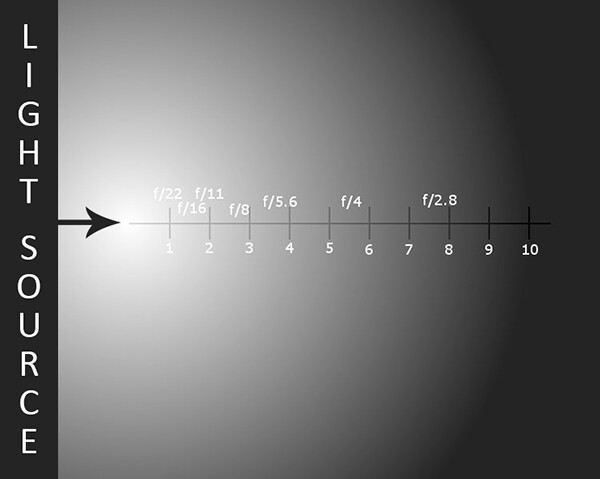
The Inverse Square Law relates the intensity of a light source to the illumination it produces at any given distance.

The Inverse Square Law relates the intensity of a light source to the illumination it produces at any given distance. One-stop increments are spread over a wider area the farther the light travels.

Now that we understand what the Inverse Square Law is and how it affects the intensity of light, how do we apply it to our photography?  Let’s assume that we are photographing a family of four on our wall.  If we position them closer to the light– let’s say in the f/8 – f//11 range– we are going to have a lot of contrast between the subjects.  Those closer to the light source catch the brunt of the light and may be overexposed, while those further from it could be underexposed.  The variance in the light over such a short distance means the light falling on our subjects will be very uneven.  If, on the other hand, we move our family down the wall to the 7- or 8-feet mark, we have a wider area in which to achieve a more even exposure across the group.

Remember, though, that the same principles apply not only to our subjects, but to the relationship between the light source and the background as well.  If we are photographing our imaginary family with a plain white wall for a background, simply moving them closer to or farther away from the wall will affect whether the wall appears white, gray, or even black.

So far, we’ve discussed what the Inverse Square Law is and how it applies to off-camera flash.  But what about natural light?  The same concept applies, whether you are using window light, a reflector, a sunset, or any other non-electrical light source.  The principles of how light travels do not change just because the light in question has no batteries.  Doubling your subject’s distance from the window, for example, is going to result in the same 75% drop in intensity that you will experience with strobes or speedlights.

So, what’s the bottom line?  The best advice I can give about the Inverse Square Law is to simply be aware of it and understand its potential impact on your photos and lighting setups.  The more you understand light and how it behaves, the better equipped you will be to efficiently compose and create consistent images with less trial and error.


Post originally from: Digital Photography Tips.

Check out our more Photography Tips at Photography Tips for Beginners, Portrait Photography Tips and Wedding Photography Tips.

An Introduction to the Inverse Square Law


Digital Photography School

 
Comments Off on An Introduction to the Inverse Square Law

Posted in Photography


Professional photographers go head-to-head in Instagram shootout

21 Aug

instagram_shootout.png

Being a photojournalist is inherently competitive. Sometimes, you are competing against other professionals in your area, sometimes you are competing against the kid with an iPhone who happened to get to the crime scene 30 minutes before you. For photographers Eric Thayer and Joshua Lott, the competition is personal and public. What started as classic one-up-manship has escalated into an official Instagram face-off. Head over to our sister site connect.dpreview.com to read more about the friendly rivalry. 

News: Digital Photography Review (dpreview.com)

 
Comments Off on Professional photographers go head-to-head in Instagram shootout

Posted in Uncategorized


On Assignment: Saving Florida’s Springs

21 Aug
On Assignment: Springs Eternal

We spend a lot of time on f/stops, shutter speeds, lighting ratios and the like around here. But none of these things — none — matters when compared against another variable: What can you actually accomplish with your photography?

Long-time readers will be familiar with Florida-based nature photographer John Moran from previous article on Strobist. Always an advocate of nature, he has been one of natural Florida's most eloquent voices for conservation. Now he's taking that fight to the next level, aiming his cannons —and his Canons — at one critical target: saving Florida's natural springs.

What a person with a camera, a few lights and a vision (and a help from his friends) can accomplish, below.

Read more »
Strobist

 
Comments Off on On Assignment: Saving Florida’s Springs

Posted in Photography


Garmin takes on GoPro with VIRB and VIRB Elite action cameras

21 Aug

virb_elite_thumb.png

Garmin has taken a leap into the rugged action camera market with the Garmin VIRB and VIRB Elite, designed to capture video and stills in extreme conditions. In a market segment currently dominated by GoPro, the VIRB steps into the ring with 1080p HD video capture, a 1.4-inch display, integrated weatherproof housing and ANT+ connectivity. The VIRB Elite is a step-up model with built-in WiFi and GPS. Both are capable of 16 megapixel still images, as well as time-lapse photography. Click through for the full press release and pricing.

News: Digital Photography Review (dpreview.com)

 
Comments Off on Garmin takes on GoPro with VIRB and VIRB Elite action cameras

Posted in Uncategorized


Ten unique cameras from the dawn of consumer digital photography

21 Aug

coolpix100_hand-trans2.png

Do you remember having to change floppy disks on your Sony Mavica? Or perhaps plugging your Coolpix 100 into the side of your laptop? The early days of consumer digital photography were filled with cameras that broke new ground, though not necessarily in directions that were widely adopted. In this article, DPReview’s Jeff Keller takes a look back at ten unique cameras from the era of PC Cards and SCSI ports. Follow the link to explore some of the interesting dead-ends of early digital photography.

News: Digital Photography Review (dpreview.com)

 
Comments Off on Ten unique cameras from the dawn of consumer digital photography

Posted in Uncategorized


Ghost Architecture: Unconscious Art of Building Demolition

20 Aug

[ By WebUrbanist in Art & Photography & Video. ]

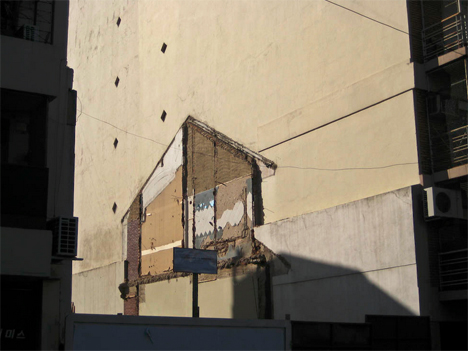
void building architectural photos

When a free-standing building is razed there is often little left to tell its story, but in places where structures directly abut one another there are sometimes amazing traces of not just buildings but floor plans, wall placements, staircases and even room contents.

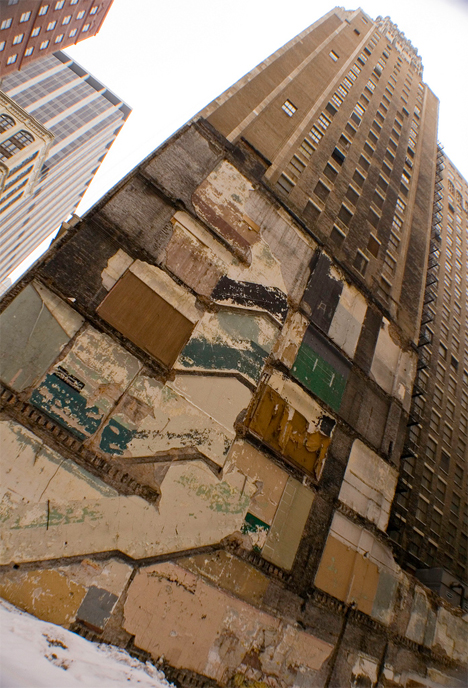
void building demolition art

Like architectural section drawings, remnant spaces can be extrapolated from two-dimensional clues, like material transitions, degree of weathering, surface shapes and color shifts. Occasionally, there are even three-dimensional fixtures still hanging on, like the showers, sinks and toilets in one of the pictures above.

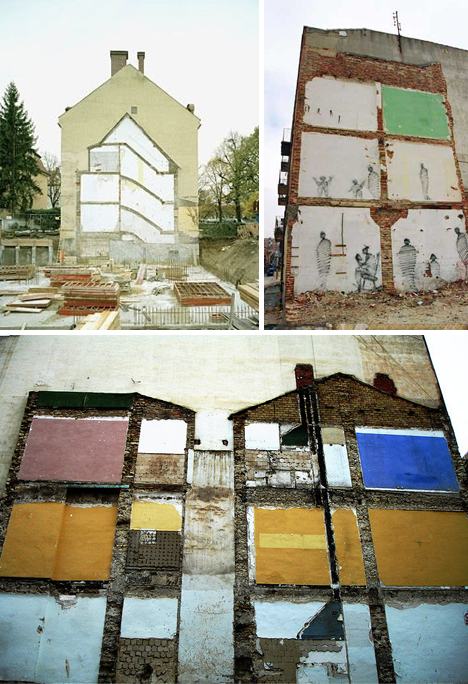
ghost void building

The Unconscious Art of Demolition is a Flickr photography group that focuses on these accidental works of ghost architecture – leftover structural voids and the spaces they imply.

void structure implied volume

In the process of observing and photographing, these passers by and onlookers are turned into amateur documentarians and de facto archaeologists, discerning and (at least subconsciously) projecting patterns into ambiguous urban decay.

void architecture building examples

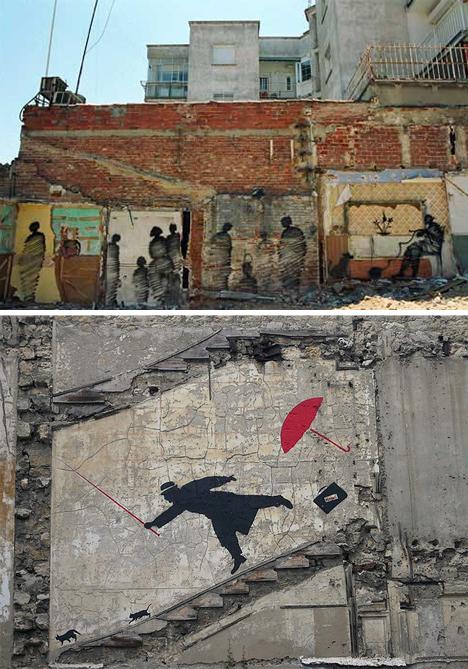
Some take an abstract approach, zooming in on the rich materials where parts of walls were left and other pieces ripped away. Others take a broader focus, highlighting building outlines and implied interiors. Still others capture works of street art placed within the flat landscapes one can imagine inside of these non-buildings.

void building street art

Images included here are by Steven Kunstler, Merrick Brown, Daniel Lobo, Thomas Hobbs, Dave Meyer and Xenmate, but many more can be found in the aforementioned Flickr group with over 500 images and members.

Share on Facebook


[ By WebUrbanist in Art & Photography & Video. ]

[ WebUrbanist | Archives | Galleries | Privacy | TOS ]


WebUrbanist

 
Comments Off on Ghost Architecture: Unconscious Art of Building Demolition

Posted in Creativity


20. August 2013

20 Aug

Ein Beitrag von: Maria Schäfer

© Maria Schäfer


kwerfeldein – Fotografie Magazin

 
Comments Off on 20. August 2013

Posted in Equipment


Faded dream: blogger looks back at the failure of the Silicon Film project

20 Aug

SiliconFilm.png

In the early days of digital photography a small American company, Imagek, started developing a digital sensor module that could be installed in film SLRs. The idea still generates excitement today, more than ten years after the company (by then named Silicon Film) failed. Photographer and blogger Olivier Duong has taken a look back at the promise and disappointment of the Silicon Film dream.

News: Digital Photography Review (dpreview.com)

 
Comments Off on Faded dream: blogger looks back at the failure of the Silicon Film project

Posted in Uncategorized


19. August 2013

20 Aug

Ein Beitrag von: bluegreenredyellow

attached-©-bluegreenredyellow


kwerfeldein – Fotografie Magazin

 
Comments Off on 19. August 2013

Posted in Equipment