RSS
 

Archive for May, 2013

Canadian Travelogue – Newfoundland – Cape Spear

06 May


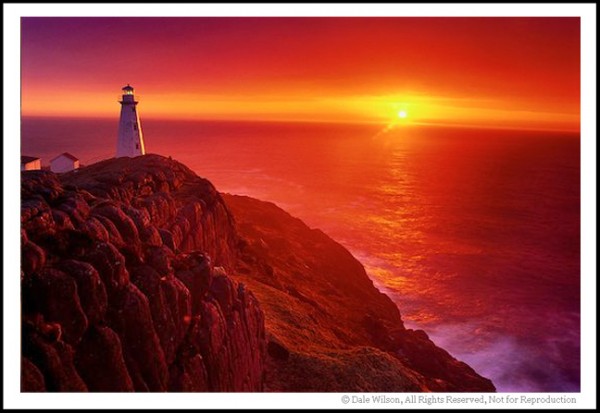
Cape Spear is the most easterly point of land in North America, so you may have the distinction of photographing sunrise here before anyone else on the continent.

 the Cape Spear shoreline is one of the most easily accessible and perectly orientated for early morning shoots. Yet, it still warrants extreme safety.

The Cape Spear shoreline is one of the most easily accessible and perectly orientated for early morning shoots. Yet, it still warrants extreme safety.

Tourists usually take the 15 minute drive along Highway 11 from downtown St. John’s to the Cape Spear National Historic Site to see Newfoundland’s oldest lighthouse, constructed in 1835, and of course to view the sunrise. But even at such early hours, photographers wishing to make images of a natural seascape with the presence of “humanoids” will face challenges.

Non-photographers have every bit as much right to be here as photographers, so the easiest solution is to side-step the challenge. As you top the hill and for the first time see the two lighthouses, you’ll notice a small parking lot to your immediate left that overlooks a small cove. Although you could go the extra distance of about 200 metres to the literal easternmost point if land on the continent, you might do better to stay here and make wonderful pictures of crashing surf without unwanted people interrupting the picture-making process.

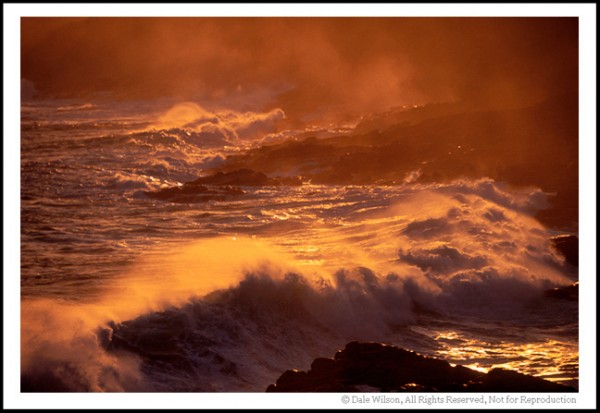
I have found that an ebb tide, nearest its lowest point, along with relatively high winds, is ideal conditions for capturing the eastward looking seascape.  As the waves crash against the reefs we need only use an 80-200mm zoom lens to compose striking images. June may offer an added bonus of icebergs, if the weather and winds are right. Typically along the eastern Canadian coast, September and October usually brings stronger winds, and indeed hurricanes, which means even bigger waves.

Study your viewfinder image carefully, as there is a small outbuilding with a power line at the extreme north tip of land that has the uncanny ability to find its way into your picture. With careful in-camera cropping this landscape image eyesore can be eliminated.

There are two lighthouses at Cape Spear, this is the new working light. The historic light is just a stones throw away.

There are two lighthouses at Cape Spear, this is the new working light. The historic light is just a stones throw away.


I know you’ll enjoy one of my favourite locations in eastern Canada to photography the seascape. Before you leave, though, walk out to the lighthouses. After all, you’ll want to say that you were to the easternmost point of land in North America.

On your drive back to St. John’s, you deserve to take a slight detour.  As you return via the Blackhead road drive about 7 kilometres until you see another road to your left; the sign should say Maddox Cove – Petty Harbour.  You will want to drive to Petty Harbour, which is approximately 11 kilometres from the Cape Spear National Historic Site.

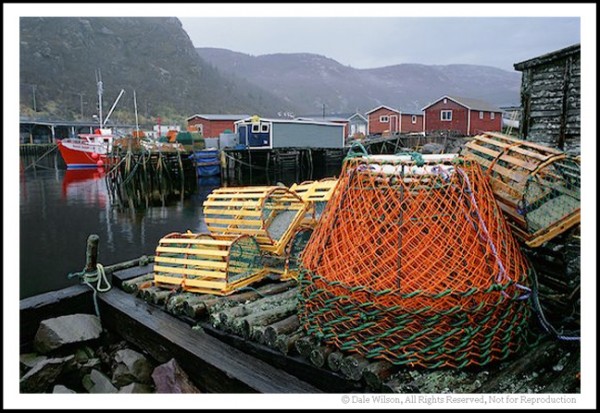
Petty Harbour is the quintessential Newfoundland fishing village.  The smells and sounds are reminiscent of days past, and few locations along the eastern coast of this province offer such easy and exquisite photo opportunities. Be prepared for fog and wet weather, but in my opinion this just adds to the mystique of the place.

The quintessential hishing village of Petty Harbour. Just park your car and have fun walking around the small harbour.

Parking your car will be challenging – there were no cars and urban planning was not a consideration when the first settlers planted roots here in 1598. The village is small so it is possible to park in a designated spot, or the church parking area and walk back to the wharf area. As with most areas in eastern Canada, you should be safe if you don’t block a driveway to either home, pasture or outbuildings.

Whereas Cape Spear is going to provide great seascapes, Petty Harbour is going to provide incredible fishing village scenes.   The producers of the 1977 film Orca also thought so when they brought Bo Derek, Richard Harris, Charlotte Rampling and supporting cast here to shoot this feature film.

Once finished shooting and enjoying Petty Harbour, you have the option of backtracking to St. John’s or continue west on the only road leaving town (Long Run Road) until you come to the Bay Bulls Road, where you will make a right hand turn and then continue to St. John’s.

-DW

Postscript: All images were shot on Fuji Velvia film with Nikon cameras, colour enhancing, colour polarizing and split-graduated filters. There has been no digital enhancing of saturation or contrast. 

Post originally from: Digital Photography Tips.

Check out our more Photography Tips at Photography Tips for Beginners, Portrait Photography Tips and Wedding Photography Tips.

Canadian Travelogue – Newfoundland – Cape Spear


Digital Photography School

 
Comments Off on Canadian Travelogue – Newfoundland – Cape Spear

Posted in Photography


Do You Take a Digital Camera With You Everywhere? [POLL]

06 May

Last week I wrote a post exploring 3 stupidly simple reasons why most people’s photography doesn’t improve – the first reason being that they don’t take their camera with them.

A lot of people agreed – so I thought it might be interesting to run a poll to see how many of us DO take a camera with us all the time.

We ran this poll over four years ago so it’ll be interesting to see if anything has changed since then.

Note: There is a poll embedded within this post, please visit the site to participate in this post’s poll.

Feel free to share more about your answer in comments below!

Post originally from: Digital Photography Tips.

Check out our more Photography Tips at Photography Tips for Beginners, Portrait Photography Tips and Wedding Photography Tips.

Do You Take a Digital Camera With You Everywhere? [POLL]


Digital Photography School

 
Comments Off on Do You Take a Digital Camera With You Everywhere? [POLL]

Posted in Photography


6 May, 2013 – Fuji X100s Review

06 May

One of the most innovative new cameras of the past few years was the Fuji X100. Fujifilm has now updated the line with the new X100s, and Nick Devlin falls in love once again.


"Yes I downloaded the videos. THEY ARE AWESOME!!! I learned so much I think my brain is going to explode.


The Luminous Landscape – What’s New

 
Comments Off on 6 May, 2013 – Fuji X100s Review

Posted in News


Company Capers: Ten Terrible Corporate Superheroes

05 May

[ By Steve in Design & Graphics & Branding. ]

terrible corporate superheroes
In today’s dog-eat-dog commercial arena, trusting clueless celebrities or characterless characters to pitch one’s products is a bad business decision at best; a quick ticket to Chapter 11 at worst. Inventing a unique corporate superhero, on the other hand, gives companies the means to punch up their sales while instilling a not-so-secret brand identity that will resonate with the youth demographic. What could possibly go wrong?

Kool-Aid Man

Kool-Aid Man terrible corporate superheroes(images via: Wikipedia and The Archnemesis)

Kool-Aid Man may not fit the stereotypical superhero mold (not to mention the stereotypical superhero tights) but his MO sure fit the bill: kids call out, Kool-Aid Man responds! The big guy doesn’t take any shortcuts, either, crashing through brick walls and dense hedges that would stop mere mortal men in their tracks. Debuting in 1978, Kool-Aid Man (and Kool-Aid itself) is still around, probably ’cause moms everywhere will buy the sweet stuff in mass quantities to avoid massive home repair bills. OH YEAH!!

Atari Force

Atari Force corporate superheroes(images via: Fustians and Armagideon Time)

In the early days of the Great Video Game Revolution of the early 1980s, many social commentators predicted the nation’s youth would throw away their comic books in favor of the futuristic, electronic, paperless excitement offered by console video games. Naturally, the visionary execs at Warner Communications subsidiary saw comic books as the ideal medium with which to promote new games issued by its subsidiary, Atari Inc.

Atari Force corporate superheroes(image via: Pixfans)

The result was Atari Force, created by Gerry Conway and Roy Thomas for DC Comics (another Warner Communications subsidiary) and featured in two comic book series published by DC Comics beginning in 1982. Alas, the multiracial Atari Force team was helpless to stop the Great North American Video Game Crash of 1983 and by 1984, Atari was history.

“BAM! POW! SWOOSH!”

Batman Nike Roberto Vergati Santos corporate superheroes(image via: UPROXX)

Roberto Vergati Santos once wondered what would happen if corporate brands branded, as it were, the classic superheroes we’ve come to know and love. Would we still love them… or more importantly perhaps, still respect them? Check out “The Dark Nike” above and decide for yourself.

Jell-O Man

Jell-O Man terrible corporate superheroes(images via: ComicAttack)

When danger looms, who ya gonna call: Man of Steel or Man of Gelatin? The answer is obvious, unless the danger happens to be the threat of an empty belly. Released at no charge in 1991, the self-proclaimed “Collector’s Edition” comic book The Adventures of Jell-O Man and Wobbly epitomized Kraft Foods’ slightly skewed marketing mojo. Stick to KD, guys, Jell-O’s doing fine.

Jell-O Man Wobbly terrible corporate superheroes(image via: ComicAttack)

As for Jell-O Man’s vaguely puppy-ish, J-shaped sidekick Wobbly, what can we say… maybe only Robin appreciated him for lowering the bar for superhero sidekicks everywhere. Bad dog, BAD! As for Jell-O Man, we can see his O-face… eww.

Next Page:
Company Capers Ten Terrible Corporate Superheroes

Share on Facebook


[ By Steve in Design & Graphics & Branding. ]

[ WebUrbanist | Archives | Galleries | Privacy | TOS ]


WebUrbanist

 
Comments Off on Company Capers: Ten Terrible Corporate Superheroes

Posted in Creativity


5. Mai 2013

05 May

Ein Beitrag von: Marco Butz

8704993587_e42dc3ab15_b


kwerfeldein – Fotografie Magazin

 
Comments Off on 5. Mai 2013

Posted in Equipment


My Most Common Portrait Mistake

05 May
Here, I managed to avoid making the mistake, by having my subject keep both eyes on the same plane.  The look is striking, in that the depth of field drops off immediately and the image softens dramatically after the area of sharp focus around the eyes.

Here, I managed to avoid making the mistake, even though I shot the lens wide open at f/1.2,  by having my subject keep both eyes on the same plane. The look is striking, in that the depth of field drops off immediately and the image softens dramatically after the area of sharp focus around the eyes.  Exposure was 1/6400, f/1.2, ISO 200. Camera was EOS-1Ds Mark III, with EF 85mm f/1.2.


We all make mistakes.  Even the best photographers I know make a mistake now and then. And usually, we all have one we can’t get seem to stop making. For me, it’s a different mistake for each type of photography, whether it’s a portrait, a landscape, or some other type of photography.  The secret to getting better as a photographer is overcoming these mistakes and to stop making them.

When shooting portraits, my biggest problem isn’t lighting, or posing.  My problem is with my own settings, especially when using my favorite portrait lens. That would be the Canon EF 85mm f1.2L II.  This is a lens with incredibly smooth bokeh, and a unique look, especially when shot wide open. And I do love to shoot it wide open.  But it does require some extra care when doing so, which leads to my most common mistake.

When shooting the 85mm f/1.2 wide open (or even close to wide open), and close up, your depth of field is paper thin. If you were to focus on an eyelash, the eye itself would be out of focus. It’s that unforgiving. When done right, it creates a beautiful image, where the eyes are the sole focus. When done wrong, it ruins the image beyond repair.  The mistake is easily fixed; it just requires that you pay attention as the pose shifts, adjusting the aperture to give you the proper depth of field. In addition, if that paper-thin depth of field is what you want, simply adjust the pose so that it works for the shot.

This is probably my least favorite mistake, in that it’s not something that can be fixed in post.  Sometimes things happen quickly and it’s not possible to turn the dial that quickly. But sometimes taking a deep breath, and mentally running through the settings, is a good way to ensure you get the shot you want.  Is my shutter speed fast enough? Or slow enough? Do I have enough depth of field? Or too much? Is my ISO too high for the lighting conditions?  Or not high enough? It’s a mental checklist that can take only a second, but can ensure that you get the image you want.

In this image, also shot at f/1.2, because the model's eyes are not on the plane, the right eye drops out of focus.  The effect is disconcerting, and a mistake I make more than I'd like. It would be so easy to turn the aperture dial and stop down enough to give me the proper depth of field. I just need to remember to do that.

In this image, also shot at f/1.2, because the model’s eyes are not on the plane, the right eye drops out of focus. The effect is disconcerting, and a mistake I make more than I’d like. It would be so easy to turn the aperture dial and stop down enough to give me the proper depth of field. I just need to remember to do that.  Exposure was 1/4000, f/1.2, ISO 100. Camera was the EOS-1D X, with EF 85mm f/1.2L II lens.

For this image, I stopped the lens down to f/5.6. This game me enough depth of field to keep both eyes sharp, while the background remained out of focus.

For this image, I stopped the lens down to f/5.6. This game me enough depth of field to keep both eyes sharp, while the background remained out of focus. Exposure for this one is 1/100, f/5.6, ISO 100. EOs-1D X with EF 85mm f/1.2L II.

Post originally from: Digital Photography Tips.

Check out our more Photography Tips at Photography Tips for Beginners, Portrait Photography Tips and Wedding Photography Tips.

My Most Common Portrait Mistake


Digital Photography School

 
Comments Off on My Most Common Portrait Mistake

Posted in Photography


browserFruits Mai #1

05 May

Heute schon gelacht? – Heute ist Weltlachtag und weil Lachen gesund ist, haben wir in unserem Fotospecial die schönsten Lachbilder zusammengesucht. Danach geht es wie gewohnt weiter mit Links kwerbeet zu aktuellem und interessantem Fotogeschehen.


Fotospecial: Lachen

Flickr

500px


Deutschsprachig

• Ein sehr schönes analoges Fashionshooting des Berliner Fotografen Hannes Caspar gibt es im Kaltblut Magazine zu sehen.

• Was Gilbert Garcin mit Schere statt Photoshop dahinzaubert, lässt den geneigten Betrachter ins Grübeln verfallen.

• Kennt Ihr die „Vereinigung professioneller Kinderfotografen“? Der Zusammenschluss deutscher Fotografen zeigt einige sehr schöne Kinderbilder.


International

• Die Fotografin Flora Borsi schmuggelt sich mit Hilfe von Photoshop auf bekannte Schwarzweiß-Bilder, um ihren Idolen näher zu kommen.

• The Guardian zeigt übrigens täglich live die besten Bilder des Tages.

• Was Astronauten da draußen im Weltall festhalten, ist schon beeindruckend, wie The Atlantic zeigt.

• Mark Laita fotografiert unterschiedlichste Menschen unter dem Namen „Created Equal“ und stellt die Bilder nebeneinander.

• Yann Arthus-Bertrand sagt Euch nichts? Dann seht doch die Welt mal mit seinen Augen. Von oben.

• Diese Wolken-Kunstinstallation in Linz dürfte für einige von uns ein fotografisches Paradies sein, oder?

• That Tree: Fotojournalist Mark Hirsch fotografiert ein Jahr lang mit dem iPhone einen einzigen Baum.

• Das Eric Dover Studio macht in der Tat abgefahrene surreale Fotografie, die den Kennern des Genres gefallen dürfte.

• Portraits mit Hundeköpfen von Zachary Rose. Einfache Idee mit großartiger Wirkung.

• Ihr sucht noch nach einem schönen Poster für Eure Wand? Wir schlagen Euch diese Sammlung alter Kameras dafür vor.


Neuerscheinungen und Tipps vom Foto-Büchermarkt

buchtip

• Liebe Architekturfotografen, Robert Häusser hat mit „Fotografien aus Industrie und Handwerk“* einen Bildband am Start.

• Und auch das neue dienacht Magazin #13 ist erschienen. Es werden verschiedene internationale Fotografen, aber auch ein Illustrator und Filmemacher vorgestellt. Für nur 7 Euro ist das Magazin immer eine großartige Empfehlung. Einen Einblick bekommt Ihr auch auf der Homepage.


Videos

Lost in Manhattan: Sehr kreative Gestaltung des Bewegtbildes.


Das Projekt STREET von James Nares macht derzeit im Netz seine Runde – auch die New York Times hat darüber berichtet. Warum der Aufruhr? Seht selbst.


Ausstellungen

Hannes Broecker / Martina Wolf – zwischendurch: konkrete Wände
Zeit: 16. März – 10. Mai 2013
Ort: Galerie Baer, Dresden
Link

Joakim Eskildsen – American Realities / Home Works
Zeit: 26. April – 1. Juni 2013?
Ort: Gallery TAIK, Bergstraße 22, 10115 Berlin
Link

Nelli Palomäki
Zeit: 26. April – 1. Juni 2013?
Ort: Niels Borch Jensen Gallery, Lindenstr. 34, 10969 Berlin
Link

Helena Schätzle – 9645 kilometer erinnerung
Zeit: 11. Mai bis 02. Juni 2013
Ort: aff Galerie, Berlin
Link

„Parallelwelten“ von Claudia Wycisk
Zeit: 5. Mai – 23. Juni 2013
Ort: Entwicklungsraum Bildkunst, Osnabrück
Link

Oliver Weber – Social Life at Beach
Zeit: 4. Mai – 30. Juni 2013
Ort: Galerie Lichtkreuzung, Gabelsbergerstrasse 70, 80333 München
Link

Heinrich Heidersberger – Kleid aus Licht
Zeit: 26. April – 20. Juli 2013
Ort: Petra Rietz Salon Galerie, Koppenplatz 11a, 10115 Berlin
Link

Christian Boltanski – Bewegt
Zeit: 2. März – 21. Juli 2013
Ort: Kunstmuseum Wolfsburg, Hollerplatz 1, 38440 Wolfsburg
Link

Jan C. Schlegel: Faces
Zeit: 20. Juni – 3. August 2013
Ort: Galerie Bernheimer, Brienner Straße 7, 80333 München
Link

Stadt in Sicht. Werke aus der Sammlung Deutsche Bank. Von Feininger bis Gursky
Zeit: 20. April – 4. August 2013
Ort: Museum Ostwall, Leonie-Reygers-Terrasse, 44137 Dortmund
Link

Bauhaus und neues Sehen
Zeit: 23. April – 5. August 2013
Ort: Kunsthalle Darmstadt, Steubenplatz 1, 63293 Darmstadt
Link

Leben mit Kunst. Reiner Ruthenbeck als Dokumentarfotograf.
Zeit: 20. April – 11. August 2013
Ort: Museum Kunstpalast, Ehrenhof 4-5, 40479 Düsseldorf
Link

IM BRENNPUNKT \ DER ZWEITE BLICK \ architekturbild – Europäischer Architekturfotografiepreis
Zeit: 4. Mai – 24. August 2013
Ort: Deutsches Architekturmuseum, Schaumainkai 43, 60596 Frankfurt/Main
Link

“Die nackte Wahrheit und anderes”. Aktfotografie um 1900
Zeit: 3. Mai – 25. August 2013
Ort: Museum für Fotografie, Jebensstraße 2, 10623 Berlin
Link

Mehr aktuelle Ausstellungen


* Das ist ein Affiliate-Link zu Amazon. Wenn Ihr darüber etwas bestellt, bekommen wir eine kleine Provision, Ihr bezahlt aber keinen Cent mehr.


kwerfeldein – Fotografie Magazin

 
Comments Off on browserFruits Mai #1

Posted in Equipment


Photography Bucket List – Cinque Terre, Italy

05 May

In this second installment of my ‘Photography Bucket List’ series we’re going to cover arguably one of the most beautiful places on earth; the Cinque Terre region on Italy’s west coast. I had the opportunity to visit this region on my first trip to Italy back in late 2011 and ever since then I’ve been waiting for the opportunity to get back.

A Quick Note On Traveling to Far Away Places

Chances are that if you’re reading this, you don’t live in or around Italy. A lot of people I talk to just accept that they will never get to travel to a place like this because it’s either too far away or too expensive to get there. Well I think that’s a load of crap. These places are a lot easier to get to than most people think, and a lot cheaper to stay in too. Life is what you make of it. If you want to go to Italy, make it a goal. Start saving up right now. Think of ways to raise money for it. Do research to find cheap plane tickets, cheap hotels or hostels. I can tell you right now that it will be worth every penny. Traveling, whether to Italy or any other part of the world, is an investment in who you are as a person.

“The world is a book and those who do not travel read only one page.”
Augustine of Hippo

“You are the same today that you’ll be five years from now except for two things: the people you meet and the books you read.”
Mac McMillan

About the Cinque Terre

The Cinque Terre is a rugged portion of coast on the Italian Riviera. It is in the Liguria region of Italy, to the west of the city of La Spezia. “The Five Lands” is composed of five villages: Monterosso al Mare, Vernazza, Corniglia, Manarola, and Riomaggiore. The coastline, the five villages, and the surrounding hillsides are all part of the Cinque Terre National Park and is a UNESCO World Heritage Site.

Over the centuries, people have carefully built terraces on the rugged, steep landscape right up to the cliffs that overlook the sea. Part of its charm is the lack of visible corporate development. Paths, trains and boats connect the villages, and cars cannot reach them from the outside. (source: Wikipedia)

My Experience

Riomaggiore at Dawn | © James Brandon

During my stay in the Cinque Terre, I opted for a quaint little hotel in the town of Riomaggiore. I did extensive research on each of the five regions and settled on Riomaggiore for several reasons. The first reason was the scenery and the rugged landscape of this southernmost town in the Cinque Terre. The shoreline here is dramatic to say the least with it’s rocks shooting straight up out of the water and the homes built up along the cliffside. The boats in the harbor belong to the villagers who go out fishing every day and sell their catches to the local restaurants and families. The second reason was just how small and uncrowded Riomaggiore looked. Now don’t get me wrong, all of the towns are small and quaint, but Riomaggiore looked more so than the others. And I was right! My goodness this town had so much character and charm. The locals were so nice and welcoming. The little coffee shop had the best cappuccinos of my life. The restaurant across the street had incredible pizza and local beer and wine.

The terrain of Riomaggiore is not for the faint of heart. If you’re looking for a town to just relax at and take it easy, this one is not for you. Getting around by foot anywhere in Riomaggiore is not easy. The streets are incredibly steep and getting anywhere requires hiking. In fact, after a few days my calves and feet were so tired that it was even hard to walk downhill! But I didn’t care, the beauty of this town made it all worth it.

Where To Stay, Where To Eat

My wife and I stayed in Riomaggiore at the Locanda dalla Compagnia. You won’t see this hotel in the picture above as it’s around the corner and up the hill about 100 yards or so, right next to the church. The staff was incredibly nice and accommodating. We got in to Riomaggiore past dark on our first night and weren’t able to call ahead like we were supposed to. Therefore, the hotel lobby was closed and locked. We were freaking out. This was our first stop in Italy. We had just been on a plane for about 11 hours. Spent an entire day in the crazy city of Milan and then a 3 hour (if I remember correctly) train ride to Riomaggiore on two different trains. So when we finally got to our hotel at the end of a very long day, only to find it closed and locked, in a foreign country with all of our luggage, we were a little frustrated! Luckily for us, there were two young men drinking coffee in the lobby who let us in. They were from Israel and it was their last night in town. They unlocked the door to the lobby and let us use the phone to call the hotel owner who had left a note for us to call when we got in. The lady arrived about 15 minutes later and led us to our room. Phew! The view from our hotel was incredible. Although in town and away from the coast, we had a view of the main street in Riomaggiore looking down over the church. The room was a decent size with a small kitchen area and a big enough bathroom and I think we paid around 80 euros a night for it.

Boats floating in Riomaggiore’s harbor | © James Brandon

As far as food goes, just pick a place! I can’t for the life of me remember the names of all the places we ate at and tried. In fact, I think just finding a place and trying it out is half the fun in a place like this. In the main part of town (around the corner in the picture above) there’s a small little place that serves great espresso and breakfast in the morning. It’s right across from another restaurant that has a covered patio eating area outside. I couldn’t even find this place on Google!  The fact is, it doesn’t matter where you go. We only ate at one bad restaurant during our entire trip to Italy and it was so bad that we laugh about it to this day (it was in Bellagio on Lake Como). It was just part of the experience.

Things To Do

Oh there’s plenty to do! Traveling between the towns in the Cinque Terre is easy and there are several ways to do it. The easiest is by train. For just a few euros you can travel to any town you’d like and be there in just a few minutes. You can also travel by boat or hike along a trail that connects to each town. I would love to have hiked the entire trail but we ended up just doing the stretch from Riomaggiore over to Manarola; a hike along the edge of the cliffs overlooking the Mediterranean called the Via Dell’Amore (Pathway of Love). The towns in the Cinque Terre were extrememly isolated from eachother and the outside world until the past century. After WWII the trail between Riomaggiore and Manarola was established as a meeting point for girls and boys from the two villages and so the name came to be. The trail is breathtaking to say the least and I highly recommend taking the time to do it.

You can also take a dip in the mediterranean at any of the beaches, lay out and get a tan, shop at any of the local stores and galleries, or just spend the day exploring without any plans (my favorite).

A home in Riomaggiore | © James Brandon

Other Parts of the Cinque Terre
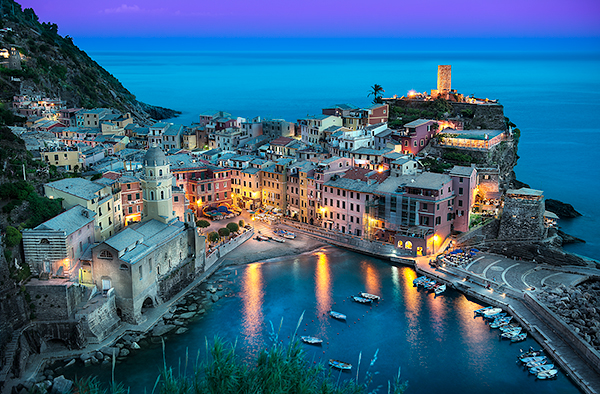
Elia-Locardi-Beautiful-Vernazza-Italy

The Beautiful Vernazza | © Elia Locardi. Click image to see bigger!

Riomaggiore is just one of five towns in the Cinque Terre. Each town has it’s own charm, it’s own look and feel. While Riomaggiore is my personal favorite, Vernazza comes in a close second. Vernazza is probably the most well know of the five towns and probably the most photographed as well. It was also nearly destroyed back in 2011 by a flood and is just now getting back to normal. Most people I talk to who have been to the Cinque Terre stayed in Vernazza. It’s also Rick Steve’s favorite of the five towns.
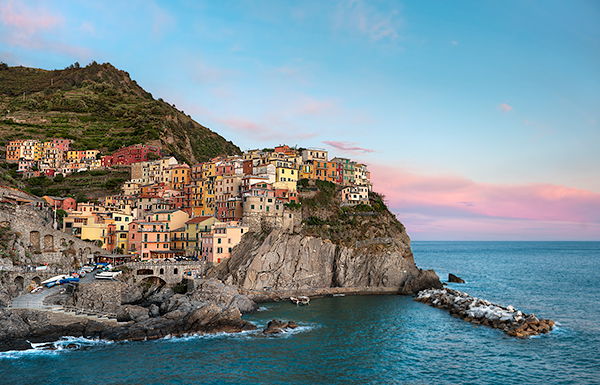
Dreams In Color | © Elia Locardi. Click image to see bigger!

Dreams In Color | © Elia Locardi. Click image to see bigger!

The next on my list would be Manarola (seen above). This town is also very rugged, like Riomaggiore with a much larger coastline. It also may be the oldest of the towns in the Cinque Terre, with the cornerstone of the church, San Lorenzo, dating from 1338.

A sculpture carved out of the cliffs at a castle in Monterosso | © James Brandon

Right behind Manarola on my list is Monterrosso. This town is probably the best town to stay in if you just want to relax and walk around. It’s very flat, has a great beach that stretches along the coastline and the town itself is quite huge. Probably the biggest of the five. We spent one evening here and had a great time. The reason it’s so low on my list is just that it’s not as dramatic, photographically speaking, as some of the others. You could easily spend a week here and get several portfolio quality shots, but it’s hard to rate these towns when they are all so amazing!

Last on my list would be Corniglia. Again, Corniglia is an amazing town and incredibly beautiful! The only reason it’s last is because it’s the only town in the Cinque Terre that isn’t on the coast. Instead, it’s nestled up in the cliffs surrounded by vineyards and terraces.

Conclusion

I hope everyone reading this will get a chance to visit this place in their lifetime. I (along with so many other photographers) have fallen in love with this place and can’t wait to go back some day soon. The scenery is jaw dropping, the people are nice and welcoming, the food is spectacular, the water warm enough to swim in, the weather perfect for hiking between towns and all the rest of Italy is just a quick train ride away. Folks…this place has it all!

Huge thanks to Elia Locardi for providing a couple of images for this article. His website Blame The Monkey is a great resource for any photographer and I highly recommend checking it out.

If you’ve been to the Cinque Terre region or are planning on going, be sure to chime in below! You can also find me on Twitter if you have any questions. Cheers!

Post originally from: Digital Photography Tips.

Check out our more Photography Tips at Photography Tips for Beginners, Portrait Photography Tips and Wedding Photography Tips.

Photography Bucket List – Cinque Terre, Italy


Digital Photography School
 
Comments Off on Photography Bucket List – Cinque Terre, Italy

Posted in Photography


4. Mai 2013

05 May

Ein Beitrag von: Markus Rebbert

Rheinaue © Markus Rebbert


kwerfeldein – Fotografie Magazin

 
Comments Off on 4. Mai 2013

Posted in Equipment


The Stunning Instrument That Sounds Like an Orchestra

04 May

[ By Delana in Gadgets & Geekery & Technology. ]

wheelharp

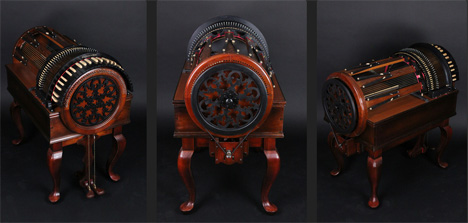
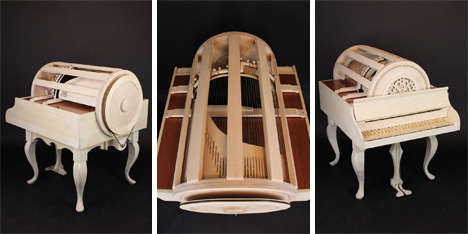
Stringed instruments have been played since time immemorial, and naturally as technology improves plenty of people are trying to recreate that kind of sound digitally. Of course, nothing compares to the rich, warm, sensual sound of an actual stringed instrument, and this is something that artist and artisan Jon Jones understands better than most people. That is why he created the Wheelharp, an incredible stringed instrument that manages to sound like the entire string section of an orchestra all on its own.

radial wheelharp

The beautiful instrument was inspired in 2001 by Jones’ hurdy-gurdy, an ancient stringed instrument that produces tones via a hand-cranked rosined wheel rubbing against strings. As much as Jones enjoyed the hurdy-gurdy, he wanted to know if he could create a full-scale chromatic instrument in which each string could produce a different sound when individually bowed on the rosined wheel. He set out to produce the first Wheelharp.

The result was an instrument of incomparable beauty and charm. Pressing on any of the Wheelharp’s keys moves a string toward the rosined wheel. Of the instrument’s two pedals, the right controls the speed of the motor which turns the wheel. The left pedal controls a damper system that extends across the strings. Although the instrument looks old-timey and low-tech, it also includes an electromagnetic pickup and a piezoelectric pickup, both of which allow the player to control the instrument’s amplification.

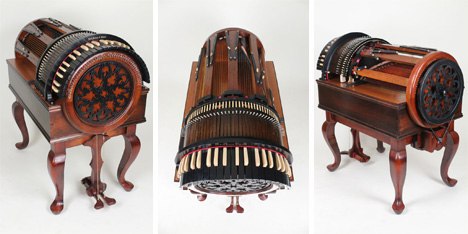
linear wheelharp

It would be impossible to describe the immense beauty and complexity of the music produced by the Wheelharp. It is truly an instrument like no other in the world. It is produced in two versions: a radial version (with the curved keyboard) and a linear model with a more familiar, traditional straight keyboard. Both models produce some of the most breathtaking music ever produced by a single instrument. It certainly doesn’t hurt that the Wheelharp is an object of beauty to look at, either. But if you want to give this incredible invention a try, be ready to pay for it: the least expensive version from Antiquity Music runs nearly $ 10,000.

Share on Facebook


[ By Delana in Gadgets & Geekery & Technology. ]

[ WebUrbanist | Archives | Galleries | Privacy | TOS ]


WebUrbanist

 
Comments Off on The Stunning Instrument That Sounds Like an Orchestra

Posted in Creativity