RSS
 

Archive for April, 2013

How to Photograph Snowflakes with a DSLR

04 Apr

By Don Komarechka

How to Photograph SnowflakesThe winter months are typically uninteresting for macro photographers. Flowers, insects, and tiny details in nature all but disappear. Only one faithful subject is left in abundance – the tiny snowflake.

Thankfully, “abundance” is an understatement. For nearly half of the year, you’ll find countless trillions of them mere feet from the warmth and comfort of home. So, how do you start? How do you capture one of these tiny crystalline subjects and fill the frame behind your lens?

The Gear:

The first thing you’ll need is an old mitten.

You’ll need more than that, however. The average snowflake is around 2-5mm across, so filling the frame with one of these crystals will require powerful magnification and good lighting. Any camera will do, as long as you can get close enough. For snowflake photography, you’re going to need to delve into the world beyond 1:1 lifesize magnification.

Macro setup

1:1 lifesize is the highest scale of magnification that most macro lenses are capable of. On a full-frame sensor, a 4mm snowflake will only fill about 2% of the image – we need to get closer.

Adding a set of extension tubes to your macro lens will often get you close to 2:1 life-size, and Kenko makes a great set. These are hollow tubes that sit between the camera and the lens, effectively allowing the camera to focus closer to its front element. This is the most convenient way to increase your magnification, but close-up filters are another good option.

Close-up filters are basically reading glasses for your camera. They act as a magnifying glass, and multiple can be stacked together for an increased effect. They cause the edges of the frame to get distorted, but when photographing snowflakes you’ll likely be cropping out the edges anyhow. Close-up filters also interfere with the autofocus capabilities of most DSLRs, but we’ll be shooting manual focus for this subject.
How to Photograph Snowflakes 2

Lighting a snowflake may seem like a challenge, but it’s fairly simple: use a ring flash. Ring flashes may not be favored in all areas of macro photography because they create a distracting reflection in water droplets and some insect eyes. It’s the perfect solution for snowflakes however, and makes capturing them a little easier. Most ring flashes (I use a Canon MR-14EX) allow you to control two banks of light and make one brighter than the other. I nearly completely turn one bank off and use half of the flash – and I aim for the perfect angle.
How to Photograph Snowflakes 3

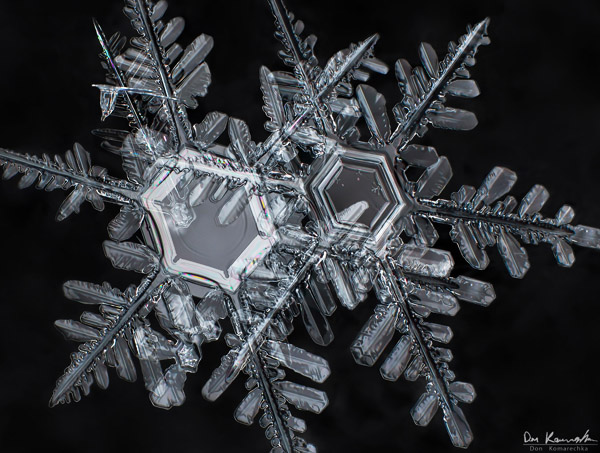
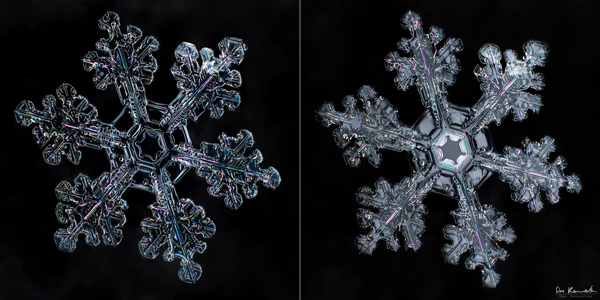
Getting the right angle can drastically change the outcome. The above image is photographed at two different angles only a few degrees apart. It takes plenty of experimenting in the field to find these angles, and I’ll occasionally use a small paintbrush to nudge the snowflake to the proper angle. I avoid this unless necessary, because the crystals often shatter when manipulated too much.

So we’ve got a lens, a light, and now we need a stage. All of my snowflake photographs are made on the same old black mitten. It’s an essential component in my images, and there are plenty of reasons why:

Mitten

  • Dark background: the mitten creates a darker background for the snowflake and allows for some beautiful contrasts. Choose another color besides black for a different feel to your images – but keep it darker for good contrast.
  • Insulation: If the snowflake were to fall on a flat metal surface, and that surface were to transfer even the slightest amount of heat – the snowflake would be a water droplet fairly quickly. With the mitten, the ice gets caught in the fibers and only makes a few contact points with the surface, keeping it insulated from heat.
  • Subject Isolation: Every shot will have some number of woolen fibers present, but these are far easier to edit out than a flat and detailed surface like felt or a BBQ cover in your backyard.

The Process:

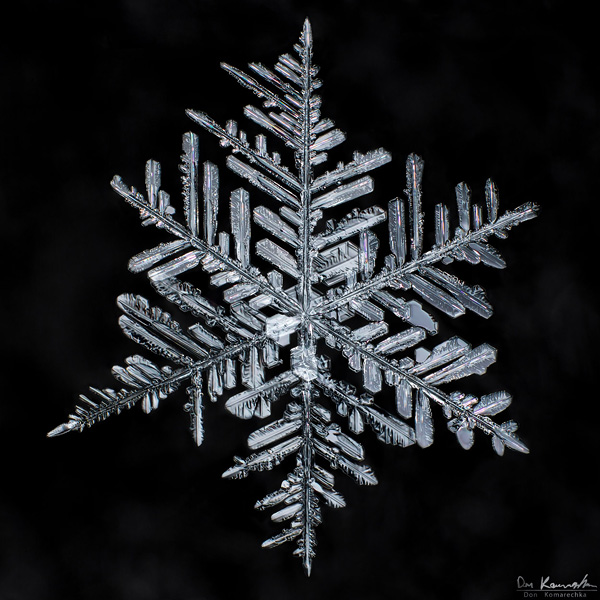
Set out the mitten during a snowfall and wait for the snowflakes to land (tip: you shouldn’t be wearing the mitten). Take a close look and see if the snowflakes are of the “beautiful” variety. You’ll commonly see balls of ice or crystals covered in frozen water droplets (called “rime”). It may take a few snowfalls before you see the best crystals for photographing – big, clean snowflakes with lots of branches:
How to Photograph Snowflakes 4

It’s very important to photograph the snowflakes during a snowfall. As soon as one hour afterwards, the crystals will begin to melt or sublimate (evaporate without melting first) and the sharp crystal edges will soon disappear. If you’ve just missed the snowfall, try to place the mitten on freshly fallen snow and pick it up again – the fibers will catch the fallen snowflakes like Velcro and you’ll have a chance at photographing a few before they deteriorate too far.

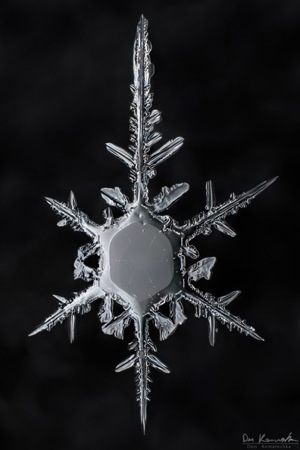
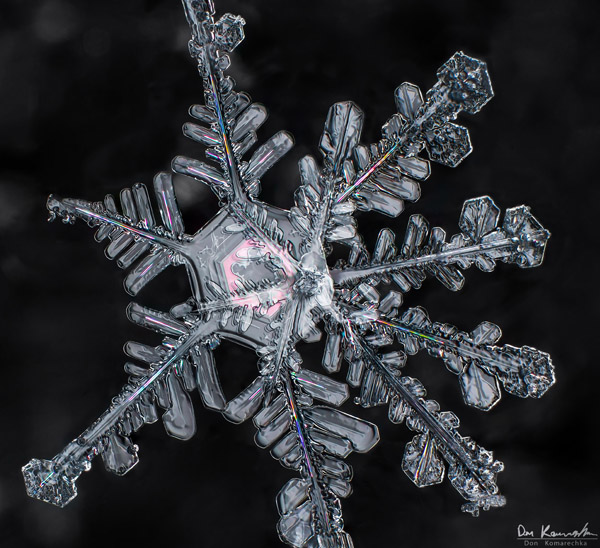
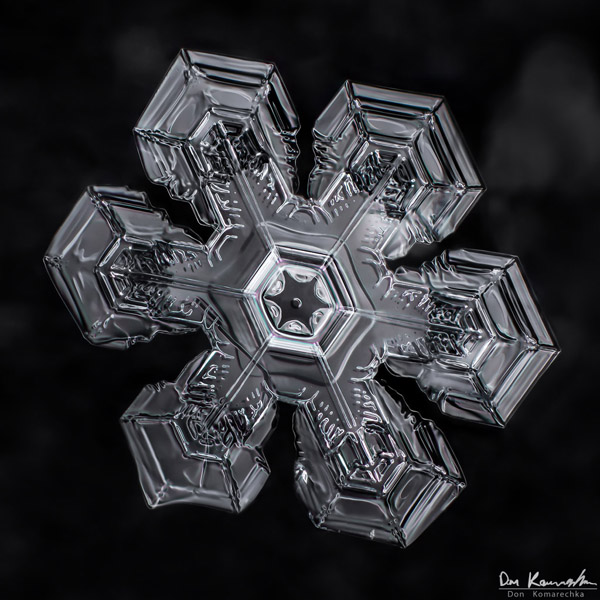
All of my snowflakes are focus-stacked. This means that I take multiple frames of the same snowflake at many different focus points; I do this by physically moving the camera forward and backward through the focus plane of the crystal, continuously shooting all the while. This process is necessary because they’re often photographed on an angle, giving only a tiny sliver of focus. I photograph them on an angle to bring out surface reflections, prismatic colors and even vibrant center colors as a result of optical interference:
How to Photograph Snowflakes 5

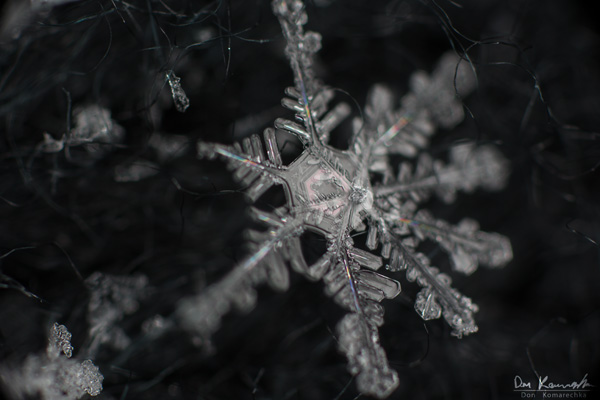
This is not, however, how the image comes out of the camera. The below image is one of 33 images used in the final composition. The process of combining the frames is lengthy, in part because every image is done without a tripod – they’re all hand-held. Because I handhold these images, I need to take far more frames than I’ll actually use (I over-shoot to make sure I cover every point). The 33 frames I used in this image were selected out of 112 in total.
How to Photograph Snowflakes 6

I’m often asked why I don’t use a tripod for these photographs. Getting a tripod set up to exactly the right angle and adjusting a focus-rail to get everything set perfectly would take a significant amount of time. I find the snowflake freehand and adjust the angle of the camera to get the desired reflection by taking test shots, something far more time-consuming if a tripod were involved. Time can’t be spent aligning a tripod in this way – I need to move quickly to be sure the snowflake won’t melt, blow away or get smothered by more falling snow. Photoshop does a pretty good job re-aligning the images, as long as your angle doesn’t deviate too much.

Snowflakes measuring roughly 0.4mm in diameter, photographed at 6:1 magnification and cropped significantly

Snowflakes measuring roughly 0.4mm in diameter, photographed at 6:1 magnification and cropped significantly

The editing and focus-stacking process will be discussed in a future article.

The Book:

If the tutorial above interests you, it will be spelled out in greater detail in my upcoming book, “Sky Crystals: Unraveling the Mysteries of Snowflakes”. The book is currently being crowd-funded on indiegogo, and a $ 35 contribution will get you a copy when it’s released in October 2013. Support the project and help the book get published!
Mar4 snowflake9

The book will be 300 pages, hardcover and detail all of the photographic techniques, science & physics, and even the psychology and philosophy of why we find snowflakes beautiful. The campaign ends April 30th 2013.

Post originally from: Digital Photography Tips.

Check out our more Photography Tips at Photography Tips for Beginners, Portrait Photography Tips and Wedding Photography Tips.

How to Photograph Snowflakes with a DSLR


Digital Photography School

 
Comments Off on How to Photograph Snowflakes with a DSLR

Posted in Photography


Cool Visual Art images

04 Apr

A few nice visual art images I found:

VSP Visual Street Performance 2007 @ Fabrica Braco de Prata, Lisbon, Portugal
visual art
Image by Graffiti Land

 
Comments Off on Cool Visual Art images

Posted in Photographs


US Judge rules for Eggleston in dispute with collector

04 Apr

20130329eggleston-promo1.jpg

Celebrated American photographer William Eggleston won a legal victory when a US District Court judge dismissed a claim of fraudulent and negligent misrepresentation brought by collector Jonathan Sobel. Sobel, an avid Eggleston collector, argued that by creating a new set of large format inkjet prints beyond the 30-year old dye transfer print limited edition of the same image, Eggleston was diluting the value of the earlier prints, one of which Sobel owned. Read on for more details. (via ARTINFO)

News: Digital Photography Review (dpreview.com)

 
Comments Off on US Judge rules for Eggleston in dispute with collector

Posted in Uncategorized


Nikon under fire for making rifle scopes

04 Apr

Screen_Shot_2013-04-03_at_11.27.50_AM.png

Nikon has come under fire from animal welfare groups and some wildlife photographers over its new ‘Monarch’ line of rifle scopes, designed for game hunting. Marketed as being ‘Engineered for Safari’ Nikon claims that the new Monarch-series scopes are created ‘for those seeking dangerous game adventure on the Dark Continent’ – an archaic term for Africa. Nikon has manufactured ‘sports optics’ for many years, and is not alone (so does Pentax) but the marketing behind its newest Monarch line of scopes has caused a degree of anger. Click through for more details. 

News: Digital Photography Review (dpreview.com)

 
Comments Off on Nikon under fire for making rifle scopes

Posted in Uncategorized


Canon announces development of 35mm Cinema EOS prime lens

04 Apr

shared:logo_2x.png

NAB 2013: Canon has announced the development of a 35mm prime lens in its Cinema EOS range. It is designed to be used on movie cameras with image sensors up to 35mm full frame in size, and includes a range of features optimized for movie shooting. The company has not finalized its specifications and pricing, but says it will release further details in due course. However as the Cinema EOS primes offer T-stops that correlate closely with existing L-series primes, it seems likely the 35mm will be approximately T1.5, and of course use the EF mount.

News: Digital Photography Review (dpreview.com)

 
Comments Off on Canon announces development of 35mm Cinema EOS prime lens

Posted in Uncategorized


Frightening Archaeological Finds: 15 Odd Human Remains

03 Apr

[ By Steph in Culture & Cuisine & Global. ]

Human Bones main

What bizarre and terrifying ‘treasures’ from long-gone ancient civilizations are still hidden in crypts, caves and deep within the earth? Most archaeologists may spend their days painstakingly brushing sand off pieces of pottery, but occasionally, they unearth evidence of the darker side of humanity – cannibalism, sacrifice, mass murder, deadly paranoia about vampires and witches, and even chemical warfare. These 15 archaeological finds of ancient human remains are among the most grisly, frightening and fascinating.

Vampire of Venice

Human Bones Vampire of Venice
Among the corpses of medieval plague victims was one very curious find: a skull with a brick shoved so forcefully between its jaws, they were broken. The technique was used on suspected vampires in Europe during this time, especially when natural biological processes after death resulted in dark blood-like liquid streaming from the mouth. Researchers have determined that not only was this elderly woman feared a vampire after her death, she may have been accused of witchcraft before she met her end. Most people didn’t live to be her age, estimated at 60-71 years, and many medieval Europeans believed that the devil gave the elderly powers to cheat death. Older women were particularly suspect because it was assumed that they had little to live for, and were vulnerable to offers of power.

The Screaming Mummies

Human Bones Screaming Mummies 2 Human Bones Screaming Mummies

Imagine opening a sarcophagus to find a mummy that seems to be screaming for all eternity. In the past, when ‘screaming mummies‘ were discovered, archaeologists assumed that they must have been buried alive or killed in some other painful manner. Now, however, they usually agree that mummies are commonly found with their jaws open due to their heads falling back after death. The most famous screaming mummy is Unknown Man E, an Egyptian mummy found in 1886, who could be the murderous son of Ramses III. Another is even more shocking, with its hands covering its face in apparent terror; it was among the remains of the Chachapoya Indians of Peru.

Pile of Headless Vikings

Human Bones Headless Vikings

Evidence of a shocking massacre was discovered when archaeologists unearthed 51 thousand-year-old skulls – along with another pit containing their headless bodies – in Weymouth, UK. Found in 2009, these young male Vikings were brutally slain sometime between 910 and 1030 CE. Analysis of their teeth confirmed that they were from Scandinavia. They were likely war captives of the Anglo-Saxons, executed by having their heads hacked off.

Neanderthal Cannibals

Human Bones Neanderthal Cannibals

The bones of twelve neanderthals found in a cave in Spain were cut and snapped, indicating that they were likely ‘processed’ by fellow neanderthals as food. The possible family group, which included three adult males, three adult females, three adolescents, two children and an infant, is one of the most significant examples of cannibalism among neanderthals. “There are many different markings in many different bones in all 12 individuals, including traditional cut marks to disarticulate bones and remove muscle insertions, snapping and fracturing of long bones to extract the marrow,”researcher Carles Lalueza-Fox told LiveScience.

Bathhouse Baby Disposal

Human Bones Bathhouse Babies

How and why were the bones of nearly 100 infants discarded like trash in a late Roman, early Byzantine sewer beneath a bathhouse in Israel? Found in 1988 in Ashkelon, the remains indicate that the babies died before three days of age, and show no signs of disease or skeletal malformation. While scholars hypothesized that the babies were girls, since female infanticide was common during that time, tests have since shown that many were male. The reasoning behind their death is still a mystery.

The First Leper

Human Bones First Leper

The earliest archaeological evidence of leprosy is found in a 4,000-year-old skeleton unearthed in India in 2009. Leprosy is difficult to study because the bacteria that causes it is tricky to culture for research, and scientists are still unsure of exactly when and where it originated. This skeleton was not only the oldest leper ever found, it was also the first evidence of leprosy in ancient India, supporting the idea that the disease migrated between Africa and Asia during a period of urbanization, growing population density and new trade routes.

Murdered Bog Bodies

Human Bones Bog Bodies

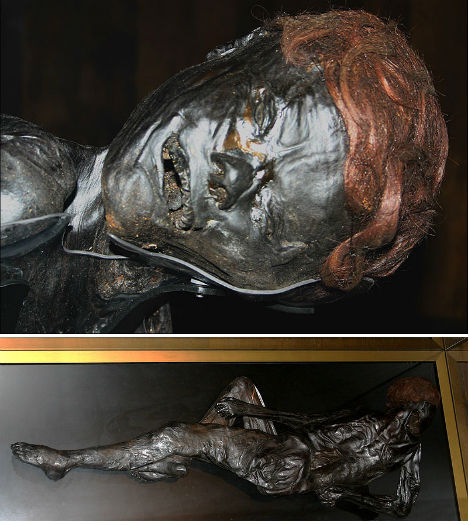
The peat bogs of northwestern Europe have turned out to be one of the richest sources of ancient human remains in the world, preserving bodies so perfectly that they sometimes still contain blood and stomach contents. ‘Bog bodies‘ such as the Grauballe Man, pictured, date from 8,000 B.C.E. to the early medieval period. It seems that these people were not buried in the peat bogs, nor did they simply die there – they died violently. Researchers believe they were most likely sacrificed, or executed as punishment for crimes or perceived flaws.

Skulls Used as Cups

Human Bones Skull Cups

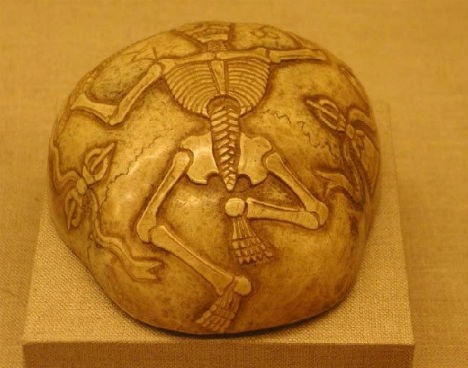
Three human skulls found in Gough’s Cave, Somerset, England were carefully worked into the shape of bowls, indicating that they were used to drink from. At 14,700 years old, these are the oldest skull cups ever discovered, and they were surrounded by other human remains that had been snapped to get to the marrow inside, suggesting cannibalism.

Next Page:
Frightening Archaeological Finds 15 Odd Human Remains

Share on Facebook


[ By Steph in Culture & Cuisine & Global. ]

[ WebUrbanist | Archives | Galleries | Privacy | TOS ]


WebUrbanist

 
Comments Off on Frightening Archaeological Finds: 15 Odd Human Remains

Posted in Creativity


365 2010 NOV 24~Texture Tender Lovin’ Sky #1 Square

03 Apr

A few nice visual art images I found:

365 2010 NOV 24~Texture Tender Lovin’ Sky #1 Square
visual art
Image by julieabrown1
I did a texture with the sky shot yesterday….. this one is on the square. I have some other shots and want to do a little series. Well, I’m easily entertained….:) This texture is available for download if it would be useful. One of the ways I see it might be fun is to cut the section with the most clouds and put it in a sky you want some more visual in.
To download you can go to actions>see all sizes>download original size or you can use this link:
www.flickr.com/photos/julie_b1/5204206762/sizes/o/

I would love to see what you do with it. If you would like, post a small image in the comment thread.
Please credit me with the image and do not represent it to be your own.

VSP Visual Street Performance 2007 @ Fabrica Braco de Prata, Lisbon, Portugal
visual art
Image by Graffiti Land

 
Comments Off on 365 2010 NOV 24~Texture Tender Lovin’ Sky #1 Square

Posted in Photographs


3. April 2013

03 Apr

Ein Beitrag von: rohfish

© rohfish


kwerfeldein – Fotografie Magazin

 
Comments Off on 3. April 2013

Posted in Equipment


8 Places For Shooting You Have To Master Before Taking Your Camera Elsewhere

03 Apr

It happens to all of us. Regardless of experience or skill level, at some point, we’ve all thought, “I have no idea where to take pictures!”. We’ve run out of new, fresh ideas and are seriously considering abandoning any photography this weekend. Of course, we know that we haven’t literally run out of locations to shoot, we just aren’t thinking Continue Reading

The post 8 Places For Shooting You Have To Master Before Taking Your Camera Elsewhere appeared first on Photodoto.


Photodoto

 
Comments Off on 8 Places For Shooting You Have To Master Before Taking Your Camera Elsewhere

Posted in Photography


VSP Visual Street Performance 2007 @ Fabrica Braco de Prata, Lisbon, Portugal

03 Apr

A few nice visual art images I found:

VSP Visual Street Performance 2007 @ Fabrica Braco de Prata, Lisbon, Portugal
visual art
Image by Graffiti Land

VSP Visual Street Performance 2007 @ Fabrica Braco de Prata, Lisbon, Portugal
visual art
Image by Graffiti Land

VSP Visual Street Performance 2007 @ Fabrica Braco de Prata, Lisbon, Portugal
visual art
Image by Graffiti Land

 
Comments Off on VSP Visual Street Performance 2007 @ Fabrica Braco de Prata, Lisbon, Portugal

Posted in Photographs