RSS
 

Archive for April, 2013

3 Tips to Ruin Your Photo with a Watermark

22 Apr

Strange as it may seem: photographers, who should be highly creative persons with fine artistic taste tend to be bloody awful designers. But don’t get me wrong here. I’m not expecting someone to be able to design me an outstanding corporate logo just because he is a great photographer. But the massacre begins even at the level of watermarking their Continue Reading

The post 3 Tips to Ruin Your Photo with a Watermark appeared first on Photodoto.


Photodoto

 
Comments Off on 3 Tips to Ruin Your Photo with a Watermark

Posted in Photography


Just Posted: Hands-on with the Sigma 18-35mm F1.8 DC HSM

22 Apr

Sigma-Crop.jpg

Just posted: Our hands-on preview of the Sigma 18-35mm F1.8 DC HSM Art lens. The announcement of the world’s first constant F1.8 zoom caused a lot of discussion, much of it centered around the idea that the brighter aperture would help APS-C DSLRs to compete toe-to-toe with full frame cameras in many respects. We’ve had a chance to handle the lens and prepare a preview putting its capabilities in more context. Click here to find out more.

News: Digital Photography Review (dpreview.com)

 
Comments Off on Just Posted: Hands-on with the Sigma 18-35mm F1.8 DC HSM

Posted in Uncategorized


Im Gespräch mit Frank Buttenbender

22 Apr

Ein Beitrag von: Frank Buttenbender

Ich verfolge Dich ja jetzt schon eine Weile bei Facebook. Fast jede Woche gibt es dort wieder neue Konzert- und Festivalbilder zu bewundern. Klingt, als hättest Du einen Traumjob. Ist er das?

Das ist tatsächlich ein Traum, allerdings kein Job, denn ich arbeite nur im eigenen Auftrag für mein eigenes kleines Onlinemagazin. Das verschafft mir einerseits die Freiheit, nur die Konzerte zu fotografieren, die mich interessieren, hat teilweise aber auch den Nachteil, nicht alle Künstler vor die Linse zu bekommen. Zumindest nicht die Herrschaften, die noch immer im Internet eine Bedrohung sehen und nur Printmedien akkreditieren.

Mitunter fragen nach meiner eigenen Veröffentlichung auch Printmagazine an und ich gehe darauf ein, aber im Auftrag anderer arbeite ich nur sehr ungern. Noch besser ist die Situation natürlich dann, wenn man einen persönlichen Draht zur Band bzw. deren Management hat.

Dann findet man vor Ort auch ganze andere Bedingungen vor. Aber um zum Ausgangspunkt zurückzukommen; ja, es ist traumhaft, da es mir Gelegenheit gibt, großartige Konzerte zu besuchen und gleichzeitig zumindest einen Teil zum Ganzen beitragen zu können.

noyce TM von Frank Buttenbender

Bekommst Du denn bei der Arbeit überhaupt etwas vom Konzert mit? Die unberechenbaren Lichtsituationen, schnelle Bewegungen der Musiker – das alles erfordert ja eine hohe Konzentration. Kann man dabei die Musik genießen?

Gute Frage. Wenn ich das komplette Konzert fotografieren kann, bekomme ich nicht wirklich viel mit vom Geschehen. Aber das ist nicht die Regel, denn meistens ist ja nach drei Songs Schluss und man kann sich dem Konzert selbst widmen. Allerdings ist auch dann nicht ausgeschlossen, dass man den Lichtsituationen auf der Bühne mehr Beachtung schenkt als der Musik.

Um diese wirklich zu genießen, bin ich ohnehin lieber zuhause und höre in aller Ruhe ein Album auf CD oder Vinyl an. Bevor ich mit der Konzertfotografie begonnen habe, war ich daher auch kaum mal bei einem Konzert dabei. Und ich mag das eigentlich auch gar nicht. Zu viele Menschen auf engem Raum, der Sound ist meist übersteuert, die Luft schlecht… beim Fotografieren kann man das alles ausblenden, aber ohne das würde ich vermutlich nie Konzerte besuchen.

Das Ich von Frank Buttenbender

Interessant, ein Konzertfotograf, der an sich keine Konzerte mag. Muss man denn die Bands kennen und mögen, um gute Bilder zu machen?

Es ist vor allem motivierend, Bands zu fotografieren, die man mag oder vielleicht bislang noch nicht fotografieren konnte. Aber für gute Bilder reicht allein das nicht aus, manche Künstler sind aufgrund ihrer Statur oder ihres extremen Bewegungsdrangs generell schwieriger zu fotografieren und andere mögen keine guten Lichtbedingungen. Da nützt dann mitunter das Wollen auch nicht viel.

Manchmal sind die Ergebnisse aber trotzdem ganz passabel, das darf man dann gern der eigenen Tagesform zuschreiben oder ein paar glücklichen Momenten. Aber selbst bei perfekten Bedingungen, viel Zeit und guter Form wird es immer ein Foto geben, das man nicht gemacht hat. Vielleicht ist das auch der Grund für den bleibenden Antrieb, beim nächsten Mal wiederzukommen.

Die Leute auf der Bühne zu kennen, ist schon ein Vorteil. Es ist gut, wenn man weiß, wer gern auf welcher Seite das Mikro hält, wie groß die Bandmitglieder sind, ob sie dazu neigen, in den Graben oder ins Publikum zu springen und dergleichen mehr. Ein zu viel an Vorbereitung könnte allerdings die nötige Spontaneität ein wenig hemmen, so dass ich mir meistens nicht allzu viele Gedanken mache.

Laibach von Frank Buttenbender

Gibt es da eine Band, bei der es Dir besonders viel Spaß macht?

Derzeit muss ich da unbedingt die Band IAMX nennen, die mir auch musikalisch am meisten bedeutet. Ich habe sie erst einmal fotografiert, aber demnächst erfährt die Zusammenarbeit eine Fortsetzung. Gute Ergebnisse und daher viel Spaß gab es in der Vergangenheit mit den Bands Diorama, Project Pitchfork, Laibach oder Lacrimosa. Von den bekannteren Künstlern ist mir vor allem ein Abend mit Nick Cave in guter Erinnerung. Auf der Wunschliste stehen die Nine Inch Nails ganz oben.

Wie wichtig ist die Technik bei Deiner Arbeit und mit welcher Ausrüstung arbeitest Du?

Wichtig ist sie insofern, als dass sie mich in die Lage versetzt, unter teilweise extremen Bedinungen ordentliche Fotos zu machen. Derzeit benutze ich eine Nikon D700, eine Nikon D200 sowie einige lichtstarke Festbrennweiten. Damit bin ich derzeit zufrieden. Ich würde dennoch sagen, dass ein gutes, schnelles Auge sowie Erfahrung weitaus wichtiger sind als die optimale Ausrüstung.

The sisters of mercy von Frank Buttenbender

Aber ein gutes, schnelles Auge nützt nichts, wenn die Kamera nicht über ISO 400 hinausgeht, oder?

Es ist schon beides wichtig, keine Frage. Komisch sind immer so Äußerungen, wie „Du machst ja bessere Fotos, weil Du die bessere Kamera hast.“ Das ist sehr wirklichkeitsfern, denn ein ambitionierter Fotograf wird eher Wege und Mittel finden, bessere Technik zu verwenden, als neidvoll auf andere zu schielen.

Ich frage mich oft, warum so viele Fans auf Konzerten ihr Handy um Fotos bemühen. Gute Bilder schafft man damit aus der meist doch sehr großer Entfernung nicht, oder?

Die Handy-Knipser und Filmer sind ein ganz anderes Thema. Ich denke mal, denen geht es nicht so sehr um Qualität, sondern um den Beweis der eigenen Teilnahme. Mit Web 2.0 Apps wie Facebook und YouTube ist das Dabeisein und Mitmachen ganz wichtig geworden, wichtiger offenbar, als das pure Konzerterlebnis selbst.

Einige Künstler sprechen sich daher auch gegen die Verwendung von Handyknipsen aus, was ich ihnen hoch anrechne. Aber es gibt nicht nur zu viele Handyknipser, es gibt auch deutlich zu viele Leute, die sich um den Einzug in den Fotograben drängeln. Da ist in den letzten Jahren leider vieles in eine fragwürdige Richtung gelaufen.

Eisbrecher von Frank Buttenbender

Ja, von den Kämpfen im Fotograben hört man selbst als Nicht-Konzertfotograf in der Tat häufig. Woher kommen die ganzen Fotografen auf einmal und wo kann man ansetzen, um das Problem aufzulösen?

Die Zugangsbarierren sind einfach wesentlich niedriger als früher. Digitalfotografie und Internet sind zwei wichtige Gründe dafür, dass es in diese Richtung gegangen ist. Veranstalter sehen sich daher mit weitaus mehr Anfragen konfrontiert und soweit es möglich ist, wird diesen Anfragen auch entsprochen.

Denn im Zweifel sind mehr Vorabwerbung und Nachberichterstattung immer lukrativer als die zwei, drei Lokalmedien, die zur Analogzeit berichtet haben. Da die richtige Auswahl zu treffen, ist sicher nicht einfach und auch mal nein zu sagen leider nicht die Regel.

Wenn man die Zugangsbarierren erhöht, wäre Deine Arbeit nicht auch in Gefahr? Als eigener Auftraggeber für ein Online-Magazin bist Du doch wahrscheinlich einer der vielen neuen Fotografen im Graben, oder?

Das könnte man meinen, allerdings haben sich in den vergangenen Jahren einige gute Kontakte entwickelt, die mich zumindest innerhalb der alternativen Musikszene zuvorkommend behandeln. Das Online-Magazin war aber letztlich immer nur Mittel zum Zweck, denn ich bin dort weit davon entfernt, richtigen Journalismus zu betreiben.

Wesentlich lieber wäre mir daher die nähere Bindung an einzelne Bands, das würde dann auch eher zu einzigartigen, außergewöhnlichen Fotos führen und die beschriebene Situation gar nicht erst entstehen lassen.

fields of the nephilim & lacuna coil von Frank Buttenbender

Möchtest Du als eine Art persönlicher Fotograf Bands für eine Tour oder zumindest ein paar Konzerte begeleiten oder wie kann ich mir das vorstellen?

Für einzelne Konzerte ist das bereits schon so geschehen, eine komplette Tour wäre allerdings eine neue Erfahrung, die ich unter gegebenen Umständen gern machen würde.

Auch wenn bereits zu viele Fotografen im Konzertgraben stehen: Hast Du vielleicht Tipps für angehende Konzertfotografen?

Ein Tipp wäre eventuell, nicht so sehr die anderen Fotografen und ihre Fotos als Vorbild vor Augen zu haben, sondern eher zu versuchen, so früh wie möglich einen eigenen Weg der Bildsprache zu entwickeln. Ich war am Anfang sehr aktiv in der Fotocommunity, was letztlich aber ein Fehler war, denn dort wird eher das Streben nach einem Konsensgeschmack gefördert als die eigene Entwicklung.

Zeromancer von Frank Buttenbender

Passend zur Musik würde ich Deine Bildsprache als düster und kontrastreich beschreiben. Wie würdest Du sie charakterisieren?

Düster und kontrastreich, genau. Das hat wohl mit meiner Persönlichkeit zu tun, die gern schwarz oder weiß malt, aber niemals grau und selten farbig. Farbe gibt es vermehrt dann zu sehn, wenn es mir bei dem Ereignis gut ging, aber im Nachhinein sind das meist die schlechteren Fotos. Persönliche Krisen hingegen haben sich meist positiv auf die fotografischen Ergebnisse ausgewirkt.

Ich finde ja auch Deine wenigen farbigen Bilder schön. Entscheidest Du bereits während des Konzertes, ob die Bilder am Ende schwarzweiß werden? Und wieviel Nachbearbeitung steckt überhaupt in den Bildern?

Das ist zunächst davon abhängig, welche Bedingungen vor Ort herrschen. Im Gegensatz zur oftmals vertretenen Meinung, schwarzweiß sei nur eine Notlösung, ist es bei mir eher umgekehrt: Ich versuche fast immer, die Fotos im Ergebnis schwarzweiß zu bekommen.

Aber manche Farbkonstellationen lassen dies einfach nicht in genügendem Maße zu. Wenn das Ergebnis farbig ausfällt, kann es also nicht nur an der guten Verfassung während des Ereignisses liegen, sondern auch schlichtweg daran, dass die Umwandlung nicht geglückt ist.

Nachbearbeitet werden alle Fotos, zunächst meist im Schnitt, was eine Folge der Festbrennweiten ist. Dann wird nachgeschärft, verkleinert und der Kontrast erhöht. Von Bildmanipulationen halte ich aber nicht so viel. Mir ist der rauhere Charakter sowieso lieber als eine glattgebügelte HDR-Anmutung.

Generell halte ich Farbe für problematisch, weil es den Betrachter viel zu sehr vom Geschehen selbst ablenkt. Ich habe auch manchmal den Gedanken, einfach von vornherein schwarzweiß und analog zu fotografieren. Vielleicht werde ich das demächst wieder versuchen.

Project Pitchfork von Frank Buttenbender

Das klingt für mich nach einer großen Herausvorderung. Was steht denn in nächster Zeit noch an?

Ja, letztlich werde ich aber der Konzertfotografie weiter treu bleiben. Es gibt dann auch immer mal Anfragen der Musiker für gestellte Fotos. Ich habe mich allerdings nie so richtig wohl gefühlt, wenn es darum ging, selbst Regie zu führen, so dass ich das lieber anderen überlasse.

Falls alles klappt, werde ich in der nächsten Zeit Konzerte von IAMX, Rammstein und Dead Can Dance besuchen. Zudem freue ich mich auf verschiedene Open Air Events im Sommer auf einer malerisch gelegenen Festung in der Nähe meiner Heimatstadt, zu denen mich der Veranstalter bereits eingeladen hat.

Dann viel Erfolg dabei! Ich bin gespannt auf die neuen Bilder.


kwerfeldein – Fotografie Magazin

 
Comments Off on Im Gespräch mit Frank Buttenbender

Posted in Equipment


Perfect Pitch: Impossibly Starry City Skies in Blackest Night

22 Apr

[ By WebUrbanist in Art & Photography & Video. ]

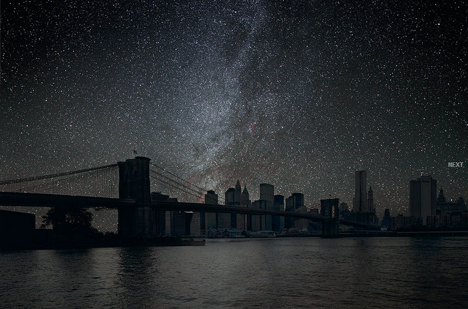
pitch black skies

Massive power outages give us rare glimpses of darkened cities, but in normal conditions, there is simply no way to see the starry skies above the typical urban metropolis – but one photographer has found a way to simulate them.

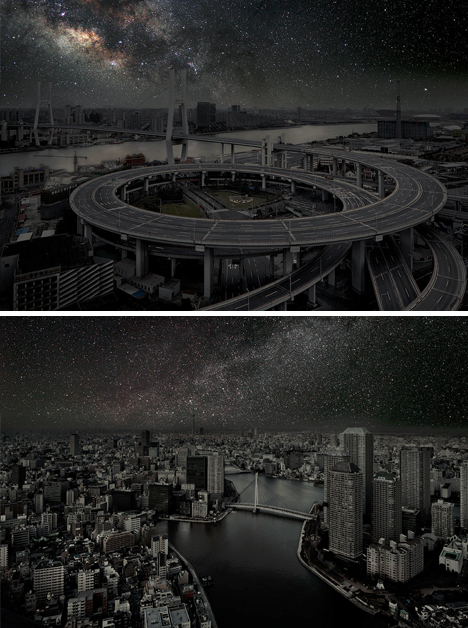
pitch black starry skies

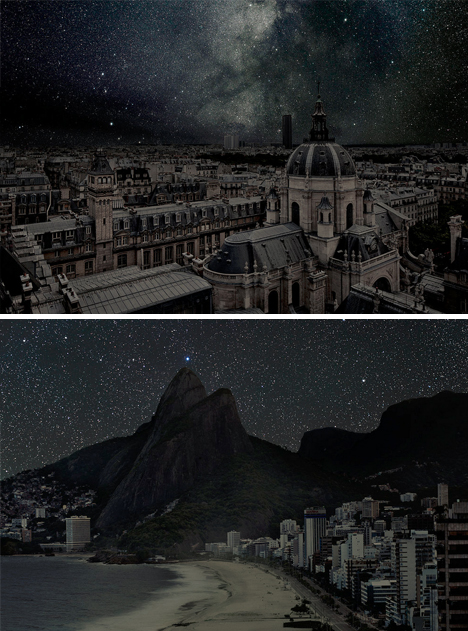
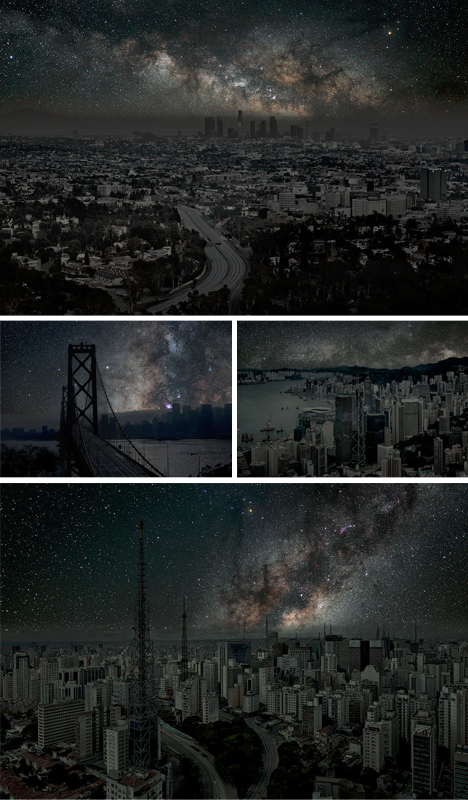
Thierry Cohen uses a multi-step process to create stunning visualizations (dubbed Darkened Cities) of would-be, could-be sights from New York to London, Shanghai to Sao Paulo … ones that the ordinary eye will rarely or never see naturally.

pitch dark night space

Cohen takes a series of shots of each of the cities themselves, and carefully removes illumination from the equation. Night sky photos from the same latitudes (adjusted for time and angle) are then layered into the background, creating a seamless illusion.

pitch photo edited cities

The results are at once mesmerizing, revealing the unseen potential for views of space right where we live, but also somewhat depressing – these are scenes that no one can actually ever see outside of deserts, at least unless disaster strikes.

Share on Facebook


[ By WebUrbanist in Art & Photography & Video. ]

[ WebUrbanist | Archives | Galleries | Privacy | TOS ]


WebUrbanist

 
Comments Off on Perfect Pitch: Impossibly Starry City Skies in Blackest Night

Posted in Creativity


21. April 2013

22 Apr

Ein Beitrag von: Lars Zimmermann

Daniela


kwerfeldein – Fotografie Magazin

 
Comments Off on 21. April 2013

Posted in Equipment


22 March, 2013 – Saguaro National Park

22 Apr

Our regular contributor, Miles Hecker, has a new geo-tagged travel article for us today about Saguaro National Park, home of The Roadrunner.


 "Every time I go back to a module I had already seen, I learn additional things.  I have never seen tutorials that have the excellent mix of what the features are, 
how to use them, enough of the under-the-hood information 
and concepts so that I can utilize the features creatively and efficiently, 
and just enough humor to keep the motivation level high.  Wow!"


The Luminous Landscape – What’s New

 
Comments Off on 22 March, 2013 – Saguaro National Park

Posted in News


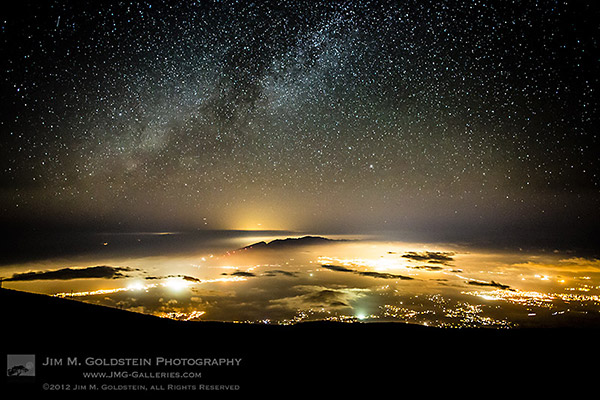
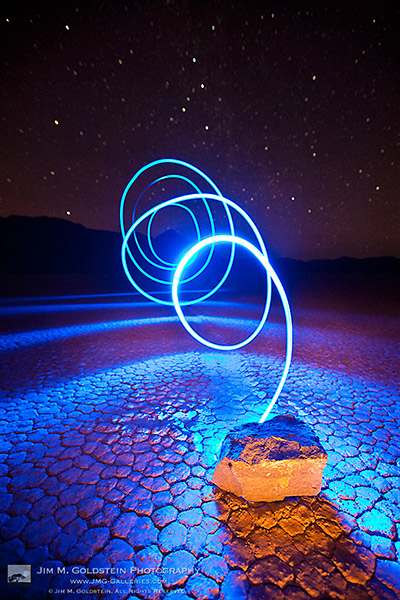
Meet The Photographers Who Write For Digital Photography School ~ Jim Goldstein

22 Apr

You’ve been reading their articles for months or years, have you ever wondered “Who are the photographers who write for dPS”?

Today we meet Jim Goldstein.

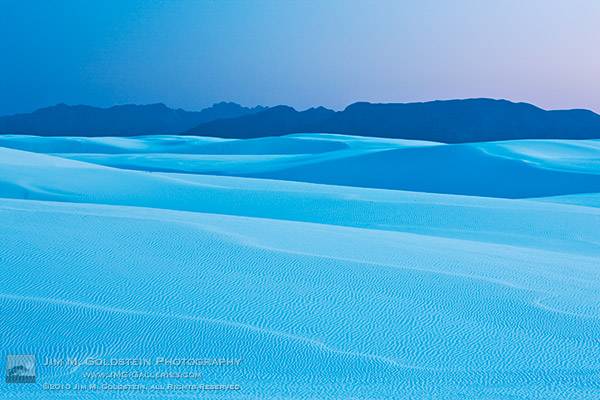
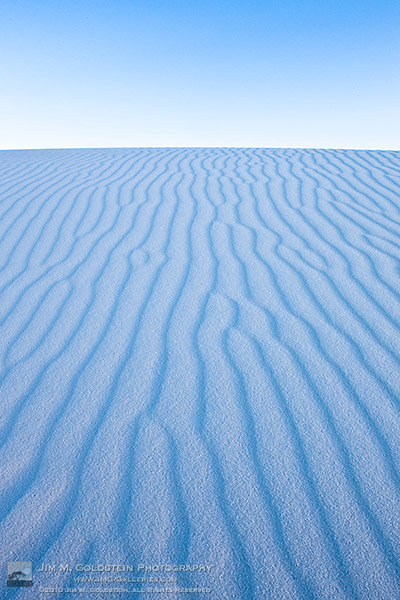
 Dusk at White Sands National Monument

1. How long have you been shooting?

I have been behind a camera perfecting the art of photography since the mid-1990′s. I honed my skills in the days of film and have been growing every day since as a photographer, digital and otherwise.

2. Do you have a full time job or are you a full time photographer?

jim_m_goldstein_headshot-sqI was a full-time professional outdoor photographer for sometime, but given my knack for social media & marketing I was recently recruited by BorrowLenses.com to help head up their marketing department.
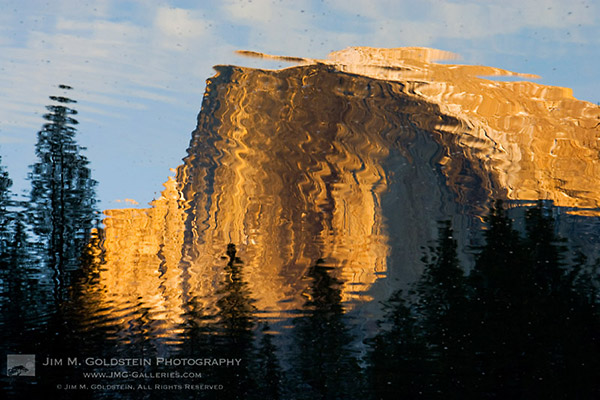
3. If you had to limit yourself to one genre of photography, what would it be and why?

That is much easier said than done, but I would say Outdoor Photography.

4. When did you start writing for dPS and why?

I began writing for Darren the first day he opened his site to authors other than himself in early 2008. I pursued writing for DPS because I’m deeply passionate about sharing with the photography community at large. I strive to share my expertise, ideas and inspire others.

5. What do you shoot with and what’s your favorite lens?

These days I shoot with a Canon EOS 5D Mark III when ever I have the opportunity, but always have my trusty Canon 5D Mark II with me as well. My favorite lens at the moment is a Canon EF 50mm f/1.0L lens as it is the newest lens to my collection, but the bulk of my work is shot with a Canon EF 16-35mm f/2.8L lens.

6. What would be your number one tip to any new photographer?

Be persistent. I can’t begin to tell you how many times I was frustrated along my journey as a photographer. Very early on, when I was 15, I stopped because of it. Only after college did I return back to try again and to push my way through the learning process. Ever since I’ve embraced each challenge to push my limits and test my creativity.

7. What’s your next big project?

My next big project is a follow up to my ebook Photographing the 4th Dimension – Time.

8. Where can people go to find out more about you and your work?

People can see my photography and writing on my blog: JMG-Galleries blog, my social media pages Google+, Twitter & Facebook and my ebooks/webinars at InspiredExposure.com.

12-jimgoldstein-HP9F8890M_full_600c

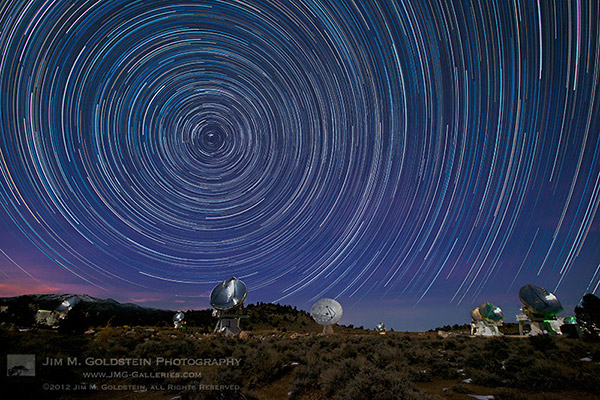
CARMA Star Trails

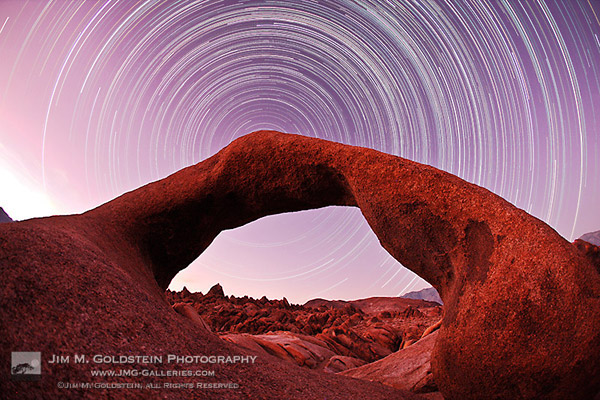
Mobius Arch Star Trails

6-jimgoldstein-TRAVEL_SF2428-Edit_600c

5-jimgoldstein-LAN_DV_JMG_0523M_600c

4-jimgoldstein-LAN_MAUI_U2C0359_600c

3-jimgoldstein_zen_wsnm_600c

8-jimgoldstein-35_LAN_DVNP_JMG8463_600c

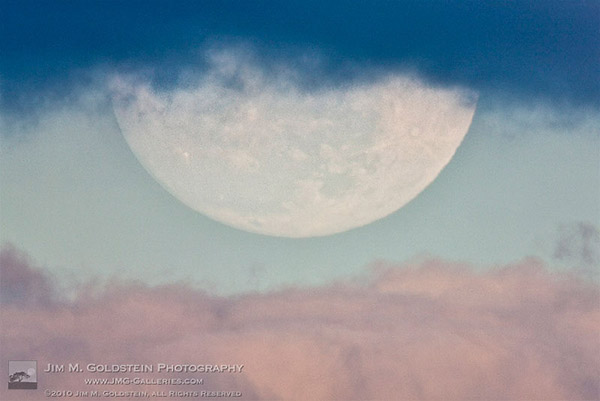
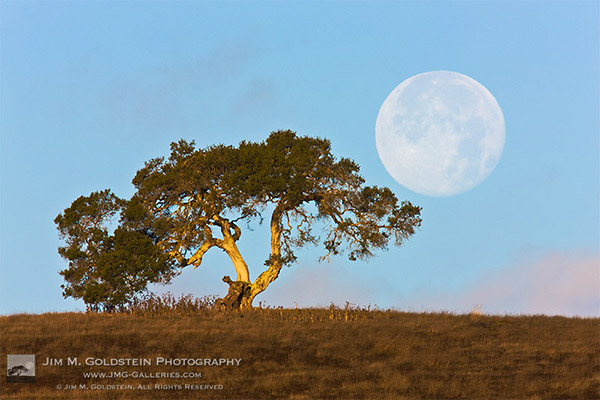
2-JimGoldstein-PerigeeMoonCaliforniaOak


Post originally from: Digital Photography Tips.

Check out our more Photography Tips at Photography Tips for Beginners, Portrait Photography Tips and Wedding Photography Tips.

Meet The Photographers Who Write For Digital Photography School ~ Jim Goldstein


Digital Photography School

 
Comments Off on Meet The Photographers Who Write For Digital Photography School ~ Jim Goldstein

Posted in Photography


Learning to See, Final

22 Apr

Make Photographs for Yourself, Critics are Critics for a Reason

Over the past ten installments from the Learning to See series (linked to below), I have hoped to lead the novice photographer through the basic concepts of not only what makes a photograph better, but also introduce some of the theories and principles to why.  I have also received comments of appreciation from advanced photographers who also might have learned a new concept, or perhaps provided a refresher from some long forgotten workshop.  However, at the end of the day this series was for the beginner and I do hope it has inspired you to make even more pictures, and above all else have fun doing it.

Generally speaking, the lessons presented followed a general flow I have employed for quite a few years whilst instructing novice photographers. You should be able to take these basic concepts of colour, tone and composition and practise these for the remaining time you are able to hold a camera – and I do hope that is forever.

As you gain a better grasp of these concepts you will soon discover why many advanced photographers will suggest rules are made to be broken. I also subscribe to this notion, but also believe we have to learn to walk before we can run.  Usually the reason you want to make a picture in the first place will be the reason you should make the picture. Once you have made the image, then it is time to start exploring with your curiosity and creativity by being adventuresome.

Don’t be afraid of failure – there is no such word in the amateur photographer’s dictionary.  If you are not pleased with the results of your efforts don’t see those images as disappointments, but as opportunities to learn.  What could I have done better … what should I have done? By challenging yourself to always advance and to learn from your results, I will guarantee you a lifelong pursuit of enjoyment from an incredible craft. I have known photographers who have been making pictures for 5, 6 and even 7 decades and the one common constant they all have is an insatiable desire to learn.

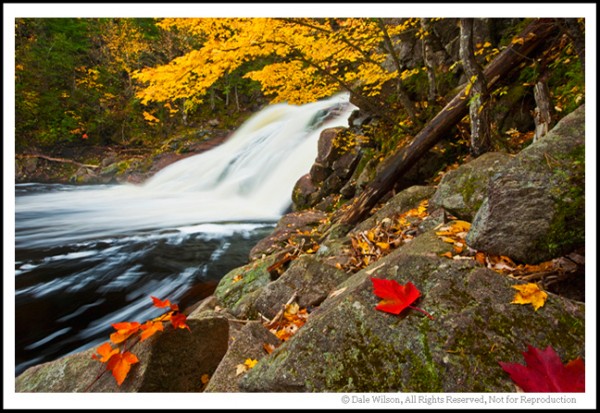
This image move away from the various "rules of composition" we have discussed, yet uses strong diagonal lines assupporting elements, as well as colour contrast. Yes, I placed the leaves in the foreground; but, somehwere today there is a photographer swearing up and down that those leaves were there just as he found them!

This image moves away from the various “rules of composition” we have discussed, yet uses strong diagonal lines as supporting elements, as well as colour contrast. Yes, I placed the leaves in the foreground; but, somehwere today there is a photographer swearing up and down those leaves were there just as he found them!


As a quick recap let’s reconsider some of the primary components and concepts that have been raised over the length of this series.

Subject:   First and foremost what is your subject? Something caught your attention and made you focus on a specific object; what was it? Once that subject is identified you should try to avoid surrounding distractions other than  incorporatinge those elements as supporting components to enhance the primary subject.

Tonal Range:    The subject will most likely be the most colourful or brightest part of the scene. When this is the case look for supporting colours or tones that will naturally enhance the contrast of the subject, and by default elevate the impact of the subject.  Think of our lesson on complementary colour and how red works well with green, blue with yellow, and so on around the colour wheel. Disregard the arguments of CMYK colours space at this junction of your photo career – think basic, primary colours and they will hold you in good stead until you are ready to explore colour theory further.

Composition: Once you have located the subject consider where you are going to place the subject in the final frame.  Recall our discussion on the Rule of Thirds and identifying the “Point  of Impact.” Also remember we can adjust the Rule of Thirds to become the Rule of Fifths, Sevenths, Ninths, or any other odd number we might choose to place the subject at a location to maximize impact. At this juncture don’t be distracted by those who would have us believe we must understand the Fibonacci theorems; just move the subject away from the centre of the viewfinder.

Elements to Support the Composition:  Think of diagonals and leading lines such as c-curves and s-curves. As you start making pictures try keeping them simple and uncluttered, allow the leading lines to draw our attention to the subject.

There will be occassions when you simply have to get the image and then attempt to refine it later. This is usually the case with animals. This harp seal pup is not the most active critter on the planet, but the mother most certainly can deliver one fast and nasty bite.

There will be occassions when you simply have to get the image and then attempt to refine it later. This is usually the case with animals. This harp seal pup is not the most active critter on the planet, but the mother most certainly can deliver one fast and nasty bite.  This image was made with a Pentax 67 format, with a light reflector held just off frame to the left and rear of the pup.


Conclusion:  Challenge yourself with assignments – perhaps one per week. Analyse your results immediately after you make the photo, and then again just before your next self-assignment a week later. By being self-critical of last week’s assignment, the lesson will be fresh in your mind for this week’s assignment and you will more than likely see improved results immediately from week-to-week.  Start training your eye to see things intuitively even though you don’t have a camera in your hands.  Look at architecture and see how the design of a building affects shadows at different times of day. Study the artworks of the great masters from the different periods and notice how they incorporate all of our discussion points in a single painting. Study the work of photographers whose work you admire, but be careful not to copy.  It is alright to emulate, but once you duplicate you are no longer true to yourself.  Photography, and art in general, is a universal language; learn to express yourself freely and with confidence.

Most importantly, and if I have been able to drive one extremely important lesson into your creative mind that would be: Always have fun.  After all, if you are having fun you are doing it right.

See the Full Learning to See Series

  • Learning to See – Part 1
  • Learning to See – Part 2
  • Learning to See – Part 3
  • Learning to See – Part 4
  • Learning to See – Part 5
  • Learning to See – Part 6
  • Learning to See – Part 7
  • Learning to See – Part 8
  • Learning to See – Part 9
  • Learning to See – Part 10
  • Learning to See – Final

Post originally from: Digital Photography Tips.

Check out our more Photography Tips at Photography Tips for Beginners, Portrait Photography Tips and Wedding Photography Tips.

Learning to See, Final


Digital Photography School

 
Comments Off on Learning to See, Final

Posted in Photography


Dialed In: 15 Cool & Quirky Radio Design Concepts

21 Apr

[ By Steve in Conceptual & Futuristic & Technology. ]

radio concept designs
The long history of radio and radios has progressed from polished wood, vacuum tube powered monstrosities through cheap Japanese transistor models to bass-pounding inner city “ghetto blasters” and finally sleek digital, satellite and internet receivers. These 15 cool & quirky radio design concepts provide a glimpse of this classic medium’s future while giving a respectful nod to its historic past.

MintPass Stackable Words Radio

Mintpass Word radio(images via: Yanko Design)

The “Used as Read” series of stacking audio components from MintPass takes almost all of the guesswork out of assembling one’s home audio system – simply chose, stack and connect the wires at the back. Even the remote control follows this design aesthetic: it’s shaped like the word “remote”.

Radio Ball Concept

Radio Ball concept(images via: Gadget Review and Gajitz)

One of the great joys offered by old-time radios was the thrill of exploration: slowly dialing up and down through the frequencies and (hopefully) stumbling upon some hidden jewel of a station playing YOUR kind of music, comedy or drama. The Radio Ball concept by Benoit Collette and Adam Kumpf of design group Teague was created to recapture the tactile, intimate & interactive thrill that seems to have been lost in the rush to digitization and automation. That’s just how it rolls.

Radio Valerie

Radio Valerie wireless radio concept(images via: The Art Of Science and WIRED/GadgetLab)

So long Radio Caroline, hello Radio Valerie! Radio Valerie from Pix Studio and chief designer Valentin Vodev is a cuter-than-cute wireless radio whose function is enabled by its form: changing the station involves moving the antenna up or down through the frequencies. What if the aerial needs adjusting to bring in a weak station but by doing so, you end up changing the station? Perhaps things aren’t as simple as they seem.

Plugg Radio

Plugg Radio concept(images via: Leibal Blog)

The Plugg Radio from Skrekkogle of Norway is more than the sum of its parts, being that said parts appear to be just a yellow cube and a cork. Secreted inside the box, however, is a fully functional AM/FM radio activated when the user removes the cork. So then: plug it in and pull the plug… makes perfect sense!

Next Page:
Dialed In 15 Cool Quirky Radio Design Concepts

Share on Facebook


[ By Steve in Conceptual & Futuristic & Technology. ]

[ WebUrbanist | Archives | Galleries | Privacy | TOS ]


WebUrbanist

 
Comments Off on Dialed In: 15 Cool & Quirky Radio Design Concepts

Posted in Creativity


Smartphone camera review: Blackberry’s back with the Z10

21 Apr

BlackBerryZ10.jpg

BlackBerry, the phone maker formerly known as Research in Motion, has a lot riding on its newest smartphone, Z10. It’s the debut handset for the long-delayed BlackBerry 10, the operating system that the company hopes will mark the beginning of a turnaround after years of losing ground to Apple’s iOS and Google’s Android platforms. We take a thorough look at the camera capabilities of the Z10 in our review on connect.dpreview.com.

News: Digital Photography Review (dpreview.com)

 
Comments Off on Smartphone camera review: Blackberry’s back with the Z10

Posted in Uncategorized