RSS
 

Archive for March, 2013

DEAL: 50% Off The Art of Black and White Photography Online Course

07 Mar

NewImageThis week’s deal over at our sister site – SnapnDeals – is one that I know will appeal to a lot of dPS readers.

It is 50% off The Art of Black and White Photography Online Course at Udemy.

Created by David J. Nightingale this course will help you to:

  • Master the techniques to create amazing black and white photographs.
  • Make more of your black and white portraits.
  • Learn from a world-renowned expert.

It contains over 19 lectures and 6.5 hours of content – all delivered online.

It is normally $ 79 but this week through SnapnDeals it is just $ 39.50 USD. Check it out at SnapnDeals.

Post originally from: Digital Photography Tips.

Check out our more Photography Tips at Photography Tips for Beginners, Portrait Photography Tips and Wedding Photography Tips.

DEAL: 50% Off The Art of Black and White Photography Online Course


Digital Photography School

 
Comments Off on DEAL: 50% Off The Art of Black and White Photography Online Course

Posted in Photography


Uebergrund gehen

07 Mar

Ein Beitrag von: Sebastian Linck

“uebergrund” gehen,
Asphalt unter den Füßen spüren.
Der urbane Raum verändert sich,
– klick – captured der Augenblick!
Streifzüge durch die Stadt bei Nacht.
Der dunkle Tunnel
und die Katakombe
strahlen kalte Wärme aus.
Irdische Orte
“ueber- und untergrund”.
Abriss
wird mit der Zeit zum “Grundriss”:
Schönheit der Vergänglichkeit.

Auf meiner Webseite habe ich im Menüpunkt „About“ oben wiedergegebenes Gedicht ? oder wie auch immer man es nennen mag ? eingefügt. Es handelt sich dabei um einen Versuch, meine Gefühle zum Ausdruck zu bringen, die ich empfinde, wenn ich in die urbane Welt abtauche und im besten Fall diese mit der Kamera festhalte.

3

Ich klettere an einem x-beliebigen Ort über eine Mauer, schlüpfe durch ein Loch im Zaun oder schleiche mich in den Untergrund. Der Lärm der Stadt wird leiser, bis er bald nicht mehr zu hören ist. Ich bin angekommen in einer Parallelwelt, in meiner Parallelwelt, weit weg vom Schreibtisch und dem Alltag!

Abriss, Zerstörung und Dunkelheit dominieren. Ich tauche ein und lasse sie auf mich wirken. Die Sinne sind wachsam, der Körper ist gespannt, plötzlich ein Geräusch – Adrenalin schießt durch meinen Körper, der Schweiß tritt aus den Poren. Was wartet in der Dunkelheit auf mich? Ich weiß es nicht.

5 8

Der Blick durch den Sucher fixiert, der Spiegel klappt hoch, festgebrannt der Augenblick. Einfangen und erhalten, bevor die Abrissbirne kommt.

Die Schönheit dieser Orte sieht man meist erst auf den zweiten Blick, doch sie ist da. Manchmal gelingt es mir, sie abzulichten, manchmal nicht. Dann wiederum habe ich kein Interesse an dieser Schönheit. Ich suche die „roughness“ und die hässliche Fratze der Stadt, die mich ebenso fasziniert wie anzieht.

6

7

Meine Art der Fotografie zeigt die rohe Authentizität. Ich mag das Unverfälschte und Echte. Spontane und schnell geschossene Fotos sind mir am liebsten, um diese Momente einzufangen. Ich möchte die Szenen so zeigen, wie ich sie vorgefunden habe und möglichst wenig retuschieren oder gar kaschieren.

Ich bewege mich allein, ich bestimme meine Geschwindigkeit, meinen „Workflow“. Von Set-Aufbauten lasse ich mich nicht fesseln. Ich nehme mir die für mich so wichtige Freiheit, lasse mich auf meinen Streifzügen treiben.

Niemand weiß, wo ich mich befinde, dieses Gefühl ist etwas Besonderes. Keiner weiß, welche Wege ich beschreite. Die Gefahr ist ein ständiger Begleiter – ich heiße sie respektvoll willkommen. Die Schritte wähle ich aufmerksam, Fehltritte kann man sich in einer maroden Umgebung nicht erlauben. Wachsamkeit!

11

Die Spannung dieser Parallelwelt möchte ich nicht nur einfangen, sondern auch in angemessenem Gewand präsentieren. Fotografien verdienen es nicht, nur ein virtuelles Dasein als nummerierte Datei auf einer Festplatte zu fristen.

Die einzige Aufstiegsmöglichkeit in einer Welt aus Einsen und Nullen ist die Position des Bildschirmschoners. Millionen von Pixeln haben mehr verdient: Sie gehören auf Papier gedruckt. In dieser Form können sie ihre Farbenvielfalt, die starken Kontraste oder die schwarzweißen Nuancen perfekt entfalten.

Das haptische Erlebnis macht den Unterschied. In analogen Zeiten wurde mit Spannung auf die Entwicklung der Fotos gewartet. Durchblättern, aussortieren und einkleben; Arbeit mit den Händen.

Im Jahr 2009 kam mir – nach einem einjährigen Auslandsaufenthalt – die Idee, meine Fotografien nicht „nur“ in einer Diashow zu präsentieren, sondern auch in Form eines Bildbandes. Einige schlaflose Nächte – und viel Herzblut – später war das „uebergrund Fotomagazin“ geboren.

16-1

Inzwischen sind vier Jahre vergangen und ich habe meine „Urban-Trilogie“ abgeschlossen und jährlich im Eigenverlag veröffentlicht. In den drei Ausgaben zeige ich Stadtansichten aus Australien, Neuseeland, Vietnam, Hongkong und verschiedenen europäischen Metropolen. Die Druckmaschine hat meine Interpretation von Abriss, Verfall, Schönheit, Dunkelheit, uebergrund, Untergrund, Urban art, Nachtilluminationen und Trash zu Papier gebracht.

Jetzt ist es Zeit für neue Wege – diese werde ich im Sommer 2013 beschreiten. Der Titel bleibt, der Inhalt wird ein anderer!


kwerfeldein – Fotografie Magazin

 
Comments Off on Uebergrund gehen

Posted in Equipment


Lunar Soil Structures: 3D-Printing Dwellings on the Moon

07 Mar

[ By WebUrbanist in Conceptual & Futuristic & Technology. ]

3d printed space base

One of the biggest challenges of settlements in space is the cost of transporting materials and technologies for construction, a problem addressed beautifully via 3D printing technology in this architectural proposal (currently being prototyped on Earth).

3d robot space printer

The design by Foster + Partners (in conjunction with the European Space Agency) uses a minimum of imported materials – mainly: an inflatable core, pumped up into domes and tunnels on site.

3d base concept prototype

Yet despite its simplicity, the project addresses everything from extreme temperature fluctuations to gamma radiation in this ingenious multi-person dwelling, effectively allowing humans to bypass the need to burrow below the surface while still using it effectively as a shield.

3d space home model

The man-made domes at the center of the concept are augmented by 3D-printed material derived from locally-sourced soil – a concrete-style foam substance providing stability, safety and structural support.

Share on Facebook


[ By WebUrbanist in Conceptual & Futuristic & Technology. ]

[ WebUrbanist | Archives | Galleries | Privacy | TOS ]


WebUrbanist

 
Comments Off on Lunar Soil Structures: 3D-Printing Dwellings on the Moon

Posted in Creativity


Quick Tip: Importing to Lightroom Made Easier

07 Mar

Introduction

This tutorial is from the Lightroom 4 Workshop Collection. Including 27 hours of A to Z Lightroom 4 education and the industry standard Lightroom 4 Preset System. DPS users can get 10% off by using the DPS10 coupon code upon checkout. Click the link above to learn more/purchase.

Overview

In this tutorial, we will give you a quick tip when importing image into Lightroom that will eliminate the need to search around for import and destination folders.

Step 1. Create Your Catalog

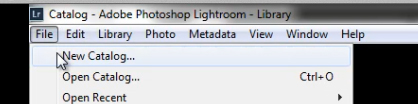
If you don’t already have a Lightroom catalog created, then let’s go ahead and create one now. Simply open Lightroom and go to File -> New Catalog.

file-new-catalog

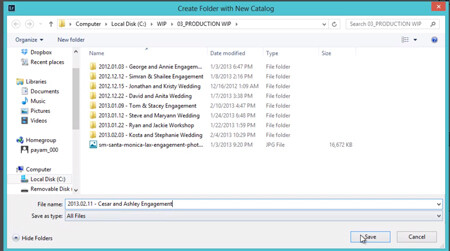
Give your Catalog a descriptive name and a destination folder of your choice. Remember to keep your naming conventions consistent to have an efficient and organized workflow. Our naming convention is as follows:

YEAR.MONTH.DAY – NAMES PHOTOGRAPHY TYPE

So, for this example we have the following:

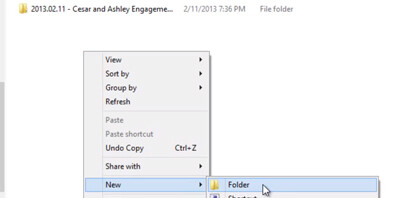
2013.02.11 – Cesar and Ashley Engagement which is typed into the File name location shown in the image below.

name-catalog

After you hit “Save”, Lightroom will close and re-open with the New Catalog which is ready for images to be imported.

Step 2. Creating the “Folders”

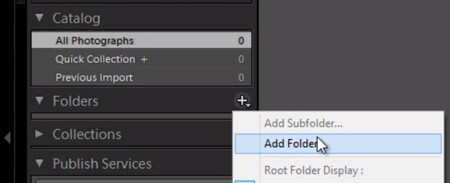
We will be directly importing the images into a folder on the left-side Panels called “Folders.” But, first we have to create a folder for the images to be imported into. On the Folders Panel, simply click the “+” icon to create a new folder as shown below.

add-folder

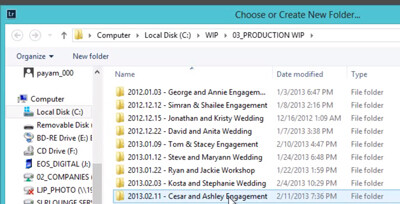
Now, select the same folder where we saved our catalog to create the folder where we want to place the original images. We do this to ensure that the images always move with the catalog if the catalog is ever transferred.

select-folder-engagement

To create new Folder for your original images, right-click within the Folder content area and select “New Folder”. Remember, we are doing this all from the “Add Folder” dialogue in Lightroom, not in the Operating System.

new-folder-engagement

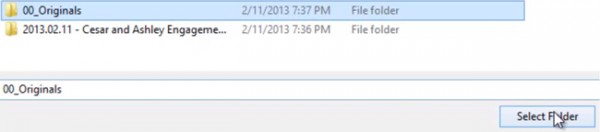
Type in “00_Originals” or the name of your choice for the Folder to contain your original images. Again, keep your naming conventions consistent for better organization. Then click “Select Folder”.

create-00-originals

Step 3. Importing Directly to Folders

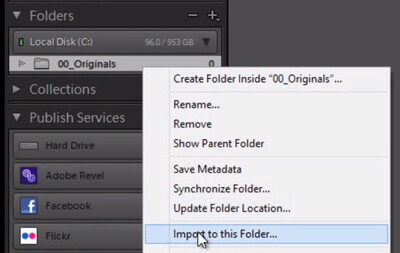
Now that we have our folder created. We have two options to import. Option number 1 is to Right-click on the Folder that shows up under the Folders Panel and select “Import to this Folder” as shown below.

right-click-import

This will pull up our Import Dialogue and automatically set the destination to the “00_Originals” Folder without having to manually select our destination as we normally would.

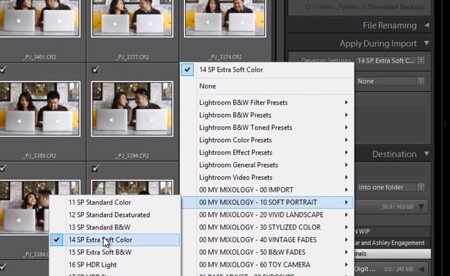
Workflow Tip: Apply a Workflow Preset on Import

Before you begin the Import process, we always select an import preset that is most applicable to the type of images being imported. In our studio, we generally use the “Extra Soft Color” Preset for portrait sessions from the Lightroom 4 Preset System by SLR Lounge as shown below.

import-with-preset

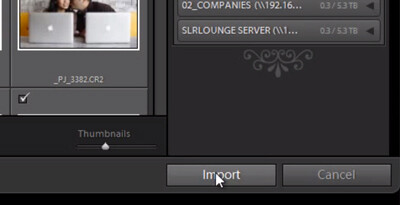
When you are finished, select “Import” located on the bottom-right in Lightroom.

FINAL-select-import

And that’s it! Hopefully this little quick tip on importing will help you to import images just a bit more efficiently.

Learn More with the Lightroom 4 Workshop Collection!

This was a sample tutorial from the Lightroom 4 Workshop Collection. A collection of nearly 30 hours of video education teaching everything from Lightroom basics to advanced raw processing techniques.

The LR4 Workshop Collection also includes the critically acclaimed Lightroom 4 Preset System which is designed to enable users to achieve virtually any look and effect within 3-5 simple clicks. From basic color correction, vintage fades, black & white effects, tilt-shift effects, faux HDR, retouching, detail enhancing, and so much more. Click the links above to learn more.

Post originally from: Digital Photography Tips.

Check out our more Photography Tips at Photography Tips for Beginners, Portrait Photography Tips and Wedding Photography Tips.

Quick Tip: Importing to Lightroom Made Easier


Digital Photography School

 
Comments Off on Quick Tip: Importing to Lightroom Made Easier

Posted in Photography


Why Your Camera Settings Don’t Matter

07 Mar

Have you ever opened up a photography magazine, saw a photo you liked and spotted the little blurb which reveals the camera settings? The conclusion you might be tempted to make is that the aperture, focal length, shutter speed, ISO and flash settings you see there somehow “made” that photo. And worse, you might try to remember those settings as Continue Reading

The post Why Your Camera Settings Don’t Matter appeared first on Photodoto.


Photodoto

 
Comments Off on Why Your Camera Settings Don’t Matter

Posted in Photography


How I Will Publish One Million Photographs Before I Die

07 Mar

Waiting for the Mother Ship -- Death Valley, CA

My friend Chris Guillebeau sent me an email this morning about my uploads to Flickr. One of the things I love about Chris is that like me he is a big dreamer/achiever. For those of you who don’t know him, you should get to know him. He’s a huge motivation and someone who can help you achieve great things as well. Chris wrote up a really nice interview on my photography a few years back.

One of the things that Chris wanted to do was to visit every country in the world by April 7, 2013. For this goal he is using the United Nations list of 193 member states. You know what? He’s visited 192/193 so far. WOW! His Brief Guide to World Domination should be required reading for every person in the world. It should be taught to students especially.

I sincerely believe human beings are capable of so much more than they think they are. Unlocking our true potential and power comes from some very basic tools and techniques that can be learned. In 2005 I read a book that dramatically changed the way I think about my own life by Brian Tracy called Focal Point. I’d encourage you to buy this book and read it. It’s probably the most important book I’ve ever read. If you’ve got kids buy it for them and give it to them as well. It teaches you how to accomplish great things.

One of the things that I’ve decided that I want to do with my own life is to publish one million photographs before I die. When I talk about publishing a million photographs, I’m not talking about simple shutter actuations — I’ve already taken over a million frames. Anyone can push a shutter a million times. You could probably train a monkey to do this. Anyone can even publish a million meaningless photo clicks to the web — many in fact already have.

My quest is not simply quantity over quality. What I’m focused on is publishing one million *quality* photographs that I believe in and care about as personal art — photos that I can be proud of. Each photo I choose to publish is carefully selected amongst many different frames from a shoot. Each photo is individually worked with, processed, edited with software, keyworded, and frequently hand titled and geotagged (although not always, for those last two points). Occasionally I will create more than one version of a single frame, but each photo is unique and different.

Although I publish my photos to many different sites on the web, Flickr is where I’m presently maintaining my larger body of work. What a deal Flickr is — unlimited high res photos for $ 24.95/year. Nobody comes close to touching this. In addition to this great value, Flickr comes with great presentation tools, an awesome new iPhone app and a pretty terrific social network too.

At present I’ve published 79,783 photographs to Flickr. In addition to these published photos, I’ve got an archive of about 22,000 fully completed and finished photos in a folder ready to go to Flickr. Each day I publish about 30 more of these to the site, pretty much at random — or about 11,000/year.

Which brings me back to Chris’ email earlier this morning. Chris is working on a new book right now and for the book had asked me some questions last month about my photography. He was following up today to confirm that last year I published about 11,000 new photos to Flickr — which I’m going to confirm with him shortly after finishing this post — but in considering this, I realize that the 11,000 number for 2012 is problematic. It’s problematic because if you assume that I continue on at this pace, I will need to live 84 more years to realize my goal of 1,000,000 photos. At age 45 today, it is highly unlikely that I will live to be 129, and so at my present pace, this sets my goal up for failure if people take my publishing rate today at face value.

My goal is much more complex than simply 11,000 photos per year for the rest of my life though. I’ve thought about my lifetime goal for many, many hours and my plan to achieve it is more complicated than a simple number for 2012 might suggest.

I’ve actually worked out my lifetime achievement goal in rough form with a spreadsheet as I’ve developed my thinking. At present what I plan on doing is increasing my publishing rate of photos by 2% per year during the next 10 years. The reason why I’m publishing less photos today is primarily because I’m so focused on actually shooting the photos today. I want to spend the time in my life when I’m most physically fit shooting the most. I also think that time/age frequently add interestingness to many photos. So I’d rather capture photos here and now today than in the future.

If I increase my publishing 2% each year for the next 10 years (something I’m very confident I’d be able to do even with my current unpublished archive alone) I should have about 200,000 photos published 10 years from now.

10 years from now my last of four children, Kate, will (hopefully) be leaving us for college. With all four of my kids out of the house, I will likely spend less time on my children than I do today. So 10 years from now I will increase my publishing rate even more, about 5% per year — more time for shooting but more importantly, more time for processing. In 10 years I’ll have approximately 370,000 photos published.

20 years from now, not only will my kids (again, hopefully) be done with college, but I’ll also be able to retire from my day job at around age 65. This will then free me up 100% to focus my time and energy on photography. I plan to increase my publishing rate by 10% per year then.

After age 65 the proportional rate of time spent shooting vs. processing will likely flip flop from what I’m doing today as well. Instead of spending 80% of my time shooting and 20% of my time processing, like I do now, I’ll likely spend 20% of my time shooting and 80% of my time processing. When you’re an old man (not that 65 is old, but I’ll get older likely after that) it’s a lot easier to sit in front of a computer and process than it is to run around the country staying up 20 hours at a stretch and shooting.

If I follow this strategy, and the part between age 65 and 80 is super important, I will publish 1 million photos when I am 80. Government life expectancy tables today give me until age 83 to live, but I wanted a few years as a buffer in case I kicked the bucket early.

My biggest challenge in all of this is maintaining my unpublished archive. I want this archive to grow larger and larger and larger, even as my published work grows as well. By growing my unpublished archive larger, I ensure that greater and greater diversity will be represented in my daily publishing. This is a secondary goal of mine, to have as much diversity with what I publish as possible. 20 years from now I like the idea of a photo from 2010 being published alongside a photo from 2015 and one from 2020. I like the idea of my photos been diversified not just by time, but by location (I’ll shoot more and more locations over my lifetime), subject matter (I’ll shoot more and more different things), style (my style will evolve and change), etc.

As I pursue this lifetime goal I’m also cognizant of a powerful tailwind at my back — technology. Technology will make my goal easier and easier to achieve. Already in 2013 I’m blown away at how much faster I can process my work than two years ago. Going from hard drives to flash storage, going from USB to Thunderbolt, faster macs, better cameras, all contribute to ensuring that I will be able to keep pace in the future even as I grow my publishing rate. For the first time, this year, I’ve felt like the only thing holding me back with my processing is actually me. For the first time with the hardware and software advances, I feel like I’m working and editing my work in real time. The future is indeed bright for the future tools that will not only continue to make our images look better, but which will also help us do more faster.

One final note — this goal is intensely personal for me and me alone. I created it, I live it, I fuel it. Over the years I’ve had many who have been critical of my goal. Many don’t understand that quantity can also be quality. Many have expressed an opinion that taking so many photos somehow diminishes my work. Many people have a desire to produce less, not more. All of this is fine. Everyone can do whatever they want. This is just what *I’m* doing. I’m not saying that this is the right path for anyone other than me and me alone. I’m not making a larger statement about photography in general, or saying that people that don’t keep my path/pace are in any way less significant as artists or photographers.

While I’ve personally admired many of the most prolific artist/photographers in the world (Warhol, Eggleston, Winogrand, Friedlander, etc.), I also admire many photographers and artists who make great art in smaller but more intense doses too. Whatever YOU do is fine. Be true to yourself and follow the artist that is inside of you.


Thomas Hawk Digital Connection
 
Comments Off on How I Will Publish One Million Photographs Before I Die

Posted in Photography


Online images and copyright infringement

07 Mar

copyrightopener.jpg

A dispute between Canadian pro photographer, Barbara Ann and Ottawa radio station HOT 89.9 illustrates the problematic climate in which companies often turn to the Internet for free photographic images. Someone at the radio station found, via a Google search, a wedding photo that was then used as part of a Keynote slide presentation made to potential advertisers. When contacted by the photographer, the station removed the image but the two parties remain far apart on an agreement over compensation. (via PetaPixel)

News: Digital Photography Review (dpreview.com)

 
Comments Off on Online images and copyright infringement

Posted in Uncategorized


Panasonic announces upcoming firmware update for GH3 camera and lenses

07 Mar

panasonic_dmcgh3.png

Panasonic has announced firmware updates for its Lumix DMC-GH3 high-end movie-focused mirrorless camera, the 14-42mm and 45-175mm power zooms and the 45-150mm lens. The update for the GH3 will allow users to connect to a computer via Wi-Fi by entering the computer name (NetBIOS names for Mac). It also adds a 1080 60p, 28Mbps mode to video recording. Meanwhile the firmware updates for the lenses promise improved autofocus performance in AF Continuous mode when mounted on the GH3. The updates will be available at the end of this month.

News: Digital Photography Review (dpreview.com)

 
Comments Off on Panasonic announces upcoming firmware update for GH3 camera and lenses

Posted in Uncategorized


Just posted: Canon EF 24-70mm f/2.8L II USM lens review

07 Mar

canon_24-70_2p8_ii.png

Just posted: Our review of Canon’s top-end standard zoom, the EF 24-70mm f/2.8L II USM. Launched a year ago to replace its 10-year old predecessor, it’s designed as a workhorse for professional photographers, and features a completely new optical design and improved, weathersealed build. In the latest of our lens reviews produced in collaboration with DxOMark, we take a look both lab and real-world performance. As usual, you can also compare it to a wide range of similar lenses using our unique lens data widget. Click through to see what we thought.

News: Digital Photography Review (dpreview.com)

 
Comments Off on Just posted: Canon EF 24-70mm f/2.8L II USM lens review

Posted in Uncategorized


Preservation Puzzle: Extreme Ideas to Save an Urban Facade

07 Mar

[ By WebUrbanist in Architecture & Public & Institutional. ]

historic preservation prentice ideas

The Prentice Women’s Hospital building at Northwestern University has some serious fans, including a range of architects such as Frank Gehry, Robert Venturi, Tadao Ando, Jacques Herzog, Pierre de Meuron, who would like to see it preserved. The open question: is the exterior of sufficient historical value to keep, even if it means building up through, above and/or around it?

historic new tower solution

While a wonder of structural engineering with an iconic shape, the structure simply is not practical or fit-to-purpose anymore. One daring proposal from Studio Gang Architects (illustration by Jay Hoffman) involves adding dozens of upper stories, and nearly a million square feet, while leaving the shell of the original intact.

historic mirrored facade idea

A scheme by Cyril Marsollier and Wallo Villacorta won a competition to suggest alternatives with another approach – one that allows half of the building to be absorbed by a new structure, while reflecting the other half – using a mirror-image effect to preserve the complete appearance via a rather ingenious and nuanced illusion.

historic original humorous proposals

Critics exist on both sides. Some say this proposal strips away so much of the building and its context that what is left is really metaphorically (not just literally) a shell. Others suggest that any solution bends too far toward impracticality to accommodate an arguably unattractive building (many consider it an eyesore). Humorists like LunchBreath have weighed in as well, as seen above.

historic preservation proposal rendering

Meanwhile, the university itself does not seem interested in considering preservation options, so these concepts, while compelling, could well be moot in the end. Still, the High Line in New York is a great example of how enough public pressure and celebrity support can change the minds of an entire city, and perhaps a private institution as well.

Share on Facebook


[ By WebUrbanist in Architecture & Public & Institutional. ]

[ WebUrbanist | Archives | Galleries | Privacy | TOS ]


WebUrbanist

 
Comments Off on Preservation Puzzle: Extreme Ideas to Save an Urban Facade

Posted in Creativity