RSS
 

Archive for March, 2013

Das Geheimnis der Bücher

14 Mar

Wenn Fotografen sich einen Namen gemacht haben, wenn sie mit ihrer Arbeit die Blicke, also die Sicht auf etwas verändern können, dann erscheint im Laufe ihres Lebens – oder oft auch erst nach ihrem Tod – das zusammenfassende Werk.

In einer Zeit, in der fast jeder seine Bilder in Buchform präsentieren kann oder zahlreiche Fotoplattformen unzählige Uploads verzeichnen, ohne einen fachkundigen Kurator zur Seite zu haben, sind diese Mammutwerke von besonderem Interesse.

Diese Bücher sind etwas Besonderes. Sie enthalten Geheimnisse. Sie inspirieren uns. Sie geben uns einen Überblick über eine Schaffensperiode. Es sind Zeugnisse von Menschen, die etwas von ihrem Handwerk verstehen oder verstanden haben. Wir sollten ihnen zuhören, wann immer wir können, von ihnen lernen und ab und an kurzweilig in Demut versinken.

Jedes Genre hat seine eigenen Helden. Meine Helden sind zwei Damen: Deborah Turbeville und Sarah Moon. Beide haben in den Wirren des zweiten Weltkrieges, die eine in den USA und die andere in Frankreich, das Licht der Welt erblickt. Beide waren früh in der Modeszene involviert, beide haben ihre eigene Sprache entwickelt und das Genre damit stark bereichert.

DeborahTurbeville_p186-187_web
(c) Deborah Turbeville

Im Oktober 2011 erschien „Deborah Turbeville: The Fashion Pictures“* im Rizzoli Verlag. Ich bin mir sicher, würde man ihre Bilder heute in einer der vielen Fotocommunities zeigen und besprechen, sie wären wohl dem Zeriss ausgesetzt.

Sie liebt die Unschärfe und man findet sie in vielen ihrer Bilder. Oft aber sind sie auch zerkratzt, geklebt, mit anderen verbunden, bruchstückhaft, träumerisch, verloren. Sie werden auch bemalt oder beschriftet. Auf einigen sieht man sogar Fingerabdrücke. Sie selbst sagte dazu: „I destroy the image after I’ve made it.“

DeborahTurbeville_p052-53_web
© Deborah Turbeville

Sie kam erst spät zur Fotografie. Mit 28 Jahren nahm sich Richard Avedon ihrer an. Er mochte ihre verschwommenen Bilder und lehrte ihr das Handwerk. Anfang der 1970er Jahre konnte sie sich offiziell Fotografin nennen. Einen Namen machte sie sich 1975 mit ihrer Serie „Bathroom“ für die amerikanische Vogue und weitere Aufträge folgten.

In ihrem Buch kann man wohlig in diese Unschärfen stürzen. Es werden die bekanntesten Modestrecken gezeigt sowie unveröffentliche Bilder, die für Chanel entstanden. Ihre Bilder, die nie ganz da wirken, haben die Modefotografie nachhaltig beeinflusst und ich bin froh, sie zwischen all den Fotografen entdeckt zu haben.

DeborahTurbeville_p065_web
© Deborah Turbeville

Sarah Moons Retrospektive Sarah Moon 12345 erschien 2008 in einem fünf-bändigen Buch zusammen mit ihrem Film „Mississipi One“ im Verlagshaus Thames & Hudson.

Die Bände sind als Film in Buchform gestaltet und jeder Band steht für ein Genre oder für eine Schaffensperiode in Moons Leben. Denn sie war nicht nur Fotografin, sondern auch Model und Filmemacherin.

Leider besitze ich ihr zusammenfassendes Werk bis heute nicht, weil mir der stolze Preis von über 150 Euro zu schwer im Magen liegt. Aber darin geblättert habe ich schon allzu oft und bin immer wieder überwältigt.

Die Menschen auf ihren Bildern werden behutsam betrachtet. Sie holt sich den Moment, der unbemerkt bleibt. Im Weggehen einer Person fängt sie das Zögerliche, im Augenblinzeln das Nachdenkliche ein. Ihre Bilder können aus tanzenden Farben bestehen, sind aber niemals aufdringlich, wenn auch fordernd.

200609P006comdes20064.1.1

© Sarah Moon

Ihre Schwarzweißwelten sind dunkel, träumerisch und verwirrend. Wie ein Zerrspiegel erscheinen die Menschen darin und man glaubt, es reiche, nur die Hand auszustrecken, um ebenfalls auf die andere Seite des Bildes gezogen zu werden.

Auch außerhalb der Modewelt legt sie ihre Kamera nicht aus der Hand, denn nicht nur Menschen sondern auch Landschaften und Tiere finden ebenso Zutritt in ihre schöpferische Welt.

Ich könnte noch ewig weiter über ihre Arbeiten und sie selbst schreiben, lege Euch aber lieber das Interview ans Herz, erschienen 2011 in der ZEIT.

eva copie
© Sarah Moon

In den Werken beider Fotografinnen habe ich etwas gefunden, das mich berührte. Die Beschäftigung mit ihren Arbeitsweisen und Ansichten haben mich beruhigt und darin bestätigt, weiter zu gehen und mir selbst treu zu bleiben.

Und nun seid Ihr dran. Erzählt mir: Wer sind Eure Helden? Wer inspiriert Euch, von wem lernt Ihr?

Die Bilder von Deborah Turbenville stammen alle aus dem Buch „The Fashion Pictures“. Die Bilder von Sarah Moon aus „Sarah Moon 12345“. Ich danke den beiden Verlagshäusern Rizzoli und Thames & Hudson für die Bereitstellung der Bilder.

* Das ist ein Affiliate-Link zu Amazon. Wenn Ihr darüber etwas kauft, erhalten wir eine kleine Provision, Ihr zahlt aber keinen Cent mehr.
kwerfeldein – Fotografie Magazin

 
Comments Off on Das Geheimnis der Bücher

Posted in Equipment


LEGO Abandonments: Home-Made Model Haunted Houses

14 Mar

[ By WebUrbanist in Art & Sculpture & Craft. ]

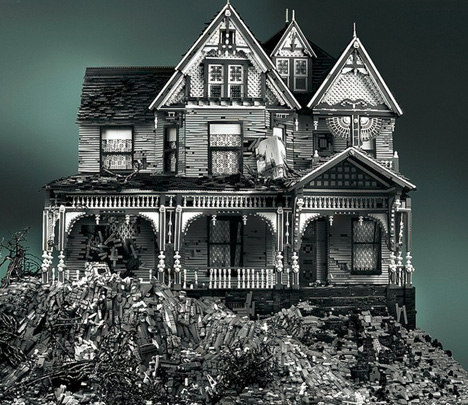
lego abandonments

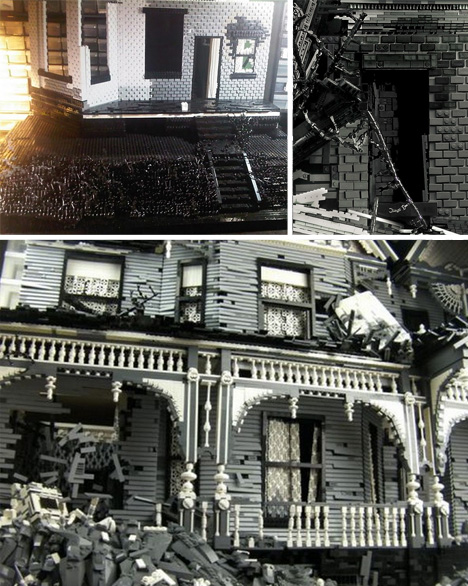
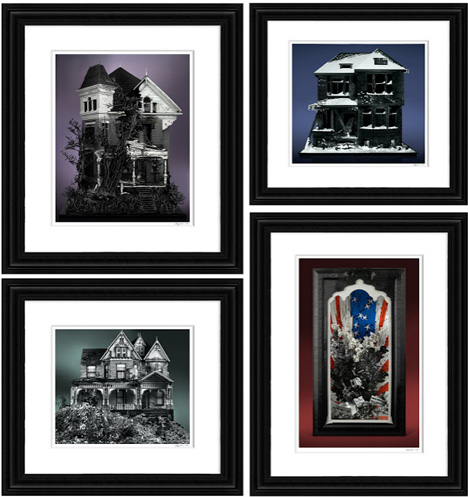
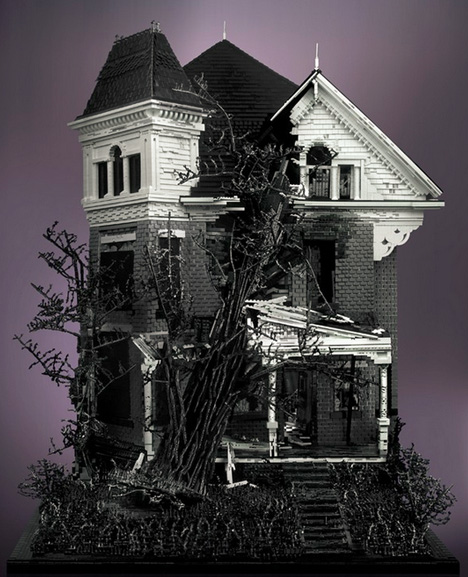
Hundreds of hours and in some cases over one hundred thousand pieces have gone into the creation of this series of seriously detailed LEGO models, each constructed to replicate the processes of decay in miniature.

lego victorian decay series

Michael Doyle makes these largely-Victorian marvels piece by piece, but of course creating something that looks intentionally chaotic is in many ways more challenging than making a conventional model home.

lego abandoned haunted house

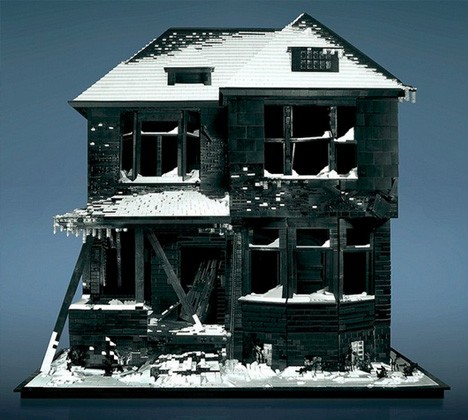
From the artist: “To my eyes, patterns of decay find a more pleasing path than an untouched object. A roof collapsed by the weight of snow, side shingles ripped by the force of winds, substructures rotting, insects and weather gnawing the exposed surfaces.”

lego deconstruction build process

“I can picture those windy days where a shingle flies off. Or the sudden creaking, cracking and burst of tinder giving way under snow’s heavy hand

lego deserted building photos

And for anyone interested in a strange slice of abandoned-faux-home ownership, he still has prints for sale of some of the works featured here as well as his other gravity-and-time-defying LEGO creations.

Share on Facebook


[ By WebUrbanist in Art & Sculpture & Craft. ]

[ WebUrbanist | Archives | Galleries | Privacy | TOS ]


WebUrbanist

 
Comments Off on LEGO Abandonments: Home-Made Model Haunted Houses

Posted in Creativity


Learning to See, Part VIII

14 Mar

Consulting the rules of composition before taking a photograph, is like consulting the laws of gravity before going for a walk.  –Edward Weston


To some photographers composition is an innate process, whereas to others it is a life-long learned challenge laden with frustration. Regardless of which category you find yourself, good composition is a learned skill that will enhance the overall aesthetic appeal of the end result.  While I subscribe to Weston’s notion, I also believe we first learn to crawl before walking.

Our challenge is to learn how to use diagonal lines, contrast, simplicity, point of interest, and so on to allow us to translate the three-dimensional scene being photographed onto a one-dimensional plane while retaining the original perception of depth and movement.

The first rule that we must accept is that there is no right way to take a picture. Regardless of the subject matter, you should always analyze your picture to ensure it answers the question: Does this picture satisfy my reasons for having made the exposure in the first place?  Should your answer be yes —congratulations.  If not — why not?

The art of making a photograph can be broken down to its most basic and elementary form: Placing the point of interest in the most satisfying position within the frame to achieve the desired result. It really is that simple; everything from this point forward will evolve by way of personal technique.

The first photographic rule that must be learned, and adhered to from this day forward, is the use of a tripod. It is unquestionably the most valuable piece of ancillary equipment you can have at your disposal. Only when your camera is firmly grounded with the flexibility and advantage of controlled movement can you then start to accurately study the scene in the viewfinder, thus ensuring all elements are properly placed in the scene prior to making the exposure. There have been many articles and reviews written on the multitude of tripod models available, please defer to those that are easily located by doing a web search.

By recognizing that we want to photograph a particular scene or subject, we have also admitted to having identified the point of impact within that scene. Perhaps it is a lazy fox in big landscape, a detail of some mammal, a grey wolf peering from behind a tree, or perhaps the snow-capped mountains in some distant vista. Where we place that identifying feature within the viewfinder will unquestionably enhance the final impact of the image.

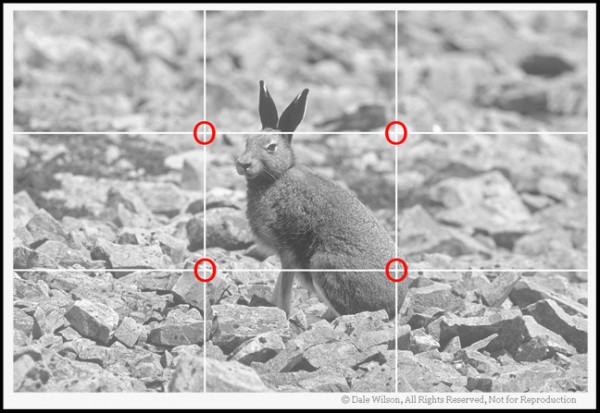
One of the very first rules of thumb to be learned in composition is the utilization of the ‘Rule of Thirds.’ Essentially the viewfinder is divided into nine equal spaces by placing two equally spaced horizontal lines and two equally spaced vertical lines. Where these lines dissect each other will create the four ‘Points of Impact’ within the frame.

Canada’s easternmost province of Newfoundland has the southernmost population of arctic hare in the world.  This fellow was located atop Gros Morne Mountain, and the photo was captured with little regard for composition. With uncontrolled animals (non-zoo setting) just get the shot first,and then concentrate on refining the image with the next frame. With gained experience you will soon find yourself intuitively placing the subject at the correct ‘Point of Impact’ as indicated here with red circles.

Canada’s easternmost province of Newfoundland has the southernmost population of arctic hare in the world. This fellow was located atop Gros Morne Mountain, and the photo was captured with little regard for composition. With uncontrolled animals (non-zoo setting) just get the shot first,and then concentrate on refining the image with the next frame. With gained experience you will soon find yourself intuitively placing the subject at the correct ‘Point of Impact’ as indicated here with red circles.

Regardless of subject matter, by placing our primary point of interest in one of the four ‘point of impact’ locations within the frame we will dramatically improve the dynamic and aesthetic appeal of the picture.

What I would like you to do now is locate simple subjects in your backyard or neighbourhood park. Do not try to make complex pictures, but just a single subject on a plain background – perhaps a solitary tree against a sky background. While employing the “Rule of Thirds” place that tree, or other chosen subject, in each of the four “point of impact” locations. For the fifth photo of the tree, place it in the centre of the viewfinder. Which photo do you prefer and why?

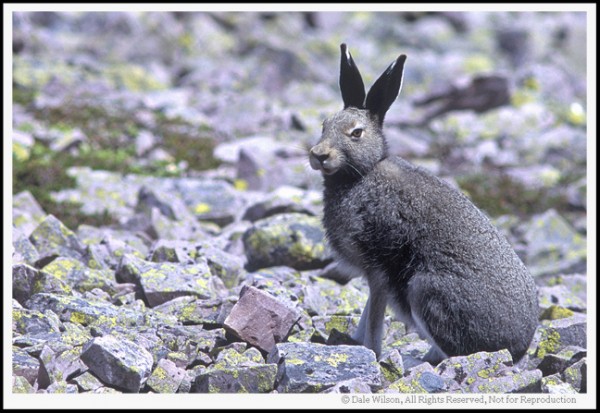
Once this hare heard the mirror-slap on my medium format camera (Pentax 67) he was gone faster than a … well, shot at rabbit. Fortunately, due to the large film size I am able to crop the image and place the ‘Point of Interest’ (the hare) in the most pleasing ‘Point of Impact’ within the frame. When we are working with “living critters, including people” we will usually want to focus on the eyes and frame the animal in such a fashion to leave room for them to “look into the frame.”

Once this hare heard the mirror-slap on my medium format camera (Pentax 67) he was gone faster than a … well, shot at rabbit. Fortunately, due to the large film size I am able to crop the image and place the ‘Point of Interest’ (the hare) in the most pleasing ‘Point of Impact’ within the frame. When we are working with “living critters, including people” we will usually want to focus on the eyes and frame the animal in such a fashion to leave room for them to “look into the frame.”


As you go through this exercise, remember the most important rule in photography: Have fun. If, after all, you are having fun then you are doing it right.

Post originally from: Digital Photography Tips.

Check out our more Photography Tips at Photography Tips for Beginners, Portrait Photography Tips and Wedding Photography Tips.

Learning to See, Part VIII


Digital Photography School

 
Comments Off on Learning to See, Part VIII

Posted in Photography


Founders of Memoto wearable camera capture 10,000 pictures at SXSW

14 Mar

DSCF1061.jpg

Founders of the GPS-equipped Memoto wearable camera, Martin Kallstrom and Oskar Kalmaru captured around 10,000 photographers at the SXSW music and film festival in Austin, Texas. This wearable square device made headlines when it surpassed initial Kickstarter funding goal in just 5 hours. The Memoto camera automatically captures two 5MP geotagged photos every minute (one every 30 seconds) and the built-in accelerometer ensures pictures are turned to the correct orientationAll Things Digital has posted an article about the Memoto and its creators – click through for more details and a link to the original feature. 

News: Digital Photography Review (dpreview.com)

 
Comments Off on Founders of Memoto wearable camera capture 10,000 pictures at SXSW

Posted in Uncategorized


Nikon and Canon UK offer Spring 2013 camera rebates

14 Mar

nikon_d3100.png

Nikon and Canon UK have announced Spring 2013 rebates with savings ranging from £30-£235. The Nikon offer applies to D3100, D3200, D5100, D5200, D700 and D600 digital SLRs. The rebates are available on purchases made between March 14th- May 31st 2013. Canon UK is offering rebates on a number of DSLRs, lenses, printers and camcorders including the EOS 5D Mark III DSLR, 24-70mm f/2.8L II lens, G1 X compact camera and Pixma Pro-1 printer for purchases made between March 7th- May 31st 2013. Click through for links to the rebates.

News: Digital Photography Review (dpreview.com)

 
Comments Off on Nikon and Canon UK offer Spring 2013 camera rebates

Posted in Uncategorized


Developing Your Photographic Style: Adding Power And Impact To Your Photography

14 Mar

I’ve been working as a photographer for almost 2 years now. And looking back at this time, I can see a number of stages I’ve grown through. Each stage is characterised by what I believed is the most important element of great photography. And in this post I decided to analyse them and come to a conclusion on the benefits Continue Reading

The post Developing Your Photographic Style: Adding Power And Impact To Your Photography appeared first on Photodoto.


Photodoto

 
Comments Off on Developing Your Photographic Style: Adding Power And Impact To Your Photography

Posted in Photography


13. März 2013

14 Mar

Ein Beitrag von: Thomas Lieser

Queen Of The Dark © Thomas Lieser


kwerfeldein – Fotografie Magazin

 
Comments Off on 13. März 2013

Posted in Equipment


DSLR time-lapse images from the International Space Station

13 Mar

iss_view.jpg

Austrian photography enthusiast Christopher Malin has produced a short film featuring time-lapse photography taken by astronauts aboard the International Space Station. Captured with several Nikon D3S cameras, these sequences make for a unique and compelling view of the Earth and its surrounding environment. The film also includes a first hand account of the considerable challenges of photographing from space. 

News: Digital Photography Review (dpreview.com)

 
Comments Off on DSLR time-lapse images from the International Space Station

Posted in Uncategorized


Rokinon gives May 2013 release date for T-S 24mm F3.5 lens

13 Mar

rokinon_24-ts.png

Rokinon has announced the T-S 24mm F3.5, a wideangle perspective control lens, for release in May 2013. Rokinon rebadges and distributes Samyang lenses for the US market, and this lens first appeared at Photokina 2012 as the Samyang T-S 24mm 1:3.5 ED AS UMC, but without a specific date for launch. The lens features manual focus and aperture setting, offers up to 12mm of shift and 8.5° of tilt, and is designed for full frame cameras. It’ll be available in Canon, Nikon and Sony mounts, at an RRP of $ 1299.99.    

News: Digital Photography Review (dpreview.com)

 
Comments Off on Rokinon gives May 2013 release date for T-S 24mm F3.5 lens

Posted in Uncategorized


Legal Photography Nightmares — and What They Mean for You

13 Mar

It’s not just photographers and social media fans who like Instagram; lawyers love the photo-sharing site too. After Instagram announced a badly-written change to its terms of service that would apparently have allowed the Facebook property to sell contributors’ images without compensation, the lawyers brought out their briefcases. Even though Instagram quickly took down the new terms and reverted to the old ones, the lawyers filed a class action suit alleging breach of contract. Last month, Instagram applied to have the case thrown out.

That case may not lead anywhere, and if it did, it would benefit photographers at the expense of a big company. That doesn’t always happen. Photographers, amateur as well as professional, need to be wary of being sued just as much as they need keep an eye out for big firms trampling over their legal rights.

Wedding Photographer Sued for Missed Kiss

That happened earlier this year to Australian wedding photographer George Ferris of Studio Edge & Multimedia who found himself in court defending a lawsuit brought by two unhappy clients. Ferris, said the couple, Jarrad and Sheree Mitchell, had missed all of the most important moments of the wedding, including the ribbon cutting, the certificate signing and the pair’s first kiss as husband and wife. They withheld $ 400 of the $ 2,700 fee — and sued for $ 6,700.

Ferris countersued for $ 6,000, claiming the remainder of the fee, court costs and $ 63 for a meal that he bought at his own expense. The Victorian Civil and Administrative Tribunal showed a surprising amount of sympathy for the difficult work of wedding photography; it agreed with Ferris that capturing the kiss is a challenge. But ordered him to pay the Mitchells $ 750 for failing to supply the full value of the package he’d sold, and told the couple to compensate the photographer for the cost of his meal.

That’s the sort of case that haunts every wedding photographer. The photographer appears to have screwed up. If you’re blaming shadows and blur on flowers and flash bounce, and missing key moments of the event, you can expect clients to be unhappy — and you can be afraid that they’re going to overreact and demand a giant chunk of compensation.

User Uploads Images, Photographer Sues the Site’s Owner

But it’s not just clients who can reach too fast for their lawyers. Photographer Charlyn Zlotnik recently threatened to bring a suit against Les Irvin, owner of jonimitchell.com. According to a page that went up on the site, Zlotnick demanded between $ 25,000 and $ 600,000 in compensation after an anonymous user uploaded four of her images without her permission.

Irvin’s site includes a legal page that explains how copyright owners can claim infringement, and he removed the images from the site as soon as he was informed of a claim. That quick deletion and the fact that the images were uploaded by a user and not by himself should have been enough to clear him of any accusation of copyright infringement.

Despite some apparent initial obstinacy, Irvin’s plea for the site’s users to write to the lawyers and to the photographer pleading with them to drop the suit might have been successful. The site no longer mentions the suit and the plea has been removed. BoingBoing has noted that the photographer was recently caught up in a drugs bust, while the legal firm that sent the letter demanding compensation has been mentioned on watchdog sites Ripoff Report and Extortion Letters Info. There may have been a lot less law to this case than meets the eye.

Prepare the Evidence Before the Suit

Zlotnick’s attempt to catch some cash might have had little credit but a recent case about one iconic image has a lot more justice on its side and offers a number of lessons for photographers.

The photograph at the center of the case dates to 1991 and shows University of Michigan’s Desmond Howard striking the Heisman Pose after returning a 93 yard punt for a touchdown. The shot was taken by freelance photographer Brian Masck who initially licensed it to Sports Illustrated.

Last month Masck sued a long list of targets, including Sports Illustrated, Nissan, Getty Images, Champions Press, Photo File, Inc., Fathead, Wal-Mart, Amazon.com, and even Desmond Howard himself for violating his copyright, either by reproducing the image without his permission or for selling unauthorized copies.

Law professor Eric Goldman has written about the suit and noted that it raises a couple of interesting issues.

The first is that because there were three photographers at the game, and all captured the image in slightly different ways, in 2011 Masck altered the image so that he would be able to track its use:

He added two tells to the photograph. First, he removed the branding from the glove on Desmond Howard’s right hand. Second, he extended the lettering on the football. These small alterations do not appear to the untrained eye, but assist Brian Masck in tracking infringing uses of his photograph.

That’s an interesting little trick that other photographers would do well to emulate especially when they’re shooting the same scenes alongside other photographers. Watermarks can be removed but these small “tells” are much harder to hide.

The second point concerns the importance of registering images with the Copyright  Office. Blaming bad legal advice, Masck didn’t register the image until 2011. That’s an error which would cost him the higher rate statutory damages.

Even without those damages though, Goldman believes that the actual damages and infringer’s profits should be both high enough and hard enough to prove for the parties to settle out of court.

That might suggest that turning to a lawyer when you think your copyright is being infringed is a good idea. Sometimes it will be. But street photographer Brandon Stanton come up with much more elegant response to an example of copyright infringement.

According to PetaPixel, Stanton was approached a few months ago by clothing firm DKNY who wanted to license 300 photos from his Humans of New York site to decorate its stores worldwide. The company offered a flat fee of $ 15,000. Believing that $ 50 per photograph was too low, Stanton rejected the offer.

That should have been the end of it. And it was until one of his fans sent Stanton a photograph of his images used to decorate a DKNY store in Bangkok.

Instead of demanding payment or calling his lawyers, Stanton told his Facebook page and asked his followers to share his demand that DKNY give a $ 100,000 donation to the YMCA in Bedford-Stuyvesant, Brooklyn. The company responded within 24 hours. The images, it said, had been used in an internal mock-up which that store had used by mistake. It apologized and donated $ 25,000 to the YMCA in Stanton’s name.

That’s not a decision that the lawyers will like but it should make photographers and social media fans happy.


Photopreneur – Make Money Selling Your Photos

 
Comments Off on Legal Photography Nightmares — and What They Mean for You

Posted in Equipment