Ein Beitrag von: Johannes Leuchtweis

kwerfeldein – Fotografie Magazin
When lighting a subject, one of the things you want to try to do is create drama, or a context, using the light. This often means modifying your light source. One of the easiest ways to modify your flash to create a context, or drama, is to use a gobo.

In this shot, the gobo was used on the background light, to create the illusion of light shining through window blinds. The off camera flash was a Canon 580 EX II, with the gobo positioned in front of it. The light on the model was a 580 EX II in a Westcott 18×42 strip box.
Gobos are templates that go in front of your light source (“Goes Between” your light source and the subject) that have patterns cut out that control the shape of the light. They can help add mood, create the idea of a setting or context, and add interest.
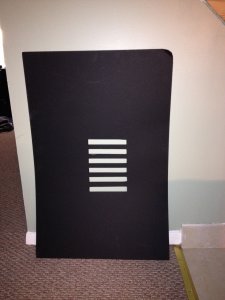
This is my homemade “windowblinds” gobo. It’s probably a bit larger (about 20×30) than it needs to be, but this helps ensure that it blocks out any unwanted stray light. You want to use flat black oak tag or mat board, as the black minimizes any reflecting light. Using a lighter colored material would reflect light that may not be wanted in the image.
Gobos can be purchased, but often times, the available patterns may not fit your need. In addition, they are relatively easy to make yourself and thus customize as needed.
Simply go to the nearest arts and crafts store, choose a piece of black oak tag, and a razor blade or exacto knife, and cut the desired pattern out. The pattern doesn’t need to be too large, keep in mind how large the flash beam is going to be at the point that it hits the gobo.
You may need to experiment a bit with the size and distance before getting the desired effect.
I will place the flash on a light stand, and then simply use a second light stand and use an A-clamp or two to hold the gobo in place. This way I can experiment easily with how far the gobo should be from the flash, and how far from the subject or background. A magic arm attached the light stand holding the flash will also work for holding the gobo.
For the accompanying photos, I wanted to create a night time mood, light projecting through the window blinds onto the wall from a street lamp. So I simply took the piece of black oak tag and cut a series of rectangles in it. When projecting flash through it, it resembles light shining through window blinds.
There are myriad other patterns that could be used to create various moods and effects. Play around and see what you come up with!

You can also use the gobo to modify light projected onto your main subject. In this instance, it creates an air of mystery about the subject.
Post originally from: Digital Photography Tips.
Check out our more Photography Tips at Photography Tips for Beginners, Portrait Photography Tips and Wedding Photography Tips.
Using Gobos To Create Dramatic Lighting

Sony has announced the Cyber-shot DSC-WX300, DSC-HX300 and DSC-TX30 compact cameras in the US market. The HX300 is a 20MP 50x superzoom with a 24-1200mm equiv. lens. Meanwhile the WX300 is an 18MP Wi-Fi compact superzoom with a 25-500mm equiv. lens. The tough, waterproof, card-style TX30 offers a 26-130mm equiv zoom. The WX300 will cost around $ 330, while the HX300 and TX30 will have retail prices of $ 500 and $ 350 respectively.
News: Digital Photography Review (dpreview.com)

Sony US has announced the Zeiss-branded Planar T* 50mm F1.4 ZA SSM and 70-400mm F4-5.6 G SSM II A-mount lenses, alongside a redesigned DT 18-55mm F3.5-5.6 SAM II entry-level kit zoom. Both have already been announced in Europe. The lenses will ship from May 2013 at retail prices of around $ 1500, $ 2200 and $ 220 respectively.
News: Digital Photography Review (dpreview.com)

Sony US has announced the Alpha SLT-A58 and NEX 3N cameras, five days after they were announced in Europe. The A58 replaces both the A37 and A57, helping to simplify the company’s lineup. Meanwhile, the NEX-3N gains a compact-camera-style zoom lever and a smaller body than its predecessor, the F3. Both gain a lock-on focus mode and Auto Object Framing mode. The SLT-A58 will cost around $ 600 as a kit with the 18-55mm zoom, while the NEX-3N comes with a 16-50mm power zoom lens for around $ 500.
News: Digital Photography Review (dpreview.com)

Just Posted: Sony NEX-3N hands-on preview with real world samples. We’ve had a chance to use and shoot with a NEX-3N and, now that Sony US has announced the camera, we can publish our look at the latest model. The 3N is the fourth entry-level NEX camera and the smallest so far. Despite this, it includes most of the features of its predecessors. We look at what has been added and what it lacks, compared to last year’s NEX-F3.
News: Digital Photography Review (dpreview.com)
 Extra photos for bloggers: 1, 2, 3 |
You, your smartphone and your DSLR are about to become the very best of friends. Like one teeny tiny gang.
It’s all thanks to the Look Lock,
an adjustable arm that mounts to your camera’s hot shoe and grabs onto your phone with a strong clamp.
When your camera and phone join forces you can really grab your subject’s attention, make a video of your photoshoot, or even set up a teleprompter.
Who needs an assistant when these pals have got your back?
Check out the Look Lock
$ 75 at the Photojojo Store
|
%20http%3A%2F%2Fphotojojo.com%2Fstore%2Fawesomeness%2Flook-lock%2F”> |
%20http%3A%2F%2Fphotojojo.com%2Fstore%2Fawesomeness%2Flook-lock%2F”>Tweet it! |

|
Share |
Related posts:
Over the last few weeks we’ve run a competition to give away $ 1000 worth of lenses and personal mentoring with Gina Milicia – author of our Portraits: Making the Shot eBook.
Over the weekend this competition ended and we’ve now drawn and notified the winner!
The winner is….
Lizabeth Simonton.
Congratulations to Lizabeth – we’ve just sent you an email with details of how to get your prize! Thanks to everyone else who picked up a copy of our Portraits eBook. We trust you’re enjoying it and seeing an improvement in your Portraits.
Post originally from: Digital Photography Tips.
Check out our more Photography Tips at Photography Tips for Beginners, Portrait Photography Tips and Wedding Photography Tips.
The Winner of $ 1000 in Lenses and Personal Mentoring is…
„Sie mussten erkennen, dass die Werte der Welt, in der wir leben, und die Menschen, mit denen wir uns umgeben, entscheidende Auswirkungen darauf haben, wer wir sind.“ – Malcom Gladwell
Eine sehr populäre Theorie unter Fotografierenden ist, dass das zentrale Element, um das sich alles dreht, gänzlich eigene Ideen sind. Ich möchte diese Theorie in Frage stellen. Und zu Beginn sei mir ein persönlicher Einstieg erlaubt.
Ich habe jahrelang versucht, eigene Ideen zu entwickeln. Mein Ding zu machen mit der Fotografie. Bilder zu gestalten, auf die noch niemand vor mir gekommen ist. Und es fühlte sich so an: Puh, naja. Zwar hatte ich ein paar Ideen, aber mit ein bisschen Recherche wurde mir schnell klar: Martin, da war schon jemand vor Dir schlau. Na toll.
Immer wieder dachte ich daran, wie schön es doch wäre, einen Fotostil zu entwickeln, der noch nie in dieser Form dagewesen war. Etwas zu erschaffen, was keiner vorher je gedacht und auf diese Weise umgesetzt hatte.
Jedoch wurde ich immer und immer wieder enttäuscht. Denn ich merkte, dass ich nichts schaffen konnte, was nur aus mir selbst heraus entstehen konnte. Ein wenig gefrustet, ließ ich nach einer Weile die Idee vom Streben nach dem Unikum eine Weile liegen. Das wiederum fühlte sich ganz gut an.
~
Doch lassen wir mal die lieben Gefühle beiseite. Heute glaube ich nicht mehr an das Geschichtchen mit der ganz eigenen Idee. Ich halte das Bemühen darum – zumindest für mich selbst – für Zeitverschwendung. Warum?
Weil wir keine unbeeinflussbaren Individuen sind. Und das, obwohl wir in einer Gesellschaft leben, die das Individuum und seine Genialität schier vergöttert.
Wir lieben es, wenn Daniel Craig, Urma Thurman oder Bruce Willis (für die Braveheart-Freunde: Mel Gibson) gegen die Bösen kämpfen. Sie sind die Helden, ganz allein. Sie schaffen es, ganze Armeen mit ihrem Einfallsreichtum, ihrer Disziplin und ihren heldenhaften Überzeugungen in Bann zu ziehen.
Was hat das mit der Fotografie zu tun? An dieser Stelle möchte ich gern eine Ebene tiefer gehen und einen kleinen Sprung in die Philosophie wagen. Der aus aus Slowenien stammende Slavoj Žižek nennt Kino „ein pädagogisches Institut“. Wenn wir eine Gesellschaft verstehen wollen, „müssen Sie nur ihre Filme ansehen.“ Es zeige ihre Struktur in Reinform.
Diese Struktur umgibt auch uns, die der Fotografie anhängig geworden sind. Sie beeinflusst unsere Wünsche, unseren Willen und die Art und Weise, wie wir an Dinge herangehen.
Das geheimnisvolle Genie
Ein weiterer Mythos, der dem Ganzen zugrunde liegt, ist die Redewendung „vom Tellerwäscher zum Millionär“, die wir aus dem Amerikanischen importiert haben. Dahinter steckt, wie jeder weiß, die Idealvorstellung, dass es jeder Arme schaffen kann, reich zu werden – und die Medien sind voll von überbordenden Heldentaten. Und auch hier lohnt ein Blick hinter Kinokulissen und Metaphern, mit denen nicht gespielt wird.
Einer (meistens ist es ein Mann) ist glorreicher als alle anderen. Er schafft das Undenk-, das Unfassbare. Gepriesen seist Du, einzelner Mann, der Du es schafftest, was keiner auch nur zu denken wagte!
Zurück auf den Boden der Tatsachen. Von solchen Ideologien umgeben sind auch wir, die Fotografen, die wir uns nicht selten auch als Künstler identifizieren. Die Fotografie als solche hat auch diesen Zweig, diesen Strang um das geheimnisvolle Genie. Und wer will nicht ein Genie sein?
Groß, bekannt, ein Star werden. Und: Mit unserer ganz eignen Idee. Mit unserem Stil. Wir, die Helden. Applaus, Applaus. Gepriesen.. ach, lassen wir das.
Zwar würde ich nicht mit den Rekreationisten sagen, dass alles ein Remix oder – das langsam einstaubte Wort – ein Mashup ist. Ich glaube nicht, wie Austin Kleon in „Steal like an Artist“ konstatiert, dass wir „nur die Summe unserer Einflüsse“, der „Remix unserer Mütter und Väter“ wären. Im Gegenteil, ich glaube, dass Kreativität das ist, was wir aus unseren Einflüssen machen.
Aber zu glauben, dass wir aus uns heraus die allergeilsten Fotos der Welt machen werden, ist Irrsinn. Uns theoretisch von unseren Einflüssen loszusagen, wirkt kontrakorrektiv, denn in diesen leben wir und können nicht ohne sie.
Vom Vor- und Sehnsuchtsbild
Der Idee des ganz und gar Eigenen liegt auch zugrunde, dass der oder die Agierende einerseits etwas schafft, was vorher nie in dieser Form dagewesen war, andererseits aber (und vor allem) keinerlei Ähnlichkeit mit Werken anderer aufweist.
Hierzu ZEIT-Redakteur Hanno Rauterberg in seinem Artikel „Schöner Klauen“:
Das ganze System der ästhetischen Produktion, das System der Kunsthochschulen, des Kunstmarkts, der Kunstmuseen, basiert auf der Vorstellung, dass Künstler etwas zu bieten haben, was andere nicht bieten.
Dass die Künstler also doch etwas Besonderes sind, eigensinnig, eigenständig, originell. Diese Vorstellung entwickelte sich im ausgehenden 18. Jahrhundert auch aus einem antiaristokratischen Impuls heraus.
Der Adel war durch seine Abkunft legitimiert, die Künstler hingegen setzten sich über alle Traditionen hinweg, wollten Abgrenzung, nicht Nachfolge. Sie waren ihre eigenen Urheber, selbstbestimmt, aus sich selbst schöpfend. Als solche, als autonome Subjekte, konnten sie zum Vor- und Sehnsuchtsbild der Bürger avancieren.
Sie waren ihre eigenen Urheber, selbstbestimmt, aus sich selbst schöpfend. Klingt eigentlich gut. Leider zu gut, oder gar: falsch.
Evelyin Finger zitiert in ihrem Artikel Wie genial muss es denn sein? den Historiker Dirk van Laak: „Es gebe, sagt Dirk van Laak, in der modernen Gesellschaft ein irres Bedürfnis, überrascht zu werden. Dahinter würden sich Abgeklärtheit und Abgestumpftheit verbergen.“
Diesem Bedürfnis begegnen wir in Kommentarform regelmäßig. Wo? Hier, in diesem Magazin. Es ist keine Seltenheit, dass Kommentatoren enttäuscht um ihre verlorene Zeit leicht beleidigt der Redaktion vorwerfen, das hiesig gezeigte wäre nun „auch keine Neuheit“ mehr. Und wäre deshalb besser in der Tonne gelandet.
Schnarchopoparch! Gar keine noch nie dargebotene Bruce-Willis-Action! Ich will sofort mein Geld zurück!
Der Beginn
Jedoch schauen wir alle auch Fotos von anderen an und bauen auf dem auf, was Fotografen vor uns geleistet haben. Fotografen, die uns mit ihren Bildern inspirieren. Dazu bewegen, mal etwas Ähnliches zu probieren.
Das geht – zu Ende gedacht – soweit zurück bis zum Beginn, als wir unser erstes Foto machten.
Irgendetwas bewegt uns dazu, ein Bild zu machen. Vielleicht, weil es eine Familientradition ist und schon unsere Eltern fotografierten. Oder weil unsere Eltern dem Musischen nahe waren. Vielleicht auch, weil wir an der Wand der Freundin so tolle Abzüge sahen und dachten: Das will ich auch. (Das sind Beispiele, die es in eintausend Abwandlungen gibt, bitte keine wörtliche Auslegung.)
Und dann beginnen wir, zu fotografieren.
Und mit der Fotografiererei werden wir ganz – unerwartet – sensibel und empfänglich für die Werke anderer Fotografen. Schauen uns deren Bilder an, lassen uns davon inspirieren und versuchen, den Look, das Gefühl oder etwas anderes von dem, was wir da sehen, irgendwie auch in unseren Fotos zu finden.
Und merken: Wir sind umgeben von Inspirationen. Wir wollen und wir können uns davon nicht trennen.
Albert Einstein soll einmal gesagt haben: Das Geheimnis der Kreativität ist es, seine Quellen verstecken zu wissen. Womit Herr Einstein auch unterstreicht, dass jeder seine Quellen hat. Doch die wenigsten können oder wollen das zugeben. Sie sehen sich lieber im Lichte der eignen Genialität.
Jedoch: Niemand ist eine Insel.
Und selbst, wenn wir eines tun, was so ganz eigen erscheint, wenn wir von vielen Fotografen Vorgemachtes umkehren, es brechen, es umdrehen, verkrümmen oder in andere Kontexte setzen: Wir beziehen uns damit dennoch ständig auf sie.
Diametrale Inspiration
Der Familientherapeut Hellinger (er ist nicht zu Unrecht umstritten) sagte einmal „Hass bindet auch“ und erklärte an anderer Stelle, dass wir gerade dann, wenn wir sagen, wir wollten nicht so werden wie unsere Eltern, so werden wie sie. Und dass dieser Drang des „Andersseins“ immer wieder auf sie zurückführt.
Natürlich hassen wir nicht die Fotos anderer (obwohl…). Doch selbst oder insbesondere eine Abneigung gegen einen bestimmten Stil hat eine Zuneigung zu einem anderen Stil zur Folge und ist somit inspiriert von – ? Dem, was zu Beginn nicht gemocht wurde.
Zum Schluss übergebe ich das Wort nochmals an den oben zitierten Malcom Gladwell*:
Kein Eishockeystar, kein Bill Joy, kein Robert Oppenheimer und kein anderer Überflieger kann aus der Höhe seines Erfolges herabblicken und ehrlich von sich behaupten: „Das habe ich nur mir zu verdanken“.
Oberflächlich betrachtet scheinen Staranwälte, Mathematikgenies und Softwaremilliardäre einer anderen Welt anzugehören als wir. Doch das stimmt nicht. Sie sind das Produkt ihrer Geschichte, ihrer Gesellschaft sowie der Chancen, die sie hatten und der kulturellen Traditionen, die sie geerbt haben.
Ihr Erfolg hat nichts Übermenschliches oder Geheimnisvolles an sich. Er ist das Ergebnis von bestimmten Vorteilen und ererbten Traditionen, er ist zu einem Teil verdient, zu einem anderen nicht, einiges haben sie sich selbst erworben, anderes ist ihnen in den Schoß gefallen – doch all das hat entschieden dazu beigetragen, sie zu dem zu machen, was sie sind.
Die Überflieger sind am Ende eben alles andere als Überflieger.
Übrigens: Dieser Artikel wurde inspiriert von der Beschäftigung mit systemischer Familientherapie, Emergenter Theologie, einem Artikel, den ich vor einem halben Jahr gelesen und den Link (dummerweise) nicht gespeichert habe, meinem Freund Daniel Ehniss und vielen kleinen Dingen, die mich zum Nachdenken gebracht haben.
* Das ist ein Affiliate-Link zu Amazon. Wenn Ihr darüber etwas kauft, erhalten wir eine kleine Provision, Ihr zahlt aber keinen Cent mehr.
kwerfeldein – Fotografie Magazin
[ By WebUrbanist in Architecture & Public & Institutional. ]

The Guggenheim Museum in New York may be the most iconic work of American architect Frank Lloyd Wright – as such, any addition to it will invariably be the center of much debate … but this one (despite being more concept than call for change) could stir more discussion than most.

A typical disjunctive approach to adding to or around classic architecture would involve setting the new elements apart from the old, to make the distinction clear. This conjunctive one by OIIO Architecture embraces the existing form, and builds dramatically upon it.

The design involves tripling the existing floor space by winding the outward-wrapping spiral that forms of gallery core up even higher and wider. The existing roof would be removed and re-added to the new top.
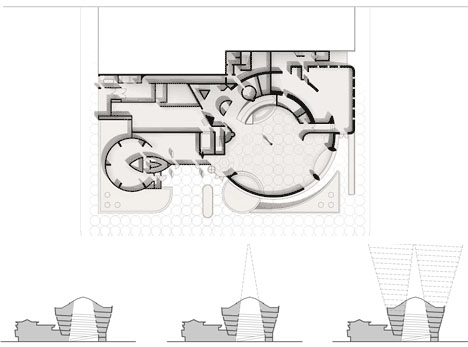
Critics will be quick to point out that though the form is maintained, the proportions are thrown for a loop, so to speak – and tapers the inner cone down to a small point. For all kinds of reasons, it is unlikely such a proposal would ever make its way into reality – still, as an experiment, it is quite beautiful.


[ WebUrbanist | Archives | Galleries | Privacy | TOS ]

 |
 |

You must be logged in to post a comment.