Ein Beitrag von: Andrea Peipe

kwerfeldein – Fotografie Magazin
After a long day of shooting, here in my hotel room I run through 5 tips that will help things go smoothly on the big day. Not to be alarmist – but it is a tough gig if you want to do it properly, so think things through, plan, and give it your very best. In Australia I recommend Digital Camera Warehouse: goo.gl Outside Australia I recommend Adorama: goo.gl & Amazon: goo.gl ====== Sign up to our mailing list at www.thatnikonguy.com See all the latest photography news & reviews on my second channel here www.youtube.com Join in: www.facebook.com Twitter: twitter.com
Video Rating: 4 / 5

Early tech blog reports suggest HTC’s much-anticipated ‘M7’ smartphone could have a Foveon-like layered sensor. All the information appears to stem from a Pocket-lint report about the phone, expected to be revealed at press events to be held in New York City and London on February 19. The suggestion is that the M7 could have a multi-layer sensor, rather than a conventional 13MP chip with a Bayer filter pattern. Foveon itself once tried to develop a sensor for smartphones and other companies are working on similar concepts. However, we wonder if the story comes from a translation error of Sony’s ‘Stacked CMOS’ technology – which is used in a 13MP Exmor RS sensor.
News: Digital Photography Review (dpreview.com)
In attempts to provide the much sought after R35 GTR with significant power gains, Greddy has put together an off the shelf twin turbo kit that enables SP Engineering to build a 9 second daily driven GTR without sacrificing the comfort of removing the interior, etc. SP Engineering was able to produce a whopping 9.62 second 1/4 mile slip at 149mph using this setup including the Type29 R-Spec XL intercooler. Another client of SP Engineering, Hing Yim, was also able to pull a 9.84 quarter mile pass. This kit provides the tuner with all the essential hardware to get their GTR up to 800+ power gains. Fuel management is not included in the kit. For more inquiries please contact any sales rep at Greddy or SP Engineering. All installation, and tuning for this video has been executed by SP Engineering techs. Please inquire with eugene@sp-power.com or turboalex@sp-power.com for any questions regarding such services. greddy.com sp-power.com
Video Rating: 4 / 5
Halo Combat Evolved Walkthrough: The Maw – Final Mission Part 24 of my Let’s Play series from Halo Combat Evolved So here we are the Final Mission. I will be uploading Part 25 today at 5pm GMT and then the Final Run tomorrow so keep tabs with my Channel as theres going to be a lot of content coming your way. Do any of you big Halo fans get goosebumps when you watch the start of this mission with the approach to the Pillar of Autumn? The music is just too epic and for some reason I geek right out on this Mission. As this is the final Mission can we aim for 40 likes? Would be awesome if we could hit that target! Follow me on Twitter – www.twitter.com Playlist – www.youtube.com
Video Rating: 4 / 5
[ By WebUrbanist in Design & Furniture & Decor. ]

Clubs, axes and bats are anything but typical furniture, and may be off-putting to ordinary people visiting your house. Hence these hybrid designs, in which weapons are built right into nightstands, coat racks and coffee tables.

First, a classic: the James McAdam bat-and-shield bedside-table set that started out as a concept design, but through a cycle of positive viral feedback has not made it into production and is available for purchase.
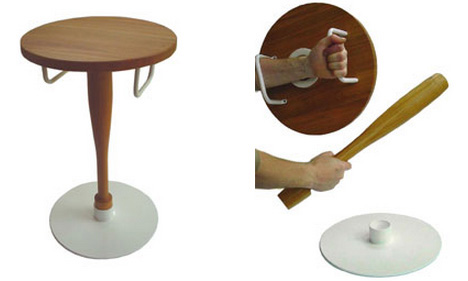
From its creator: “Here it is the [safest bedside table] you can buy. Made from Birch [plywood] Maple and Leather this table is priced at $ 245. It has been developed [since being] exhibited in the Museum of Modern Art NY and now being made in the UK for sale worldwide.”

Next, a spiked club from The Principals. “Crossing a classic piece of sports equipment with an everyday household piece of furniture, the Bat Rack uses iconographic items to create a unique piece that functions both passively and actively, to serve and protect.
“As a weapon of self defense and a place to hang your belongings, the Bat Rack can be installed on any wall by swinging, spike-end first, or used to stop any burglar in their tracks. Constructed from solid Carolinian maple and hand-turned stainless steel, the Bat Rack is inspired by the supple curves of Danish mid-century masters and the crack of a bat heard from neighborhood sandlots.”

Finally, from designer Chris Duffy, the less-practical but quite-beautiful axe table. “Walnut veneer or light Oak veneer from Stewardship Council managed forests and other controlled sources, the solid hickory axe handles are specially imported from the USA. Resin composite axe heads.”

From the moment guests arrive at your doorstep, they’ll know just how geeky you are with these 12 fun computer-inspired home decor designs.
Click Here to Read More »»

The Matroshka all-in-one, space-saving furniture set starts out as a compact cube and unpacks into an entire room of furniture, including a bed and dining table.
Click Here to Read More »»


[ By WebUrbanist in Design & Furniture & Decor. ]
[ WebUrbanist | Archives | Galleries | Privacy | TOS ]
A few nice visual art images I found:
VSP Visual Street Performance 2007 @ Fabrica Braco de Prata, Lisbon, Portugal

Image by Graffiti Land
for my current project watch in 1080p please!
Hey everyone, this is a Nikon D300s video review. This video is available in HD. Please come to my channel and check out my other camera reviews ! Thanks for watching and please subscribe !
Video Rating: 0 / 5
This is the first in a series of articles by Andrew S Gibson, the author of Understanding EOS: A Beginner’s Guide to Canon EOS cameras.
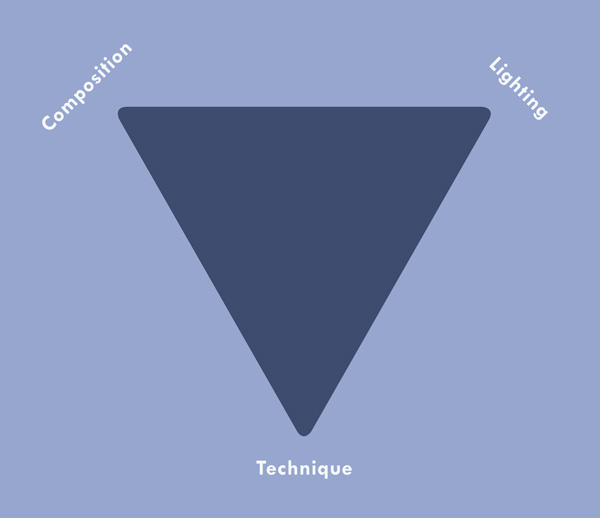
The ‘creative triangle’ is my term for the idea that great photos are made from a combination of good composition, an understanding of beautiful lighting and the technical ability to control your camera.
You could even think of this as another version of the rule-of-thirds. A good photo is comprised of one-third the composition, one-third the lighting and one-third the technical ability of the photographer.
It’s not enough to learn what the various buttons, modes and functions on your camera do, important though that is. You also need to cultivate your eye for a good photo and an appreciation of the beauty of great lighting.
How can you do this? One way is to look at the work of your favourite photographers with a critical eye. It’s not enough just to say that you like particular photo. Go deeper. Why do you like it? What are the elements of composition and light that help make the photo? Why has the photographer chosen to use the camera settings that he has? What lens did he use? How can you apply these ideas to your own photos?
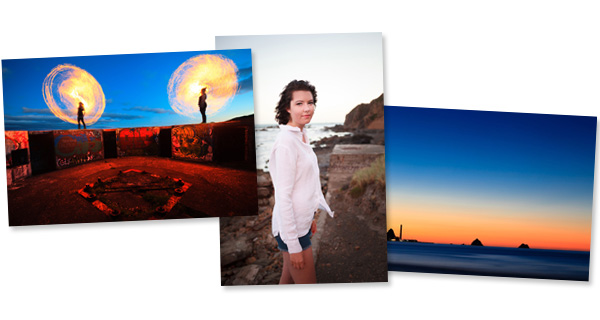
To help you out I’m going to take a deeper look at three of my own images:
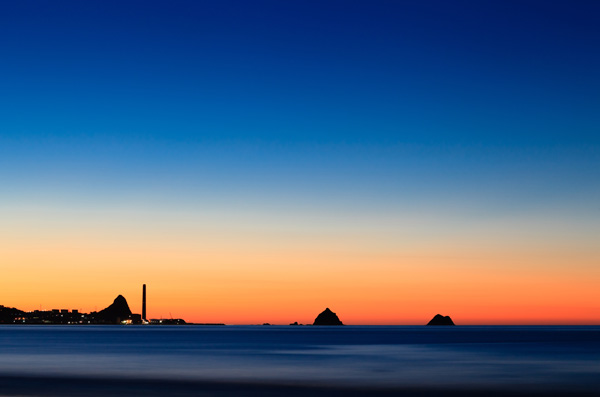
Camera: EOS 5D Mark II
Lens: Canon EF 85mm f1.8
Exposure: 219 seconds @ f11, ISO 200
Focal length. I was drawn to this scene by the silhouettes of the rock stacks and the chimney. I needed to use an 85mm lens to ensure that they were large enough to have impact. A wider focal length would have made the rocks and chimney too small.
Shutter speed. I used a shutter speed of 219 seconds. Mainly due to necessity – it was taken some time after sunset so light levels were low. I stopped down to f11 to ensure good depth-of-field and used a relatively low ISO for good image quality. The sea has recorded as a misty blur. This adds mood.
Light. I took the photo after the sun had set. If you try to take the photo with the sun above the horizon, the contrast is too high. It’s much easier to take photos after the sun has disappeared. The colours are often better and as the sky gets darker you may see some stars.
Colour contrast. The light from the sunset has split the image into three bands of colour. Blue and orange are contrasting colours and they give the photo impact. Colour temperature comes into play here. Blue light is cool, orange light is warm and the contrast between the two creates atmosphere.
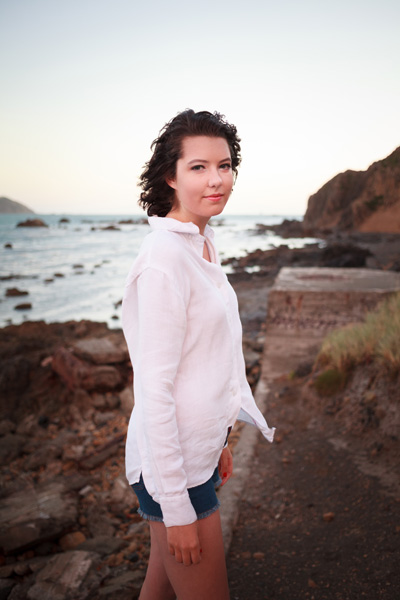
Camera: EOS 5D Mark II
Lens: Canon EF 40mm f2.8
Exposure: 1/180 second @ f2.8, ISO 800
Focal length. I took this photo with my 40mm pancake lens. This lens is a moderate wide-angle on a full-frame camera. I like to use it for portraits, as the perspective is wide enough to include the background without too much distortion.
Aperture. I set the aperture to f2.8 (the widest on this lens) to throw the background out of focus. This helps concentrate attention on the model. A sharp background competes with the model, which may be useful if you are trying to tell a story in the way that photojournalists do, but can be a distraction with photos like this.
Light. This photo was taken late in the evening. The shoot was delayed so were were out later than I had intended, but I was rewarded with beautiful light. The sun had disappeared beneath the horizon, but the light still had a red glow and a beautiful, soft quality ideal for portraits.
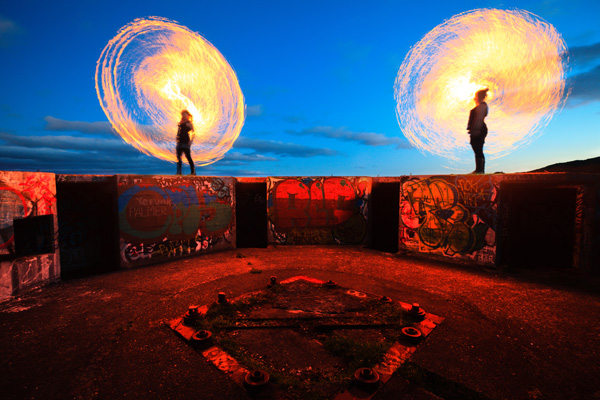
Camera: EOS 5D Mark II
Lens: Canon EF 17-40mm f4L lens @ 17mm
Exposure: 6 seconds @ f5.6, ISO 400
Focal length. This photo is different from the other two because it is taken with an ultra wide-angle focal length of 17mm (equivalent to around 11mm on an APS-C camera). There is a real sense of distance between the metal bars set into the concrete in the foreground and the performers standing on the wall.
Unusual subject: The two women in the photo are fire performers. They are spinning kevlar whips dipped in flammable fuel and set alight.
By the way, don’t try this at home. These women are trained fire performers and know how to handle these whips safely. If you want to try something similar, find someone who knows what they are doing to spin the whips.
Shutter speed: I used a slow shutter speed of six seconds so that the spinning whips created circles of fire.
Composition: I opted for a symmetrical composition. I like the way there are two circles of fire, one on either side of the frame. I could have moved closer to take the photo, but I preferred to stay back and include more of the setting.
Light. I shot this photo at dusk. Partly from necessity – it’s easier to see the flames when it’s dark. I also wanted some colour in the sky. I didn’t want it to be completely black.
Colour contrast. The cool colour of the blue sky contrasts with the orange flames and the red glow in the foreground. This is colour temperature in action again. The sky is lit by the fading daylight, which has a deep blue colour. The light from the flames is orange, like the light from a tungsten bulb.
When it comes to evaluating photos, camera settings (aperture, shutter speed, Picture Style, white balance etc) are only part of the story. A camera is just a lightproof box that records light. It has no heart or soul. That comes from the photographer and their understanding of light and composition. Hopefully the way that I’ve analysed my own images in this article will help you understand how deconstructing photos taken by other photographers can help you take better photos.
This article is the first in a series. The next one will take a close-up look at your camera’s Mode Dial. Why are there so many exposure modes and do we need them all? I don’t think so – and I’ll tell you why.

Andrew S Gibson is the author of Understanding EOS: A Beginner’s Guide to Canon EOS cameras. The creative triangle is one of many concepts discussed in the ebook.
Post originally from: Digital Photography Tips.
Check out our more Photography Tips at Photography Tips for Beginners, Portrait Photography Tips and Wedding Photography Tips.
Introducing the Creative Triangle
Nikon D800 sample time lapse photography in Dallas, Texas.
Video Rating: 0 / 5
www.theHOTSAUCEcommittee.net Band The Hot Sauce Committee Filming by KMA Management Edits and Color Corrections by: Wicked Mind Studios Filmed at Elbo Room in Chicago, IL. Nikon D5100 18-55mm f/3.5 Nikon DX VR AF-S Nikkor 30mm f/1.4 Nikon Zenitar-N2, 8/16 f/2.8 FISHEYE Edited in CyberLink Power Director
You must be logged in to post a comment.