RSS
 

Archive for December, 2012

Nikon Coolpix L110 26194 Coolpix Digital Camera

22 Dec

The Nikon Coolpix L110 26194 Coolpix Digital Camera has 15x Zoom and wide-angle capability bring special moments closer. With the Nikon Coolpix L110 26194 Coolpix Digital Camera The fun starts with the compositional freedom of a 15x zoom, NIKKOR lens with 28mm wide-angle to 420mm super-telephoto coverage1 and macro shooting capability. Designed to deliver advanced photographic performance through easy operation, the COOLPIX L110 will help you capture those special moments with quality and ease.
Video Rating: 4 / 5

 
Comments Off on Nikon Coolpix L110 26194 Coolpix Digital Camera

Posted in Nikon Videos


Carlson School of Management Flash Mob, Deck the Halls

22 Dec

The Carlson School of Management received a surprise visit from a saxophonist…and nearly 300 of his friends from the University of Minnesota’s School of Music this November. “Deck the Halls” arr. Francisco J. Núñez and Jim Papoulis from “Coolside of Yuletide” Special Thanks To: Greg Wrenn (saxophone), Campus Singers Maroon, Gold, and Mosaic; Men’s Chorus, Women’s Chorus, University Singers, Kathy S. Romey (coordinator), Judy Sagen and Kelley Sundin (choreography), Phillip O’Toole (audio), Boosey & Hawkes, Northern Lights Video, Michael Teachout, Bryan Koop (director of photography), Steve Rudolph (producer) For more information on the Carlson School of Management visit www.CarlsonSchool.umn.edu
Video Rating: 4 / 5


Mates of State – Maracas – HearYa Live Session

22 Dec

Mates of State performs “Maracas”live in-studio for HearYa.com on 10/1/11. The session was recorded in downtown Chicago at Shirk Music + Sound and sponsored by BEER NUTS Brand Snacks. Download mp3’s from the session for free here: www.hearya.com Hear more live sessions at www.HearYa.com Eat sweet and salty nuts at http Record your music at www.ShirkMusic.com Shoot your video with www.ChrisHershman.com Camera Ops Chris Hershman, Nathan Saks, Ryan Luciani Video Editor: Stephen Shirk Audio Producer/Engineer: Stephen Shirk
Video Rating: 5 / 5

Highlight Reel – Photography by Chris Amos Includes the best photos and appropriate video clips from 2010. Enjoy 🙂


Wildlife Photography

22 Dec

Examples of wildlife photography – mainly birds – with details of camera and lens settings for each image. There is no sound with this video.
Video Rating: 0 / 5

 
Comments Off on Wildlife Photography

Posted in Nikon Videos


Episode 448 – 12-01-2005

22 Dec

Nil
Video Rating: 0 / 5

 
Comments Off on Episode 448 – 12-01-2005

Posted in Photography Videos


Nice Visual Art photos

22 Dec

Check out these visual art images:

“Haragizkoa” el 5 de maig a Barcelona.
visual art
Image by Joseba Barrenetxea Altuna
vimeo.com/29266230
Espectacle que uneix paraula, música i imatge, basat en el llibre de poemes d’Omar Nabarro

· Edorta Jimenez (veu)
· Rafa Rueda & Jaime Nieto (música)
· Joseba Barrenetxea (imatge)

Bartzelonako Euskal Etxea
Arc de Sant Vicenç
08003 Barcelona
www.euskaletxea.cat
Telèfon.- 93.310.22.00

Anticipada 3€ (socis gratuït), taquilla 5€ (socis 3€)

Nou textos on la paraula escrita mostra la seva llengua i on el so complementa les imatges de cada lletra i les seves pròpies. Haragizkoa és un dels projectes més suggeridors de l’any, un treball simbiòtic replet d’emocions, sentiments i mirades cap a un costat i un altre de la vida.

Arkibea: caixa de fusta per a sèpies, fonamentalment, dotada de diversos orificis, que es deixa en l’aigua del mar per mantenir vives a les preses. (Bizkaiko Arrantzaleen Hiztegia; Eneko Barrutia).

L’expressió Haragizkoa, que es podria traduir en català com “en viu”, tant com a “carnal”, resumeix el contingut de l’espectacle al que dóna títol. Sobre l’escenari, en viu, estan els músics Rafa Rueda i Jaime Nieto, al costat de l’escriptor Edorta Jiménez que presenta en carn i os al seu heterònim Omar Nabarro. Al fons de l’escenari, sobre una pantalla, es projecten les imatges creades per Joseba Barrenetxea, donant alè visual a una trobada de dos mons: el musical de Rafa Rueda i el poètic d’Omar Nabarro, heterònim, com ja s’ha dit, de Edorta Jiménez.

Rafa Rueda i Edorta Jiménez ens van deixar en la memòria una sèrie de concerts en homenatge al poeta Lauaxeta, treball que quedo reflectit en el disc CD Ehungarrenean hamaika. A partir d’aquell treball en comú els dos creadors han seguit col·laborant en diversos moments, fins a arribar a aquest espectacle, Haragizkoa, en el qual han tractat d’unir els seus mons per mitjà d’un mar de sensacions. En aquest mar la presència de Jaime Nieto aporta el color i el salitre del músic especialment sensible que és. Ells, al costat de Joseba Barrenetxea, han creat un espectacle global i autònom, nou, que va més enllà de la combinació de música i poemes ben cantats o recitats.

Sobre l’escenari no hi ha més element que una simple caixa, el arkibea dels pescadors tradicionals, com a metàfora d’aquest mar de sensacions en el qual es tracta de submergir a l’espectador. Una caixa en la caixa escènica que fa al seu torn de caixa de ressonàncies i de la qual Omar Nabarro va extraient parts de la seva pròpia biografia acompanyat de Edorta Jiménez. Així, el poeta llegeix textos dels seus primers llibres, si ben el pes fonamental recau sobre els poemes de "Haragizko amoreak" (Susa, 2010), que ha tingut un gran acolliment. Rafa Rueda ha convertit en cançons varis d’aquests poemes. A més d’aquestes, altres cançons del seu repertori i temes musicals diversos s’escolten en Haragizkoa. Sense artificis. Buscant el sentit profund del titulo Haragizkoa: espectadors de carn i os que sentin l’alè dels creadors també de carn i os a una distància gairebé imperceptible.

Literaldia 12 (L’Euskal Herria d’avui en la literatura)
www.haragizkoa.com

Trash Chaos Vessal –“What Lies Within” 03
visual art
Image by Urban Woodswalker
This series of art is a commentary about society: our over stimulating culture, bombardment of visual "noise" and attention deficits, as well as being graphic, eye catching conversation pieces made from trash usually thrown out in the garbage.
"What Lies Within" measures 4.5" wide by 3 " wide, and 2.75" deep.

 
Comments Off on Nice Visual Art photos

Posted in Photographs


Nikon 55-200mm ƒ/4.0-5.6G AF-S ED-IF DX VR

22 Dec

Questions? Go here: www.youtube.com Hands-on review on Nikon 55-200mm ƒ/4.0-5.6G AF-S ED-IF DX VR. Autofocus available on all DSLRs.
Video Rating: 0 / 5

 
Comments Off on Nikon 55-200mm ƒ/4.0-5.6G AF-S ED-IF DX VR

Posted in Nikon Videos


6 Tricks for Shooting Steady Shots Without a Tripod

22 Dec

Once upon a time, every photographer needed a tripod. Early cameras were too bulky and heavy to hold by hand. Later, it was absolutely essential to have a tripod in order to get a steady shot. Indeed, tripods can help achieve sharp, crisp shots with your DSLR camera. However, tripods aren’t without fault. They can be expensive. Tripods can also Continue Reading

The post 6 Tricks for Shooting Steady Shots Without a Tripod appeared first on Photodoto.


Photodoto

 
Comments Off on 6 Tricks for Shooting Steady Shots Without a Tripod

Posted in Photography


“what a wonderful world” Loius Armstrong, played on EWI USB

22 Dec

Hi, there. I played on EWI USB Clarinet sound B flat. I used vocal reducer and I shooting on Nikon D90 with EF50mm/f1.4. also I using DAW “mixcraft5”
Video Rating: 4 / 5

…in Hong Kong anyway. I’m sure it was just one stop of a world tour.


6 Tips for Near-Macro Photography with a Telephoto Lens

22 Dec

Macro photography is the art of capturing the fine detail of very small subjects that may not be able to be seen by the naked eye.  Technically, to fall under the term ‘macro’, the subject should be captured with a reproduction ratio of 1:1, i.e. the subject will be captured on the sensor at 100 % life size.

Macro lenses are specially designed to minimise the focussing distance, allowing the photographer to get closer to the subject and so increase the reproduction ratio.  There are a number of other techniques that can be used to help achieve the desired magnification without a dedicated lens (extension tubes, close-up filters, reversing rings), however, one of less often considered techniques is to use something that you probably already have in your kit bag: a telephoto lens.

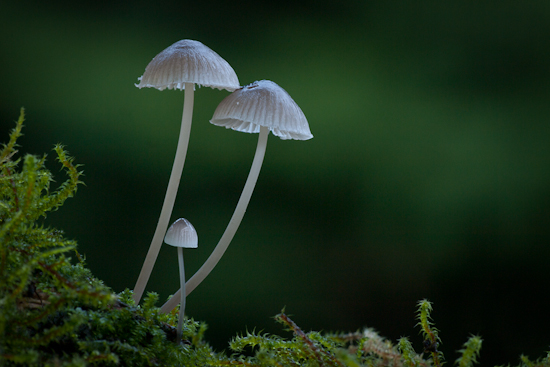
Milking Bonnet Fungi (Mycena galopus)

Milking Bonnet Fungi (Mycena galopus)

Telephoto lenses offer extreme magnification but generally have much larger minimum focussing distances pushing the photographer further from the subject and so reducing the reproduction ratio.  Some telephoto lenses, when combined with camera systems utilising smaller sensors, are able to offer 1:1 magnification (‘true macro’) however, typically, telephoto lenses are limited to close-up photography, at near-macro reproduction ratios.

Using a telephoto lens for this kind of work offers a couple of advantages over a dedicated macro lens that are a direct result of the large minimum focus distance.  Because the working distance to the subject is in the region of 1 metre (compared to 15 – 30 cm of standard macro lenses) the risk of disturbing your subject as you compose your shot is much reduced.  Also, given the extra distance between the camera and the subject, you are much less likely to cast a shadow over your subject and have a lot of freedom with the lighting you can employ to light the subject – both natural and flash.

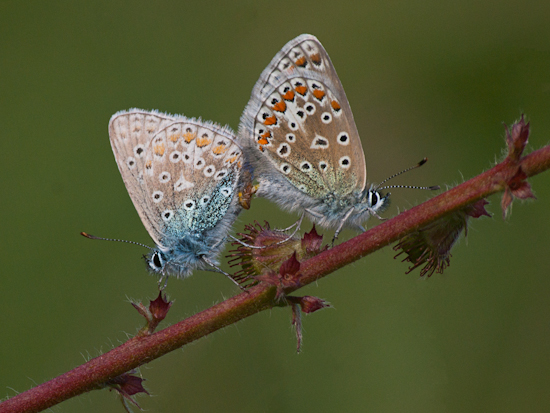
Common Blue butterflies, mating (Polyommatus icarus)

Common Blue butterflies, mating (Polyommatus icarus)

Using a telephoto lens for such precise work is not without challenge, so here are a few tips to help maximise your chances of getting that near-macro shot, with your telephoto lens:

  1. Due to the extreme focal length, the risk of reduced sharpness due to camera shake is higher.  Therefore, it is imperative to use a tripod and remote shutter release to try and limit lens/camera movement.
  2. Even on a tripod, images can still suffer from camera sake.  Try and use a tripod collar for your telephoto lens, so that the lens is clamped directly to the tripod, reducing the chances of ‘lens wobble’.  If not, use the ‘1/focal length’ shutter speed rule to help capture sharp images (I always use 1/effective focal length (i.e. multiply your focal length by sensor crop factor to give the focal length in 35 mm terms) when selecting a shutter speed to reduce movement).
  3. Be aware of the depth of field.  Using extreme focal lengths at such close distances can reduce the depth of field to fractions of a millimetre.  Therefore, to ensure the subject is sharp throughout, use a small enough aperture to ensure the depth of field extends across your whole subject (there are websites and apps to help you do this).
  4. Ensure your subject is parallel to the sensor.  If you want to capture your subject in focus from front to back, ensure that it is parallel to your sensor.  The depth of field will be so narrow at the extreme focal lengths that you may not have more than a few millimetres to play with.  Therefore, position yourself accordingly to maximise your chances of capturing a sharp image.
  5. Switch the lens to manual focus.  If your telephoto lens as an AF/MF switch, switch it to manual focus and compose/focus the shot manually.  You may find that when focussing manually, the minimum focussing distance decreases meaning that you can get closer to your subject, increasing the magnification.
  6. Use a teleconverter to increase the focal length, but retain same minimum focussing distance.  This will allow you to significantly increase the magnification of the subject, without having to move any further away.  Increasing the focal length in this way will have consequences on your choice of shutter speed and aperture, but as long as it is taken into consideration, a teleconverter can successfully be used to increase the reproduction ratio.
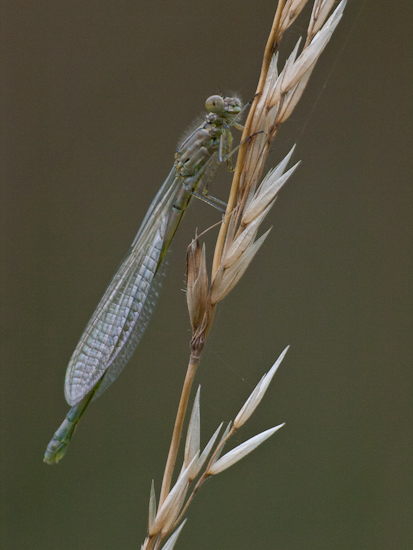
Common Blue Damselfly (Enallagma cyathigerum)

Common Blue Damselfly (Enallagma cyathigerum)

Using a telephoto lens for near-macro photography will typically not allow you to magnify your subject as far as if using a dedicated macro lens, but you will be able to test the water to see if macro photography is something you enjoy, without having to splash out on any additional kit.  If you do decide that macro photography is for you, by putting this technique to practise you will learn a lot of good field craft that will be of benefit when you get around to picking up that new macro lens.

Post originally from: Digital Photography Tips.

Check out our more Photography Tips at Photography Tips for Beginners, Portrait Photography Tips and Wedding Photography Tips.

6 Tips for Near-Macro Photography with a Telephoto Lens


Digital Photography School

 
Comments Off on 6 Tips for Near-Macro Photography with a Telephoto Lens

Posted in Photography