RSS
 

Archive for August, 2012

Acorn to Oak filmed over an 8 month period time-lapse

21 Aug

Acorn to Oak seedling filmed over a period of 8 months. Filmed by Neil Bromhall for www.rightplants4me.co.uk The acorn was collected in September and filmed in an underground set using a 2 hour interval between exposures. The acorn split soon after it was planted and continued to split during the winter months. In January the first sign of root growing could be seen followed in February by the emergence of shoot. In March the shoot broke through the soil surface. The leaves formed between March and April. This is an example of hypogeal germination. Filmed on Nikon D300. 55mm macro nikkor lens and studio flash with growlight for top shot. This sequence accompanies my interactive plant identification website www.rightplants4me.co.uk Music ‘Pendulum’ by Oliver Ledbury
Video Rating: 4 / 5

This video Features the 1st place winners of all the pullup contests this summer… but it’s not about that alone. Shout out to the entire Bar/Calisthenics Community. We have definitely “Raised the Bar” to say the least. But this is the time to take it to the next level. This is our time!


Sony NEX-VG10E Handycam Interchangeable Lens Digital HD Camcorder Unboxing & Review

21 Aug

Sony’s NEX-VG10 provides the options previously reserved for professional videographers to consumers. It is equipped with the same ExmorTM APS HD CMOS sensor used in Sony’s “NEX-5” and “NEX-3” digital cameras which is approximately 19.5 times bigger than what you would find in conventional camcorders. It has a powerful BIONZTM processor allowing photographers the ability to capture full 1920×1080/60i high definition video at up to 24Mbps for true cinematic Blu-ray quality. And most of you must ask that how much does it cost? I bought the Cam itself 00, the Video Light 0 & I also got a 16GB Memory Stick Pro Duo Mark 2 for 0 that records for 2 hours. Here’s the link of the Official video of the NEX-VG10 by Sony www.youtube.com
Video Rating: 4 / 5


Windows 7 – View or Print out a System Summary

21 Aug

View and print Windows 7 system and performance information, useful to compare computers or to provide to techies if you are having problems.

Windows 7 users – are you comparing computers at a local store and want to ensure a PC has everything the vendor claims? Or for your own machine do you need a list of programs that run at startup, a list of running tasks, data on devices that Windows cannot recognize, or the amount of video adapter available RAM? Or are you having computer difficulties and need to print out a list of system information to provide to a technician?

There are a couple of ways to view and optionally print system information, depending on how much detail you or a technician need….

Read more at MalekTips.
New Computer and Technology Help and Tips – MalekTips.Com

 
Comments Off on Windows 7 – View or Print out a System Summary

Posted in Technology


Hipstamatic moving ‘full force ahead’ despite major layoffs

19 Aug

hipstamatic_icon.png

Hipstamatic denies that the layoffs of five employees signifies the death knell for the longtime mobile photography favorite. Yesterday the Hipstamatic team was reduced from a team of 11 to a mere six employees through a restructuring effort and questions quickly arose about the future of the app known for its toy camera capabilities. ‘We’re still moving full force ahead — the original team that built Hipstamatic is still here, and remains deeply committed to continuing to make great products that inspire our community and the world,’ said Molli Sullivan, Hipstamatic’s director of communications.

News: Digital Photography Review (dpreview.com)

 
Comments Off on Hipstamatic moving ‘full force ahead’ despite major layoffs

Posted in Uncategorized


#6 How to make a 3D computer game [level design]

19 Aug

In this part, we’re taking our first steps into level design by importing models into the Unity 3d engine. To download these models for FREE, click here: gameprefabs.com ALL I ASK IN RETURN… is if you can make a quick capture of your level and post it as a video-reply. I’d LOVE to see what you can come up with!! It makes creating these videos much more fun! -TornadoTwins
Video Rating: 4 / 5

40th anniversary of the moon mission


Lady Gaga In Red

19 Aug

Some cool visual art images:

Lady Gaga In Red
visual art
Image by qthomasbower
A mosaic portrait of Lady Gaga from her "Marry the Night" video. This highly processed image is the second in my new series of Percolated Tiles mosaics.

You can view the Marry the Night video here:

www.youtube.com/watch?v=cggNqDAtJYU

I have posted the official Lady Gaga "Marry the Night" Video Mosaic!

Lady Gaga Marry the Night

I hope you enjoy it!

Army Photography Contest – 2007 – FMWRC – Arts and Crafts – Fallin’ Comrades
visual art
Image by familymwr
Army Photography Contest – 2007 – FMWRC – Arts and Crafts – Fallin’ Comrades

Photo By: SGT Jess Williams

To learn more about the annual U.S. Army Photography Competition, visit us online at www.armymwr.com

U.S. Army Arts and Crafts History
After World War I the reductions to the Army left the United States with a small force. The War Department faced monumental challenges in preparing for World War II. One of those challenges was soldier morale. Recreational activities for off duty time would be important. The arts and crafts program informally evolved to augment the needs of the War Department.
On January 9, 1941, the Secretary of War, Henry L. Stimson, appointed Frederick H. Osborn, a prominent U.S. businessman and philanthropist, Chairman of the War Department Committee on Education, Recreation and Community Service.
In 1940 and 1941, the United States involvement in World War II was more of sympathy and anticipation than of action. However, many different types of institutions were looking for ways to help the war effort. The Museum of Modern Art in New York was one of these institutions. In April, 1941, the Museum announced a poster competition, “Posters for National Defense.” The directors stated “The Museum feels that in a time of national emergency the artists of a country are as important an asset as men skilled in other fields, and that the nation’s first-rate talent should be utilized by the government for its official design work… Discussions have been held with officials of the Army and the Treasury who have expressed remarkable enthusiasm…”
In May 1941, the Museum exhibited “Britain at War”, a show selected by Sir Kenneth Clark, director of the National Gallery in London. The “Prize-Winning Defense Posters” were exhibited in July through September concurrently with “Britain at War.” The enormous overnight growth of the military force meant mobilization type construction at every camp. Construction was fast; facilities were not fancy; rather drab and depressing.
In 1941, the Fort Custer Army Illustrators, while on strenuous war games maneuvers in Tennessee, documented the exercise The Bulletin of the Museum of Modern Art, Vol. 9, No. 3 (Feb. 1942), described their work. “Results were astonishingly good; they showed serious devotion …to the purpose of depicting the Army scene with unvarnished realism and a remarkable ability to capture this scene from the soldier’s viewpoint. Civilian amateur and professional artists had been transformed into soldier-artists. Reality and straightforward documentation had supplanted (replaced) the old romantic glorification and false dramatization of war and the slick suavity (charm) of commercial drawing.”

“In August of last year, Fort Custer Army Illustrators held an exhibition, the first of its kind in the new Army, at the Camp Service Club. Soldiers who saw the exhibition, many of whom had never been inside an art gallery, enjoyed it thoroughly. Civilian visitors, too, came and admired. The work of the group showed them a new aspect of the Army; there were many phases of Army life they had never seen or heard of before. Newspapers made much of it and, most important, the Army approved. Army officials saw that it was not only authentic material, but that here was a source of enlivenment (vitalization) to the Army and a vivid medium for conveying the Army’s purposes and processes to civilians and soldiers.”
Brigadier General Frederick H. Osborn and War Department leaders were concerned because few soldiers were using the off duty recreation areas that were available. Army commanders recognized that efficiency is directly correlated with morale, and that morale is largely determined from the manner in which an individual spends his own free time. Army morale enhancement through positive off duty recreation programs is critical in combat staging areas.
To encourage soldier use of programs, the facilities drab and uninviting environment had to be improved. A program utilizing talented artists and craftsmen to decorate day rooms, mess halls, recreation halls and other places of general assembly was established by the Facilities Section of Special Services. The purpose was to provide an environment that would reflect the military tradition, accomplishments and the high standard of army life. The fact that this work was to be done by the men themselves had the added benefit of contributing to the esprit de corps (teamwork, or group spirit) of the unit.
The plan was first tested in October of 1941, at Camp Davis, North Carolina. A studio workshop was set up and a group of soldier artists were placed on special duty to design and decorate the facilities. Additionally, evening recreation art classes were scheduled three times a week. A second test was established at Fort Belvoir, Virginia a month later. The success of these programs lead to more installations requesting the program.
After Pearl Harbor was bombed, the Museum of Modern Art appointed Mr. James Soby, to the position of Director of the Armed Service Program on January 15, 1942. The subsequent program became a combination of occupational therapy, exhibitions and morale-sustaining activities.
Through the efforts of Mr. Soby, the museum program included; a display of Fort Custer Army Illustrators work from February through April 5, 1942. The museum also included the work of soldier-photographers in this exhibit. On May 6, 1942, Mr. Soby opened an art sale of works donated by museum members. The sale was to raise funds for the Soldier Art Program of Special Services Division. The bulk of these proceeds were to be used to provide facilities and materials for soldier artists in Army camps throughout the country.
Members of the Museum had responded with paintings, sculptures, watercolors, gouaches, drawings, etchings and lithographs. Hundreds of works were received, including oils by Winslow Homer, Orozco, John Kane, Speicher, Eilshemius, de Chirico; watercolors by Burchfield and Dufy; drawings by Augustus John, Forain and Berman, and prints by Cezanne, Lautrec, Matisse and Bellows. The War Department plan using soldier-artists to decorate and improve buildings and grounds worked. Many artists who had been drafted into the Army volunteered to paint murals in waiting rooms and clubs, to decorate dayrooms, and to landscape grounds. For each artist at work there were a thousand troops who watched. These bystanders clamored to participate, and classes in drawing, painting, sculpture and photography were offered. Larger working space and more instructors were required to meet the growing demand. Civilian art instructors and local communities helped to meet this cultural need, by providing volunteer instruction and facilities.
Some proceeds from the Modern Museum of Art sale were used to print 25,000 booklets called “Interior Design and Soldier Art.” The booklet showed examples of soldier-artist murals that decorated places of general assembly. It was a guide to organizing, planning and executing the soldier-artist program. The balance of the art sale proceeds were used to purchase the initial arts and crafts furnishings for 350 Army installations in the USA.
In November, 1942, General Somervell directed that a group of artists be selected and dispatched to active theaters to paint war scenes with the stipulation that soldier artists would not paint in lieu of military duties.
Aileen Osborn Webb, sister of Brigadier General Frederick H. Osborn, launched the American Crafts Council in 1943. She was an early champion of the Army program.
While soldiers were participating in fixed facilities in the USA, many troops were being shipped overseas to Europe and the Pacific (1942-1945). They had long periods of idleness and waiting in staging areas. At that time the wounded were lying in hospitals, both on land and in ships at sea. The War Department and Red Cross responded by purchasing kits of arts and crafts tools and supplies to distribute to “these restless personnel.” A variety of small “Handicraft Kits” were distributed free of charge. Leathercraft, celluloid etching, knotting and braiding, metal tooling, drawing and clay modeling are examples of the types of kits sent.
In January, 1944, the Interior Design Soldier Artist program was more appropriately named the “Arts and Crafts Section” of Special Services. The mission was “to fulfill the natural human desire to create, provide opportunities for self-expression, serve old skills and develop new ones, and assist the entire recreation program through construction work, publicity, and decoration.”
The National Army Art Contest was planned for the late fall of 1944. In June of 1945, the National Gallery of Art in Washington D.C., for the first time in its history opened its facilities for the exhibition of the soldier art and photography submitted to this contest. The “Infantry Journal, Inc.” printed a small paperback booklet containing 215 photographs of pictures exhibited in the National Gallery of Art.
In August of 1944, the Museum of Modern Art, Armed Forces Program, organized an art center for veterans. Abby Rockefeller, in particular, had a strong interest in this project. Soldiers were invited to sketch, paint, or model under the guidance of skilled artists and craftsmen. Victor d’Amico, who was in charge of the Museum’s Education Department, was quoted in Russell Lynes book, Good Old Modern: An Intimate Portrait of the Museum of Modern Art. “I asked one fellow why he had taken up art and he said, Well, I just came back from destroying everything. I made up my mind that if I ever got out of the Army and out of the war I was never going to destroy another thing in my life, and I decided that art was the thing that I would do.” Another man said to d’Amico, “Art is like a good night’s sleep. You come away refreshed and at peace.”
In late October, 1944, an Arts and Crafts Branch of Special Services Division, Headquarters, European Theater of Operations was established. A versatile program of handcrafts flourished among the Army occupation troops.
The increased interest in crafts, rather than fine arts, at this time lead to a new name for the program: The “Handicrafts Branch.”
In 1945, the War Department published a new manual, “Soldier Handicrafts”, to help implement this new emphasis. The manual contained instructions for setting up crafts facilities, selecting as well as improvising tools and equipment, and basic information on a variety of arts and crafts.
As the Army moved from a combat to a peacetime role, the majority of crafts shops in the United States were equipped with woodworking power machinery for construction of furnishings and objects for personal living. Based on this new trend, in 1946 the program was again renamed, this time as “Manual Arts.”
At the same time, overseas programs were now employing local artists and craftsmen to operate the crafts facilities and instruct in a variety of arts and crafts. These highly skilled, indigenous instructors helped to stimulate the soldiers’ interest in the respective native cultures and artifacts. Thousands of troops overseas were encouraged to record their experiences on film. These photographs provided an invaluable means of communication between troops and their families back home.
When the war ended, the Navy had a firm of architects and draftsmen on contract to design ships. Since there was no longer a need for more ships, they were given a new assignment: To develop a series of instructional guides for arts and crafts. These were called “Hobby Manuals.” The Army was impressed with the quality of the Navy manuals and had them reprinted and adopted for use by Army troops. By 1948, the arts and crafts practiced throughout the Army were so varied and diverse that the program was renamed “Hobby Shops.” The first “Interservice Photography Contest” was held in 1948. Each service is eligible to send two years of their winning entries forward for the bi-annual interservice contest. In 1949, the first All Army Crafts Contest was also held. Once again, it was clear that the program title, “Hobby Shops” was misleading and overlapped into other forms of recreation.
In January, 1951, the program was designated as “The Army Crafts Program.” The program was recognized as an essential Army recreation activity along with sports, libraries, service clubs, soldier shows and soldier music. In the official statement of mission, professional leadership was emphasized to insure a balanced, progressive schedule of arts and crafts would be conducted in well-equipped, attractive facilities on all Army installations.
The program was now defined in terms of a “Basic Seven Program” which included: drawing and painting; ceramics and sculpture; metal work; leathercrafts; model building; photography and woodworking. These programs were to be conducted regularly in facilities known as the “multiple-type crafts shop.” For functional reasons, these facilities were divided into three separate technical areas for woodworking, photography and the arts and crafts.
During the Korean Conflict, the Army Crafts program utilized the personnel and shops in Japan to train soldiers to instruct crafts in Korea.
The mid-1950s saw more soldiers with cars and the need to repair their vehicles was recognized at Fort Carson, Colorado, by the craft director. Soldiers familiar with crafts shops knew that they had tools and so automotive crafts were established. By 1958, the Engineers published an Official Design Guide on Crafts Shops and Auto Crafts Shops. In 1959, the first All Army Art Contest was held. Once more, the Army Crafts Program responded to the needs of soldiers.
In the 1960’s, the war in Vietnam was a new challenge for the Army Crafts Program. The program had three levels of support; fixed facilities, mobile trailers designed as portable photo labs, and once again a “Kit Program.” The kit program originated at Headquarters, Department of Army, and it proved to be very popular with soldiers.
Tom Turner, today a well-known studio potter, was a soldier at Ft. Jackson, South Carolina in the 1960s. In the December 1990 / January 1991 “American Crafts” magazine, Turner, who had been a graduate student in art school when he was drafted, said the program was “a godsend.”
The Army Artist Program was re-initiated in cooperation with the Office of Military History to document the war in Vietnam. Soldier-artists were identified and teams were formed to draw and paint the events of this combat. Exhibitions of these soldier-artist works were produced and toured throughout the USA.
In 1970, the original name of the program, “Arts and Crafts”, was restored. In 1971, the “Arts and Crafts/Skills Development Program” was established for budget presentations and construction projects.
After the Vietnam demobilization, a new emphasis was placed on service to families and children of soldiers. To meet this new challenge in an environment of funding constraints the arts and crafts program began charging fees for classes. More part-time personnel were used to teach formal classes. Additionally, a need for more technical-vocational skills training for military personnel was met by close coordination with Army Education Programs. Army arts and crafts directors worked with soldiers during “Project Transition” to develop soldier skills for new careers in the public sector.
The main challenge in the 1980s and 90s was, and is, to become “self-sustaining.” Directors have been forced to find more ways to generate increased revenue to help defray the loss of appropriated funds and to cover the non-appropriated funds expenses of the program. Programs have added and increased emphasis on services such as, picture framing, gallery sales, engraving and trophy sales, etc… New programs such as multi-media computer graphics appeal to customers of the 1990’s.
The Gulf War presented the Army with some familiar challenges such as personnel off duty time in staging areas. Department of Army volunteer civilian recreation specialists were sent to Saudi Arabia in January, 1991, to organize recreation programs. Arts and crafts supplies were sent to the theater. An Army Humor Cartoon Contest was conducted for the soldiers in the Gulf, and arts and crafts programs were set up to meet soldier interests.
The increased operations tempo of the ‘90’s Army has once again placed emphasis on meeting the “recreation needs of deployed soldiers.” Arts and crafts activities and a variety of programs are assets commanders must have to meet the deployment challenges of these very different scenarios.
The Army arts and crafts program, no matter what it has been titled, has made some unique contributions for the military and our society in general. Army arts and crafts does not fit the narrow definition of drawing and painting or making ceramics, but the much larger sense of arts and crafts. It is painting and drawing. It also encompasses:
* all forms of design. (fabric, clothes, household appliances, dishes, vases, houses, automobiles, landscapes, computers, copy machines, desks, industrial machines, weapon systems, air crafts, roads, etc…)
* applied technology (photography, graphics, woodworking, sculpture, metal smithing, weaving and textiles, sewing, advertising, enameling, stained glass, pottery, charts, graphs, visual aides and even formats for correspondence…)
* a way of making learning fun, practical and meaningful (through the process of designing and making an object the creator must decide which materials and techniques to use, thereby engaging in creative problem solving and discovery) skills taught have military applications.
* a way to acquire quality items and save money by doing-it-yourself (making furniture, gifts, repairing things …).
* a way to pursue college credit, through on post classes.
* a universal and non-verbal language (a picture is worth a thousand words).
* food for the human psyche, an element of morale that allows for individual expression (freedom).
* the celebration of human spirit and excellence (our highest form of public recognition is through a dedicated monument).
* physical and mental therapy (motor skill development, stress reduction, etc…).
* an activity that promotes self-reliance and self-esteem.
* the record of mankind, and in this case, of the Army.
What would the world be like today if this generally unknown program had not existed? To quantitatively state the overall impact of this program on the world is impossible. Millions of soldier citizens have been directly and indirectly exposed to arts and crafts because this program existed. One activity, photography can provide a clue to its impact. Soldiers encouraged to take pictures, beginning with WW II, have shared those images with family and friends. Classes in “How to Use a Camera” to “How to Develop Film and Print Pictures” were instrumental in soldiers seeing the results of using quality equipment. A good camera and lens could make a big difference in the quality of the print. They bought the top of the line equipment. When they were discharged from the Army or home on leave this new equipment was showed to the family and friends. Without this encouragement and exposure to photography many would not have recorded their personal experiences or known the difference quality equipment could make. Families and friends would not have had the opportunity to “see” the environment their soldier was living in without these photos. Germany, Italy, Korea, Japan, Panama, etc… were far away places that most had not visited.
As the twenty first century approaches, the predictions for an arts renaissance by Megatrends 2000 seem realistic based on the Army Arts and Crafts Program practical experience. In the April ‘95 issue of “American Demographics” magazine, an article titled “Generation X” fully supports that this is indeed the case today. Television and computers have greatly contributed to “Generation X” being more interested in the visual arts and crafts.
Connect with us:
www.Facebook.com/FamilyMWR
www.Twitter.com/FamilyMWR
www.YouTube.com/FamilyMWR

Dreaming of Dreaming #6
visual art
Image by chooyutshing
By Khalil Chisteen from Pakistan.. These sculptures are created by using plastic rubbish bag of figures display at the Esplanade Concourse.

 
Comments Off on Lady Gaga In Red

Posted in Photographs


How to make a 3D film strip in Photoshop – Week 69

19 Aug

Digital cameras may have changed the face of Photography forever, but film still has a place in a hearts. In this video Photoshop expert, Gavin Hoey www.gavtrain.com walks you through the steps you need to make a film strip from scratch and give it a 3D twist.
Video Rating: 4 / 5

Cartoon videos, show for children, puzzles and visual riddles to play with toodlers and kindergarten. Van Dogh is painting a bird when their friends come but the kids make a picture a little more complicated, it also bear on hen and chicks. Do you know what is it? Synopsis: Won, Pan and Kit, ride their tricycles through colorful, Spring-like paths, knowing they’ll find Van Dogh on their way. He shows them the magic in his brushstrokes, where shining stars mix his drawings and transform them into puzzles. Every day, the imagination of Yon, Pat and Kit, shall have to face the challenge of solving such these visual and colourful enigmas, while with his funny suggestions, Van Dogh fills their meetings with lots of laughter. Cartoon series that helps the development and stimulation of imagination and creativity of children through entertainment. Videos of games for children © Motion Pictures, SA Production – www.motionpic.com Format 104×4′ – 3D HDTV Target: Preschool More Van Dogh cartoon videos: www.youtube.com Subscribe to Channel: www.youtube.com Other cartoon videos: www.youtube.com Motion Pictures in social networks: Twitter – twitter.com Facebook – www.facebook.com Pinterest – pinterest.com
Video Rating: 5 / 5


Trails of a Legend 3D (International Trailer)

19 Aug

“Thai Ponies, Path to Legend” follows the quest of the “Thai Horse Savior”, Dr. Siraya Chunekamrai. Cross breeding and improper care have reduced their numbers drastically. Her quest to save the Thai Pony from extinction has lead her on a path of discovery. In treating these regal animals Dr. Siraya began to notice striking similarities between the Thai Pony and the Mongolian Wild Horses. Known as Przewalski’s Horse, these animals are considered to be the last of the true wild horse left in the world. From 2003 – 2007 hair and blood samples were taken and tested at the Veterinary Genetics Laboratory at the University of California, Davis. The Veterinary Genetics Laboratory is the most technologically advanced and carries the largest equine genetic database in the world. The startling results showed that these gentle ponies are not a modern horse breed but are indeed descendents of ancient horse breeds, including the Przewalski and Asian Wild Horse. In addition, these remarkable creatures show a unique ability to withstand some of nature’s most deadly diseases like the deadly West Nile virus. How do they surrive? What other secrets do they hold? Follow Dr. Siraya from the mountains of Northern Thailand to the steppes of Mongolia and into the vastness of the Gobi Dessert in search of the DNA evidence to validate their heritage. Production partners Al Caudullo and Dorn Ratanathatsanee have teamed up to create this visually compelling 3D documentary. The pair are using the

 
1 Comment

Posted in 3D Videos


20 Pro Tips For Photographers on Google+

19 Aug

20 Pro Tips For Photographers on Google+

Google+ continued to grow last month. Although slowing a touch after June’s big run, it’s clear that Google+ is emerging as a major and important social network going forward. Like most networks, those connecting earliest benefit the most in the end. It pays to be an early adopter as far as social networks are concerned.

Many different and independent communities are emerging on Google+. More than any other community, photographers have thrived on Google+. Every day millions of new photos are added to Google+ and photographers have flocked to the site to interact in many ways around their work.

Every now and again I hear from photographers saying that they just don’t get Google+, that despite seeing so many others succeed here, they just can’t seem to gain any traction. At the end of the day a basic tenant of any social network is that you get out of it what you put into it. None of us can expect to simply post our photos and have the abyss that is the world wide web immediately recognize our artistic brilliance and talent and propel us to new heights of exposure.

Social networks take work. They take tending to. They take activity and participation. With this in mind, I thought I’d share 20 Pro tips that might help you do better at Google+.

1. Consider not watermarking your work. Many photographers and viewers dislike having to consume watermarks and signatures. A person who posts unwatermarked photographs never alienates anyone. Someone who posts watermarked photos will likely alienate at least some. I know all the arguments about your work being stolen and all that — this post is not about how to avoid having your photos stolen though, it’s about how to gain exposure on Google+.

Lots of folks, like me, generally dislike consuming watermarks and so we don’t follow a lot of photographers who use them. For what it’s worth, it’s super liberating to stop caring about whether your photos are stolen on the web or not.

This is not a hard and fast rule, but if you’re not gaining traction on Google+ you may want to ask yourself is it me, or is it my watermark?

2. Respond to every question someone asks you on your photo. As you develop a following over time, inevitably you will be asked questions on your photos. What settings did you use? Where did you take this? Did you use a filter on this? Look for opportunities to interact with others on your photos. It’s your job to stay on top of the comments on your photos most of all. If someone asks you a question on your photo and you don’t respond to them, they probably won’t ask another one.

3. Use the +username feature on Google+ and ask lots of questions of others. Show an authentic curiosity and interest in the work of others. Google+ is not just a place for you to share your work. It’s a place for you to learn and grow as a photographer. If you have a question about a photo, ask it — and when you ask it, always +username the person you’re asking. If someone is super popular and busy, they might not always be able to get back to you, but a lot of people will get back to you.

By +username mentioning someone it creates a hyperlink to their name and it also sends them a notification in their G+ notifications and possibly into their email. I routinely go through my mentions (sorry I can’t keep up with all of them) and answer lots of questions that people have for me about my own work. If you comment on my photo without a +username mention there’s a bigger chance I might not see it. If you use the +username I’ll be more likely to see it. Don’t abuse this, but if you do have a question, don’t be shy. Ask it and +mention the person you are asking.

4. Participate in some of the photography related shows on Google+. Lotus Carroll and I broadcast Photo Talk Plus every Wednesday night. Trey Ratcliff’s Variety Hour is on Mondays. Life Through the Lens, The Photoshop Show, The Billy Wilson and Tibby Show. You can find some great G+ hangout shows on Keith Barrett’s Vidcast Network.

Many of these shows have chat rooms that go on when they broadcast live. Watch the show and chat with other photographers during the show. You’ll meet some of the most active photographers on Google+ and make new friends.

5. Sharing is caring. If you see something you really like, share it. The other day I saw this kick ass photo that my sister took of my wife and I shared it. You have to be careful about balancing your stream with your own work and shared work, but people love it when you share their work. When you share something, don’t just share it, add a note about why you like it and what caught your eye particularly.

Most importantly, +mention the person whose work you are sharing in your note about why you like their work so that they are notified that you’ve shared something of theirs.

Also be sure to +1 and comment as much as you can too. If you like something don’t be shy. +1 every single thing you like. If something stands out in particular comment too.

6. Post regularly. If you really want to be active on Google+ I think you need to post at least once a day if you can. It’s easy. It only takes a few seconds to send a photo to G+. Build a folder up of work that you want to share so that it’s easily accesible on your computer even when you don’t have time and just pop a photo up regularly.

Nothing is a turn off like looking at someone’s G+ stream and seeing that they haven’t posted in 6 weeks. There are even scripts which people use to uncircle inactive people on G+. I try to post 5 photos a day spread out throughout the day on G+. This feels about right to me for what I do. You may not have the output I do or the inclination to post that often, but post regularly so that people know you are serious about using G+.

7. Fill out your profile as completely as possible. Have a creative avatar. Give yourself a description. Add in the other social networks where you have accounts. Take advantage of your photostrip on your profile page. Don’t just use the generic circle pattern that Google puts there if you don’t upload something. Here’s my profile. Your profile says a lot about who you are.

8. Don’t be a jerk, offer unsolicited criticism, troll, etc. Try to avoid negativity as much as possible. Don’t bitch about how something on G+ sucks, or how you can’t believe how unfair something is.

In fact, be super nice to everyone you meet. Be authentically positive. I’ve been on the web for over a decade and it took me a while to learn this one myself. Nobody wants to hang out with someone who is bitching all the time. If you feel you need to criticize something, do it respectfully, genuinely and make sure that a person that might feel criticized by your remarks knows that it’s not personal.

I don’t mind people who want to respectfully debate something, but yeah, haters gonna hate. Haters also gonna get blocked though. It’s so easy to block someone on G+. I block people all the time. Then you’re completely invisible to me.

Also, unless you know someone really well and know that they actually *want* your unsolicited criticism on their photo, don’t offer it up. Keep it to yourself. Yes, someone may actually want that, but a lot of people won’t — and if you don’t know them well enough to know what kind of person they are it’s best not to tell them that their HDR is garish or that they should go back to photography school and start over. Art is subjective, always remember that.

9. Don’t post gifs, crazy memes, stuff that’s being passed around Facebook and other stupid crap. People hate this stuff. They will uncircle you. If it’s *your* cat and *you* took the photo and *you* came up with the witty caption, *and* it’s caturday, maybe, just maybe, but otherwise avoid this stuff like the plague. The rare exception to this is if the meme is ABOUT someone in the community. Feel free to participate in these.

10. It’s YOUR job to get your friends here from other networks, not Google’s. Don’t be lazy. Don’t blame G+ for not getting all your Facebook friends over here. These people are your base. Don’t let them say no. Keep bugging them over and over again and get them on Google+. Post often on your other networks linking to your Google+ page and talking about how cool a place it is and how all your friends should come join you.

Many of my favorite people on G+ came here because I posted non-stop on Flickr about how much fun I was having on Google+. Make sure your profile pages on your other networks include a link to your Google+ page. Go on Twitter and Facebook and tell other photographers especially that they should be on G+. Write blog posts (like this one) about how great G+ is. There is only one person to blame for your copout that all your friends are on Facebook instead of Google+: YOU! Make it your personal goal to bring these people over!

11. Try to post your best work. Especially on weekday mornings. Nothing gets you followers like really well done work.

12. Keep an eye out for popular circles that are shared on Google+. If someone shares popular circles on G+, they are someone you might want to try and get to know. Don’t just ask them as a stranger to put you in their photographers circle — instead make it a point to try and get to know them, to try and interact with them. Hopefully this can happen authentically and organically. If you *do* get to know someone and know them well and they’ve just overlooked your work in their circle, maybe you can ask them then. Popular circles are one of the biggest ways to gain new followers on G+. Make some circles and share them yourself too. Don’t go crazy or overboard with this, but try it out.

13. Participate in active conversations. Look for active conversations on other people’s photos and participate on them. There is constantly a debate or conversation going on somewhere on Google+. Find it and participate.

14. Be funny. Everybody loves humor. Because of this everybody loves Michael Seneschal.

15. Participate in social games and activities. There are so many daily themes on G+ now. Some of them are really well curated and followed. #selfysunday, Macro Monday, Christa Rae’s Photography Scavenger Hunt, etc. Here’s a whole bunch of G+ photo themes for you to explore.

16. Developing friends on any social network takes time. Just like in real life. People need to get to know you a little bit first.

When I first met Gino Barasa I thought he was a stalker, hell, I still think he’s a stalker but a really cool stalker now.

Especially if you are male and the person you are interacting with is female there will be some natural tension there. Females get a lot of crap thrown at them online. There’s a lot of crazy people out there in internetland. Some people are creepy. Don’t expect everyone just to immediately recognize you for what a great guy you are. Don’t overdo it. Just be natural and be yourself. If someone doesn’t like you for some reason, don’t let it bother you. Lots of people don’t like me.

17. Make sure that there are photos of you on your photos of you page. This makes you seem like a real person. If nobody else has posted any, do a few self portraits yourself or put some family photos up that show you. This makes you feel more approachable and human. Don’t worry if you’re not a total hunk like Michael Bonocore, just get those photos of you up and you’ll be that much more inviting.

18. Participate in hanoguts and follow up. There are always hangouts going on G+. Don’t be shy. Jump into one. Introduce yourself. Say hello. Spend an hour or so just chatting with folks. Get to know them.

If there is someone who you find interesting, be sure to follow them after the hangout. Maybe even set up a special circle for “people I’ve done hangouts with” and make sure to go back and interact with their posts. Also look for G+ photowalks in your area. These are GREAT ways to interact in a highly personable way with people in the community.

19. Let people know more about you than just your photography. I’m a photographer, but I’m also a husband and father, a blogger, a caretaker of two awesome labradors. I love San Francisco and Oakland and great restaurants and food and wine and especially music. Share not just what you make but who you are.

20. *MOST IMPORTANT* Keep at it. Don’t give up. Charles Bukowski once said that endurance is more important than truth. I don’t know if it really is, but I’ve always liked the way that sounded. DO NOT GIVE UP. It will take you a while to build up friends/traction/an audience etc. This does not just happen overnight. Keep at it and I guarantee you if you plug into the community like I’ve described above and you are a genuinely nice and authentic person, you’ll end up getting a ton out of Google+ both for you and your photography.

By the way, if you want to find some active photographers on G+ to get to know, be sure and check out my 2,000 Kick Ass Photographers on Google+ circle.

You can follow me on Google+ here.

Do you have more tips on using Google+? Be sure to add them here!


Thomas Hawk Digital Connection

 
Comments Off on 20 Pro Tips For Photographers on Google+

Posted in Uncategorized


Face It! These 12 Creative Facebook Timeline Covers Are Worth Copying

18 Aug

[ By Marc in Design & Graphics & Branding. ]

When Facebook added its timeline cover image, it was likely the first time users didn’t revolt against a Facebook change; it gave the flexibility to truly customize one’s profile page and a lot of creative folks have taken full advantage of that opportunity.

(Images via epiclol, geekscrunch, nonexiste)

Nothing adds a little energy to a profile like a bit of danger. With clever manipulation and Photoshop work, the small box that usually houses a person’s face can become an epic life or death struggle. Whether it’s running from a lurching Tyrannosaurus Rex, battling a giant clone, or fighting off a terrifying dragon… these profile owners can rest assured they have risen in the esteem of their friends if only because they have portrayed themselves in such an awesome light.

(Images via techeblog, facebook-cover-profile)

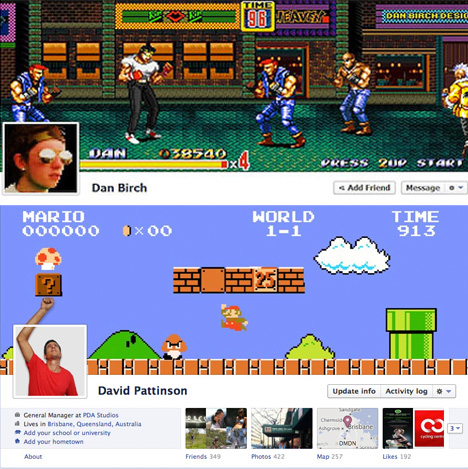
Classic videogames are the door to the geek soul, so it’s fitting that the more creative ones have put together excellent homages to their old school favorites. Dan has entered Streets of Rage as a streetwise brawler, while David has settled on an all time favorite: Super Mario Bros. Power up!

(Images via bestwebhostsanddomains, best-ever-facebook-timeline)

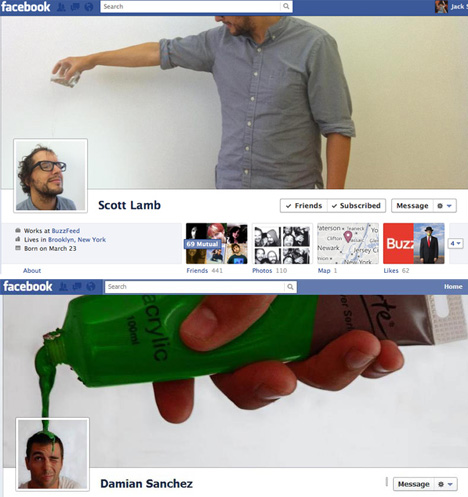
There is something very meta about a timeline cover photo in which the profile owner is pouring something on their own head, and while the subject matter is a bit odd, it’s definitely executed well in the above examples.

(Images via baconwrappedmedia, scotgat, xploringminds)

There are several ways to react to cover photos that show surveillance equipment narrowing down on the profile owner’s face: They can be seen as a comment on social media and the death of privacy, or they can be a tech-minded individual showing off their love for technology in a creative way. The top images are great examples of the zoom / enhance overwhelming surveillance found in spy thrillers. The bottom example is just plain fun, and likely the most epic use of a “man at a desk” thumbnail ever created.

(break, imgur)

It’s true… animals attack. In these creative examples this is especially true. It would be interesting to know which way most people would rather go; smushed by a giant crab claw, or consumed by a giant shark? Can’t get enough of these? Check out more of the best, with 24 Poke-worthy Facebook Timeline Covers.


Want More? Click for Great Related Content on WebUrbanist:

Re-Faced: 24 Poke-Worthy Facebook Timeline Covers

Facebook’s new Timeline caused a landslide of creativity, as all the artsy types and tech-inclined began to push this new playground to its creative limits. 6 Comments – Click Here to Read More »»


16 Creative Billboards Worth Advertising

The old fashioned billboard is plastered with text and ugly graphics, but there are pioneers who are pushing the limits of a once conservative business. 12 Comments – Click Here to Read More »»


Share on Facebook


[ By Marc in Design & Graphics & Branding. ]

[ WebUrbanist | Archives | Galleries | Privacy | TOS ]


WebUrbanist

 
Comments Off on Face It! These 12 Creative Facebook Timeline Covers Are Worth Copying

Posted in Creativity