RSS
 

Posts Tagged ‘Worth’

Company behind Lily drone shuts down despite $34m worth of pre-orders

13 Jan

When the Lily camera drone was announced in May 2015 it garnered a lot of attention for being one of the first drones capable of flying itself and tracking a user while capturing video footage for up to 20 minutes. As a consequence the company managed to secure $ 15 million in investment and an additional $ 34 million in pre-orders.

However, today the founders of Lily have announced in a letter and email to customers that the start-up is shutting down operations because it failed to raise additional funding to start production of its drone. The founders promise to reimburse all pre-order customers within the next 60 days.

“We have been racing against a clock of ever-diminishing funds,” wrote the company’s co-founders, Henry Bradlow and Antoine Balaresque. “Over the past few months, we have tried to secure financing in order to unlock our manufacturing line and ship our first units – but have been unable to do this. As a result, we are deeply saddened to say that we are planning to wind down the company and offer refunds to customers.” 

The Lily drone was launched with a pre-order price tag of $ 499 and scheduled to ship in February 2016. Shipping was later delayed until summer and then again to early 2017. In the same time frame tracking drones from DJI, Zero Zero Robotics and Yuneec have all been brought to market successfully.

Articles: Digital Photography Review (dpreview.com)

 
Comments Off on Company behind Lily drone shuts down despite $34m worth of pre-orders

Posted in Uncategorized


Review and Field Tests of the new Canon 5D Mark IV – Is it Worth Upgrading?

28 Nov

Canon recently announced the new incarnation of its 5D lineup, the Canon 5D Mark IV. I myself have owned the 5D Classic (Mark I), and I currently own the Mark III. Personally, I don’t have any plans to upgrade as I went another way instead, choosing to shift to the Fuji X-series as they are smaller and lighter for traveling. However, I am eyeing the new X-T2!

For those of you considering an upgrade on your Canon camera body, here are some reviews and field tests I found for the 5D Mark IV. Whether you’re going from an APS-C camera up to full frame, or just looking to upgrade from an older 5D model, do your own testing and decide if it’s the right move for you.

The Camera Store Guys

This store is in Calgary, AB, Canada – a mere four hours drive from my city. Not the place you’d expect world class camera reviews to come from – but these guys really do some great tests, in real-world situations and they produce some great videos that are totally impartial. If they find a flaw or sticky bit, they will tell you about it. I like that.

Let’s see what they had to say about the Canon 5D Mark IV:

Hmmm, interesting! Watch to the end where Chris sums up his thoughts on the 5D Mark IV they may surprise you. He’s very honest about it.

PhotoRec TV – Comparison of three cameras

The Canon 5D Mark IV, 5D Mark III and the Sony A7RII

Toby from PhotoRec TV has some notes for you comparing three different cameras including the 5D Mark IV’s predecessor, and the Sony A7RII full frame camera. He talks about what’s new and improved from the Mark III and how it compares to the Sony.

Dphog discusses the new dual-pixel RAW capability

This is a new introduction by Canon, dual-pixel RAW format. What does that mean? Quoted from Canon’s UK site:

Using the Dual Pixel RAW Optimizer in Digital Photo Professional software, users can make use of the Dual Pixel data recorded with the Dual Pixel RAW image for micro-adjustments of the position of maximum sharpness using the depth information contained within the file.

Is it worth it? Would you use this feature?

Pye from SLR Lounge shot a wedding with the Mark IV

Pye has done quite a few articles for us here on dPS, so you may be familiar with him. He took this camera to a wedding shoot and put it to work. He pushed the limits on it in many areas and tested ISO, dynamic range, the new dual-pixel RAW and some of the great new focus features.

Conclusion

So are you considering buying the Canon 5D Mark IV? If so you can price them out here:

  • On Amazon.com
  • On B&H Photo’s site

I would be remiss if I didn’t mention there have been some reported issues with the 5D Mark IV. So do some research and due diligence if you are thinking about buying this camera.

Have you tried one of these cameras out yet? Give us your thoughts in the comments below.

googletag.cmd.push(function() {
tablet_slots.push( googletag.defineSlot( “/1005424/_dPSv4_tab-all-article-bottom_(300×250)”, [300, 250], “pb-ad-78623” ).addService( googletag.pubads() ) ); } );

googletag.cmd.push(function() {
mobile_slots.push( googletag.defineSlot( “/1005424/_dPSv4_mob-all-article-bottom_(300×250)”, [300, 250], “pb-ad-78158” ).addService( googletag.pubads() ) ); } );

The post Review and Field Tests of the new Canon 5D Mark IV – Is it Worth Upgrading? by Darlene Hildebrandt appeared first on Digital Photography School.


Digital Photography School

 
Comments Off on Review and Field Tests of the new Canon 5D Mark IV – Is it Worth Upgrading?

Posted in Photography


DEAL: $5000 worth of Post Production Tools for Just $79

13 Jul

It’s the 7th and final day of our 2016 Summer Sale… and we’ve saved the biggest deal until last!

The good people over at Photographypla have made their Ultimate Photography Bundle, worth a whopping US$ 5,000+, available to dPS subscribers for just US$ 79.

NewImage

Yes, $ 5,000+, worth of resources for Lightroom and Photoshop for $ 79.

In it you’ll get:

  • 1,000+ Lightroom presets
  • 1,000+ Photoshop actions
  • 500+ actions for Photoshop Elements to apply a huge variety of different effects to your photos in no time.
  • 1,000+ photo overlays for weddings, engagements, graduations and more
  • 130+ print templates with announcements for births, graduation, weddings and more
  • 120+ digital frames
  • Collection of business and marketing resources (including contract templates)

Why buy presets or actions in small packs when you can get this MASSIVE bundle at an amazing price? Get it while it lasts!

googletag.cmd.push(function() {
tablet_slots.push( googletag.defineSlot( “/1005424/_dPSv4_tab-all-article-bottom_(300×250)”, [300, 250], “pb-ad-78623” ).addService( googletag.pubads() ) ); } );

googletag.cmd.push(function() {
mobile_slots.push( googletag.defineSlot( “/1005424/_dPSv4_mob-all-article-bottom_(300×250)”, [300, 250], “pb-ad-78158” ).addService( googletag.pubads() ) ); } );

The post DEAL: $ 5000 worth of Post Production Tools for Just $ 79 by Darren Rowse appeared first on Digital Photography School.


Digital Photography School

 
Comments Off on DEAL: $5000 worth of Post Production Tools for Just $79

Posted in Photography


Worth the wait? A look inside the Pentax K-1

18 Feb

Announcing the K-1

Here it is – the long awaited full-frame Pentax. The K-1 is a solidly constructed camera that feels good in the hand, and should appeal to many photographers looking to step up from APS-C Pentax DSLRs, as well as those looking to use older K-mount glass on a full-frame format.

The body of the K-1 is constructed of a lightweight magnesium alloy, and has 87 seals around the body. Ricoh claims that the K-1 is dustproof, weather-resistant and cold-resistant.

Big viewfinder

Although most people are likely to buy a full-frame camera because they tend to offer better image quality than smaller sensor models, full frame DSLRs gain an operational benefit as a side effect. The larger mirror needed to cover the larger sensor means that more light is reflected up into the viewfinder, meaning it’s easier for a full-frame DSLR to have a large, bright viewfinder, compared to a smaller-sensor version.

The K-1’s viewfinder offers a ‘near 100%’ field of view at a pretty substantial 0.7x magnification. This isn’t the very largest available but it’s still very large and very bright, and will be a significant step up for any users of APS-C cameras. By way of comparison, the Pentax K-3 II’s 0.95x viewfinder is equivalent to 0.63x once you take crop factor into account.

Tilting cradle LCD

The K-1 features an unusual rear LCD arrangement. The panel itself is attached to a tilting cradle that itself is mounted on four legs that slide along a cross-shaped series of slots. As the legs slide out towards the outer points of this cross, the screen moves outwards from the back of the camera. Because the legs all move independently, the cradle can tilt slightly up/down and left/right, even before the LCD is tilted up or down.

The ribbon cable extending from the back of the camera to the LCD is enclosed in a rubber sleeve, so that the weather sealing extends to the rear screen.

LED lights

On the back of the LCD cradle are four small LED lamps that can be used to shed light on the camera’s rear controls. Ricoh says that compared to backlit buttons, this is a better way of providing illumination while maintaining the weather sealing of the buttons on the back of the camera. You do, of course, have to position the LCD in such a way that it the light from those LEDs reaches the controls.

Another LED sits below the viewfinder hump and lights up the lens mount to make it easier to swap lenses in the dark. Finally, there’s an LED fixed in the camera’s card bay that lights up both the card slots and the socket for remote control connection. The brightness of each of these lamps can be configured independently, so that only the area of illumination you want to operate have any effect when you press the lamp button on the top of the camera.

Multi Function Dial

One of the main areas on which the K-1’s controls differ from the well-liked K-3 series bodies is the addition of the Multi Function Dial. This adds a third command dial to the camera’s rear corner but one whose function can be changed simply by rotating a labelled dial just next to the viewfinder hump.

This means that an already customizable two-dial camera becomes a three dial camera whose behavior can be altered without digging into the camera’s menus. We suspect most people will leave the third dial set to ISO or Exposure Comp, most of the time, but it’s an interesting way of extending the degree of direct control and we’ll be interested to see how it ends up being used.

Autofocus module

The autofocus sensor, which Ricoh is calling SAFOX 12, has been updated. Thirty-three AF sensors, twenty-five of which are cross-type (and centrally located), cover a relatively small portion of the frame. The center point along with those directly above and below can focus down to -3EV, and are also ‘high precision’ (longer baseline), which means that when a F2.8 or faster lens is attached, focusing using these points leads to higher accuracy. This is particularly important when shoot faster primes with this camera: as we’ve seen on other brands’ DSLRs, 36 megapixels have a way of highlighting any slight focus imprecision. We’d expect users to have to do some focus fine-tuning to get the best from the K-1, and Ricoh offers a rudimentary AF microadjustment feature to do just that.

With the current ecosystem of Pentax lenses, we expect autofocus speeds to vary considerably based on lens (with older screw-driven lenses in particular likely to exhibit slower performance), but the good news is that the newest Pentax zoom lenses we’ve tried do appear to have significantly quicker AF motors.

Metering and continuous AF

Ricoh is also claiming a ‘Real-Time Scene Analysis System’ that utilizes the new PRIME IV engine and an 86,000-pixel RGB metering sensor for scene analysis using color, facial information, and movement to aid the camera’s metering and AF systems. Not only does this promise to increase accuracy of metering, it also allows the camera to automatically select the correct AF point to stay on your subject (subject tracking) when using continuous AF.

This isn’t new to Pentax – nor any recent Nikon or Canon DSLR with 3D tracking and iTR, respectively – but we’ve found performance to be lacking in previous bodies like the K-3. A brief play with a pre-production K-1 and the relatively fast-to-focus 15-30mm F2.8 in a non-test environment indicated that the system, while fairly accurate, was slow at tracking subjects across the frame. The AF points do move to stay on a moving subject, but do so sluggishly, which means it’ll be of limited utility with faster moving subjects. The limited AF coverage also means it’s unlikely fast-paced shooters will experience much success shooting this way, possibly falling back to relying on single point AF.

Pixel-shift to sample all colors

The K-1 includes an updated version of the Pixel-Shift Resolution mode introduced on the K-3 II. Like that camera, the K-1 takes four shots, shifting its sensor by one pixel between each shot. This means it captures red, green and blue information at every capture location, resulting in an image with full color information for every output pixel.

The latest implementation tries to cancel-out the effects of subject movement as its shooting the four images. Ricoh tells us not to expect it to cope with major changes, such as a car driving across the frame but that it should cope with leaves moving in the breeze.

As well as the more accurate color capture, the benefit of capturing four frames is that the noise performance is improved (because noise can be averaged-out between the frames). It should also mean higher dynamic range, which theoretically could improve up to 2 EV from sampling four images, possibly putting it in competition with the 645Z’s industry-leading Raw dynamic range.

AA-filter simulation

The K-1 also offers the anti-aliasing filter simulator feature that first appeared on the K-3. This vibrates the sensor during exposure just enough to blur the light across more than one pixel. This removes the risk of high frequency patterns clashing with the camera’s color filter, which otherwise results in false color and spurious patterns (aliases) appearing in images.

The camera offers two intensities of filter simulation and, because the sensor itself doesn’t have a physical AA filter, it can also offer an ‘Off’ mode. As on the K-3 II there’s also a filter bracketing option that lets you shoot consecutive images with different degrees of AA filter effect applied, so that you can use a filtered version of the shot if the unfiltered version exhibits moiré.

Astrotracer

The K-1 includes built-in GPS and an electromagnetic compass, giving it the kind of location awareness that you’d usually only expect from a smartphone. The camera uses this, in conjunction with its image stabilization system, to offer the Astrotracer feature that Pentax developed back in 2011. This uses the GPS to work out where the camera is and hence how much the Earth’s rotation will affect the apparent position of the stars overhead.

The camera can then shift and rotate its sensor during a long exposure to track the relative movement of the stars so that they appear as points, rather than trails, in the resulting image. Since this inevitably blurs static objects in the scene, it is most useful for creating low noise starscapes. Night time landscape photographers will also find this tool useful if they combine images with the Astrotracer on and off, using appropriate masking techniques. (Image courtesy of Pentax)

Lens-lineup: FA lenses

At the time of launch, Ricoh offers approximately 12 FA and DFA full-frame lenses. This list includes five FA primes, including the 31, 43 and 77mm ‘Limited’ series. On top of these there are five D FA zooms: a 15-30mm F2.8, 24-70mm F2.8 and 70-200mm F2.8, along with the newly-announced 28-150mm F3.5-5.6 and the 150-450mm F4.5-5.6. Finally, there are two D FA macro lenses: a 50mm and a 100mm.

In addition to these, the camera includes lens correction data for 14 out-of-production lenses – making clear how important backwards compatibility is to this camera.

Using crop lenses on K-1

The K-1 can, of course, still use the Pentax DA lenses designed for the company’s APS-C cameras. By default the camera will use a 15MP APS-C-sized crop of the sensor if a DA lens is mounted but can be made to use its full sensor region, if you’d prefer. Ricoh has published a list of those lenses (all of which are primes) that will produce relatively useable results in full frame mode, if the aperture is stopped down.

DA Prime Lens / Utility on K-1
DA 14mm Crop Mode Only DA 50mm F1.8 Stopped-down
DA 21mm Limited Crop Mode Only DA* 55mm F1.4 Stopped-down
DA 15 F4 Limited Crop Mode Only DA 70mm Limited Stopped-down
DA 35mm F2.4 Stopped-down DA* 200mm F2.8 SDM Fully Functional
DA 35mm F2.8 Macro Stopped-down DA* 300mm F4 SDM Fully Functional
DA 40mm Limited Stopped-down DA 560mm F5.6 Fully Functional
DA 40mm XS Stopped-down RC1.4X Crop Mode Only

Summary

It should be apparent to anyone that the K-1 is a very impressive-looking camera. While we doubt it’s going to be cutting-edge in every respect when it comes to performance, it offers a very solid looking set of specifications with some very clever and genuinely useful flourishes in a very solid looking body.

That in itself is likely to be enough to satisfy the patient Pentax lens owners who’ve been wanting a camera like this for so long. For those people not already committed to the system, there’s the appeal of the price. $ 1799 is an aggressive price for a camera of this caliber and should help extend its appeal beyond the system’s existing users.

Articles: Digital Photography Review (dpreview.com)

 
Comments Off on Worth the wait? A look inside the Pentax K-1

Posted in Uncategorized


Urban Algae Canopy Produces a Forest’s Worth of Oxygen Daily

11 May

[ By WebUrbanist in Architecture & Cities & Urbanism. ]

urban algae prototype system

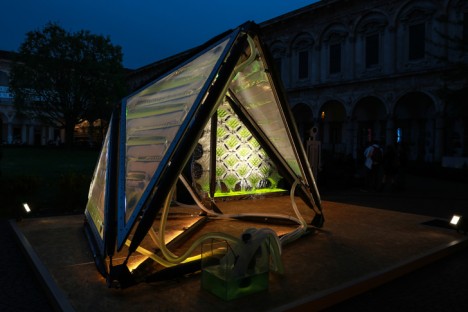
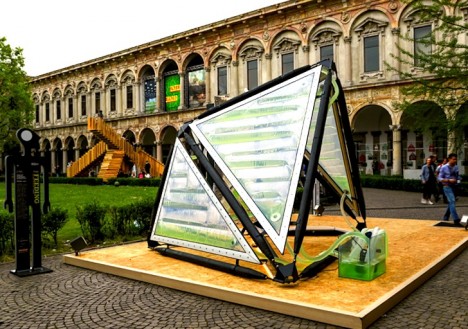
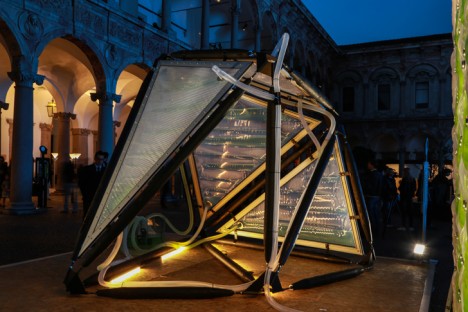
Generating as much oxygen per day as 400,000 square feet of natural woodland, the Urban Algae Canopy combines architecture, biology and digital technology to create a structure that responds to and enhances its environment.

urban algae exterior shelter

Created by EcoLogics Studio, this “world’s first bio-digital canopy integrates micro-algal cultures and real time digital cultivation protocols on a unique architectural system,” with flows of water and energy regulated by weather patterns and visitor usage. Sun increases photosynthesis, for example, causing the structure to generate organic shade in realtime. The canopy as a whole can produce over 300 pounds of biomass daily.

urban algae water system

A hybrid of architectural and ecosystem design, the canopy is made to adapt its features based on manual as well as environmental inputs, letting users exert control (via a digital interface) within a larger dynamic system. “This process is driven by the biology of mico-algae is inherently responsive and adaptive; visitors will benefit from this natural shading property while being able to influence it in real-time.”

urban canopy

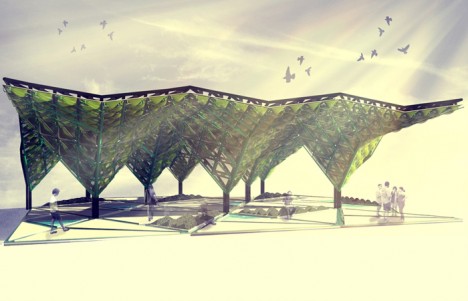
For EcoLogics, this is just the beginning of a larger vision – organic systems tied to high-tech ones in current and future buildings and infrastructure, as well as a breakdown of the differentiation between urban and rural, cities and nature. Integrating organic and artificial systems opens up sustainable possibilities for everything from temperature control to power generation.

urban algae canopy project

More from its creators: “In ecoLogicStudio we believe that it is now time to overcome the segregation between technology and nature typical of the mechanical age, to embrace a systemic understanding of architecture. In this prototype the boundaries between the material, spatial and technological dimensions have been carefully articulated to achieve efficiency, resilience and beauty.”

Share on Facebook


[ By WebUrbanist in Architecture & Cities & Urbanism. ]

[ WebUrbanist | Archives | Galleries | Privacy | TOS ]


WebUrbanist

 
Comments Off on Urban Algae Canopy Produces a Forest’s Worth of Oxygen Daily

Posted in Creativity


Look Out! 12 Outstanding Observation Towers Worth Climbing

28 Apr

[ By Steph in Architecture & Cities & Urbanism. ]

ob tower grand central 4

From Canal Street in New Orleans to a nature preserve in Latvia, these diverse observation towers look out over everything from bird sanctuaries to Formula One race tracks. With designs that stand out for both their brilliance and quirks, these 12 viewing decks in the sky provide unparalleled views of both urban and rural settings.

Phoenix Observation Tower by BIG Architects
ob tower phoenix

ob tower phoenix 2

ob tower phoenix 3

Arizona’s capital city will soon get a 70,000-square-foot addition to its skyline, a spiraling walkway stretching toward the clouds. Three glass elevators lead to the helical apex, with retail, exhibition and recreation spaces at the base. BIG Architects envision it as a pin on the map, which “becomes a point of reference and a mechanism to set the landscape in motion through the movement of the spectator.”

Floating Observation Deck for Grand Central Terminal by SOM
ob tower grand central 2

ob tower grand central 1

ob tower grand central 3

A floating ring slides up and down two supporting towers right over New York City’s Grand Central Terminal in this design by SOM. The moving deck preserves the original 100-year-old station while rethinking the available space around the building, turning it into a landmark with 360-degree views of the city.

Leaning Tower of Belgium by Ateliereen Architecten
ob tower leaning 1

ob tower leaning 2

ob tower leaning 3
There’s only one angle from which Ateliereen Architecten’s observation tower in Belgium looks like it’s standing up straight. Everywhere else, the 30-meter steel and timber tower draped with ribbons of rope appears to be leaning. The ropes reference the nearby sand dunes in the nature preserve in which the tower is set.

Observation Tower in Jurmala by Arhis Architects
ob tower jurmala 2

ob tower jurmala 1

Observation decks jut out from this lookout tower in Jurmala, Latvia like balconies from a skyscraper, providing a variety of vantage points from which to enjoy Dzintaru Park. Consisting of an open-air cage, the structure reaches to 124.6 feet at its pinnacle.

Next Page – Click Below to Read More:
Look Out 12 Outstanding Observation Towers Worth Climbing

Share on Facebook


[ By Steph in Architecture & Cities & Urbanism. ]

[ WebUrbanist | Archives | Galleries | Privacy | TOS ]


WebUrbanist

 
Comments Off on Look Out! 12 Outstanding Observation Towers Worth Climbing

Posted in Creativity


Wisdom on Creativity Worth Viewing by John Cleese

17 Apr

Whether you find yourself in a creative rut or you’re looking to improve your creative mojo I highly recommend viewing this presentation on Creativity by John Cleese. I guarantee devoting 36 minutes to view this will be worth your while. Enjoy!

Can’t watch videos where you are?

Here is the transcription of his presentation

Copyright Jim M. Goldstein, All Rights Reserved

Wisdom on Creativity Worth Viewing by John Cleese

The post Wisdom on Creativity Worth Viewing by John Cleese appeared first on JMG-Galleries – Landscape, Nature & Travel Photography.


Related Stories

  • Wisdom on Creativity Worth Viewing by John Cleese – Enclosure
  • Vemödalen vs. Zero to One
  • Vemödalen vs. Zero to One – Enclosure
Feed Ads by FeedBlitz
powered by ad choices


JMG-Galleries

 
Comments Off on Wisdom on Creativity Worth Viewing by John Cleese

Posted in Equipment


10 Inspiring Photo Documentaries Worth Your Time

04 Mar

As we try to find inspiration in our environment that fuels our desire and imagination as artists, we each develop our own style. Sometimes, you may find yourself feeling stuck creatively. Or you might be enthusiastic about taking photos but be unsure where to focus your energy and enthusiasm. If that’s the case, you might profit from a little history Continue Reading

The post 10 Inspiring Photo Documentaries Worth Your Time appeared first on Photodoto.


Photodoto

 
Comments Off on 10 Inspiring Photo Documentaries Worth Your Time

Posted in Photography


7 Photography Podcasts That are Worth a Listen

28 Jan

There is no shortage of podcasts about photography. They cater for everyone from beginners to experienced amateurs, semi-pros and professionals. A quick search in Google returns so many options it can be a bit overwhelming. It’s impossible to listen to them all, so how do you decide which ones to download or subscribe to? The simplest answer is to follow recommendations from friends and colleagues. So, in no particular order, here are seven photography based podcasts that I currently subscribe to, that I think will be of interest to you as a photographer:

1. This Week in Photo

Image 1 twip podcast logo sans text 480

This Week in Photo (TWiP) has been on my playlist for a long time now. My listening goes back to when Scott Bourne was running it. I found the show early in its lifetime, and have enjoyed listening each week as the many guests and co-hosts share their knowledge and expertise. TWiP is now hosted by Frederick van Johnson. It’s a light hearted look at the major stories from the previous week. Frederick and his guest hosts get down to the nitty gritty of the photographic world. The show is topical, very relevant and usually delivered with just a smattering of humour. It’s one of those podcasts that hasn’t left my playlist from the time I first discovered it quite a few years ago!

Editor’s note: yours truly, Darlene Hildebrandt, has been a co-host on the show several times as well! Always a good time and great discussion.

2. TWiP Street Focus

Image 2 TWiP SF

Street Focus is a new podcast under the TWiP umbrella, hosted by dPS author, Valerie Jardin. She says on her website, “The day I picked up a camera I became a storyteller. Photography is my passion, my obsession, my addiction. I live and breathe in pixels!”

This is obvious when you listen to the Street Focus podcast. I listened to a couple of episodes and immediately subscribed. These days I have to think a podcast is very good before I subscribe because I always unsubscribe from another to make way for the new one. There just isn’t enough time to listen to all the great podcasts out there. This one was good enough for me to do just that! Valerie shares her knowledge about street photography openly, and freely, and has some great guests too.

Her interviews draw out interesting snippets of information from her guests. If you’re thinking of travelling somewhere for the first time, it might pay you to check out the Street Focus archives and see if Valerie has interviewed a photographer from the city you’re visiting. They always describe locations, often in areas not usually frequented by tourists, that offer great opportunities for street photography.

3. The Digital Story

Image 3 Derrick with TDS logo

The Digital Story is a short and pithy podcast hosted by Derrick Story. He usually covers a few topical stories at the beginning of each episode before getting into three more in-depth stories. His technical knowledge is very good and he distills that knowledge into language that everyone can understand. Derrick wears many hats as a photographer and technologist, and his stories cover all manner of subject matter that relate in some way or another to photography. Derrick is also known as the “Nimble Photographer” and enjoys sharing ways to make your life easier as a travelling photographer. He is also a semi-regular guest host on This Week in Photo.

4. The Candid Frame

Image 4 TCFlogo3

I discovered The Candid Frame a couple of years ago and it is one of the most refreshing photography podcasts I’ve heard. You won’t find anything to do with the latest cameras or equipment. Nor will you find anything to do with technique. What you will discover is Ibarionex Perello, a man with a deep insight and understanding of the photographic world.

Each episode, Ibarionex interviews someone new and delves deep into their psyche to extract information about their thought processes. He has grown as an interviewer and is a pleasure to listen to. It’s obvious that Ibarionex does his research before each interview because his questions are not those you would normally expect to hear. They are insightful and deliver responses that go to the core of the interviewee.

5. Photobiz Xposed

Image 5 PhotoBizX logo 600

The Photobiz Xposed podcast by Andrew Hellmich is well worth a listen for any photographer. Its primary focus is the business of photography, particularly for those specializing in portraits and weddings. To be honest though, any photographer can learn from the expert guests Andrew has on his show. In fact, I’d say many of the strategies and much of the information could be helpful to anyone running a business, no matter what it is. The principles explained during the podcast episodes could translate equally well across many platforms.

Andrew has a relaxed way of interacting with his guests and manages to elicit great information from them. There are two levels for this podcast – a free version and a subscription version. Those that pay the monthly subscription get the full interview, whereas those that subscribe to the free version get a shortened, but still very valuable, version. There are usually downloads for those who subscribe too. I’m a fan, and I do pay the monthly subscription.

6. Martin Bailey Photography Podcast

Image 6 mbpp logo 600px

The Martin Bailey Photography Podcast is another long running show. Martin has been putting out weekly episodes since 2005. He hails from England originally, but has been based in Tokyo for many years and specializes in nature and wildlife photography. He’s also a regular guest host of This Week in Photo, an author, and a Master in The Arcanum. Martin is a font of knowledge and his relaxed attitude makes him easy to listen to each week. He covers many topics related to photography and the business of photography. Another must listen!

7. Tips from the Top Floor

This is probably one of the first, if not THE first photography podcast to hit the air. Hosted by Chris Marquardt, Tips from the Top Floor has been running since about 2005 and covers all sorts of photography related topics – from photographing the night sky, to answering reader / listener questions and shooting portraits. Each episode is relatively short and easy to listen to. Like the other podcasts in the list, Chris has an easy going approach and shares his knowledge freely.

Honourable Mentions

Although this is the list of seven podcasts I currently listen to, there have been many others I’ve subscribed to over the years. There just aren’t enough hours in the day to listen to them all, so I have to unsubscribe from some occasionally. That doesn’t mean they’re bad podcasts, or not as good as the seven above, it simply means that at this current time I find myself listening to these seven. So, here’s a few more that might be more suitable for you (check out them all and you decide):

TWiP Your Itinerary is a new addition to the TWiP network and I’ve listened to them all so far to check them out. I’m not sure I’ll subscribe at this point, but I’m certainly keeping my eyes and ears on it. The content is good and Rob Knight is well suited to the hosting role. The podcast covers topics related to travel photography.

TWiP All About The Gear is another one from the TWiP network. Frederick van Johnson has made some really good decisions with the format of the main show and then branching out into sub-genres. This one is no different. Host Doug Kaye and Frederick discuss the nitty-gritty of cameras and other related products. They delve into the heart of the subject to keep listeners informed about all the latest gear. This is a great podcast, but not one I subscribe to. I regularly visit their website to check what the latest episode is about and then listen if it’s of particular interest to me. So I pick and choose the episodes I listen to.

Ready Steady Pro is a podcast hosted by Michael Rammell out of the United Kingdom. It’s dedicated to those moving from amateur to pro and has some great information. The show has been on a bit of a hiatus lately but Michael is planning more episodes again soon. The podcast will be moving from weekly to bi-weekly when it resumes. I’m looking forward to listening to this one again as Michael always covers interesting topics.

Digital Photo Experience hosted by Juan Pons and Rick “Godfather” Sammon is a fantastic listen. Although I’m not currently subscribed, I highly recommend this podcast. Both Juan and Rick discuss all sorts of topics around photography. They’re easy to listen to and get the information across in a way that’s easy for beginners to understand, without being too simplified for the advanced amateur. I’m sure Rick’s mind only stops when he’s sleeping and I’m not sure it even stops then! There’s always something new and exciting on this show.

Adorama TV post numerous video podcasts covering quite a range of topics. There’s tutorials by Mark Wallace, Gavin Hoey, Tamara Lackey – there’s something for everyone under the Adorama banner. They’re well worth checking out. I tend to watch them ad hoc when I have some spare time because they’re video related and I usually listen to my regular podcasts while I’m driving.

Do you have any other favourite podcasts not on this list? We’d love to hear about them or if you listen to the ones mentioned tell us what you enjoy about those.

googletag.cmd.push(function() {
tablet_slots.push( googletag.defineSlot( “/1005424/_dPSv4_tab-all-article-bottom_(300×250)”, [300, 250], “pb-ad-78623” ).addService( googletag.pubads() ) ); } );

googletag.cmd.push(function() {
mobile_slots.push( googletag.defineSlot( “/1005424/_dPSv4_mob-all-article-bottom_(300×250)”, [300, 250], “pb-ad-78158” ).addService( googletag.pubads() ) ); } );

The post 7 Photography Podcasts That are Worth a Listen by Ken Lyons appeared first on Digital Photography School.


Digital Photography School

 
Comments Off on 7 Photography Podcasts That are Worth a Listen

Posted in Photography


2 B&W Photography eBooks Worth $30… Yours Today for $7

15 Dec

It is day 2 in our 12 Days of Christmas and if you like $ 7 eBooks (and the popularity of yesterdays deal says you do) you’re going to LOVE this one.

The Deal

It’s our very own Essential Guide to Black and White Photography for just $ 7

Blackandwhitephotographycover

It’s normally $ 20 so that’s a discount of 65%… but that’s not all. We’re going to throw in a bonus eBook ’10 Recipes for Amazing Black And White Photography’ which is worth $ 10!

This eBook from renowned photographer David Nightingale launched earlier in 2014 and got some fantastic reviews.

The Essential Guide to Black and White Photography will walk you through:

  • how to ‘see’ in black and white
  • the best gear to use
  • the special skills and setup needed to shoot
  • how to process your black and white photos to perfection
  • much much more

This eBook has it all covered and has helped thousands of dPS readers to improve their black and white photography.

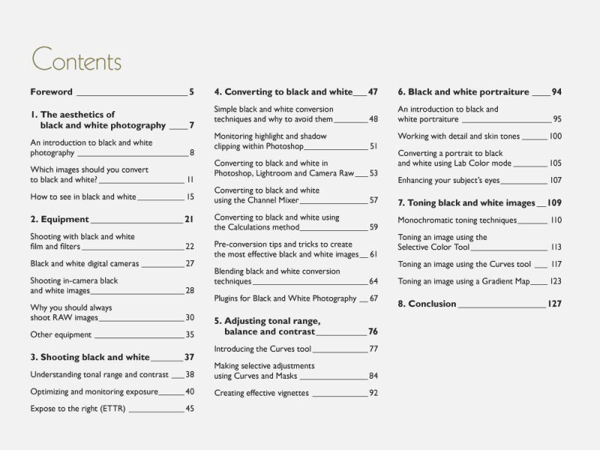
Here’s the table of contents of the main guide:

NewImage

NewImageThe bonus guide (pictured right) shows you exactly how 10 black and white images were created – a fantastic companion to the main guide to show you how to put the theory into action!

Don’t Miss This Deal

Ready to take the quality of your black and white photography to a whole new level?

Grab this amazing deal in before our 24 offer expires here.

googletag.cmd.push(function() {
tablet_slots.push( googletag.defineSlot( “/1005424/_dPSv4_tab-all-article-bottom_(300×250)”, [300, 250], “pb-ad-78623” ).addService( googletag.pubads() ) ); } );

googletag.cmd.push(function() {
mobile_slots.push( googletag.defineSlot( “/1005424/_dPSv4_mob-all-article-bottom_(300×250)”, [300, 250], “pb-ad-78158” ).addService( googletag.pubads() ) ); } );

The post 2 B&W Photography eBooks Worth $ 30… Yours Today for $ 7 by Darren Rowse appeared first on Digital Photography School.


Digital Photography School

 
Comments Off on 2 B&W Photography eBooks Worth $30… Yours Today for $7

Posted in Photography