RSS
 

Posts Tagged ‘World’

Future Perfect: 7 Potential Wonders of the World

22 May

[ By Steph in Conceptual & Futuristic & Technology. ]

Future Wonders of Technology Main

One hundred years from now, will we be living on other planets, teleporting from place to place, communicating to each other telepathically, or even becoming immortal by shifting human consciousness from our biological bodies to artificial ones? These predictions for the distant future seem outrageous and virtually impossible to achieve, yet steps are being made toward them at this very moment. The seeds of the potential future wonders of the world have already been planted, and in many cases, it’s not a question of whether they’ll happen, so much as when.

Teleportation

Future Wonders Teleportation 1

Future Wonders Teleportation 2

(images via: physical review focus, ail)

As unlikely as this may sound, teleportation isn’t entirely sci-fi. Physicists have already succeeded in teleporting photons – but right now, it’s not so much about teleporting matter from one location to the next, as it is information. Quantum teleportation is a complex topic involving concepts like ‘entanglement’, the connection that links the quantum states of two particles no matter who far apart they are. Teleporting a single particle is one thing, but what about human beings, Star Trek style?

As PBS’ The Nature of Reality column explains, “Remember that we wouldn’t be moving Kirk’s molecules from one place to another. He would interact with a suite of previously-entangled particles, and when we read the quantum state we would destroy the complex quantum information that makes his molecules into him while instantly providing the information required to recreate his quantum state from other atoms in a distant location. Quantum mechanics doesn’t forbid it. The rules of quantum mechanics still apply whether you’re talking about a system of two particles or human being made of 1027 atoms.”

The verdict? Teleportation is certainly possible, and scientists may soon begin working on attempts to teleport living matter, like viruses. Physicist Michio Kaku believes that the transport of a molecule will happen within the next ten years, followed by DNA, but that teleporting an entire human is probably still centuries away.

Artificial Intelligence Surpassing Human Intelligence

Future Wonders Artificial Intelligence

(images via: mashable)

How long do we have until human-level artificial intelligence is achieved? H+ Magazine surveyed experts, asking when they estimated AI would meet four major milestones: carrying on a conversation well enough to pass as a human, solving problems as well as a third grade student, performing Nobel-quality scientific work, and finally, surpassing human intelligence altogether. Robots can already see, hear, learn, solve problems and respond to questions, and some are even getting senses of smell and taste. The Eccerobot is creepily human in its movements thanks to artificial muscles and bones.

The general consensus was that we’ll have AI at the human level or beyond will happen by the middle of the century, or maybe even sooner – but may not surpass humans for a hundred years, if ever.

Space Settlements

Future Wonders Space Colony

(images via: space.com)

Applications are now open for a one-way ticket to a private space settlement on Mars. The Mars One project intends to land supplies on the red planet in 2016, and get settlers there by 2023; about 78,000 people have already applied. The company responsible, Lansdorp, insists that the technology needed to achieve this lofty goal already exists. And according to a group of astronauts, researchers and space flight firms who met in May 2013 for the first Human to Mars Summit, establishing a permanent, sustainable outpost on another planet might be a matter of saving the human species.

Supplies would be dropped off first, and then a crew of either humans or robots would construct the base. There are a lot of obstacles, not the least of which is the question of transportation between Earth and Mars, and whether Mars inhabitants could maintain their own food source, rather than relying on interplanetary deliveries.

Will it really happen? it’s hard to say. Private companies with an interest in space colonization are working with some of the same companies that have completed commercial cargo missions to the International Space Station. Lansdorp intends to make the technology developed during its mission available for sale, to fund Mars One and help speed up progress for additional colonies.

Body-Embeddable Electronics

Future Wonders Human Body Gadgets

(images via: io9, sync-blog)

In the future, it might be possible to hack other human beings thanks to all manner of body-embeddable gadgets. Many futurists and technology experts believe the trend for future devices isn’t to go smaller, but rather to integrate them into ourselves. Scientists have already developed tiny chips that can translate tiny bodily movements into energy to power gadgets, as well as devices that can be implanted into our bodies. Everyday electronics can already be implanted into human tissue, and medical devices are paving the way for recreational. Ready or not, the bionic human is on the horizon.

Researchers have also developed the first electronic sensor that can be printed directly onto human skin, creating a sort of ‘smart tattoo’ that could theoretically enable people to communicate with each other and our environments with thought commands. The devices, which are thinner than the diameter of a human hair, can detect electrical signals linked with brain waves, communicate wirelessly and receive energy.

Next Page:
Future Perfect 7 Potential Wonders Of The World

Share on Facebook


[ By Steph in Conceptual & Futuristic & Technology. ]

[ WebUrbanist | Archives | Galleries | Privacy | TOS ]


WebUrbanist

 
Comments Off on Future Perfect: 7 Potential Wonders of the World

Posted in Creativity


Google Unveils Cutting Edge Photography Tools to Make Your Photos Look Better and the World A More Beautiful Looking Place

16 May

Through Glass

Google unveiled significant new innovation in the world of online photography this morning, continuing their rapid development pace on Google+. All in, Google+ pushed out 41 new features today.

Much of the new work is focused on post production photography to make people’s photographs look better than they can straight out of the camera.

Some have suggested that part of Instagram’s success has been their ability to enhance users’ photos with very simple, one touch filters. Instagram has focused on a faux film aesthetic which actually highlights the flaws in many photos to give them more of an artistic, old school feel. By contrast, Google’s easily and automatically applied post production tools, released today, work to make photos look more vivid, life like and realistic.

By using simple techniques like skin softening, clarity adjustment, smart vignetting, HDR and other enhancements, Google, by default, now offers an enhanced photo for every photo uploaded by users to Google+. Also, with this new tech, Google will give you the ability to view the before and after results and decide which you prefer to use. For photographers who do not want their photos altered in any way, these users can turn this default functionality off.

Google Releases New Tools for Photographers Using Google+

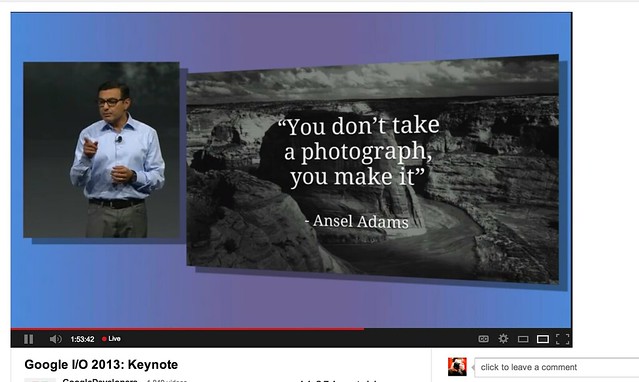
As a photographer, I have long been a believer of photo manipulation and post processing technology. Ansel Adams said “you don’t take a photograph, you make it,” as highlighted in Google Social Chief Vic Gundotra’s keynote this morning. Much of Ansel Adams’ genius has been attributed to the work that he did in the darkroom with his photos, his zone system, his post production technology of his time.

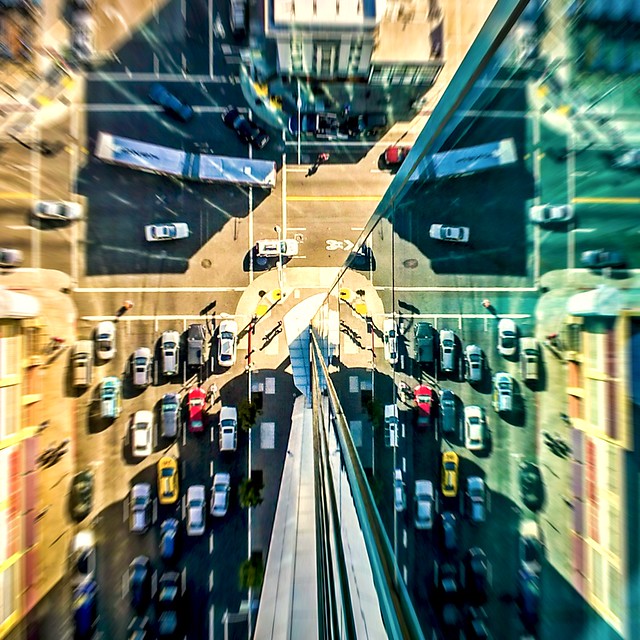
I post process all of my photos. The photo at the top of this post is the very first photo that I made with my new Google Glass that I bought yesterday. While I was able to get the composition to a point where I wanted in camera, much of the pop of that image is done with my own post production technique and style.

Many of my photographer friends also spend a great deal of time post processing their images — but the vast majority of the people out there really don’t post process at all. These people don’t own Lightroom and Photoshop or Nik Suite or Aperture or whatever else they might use to improve their photos. These are every day non-photographers who are still enamored with photography and imagery.

By applying some very basic algorithmic based enhancements, Google can make photos for the masses look much better than straight out of the camera. This is a very smart move on Google’s part. Where Instagram makes your bad photos look purposefully worse, Google now makes your bad photos look purposefully better! I stole that line from an unnamed source, btw. ;)

Where this new tech is especially powerful is in photos of people. By using basic skin softening post production tech, photos of people will look better on Google+ than on other social networks. By appealing to our vanity, this gives Google a big advantage. If people can post photos of themselves on Google+ that make them look BETTER than on other networks, many more people will choose to post their photos on G+. Just watch as people post photos of themselves on G+ for auto beautification and even download and post them to other networks I bet.

All of this sort of fancy post production *can* be done today by skilled post production photographers who spend hours and hours behind Photoshop. Now much of it will be automated and released to the masses.

There will undoubtedly be some naysayers about this tech. The same folks who moaned about the Instagramification of mobile photography will probably also complain about this new tech too. Google was smart here by giving users a very simple way to deal with this, by simply turning off this feature.

While the photo enhancements were the sizzle of Google’s announcements today, there were many other significant enhancements added to Google Photos.

Google will now begin to analyze your images and auto tag them. This is no trick where low paid overseas workers are manually reviewing your images; Googles’ algorithms now can look at the context of your photo and the actual subjects in your photos to identify possible tags for the images. If you post a photo of the Eiffel Tower, Google can detect the Eiffel Tower in your photo and add that tag for you. If Google gets the tag wrong, for whatever reason, it’s simple for you to just remove it.

What this means is that more of your photos will be seen in search by people using Google products. Many photographers are looking for more traffic and views on their photos. Who better to provide this traffic than Google Search, yes, using Google auto applied tags. This is the future of image search. If you are a photographer, especially one who depends on photography for your living, you cannot afford to ignore the significance of Google Search. Many of my own photo sales are made by people finding my photos while searching on Google. By uploading your photos to Google+, your photos will rank better in search and now even moreso with this new auto-keywording functionality.

Google Releases New Tools for Photographers Using Google+

Google also introduced a new smart algorithm that can analyze your photos and show you which ones Google thinks are the best of the batch, offering you highlights. Oftentimes we will “spray and pray,” taking 20 images of one person or subject. Google will analyze all of the images and suggest the best one for you. Google uses not just technical information about a photo (is it blurry or underexposed?) but they are using human tested aesthetics to look for what is most appealing.

But there’s more! In addition to the tech released above, Google has also added some very easy tools which will auto generate gifs for you of your photos, auto HDR bracketed shots, and suggest other compelling ways for you to present your photography to the world. Almost miraculously, Google can even look at photos of multiple people and merge the photos into a single photo that takes the best expression of each individual from *different* photos.

All of this also comes with an awesome new look and layout of Google+ which better highlights photography on the network. Popular photos will now be featured in jumbo new oversized form across a three column layout. For non highlighted photos, Google also made portrait oriented photos, especially, look better and bigger. In the past, the portrait format was the worst looking photo format on Google+, now it’s the best — that’s worth noting. ;) For folks who don’t like the three column layout, they can switch back to a single column if they’d like.

A couple of other notes: all of this work that Google does with your photos is done behind the scenes for your eyes only. You can use the tech or not use the tech. If you use the tech and like it, *you* then choose to share the image to Google+. Nothing is shared until you choose to share it.

The new technology will only work with the JPG format (hopefully Google comes out with RAW support down the road). Google increased everyone’s storage to 15GB of online storage, but note that any photo sized 2048 px or smaller does not count towards your 15GB storage limit (you can also buy more storage if you want to). Google allows unlimited uploading of photos that you either manually resize or allow Google to resize to 2048 px. There is an option on Google where you can set whether or not you want to upload full high res photos or resized 2048 sized images.

I upload some of my photos full res, and many of them I resize manually myself to 2048 px.

Google also introduced a free, stand alone hangout app that you can now use with your mobile phone or desktop device bridging text, photos and real time group video into a single app that preserves conversations (at your choice) over long periods of time. Hangouts have been one of the most popular Google+ feature and several photography related shows have been built around them.

More detail on these changes at Google here. More from Matthew Hanley here. Trey Ratcliff wrote insightful commentary here.


Thomas Hawk Digital Connection

 
Comments Off on Google Unveils Cutting Edge Photography Tools to Make Your Photos Look Better and the World A More Beautiful Looking Place

Posted in Photography


Sony World Photography Awards 2013

01 May

In der vergangenen Woche fand in London die Verleihung eines der renommiertesten Fotopreise statt – dem Sony World Photography Award.

Innerhalb weniger Jahre – der Preis wird seit 2007 jährlich von der World Photography Organisation verliehen – hat sich das Ereignis zu einer internationalen Plattform für herausragende Amateur- und Profi-Fotografie entwickelt. Es war mir daher eine besondere Freude, in diesem Jahr der Prämierung der besten Arbeiten in London beiwohnen zu dürfen.

Aus einem schlichtweg überwältigenden Pool richtig guter Beiträge habe ich einige repräsentative Beispiele herausgepickt. Nicht alle dieser Arbeiten, die ich nun im Folgenden vorstellen möchte, sind auch Gewinner in ihrer jeweiligen Kategorie gewesen. Sie sind es, wie ich finde, dennoch wert, hier unbedingt gezeigt zu werden.


Andrea Gjestvang – One day in history

One day in history © Andrea Gjestvang

One day in history © Andrea Gjestvang

Mit ihrer Portraitserie von jungen Menschen, die das Massaker von Utøya in Norwegen überlebten, gewann die norwegische Fotografin in der Kategorie Menschen den ersten Preis sowie den Hauptpreis, die Iris d’Or.

Ihre Bilder sind unaufgeregt, nah, einfühlsam und zeigen uns die Menschen, die dem Horror des zutiefst erschütternden Ereignisses trotzten und wie sie eine würdevolle Selbstverständlichkeit gefunden haben, mit den erlittenen Verletzungen und ihren offensichtlichen Spuren umzugehen.

Gjestvangs Arbeiten wurden bereits international veröffentlicht und sie wurde im letzten Jahr von PDN in die Liste der 30 interessantesten aufstrebenden Fotografen aufgenommen.


Christian Åslund – Jim Rickey Project

Jim Rickey Project © Christian Åslund

Jim Rickey Project © Christian Åslund

In der Kategorie Werbung konnte sich diese Arbeit des schwedischen Fotografen Christian Åslund durchsetzen. Inspiriert von der 2D-Grafik früher Computerspiele entstand die Auftragsarbeit im engen Straßennetz von Hongkong. Åslund fotografierte aus der Höhe nach unten, wobei die Straße seinen Modellen als Kulisse diente.

Erheiternd und erfirschend finde ich diese Arbeit deswegen, weil sie mit einer simplen Idee – nämlich einfach die Aufnahmeperspektive um 90° zu drehen – ganz beiläufig unsere normale Perspektive in Frage stellt.

Welche Verwirrung das schon bei der Aufnahme der Bilder stiftete, beschrieb der Fotograf so: „Einmal rief sogar jemand den Krankenwagen, weil er dachte, unser Modell wäre aus der Höhe gestürzt und verletzt.“


Gali Tibbon – Journey to the Jerusalem of Africa – Lalibela, Ethiopia

Journey to the Jerusalem of Africa © Gali Tibbon

Journey to the Jerusalem of Africa © Gali Tibbon

Ursprünglich arbeitete sie an einem Projekt über orthodoxe Christen in Jerusalem, so die israelische Fotografin, und wurde dabei auf die Pilger aus Äthiopien aufmerksam.

Die Erzählungen der Pilger von Lalibela machten sie neugierig. Der Pilgerort für orthodoxe Christen im Hochland von Äthiopien ist auch bekannt als das Jerusalem von Afrika. Seine Besonderheit sind die im 13. Jahrhundert aus dem Fels gehauenen monolithischen Steinkirchen.

Tibbon dokumentierte diesen faszinierenden Ort und die Rituale der Pilger zum orthodoxen Weihnachtsfest. Sie sei dabei insbesondere vom ungewohnt offenen Umgang mit Nacktheit und Körperlichkeit fasziniert gewesen, sagte die Fotografin.


Ilya Pitalev – Personality and society. Reality vs. illusions.

Personality and society. Reality vs. illusions. © Ilya Pitalev

Personality and society. Reality vs. illusions. © Ilya Pitalev

Als sich 2012 in Nordkorea der hundertste Geburtstag des Staatsgründers Kim Il Sung jährte, begleitete der russische Fotograf die staatlichen Feierlichkeiten mit seiner Kamera.

Mit seinen Fotos der propagandistischen Massenveranstaltung gewann Pitalev den ersten Preis in der Kategorie Zeitgeschehen. Sein nüchterner und zuweilen frecher Blick auf das Ereignis führt den Personenkult gekonnt ad absurdum.

Dass es ganz klar eine internationale Aufmerksamkeit für Nordkorea gibt, war schon allein daran zu erkennen, dass dies bei Weitem nicht die einzige eingereichte Arbeit war, die sich mit dem Land auseinandersetzt.


Daesung Lee – On the shore of a vanishing island

On the shore of a vanishing island © Daesung Lee

On the shore of a vanishing island © Daesung Lee

Eine sehr schöne Arbeit, die jedoch keinen Preis bekam, ist die Bildserie des südkoreanischen Fotografen über Ghoramara – einer Insel in Bengalen, der durch den Anstieg des Meeresspiegels buchstäblich der Untergang droht.

Zwei Drittel der Bevölkerung haben die Insel seit den 1960er Jahren bereits verlassen. Die Übriggebliebenen sind Bauern und Fischer, deren Heimat nach und nach erodiert, während ihre Zukunft unklar bleibt.

Lee hat einige dieser Menschen an den zerfransten Ufern der Insel portraitiert. Seine Bilder vermitteln die Ungewissheit, in der diese Menschen leben und ihre Machtlosigkeit gegenüber der Natur, zugleich aber auch ihre enorme Anpassungsfähigkeit.


Fabrice Fouillet – Corpus Christi

Corpus Christi © Fabrice Fouillet Corpus Christi © Fabrice Fouillet

Mit seinen Innenaufnahmen moderner Kirchenräume konnte sich der französische Fotograf in der Kategorie Architektur behaupten.

Die minimale Ästhetik der erst wenige Jahrzehnte alten Kirchenbauten war der Aspekt, der Fouillet bei dieser Arbeit am meisten beschäftigte.

Die immer gleiche Grammatik von Hochformat und Zentralperspektive auf den Altar unterstreicht dabei den sakralen Raumeindruck und vereint die Bildserie zu einer gelungenen typologischen Studie.


Klaus Thymann – i-D Iceland

i-D Iceland © Klaus Thymann

Bärtig, rau und sagenhaft gut gekleidet steht das Modell des dänischen Fotografen Klaus Thymann in der schroffen Landschaft Islands.

Im Auftrag für eine Modemarke fotografiert, definiert die Arbeit die Grenzen der Modefotografie neu und beweist: Es braucht nicht zwangsläufig faltenlose Hochglanzmodelle, um gute Kleidung auch gut in Szene zu setzen.


Ernest Goh – Cocks!

Cocks! © Ernest Goh Cocks! © Ernest Goh

Der Fotograf aus Singapur konnte mit seiner Fotoserie über Zierhühner in der Kategorie Natur & Tierwelt überraschenderweise nicht punkten.

Ich zeige die Arbeit hier dennoch, weil sie wunderbar humorvoll und nicht zuletzt auch technisch höchst professionell umgesetzt ist.

Ausleuchtung und Bildsprache unterstützen den Portraitcharakter der Bilder und veranlassen uns als Betrachter unwillkürlich, eine Persönlichkeit in dem uns entgegenblickenden Vogel zu erkennen.


Positiv überrascht war ich übrigens auch, die Arbeit „Dreaming of Dubai“ unseres Gastautors Johannes Heuckeroth in der engeren Auswahl der Kategorie Travel zu entdecken. Dafür herzlichen Glückwunsch von uns!

Wer mehr Gewinnerbilder sehen möchte, kann sich online in den Award Galleries umschauen.

Und wer es bis zum 12. Mai noch nach London schaffen sollte, dem sei unbedingt ein Besuch der Ausstellung im Somerset House ans Herz gelegt.


kwerfeldein – Fotografie Magazin

 
Comments Off on Sony World Photography Awards 2013

Posted in Equipment


Sony hosts workshops with the World Photography Awards in London

23 Apr

WPO.png

As part of its partnership with the World Photography Awards, Sony is hosting a series of workshops at London’s Somerset House. The sessions take place from April 26th – 28th and cover a range of interests from beginner topics to those looking to make a career out of photography. Individual sessions are are priced at £5 each. Speakers include commercial photographers Michael Wayne, Magdi Fernandes, What Digital Camera’s Editor, Nigel Atherton and Technical Editor of Amateur Photographer, Richard Sibley. The workshops promote the Winners Exhibition of the World Photography Awards 2013 that will be showcased from April 26th – May 12th at the Somerset house. Click though for more details

News: Digital Photography Review (dpreview.com)

 
Comments Off on Sony hosts workshops with the World Photography Awards in London

Posted in Uncategorized


Submerged Cities: 7 Underwater Wonders of the World

22 Apr

[ By Steph in 7 Wonders Series & Global. ]

Submerged Cities Main

Sucked into the sea by earthquakes or intentionally flooded to create dams, ancient and contemporary cities lurk just beneath the surface in bodies of water all over the world. Some, like Alexandria in Egypt, represent some of the most significant archaeological findings in recent history; others are more mysterious in origin. The eerie remains of these 7 submerged cities will reveal their secrets only to those who can swim through their underwater streets in scuba suits.

Cleopatra’s Alexandria, Egypt

Submerged Cities Alexandria

Submerged Cities Alexandria 2

(images via: smithsonian, archdaily)

The Alexandria of ancient Egyptian ruler Cleopatra was lost for 1,600 years, with tales of its existence seeming like no more than legends. But a team of marine archaeologists stumbled across the ruins off the shores of the modern-day Alexandria in 1998, unearthing vast monuments still standing after all this time. The city was likely taken by the sea as a result of earthquakes. Historians have found columns, sphinxes, statues, temples and the foundations of a palace that likely belonged to Cleopatra herself.

Alexandria is considered one of the richest archaeological sites in the world. In addition to these vast stone monuments, coins and everyday objects have been discovered, painting a picture of a city described more than 2,000 years ago by Greek geographers and historians. Recent dives have unearthed some of the major scenes from the lives of Cleopatra and Marc Antony as well as statues of the queen’s son and father.

Pavlopetri, Greece

Submerged Cities Pavlopetri

(images via: university of nottingham)

Believed to have been submerged off the coast of Greece by a series of earthquakes around 1,000 BCE, Pavlopetri is the oldest-known underwater archaeological town site in the world. Unlike other underwater ruins, which are incomplete or difficult to verify as actual man-made structures, Pavlopetri has a complete town plan, including streets, architecture and tombs. It consists of about 15 structures, submerged about 10-13 feet underwater.

Discovered in 1967, the site has been routinely explored by the University of Cambridge and the University of Nottingham, the latter of which has an ongoing excavation project to find and date artifacts found on the ocean floor.

Port Royal, Jamaica

Submerged Cities Port Royal

Submerged Cities Port Royal 2

(images via: wikimedia commons, nautilarch.org)

Tranquil tropical seas have silenced what was once “the most wicked and sinful city in the world,” according to those who traveled there during its heyday as pirates’ favorite party city. Port Royal, Jamaica was famous for its booze, its prostitutes and its raging all-night entertainment. As one of the largest European cities in the New World, it was also home to a number of very wealthy plantation owners. It was devastated by an estimated 7.5-magnitude earthquake in June of 1692, which sucked it into the ground on its unstable sand foundations and killed about 2,000 people. Its ruin was seen by the pious as retribution for all that had occurred there.

Forty feet of water now separate the remains of Port Royal from the surface of the sea; though it was still visible from above until the early 20th century, it has continued to sink and much of it is now covered with sand. It, too, has been an incredible site for archaeological exploration, revealing artifacts in near-perfect condition, like a pocket watch from 1686 stopped at 11:46.

Dwarka, Gulf of Cambay, India

Submerged Cities Dwarka India

(images via: city of dwaraka)

Could the undeniably geometric ruins in India’s Gulf of Cambay be the lost city of Lord Krishna? Many Indians believe so, designating Dwarka as an important site for Hindu pilgrimage. The ruins are located just off the coast of modern-day Dwarka, one of the seven oldest cities in India. The ancient Dwarka was a planned city built on the banks of the Gomati river but was eventually deserted and submerged into the sea, as documented in texts like the Mahabharata and Purana, though some experts maintain that it was mythological.

As the story goes, Lord Krishna had a beautiful and prosperous city built, with 70,000 palaces made of gold, silver and other precious metals. It was his death that supposedly sent Dwarka sinking into the sea.

The ruins, discovered in 2000 and investigated with acoustic techniques, are known as the Gulf of Khambat Cultural Complex. They’re 131 feet beneath the surface. One of the artifacts dredged up by scientists was dated around 7500 BCE, which could support the theories that it is, in fact, the ancient Dwarka.

Next Page:
Submerged Cities 7 Underwater Wonders Of The World

Share on Facebook


[ By Steph in 7 Wonders Series & Global. ]

[ WebUrbanist | Archives | Galleries | Privacy | TOS ]


WebUrbanist

 
Comments Off on Submerged Cities: 7 Underwater Wonders of the World

Posted in Creativity


7 Top-Secret Architectural Wonders of the World

15 Apr

[ By Steph in 7 Wonders Series & Global. ]

Secret Architecture Main

Bunkers under luxury hotels, wartime factories hidden beneath fake neighborhoods and vast systems of intricately decorated tunnels just beyond humble houses are among the many incredible architectural wonders just out of sight. Often built for top-secret purposes like manufacturing weapons or housing important officials during attacks, these complex and fascinating facilities went undiscovered for decades.

America’s Top-Secret Atomic Cities

Secret Architecture Oak Ridge 1

Secret Architecture Oak Ridge 2

Secret Architecture Oak Ridge 3

“What you see here, what you do here, what you hear here, when you leave here, let it stay here.” So say posters and billboards that were once posted all over Oak Ridge, Tennessee, one of the United States Government’s three secret cities that toiled away on The Manhattan Project: atomic bombs that would soon devastate two cities in Japan. 75,000 employees lived and worked in Oak Ridge with absolutely no idea what they were actually party to. Their town wasn’t even on the map, and visitors were restricted. They didn’t find out the exact nature of their work until the infamous atomic bombings of Hiroshima and Nagasaki, in the final stages of World War II in 1945.

Oak Ridge joined Los Alamos, New Mexico and Richland, Washington as a major research and development site producing fissionable materials for nuclear weapons. Employees brought in from other areas of the country were screened with lie detector tests. There were so many of them in this small town with a former population of just 3,000, the government had to house them in temporary huts. Hundreds of photos of life inside Oak Ridge were captured by Ed Westcott, the only government-authorized photographer during the Manhattan Project. The American Museum of Science and Energy has published them on Tumblr.

Britain’s Secret Underground City of Burlington

Secret Architecture Burlington 1

Secret Architecture Burlington 2

You’d never guess that below a charming historic market in Wiltshire, England is an entire underground city inside a system of limestone caves. And it’s not dank and primitive. Built in the 1950s to house 4,000 central Government employees during a nuclear strike, the mile-long facility with sixty miles of roadways has kitchens, laundry facilities, its own pub and even a communications hub from which the Prime Minister would have addressed the nation in the event of a real attack.

The Burlington Bunker can withstand bombs, radiation and poison gas, and was designed to sustain its inhabitants for a three-month stretch. In fact, it boasted an underground lake (now drained) to provide fresh water, and a secret rail line from London for the English Royal Family.

No one knew about the existence of Burlington until 2004, when it was decommissioned. See photos, videos and maps at BurlingtonBunker.co.uk.

The Fake Washington City Hiding Boeing’s Wartime Plant

Secret Architecture Boeing Plant 2

Secret Architecture Boeing Plant 2-2

Anticipating the possibility of a direct attack on its most important facilities during World War II, Boeing didn’t want to take its chances with vast factory roofs that would be clear from the air. So at the Seattle facility known as Boeing Plant 2, the company created a surprisingly convincing form of camouflage in the form of a fake neighborhood. Blending in fairly well with its surroundings, the plant was covered in streets, trees and plywood shells of houses. A Hollywood set designer was brought in to make sure the housing development looked as realistic as possible. Boeing Plant 2 helped turn Seattle into a boomtown for technology, and the bombers built there helped win the war.

Luckily, the ploy was never tested. After the camouflage was removed, the factory sat empty and abandoned for decades before it was demolished in late 2010.

Secret Society in the Catacombs of Paris

Secret Architecture Paris Catacombs

The Catacombs of Paris are mysterious enough on their own, an underground ossuary holding the remains of about six million people connecting to a larger system of tunnels throughout the city. But in 2004, they became even more intriguing as police discovered that they were in use as a hidden lair complete with an underground cinema. Using pirated electricity, the 3,000-square-foot space even had a security system mostly made up of recorded barks of guard dogs. What the cops first thought was a bomb later turned out to be a couscous maker. Once their hideout was discovered, those responsible for it came back in the night to claim their equipment, wiring and booze. Parisians wondered what secret society could possibly have ben using the space, with news outlets theorizing “extreme right-wing” connections.

The truth is not quite so dramatic, though no less interesting. An anonymous group of Parisian underground explorers calling themselves LMDP built the cinema and other areas nearby over a period of 18 months starting in 1999, and screened Urbex movies for audiences of twenty to thirty people. The main point was escaping the realities above the surface, holding free events for those in the know. Read the whole story at Gizmodo.

Next Page:
7 Secret Architectural Wonders Of The World

Share on Facebook


[ By Steph in 7 Wonders Series & Global. ]

[ WebUrbanist | Archives | Galleries | Privacy | TOS ]


WebUrbanist

 
Comments Off on 7 Top-Secret Architectural Wonders of the World

Posted in Creativity


7 Destroyed Architectural Wonders of the Modern World

08 Apr

[ By Steph in 7 Wonders Series & Global. ]

Destroyed Architecture Main

We hear so much about the vanished wonders of the ancient architectural world, it’s easy to forget about those of our more recent history, from the 19th century to the present. These train stations, palaces, monuments and skyscrapers may not be as grand and dramatic as the Colossus of Rhodes and the Hanging Gardens of Babylon, but each of them represents the loss of an icon. Whether by fire, war, demolition or terrorist attacks, these 7 destroyed architectural wonders may be gone, but they remain important symbols of our cultural heritage.

Old Penn Station, New York City

Destroyed Architecture Penn Station

Just one of many historic New York City buildings that have vanished, the original Pennsylvania Station was a pink granite structure inspired by Roman and Greek architecture, occupying two city blocks from Seventh Avenue to Eighth Avenue and from 31st to 33rd Streets. It covered an area of 8 acres, and featured a cavernous concourse. Inspired by the Roman Baths of Carcalla, the main waiting room was the largest indoor space in New York City at 150 feet in height, and one of the largest public spaces in the world. It served as a spectacular entrance to the city, with dozens of passenger trains arriving and departing each day for cities like Chicago and St. Louis.

Its grandiosity couldn’t save it from the onward march of progress, however. By the late 1950s, intercity rail travel declined dramatically. Plans for a new Penn Station, which is now the busiest passenger transportation facility in the United States, were announced in 1962; demolition on the old building began in 1963, making way for Madison Square Garden. The cost of maintaining the building had become prohibitive. Three eagles statues from the station were salvaged and remain in the city, including two in front of the Penn Plaza and Madison Square Garden complex.

The Crystal Palace, London

Destroyed Architecture Crystal Palace London 2 Destroyed Architecture Crystal Palace London

Built in Hyde Park, London to house the Great Exhibition of 1851, The Crystal Palace was a cast iron and plate glass building measuring 990,000 square feet. It hosted more than 14,000 exhibitors from around the world, displaying examples of the latest technology. The building was rebuilt even larger when the exhibition was over, in a residential area beside Sydenham Hill, to become a ‘winter park and garden under glass.’ It boasted two towers and a number of fountains with over 11,000 jets, and soon became the world’s first theme park with a rollercoaster, cricket matches and other entertainment. The gardens even had a prehistoric swamp with models of dinosaurs, just thirty years after the existence of these creatures was discovered.

But times were hard, and the owners had difficulty making enough money to keep the Palace running. It fell into financial ruin and underwent a series of misfortunes including wind damage and fires. It was declared bankrupt in 1911. In 1936, another fire broke out, this one catastrophic, and the building could not be saved. The grounds have been used for various purposes since then, and in 2011, it was announced that the Crystal Palace Football Club would build a new stadium and athletic track there.

Königsberg Castle, East Prussia

Destroyed Architecture Konigsberg Castle

With its beginnings in the 13th century and a great expansion in the 1700s, Köningsberg Castle was an important landmark in the East Prussan capital of Königsberg (Kaliningrad) for centuries. What began as a fortress was later designated a castle, home to the Grandmasters of the Teutonic Order and then various Prussian rulers. It featured a gothic tower stretching 328 feet into the air, with 284 steps to the top. It contained an extensive library as well as a palace church. By the 20th century, many rooms were turned into a museum full of art and provincial archives.

The region was plunged into disorder and violence during World War II, and the city was bombed in a series of air raids by the Soviet Air Force, mainly in retaliation for the German bombing of Moscow. More than 90% of the city, including the castle, was destroyed by 1945, and the German population was forced out of the city by the occupying Soviets. Under their rule, the city became Kaliningrad. While the ruins of the castle’s stone walls still stood for decades, they were ultimately blown up in 1968. The site of the castle is now the city’s main square.

Pearl Monument, Bahrain

Destroyed Architecture Pearl Monument

Erected in 1982 in honor of Bahrain’s first time hosting the Gulf Cooperation Council, the Pearl Monument featured six ‘sails’, representing the member nations of the council, supporting a pearl, which symbolized those nations’ shared heritage and Bahrain’s history of pearl cultivation. It was built in the center of Pearl Roundabout, located near the city of Manama’s financial district.

In 2011, the monument became central to the Bahraini uprising. Several thousand demonstrators set up tents  and obstructed traffic in the roundabout to protest the first fatality of the uprising, and police soon cracked down, killing at least four more civilians. Tanks were deployed to disperse the demonstrators, and while the Prince of Bahrain urged the government to allow peaceful protest, the camp was bulldozed and set on fire. The government tore down the Pearl Monument, stating that it had been “desecrated” by the protests and had to be “cleansed.”

Next Page:
7 Destroyed Architectural Wonders Of The Modern World

Share on Facebook


[ By Steph in 7 Wonders Series & Global. ]

[ WebUrbanist | Archives | Galleries | Privacy | TOS ]


WebUrbanist

 
Comments Off on 7 Destroyed Architectural Wonders of the Modern World

Posted in Creativity


Hotel on Wheels: Portable Room Travels the World With You

30 Mar

[ By Delana in Boutique & Art Hotels & Global. ]

hotello portable hotel room

Cities all around the world have vast, empty spaces just going to waste – abandoned buildings, empty lots, decommissioned military barracks – but the Hotello wants to put those spaces to use. The Hotello is a tiny, portable hotel room that can go anywhere and provide a comfortable sleeping space no matter where you are.

hotel room on wheels

Designed by Antonio Scarponi and Robert de Luca for the Swiss firm daskonzept, the Hotello starts out as a rather nondescript wheeled trunk. It does the seemingly impossible by packing an entire 4 square meters room into a surprisingly small area – bed, desk, wardrobe and all.

hotello portable hotel room

Thanks to its wheels, the Hotello can be taken almost anywhere. You can set up the room in a matter of minutes by folding out the bed and setting up the metal structure that supports the sound absorbent privacy curtain. A small work space and stool let you catch up on work before bedtime, and the trunk itself acts as a storage area for clothing or other objects.

hotello

Several Hotellos could be placed together to create unique configurations if desired, but a single unit is perfect for the business traveler who simply needs a place to lie down for several hours before work starts again in the morning. Since the portable hotel room doesn’t come with a bathroom, though, it would be wise to plunk the Hotello down in a place near some public facilities.

hotel room in a trunk

Looking beyond the most obvious uses of the Hotello, though, it is clear that a solution like this would be ideal for housing victims of natural disaster. Similar, though hopefully more modest and cost-effective, solutions could be used to house homeless populations in otherwise-abandoned buildings. But of course, part of the project’s appeal is the idea that you can travel around the world with nothing  but a suitcase and a red trunk on wheels and always have a comfortable place to sleep at night.

Share on Facebook


[ By Delana in Boutique & Art Hotels & Global. ]

[ WebUrbanist | Archives | Galleries | Privacy | TOS ]


WebUrbanist

 
Comments Off on Hotel on Wheels: Portable Room Travels the World With You

Posted in Creativity


Nikon D7100 preview updated with studio scene and real world samples

26 Mar

D7100_18_105_front.png

We’ve just received a reviewable Nikon D7100, and have been lucky enough to get access to pre-release raw support from Adobe, which has allowed us to add Nikon’s newest 24MP DSLR to our studio comparison database. We’ve also taken advantage of our first opportunity to shoot ‘real world’ images with the D7100 and its 18-105 kit lens at a range of ISO sensitivities. Click through for links to both the studio comparisons and real-world samples gallery. 

News: Digital Photography Review (dpreview.com)

 
Comments Off on Nikon D7100 preview updated with studio scene and real world samples

Posted in Uncategorized


First winners Announced in Sony World Photography Awards 2013

19 Mar

WPO.png

The World Photography Organisation has announced the winners for the Open, Youth and 3D categories of the 2013 Sony-sponsored World Photography Awards. The organization announced a shortlist for all the categories last month, and will be announcing the professional category winners at Somerset House in London on April 25th. Click through to read more about the winners and see their winning images.

News: Digital Photography Review (dpreview.com)

 
Comments Off on First winners Announced in Sony World Photography Awards 2013

Posted in Uncategorized