RSS
 

Posts Tagged ‘works’

Nikon’s president confirms a ‘D5’ mirrorless equivalent is in the works

18 Jun

Japanese business publication Nikkan Kogyo Shimbun has shared a quote from a recent interview with Nikon’s CEO, Mr. Toshikazu Umatate, wherein he says a flagship mirrorless camera—equivalent to Nikon’s D5 DSLR—will be introduced.

The quote, translated via Google from Nikkan Kogyo Shimbun’s paywalled coverage (translated), reads:

Nikon to introduce a top-end model of the mirror-less camera. Time is a non-published, but Umatate Toshikazu president was revealed in response to the interview of the Nikkan Kogyo Shimbun. Top-end model of the digital single-lens reflex camera “D5.”

No specific time-frame was given for the impending release, but this marks the first time anyone from Nikon has officially confirmed a pro-style mirrorless camera designed to replace Nikon’s flagship D4/D5 DSLR lineup.

Articles: Digital Photography Review (dpreview.com)

 
Comments Off on Nikon’s president confirms a ‘D5’ mirrorless equivalent is in the works

Posted in Uncategorized


How to Find the Right Website Platform that Works For You

09 Nov

A while ago, I heard an interesting fact from the former managing editor of dPS. According to their reader survey, less than 18% of dPS readers own photography websites/blogs. So, I assume that the rest of them are posting photos on places like Instagram, Flickr, Facebook, etc.

Rented Land (Social Media) or Permanent Home (Your Website)

There’s nothing inherently wrong with social media, but it’s a little concerning not having a ‘permanent home’ for your photos. Instagram is probably the king of social media today (especially for us photographers), but we don’t know how long the popularity will last. The top places today may be deserted if a better platform comes along (do you remember MySpace!?). You’ll end up having to re-build your online presence all over again.

So, rather than having your photography home on ‘rented land,’ why not set up a website/blog as your ‘permanent home’ to stand the test of time? In this post, I’ll talk about three options to set up your own photography home.

How to Find the Right Website Platform that Works For You 1

My website is specifically for cityscape photography shot at blue hour. It’s a portfolio site with galleries, but I also share my experiences and tips using blog posts.

Free Blogging Platform

A free blogging platform is the easiest and cheapest (free) way. There are more than a handful of platforms, namely WordPress.com (free plan), Tumblr, Google Blogger, Weebly (free plan) to name but a few. If you’ve ever set up your social media account, you shouldn’t have any trouble starting with these platforms, either.

Unlike social media platforms (that give you no control over how your page looks), these platforms have quite a few themes (design templates) available. You should be able to find one that you like.

Wordpress dot com - How to Find the Right Website Platform that Works For You

WordPress.com is one of the most popular platforms today. It has one free and three paid plans.

Tumblr - How to Find the Right Website Platform that Works For You

Tumblr is entirely free and lets you fully edit HTML, CSS, and JavaScript.

Pros:

  1. Free of charge and easy to set up.
  2. Comes with social networking features (e.g., follow others on the same platform) that get you noticed faster.
  3. Possible to outlive you (As long as the service exists, even if you die, your free blog remains hosted).

Cons:

  1. Very little scalability (cannot do much besides blogging).
  2. Their insert their branded ads (e.g., Powered by Weebly). To remove these, you need to upgrade to a paid plan (where applicable).
  3. You have no control over the direction of the blogging platform (it may suddenly decide to compress uploaded photos, and you have no say in their decision).
  4. Themes are not always fully customizable (depending on platforms).
  5. Your default web address includes their brand name (e.g., your-chosen-name.wordpress.com). To remove their brand from the URL, you’ll need to upgrade to a paid plan (where applicable) or buy a custom domain that costs USD$ 10-15 a year.
    If your primary purpose is just photo blogging, these free blogging platforms should be sufficient. If you’re planning to scale up beyond photo blogging (e.g., selling photography prints on your website), I’d recommend one of the next two options.

Self-hosted Website

Self-hosting is how I host my photography website, and probably the case with many of fellow dPS contributors. If you’re aiming to scale up and do much more than photo blogging (e.g., selling eBooks, starting a tutorial site like dPS, running workshops and letting participants book and pay online), a self-hosted website is your go-to platform. I’m using WordPress (.org) which powers 31% of the web today.

Don’t get WordPress.org mixed up with the WordPress.com as mentioned above which is a free blogging platform (I know this always confuses people). Self-hosted WordPress is a content management system that you install on a web server by purchasing a web hosting plan (USD$ 100 or less a year including a domain name) with a hosting company like Bluehost. It’s a little more complicated to set it up, but you don’t have to be very techy to manage a self-hosted WordPress website. Many web hosting companies offer one-click installation with no coding skill required to run the site.

That said, being tech-savvy helps if you’re a control freak like me and you want to customize the look and function of your website down to the finest details by editing HTML, CSS, PHP, and JavaScript. Self-hosted WordPress is the only platform mentioned in this post that allows you full control from beginning to end.

Wordpress dot org - How to Find the Right Website Platform that Works For You

WordPress powers 31% of the web today, and the number is growing every year.

Pros:

  1. You have the freedom to add any functionalities (gallery, contact form, sliders, forum, etc.) by installing plugins. The design is fully customizable by tweaking the code.
  2. As the website is ‘self-hosted,’ you don’t need to rely on anyone to run it, unlike free blogging platforms that may be discontinued anytime.
  3. Being such a popular platform, a ton of resources are available.

Cons:

  1. You’re responsible for your website’s security and maintenance. Although, you can utilize a few plugins and seek help from a hosting company’s support team.
  2. Compared to free blogging platforms with built-in social networking features, it typically takes longer to get noticed and build an audience.
  3. E-commerce doesn’t come equipped. There are very few options available if you want to sell prints directly on your website (try Fotomoto plugin if going this route).
How to Find the Right Website Platform that Works For You

A blog is a perfect place to talk about behind-the-scenes stories of your photos.

Made-For-Photographer Platforms

If selling photography prints on your website is the main criteria, or you’re doing client work (e.g., for event or wedding photography), services like SmugMug and Zenfolio are a good option. They are paid, but they let you host a website with a built-in print and digital download store. It also handles printing and shipping for you.

Their strength lies in the fact that the platform is made solely for photographers and understands their needs very well. Most importantly, it lets you focus on what matters most to photographers: taking photos. You can leave the rest for them to handle.

SmugMug - How to Find the Right Website Platform that Works For You

SmugMug is probably the most significant player among made-for-photographers platforms. It has recently acquired Flickr.

Zenfolio - How to Find the Right Website Platform that Works For You

Zenfolio is another big player that has a strong fan base.

Pros:

  1. Selling made easy with a built-in shopping cart plus payment processing. One of several professional labs automatically fulfills print orders.
  2. Equipped with robust tools like client proofing, boutique packaging, custom coupons for promotions, etc.
  3. Excellent customer support and a thriving community forum.

Cons:

  1. Running cost is higher than a self-hosted website.
  2. Themes are not fully customizable.

Conclusion

Hopefully, this post helps you set up ‘permanent home’ for your photos. What platform to go with is totally up to you and your needs, but I’m sure that your fun will be doubled (photography + your own website). Lastly, let me end this post with a quote by Derek Sivers —

“When you make a company, you make a utopia. It’s where you design your perfect world”.

Replace ‘company’ with ‘website.’ That’s what you get when you have your own website!

If you have any questions or info to share, feel free to do so in the comments below.

The post How to Find the Right Website Platform that Works For You appeared first on Digital Photography School.


Digital Photography School

 
Comments Off on How to Find the Right Website Platform that Works For You

Posted in Photography


Video: How phase detection autofocus works

19 Jul

Have you ever wondered how your DSLR’s autofocus works? Wonder no more! YouTuber ZY Productions has created a succinct video that details how phase detection autofocus (PDAF) systems work inside DSLR cameras.

As noted in the video, the phase detection autofocus mentioned in this video applies specifically to DSLRs, since it relies on a dedicated autofocus sensor and a translucent section of a DSLR’s mirror to achieve focus — components you won’t find inside a mirrorless camera.

The exact type of autofocus system depends entirely on what camera you have. Newer DSLRs have robust autofocus systems, with more image coverage and more cross-type focus points — the importance of which is documented in the video — while older cameras might not have as much coverage or as many cross-type focus points (if any at all).

Regardless of what DSLR you use and how capable its autofocus system is, knowing how your camera’s autofocus works and what its shortcomings are should help you to overcome any issues and limitations you come across.

If you’d like a more robust explanation, Photography Life has a great article explaining the process in more detail.

Articles: Digital Photography Review (dpreview.com)

 
Comments Off on Video: How phase detection autofocus works

Posted in Uncategorized


Teardown video shows how the Galaxy S9 variable aperture works

15 Mar

The YouTube channel JerryRigEverything recently tore down (or rather tore apart…) the new Samsung Galaxy S9, giving us the closest look at yet at the new smartphone’s camera hardware. So if the still images in the iFixit teardown weren’t quite interesting enough for you, this might just do the trick.

The camera teardown is about one minute and a half long, running from the 3:30 mark until about 5:00. In that time, we get to see the Optical Image Stabilization system demoed and torn open to reveal the magnets inside:

Then, we get really close look at one of the phone’s most intriguing features: the variable aperture. It turns out the system works using a little lever on the side of the housing. So when the phone senses that there is enough light to justify it, it’ll flip this switch electronically and switch from it’s world’s-brightest F1.5 setting to F2.4.

Here’s a very close look at that switch in action:

You can check out the full teardown in the video at the top. And stay tuned, because we’ll be bringing you a full smartphone camera review of the Samsung Galaxy S9 just as soon as we can put a unit through its paces.

Articles: Digital Photography Review (dpreview.com)

 
Comments Off on Teardown video shows how the Galaxy S9 variable aperture works

Posted in Uncategorized


The Phottix Juno is a fully-manual transceiver flash that works with all major brands

25 Oct

Phottix has announced a new fully-manual speedlight that is compatible with all major camera brands, and also features the company’s radio control system so it can operate as commander or slave in a group of other flashes.

The Juno has a maximum guide number of 58m/190ft at the longest end of its zoom head and offers power settings of 1/128th to full power in 1/3EV steps across eight stops. As the gun is fully-manual, it only needs a basic connection to the camera to trigger, so it is compatible with almost all camera models that feature a hotshoe.

In addition, Phottix has built its 2.4GHz Ares ll system into the Juno flash unit so it can work with up to four groups of flashes across 16 channels, and can be triggered by both Ares and Strato wireless controllers, as well as by other flashes and certain Sekonic light meters. Juno also features optical slave sensors to ensure it works with older and non-radio systems, and offers a thread on its side for mounting it in the horizontal position.

Phottix says its radio system operates over 100m and full power recycling takes about five seconds.

The Phottix Juno is powered by four AA batteries or an external battery pack, and costs $ 130. For more information, visit the Phottix website or watch the introductory video below:

Articles: Digital Photography Review (dpreview.com)

 
Comments Off on The Phottix Juno is a fully-manual transceiver flash that works with all major brands

Posted in Uncategorized


Video: See exactly how a mechanical DSLR shutter works

01 Aug

Have you ever wondered what exactly happens when you press your DSLR’s shutter button? Many of us know the theory, we may have even seen (or made) diagrams and GIFs showing how the standard mechanical shutter works. But for this video, YouTuber Chris Marquardt actually yanked the shutter out of a Nikon D500 to show you the mechanism IRL.

The demonstration is pretty simple, showing you how the two spring-loaded curtains move across the frame, and revealing the electromagnets that keep them in place when the curtains are cocked.

“The first and second curtain are both cocked against spring tension and held back by electro magnets,” explains Marquardt. “When it’s time to fire the shutter, the electronics release the first curtain, then after the exposure time is up, the second curtain.” It’s definitely an interesting demo if you enjoy these kind of tear downs, although you might want to turn the volume down… or off. As our own Richard Butler put it, the music “makes me want to rip my sound card out of my computer and destroy it.” Okay then…

Once you’ve watched the video (sound card intact, we hope), click the button below to read our more comprehensive dive into all things shutter related.

Electronic shutter, rolling shutter and flash: what you need to know.

Articles: Digital Photography Review (dpreview.com)

 
Comments Off on Video: See exactly how a mechanical DSLR shutter works

Posted in Uncategorized


Rare Nikon D500 ‘Rex Edition’ still works despite run-in with German Shepherd

27 Jun

Just a day after purchasing the camera new, a customer of Belgian camera shop PCH brought his Nikon D500 back in with some, uh, unique cosmetic modifications. His German Shepherd ‘Rex’ got ahold of the camera and gave it a bit of a makeover, chewing through most of the lens hood and memory card port cover.

As highlighted in the video above, the D500’s magnesium-alloy build prevented Rex from doing any real structural damage. And amazingly, the camera seems to be in perfect working condition, aside from a lingering dog-chew-toy-smell noted by PCH. If nothing else, it’s a testament to the D500’s toughness, and reminder to dog owners to keep new cameras out of reach from curious pets.

Articles: Digital Photography Review (dpreview.com)

 
Comments Off on Rare Nikon D500 ‘Rex Edition’ still works despite run-in with German Shepherd

Posted in Uncategorized


The Earth as a Canvas: 25 Monumental Works of Land-Based Art

27 Jun

[ By SA Rogers in Art & Installation & Sound. ]

Treating the Earth like a canvas and natural objects like rocks, sticks, sand and ice as art materials, we alter the natural environment to reflect ourselves and our own artistic impulses – even if only temporarily, until these works of land-based art are erased by nature itself.

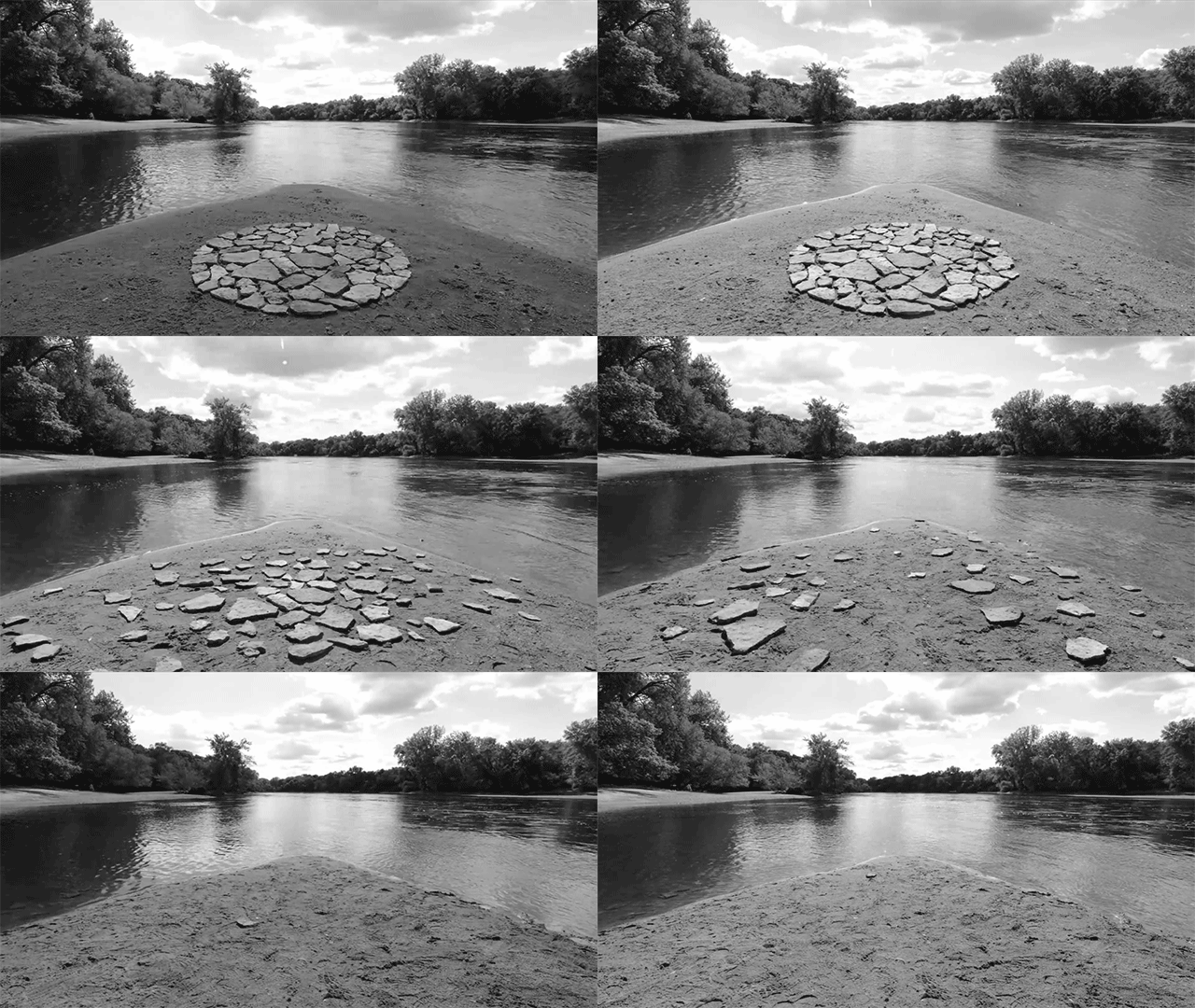
Animated Land Art by Paul Johnson

For his ‘Earthworks in Motion’ series, artist Paul Johnson takes inspiration from such legendary land artists as Andy Goldsworthy and Jim Denevan, using some of the same techniques but crafting them into stop-motion animations filmed in parks and nature preserves around Minneapolis/St. Paul, Minnesota.

Ash Dome by David Nash

In 1977, sculptor David Nash secretly planted and trained a circle of 22 ash trees to grow into a shape resembling a vortex on an area of land in Wales. 40 years later, they’ve grown enough for the shape to be discernible. Nash says that at the time, during the Cold War and other unrest, planting something that couldn’t be properly enjoyed until the 21st century seemed like a leap of faith.

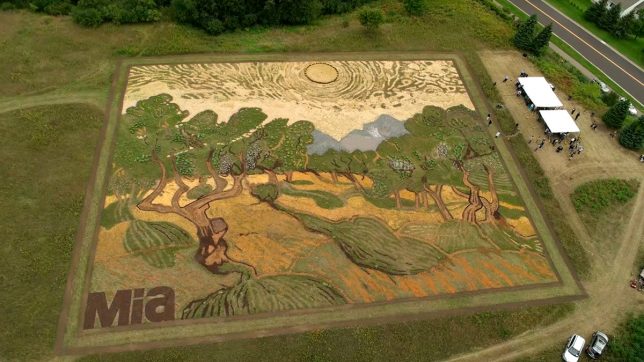
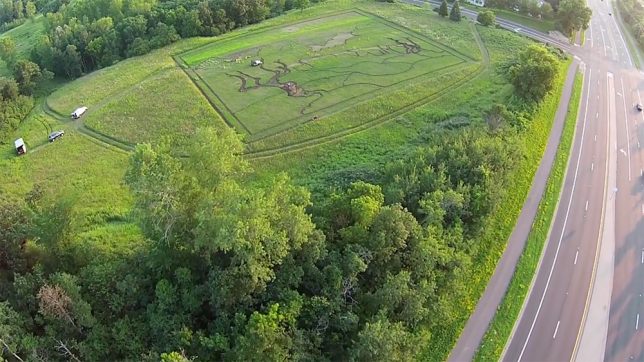
Van Gogh’s ‘Olive Trees’ Planted in a Field

Vincent Van Goh’s masterpiece painting ‘Olive Trees,’ completed in 1889, comes to life – literally – in a Minneapolis field as artist Stan Herd uses nature as his canvas and paints. The piece was viewable from the air during autumn 2015 and then mowed down in concentric circles reminiscent of Van Gogh’s painting strokes.

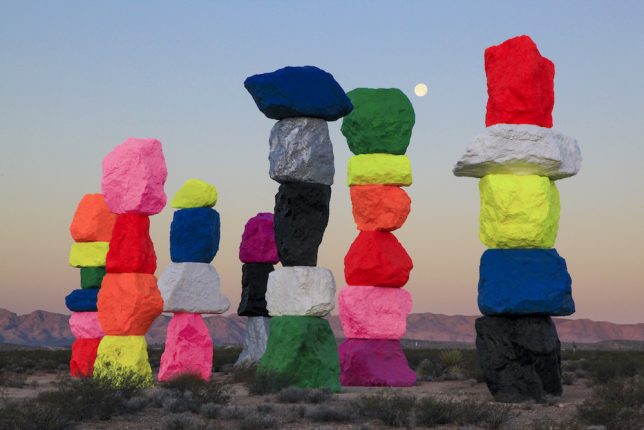
Seven Magic Mountains by Ugo Rondinone

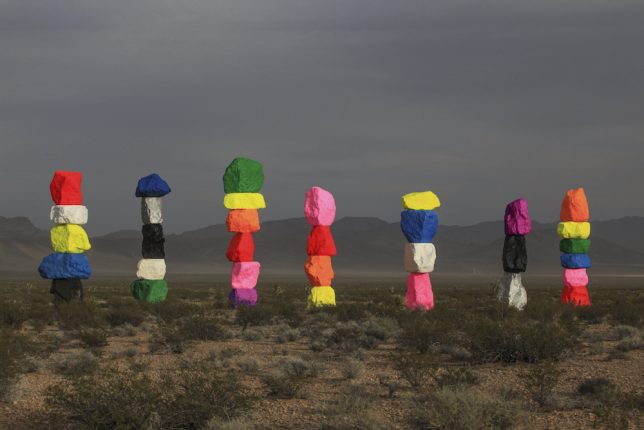
Each of Swiss artist Ugo Rondinone’s ‘Seven Magic Mountains’ made of stacked limestone stands between 30 and 35 feet tall painting in dayglo yellow, red, pink, silver and other colors. They’re set just south of Las Vegas as a monumental work of land art, installed in May 2016 and due to remain in place until May 2018, so there’s still time to see it in person.

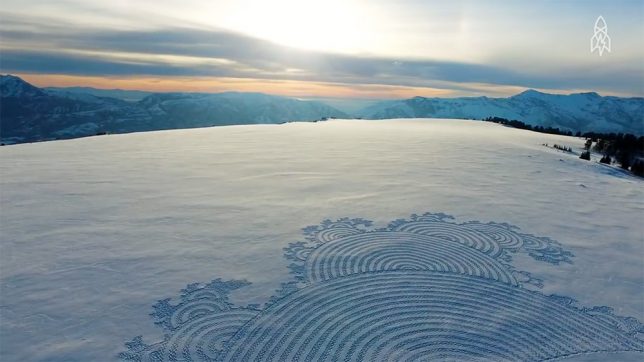
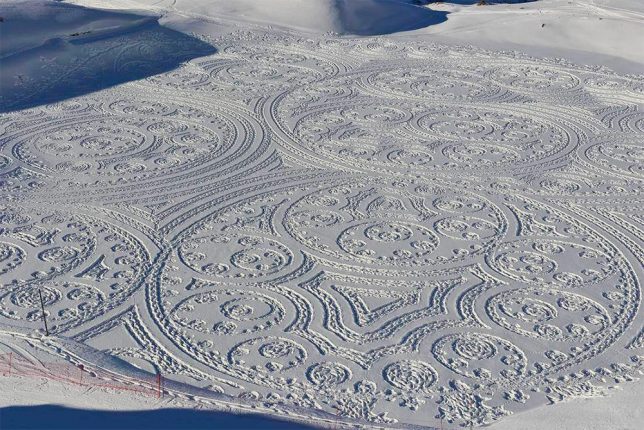
Snow Murals by Simon Beck

Simon Beck uses snowshoes to manually imprint dazzling patterns and shapes into snowy fields, photographs them from above and then allows them to be blown away, covered by more snow or trampled. It can take up to 5,000 steps an hour for 10 hours at a time to complete an average piece.

Next Page – Click Below to Read More:
The Earth As A Canvas 25 Monumental Works Of Land Based Art

Share on Facebook


[ By SA Rogers in Art & Installation & Sound. ]

[ WebUrbanist | Archives | Galleries | Privacy | TOS ]


WebUrbanist

 
Comments Off on The Earth as a Canvas: 25 Monumental Works of Land-Based Art

Posted in Creativity


A visual history of Canon autofocus and how it works today

16 Jun

This short video does an excellent job explaining how autofocus systems work, without over-complicating the subject matter. It touches on the various types of autofocus systems in Canon cameras as well as specific features like subject tracking and Dual Pixel AF.

It starts with the dawn of autofocus and moves on to modern day from there. And though it is marketing material from Canon USA, it’s still worth a watch. In fact, it got us thinking about how incredibly far AF technologies have come in just about 30 years. Imagine where we’ll be in another 30.

Articles: Digital Photography Review (dpreview.com)

 
Comments Off on A visual history of Canon autofocus and how it works today

Posted in Uncategorized


Murals with a Message: 23 Works of Statement-Making Street Art

22 May

[ By SA Rogers in Art & Street Art & Graffiti. ]

Banksy may be the most famous street artist addressing topics like capitalism, war, the refugee crisis and environmental degradation, but he’s far from the only one. These political works by a wide range of international artists call attention to the ravages of the palm oil industry, police brutality, climate change, rapid industrialization and human trafficking with powerful visuals in public places.

Ernest Zacharevic, Isaac Cordal & Strok: Splash and Burn

In western Indonesia, on the island of Sumatra, the palm oil industry is ravaging the forests, cruelly killing and displacing species like the orangutan. The ‘Splash and Burn’ project, curated by Ernest Zacharevic, aims to call attention to these issues through art installations by international creatives. Ernest’s own contribution is a gut-wrenching mural of the forest on fire as an orangutan tries to escape, while Strok’s shows how workers attempt to rescue orangutans clinging to life in mostly-destroyed forests. Isaac Cordal, who’s known for his street installations of miniature figures, shows recovery efforts in action, along with a striking representation of those who get rich on the industry.

Sophia Dawson: Police Brutality

Brooklyn artist Sophia Dawson has painted many hard-hitting murals in her own city, including the two shown here, which say “We Want an Immediate End to Police Brutality and Murder of Black People’ and educate the public on their rights. “I endeavor to create a narrative art that addresses human and political struggle,” says Dawson. “In doing so my aim is to convey the true stories and experiences of oppressed people from political movements in ways that more broadly form, shade and convey the individual and collective injustices they face.”

NeverCrew: Environmental Tragedies

The Swiss street artist duo known as NeverCrew (Christian Rebecchi and Pablo Togni) created a series of public murals addressing climate change, women asylum seekers and other issues throughout 2016. Of ‘Black Machine,’ the image of the polar bear covered in oil, the artists say “Playing with the line of sight of the forced point of view from the sidewalk and inspiring us to the theater (on whose wall was made the painting,) we decided to work on the idea of representation intended in a broad sense as portrayal, as performance and as a figuration of reality. We used direct references to the theatrical context to define a ‘real’ proportion and a starting point, but we wanted to move the attention on global warming related to human habits. We have then developed these issues trying to evoke the position (and responsibility) of man in a delicate balance, into the ecosystem, and so the choice points of view, of real awareness and the idea of a passive condition in a system.”

Sr. X: Capitalism Critiques

Spanish artist Sr. X completed this rooftop mural on an old billboard platform on London’s Great Eastern Street, with a pointed critique that requires no further explanation.

Pejac: The World Going Down the Drain

The world threatens to melt through a storm drain into the sewer below in this Santander, Spain street piece by Spanish artist Sylvestre Santiago, better known as Pejac.

Next Page – Click Below to Read More:
Murals With A Message 23 Works Of Statement Making Street Art

Share on Facebook


[ By SA Rogers in Art & Street Art & Graffiti. ]

[ WebUrbanist | Archives | Galleries | Privacy | TOS ]


WebUrbanist

 
Comments Off on Murals with a Message: 23 Works of Statement-Making Street Art

Posted in Creativity