RSS
 

Posts Tagged ‘want’

So You Want to Be a Stock Photographer, Part II

18 May

Preface:  There will be no images included in this entry. The point is to have the reader start reviewing the work of  great stock shooters. Stock photography is work and part of that work is research.  In this entry I have dropped names and agencies.  Now the research begins. Check out Part I of this series here. -DW

Stock photography has been going through an evolutionary process since the beginnings of photography as a popular hobby, and continues to be an industry in search of itself. The foundation is well established, but the end means is being continually in a state of flux by technology.

From its inception stock photography has been the process of making photographs on a speculative basis, for the most part, and despite the changes in the industry this notion has not changed.  Up until the early 1980’s, the collectives and libraries concentrated on global spot news, photo essays and photojournalism with a particular emphasis on editorial content.

One of the most respected of these original agencies, Black Star, who opened their doors in 1936, and remains a force in the editorial world to this day.  Many of the leading magazines, such as Time and Life, owe countless covers and visual content to Black Star, and its stable of noted photographers such as Robert Capa, Henri Cartier-Bresson, and other others.

Capa, Cartier-Bresson, and fellow photographers George Rodger and Chim Seymour would eventually move on and start the agency Magnum Photos. Magnum also attracted the best shooters of the day and concentrated on covering global wars and human interest photo essays.

Both Black Star and Magnum continue to be leading editorial content providers and are very selective of the photographers they will represent, ensuring editorial integrity as a cornerstone of their respective businesses.

Although there were stock houses concentrating their efforts on licensing commercial and advertising photography before the 1980’s, Miller Services and  Comstock were several of earliest libraries that blazed the way for photographers to have the possibility of earning a living shooting stock images exclusively.  As commercial image libraries matured, along came the likes of Tony Stone, Masterfile, Image Bank and many others. These agencies would license image rights, as opposed to selling a picture in what was known as a Rights Managed business model. Consequently an advertiser licensing the image could be assured of not having the image also licensed by a competitor, and this exclusivity came with a premium pricing formula.

Several of the early agencies accepted image out-takes from assignment shoots; however, they soon realized good stock photography had a unique look and feel and those agencies that didn’t maintain high content standards were eventually swallowed and spit out by the dedicated and exclusive stock houses.

During the so-called heydays of the 90’s and early into the new millennium, skilled stock photographers were experiencing annual sales figures in the hundreds of thousands of dollars, or more.  Many photographers would claim their average license fee was in the vicinity of $ 400 per license, and monthly revenue with the better agencies could be estimated to average around $ 17.50 to $ 20.00 per image on file, per month, and with some select artists that number was much higher. These were no longer the days where stock images were outtakes from an assignment, but highly executed imagery with very sophisticated and targeted approaches to visually portray the art directories anticipated copy writing.

In the early 1990’s Corel™, out of Ottawa, Canada, started buying images outright for inclusion in CD bundles that being sold to a relatively new player in the field – desktop publishing.  By the mid-90’s Adobe Photoshop™ was coming into the mainstream, and digital camera’s of some consequence were starting to appear by the year 2000.  Next was the digital revolution and the start of a whole new business model in the world of stock photography.

In 2000, based out of offices in Calgary, Canada, a new upstart called iStockphoto would turn the stock photo business into a period of uncertainly.  Based on a concept of primarily giving access to amateur photographers the opportunity to earn a few bucks from their pictures, microstock was born. No longer was stock photography the exclusive milieu of dedicated full time image makers.

Seasoned stock photographers had difficulty comprehending why anyone would want to give an agency their work for a royalty as low as 15%, especially when traditional stock was providing photographers, on average, 50% of the license fee. There was even further confusion when the micro agencies demanded the photographer ensure the image was categorized, captioned, keywords applied and a myriad of other backend metadata duties became the requirement of the photographer; this work that had previously been completed by the agency as part of their cost in the Rights Managed world.

Many cigar chomping photographers dismissed this new revolution that came crashing at their doors in the form of microstock. Within a very few years there was a deluge of microstock agencies available to photographers —mostly amateurs with no previous skill or training—but with the technology advances in both cameras and post production software it quickly became inevitable this tidal wave was here to stay and would be a storm that would inflict change in its evolutionary wake.

Many agencies today continue to offer Rights Managed content for their clients, clients who require the knowledge that they have the opportunity to license an image with some degree of exclusivity. These rights managed images continue the trend of being highly executed stock images with unique looks and feel. The same agencies also offer Royalty Free images for those clients who are not concerned if their business competition uses the same images in similar media.

While microstock initially featured the work of amateurs, there have been professional photographers who have learned how to make the model work for them, and, indeed, work very well. However, the majority of microstock contributors continue to be the part-time pro, or amateur, who are complacent with potentially earning a few bucks for pizza and beer.

It really is anyone’s guess at this juncture what the long term prospects for stock photography as a business will be, and whether the photographer will have the capacity to develop a successful business model. The one thing that is showing trends is the very fact that a phenomenal number of images are being loaded to stock photography portals every day. As with any business, stock photography also subscribes to the concept of supply and demand. With such an oversupply of certain categories the price for images has plummeted. In some cases agencies are giving away images for free in an effort to keep those potential clients who are browsing their site.

One thing is certain, good stock images will always be in demand. The question is whether they can be created and marketed in such a manner that everyone can earn a living? With a royalty retention of 20%, or less for the photographer, it is highly unlikely the ROI (Return on Investment) will be sufficient to justify being a full-time, exclusive stock photographer.

Who knows, in 5 years everything will probably have changed again.

Postscript:  In Part III we will start discussing the process of how to learn what makes a stock photograph. 


Post originally from: Digital Photography Tips.

Check out our more Photography Tips at Photography Tips for Beginners, Portrait Photography Tips and Wedding Photography Tips.

So You Want to Be a Stock Photographer, Part II

Digital Photography School

 
Comments Off on So You Want to Be a Stock Photographer, Part II

Posted in Photography


Tell Us What You Want Out of a dPS Redesign

13 May

It has been a couple of years since we did a complete overhaul of the design of dPS so over the coming months we’ve commissioned a team of designers and developers to give our site a once over – and we’d LOVE your feedback!

So now is your chance to tell us what features and design elements you’d love to see on the newly designed dPS.

Is there something missing that you’d like to see added? Is there a feature on another site that you’d love to see here?

You’re welcome to give feedback upon the blog area, the forum area or even our social media accounts (Facebook, Twitter, Pinterest etc).

Feel free to tell us what you honestly think (as long as you’re constructive that is) – we’ll keep this post open for comment for a day or two before closing it off to pass onto our team.

Thanks – ultimately dPS is nothing without you as readers so we can’t wait to hear what you’d like to see to make it even better than it is.

It’ll be a couple of months before you notice too many changes but rest assured we’re listening to your feedback today!

Post originally from: Digital Photography Tips.

Check out our more Photography Tips at Photography Tips for Beginners, Portrait Photography Tips and Wedding Photography Tips.

Tell Us What You Want Out of a dPS Redesign


Digital Photography School

 
Comments Off on Tell Us What You Want Out of a dPS Redesign

Posted in Photography


So You Want to be a Stock Photographer, Part I

16 Apr
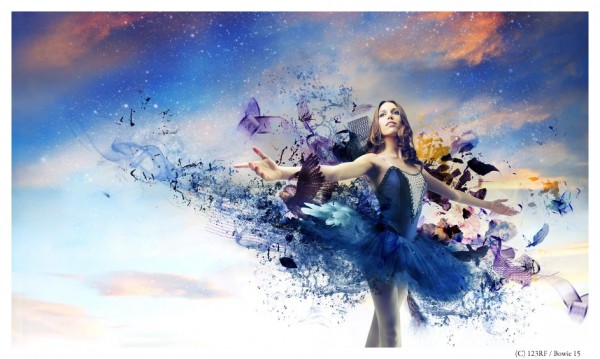
The photographer has spent a fair amount of time creating this image both in shooting the elements and model, and compositing in post production.  But as a stock image - what does it say?  How will the end user use the image for their messaging?  License cost was 3 credits or about $  2.58; photographer will receive about 52 cents.

The photographer has spent a fair amount of time creating this image both in shooting the elements and model, and compositing in post production. But as a stock image – what does it say? How will the end user use the image for their messaging? License cost was 3 credits or about $ 2.58; photographer will receive about 52 cents. How much is the photographers time worth?

A few weeks back there was an opinion piece posted on dPs that raised the ire of many, and garnered supporters from others.  The fact remains that while it was an interesting read from a single individual, there were several inaccuracies in that piece.

First,  iStock was not the first microstock agency to enter the marketplace; the most widely known perhaps, but it definitely was not the first.  That claim to fame can be laid on another Canadian upstart – Corel.  While I can’t recall the exact dates, in was around 1993-94 time frame when Corel started to purchase images outright for inclusion in CD bundles and incorporation in Corel Draw and Word Perfect. In those days it was pretty much called clip art.  Now it can be argued that Corel wasn’t a microstock agency. I would suggest they were as they purchased images from amateurs and professionals alike. The only difference between them and an iStock, for example, was that Corel purchased the rights and owned the image whereas the microstock agencies today simply work on a royalty basis with the contributor.

The other inaccuracy in the article was the implication that agencies only provide 20% royalty to the photographer.  In some cases this may be true; however, there are also agencies that provide 50% royalty to the contributor, and any percentage combination below that which you can think of.  Usually, the extreme low percentages are in microstock and traditional agencies marketing RF images.  However, in order to compete traditional rights managed agencies are also making package and bundle deals that can see rights managed license fees dramatically reduced to levels even below royalty free image fees.

But let’s not get hung up on the 20% royalty. Yes, the contract most likely states that the photographer will receive 20% royalty from “monies received.” Let’s put that in context.  Somewhere else in that contract you are most likely giving the agency the exclusive right to redistribute the image through their other supply networks.  What this means is that you will not get 20% of the purchase price, but 20% of your contracted agencies receipts.

Put in context it translates to this:  Photographer A makes an image available to his contracted agency – let’s call them Agency X.  Agency X then places that image in the redistribution circuit with Agency Y.  (Photographer A usually does not know who Agency Y is or what the financial arrangement between Agency X and Agency Y might be.)  Agency Y licenses the Royalty Free image to a client for $ 10.00 USD.  Agency Y then remits $ 5.00 to Agency X (assuming their split if 50%), and agency X then redistributes its 20% obligation amounting to $ 1.00USD to Photographer A.

This is a really nicely executed stock image. Are the two ladies friends, or lovers? Is this image about fashion, seasons, or simply looking toward the future? The image provides options for the copy writer, and the more options provided typically the better sales. However, this image has only been licensed twice in more than one year. The license for appearance here cost one credit or about 60 cents; the photographer will receive, unfortunately,  about 12 cents.

This is a really nicely executed stock image. Are the two ladies friends, or lovers? Is this image about fashion, seasons, or simply looking toward the future? The image provides options for the copy writer, and the more options provided typically the better sales. However, this image has only been licensed twice in more than one year. The license for appearance here cost one credit or about 60 cents; the photographer will receive, unfortunately, about 12 cents… it is most definately worth more just in production value alone.

So as you can see, if you are signed with a small agency who more than likely is clamouring to get their material with the large image machines that have far reaching marketing clout, you are more than likely only going to receive 10%, or less, of the initial license price.

Let’s put this financial translation into further context.  I am going to assume you are a Canon user, and you need a new popular lens; let’s say the 70-200mm F4L which retails for about $ 700.  You offer that you can warrant purchasing the lens because of your stock sales and over time you will recover the purchase price.  But wait, when you receive the $ 1.00 from that sale, that is not a deposit in your bank account.  How much time did you take to edit and prep the image by sizing and ensuring the right colour space? How much time did you spend ensuring the correct metadata and keywords were applied. How much is your time worth?  Now that you have received your royalty I suspect you have the usual income tax deductions that can range anywhere from 15-40% depending upon where you live. And on it goes – the list of expenses is endless. However, a general rule of thumb is to endeavour that you would like to retain 30% of your gross income as profit … although many stock photographers today are suggesting they are in a negative profit position and are getting out of the business.

Therefore, and assuming we are going to keep good business practises and retain 30% of the gross sale, we would have 30 cents from each sale from which to purchase that lens. (I don’t want to get into the minutiae of whether or not your capital reserve is included in your business plan.)  Quick translation realizes that we would have to make 2,333 sales in order to purchase that lens!  I can tell you that in more than 20 years as a full time stock photographer I have not had one image be licensed for even half that many times.

So the point of this primer on the financial benefit of the microstock industry and part-time photographer is this: There probably isn’t any financial benefit and in all likelihood it will cost you money.

So yes, if you want to continue shooting for pizza and beer go for it; but at the same time you should calculate all your costs, including time, to see if you would be further ahead by spending that time and money with family.

In the next installment we’ll take a look at cost per image versus return per image.

Post originally from: Digital Photography Tips.

Check out our more Photography Tips at Photography Tips for Beginners, Portrait Photography Tips and Wedding Photography Tips.

So You Want to be a Stock Photographer, Part I


Digital Photography School

 
Comments Off on So You Want to be a Stock Photographer, Part I

Posted in Photography


Aussies: Do You Want to Attend a dPS Portraits Workshop?

20 Dec

Do you live in or near Melbourne Australia (or are able to get there)? If so – we’re thinking of holding our first dPS photography workshop in 2013. The topic will be ‘Taking Great Portraits’ and the in structure is a leading Aussie portrait photographer.

We’re still finalising the details but to help us plan we’re looking to see what level of interest there would be in such an event.

If you’re interested in attending workshops and live in or can get to Melbourne please leave your email address below.

It will help us get an idea of the level of interest but will also enable us to shoot you an email in the new year with information on what we’re planning.

If you’re not in Melbourne – stay tuned – we’d love to take these workshops on the road at a later time.

Post originally from: Digital Photography Tips.

Check out our more Photography Tips at Photography Tips for Beginners, Portrait Photography Tips and Wedding Photography Tips.

Aussies: Do You Want to Attend a dPS Portraits Workshop?


Digital Photography School

 
Comments Off on Aussies: Do You Want to Attend a dPS Portraits Workshop?

Posted in Photography


Why You Might Want To Consider A Full Frame Fisheye Lens Even If You Have A Crop Sensor Camera

13 Nov

There are few things better in life than having something go wrong that leads to the discovery of something even better.

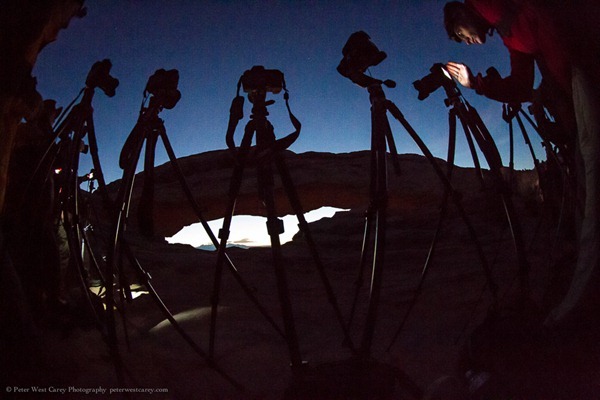
Such is the case with my plan to test out a Canon 8-15mm fisheye lens courtesy of BorrowLenses.com. My intent with the lens was to take it with me to the wilds of Arches and Canyonlands National Parks in Utah for some crazy, circular images. The problem is I lack a full frame Canon camera, but would be traveling with Michael Riffle, who owns a Canon 5D Mark III. He accepted the challenge to test the lens, being familiar with fisheyes himself.

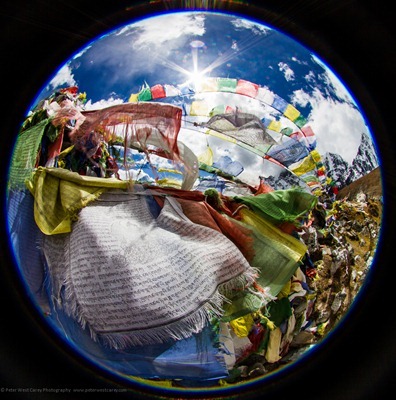
One thing led to another and we never got around to testing the lens on his camera. Instead, I often found myself using the lens on my Canon 7D, a crop sensor camera. The Canon 8-15mm is intended to fit a full frame sensor and produce, at 8mm, a fully circular image, much like this example from a Sigma 4.5mm on a crop sensor camera.

PeterWestCarey-Nepal2011-1008-9891

What happened instead was a cross between this full circle and a more traditional 15mm on a crop sensor. The 8-15mm lens will show edges of the circle when below 10mm but will otherwise fully cover the sensor from 10mm-15mm. A major difference from a non-fisheye lens, though, is the curving in the image.

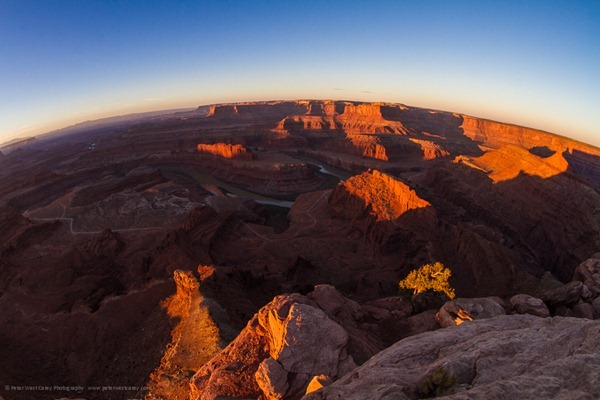
For instance, here are two shots, both taken at 10mm. The difference: the first lens is a non-fisheye Canon EF 10-22mm lens and the second is the Canon 8-15mm fisheye.

PeterWestCarey-Utah2012-1021-7193

PeterWestCarey-Utah2012-1021-7187

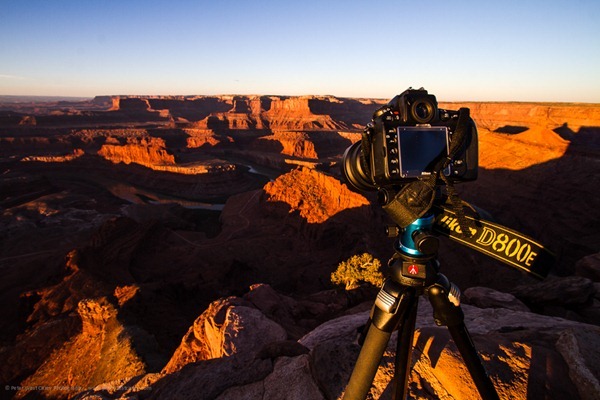
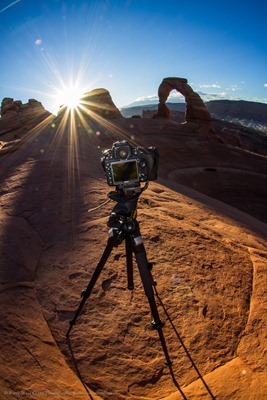
Both shots are taken from nearly the same perspective (the fisheye is taken from the position of the Nikon D800E in the first image) but the fisheye gives a different feel. I only made slight clarity and level adjustments in the photos and did not crop them, so this is what you can expect at 10mm.

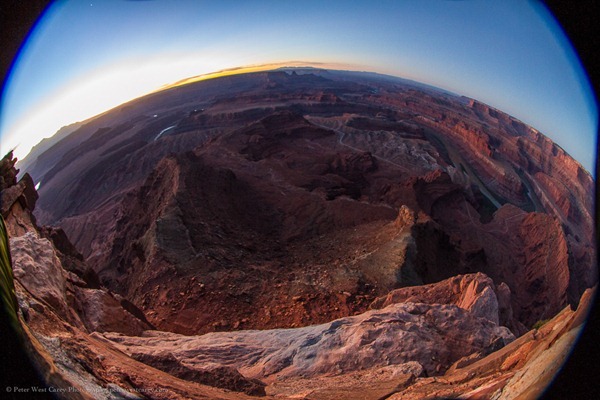
Below 10mm the black edge of the area outside the fisheye is seen. How bad is it? It depends.

At first it annoyed me to have the incomplete image. Neither full fisheye nor filled frame. Like this:

Peter-West-Carey-Utah2012-1021-7155

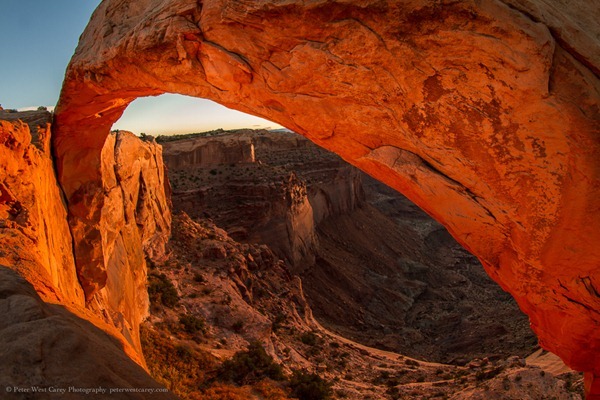
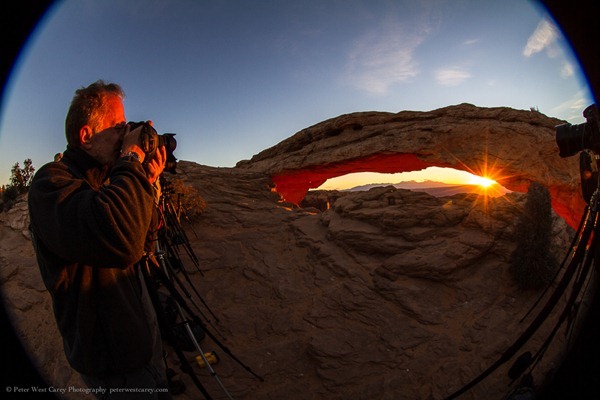
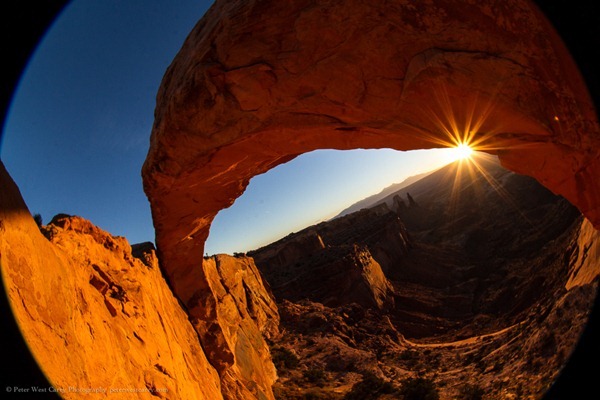
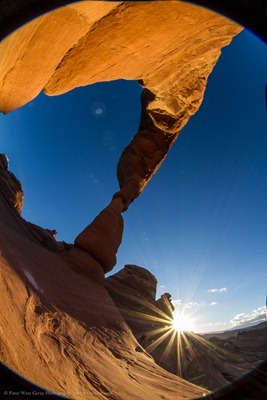
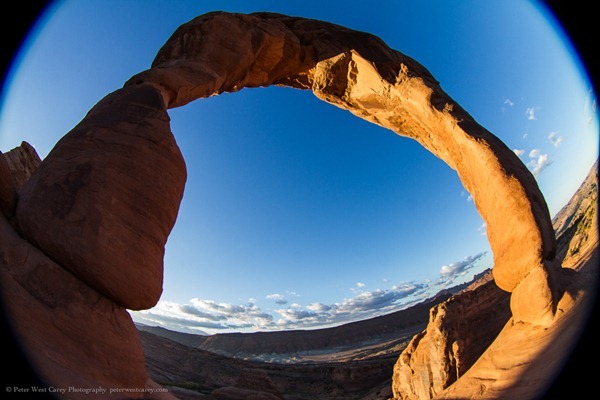
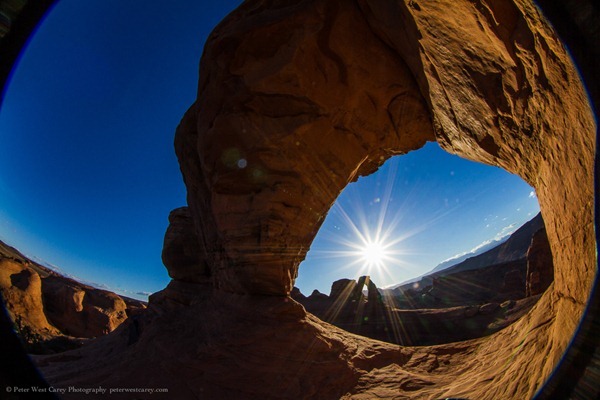
But then I started finding instances where it worked well. The arches found in these parks lent themselves naturally to the form factor. The more I experimented, the more I enjoyed the effect.

I realize not everyone will like this look. By the time you read this, there might be a dozen notes in the comment section below stating how horrible it is. But this is photography and it is art, so it doesn’t really matter what I like or the commenters like. It matters what you like.

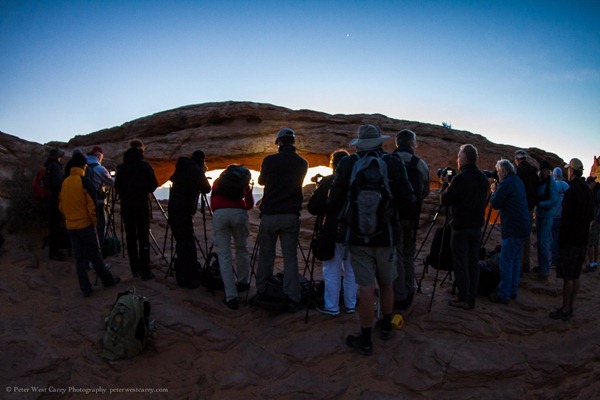
Below are more examples from my short trip. If they intrigue you to give the lens a try, all the better. Some have the corners blacked out and some are zoomed in slightly. Experiment, play, have fun.

(Click on an image for a 1000px version)

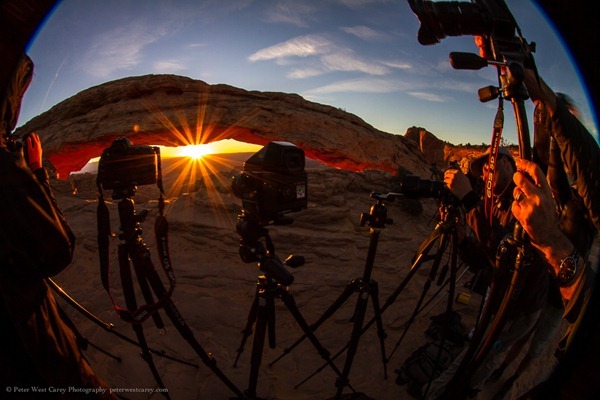
The first set of images are from Mesa Arch in Canyonlands NP at sunrise which was packed with 20 or more photographers. The second set is from Delicate Arch in Arches NP at sunrise with absolutely no one else around.

Peter-West-Carey-Utah2012-1022-7348

Peter-West-Carey-Utah2012-1022-7392

Peter-West-Carey-Utah2012-1022-7445

Peter-West-Carey-Utah2012-1022-7451

Peter-West-Carey-Utah2012-1022-7456

Peter-West-Carey-Utah2012-1022-7500

Peter-West-Carey-Utah2012-1023-7955

Peter-West-Carey-Utah2012-1023-7961

Peter-West-Carey-Utah2012-1023-8001

Peter-West-Carey-Utah2012-1023-8010

A special thank you to BorrowLenses.com for giving me the chance to play with the lens.

Post originally from: Digital Photography Tips.

Check out our more Photography Tips at Photography Tips for Beginners, Portrait Photography Tips and Wedding Photography Tips.

Why You Might Want To Consider A Full Frame Fisheye Lens Even If You Have A Crop Sensor Camera


Digital Photography School

 
Comments Off on Why You Might Want To Consider A Full Frame Fisheye Lens Even If You Have A Crop Sensor Camera

Posted in Photography


Nikon SB-900 Speedlight Review: A Look at Nikon’s Flash Flagship and Why You Might Want to Up-Grade

05 Nov

www.artoftheimage.com – Reviewing the Nikon SB-900 Speedlight and looking at the new features and reasons you may want to up-grade.

See how easy it is to pair your iPhone / iPad, Android tablets or any compatible Bluetooth devices to the ZiiSound Wireless Modular Speaker System. Learn more: www.creative.com

 
Comments Off on Nikon SB-900 Speedlight Review: A Look at Nikon’s Flash Flagship and Why You Might Want to Up-Grade

Posted in Nikon Videos


Flame On! 19 Fire Hydrants You’ll Want To Use

26 Oct

[ By Marc in Art & Street Art & Graffiti. ]

Fire hydrants are looked down on by everyone who isn’t wearing a firefighter uniform. They prevent you from parking, they block the sidewalk… even dogs mistreat them. Some urban artists have decided to help out this urban landmark and give it a confidence boost.

(Images via csuohio, wumc, csuohio, smartcarvs)

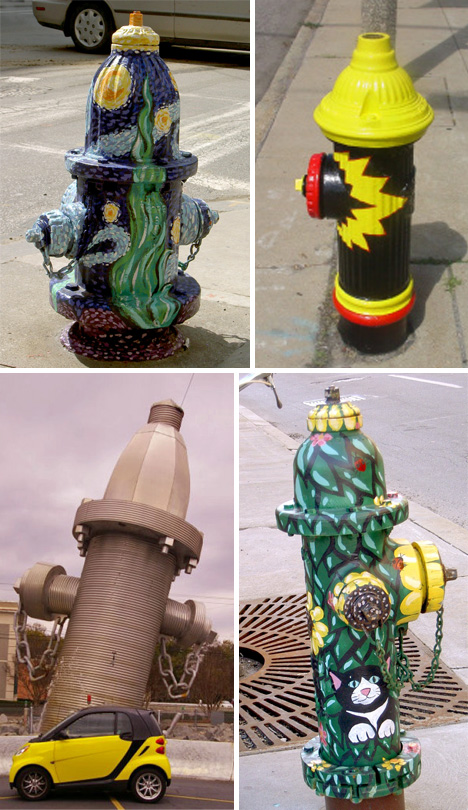
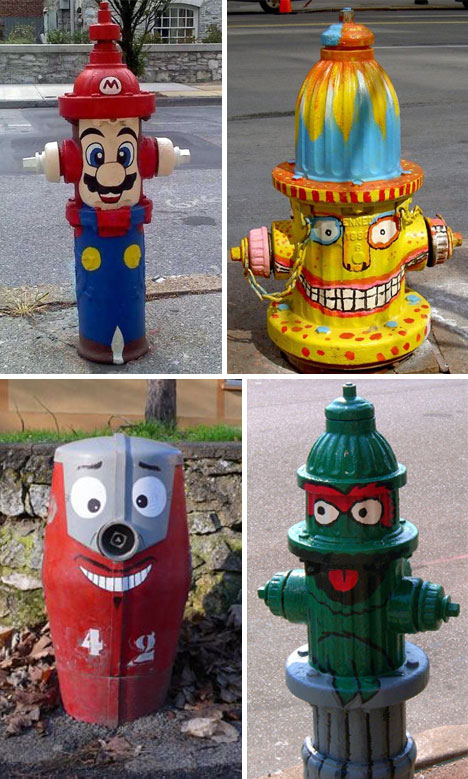
Van Gogh’s Starry Night gets a remake with this example of fine art on the street. Washington University Medical Center decided to team up with artist Grace McCammond to decorate their hydrants, and this is one example of the cool designs she created. To give dogs a little more fun when they’re doing their business, the bottom left hydrant prominently features a cat, at the perfect level. Lastly, a Smart Car is contrasted with a huge structure with the definite appearance of a hydrant.

(Images via csuohio, windingpathtravel, carlbrookschool, portajohn)

It’s natural to anthropomorphize objects in our daily lives, and fire hydrants are no exception. An artist had a lot of fun creating the top left portrait, using bright colors and an abstract eye. The top right hydrant is a powerful lumberjack, found along with dozens of other hydrant people in Quesnel, British Columbia. South Boston features this colonial figure, painted to celebrate the city’s history. Lastly, this hydrant features an old style diver, and resides in Solomons, Maryland.

(Images via oldstersview, brooklynstreetart, killingdenouement)

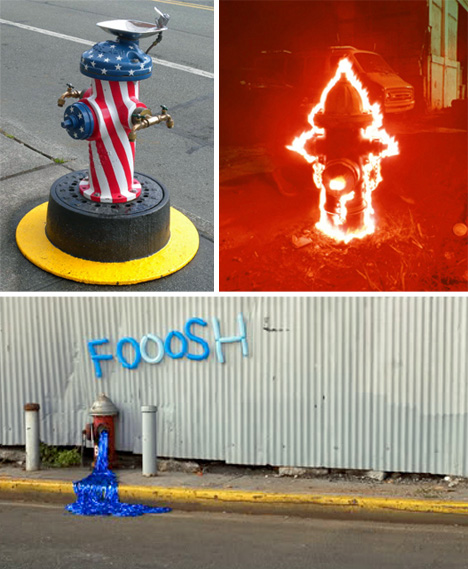
This fire hydrant serves multiple purposes, including being a water fountain. It’s a great multi-use set up and it has some patriotic flair as well – found in Washington state. Artist Gary Stubelick came up with this bright photo, by setting a fire hydrant ablaze. Brooklyn artist DBILLY created the last piece, out of balloons!

(Images via walyou, inventorspot, mightylists, streetartmafia)

The Super Mario Bros. have saved the day a lot, so why not let Mario save the day if there’s ever a fire in the neighborhood? Mario would definitely be preferable to the frightening yellow face painted on the top right hydrant. There’s no doubt that everyone wants Oscar the Grouch on their street corner, so why not make him a permanent addition? Last but not least, a cute fire hydrant will make the kid’s laugh even if it isn’t a recognizable character.

(Images via grinding, animalhousepetcare, pennlive, nowthatsnifty)

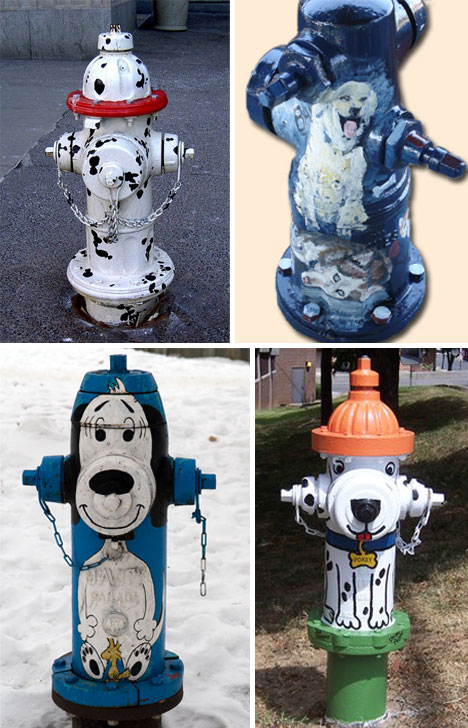
For several reasons, it’s fitting and hilarious to put a dog on a fire hydrant. The first hydrant makes this abundantly clear, with its transformation into a Dalmation, the well known mascot of firefighters everywhere. In Carlsbad, California, the Animal House Fire Hydrant was created as part of a community art project and charity event. Meanwhile, Harrisburg, Pennsylvania, a fire hydrant competition caused someone to submit this cute looking pooch. Lastly, a Snoopy look-alike adorns this snowbound hydrant, keeping a happy and watchful eye over the neighborhood.


Want More? Click for Great Related Content on WebUrbanist:

Creative Japanese Urban Camouflage: From Soda Machines to Fire Hydrants

Whether they be viewed as polemical or pragmatic, this latest in the tradition of creative urban camouflage is at least entertaining and arguably even practical.
15 Comments – Click Here to Read More »»


Flame Fame: 12 Red Hot Designer Fire Stations

These 12 hot designer fire stations are hook & ladder leaders in more ways than one, combining WYSIWYG practicality with livability, economy and style.
1 Comment – Click Here to Read More
»»


Share on Facebook


[ By Marc in Art & Street Art & Graffiti. ]

[ WebUrbanist | Archives | Galleries | Privacy | TOS ]


WebUrbanist

 
Comments Off on Flame On! 19 Fire Hydrants You’ll Want To Use

Posted in Creativity


so you want to be a landscape photographer

21 Oct

www.dombower.com This video i tell you the basic needs for a “landscape” photographer. from the type of camera and lenses to the attituded needed.
Video Rating: 4 / 5

Fifty/Fifty is a personal project by Belgian professional photographer Bert Stephani (www.bertstephani.com). For 50 days Bert will shoot whenever and whatever he can with a full frame camera (Canon 5D mkII) and a 50mm lens. The goal of this project is to become a better photographer by training his photographic eye, working with limited equipment and shooting subjects that Bert is not familiar with in his regular assignments.
Video Rating: 4 / 5

 
Comments Off on so you want to be a landscape photographer

Posted in Photography Videos


So You Want to Keep your Camera Safe? Here’s How

18 Oct

A Guest Post by Ben Evans

So we got my girlfriend her first proper camera last week. A Nikon D5100 with a 35mm f1.8 prime lens; which is my recommendation for a modest budget. She’s super excited, not least because she’s got something to do now when I’m photographing!

New Photographer!

Barcelona is great but while there’s not much violence, it rivals Naples for petty theft.

I’ve learned a lot from photographing here, so I put together this guide about keeping your camera safe. My girlfriend and students have found it really useful so I thought I’d share it with you too.

1. Insure It

Some manufacturers have long warranties that are useful, but look for additional insurance against accidental damage and theft. Camera insurance is pretty reasonable now.  
Shop around and see what you can find. You might even be covered by your home insurance; worth checking.

2. Use the Camera Strap

Some people don’t. Do! It’s often saved my Nikon from a fall. Make sure it’s securely attached, and keep it wrapped twice around your wrist when you’re shooting.

Otherwise, wear the camera either across your body with the top nearest your hip, or on one shoulder with a rucksack worn over the top.

This keeps the lens closest to you and prevents theft, which is becoming more common.

The strap that came with your camera probably has a bright logo which only attracts thieves; keep it hidden or get a new strap.

Upstrap is good because they’re ‘sticky’, but avoid getting anything with buckles because they’re not safe.

3. Adopt the ’Backward Look’

When you leave anywhere, have a good look behind you before you go.

This has saved me hundreds in lost gear already! It’s surprisingly easy to forget a new camera when you’re in a rush.

4. Sand and Water Kills Cameras

Sand acts like grit, destroying from within. I normally don’t recommend a UV filter to protect your lens, but found one essential in the Sahara desert when storms sand-blasted the glass.

Sahara Sand Storms

Closer to home, I’ve had more than one camera die at the beach. Even a quick dip will put an end to the toughest dSLR, though the photos on the memory card will probably be okay. Surfing shops sell dry-bags that will protect your camera from water and sand.

5. Your Sensor Attracts Dust

This shows up as small black spots or lines when you use small apertures like f22.

Some try and shake it off, which helps a bit, but isn’t totally effective. Prevention is much better than cure.

You need special, overpriced tools to clean your sensor, and the process is a pain in the arse! Also, every time you clean the sensor you damage it a bit; and it’s all too easy to ruin it if you slip.

So avoid having to clean it by only changing lenses when necessary, keeping the camera held downwards when you do.

Try not to change lenses in dusty or windy environments. And don’t clean it when there’re only one or two tiny specks of dust in the photos. It’s pretty easy to airbrush them out; Photoshop is your friend.

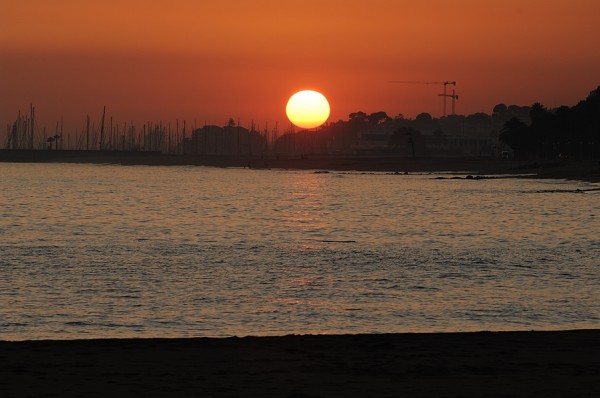
Beach & Sea Sunset

6. Never lend your Camera

Unless they are happy to replace it if it breaks; which they won’t be! Accidents happen, and it’s not worth upsetting a friendship for.

It goes without saying that asking strangers to take photos of you risks having them run away with it.

If you must, choose someone who looks trustworthy; and who you could outrun!

7. Don’t let People in your Bubble

I actually opted for a Krav-Maga training course instead of camera insurance when I was travelling around Bosnia. This idea of personal space was one I learned there.

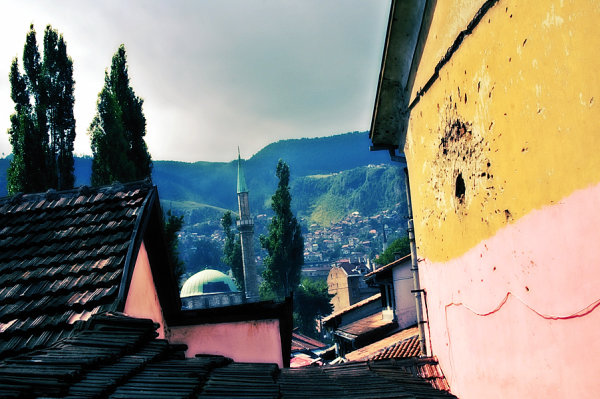
Downtown Sarajevo, Bosnia

Essentially, if no-one comes within a meter of you, it makes it much harder to have anything stolen.

Therefore, don’t accept random offers for ‘free hugs’ from strangers, nor let them get too close at all.

Either move away or tell them not to touch you. Watch Derren Brown’s videos about pick-pocketing to see how skilled people can be.

8. Scratch your Email Address on the Bottom and on the Battery

My girlfriend flat-out refused to engrave hers, so we settled on stickers! They’ll help honest souls return your camera to you, while an engraved name ruins resale value and makes it easier to trace so might help with theft. Email your serial number to yourself today.

So that’s it! Not the normal wow-factor but really essential to be aware of. I’ve taken my main camera everywhere and while it’s had a few close calls, it’s survived intact. Lots of people aren’t so lucky; follow this advice and make sure you’re not one of them! And in case you haven’t already done so, remember to get your copy of my book Photography: The Few Things You Need To Know for less than an espresso HERE NOW to ensure you get the most value from these articles.

Ben is an English Photographer who works internationally. Ben teaches photography classes in Barcelona and keeps a photoblog of ‘fine art street’ photos of Barcelona at www.i-Barcelona.com.

Ben is working on two photography teaching projects, Better Than 90 Percent and Holistic Photography.

He shoots Nikon, Hasselblad, Apple (iPad 3) and those little throwaway waterproof film cameras with the plastic lenses.

Post originally from: Digital Photography Tips.

Check out our more Photography Tips at Photography Tips for Beginners, Portrait Photography Tips and Wedding Photography Tips.

So You Want to Keep your Camera Safe? Here’s How


Digital Photography School

 
Comments Off on So You Want to Keep your Camera Safe? Here’s How

Posted in Photography


Google Chrome – Disable Plugins Such as Flash Unless You Want Them to Run

16 Oct

Show boxes inside Google Chrome when a Flash, Shockwave, Adobe Reader, or other plug-in wants to run, allowing you to click to play them.

If you are concerned about the privacy, security, and system stability implications of running plug-ins such as Flash and Shockwave inside Google Chrome, you may have thought about completely disabling plug-ins. Unfortunately, doing so makes some websites difficult, if not impossible, to access.

One option is to have Google Chrome show you when it wants to run a plug-in, but not actually do so, giving you the ability to selectively turn on a Flash widget, play a Shockwave game, display a PDF file with an external viewer such as Adobe Reader, etc….

Read more at MalekTips.
New Computer and Technology Help and Tips – MalekTips.Com

 
Comments Off on Google Chrome – Disable Plugins Such as Flash Unless You Want Them to Run

Posted in Technology