IOPU “GET DRUNK” MUSIC VIDEO FEAT.PROPHECY & MIKE,ROCKSOLID STUDIOS DIRECTED BY:RATED 2011
IOPU “GET DRUNK” MUSIC VIDEO FEAT.PROPHECY & MIKE,ROCKSOLID STUDIOS DIRECTED BY:RATED 2011
Download my first album on iTunes at this link! itunes.apple.com Like me on facebook! www.facebook.com Who is Jenny? A deep psychological question addressed in MikelWJ’s dark single “Jenny”. Download it in Mikel’s mixtape, “The First Year”. Video by Cody Powers Films: www.youtube.com www.codypowersfilms.com Camera Canon EOS 7d Lenses: Nikon 50mm f1.4 pre-ai, Nikon 200mm f4 pre-ai, Nikon 105mm f2.5 pre-ai, Tamron 17-50mm f2.8 VC
Video Rating: 4 / 5

Lake Winnipesaukee Playlist — bit.ly July 26, 2012: Jon shares a random collection of time-lapse and underwater GoPro footage from his summer vacation at Lake Winnipesaukee. ~~ Jon’s Adventure Vlog ~~ Whenever Jon ventures out into the world to do something exciting, he will take you along for the adventure! New episodes are posted sporadically, often in small bursts immediately following any traveling Jon does, so the schedule depends on when Jon actually goes on an adventure! Born in February 1986, Jonathan Paula is a professional YouTuber and creator of the hit web series, “Is It A Good Idea To Microwave This?”. In April 2006 he founded Jogwheel Productions, a new media production company that specializes in web video. Jon graduated from Emerson College in 2008 with a degree in Television Production / Radio Broadcasting. He currently lives in Rockingham, NH with his wife Rebecca. ~~ Links ~~ Main Channel —– bit.ly Twitter —————- bit.ly Facebook ———– bit.ly The World ———- bit.ly Game Time ——– bit.ly Movie Night ——– bit.ly FAQ Video ——— bit.ly T-Shirts ————– bit.ly ~~ Technical ~~ Created by —— Jonathan Paula Camera ———- Panasonic DMC-FZ150 Software ——— Adobe Premiere Pro CS5 Computer ——- bit.ly • Jogwheel Productions © 2012 • ~
Video Rating: 4 / 5
In this tutorial I go over the technique I use to retouch skin in all of my photos. enjoy! www.garettfranz.com All Music was provided by DJ Scott Brio (the guy in the picture) www.scottbrio.com
Dennis Agajanian Fast Flat Finger Picking Live at Calvary Chapel Chico, Ca. 2008 Won an CCMA Award www.dennisagajanian.com
Video Rating: 4 / 5
Become a fan on Facebook: facebook.com “Cold as Ice” was shot in December 2010 in Hamburg (Germany) with the Canon EOS 60D and a 18-135mm lens. Music: “Kool Kats” by Kevin MacLeod New blog about DSLR films, editing and HD cameras: www.fenchel-janisch.com Subscribe to our channel for more DSLR videos! http Twitter: www.twitter.com
Video Rating: 4 / 5
Music video I directed for singer song writer Jeff Redd
Video Rating: 5 / 5
The Ayuri Project NYC Photo shoot in Brooklyn newyork with photographer ayuri luciano. shot and directed by lamont goodine.
Video Rating: 4 / 5
It may be a bit late in coming, but Luminous Landscape Video Journal #20 is now ready for download.
This issue contains a visit and interview with preeminent photographer Art Wolfe, and a look at not only his work but also his gallery and home.
One of the few people to attempt the incredibly time consuming, exacting and expensive Carbon Pigment printing process is Mark Dubovoy. Issue #20 features an interview with Mark and a look at some of his original prints.
The travel segment this issue is on China, with a shoot along the Li River and in the incredible Yellow Mountains being featured.

Nomad 2 – The Long Way Home – 31.5.2011 Camera, edit, postpro – DJ Wich www.facebook.com www.facebook.com www.facebook.com www.twitter.com www.twitter.com
A guest post by Phil Hart – author of the Shooting Stars eBook (use code DPSTARS for a 25% discount).
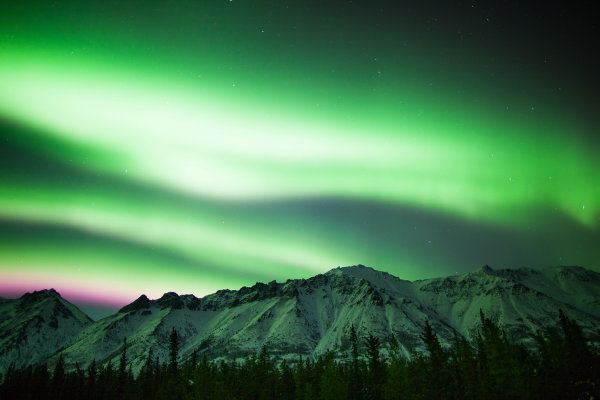
In this post, I’d like to share the back story to a new video I have released after a nine week ‘extreme astronomy’ adventure in the Yukon earlier this year, where I went to capture timelapse footage of the Northern Lights (the ‘Aurora Borealis’).
First the video, ‘Valentine’s Aurora’, which I hope you will enjoy with the lights down and the music up:
Valentine’s Aurora from Phil Hart on Vimeo.
All of the footage for this video (except the fisheye sequences) was shot on Annie Lake Road, south of Whitehorse the capital of Canada’s Yukon Territory. See this Map Link.
It was the 14th February, and only my second night out on location away from home base where I was staying on the shores of Shallow Bay, Lake Laberge, to the north of Whitehorse. The weather was good during the day and I was confident of clear skies, so I made the trek an hour and a half south. There was nothing to indicate that aurora activity was going to storm that night, but that’s the nature of aurora. When you’re this far north you have to get out whenever the weather is good and capture whatever happens. Further south, you might like to monitor the forecasts on spaceweather.com.
I could actually see aurora curtains low in the north even before the end of twilight, so I had an idea I was in for a great night, and had to get moving quickly.
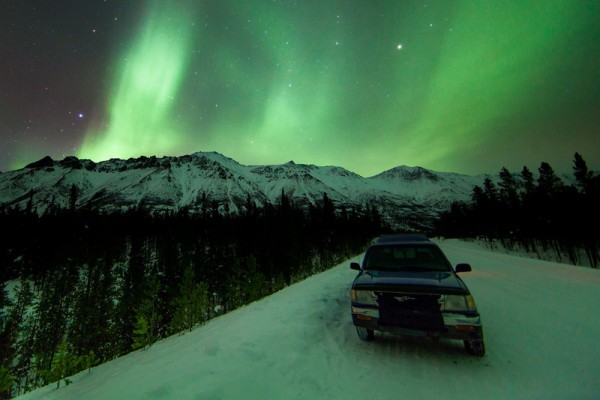
On location at Annie Lake Road: Canon 5D Mark II, 14mm lens, 30 secs, f2.8, ISO800
I used four cameras to capture all the footage in this video:
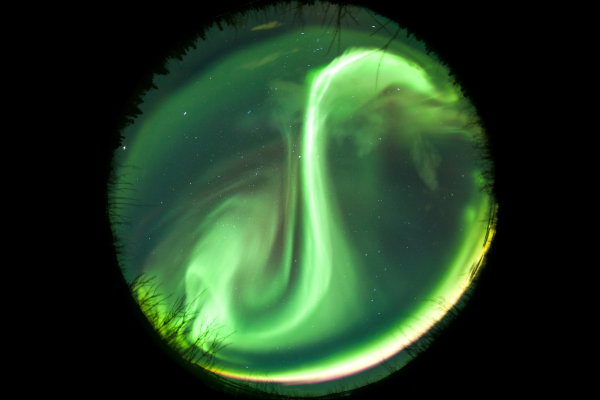
Fisheye Aurora: Canon 5D, 8mm lens, 30 secs, f3.5, ISO800
All of these lenses were used at their maximum aperture, as to capture the motion of the aurora requires exposures that are as short as possible. In general, exposures were ~6-8 seconds with the fast f1.4 lens and ~15-25 seconds with the slower lenses. But when the aurora was very bright and active, I was using exposures as short as ½ second with the f1.4 lens. In fact, there were actually a few minutes that night where I could record live video of the aurora, but that footage was too grainy to use in this compilation.
Although I was recording long timelapse sequences of images very quickly, I still tried whenever possible to capture full size RAW files. Only when the exposures were short (<1 second) was I forced to shoot straight to JPG as the camera could not keep up otherwise. At the end of the nine weeks, I had nearly three terabtyes of data, which is quite a headache!
These last two cameras were set to continuous shooting mode, and a simple push button remote release was used to fire off the shutter for as long as the button was locked down.
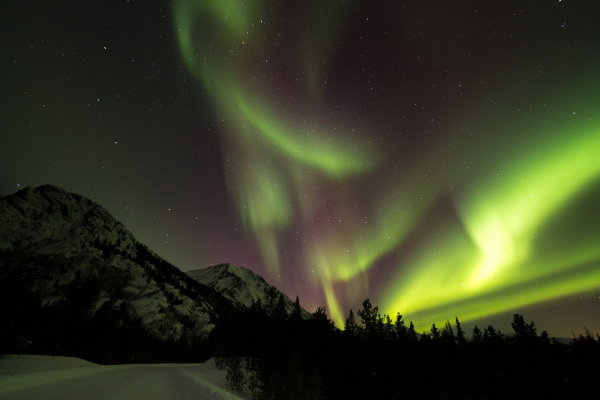
Canon 1100D (Rebel T3), 10-22mm lens @10mm, 25 secs, f3.5, ISO800
With aurora, like other night sky photography and landscape work in general, it’s the combination of foreground and sky that makes an image. So I spent a lot of time looking for rugged mountains and other attractive foregrounds. But location scouting is quite difficult in the Yukon in the middle of winter, with very few roads open and clear. Despite several more weeks touring around after this, Annie Lake remained one of my favourite locations and it was one of the more accessible as well.
One of the factors to consider when chasing aurora, and one of the advantages of this site, is to look for a low northern horizon to increase visibility when aurora activity is low, but interesting horizons around to the east and west for when activity increases.
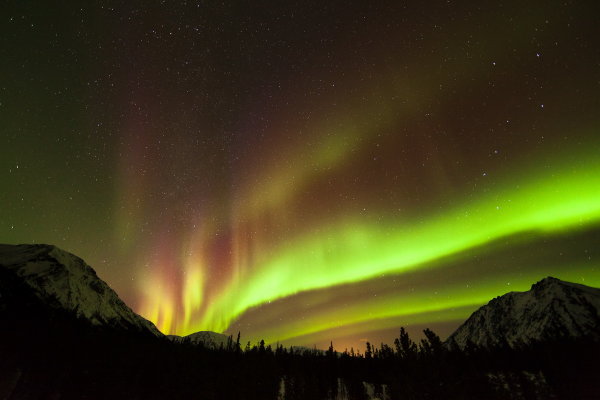
Landscape with low northern horizon: Canon 5D Mark II, 14mm lens, 15 secs, f2.8, ISO1600
Unless you resort to light painting, in general the foreground appears silhouetted against the aurora, so you need strong profiles (isolated trees for example, rather than a wall of them). But occasionally the aurora is so bright overhead that it can actually illuminate the scenery. You can see that in the image below. Other times you may have moonlight which creates a very different lighting environment, and turns the sky blue just like the daytime sky.
Bright aurora illuminating the landscape: Canon 5D Mark II, 24mm lens, 5 secs, f1.4, ISO800
I learnt a lot as I began to process these Image sequences back home in Melbourne. To get the most out of them, I used Adobe After Effects to directly import the RAW image sequences. I also used the Neat Video noise smoothing plugin to reduce the appearance of noise without sacrificing too much detail. In some cases I also used Lightroom and LR Timelapse to smoothly vary some development parameters across the sequence, to cope with large variations in brightness of the aurora, before importing the sequence into After Effects. These frequent and often fast changes in brightess of the aurora is one reason why I often shot at lower ISO settings (~ISO800) than I normally would for night sky photography, to prevent clipping of bright areas of the aurora as much as possible.
The Star Trail effect at the end of the video was created using the ‘Lighten’ blending mode in the freeware program StarStax by Markus Enzweiler, which I highly recommend.
I hope you enjoy this Valentine’s Aurora video and a little of the behind the scenes story. Feel free to share it!
Post originally from: Digital Photography Tips.
Check out our more Photography Tips at Photography Tips for Beginners, Portrait Photography Tips and Wedding Photography Tips.
Capturing the Northern Lights in Timelapse Video

Olympus’s new flagship Micro four thirds camera the OM-D E-M5 Versus Nikon’s Shiny new D800 Full frame shoooter. (& yes, dedicated reviews of both cameras are coming soon 😉 ) Olympus OM-D E-M5 with the fantastic M.Zuiko Digital ED 45mm F1.8 The Nikon D800 with the much lusted after Nikkor 85mm f/1.4G… It’s as close as makes no real difference an equivalent (effective) focal length FOV on each camera. (the D800 is full frame, and the E-M5 has a 2x crop factor, giving the 45mm lens an 35mm equivalent focal length of 90mm) Both set to record 1080@30P, using the Standard picture profiles on each, ISO set to 200, shutter & aperture set to full manual mode, and Focus S-AF. And cameras were recording each scene simultaneously, mounted to the same monopod (using a hot-shoe extension bar & appropriate adapters) This May not be a fair fight in stills mode, given the VAST difference in megapixel resolution… 16MP vs 36MP… But in VIDEO mode, where the play-ground is levelled as much as posisble, and with both cameras independently impressing video shooters in early testing & reviews… Well, it proved to be a very interesting head-to-head shootout indeed… What do you think? …
Video Rating: 4 / 5

The P300 is equipped with an f/1.8 wide-angle zoom (beginning at 24mm) NIKKOR lens Nikon COOLPIX P300 1280 x 720@60fps 13th ACGHK 2011