RSS
 

Posts Tagged ‘Users’

Why Limiting Free Users to 1,000 Photos on Flickr is a Smart Move

02 Nov

Tim O'Reilly

Yesterday Flickr made their first big restructuring announcement since recently being purchased by SmugMug. Beginning next year on January 8th, Flickr will limit free accounts to 1,000 photos. The previously offered free 1 terabyte of storage goes away. At the same time Flickr is returning their paid pro account to unlimited storage which had been their original offer before capping new Pro accounts at 1 terabyte back in 2013. If you were Pro before 2013 you were considered “old school” Pro and kept your unlimited storage, but new accounts were limited. Now all Pro accounts are back to being unlimited.

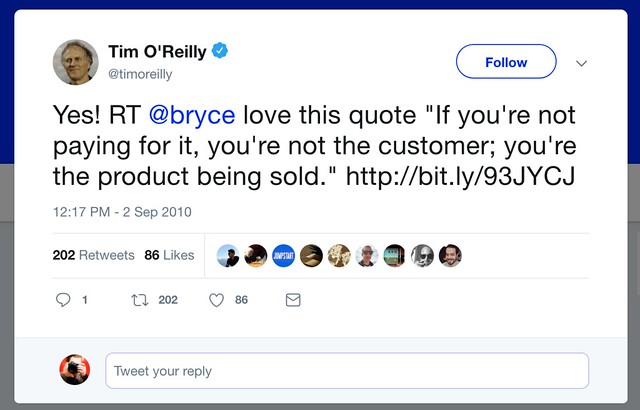
In 1973 the artists Richard Serra and Carlota Fay Schoolman broadcast a short video titled “Television Delivers People”. In that video a simple assertion was made: the product of television. commercial television. is the audience. Television delivers people to an advertiser. Since then, various influential individuals from Tim O’Reilly to Steve Wozniak to Apple CEO Tim Cook have all repeated the mantra: “if you’re not paying for it, you’re not the customer, you’re the product being sold.”

To put things more simply, there are two viable business models on the internet today to deliver service. There is a paid subscription model and there is a “free” model where business sell your data and make money on advertising everything from Butterfinger candy bars on Instagram to “brain force” pills via Alex Jones.

Personally I prefer to pay for an ad-free online experience which is one of the reasons why I’ve enjoyed Flickr so much where I’ve had an opportunity to pay annually since I joined the service back in 2003. Flickr delivers a clean user interface, full high res photos, a compelling app for my iPhone, unlimited storage, kick ass organizational tools, a social community to engage with, search tools, stats, and much more.

At $ 50/year (well technically $ 49.99 but I like to round up) I think Flickr delivers tremendous value. I have spent thousands of hours of my life on the site — thousands of ad-free hours not just for me, but for any of my friends or even strangers who happen to land on my photo page too. I am more than happy to pay this every year and will continue to do so until I die most likely. Hopefully I will figure out a way to even continue paying after I die as my personal life goal is to publish 1,000,000 photos before I die and then let that archive of work stand in all perpetuity after I am gone.

So obviously Flickr works for me, but what about all those people who don’t/haven’t paid and just want to use the service for “free.”

I believe that one of the reasons why Flickr was sold by Oath (who had purchased Yahoo’s content businesses) to Smugmug was because Oath realized that a hybrid subscription/free service doesn’t really work. It’s the same reason why Facebook is so resistant to offering a paid ad-free option to customers.

Oath is basically an advertising company and when you are advertising at people you need to be able to advertise to your most profitable customers to make the service work. When you give your most profitable customers (i.e. the ones with money) the option to pay to opt out of ads they do and will. What you are left with is a bunch of accounts by heavy users who are either poor Americans or more likely poor overseas accounts or very light users who can put up with ads but won’t see very many because they are only on your site 2 minutes a week. Whatever the case, you are basically providing a terabyte of enterprise storage, bandwidth, support, etc., to customers who cannot economically be supported by advertising.

In order for Flickr to survive it has to be a long-term profitable business. SmugMug knows a thing or two about how to do this as their primary model for over a decade has been entirely subscription based. As someone who wants to be able to host my photos on Flickr for the 50 remaining years I likely have left on this planet (and even after my death) in order to publish 1,000,000 photos, it’s important to me that Flickr has a long-term viable business model. This means that strongly encouraging free users (who are not currently paying their way) to migrate to paid Pro is important.

I do think it is important for Flickr to offer a free account in order to give people an opportunity to try out the service to see if it is for them. 1,000 photos gives you plenty of opportunity to do just that. It gives you hundreds, even thousands, of hours to explore and enjoy the service without paying — but if you are a heavy user of the site and are using over 1,000 photos of space, at some point you ought to pay.

By the way, Flickr’s original deal when I started with them was that they would only show your most recent 100 photos if you were a free account and the Pro account cost $ 60 (or $ 59.99) per year. So you might say the current account that gives you 10x that or 1,000 is 10x more generous than the original Flickr from way back.

Besides the obvious business model reasons why this is a smart decision for Flickr and their users, there are other important reasons this makes Flickr better as well. One of the things I noticed after Flickr began offering 1 terabyte for free to users was that many users simply began using Flickr as a backup site for all of their photos. Instead of sharing their best photos with a community, they simply dumped everything on their hard drive to Flickr and left and went away. These photos were then indexed for search and populated the service littering it with low quality content (screengrabs, 1,000 bad photos in a row of fireworks, 3,000 poorly composed photos in a row of somebody’s sister’s wedding, etc.). By focusing Flickr’s vision on photo sharing and community rather than simply another online photo backup dump this makes the visual experience better for those of us who are actually there to share photos and engage with each other.

Also, if people are willing to pay for something they tend to put more effort into it. If you are paying for something and perceive it’s value you’ll care more, contribute more and be a part of something. These are the accounts that I value on Flickr the most.

Yesterday morning I had an opportunity to talk to Don MacAskill (SmugMug/Flickr CEO) about this most recent decision that Flickr is making on the phone. Don is someone who cares deeply about Flickr and its community. How many CEOs do you know that spend an entire day interacting with users in an online forum about a big change like this?

I truly believe that yesterday’s decision not only paves the way to make Flickr viable for many years ahead, but that it paves the way for Don and his team to continue to spend money growing and building out the site for the community that is there and loves the service so much.

There are still so many great things that can be done with Flickr going forward. Groups need work. Search needs work. Community needs work. The app needs work. All of these things do cost money though and by getting rid of the massive storage/bandwidth demands of 1 terabyte free accounts and gaining more paid subscribers, this will allow Flickr to do this important work to continue making Flickr the best photo sharing site on the internet for all of us who are a part of the Flickr community and love the site so much.

I do understand that people don’t always want to pay for things, but I think that the right people will pay for Flickr because it provides them tremendous value. I pay for my Adobe Lightroom subscription. I pay for my Netflix account. I pay for these things because they provide me value. This is also why I pay for Flickr and will continue doing so many years into the future.

Unfortunately as we have seen with services like Friendfeed (purchased by Facebook) or even Google+ (in the process of being killed by Google) social networks oftentimes get shut down. It is very important to me that Flickr remains profitable for the long-term so that I can count on it being there many, many years from now. I think yesterday’s decision helps make Flickr more economically viable and sustainable many years into the future.

You can find me on Flickr here.

[disclosure, I know people and have friends that work at both Flickr and SmugMug]


Thomas Hawk Digital Connection

 
Comments Off on Why Limiting Free Users to 1,000 Photos on Flickr is a Smart Move

Posted in Photography


Sony users are reporting issue using 128GB SanDisk Extreme SD cards with a7 III

18 Oct

According to multiple users on the Sony Alpha subreddit, Sony’s a7 III camera is having issues with a particular SanDisk SD card.

Reddit user “shadyashell” originally made a post regarding an issue they were having with their Sony a7 III camera and SanDisk Extreme Pro 128GB SDXC UHS-I Card (Class 3) memory card. In the text of the post, they wrote:

“Everytime I insert the card into slot 1 [I get] the error message ‘Unable to read memory card. Reinsert memory card. Slot 1’ appears. I’ve reset the camera multiple times, formatted the card both on slot 2 and my laptop. Any advice on solving this issue?”

Not long after posting, other Reddit users chimed in and echoed that they too had experienced an issue. Reddit user ‘iamtridluu3’ said “I’m having the same issue. All six cards. Identical 128gb Extreme Pro. I could use it in slot 2 fine. Just slot 1 of both my a7 III and all six cards. Something is wrong with these cards.”

Reddit user ‘dany74m’ claims to have contacted Sony and been told that “[Sony] officially recognize[s] the problem” and “the camera or the card are not defective [it’s] just an incompatibility with the SD extreme V.30 128GB.” Reddit user ‘dany74m’ added “[Sony] said they are aware and they are working to fix the issue with a firmware update in few weeks.”

DPReview contacted Sony regarding the issue. A spokesperson for the company kept it short and vague, saying “our team is currently investigating the claims.” We will update this article if any new information becomes available.

Articles: Digital Photography Review (dpreview.com)

 
Comments Off on Sony users are reporting issue using 128GB SanDisk Extreme SD cards with a7 III

Posted in Uncategorized


Some iPhone X users report major display color and contrast changes in iOS 12

22 Sep

Apple officially released iOS 12 to the public on September 17 and reports from users are rolling in. According to a post on Reddit’s Apple subreddit, some iPhone X users are less than happy with the new operating system, after experiencing decreased display contrast levels, slightly desaturated colors, overexposed black regions, and more.

The post, made by user “shannister”, claims the display changes appeared after updating to iOS 12. “Experiencing a slightly washed out screen, colours popping less and blacks appearing more greyed out,” the post states. Several other users report similar experiences,

One poster going by the name “RandomUser9785” states, “The OLED panel on the iPhone X had such wonderful colours and contrast on iOS 11. After the iOS 12 update, the colours and the contrast have been ruined on my iPhone X.”

An ongoing thread on the MacRumors forum contains dozens of reports and complaints following the public iOS 12 release.

Some users report the Accessibility contrast feature being enabled automatically after updating, requiring them to manually disable it. This doesn’t eliminate the problem, however, according to at least one user who says toggling the setting wasn’t effective. The issue is reportedly present on both the iOS 12 interface and within apps.

This isn’t the first mention of washed out colors in iOS 12. Earlier this summer, iPhone X users reported issues with colors and contrast while using the beta version of the software. An ongoing thread on the MacRumors forum contains dozens of reports and complaints following the public iOS 12 release.

We’ve updated our iPhone X here at DPReview and while we haven’t carried out any controlled tests, we haven’t noticed any significant changes to screen experience in iOS 12. Apple has yet to comment on the issue, but if you’re experiencing washed our or subdued colors on your iPhone, let us know.

Via: Reddit

Articles: Digital Photography Review (dpreview.com)

 
Comments Off on Some iPhone X users report major display color and contrast changes in iOS 12

Posted in Uncategorized


Instagram reaches 1 billion active users

22 Jun

With its stand-alone IGTV video app Instagram had a big product announcement this week, but at the launch event in San Francisco the company had another milestone to talk about: after surpassing 800 million active users last September, Instagram has now reached the 1 billion mark.

After Messenger (1.3 billion), Whatsapp (1.5 billion) and Facebook itself (2.2 billion), this makes the mobile image sharing platform the fourth Facebook-owned social media app to reach this lofty number. When Instagram was taken over by Facebook in 2012, it had approximately 40 million users. The app’s massive growth makes the 1 billion dollar price tag back then look like a very sound investment now.

It also shows that the recent privacy controversies around Facebook after the misuse of data belonging to 50 million of its users don’t appear to have a lasting impact on the company’s apps’ and services’ user numbers.

Articles: Digital Photography Review (dpreview.com)

 
Comments Off on Instagram reaches 1 billion active users

Posted in Uncategorized


Technical Camera is an iPhone camera app for advanced users

12 Jun

Dire Studio today launched Technical Camera, an iPhone app aimed at mobile still photographers who prefer manual control over auto modes, along with artificial intelligence and a range of interesting features.

The app offers a highly customizable interface, with manual exposure and focus, compensation and locks, focus peaking, and fully configurable auto ISO. The Smart Function Keys feature lets you customize the function of on-screen buttons and you can set the direction of the virtual dials in the user interface.

Advanced users will also appreciate the ability to shoot in Adobe RGB color space and – as far as we are aware – the ability to define image settings for different albums and shoot directly into these albums is unique. For example, you can set a small image size and turn geotagging off for images saved into a “Notes” folder, but toggle Raw capture and maximum image quality for your “Prints” folder.

If you are using a dual-camera iPhone the Framing Previsor feature should be useful as well. It allows you to preview the tele camera’s angle of view on the wide-angle camera’s live view image, giving you a direct comparison between the two lens options. In addition there are highlight and shadow clipping alerts and a range of grids to choose from.

Lastly, Technical Camera also looks like an interesting app for the users of super-wide-angle accessory lenses. The app can correct the distortion of a number of popular lenses and also offers basic corrections for non-supported lenses. More information and a list of all supported lenses can be found on the Technical Camera website.

The app is compatible with newer Apple devices running iOS 10.3 or later and can be downloaded now from the App Store for $ 6.99.

Articles: Digital Photography Review (dpreview.com)

 
Comments Off on Technical Camera is an iPhone camera app for advanced users

Posted in Uncategorized


Report: iPhone users will have to wait until 2019 for a triple-camera device

09 May

If you want a smartphone with a triple-camera setup, Huawei’s P20 Pro is currently your only option. And vy the looks of it, this won’t change any time soon… at least not if you prefer to stick to Apple’s iPhone over Android devices. According to a report in the Taipei Times—which is citing a research note from Yuanta Securities analyst Jeff Pu—Apple is likely to launch a triple-camera iPhone model, but this won’t happen before the second half of 2019.

Like on the Huawei, the third lens would likely provide a 3x optical zoom, improving zoom quality over the current top-models’ 2x lenses. It’s also fair to assume the triple-camera will be reserved for a flagship device, likely a third generation iPhone X that could launch around September of next year if Apple sticks to its usual launch schedule.

This scenario is supported by another previous report by former KGI Securities analyst Ming-Chi Kuo, who ruled out any significant changes to Apple’s current dual-camera system on the iPhone X and 8 Plus for the 2018 models.

Articles: Digital Photography Review (dpreview.com)

 
Comments Off on Report: iPhone users will have to wait until 2019 for a triple-camera device

Posted in Uncategorized


Snapchat launches more realistic AR face masks for iPhone X users

07 Apr

It looks like more and more third party developers are starting to make use of the iPhone X’s TrueDepth front camera that was originally implemented on the device for Apple’s FaceID unlocking feature. Yesterday, Bellus3D launched a 3D face scanning app for the iPhone X. Today, Snapchat has delivered an update to its iOS app which lets iPhone X users decorate their selfie images with augmented reality masks that take advantage of Apple’s advanced facial mapping technology.

Apple’s TrueDepth front camera will help the masks more realistically superimpose onto the user’s face, and face motion will be tracked more precisely than for Snapchat users with other mobile devices. To start with, there are three Snapchat lenses that utilize the TrueDepth technology: a Mardi Gras-style mask, a Day of the Dead skull, and a gold-plated eye cover. More masks are expected to be made available in the near future.

The TrueDepth camera also allows for DSLR-style blurring of the background, and more accurate application of small details and 3D objects that reflect and react to ambient light in the image.

If you happen to own the iPhone X, let us know in the comments how the new feature works for you. With similar technologies being adopted by other smartphone makers, we’d hope the new Snapchat masks make it to Android devices (at least high-end ones) in the nearer future as well. Snapchat for iOS can be downloaded free of charge from the App Store.

Articles: Digital Photography Review (dpreview.com)

 
Comments Off on Snapchat launches more realistic AR face masks for iPhone X users

Posted in Uncategorized


ImageBrief is shutting down, users have one week to save their images

03 Mar

Photo licensing service ImageBrief, which was founded in 2011, is officially shutting down. The news was announced over email, in which ImageBrief notified current users of the close, and told them they have one week to download their images before the site’s servers are wiped.

During its six years in the licensing industry, the company offered customers a different way to get the images they need: rather than searching a pre-defined library, companies could submit on-demand “briefs” detailing the work needed, which photographers responded to in hopes of having their images purchased. This was a big change over how traditional stock photography agencies operate—and one that has been picked up by other companies over time—but the model doesn’t seem to have worked out in the long run.

ImageBrief users were surprised by the closure announcement, which was delivered in the form of an email earlier this week. The statement, which says ImageBrief connected more than 70,000 creators with clients from around the world, fails to provide a reason for the company’s demise. It does, however, advise photographers who participated in project briefs that they must download their account assets within the week, after which point the content will be deleted.

The full email reads:

Today, we’re announcing that after six years of connecting agencies, brands and creators, we will be closing down ImageBrief’s photographer marketing services

We’re proud of the products and apps we built, but even more so, we’re grateful for the community that enabled them to grow. More than 70,000 creators earned millions of dollars collaborating with 12,500+ global agencies and brands in 169 countries.

There has never been a better time for creators to thrive. Demand for content has increased, and the tools to create world-class creative are more accessible than ever.

Our talented team of engineers, designers, developers, and curators have worked tirelessly to make ImageBrief a success in a competitive and rapidly evolving landscape, and our immediate priority is to help you transition to other services to support your business.

In the coming days, our team will be in contact with you directly with detailed information about your specific account, license history, and services. Over the next week, we recommend logging into ImageBrief to download and retain your license history and related assets. […]

We want to thank you for your participation and loyalty, and look forward to working with you in the coming weeks to ensure a smooth transition.

Sincerely,

Team ImageBrief

As of this morning, all of ImageBrief’s social media pages have been deleted. And the homepage has been pared down into a simple log in page for buyers and photographers, with no mention of the closure.

Articles: Digital Photography Review (dpreview.com)

 
Comments Off on ImageBrief is shutting down, users have one week to save their images

Posted in Uncategorized


Fujifilm interview: ‘We want the X-H1 to be friendly for DSLR users’

21 Feb

Fujifilm’s new X-H1 sits above the X-T2 in the company’s X-series APS-C lineup. As well as offering several enhancements in its core stills photography feature set, the X-H1 also brings high-end 4K video capture with up to 200Mbps capture and 5-axis in-body stabilization.

At the X-H1’s launch in Los Angeles last week, we sat down with the camera’s product manager, Jun Watanabe, to get a detailed look at the new camera. The following interview has been edited for clarity and flow.


Jun Watanabe is the Manager of Product Planning in the Sales & Marketing group of the Optical Device & Electronic Imaging Products Division at Fujifilm.

Fujifilm has stated previously that IBIS would not be possible in X-series cameras because of the small imaging circle of some XF lenses. What changed?

We have spent the past two or three years developing a system where using both hardware and software, we can cover [the necessary] imaging circle. The most important thing is precision. Because a sensor with IBIS is a floating device, it has to be perfectly centered and perfectly flat. We had already achieved a sensor flatness tolerance down to an order of microns, but the challenge was to maintain this precision with IBIS.

A laser measurement device is used during the process of manufacturing the image stabilization unit, and the assembly process also includes inspection and adjustment of each individual camera. For that reason, a micron order level of sensor parallelism is realized even while IBIS is activated.

A chart showing CIPA figures for image stabilization benefit of all compatible XF lenses, when used with the X-H1. As you can see, the least amount of benefit comes when the 10-24mm wideangle zoom is used. Users of the vast majority of XF lenses should see 5 stops of stabilization benefit.

Are there some lenses that will deliver better stabilization than others, as a result of having a larger imaging circle?

Yes. The most effective is the 35mm F1.4. But every XF lens without OIS will benefit from five stops of stabilization.

When you were developing the X-H1, how important was the requirement to add high-end video features?

Many videographers gave us input. A lot of them said they needed in-body stabilization, and F-Log in-camera recording. Those were the top requests from video users.

Compared to the X-T2, the X-H1 is a larger, more DSLR-styled camera which inherits a lot of styling cues from the medium-format GFX 50S. It is also 25% thicker, and better sealed against the elements.

What kind of feedback have you had from videographers since the X-H1 was announced?

Pretty good. We’ve heard from videographers that they really like the 200Mb/s internal recording and 12 stops of dynamic range with the Eterna film simulation. They’ve told us that this combination is the best solution for quick, high-quality video capture.

We wanted to create a more cinematic look, so we studied ‘Eterna’ – one of our cine film emulsions

We received a lot of feedback after we launched the X-T2, from videographers and DPs who said that our film simulation modes in video were unique, but too still photography oriented, with the narrow dynamic range. They wanted a real cinema look. On the product planning side we wanted to create a more cinematic look, so we studied one of our cine film emulsions – ‘Eterna’. That was the starting point.

Velvia is tuned to give you colors as you remembered them. More vivid blue skies, for example. Eterna is tuned in the opposite direction, for moderate saturation, with more cyan and green bias. With Eterna, combined with the X-H1’s dynamic range settings, we have achieved a 12 stop dynamic range.

How did you decide on what video features to include in the camera? Some expected features – like zebra – are missing.

Honestly, we couldn’t add zebra because of hardware constraints. The processor cannot support it. It requires too much processing power. At this time, we’ve achieved the best possible performance for the processor.

The X-H1 (on the left) features a substantially deeper handgrip than the X-T2, which we’re told was a major feature request from existing X-series customers. It also sports a top-plate mounted LCD, which should make it more familiar to photographers coming from using an enthusiast DSLR.

Is 8-bit capture enough, for F-Log recording?

There are 10-bit cameras on the market, but we recommend using Eterna to short-cut the recording process. We think 8-bit is enough for good quality.

Do you think the X-H1 will be bought mostly by stills photographers, or videographers?

We are targeting both. We have greatly upgraded the video performance [compared to the X-T2] but we have upgraded the stills performance too, especially autofocus in low light, and subject tracking. We also added flicker reduction and dynamic range priority, and so on. We are targeting both kinds of professional users.

When it comes to autofocus, minimum low light AF response has been improved from 0.5EV to -1EV. We’ve also introduced a new phase-detection autofocus algorithm and parallel data processing. The X-H1 has the same processor as the X-T2 but the algorithms are new. A single autofocus point in the X-T2 was divided into 5 zones. In the X-H1, this has been increased to 20 zones.

Phase-detection autofocus will be possible with our 100-400mm lens in combination with a 2X teleconverter

Data from each zone is processed in three ways, for horizontal detail, vertical detail, and fine, natural detail like foliage or a bird’s feathers. This processing happens simultaneously, rather than in series, which is a big advantage over the X-T2. We’ve also achieved phase-detection performance down to F11, which means that phase-detection autofocus will be possible with our 100-400mm lens in combination with a 2X teleconverter, with a much higher hit-rate compared to the X-T2.

During shooting, the predictive AF algorithm now generates information from captured images in a sequence, for more reliable subject tracking while zooming.

Now that you have a powerful 4K-capable video camera with IBIS, how will this change how you develop lenses, in the future?

For stills lenses, our approach will stay the same. But we’ve also announced two cinema lenses. These both work with IBIS and the MKX 18-55mm zoom will deliver 5 stops of correction. This is a unique selling point.

We have had requests from some of our professional users for a bigger camera

The X-H1 is considerably larger than its predecessors. Is there a point when the size advantage of APS-C compared to full-frame gets lost?

Professionals are generally more accepting of larger cameras, and [compared to DSLRs] the X-H1 isn’t that big. And we have had requests from some of our professional users for a bigger camera, especially those photographers that use our longer lenses. A bigger grip and more solid body were both requested.

Here’s that deeper handgrip, in action.

When the camera gets bigger, does it make some aspects of design easier? Like heat management?

Yes, the increased camera volume gives us some advantages when it comes to heat and cooling systems. In fact the X-H1’s 4K recording time is 50% longer than the X-T2, thanks to a new cooling system and two large copper heat sinks.

How much technology from the GFX 50S has made it into the X-H1?

Some of the operation and operability improvements have made their way into this camera. We hope that some DSLRs users will come over to the X-series, thanks to things like the top LCD, and twin control dials and so on. We wanted the X-H1 to be ‘friendly’ to photographers who are used to DSLRs.


Editor’s note:

I always enjoy talking to engineers, even with the caveat that some of what they say occasionally goes completely over my head. I was very surprised, for instance, after hearing Mr. Watanabe detail all of the clever ways in which the X-H1 processes AF information, to be told that the new camera has the same processor as the X-T2.

It’s not impossible to imagine that the X-T2 might yet benefit from some of these advances.

Quite how Fujifilm has managed to eke such increased efficiency from essentially the same amount of computing power is beyond my intellect, but if the claimed increase in performance holds up in our testing, the company deserves a lot of credit. And given Fujifilm’s excellent track record of updating older models, it’s not impossible to imagine that the X-T2 might yet benefit from some of these advances.

Apparently there were internal discussions about including a dual, or even a completely new processor in the X-H1, but this would have added to development time, as well as cost. It’s possible too that some of the heat-management benefits of the X-H1’s larger internal volume compared to the X-T2 might have been nullified.

‘Silent control’ in movie shooting allows you to adjust exposure settings by touching the rear LCD – avoiding the noise and vibration of clicky buttons and dials making its way into your footage.

And in these days of 4K video capture, heat matters. The X-H1 isn’t a perfect video camera by any means, but it’s the most convincing X-series model yet. It should compare well against most of its competitors, barring only the more specialized Panasonic GH5/S. In-camera 5-axis stabilization is a big part of that (involving 10,000 calculations per second, if you can believe it), but features like 12EV of video dynamic range (Eterna + DR400%), internal F-log recording and a maximum quality of 200 Mbps are sure to attract the attention of professional, as well as casual videographers.

One of the most requested features from Fujifilm’s X-series customers was a bigger grip

Even for people with little or no interest in video, the X-H1’s enhanced feature set might still be enough to justify the extra cost over the X-T2. And possibly also its ergonomics. According to Mr. Watanabe, one of the most requested features from Fujifilm’s X-series customers was a bigger grip. The X-H1 gets bigger everythings, just about. Obviously this means that the camera is bigger as a result, but Fujifilm is hoping that this will make the X-H1 appeal to more traditional DSLR users.

Will the X-H1 prove a hit? I hope so. It’s an impressive camera, and a bold move by Fujifilm. I can’t see the company creating a dedicated video camera any time soon (and Mr. Watanabe would not be drawn on this question when I asked him) but however it gets there, one thing is clear: Fujifilm really wants to be taken seriously by filmmakers, as well as traditional stills photographers.

Articles: Digital Photography Review (dpreview.com)

 
Comments Off on Fujifilm interview: ‘We want the X-H1 to be friendly for DSLR users’

Posted in Uncategorized


Instagram test lets users re-share content, but there’s a way to disable it

10 Feb

Instagram has confirmed that it is testing a feature for sharing publicly available content posted by other users. In a statement to TechCrunch, Instagram explained that the company regularly tests new ways for users to “share any moment” with their friends. The feature, which some people are referring to as “regram,” allows for public content to be shared within a user’s Instagram Story.

The sharing feature is only available to a small percentage of users at this time. Instagram didn’t provide any sort of time frame for when the feature may launch for all users, nor whether that is certain to happen. However, it seems likely that the feature will see a wider launch due to all users already having the ability to disable re-shares.

Photographers can prevent users from re-sharing their content by opening their Instagram profile, then tapping the menu icon. Within the app’s menu, a new setting option is listed that reads “Allow Others to Reshare” alongside a toggle switch. Toggling the switch off will disable other users’ ability to re-share content posted by that account.

Via: The Verge

Articles: Digital Photography Review (dpreview.com)

 
Comments Off on Instagram test lets users re-share content, but there’s a way to disable it

Posted in Uncategorized