RSS
 

Posts Tagged ‘Urban’

Colorful Cabs: Taxi Fabric Project is a New Form of Urban Art

04 Sep

[ By Steph in Design & Fixtures & Interiors. ]

taxi fabric project

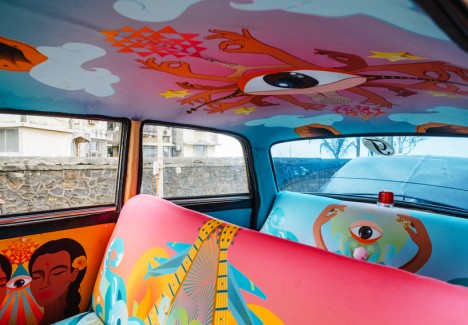
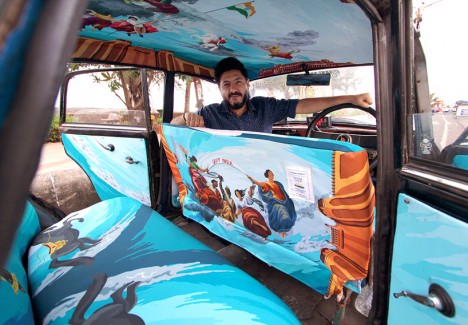
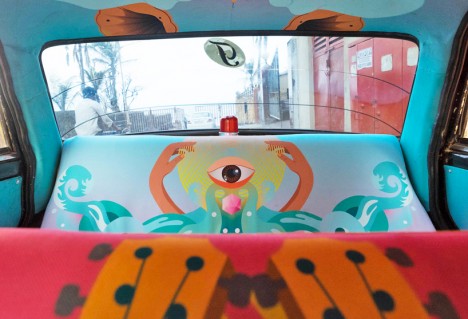
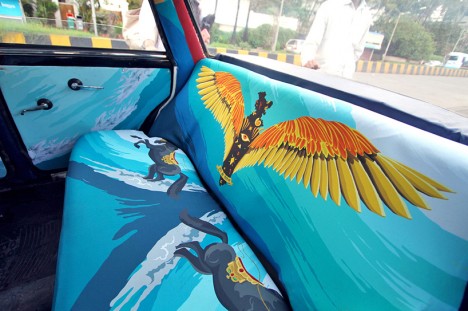
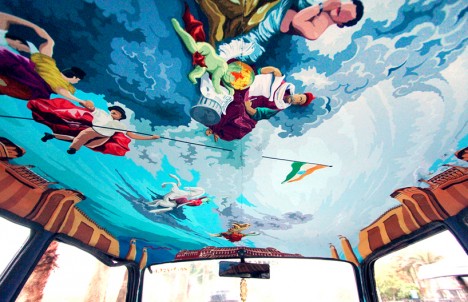
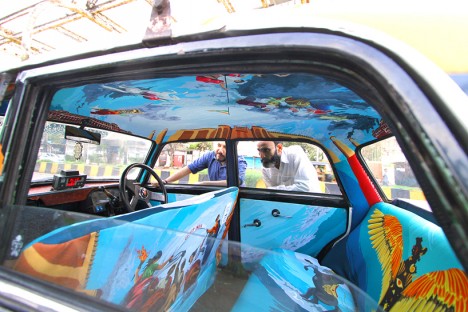
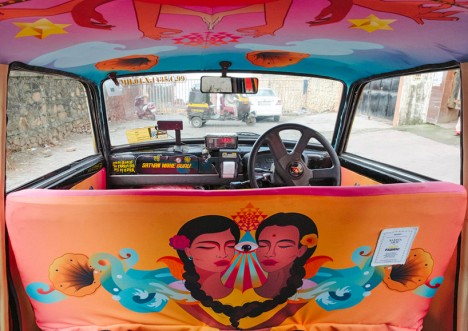
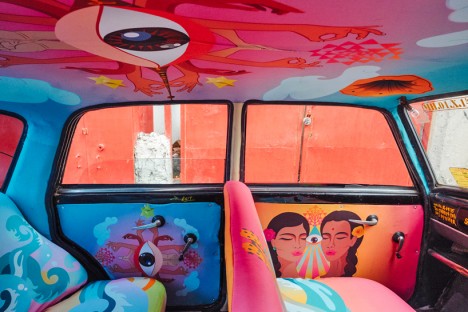
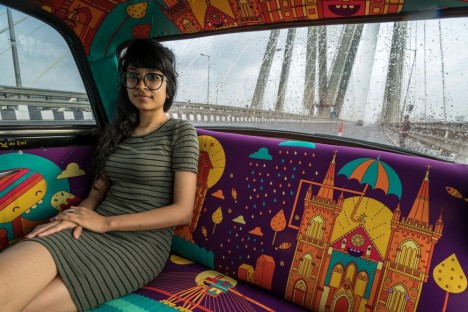
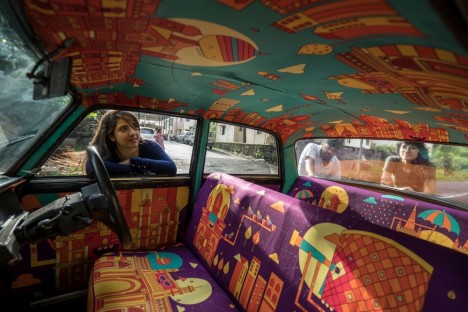
Thousands of people get to gaze at beautiful original artwork while taking a ride from one place to another in Mumbai, India, bringing exposure to local design talent through a new form of urban art. The Taxi Fabric Project beautifies this often impersonal mode of transport, making cabs stand out as individuals in a crowded sea of cars and creating mobile galleries that immerse riders in a particular artist’s imagined world.

taxi fabric project 10

taxi fabric project 5

taxi fabric project 9

“Design – as a job or studied at school – is unfortunately not widely recognized in India,” say the creators of the project. “Older generations don’t understand it. Design to them just performs a function. Many people don’t know that design can create a real impact. With so few spaces for young people to show off their skills, it’s hard to change that perception.”

taxi fabric project 2

taxi fabric project 7

taxi fabric project 8

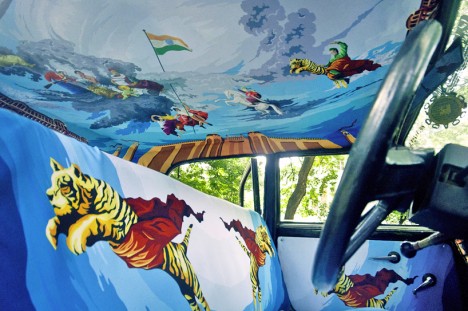
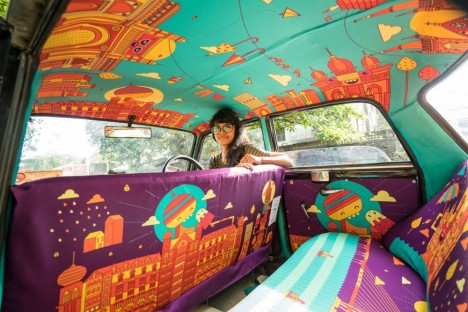
In a city where cabs are the most convenient and common way to get around, this unusual mashup of art and transportation has the potential to get a lot of people excited about design and curious about the artists. Up to 30 taxis will be made over for the project, printing colorful works onto fabric and stitching it directly to the interior surfaces of each car.

taxi fabric project 6

taxi fabric project 4

taxi fabric project 3

One notable example is ‘A Century of Revolt’ by Kunel Gaur, which illustrates the Indian Independence in a fresco-inspired style. Another – ‘Monad’ by Samia Arif – reminds Indians how similar their culture is to that of neighboring Pakistan, while conflicts continue to rage between the two countries.

taxi fabric project 11

taxi fabric project 12

taxi fabric project 13

‘Happily Ever After’ by Shaivalini Kumar celebrates the landmarks of Mumbai. “The architecture of Mumbai blends Gothic, Victorian, Art Deco, Indo-Saracenic and contemporary architectural styles. Many buildings, structures and historical monuments remain from the colonial era. All these buildings coexist beautifully and are also as resilient as the amazing people of Mumbai.”

Share on Facebook


[ By Steph in Design & Fixtures & Interiors. ]

[ WebUrbanist | Archives | Galleries | Privacy | TOS ]


WebUrbanist

 
Comments Off on Colorful Cabs: Taxi Fabric Project is a New Form of Urban Art

Posted in Creativity


Pink Marble Public Pissoir: Open-Air Urinal in Urban Zurich

28 Aug

[ By Steph in Architecture & Public & Institutional. ]

sculptural urinal 2

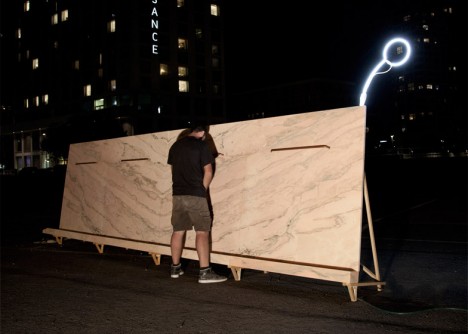
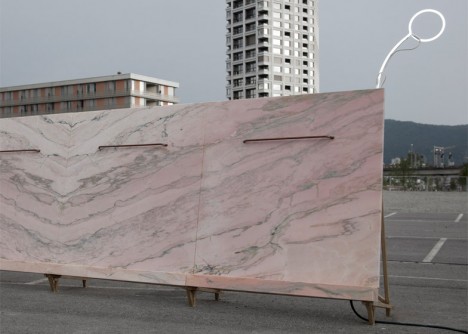
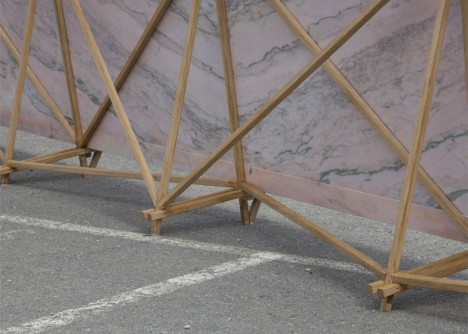
This giant hunk of pink marble in the middle of a Zurich car park isn’t a sculpture, exactly; it’s a place to relieve yourself in the open air so you don’t go stinking up the city. So-called ‘pissoirs’ can be found all over Europe, ranging from ornate Victorian designs resembling gazebos to portable plastic contraptions to cylindrical urinals that actually retract into the ground. Portuguese architecture firm Bureau A’s version, standing in the middle of a parking lot, looks like modern art.

sculptural urinal 1

sculptural urinal 5

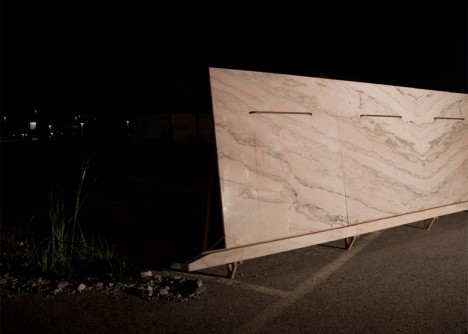
From the rose tint of the high-end marble imported from Lisbon to the LED light advertising its presence after dark, this thing doesn’t look anything like what most of us would identify as a urinal. “In the form of a noble fountain, a classical figure of occidental culture, Lisbon sends a solid salute to rich Zurich,” say the designers.

sculptural urinal 4

sculptural urinal 3

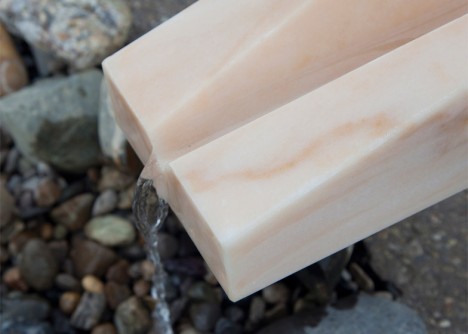
Indeed, streams of water pour down the marble faces to whisk away foul-smelling excretions, which pour from a spout directly into a pothole planted with pebbles and grasses. The classically-influenced design pays tribute to adjacent historical attractions and acknowledges the fact that such facilities are required in order to keep the city clean.

urinals for women 2 urinals for women

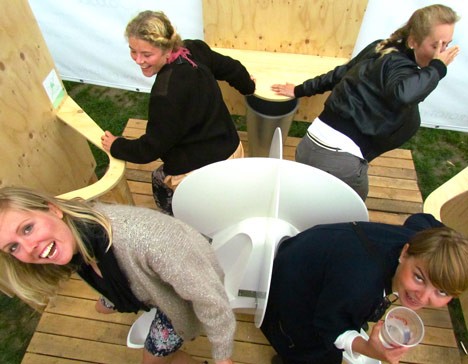
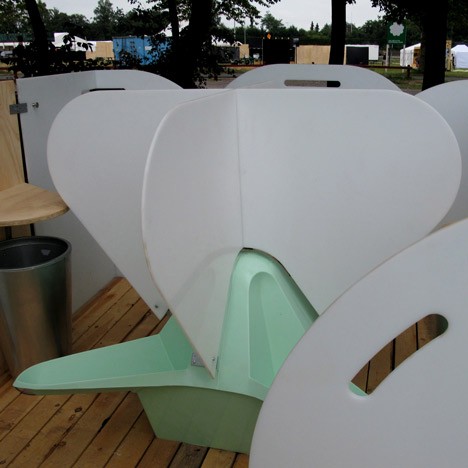
Of course, there’s one big problem with such pissoirs, even fancy ones like this: they’re only for men. While Copenhagen studio UiWE designed some efficient-looking urinals for women (pictured above), they’ve yet to catch on in any real way, forcing anyone who can’t use a conventional urinal to mad dash it around the city looking for accessible restrooms when they have to go.

Share on Facebook


[ By Steph in Architecture & Public & Institutional. ]

[ WebUrbanist | Archives | Galleries | Privacy | TOS ]


WebUrbanist

 
Comments Off on Pink Marble Public Pissoir: Open-Air Urinal in Urban Zurich

Posted in Creativity


City Lab: World’s Largest Urban Simulator Spans 26 Square Miles

28 Aug

[ By WebUrbanist in Architecture & Cities & Urbanism. ]

city lab new mexico

It will be a brand-new, from-scratch American city like any other, with urban, suburban, exurban and rural zones dotted with houses, malls, power plants, police and fire stations, missing only one key ingredient: inhabitants. Currently under construction in the New Mexico desert, the Center for Innovation, Testing, and Evaluation (CITE) is a sort of real-life Sim City, the “first of its kind, in scale and scope,” a unique “fully integrated test, evaluation and certification facility dedicated to enabling and facilitating the commercialization of new and emerging technologies.”

city lab deserted complex

Known informally as City Lab (click to enlarge the diagram above), the 26-square-mile urban laboratory complex has a billion-dollar budget and will host all kinds of tests, including but not limited to: intelligent transportation systems, smart grid technologies and green energy strategies. Wired for data collection and replete with tunnels, system-wide scenarios can be monitored in the minutest detail, a dystopian twist on what might otherwise seem an idyllic mid-sized city capable of supporting 35,000 citizens.

citylabmasterplan

Complete with all the infrastructure of a ‘real’ city, the developer’s target clients include university researchers, federal agencies and commercial enterprises. The facility aims to combine elements of private and governmental test environments like Gravesend, a military and police complex in the UK, Liberty City, a drone-oriented cityscape in the US and Mcity, a newly-built autonomous vehicle testing site in Detroit.

city lab simulation space

If you have one in your town it is a safe bet CITE has one as well, from churches and highways to a city hall and even an airport. While this place contains all a community could ever hope for, the only ‘residents’ of the place will be a staff of over 300 that maintain its infrastructure and supervise experiments. Imagine the reaction of some archeologist from the distant future, seeing a sort of dystopian settlement wired for full surveillance and connected by a vast array of underground tunnels (The Cabin in the Woods comes to mind, poster below), but at the same time oddly unoccupied and devoid of art, brands or billboards.

cabin in the woods movie

Noting the lack of these quintessential hallmarks of modern civilization, a professor at the University of New Mexico decided to ask what kind of public art would fit such a strange and made-to-be-deserted city. Her students solicited proposals from around the country and selected a set of winners. Ingenious ideas included: sculptural mounds made from the dirt displaced during excavation, testing paint colors around the complex for durability and weather resistance and a farcical strategy to sell lots and gentrify the faux city.

city lab public art

More from Pegasus Global Holdings: “As a privately-owned, privately-operated test and evaluation center, CITE is open and accessible to a wide array of public and private customer segments – domestic and international. The structure and policies in place at CITE are specifically designed to remove legal, cultural and budgetary impediments as are currently prevalent in the process of moving beyond basic research and development activities.”

Share on Facebook


[ By WebUrbanist in Architecture & Cities & Urbanism. ]

[ WebUrbanist | Archives | Galleries | Privacy | TOS ]


WebUrbanist

 
Comments Off on City Lab: World’s Largest Urban Simulator Spans 26 Square Miles

Posted in Creativity


Liberty City: Inside an Urban Governmental Drone Test Complex

20 Aug

[ By WebUrbanist in Travel & Urban Exploration. ]

drone system

If you have ever wondered how and where the Department Homeland Security evaluates drones for real-world applications, this Freedom of Information Act request reveals some of the secrets behind the operations taking place at one of these rather mysterious locations. Not to be confused with its video game namesake, tracing back to Grand Theft Auto’s own digital Liberty City, this real-world test site is fascinating to learn about remotely but not somewhere you want to have an actual vehicular adventure.

artifical-street-urban-complex

For years, the government has been testing drones for everything from monitoring infrastructure and special events to patrolling harbors and supporting first responders. Run by Robotic Aircraft for Public Safety (RAPS), Liberty City and sites like it let local, regional and national governments deploy different models of drone and decide which best suit their needs. Like Gravesend in the UK (pictured above), officers and troops are also called in on the ground to interact in these remarkably complete but staged environments.

urban drone testing

Variegated urban terrains help those overseeing the tests determine a drone’s ability to identify key objects and individuals in the built environment, distinguish assailants and perpetrators in complex situations and track persons through challenging architectural landscapes. Simulations revolve around everything from ordinary robberies to hostage situations and terrorist attacks. The goal, ultimately, is to figure out what (completely or partially) autonomous vehicle technologies will work both generally and around specific purposes, for applications ranging from emergency search-and-rescue to broader everyday surveillance. While the work they are doing in these places is not classified as such, it is still highly secretive and much of it still remains undisclosed after years of inquiry.

drone testing documents_edited-1

Submitted via MuckRock, the FOIA request behind the details featured here sheds light on the reasons and methods behind these processes and places. Per Shawn Musgrave, “The broad objective of RAPS is to determine whether drones can play a practical role in a broad range of public safety deployments. Such applications include law enforcement, firefighting, disaster response, and search-and-rescue. The RAPS testing program evaluates each drone model for ease of operation, durability and performance in simulated scenarios. Reviewers compile their findings into a database for first responders nationwide to use when weighing a drone purchase.”

Share on Facebook


[ By WebUrbanist in Travel & Urban Exploration. ]

[ WebUrbanist | Archives | Galleries | Privacy | TOS ]


WebUrbanist

 
Comments Off on Liberty City: Inside an Urban Governmental Drone Test Complex

Posted in Creativity


Amazing Aerial Photos of LA and NYC Reveal Urban Geometry

04 Aug

[ By Steph in Art & Photography & Video. ]

Screen Shot 2015-08-03 at 4.55.33 PM

No matter how far and often you might wander around your city, there’s one way you most likely never get to experience it: from above. Approached from directly overhead, the bird’s-eye-view renders virtually any urban scene unrecognizable, reducing landscaped streets and towering skyscrapers to mere shapes within an abstract composition, as if it’s a work of art. And perhaps, for some urban planners, it is. Thanks to photographer Jeffrey Milstein, we can all appreciate New York City and Los Angeles from a new perspective.

Screen Shot 2015-08-03 at 4.56.48 PM

Screen Shot 2015-08-03 at 4.56.41 PM

Screen Shot 2015-08-03 at 4.56.28 PM

Screen Shot 2015-08-03 at 4.56.03 PM

Screen Shot 2015-08-03 at 4.54.55 PM

Captured from a helicopter both at night and during daylight, Milstein’s aerial imagery of these two iconic American cities presents entire neighborhoods as tapestries of geometric shapes. New York’s Stuyvesant Town looks like a bunch of crosses embedded in greenery, and the Statue of Liberty is strikingly jewel-like on its island. 

Screen Shot 2015-08-03 at 4.53.40 PM

Screen Shot 2015-08-03 at 4.53.00 PM


Some of LA’s most posh neighborhoods are unsurprisingly picturesque from above, laid out in their carefully-arranged grids and often centered upon parks. In comparison, the shots of downtown look downright bleak, sort of like you’re looking at a circuit board rather than a full-scale city. The photographs are on display now at New York’s Benrubi Gallery and LA’s Kopeikin Gallery.

Screen Shot 2015-08-03 at 4.53.58 PMScreen Shot 2015-08-03 at 4.54.06 PM

Screen Shot 2015-08-03 at 5.52.30 PM

If looking at the pictures gives you vertigo, good, says Milstein. That’s the effect he’s going for. “That’s exactly what I want. To get a visceral reaction from it,” he told City Lab. 

Share on Facebook


[ By Steph in Art & Photography & Video. ]

[ WebUrbanist | Archives | Galleries | Privacy | TOS ]


WebUrbanist

 
Comments Off on Amazing Aerial Photos of LA and NYC Reveal Urban Geometry

Posted in Creativity


Think Tank Photo Sub Urban Disguise 30 Shoulder Camera Bag Review

02 Aug

Packing and carrying equipment for travel adventures is always a challenge. With increasing airline restrictions and not being willing to check your gear, you need to find the best possible alternative for your needs. Like most of my peers, I covet several bags. Usually when going abroad I take a bag with all the equipment and a smaller, second bag for everyday outings once on location. As I tend to travel lighter and lighter every day, I was on the lookout for a bag that could serve dual purposes for my recent Italy trip. I wanted a bag that could carry my two Fuji X bodies, some lenses, a filter kit, and my iPad. The other important consideration was that the bag needed to be easy to access and work from.

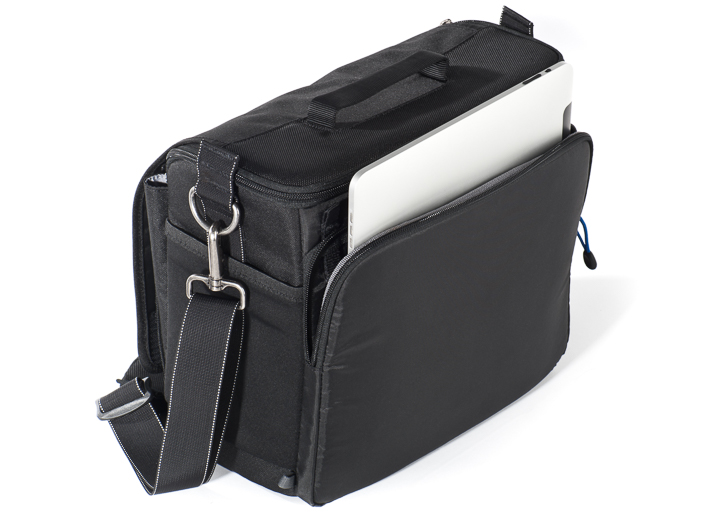
Think Tank Photo Sub Urban Disguise 30 - Image Courtesy of Think Tank Photo

Think Tank Photo Sub Urban Disguise 30 – Image Courtesy of Think Tank Photo

After much looking around, I settled on the Think Tank Sub Urban Disguise 30. As you may know, Think Tank products are legendary and they carry their well-known “non-rhetoric warranty.” This bag is one from their compact series, designed for small kits. There are four different models and the 30 is the biggest of them all, the one that features a separated iPad compartment.

The bag is constructed of high-quality ballistic polyester, treated for water resistance. It features YKK® zippers, stretch pockets on the sides, two-ply bonded nylon thread, and a removable shoulder strap. The interior comes with removable dividers and a rain cover that fits in the main outside pocket.

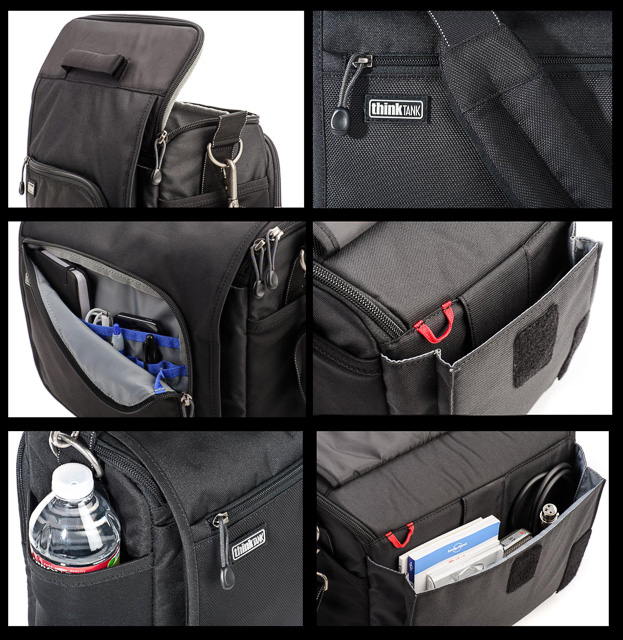
Besides the main compartment, the Sub Urban Disguise 30 has multiple pockets. There is a front organizer pocket on the front flap that can accommodate personal items. Under the main flap, there is a large pocket that is roomy enough to store bigger accessories, like battery chargers, cables, or perhaps a travel book. There is also a mesh pocket inside the main flap for smaller accessories. The exterior stretch side pockets can fit a bottle of water or a flash.

Think Tank Photo Sub Urban Disguise 30 Details - Images Courtesy of Think Tank Photo

Think Tank Photo Sub Urban Disguise 30 Details – Images Courtesy of Think Tank Photo

The bag dimensions are:

  • Exterior: 12” x 10” x 7.3” ((W x H x D)
  • Interior: 11” x 9.5” x 5” (W x H x D)
  • iPad pocket: 10.7” x 8.5” x .8” (W x H x D)

According to Think Tank, this bag can fit a standard-size DSRL, two to four zoom lenses, a regular iPad, and a 70-200 f/2.8 lens unattached. As I am shooting mirrorless, my use was a little different, and I was able to fit two Fujifilm X-T1 bodies with lenses attached, three separate lenses, a full-size filter kit, the iPad, and accessories, and I had room to spare.

Lower Section Think Tank Photo Sub Urban Disguise 30

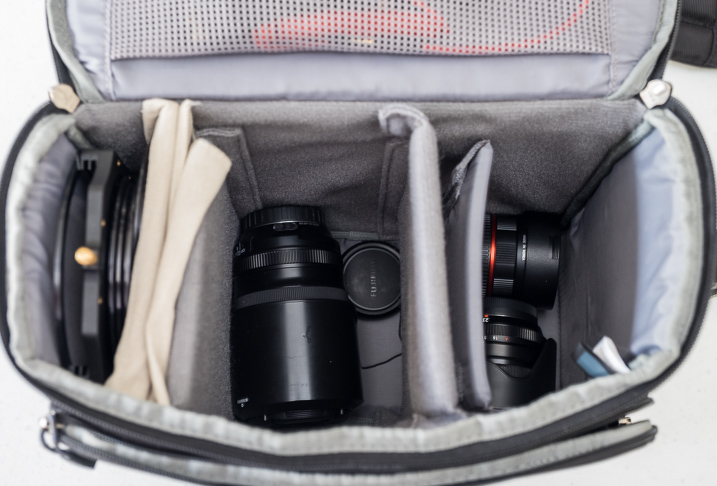
My kit bottom layer  contains Fujinon XF 55-200 mm f/3.5-4.8, Fujinon XF 23mm f/1.4 and Rokinon 8mm f/2.8 fisheye for Fuji X mount.

Lower Section Think Tank Photo Sub Urban Disguise 30

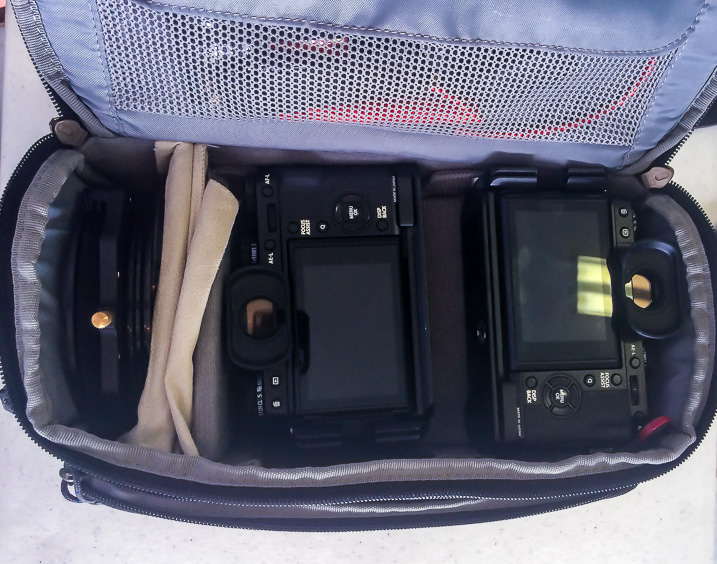
My kit upper layer contains Fujifilm X-T1 body with Fujinon XF 10-24mm f4.0 lens attached, Fujifilm X-T1 body with Fujinon XF 16-55 f/2.8 attached and on there is a complete Lee Filter kit with 3 ND grads and 2 NDs. (Photo taken with iPhone)

As you can see, I loaded mine by layering the interior in two tiers. I placed lenses on the bottom of the bag, which I separated from the top with the provided dividers, and then placed both camera bodies on top for easy access. On the side I had the filter kit. As explained above, one of the things that I was looking for was to have easy access to the gear, and this way I had both bodies with the most used lenses within very easy access. The bag is very comfortable to wear as the shoulder strap is solid but very well padded.

One of the best things about this bag is the way it opens. There is a flip-top lid that folds away from your body, and that really helps you to reach the camera fast. This top lid is zippered and totally separated from the main Velcro exterior flap that accesses the bigger pocket. In the end, the bag was everything that I expected, so I will continue to use it on future trips, especially the ones around cities with lots of walking, and where I need quick access to the cameras, to take a shot and put it away again.

Obviously, how much you can fit in the bag will depend on the type of configuration you use and how you divide the bag internally, but if you want something relatively light for urban walks or travel, this is really a very good option. If you don’t need to carry a tablet, you can also consider this bag’s smaller siblings with three more models to choose from. There is probably one that will suit you well. The price for this bag starts at $ 49.75 and this particular model is $ 84.75, a price that I believe is more than reasonable for all these features and quality.


googletag.cmd.push(function() {
tablet_slots.push( googletag.defineSlot( “/1005424/_dPSv4_tab-all-article-bottom_(300×250)”, [300, 250], “pb-ad-78623” ).addService( googletag.pubads() ) ); } );

googletag.cmd.push(function() {
mobile_slots.push( googletag.defineSlot( “/1005424/_dPSv4_mob-all-article-bottom_(300×250)”, [300, 250], “pb-ad-78158” ).addService( googletag.pubads() ) ); } );

The post Think Tank Photo Sub Urban Disguise 30 Shoulder Camera Bag Review by Daniel Korzeniewski appeared first on Digital Photography School.


Digital Photography School

 
Comments Off on Think Tank Photo Sub Urban Disguise 30 Shoulder Camera Bag Review

Posted in Photography


13 Great Subjects for Urban Night Photography

14 Jul

The great thing about night photography is that subjects that appear commonplace during the day take on a new, interesting appearance at night. Urban scenes are lit (or not lit) at night in fundamentally different ways that our eyes are not used to. The long exposure times required in night photography allow you to use different techniques to capture the scenes in creative and often dramatic ways. Plus you aren’t beholden to the sun’s rays and the changing daytime light.

Nevertheless, you may struggle with finding good subjects when you do have opportunities to get out and shoot at night. Further, you may not know what subjects lend themselves to great photographs at night, or overlook great scenes and subjects in your own city. Therefore, this article is designed to help you pick out some good subjects that might be right around the corner.

Obviously, the point here is not to limit your subject matter, but rather to show you things that might be nearby next time you are stumped for ideas. I hope you’ll use these subjects as starting points for your own thinking, and the go well beyond the ideas presented here.

1. Reflections

Great Subjects for Urban Night Photography - St. Paul reflection example

St. Paul’s Cathedral, London (Shutter speed: 1.3 seconds; Aperture f/8; ISO: 200).

Most cities have plenty of modern office buildings made of glass and steel. These are often not particularly photogenic subjects in themselves, but the glass and steel provide great opportunities for capturing reflections of anything nearby. At night, the glass can appear particularly reflective. The bright lights of the city at night will show up clearly in the glass of nearby buildings. The next time you are downtown, keep an eye out for reflections in those glass buildings.

Of course, water presents a great opportunity for capturing reflections as well. A very slow shutter speed will remove any ripples from the water and make the reflection show up more clearly. Using a slow shutter speed will not usually be a problem at night because your camera will be struggling to capture more light to achieve a proper exposure, but if it is just add a mild neutral density filter to your lens.

Keep in mind that the water with the reflection doesn’t have to be a lake or a river (although those often work great); sometimes just a puddle will do.

2. Streaking Lights
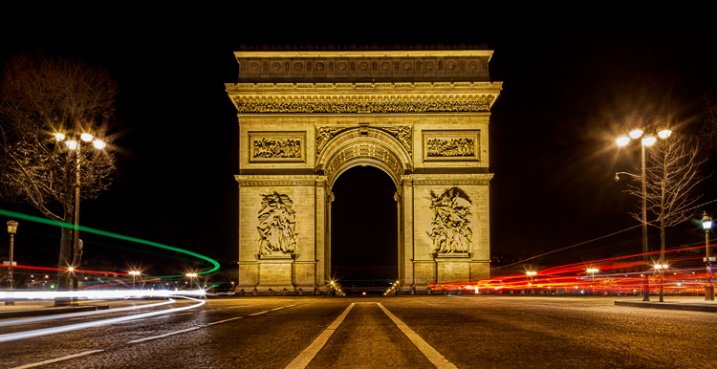
Great Subjects for Urban Night Photography - Arc de Triomphe example

Arc de Triomphe, Paris (Shutter speed: 30 seconds; Aperture f/22; ISO: 50).

Streaking headlights and taillights from passing vehicles are a great way to deal with the problem of traffic in your picture, and as a bonus, it adds a sense of movement to your scene.

To include streaking lights, start by using a slow shutter speed. You will typically set a shutter speed of at least 15 seconds to allow enough time for the vehicles to move through your frame. Set a mid-range aperture (around f/8) and a low ISO (100) to accommodate the long shutter speed, then adjust from there depending on conditions. After that, just wait until traffic is about to enter your frame and trip the shutter. The shutter will stay open during the time the traffic moves through the frame and only the headlights and taillights of the passing vehicles will show up in your picture.

Where should you go to find good places for streaking lights? That depends. If you just want the streaking lights to accentuate a picture of something else, then you can go anywhere. If you want the streaking lights to be the cneterpiece of the photo, however, you will need to find a place where you can overlook a highway or major street. Bridges and overpasses work great for this. In addition, parking garages that are next to a highway can work great as well (if you can access them).

3. Skylines

Great Subjects for Urban Night Photography - NYC skyline example

Midtown Manhattan, taken from Roosevelt Island (Shutter speed: 10 seconds; Aperture f/8; ISO 100).

Skyline shots nearly always look great at night. In every city, the buildings will be lit, and will contrast against the black sky. Further, you don’t have to worry about a lot of things that cause problems during the day. For example, there will be no glare from front-lit buildings, or shadows from backlit buildings. For the most part, cloud conditions do not matter.

The key is to find a good vantage point. If your city has a river or bay your can shoot across, those make great spots. Another good choice is a high spot overlooking the skyline (look for overpasses of highways leading into downtown). Make liberal use of Google Maps’ street view to find good vantage points.

4. Monuments

Great Subjects for Urban Night Photography - Alamo example

The Alamo, San Antonio, Texas (Shutter speed: 13 seconds; Aperture f/16; ISO: 100).

The best part about photographing monuments at night is that they are usually well-lit. Further, the night provides a different perspective on a monument that might otherwise be commonplace.

The worst part about monuments is that, even at night, they can attract a lot of people. The long exposures required at night can help you eliminate them though. By using an extremely long shutter speed (over 30 seconds, so you will need to use Bulb mode), any people that happen to walk through your view will not show up in the final picture. Of course, if the people happen to stop walking and stand around in your frame, they will show up and you will have to use the Clone Stamp tool in Photoshop later to get rid of them.

Remember that many times the lights of monuments are not kept on all night. They seem to go out around midnight.

5. Fireworks

Great Subjects for Urban Night Photography - St. Louis fireworks example

St. Louis, Missouri (Shutter speed: 6 seconds; Aperture f/3.5; ISO: 100).

It doesn’t have to be the 4th of July or some major celebration to find a fireworks display. Many cities and towns now have fireworks displays on a regular basis as a means to draw people to local business. For example, the picture above of fireworks over St. Louis was taken on a random weekend. In addition, I live near a lake in Texas that has fireworks every weekend during the summer. See if you can find a fireworks display near you.

The key to capturing fireworks displays is to use the right shutter speed, and time the explosions. A shutter speed of around 10-15 seconds seems to work the best. That provides enough time for the fireworks to fully explode, but is not so long that the fireworks don’t show up well. Trigger the shutter when you see the dot of the firework going up. That way your picture will capture the explosion from beginning to end. After a while, you’ll develop a feel for when things are about to happen based on the rhythm of the fireworks show and you can trigger the shutter then.

6. Individual Buildings

Great Subjects for Urban Night Photography - Dallas example

Building in downtown Dallas, Texas (Shutter speed: 13 seconds; Aperture f/16; ISO: 200).

Don’t overlook shots of individual buildings. I know . . . it sounds boring. If you photographed an individual building during the day, you would end up with something really uninteresting. But you’ll be surprised at how certain buildings look at night, be on the lookout for ones with interesting lights. There is no better way to find them than to just pound the pavement.

Don’t look just for brightly-lit buildings either. Industrial buildings and scenes have great shapes and textures to them, often better than anything modern. While you might not want to be trolling around in an abandoned factory, there are plenty of historical public structures or working factories you can photograph from the street.

7. Streetlights

Great Subjects for Urban Night Photography - London lights example

Gates and streetlamps between Green Park and Buckingham Palace, London (Shutter speed: 1.3 seconds; Aperture f/8; ISO: 800).

If you can find a row of streetlights, it will often make a great subject. It can also be a great way to accentuate a picture of something else.

Sometimes you will want to create a starburst effect to the lights. To do that, stop down your aperture to a very small setting, somewhere in the range of f/16 – f/22. The lights will appear to twinkle in the result.

8. Carnivals

Great Subjects for Urban Night Photography - State Fair example

State Fair, Dallas, Texas (Shutter speed: 10 seconds; Aperture f/22; ISO: 100).

Carnivals are all about bright lights, vibrant colors, and movement. As such, they can be great places for the prepared night photographer.

Carnivals don’t happen every day, so you’ll need to plan ahead. Most metropolitan areas have publications listing all upcoming events. If nothing else, you can check a guidebook for your city.

Once you are there, set your exposure so that your shutter speed is in the range of 8-15 seconds. That will capture the movement of the carnival in your shot. This will usually allow you to use a low ISO to keep noise under control and a moderate aperture so that you will have a sufficient depth of field.

9. Museums

Great Subjects for Urban Night Photography - Louvre example

The Louvre, Paris (Shutter speed: 1/8 second; Aperture f/4; ISO: 3200) Note: these settings were used because I was forced to hand hold this shot.

Museums are places that cities want to show off. As a result, most museums present dramatic facades, and are well lit at night. They are an easy way to find a good subject for night photography.

In addition, you will not have to search for museums. All museums will be listed in every guidebook or tourism website for your city. There are often several museums to choose from. Just find the most attractive one and check it out.

Once you get there, the key to success is composition. Start with the obvious frontal shot, and then work the scene from there, trying out different angles and perspectives.

10. Neon

Great Subjects for Urban Night Photography - Times Square neon example

Times Square, New York (Shutter speed: 3 exposures at .6, 1/6, and 2.5 seconds; Aperture f/16; ISO: 100).

Flashing signs are everywhere, and can be easily overlooked. Next time you are out, make a point to include the signs in your picture.

11. Overlooks and Views
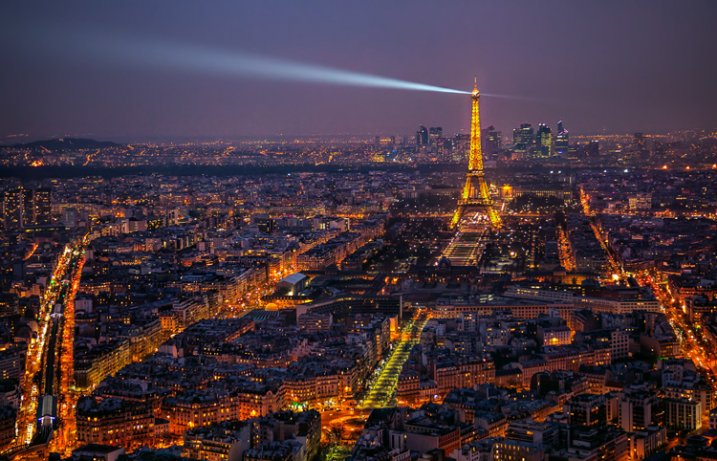
Great Subjects for Urban Night Photography - Paris example

Paris at Night, Taken from the Montparnasse Tower (Shutter speed: 1/4 second; Aperture f/4; ISO: 800).

A good view can present a great opportunity for photography at any time, and nighttime is no exception. Be careful though – a great view does not necessarily make a great picture. The key to success often lies in the foreground. Make sure there is something of interest in the foreground draw your viewer into the great view.

Finding a great view can be difficult. This is particularly true at night, since often the parks or towers from which you capture the view are closed. The best way I have found to find great views is to use guidebooks for your city. Sometimes the guidebook will actually have a section on the best views. If that doesn’t work, take a look at the map on 500px to see what views others have found.

12. Bridges

Great Subjects for Urban Night Photography - Golden Gate Bridge example

Golden Gate Bridge from Marin Headlands, San Francisco (Shutter speed: 4 seconds; Aperture f/9; ISO: 800).

When in doubt, find a bridge to photograph at night. While your city may not have the Brooklyn Bridge or the Golden Gate Bridge, I can almost guarantee you that it will have a bridge, and that it will be well lit at night. Almost every city is built on a river or a bay, meaning there will be bridges. They are always lit.

The key is to find the best vantage point to view the bridge. In your quest to find this, there is no greater tool than the street view function of Google maps. Using Google maps, find the main bridge(s) of your city and then, at either end, virtually walk around using street view. Be sure you find a place to park as well, as this is often tricky around bridges.

Take special notice of the water under the bridge. There will be two effects related to the water. First, the long exposure time will smooth out the water. In rivers it will sometimes show a smooth current. Second, the lights from the bridge will often create reflections in the water. As such, if you can maneuver to use the water as your foreground, you may be rewarded.

When photographing a bridge, don’t overlook the passing traffic. You might be able to incorporate streaking lights from the cars as an element of the shot. As mentioned above, make sure you time the exposure right so that you start it right as traffic is about to enter the frame.

13. Fountains

Great Subjects for Urban Night Photography - Trafalgar Square fountain example

Fountain in Trafalgar Square, London (Shutter speed: 13 seconds; Aperture f/10; ISO: 100).

Many central plazas and squares are centered around a fountain, and these are usually brightly lit at night. They are great places to start when looking to photograph a city a night. What’s more, photographing at night works to your advantage when you find such a fountain. The slow shutter speeds that are required by the low-light scene allow the water to flow while your shutter is open. This makes the water appear smooth.

Start with a low to mid-range ISO (100-400) and a moderate aperture (around f/8). Start with these settings, then adjust your shutter speed to get the correct exposure ought to result in a sufficiently slow shutter speed to create the smooth, flowing water you want.

Conclusion

Night takes up roughly half of each day. Further, it is often easier to get out and shoot at night because most of our work and family obligations take place during the daylight hours. So get out and shoot in your town. Even if you do not live in a major city – many moderate-sized metro areas have most, if not all, of the same subject matter.

When you do start planning night photography, you’ll be surprised how many of the subjects above are near you. It just takes a little effort and advance thought. So check out the available subjects nearby and get after it.

googletag.cmd.push(function() {
tablet_slots.push( googletag.defineSlot( “/1005424/_dPSv4_tab-all-article-bottom_(300×250)”, [300, 250], “pb-ad-78623” ).addService( googletag.pubads() ) ); } );

googletag.cmd.push(function() {
mobile_slots.push( googletag.defineSlot( “/1005424/_dPSv4_mob-all-article-bottom_(300×250)”, [300, 250], “pb-ad-78158” ).addService( googletag.pubads() ) ); } );

The post 13 Great Subjects for Urban Night Photography by Jim Hamel appeared first on Digital Photography School.


Digital Photography School
 
Comments Off on 13 Great Subjects for Urban Night Photography

Posted in Photography


Urban Playscapes: 14 Interactive Installations in NYC

30 Jun

[ By Steph in Art & Installation & Sound. ]

tight spot 1

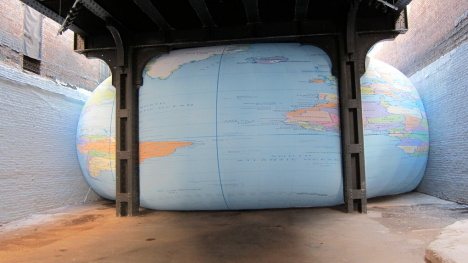
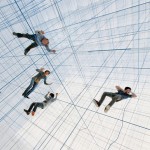
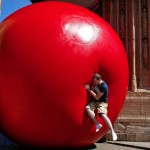
New York City is essentially one massively oversized playground, with interactive art installations ranging from vibrating inflatable globes stuffed under the High Line to mazes in Madison Square Garden just waiting to be discovered by passersby. At any given time, there are dozens of playful outdoor exhibits inviting visitors to climb, touch, listen, connect or simply gaze up in wonder.
City of Dreams Pavilion by Izaskun Chinichilla Architects

nyc city of dreams 1

nyc city of dreams 2

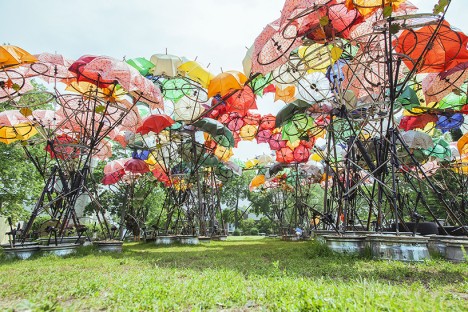
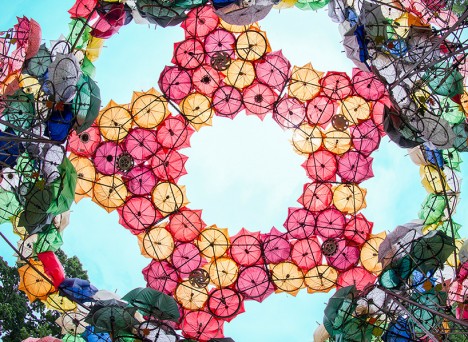
A colorful pavilion made of reclaimed materials has sprouted up on Governors Island in New York City. ‘City of Dreams’ by Izaskun Chinichilla Architects is a visualization of the need to be flexible when designing and carrying out architectural projects, adjusting to changes in budget, specifications and other requirements in an imaginative and intuitive way. Get close and you’ll see all of the broken umbrellas, damaged bicycles, car rims, stools and other waste products that were used to create it.
Please Touch the Art by Jeppe Hein

nyc please touch 2

nyc please touch 3

nyc please touch 4

nyc please touch 1

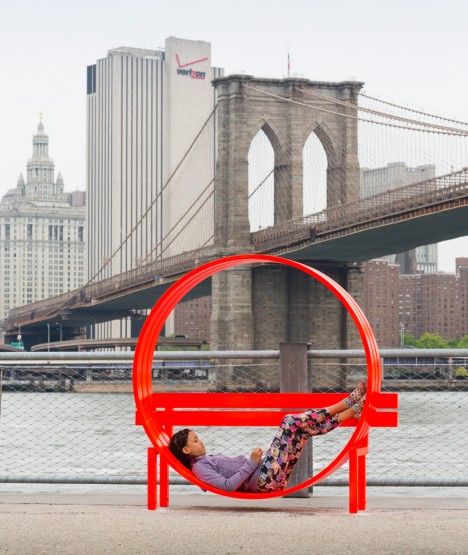
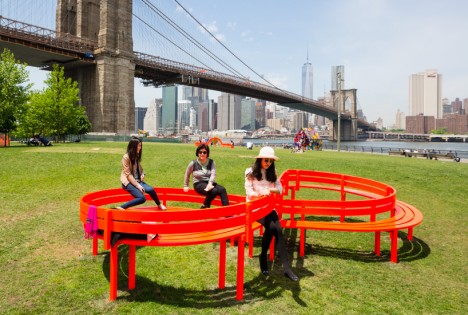
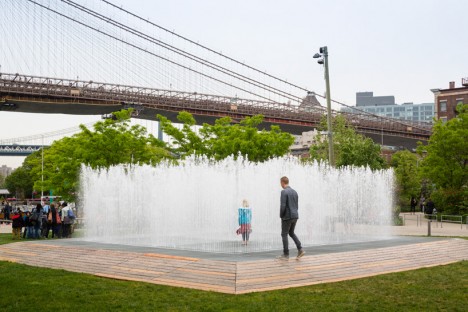
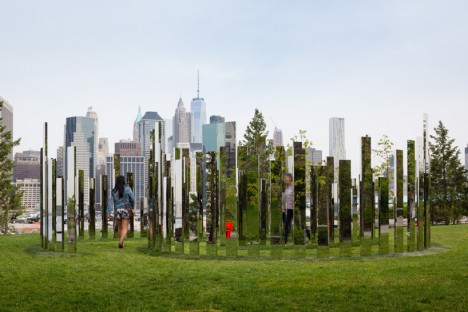
Unlike many art installations, which ask you to look but not touch, this series of sculptural projects by Jeppe Hein beg passersby to interact with them. ‘Please Touch the Art’ is an exhibition of 10 sculptures including benches, a mirror maze and rooms made of water spouts, all located within the waterfront Brooklyn Bridge Park.

Clouds by Olaf Breuning

nyc clouds

nyc clouds 2

nyc clouds 3

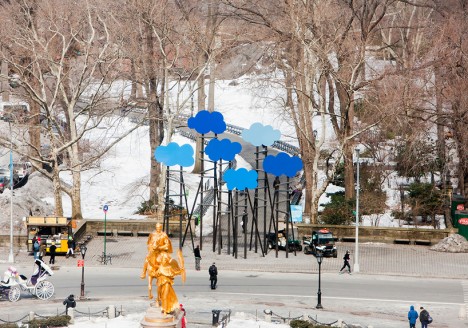
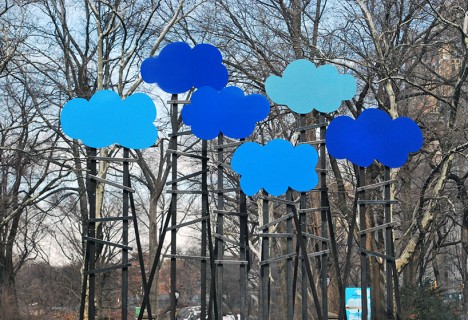
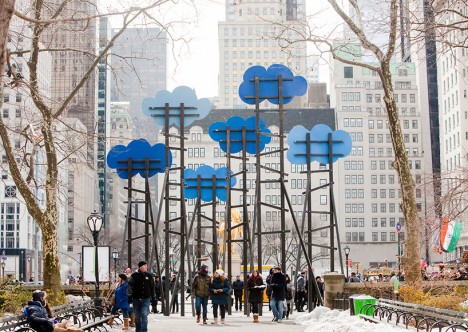
At an entrance to Central Park, childlike clouds in shades of blue hover against a backdrop of winter-bare trees and snow. The effect is that of a stage set for a play, positioning passersby as actors participating in an as-yet-unknown piece of performance. The clouds tower 35 feet above the park on steel ladders.

Cloud City on the Roof of the Met by Thomas Saraceno

nyc cloud cities 1

nyc cloud cities 2

nyc cloud cities 3

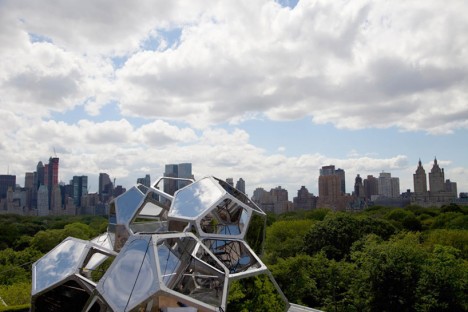
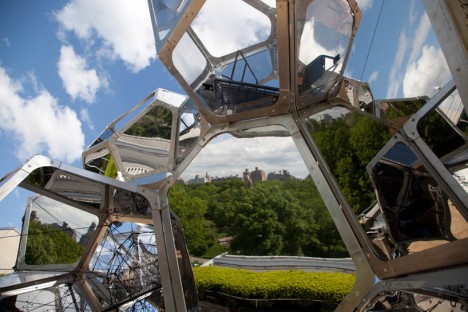
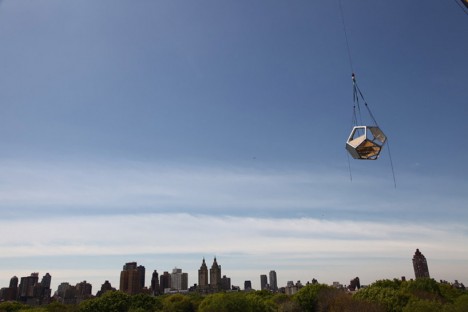
Sixteen interconnected modules come together to form ‘Cloud City,’ a geodesic dome installed on the roof of New York City’s Metropolitan Museum of Art. Argentinian artist Tomas Saraceno, who has installed similar domes in unexpected locations around the world, created the site-specific installation as a fusion of architecture, geometry, biology and ‘human involvement in order.’ Some facets of the modules are mirrored and some aren’t, distorting the view of the city’s skyline and the treetops of Central Park.

Pet Sounds by Charles Long

nyc pet sounds

pet sounds 2

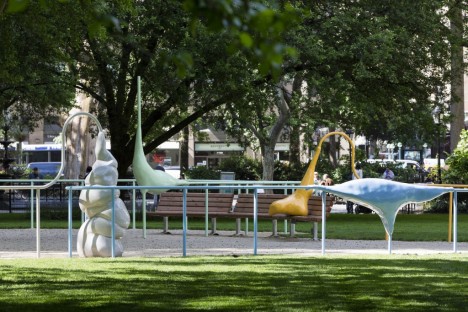
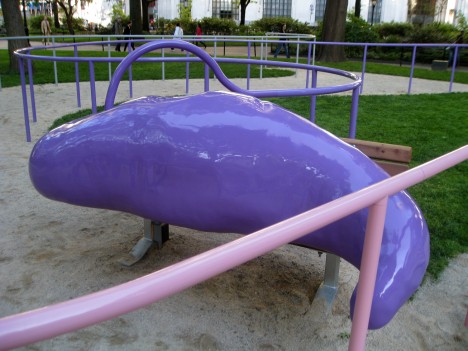
Strange, colorful globs glisten on park benches, along playground railings and in the grass at Madison Square Park, creating new paths and converging around a common seating area. And if anyone is brave enough to actually touch these strange-looking things, they’re rewarded with a variety of sounds and vibrations. ‘Pet Sounds’ by California sculptor Charles Long invites people to add an aural landscape to the physical one in the park. “My re-occuring interest in the uncanny over many years is in full effect here in the Pet Sounds project where something as familiar and literally grounding as a handrail morphs into an unnamable blob that has a very physical presence with some power to dialog with the viewer’s own somatic sense. As one pets the blobs, a wide range of sounds are triggered and are coming from within the bodies of the forms.”

Next Page – Click Below to Read More:
Urban Playscapes 14 Interactive Installations In Nyc

Share on Facebook


[ By Steph in Art & Installation & Sound. ]

[ WebUrbanist | Archives | Galleries | Privacy | TOS ]


WebUrbanist

 
Comments Off on Urban Playscapes: 14 Interactive Installations in NYC

Posted in Creativity


Vertical Cities: 12 Towers Take Urban Density to the Skies

18 Jun

[ By Steph in Architecture & Cities & Urbanism. ]

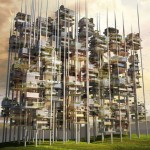
vertical cities singapore futuristic

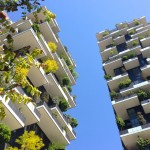
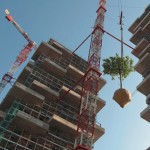
Taking advantage of virtually endless vertical space within urban centers, entire cities-within-cities could spring up into the skies, packing in thousands of new housing units as well as parks, recreational space, offices, shops and everything else you’d expect to find on a typical block. These 12 residential skyscraper designs build up instead of out, often using staggered or stepped arrangements of stacked modules to maintain air circulation, access to daylight, and views. Rather than creating closed class-based communities, most make their communal spaces open to the public, and reserve the ground level for greenery.

High-Rise High-Density Tropical Living in Singapore
vertical cities singapore futuristic 2

How do you pack 100,000 people into a square kilometer without sacrificing quality of life? WOHA’s entry into a competition to design a vertical city for Singapore devised a greenery-laden ‘lattice city’ made of staggered modules. This porous arrangement ensures that all levels get plenty of fresh air and daylight, free up the ground level for nature reserves and heavy industry, and weave social spaces throughout. The plan was created to be walkable, but large elevators and people movers can zip inhabitants vertically and horizontally as needed.

Stacked Modules in Vancouver

vertical cities geometric extruded 1

vertical cities geometric extruded

vertical cities geometric extruded 3

Conceived for Vancouver, this design by Ole Scheeren is made up of stacked rectilinear modules that poke out of the main tower at various angles, projecting the living spaces outward to mimic the spacious feel of living on the ground and create cantilevered terraces. The aim is to reconnect architecture with the natural and civic environment, encouraging social interaction between inhabitants.

Vertical Village in Singapore by OMA

vertical cities singapore village

vertical cities singapore village 2

Condo units that would take up a lot of space if there were all placed on the ground are instead stacked in hexagonal arrangements for The Interlace, a residential project by Ole Scheeren/OMA. 31 individual six-story blocks come together to create a network of both private living spaces and communal areas, with eight large courtyards and various terraced gardens.

Vertical City in Jakarta

vertical cities jakarta

vertical cities jakarta 2

vertical cities jakarta 3

The city of Jakarta in Indonesia is in need of both higher density housing and green space – but designs like these prove that you don’t have to choose. MVRDV has designed a 400-meter-tall tower called Peruri 88 that integrates housing, offices, retail, a luxury hotel, parking, a mosque, an imax theater and more into what is essentially its own city within the city.

Next Page – Click Below to Read More:
Vertical Cities 12 Towers Take Urban Density To The Skies

Share on Facebook


[ By Steph in Architecture & Cities & Urbanism. ]

[ WebUrbanist | Archives | Galleries | Privacy | TOS ]


WebUrbanist

 
Comments Off on Vertical Cities: 12 Towers Take Urban Density to the Skies

Posted in Creativity


Inner City Visions: 12 Eye-Opening Urban Eye Charts

15 Jun

[ By Steve in Architecture & Offices & Commercial. ]

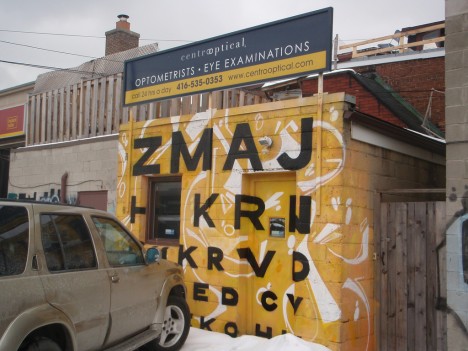
urban eyechart 1a

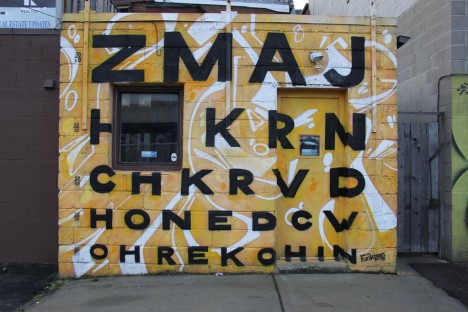
Have no illusions, these awesome urban optical eye charts test not only your vision but the varied ways in which we visualize the world around us.

urban eyechart 1b

If you can’t read the characters on this downtown Toronto eye chart, what the heck are you doing behind the wheel?? Flickr users jbjelloid and John Tavares captured this clever use of an optician’s rear facade (the front is remarkably unremarkable) on January 27th of 2011 and December 4th, 2012 respectively.

What’s In Your Wallet?

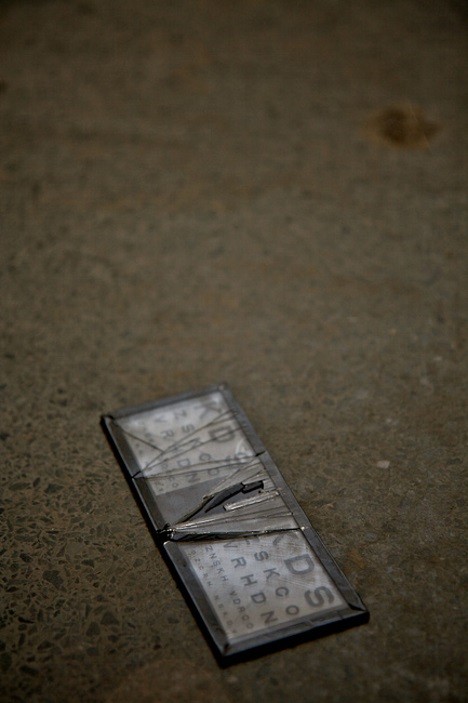
urban eyechart 11

If you were an optometrist working at the now-abandoned Alameda Naval Air Station, then this handy-dandy portable eye chart would rest cheek-by-jowl with your cash and credit cards. How this particular  mini-chart ended up on the clinic floor is a mystery. Maybe the doctor was mugged… one might say he was robbed blind.

Optical Illumination

urban eyechart 2a

urban eyechart 2b

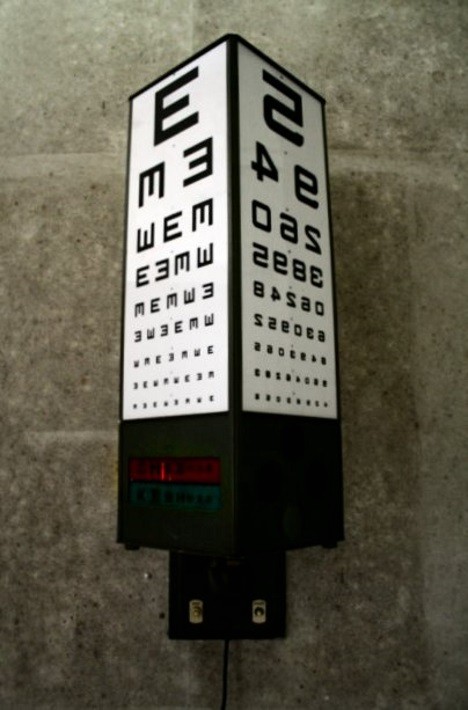
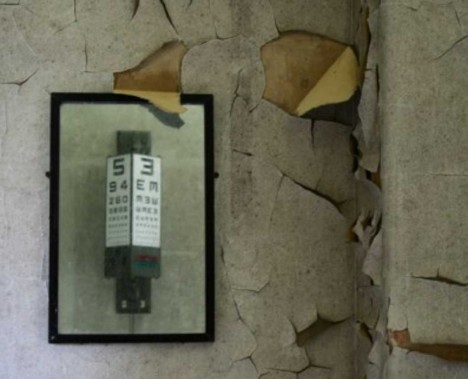
Maybe we’re wrong but these curious eye chart wall sconce thingies (for want of a better term) would seem to be the optician’s equivalent of the iconic barber pole. This one isn’t lit – photographer Adam Slater captured several images shortly before the abandoned West Park Hospital/Asylum was demolished – and it’s a pity someone didn’t “liberate” it for creative re-use. Then again, maybe someone did: as far as we know it might be illuminating Slater’s living room right now.

Real And Spectacle-er

urban eyechart 3a

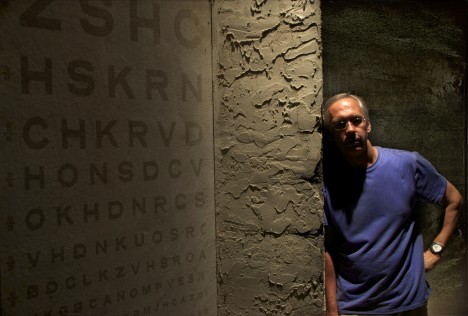
Flickr user Bill Walker celebrated Self Portrait Thursday on June 23rd of 2011 with the above entry posted the previous day. Walker’s composition is all about texture, normally an attribute related to touch but in this case focused on vision.

Next Page – Click Below to Read More:
Inner City Visions 12 Eye Opening Urban Eye Charts

Share on Facebook


[ By Steve in Architecture & Offices & Commercial. ]

[ WebUrbanist | Archives | Galleries | Privacy | TOS ]


WebUrbanist

 
Comments Off on Inner City Visions: 12 Eye-Opening Urban Eye Charts

Posted in Creativity