RSS
 

Posts Tagged ‘Under’

Under London: Disused Tunnel Now a Subterranean Skate Park

26 Aug

[ By Steph in Architecture & Cities & Urbanism. ]

House of Vans Skate Park 1

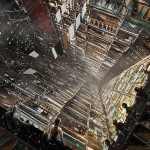
The infamous Old Vic Tunnels under London’s Waterloo Station are now home to the city’s first subterranean skate park with the opening of House of Vans, a cultural complex taking up the entire 32,000-square-foot space. In addition to the pool-style bowl, street section and mini-ramp for skaters, the space will offer a music venue, cafe, bar, cinema, artist studios and gallery space.

House of Vans Skate Park 2

House of Vans Skate Park 5

The four massive tunnels were the subject of a bidding war once the Old Vic Theather vacated the underground space, with Vans reportedly beating out Apple and Nike. The skate park is a fitting usage for it, located adjacent to London’s largest legal graffiti wall and another skate park on the Thames River.

House of Vans Skate Park 3

House of Vans Skate Park 4

The smooth new concrete surfaces and black-and-white checkered floors contrast with the centuries-old weathered brick surfaces of the original tunnels, which are still under control of England’s Department of Transport. Before it was taken over by Old Vic, the disused tunnel played host to the premiere of Banksy’s movie Exit Through the Gift Shop.

House of Vans Skate Park 6

House of Vans Skate Park 7

Skate sessions are free, but must be reserved in advance, with time slots getting snapped up as much as a month ahead of time. Artists selected to utilize the studios for free get the opportunity to display their work in the gallery space at the end of their tenancy.

Share on Facebook


[ By Steph in Architecture & Cities & Urbanism. ]

[ WebUrbanist | Archives | Galleries | Privacy | TOS ]


WebUrbanist

 
Comments Off on Under London: Disused Tunnel Now a Subterranean Skate Park

Posted in Creativity


Iconic ‘Flag Over Reichstag’ Leica to go Under the Hammer

16 Jul

The Lecia III used by Yevgeni Khaldei to take Raising a Flag Over The Reichstag is to go on sale in Hong Kong this November with a guide price of $ 390,000 – 580,000. Khaldei took the famous shot in 1945, as Russian troops overran Berlin in the final days of World War II. Learn more

Articles: Digital Photography Review (dpreview.com)

 
Comments Off on Iconic ‘Flag Over Reichstag’ Leica to go Under the Hammer

Posted in Uncategorized


Prototype battery fully charges in under 30 seconds

12 Apr

storedot.jpg

While smartphone processing power, screen resolutions and camera performance have all improved significantly over the last few years, one area of development is seemingly standing still. Under heavy use most smartphone batteries still won’t make it through the day, and once plugged in, devices take a long time to charge. Faster charging batteries are certainly welcome news to smartphone and tablet users but could also reduce the need for carrying spare batteries on longer photographic excursions. Learn more

News: Digital Photography Review (dpreview.com)

 
Comments Off on Prototype battery fully charges in under 30 seconds

Posted in Uncategorized


Understand Exposure in Under 10 Minutes

13 Mar

DPS-Annie-Tao-Exposure-article-perfect-exposure-exampleThere are countless Photography books and classes that explain exposure, yet after reading or attending them, your photos may not have improved because…well, let’s be honest… some of us Right-Brainers aren’t super technical!

I recently taught a small photography class to newbies. I thought hard about how I could explain exposure in the simplest way possible. I found that a parallel example of something relatable was the best way to convey the different aspects that impact exposure.

I tested this theory by explaining exposure to my 8-year old daughter and then quizzed her. She proved the theory was a success by grasping the concepts within 10 minutes. So I’d like to share my lesson with you so you can understand exposure in under 10 minutes!

A 10-minute lesson that will change your Photography

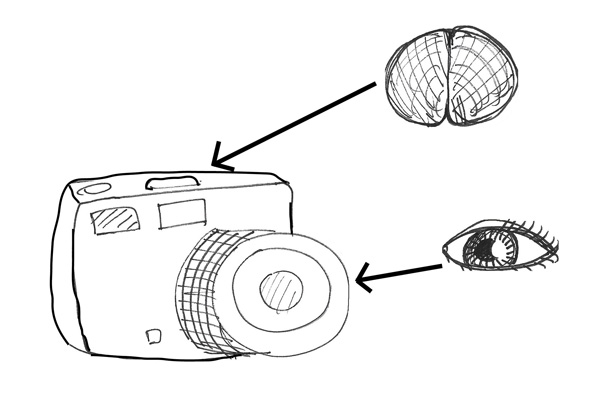
Your DSLR camera is like your head with the LENS being your vision and the camera BODY is your brain. Your vision sees things and your brain records the details.

DPS-Annie-Tao-Exposure-article-camera-metaphor

Just like when you look at something – let’s say, a flower – your eyes see it and send information to your brain that the flower has long petals and that it is yellow. If you looked at it too quickly or it was too dark, for example, the information your brain records is compromised.

The “exposure triangle” is about how 3 things — aperture, shutter speed and ISO — work together to provide enough light for your brain (the camera) to record what you see. You need the right combination of these 3 components to have perfect exposure.

DPS-Annie-Tao-Exposure-article-perfect-exposure-example

Good exposure

For example, if you don’t let in enough light, you won’t see things very well because it’ll be too dark (underexposure).

DPS-Annie-Tao-Exposure-article-underexposure-example

Too dark, or underexposed

If you let in too much light, then it’ll be too bright and you can’t see a lot of the details (overexposure).

DPS-Annie-Tao-Exposure-article-overexposure-example

Too bright, or underexposed

APERTURE = how WIDE you open your eyes

A small aperture (a large f-stop or f-number, like f/22) is like squinting. A large aperture (a small f-stop or f-number, like f/1.4) is like having “bug eyes”.

Quiz:  If you are shooting in low light, how wide do you open your eyes? Will you see well at night if you are squinting (small aperture)?

Quiz:  What happens on a super bright day if your eyes are wide open and they’re open for a long time (slow shutter and large aperture)? Can you see well then?

DPS-Annie-Tao-Exposure-article-fish-with-eyes-open-wide-and-squinting

Aperture is how big you open your eyes – bug eyes, or squinting

SHUTTER SPEED = how LONG you open your eyes

A fast shutter, like 1/1000th of a second, is blinking super fast. A slow shutter speed, like 2 seconds, is keeping your eyes open and then blinking. The thing to remember is:  your brain is recording everything when your eyes are open. So if you or something you’re looking at is moving, and your eyes are open a long time (slow shutter), then your brain will record a blurry image.

Quiz:  If you want a crisp shot of someone jumping, how long do you need your eyes open? What will freeze the shot:  a quick blink (fast shutter) or a slow one (slow shutter)?

DPS-Annie-Tao-Exposure-article-moonglasses

ISO special glasses

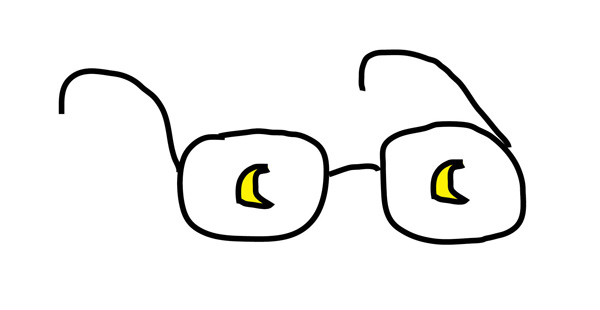
ISO = special glasses that help you see in the dark

ISO is like the opposite of sunglasses. Let’s call them MOONglasses!  ;)

The higher the ISO, the thicker your moonglasses, so the more you are able to see in low light. You need thick moonglasses (high ISO) when shooting indoors or at dusk. You need very thin moonglasses (low ISO) when it’s a sunny day.

Quiz:  do I need thick, thin or medium moonglasses if I’m shooting at the beach on my lunch break?

All 3 of these things work together

Here is an example:  You are photographing your sleeping cat who is snuggled on the couch. There is not much light coming through the windows or additional ambient light. To see well, you have medium-to-thick moonglasses on (such as ISO 600). You need to have your eyes open pretty wide (large aperture, such as f/1.4). However, you don’t have great vision (you have a kit lens that only goes up to f/4.5), so you need more light to see. Thus, you leave your eyes open longer (slow shutter speed, such as 1/30th sec).

Final Quiz:

  1. In the same scenario, your cat notices you are snapping photos, so she starts walking away and leaps off the couch. You still want to photograph her. Which would you change:  how open your eyes are (aperture), how long you leave your eyes open (shutter speed), or thickness of your moonglasses (ISO)?
  2. If you increase your shutter speed because you want to freeze the image, what else would you need to change? (If you changed nothing else, the image would be too dark because you let in less light.)

Once you get the basic concept of exposure and how the three components of the exposure triangle (aperture, shutter speed and ISO) work together, turn your DSLR camera to “manual” and practice the specific settings based on different circumstances.

Want more on exposure?  Try these:

  • Your First DSLR – now what?!
  • Getting off Auto – Manual, Aperture and Shutter Priority modes explained
  • Introducing the Creative Triangle
  • Using Manual Mode: Exposure Lesson #4
  • Photo Nuts and Bolts – a dPS ebook

The post Understand Exposure in Under 10 Minutes by Annie Tao appeared first on Digital Photography School.


Digital Photography School

 
Comments Off on Understand Exposure in Under 10 Minutes

Posted in Photography


Disappearing Bed for Tiny Flat Rolls Under Kitchen Floor

21 Jan

[ By Steph in Design & Furniture & Decor. ]

Disappearing Bed Tiny Apartments 1

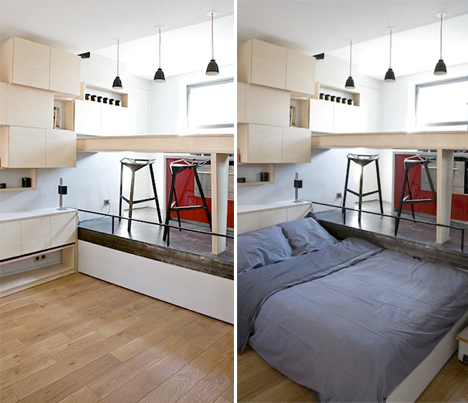
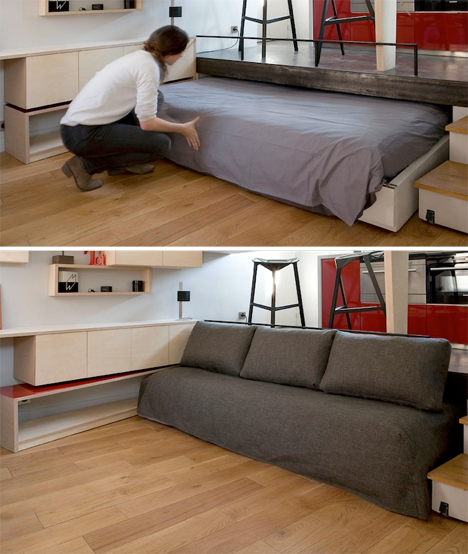
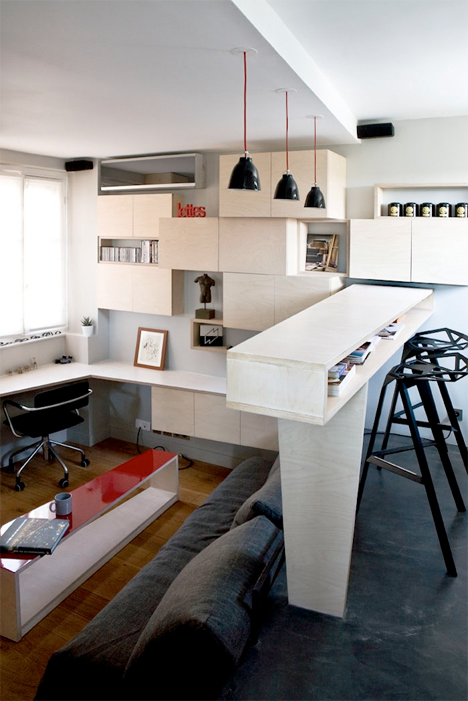
When you’re trying to pack an entire apartment worth of furniture into just 130 square feet, where do you find the room for a full-sized bed? The answer, in this case, is a place you’d likely never expect: under the kitchen floor. ‘Disappearing Bed’ rolls under a raised platform to go away altogether when floor space is required, or it can be pulled halfway out like a drawer to serve as a couch.

Disappearing Bed Tiny Apartments 2

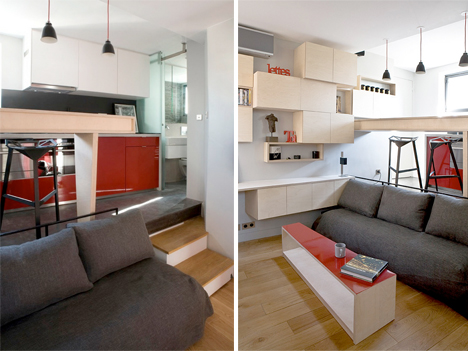
Architects Julie Nabucet and Marc Baillargeon found every possible inch of space in a tiny micro flat in Paris, hiding storage and extra functions in nearly every corner. Raising the kitchen to accommodate the hidden mattress is not only an incredibly clever solution, but also makes the room feel larger by adding an extra level.

Disappearing Bed Tiny Apartments 3

Disappearing Beds Tiny Apartments 5

A rectilinear table tucks away under a series of under-table cabinets, or can be swung out in front of the couch to act as a coffee table. Desk-height shelving that runs in an L-shape along the wall provides workspace, and staggered wall cabinets hide away clutter.

Disappearing Bed Tiny Apartments 4

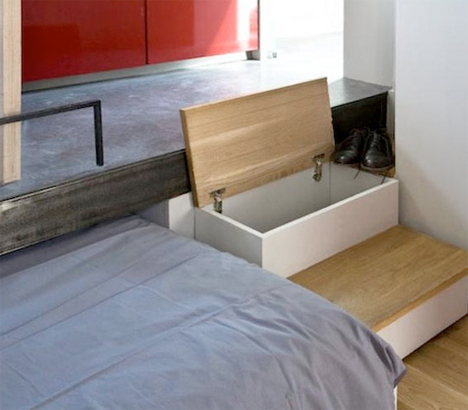
The stairs leading up to the kitchen offer hidden storage space for shoes, and the narrow bar overlooking the living space is hollow to hold magazines, books and other small items.

Share on Facebook


[ By Steph in Design & Furniture & Decor. ]

[ WebUrbanist | Archives | Galleries | Privacy | TOS ]


WebUrbanist

 
Comments Off on Disappearing Bed for Tiny Flat Rolls Under Kitchen Floor

Posted in Creativity


DPReview Recommends: Interchangeable Lens Cameras for Under $1000

05 Dec

under1000.jpg

A few years ago, the idea of a DSLR under $ 1000 was just a distant dream, but these days the financial bar to entry is much lower than it was in the past. And DSLRs aren’t the only game in town anymore either – mirrorless interchangeable lens cameras are maturing quickly, and there are plenty of affordable options on the market. Here’s our list of the top five interchangeable lens cameras that we’d currently recommend for under $ 1000 – including a kit zoom lens.

News: Digital Photography Review (dpreview.com)

 
Comments Off on DPReview Recommends: Interchangeable Lens Cameras for Under $1000

Posted in Uncategorized


Decay Down Under: 7 Abandoned Wonders of Australia

27 Nov

[ By Steph in 7 Wonders Series & Global. ]

Abandoned Australia Main

Whether covered in colorful graffiti or slowly disappearing under a profusion of moss and vines, Australia’s most intriguing abandoned places share the same sense of mournful decay as landmarks that are nearly lost to the ravages of time. These 7 wonders of abandoned Australia include historic tram stations, theme parks, asylums and factories.

Atlantis Marine Park, Yanchep, Western Australia

Abandoned Australia Atlantis Marine Park

(images via: tor lindstrand)

A massive statue of King Neptune still looks out over a marine park that’s been closed for nearly 25 years. Atlantis Marine Park opened in Yanchep, Western Australia in 1981 and hosted the typical array of aquarium wildlife like dolphins, sea lions, penguins and seals. But in the late 1980s, regulations about the size of enclosures for dolphins changed, and accommodating them proved too costly for the owners. All nine dolphins were rehabilitated and released back into the wild, but when three of them failed to thrive, they were relocated to another marine park.

Since then, the property has been in limbo, with much of the ruins retaken by nature. No fences keep out members of the public, so anyone can get in to take photos and enjoy the views of the ocean. Members of the community have petitioned to restore the park, but the property owners plan to develop the space for residential and commercial use.

Aradale Mental Hospital, Ararat, Victoria

Abandoned Australia Aradale Hospital 1

Abandoned Australia Aradale Mental Hospital 2

(images via: aradale ghost tours)

Built in 1863, Aradale Mental Hospital was an Australian psychiatric hospital built to accommodate the burgeoning population of ‘lunatics’ in Victoria. Designed as a town within a town, it had its own gardens, markets, orchard, vineyards, pig farm and other livestock along with hundreds of staff. The Victorian complex was built high on a hill and held thousands of patients in 18 wards until 1993. It held female prisoners until 2001 during the renovation of a nearby facility, and then closed for good. Companies like Aradale Ghost Tours now take curious visitors through the complex, including the morgue.

And how was it that Victoria was home to so many so-called lunatics? It was common during that time, all over the world, for people with conditions like Down Syndrome, epilepsy or autism to be declared insane. Sometimes, all it took was postpartum depression, homosexuality or ‘promiscuous behavior’ to be institutionalized for life.

Helensburgh Train Station, New South Wales

Abandoned Australia Helensburgh Train Station

(image via: robert montgomery)

Sometimes the most striking abandonments are those that are so overgrown, they’re almost entirely hidden. Such is the case with the Helensburgh train station in New South Wales. Left to decay since 1915, when a new station was built about 200 meters to the north, this stone-walled relic is all rust and rotting wood, lush with ferns, moss and ivy. Unsurprisingly, it’s an irresistible attraction for photographers – check out some stunning photos by Tom Jarman at Urban Ghosts Media.

Rozelle Tram Depot, Glebe, New South Wales

Abandoned Australia Rozelle Tram Depot 1

Abandoned Australia Rozelle Tram Depot 2

(images via: wikimedia commons)

Once the second-largest tram depot servicing Sydney and among the most sophisticated public tramway systems in the world, the Rozelle station in Glebe was open from 1918 until 1958. Six 1930s trams, mostly gutted on the inside, still sit inside the station so many decades later. Though they may have been abandoned inside this massive concrete and steel facility, they’re now practically works of modern urban art, brightly colored and covered in layer upon layer of graffiti. The trams were in near-mint condition prior to 2000, and could have been beautiful historical artifacts if not for the vandalism that began around that time. The whole property has been purchased by a developer, who plans to turn the site into medium density housing.

Next Page – Click Below to Read More:
Decay Down Under 7 Abandoned Wonders Of Australia

Share on Facebook


[ By Steph in 7 Wonders Series & Global. ]

[ WebUrbanist | Archives | Galleries | Privacy | TOS ]


WebUrbanist

 
Comments Off on Decay Down Under: 7 Abandoned Wonders of Australia

Posted in Creativity


Sky Rock Under the Stars

24 Oct

Ancient petroglyphs are amazing to see, but one question that always comes to mind is, “What were their significance?”

In the case of Sky Rock I’ve often wondered if they reflected an interest in the stars, represented every day things, told a story, or were the musings of someone who was just passing the time. It is this curiosity coupled with their distinct artistic and historical qualities that make them so special to me.  Seeing these ancient petroglyphs under billions and billions of stars that make up the Milky Way was an awe-inspiring experience given both the immensity and timelessness of the scene. It’s grounding to take in a view that very likely was the same 8000 years ago when someone created these rock drawings as it was on the night I stood here taking this photo.

Photo Details

Canon 5D Mark III and Zeiss Distagon T* 2.8/15 ZE via BorrowLenses.com

ISO 6400, 30 sec at f/2.8

16 image panoramic with foreground lit via light painting

~180 degree field of view capturing both the entire Milky Way and Sky Rock petroglyph

Copyright Jim M. Goldstein, All Rights Reserved

Sky Rock Under the Stars

The post Sky Rock Under the Stars appeared first on JMG-Galleries – Landscape, Nature & Travel Photography.


Comments

  • I love this! 4D seeing 5D coming.. the old/past, & the … by Peggy Jackson
  • Amazing work Jim! Worth all the time you spent working on the … by latoga
  • Thanks! Fish-eye lenses introduce a large amount of distortion … by jimgoldstein
  • Jim, it’s beautiful.. the canopy of Milky Way sheltering the … by bartek_narozny

Related Stories

  • Sky Rock Under the Stars – Enclosure
  • Hunter’s Moon Rising
  • Hunter’s Moon Rising – Enclosure


JMG-Galleries

 
Comments Off on Sky Rock Under the Stars

Posted in Equipment


First impressions review: Tiny Panasonic GM1 under the microscope

17 Oct

specs.jpg

It’s not every day when you see a mirrorless interchangeable lens camera that can fit in the palm of your hand. That’s why we jumped at the chance to take a look at Panasonic’s new Lumix DMC-GM1, which offers many of the features of its larger siblings, in a much smaller package. Read our first impressions review after the link.

News: Digital Photography Review (dpreview.com)

 
Comments Off on First impressions review: Tiny Panasonic GM1 under the microscope

Posted in Uncategorized


Miniature wide angle lens under development at UCSD

28 Sep

UCSD.jpg

Researchers at UCSD’s Jacobs School of Engineering are working on a miniature wide angle lens, taking advantage of the benefits of spherical lenses. At just a tenth of the size of a traditional wide angle lens, a spherical lens can create wide angle images without chromatic aberration or loss of resolution at corners. The challenge is capturing the lens’ spherical projection on a flat sensor. The team have overcome this by using optical fibers fused to the rear of the lens to relay light to electronic sensors. Click through to read more about the this unique concept.

News: Digital Photography Review (dpreview.com)

 
Comments Off on Miniature wide angle lens under development at UCSD

Posted in Uncategorized