RSS
 

Posts Tagged ‘this..’

This instant camera is made almost entirely of cardboard

01 Feb

$ (document).ready(function() { SampleGalleryV2({“containerId”:”embeddedSampleGallery_9055945704″,”galleryId”:”9055945704″,”isEmbeddedWidget”:true,”standalone”:false,”selectedImageIndex”:0,”startInCommentsView”:false,”isMobile”:false}) });

A Ukrainian startup is looking to fund mass production of Jollylook, a camera made mostly of cardboard and paper that accepts Fujifilm Instax mini cartridges. The camera exists in prototype form now, and contains no electronic parts – a specially designed shutter and hand crank used to start the development process are operated manually. 

Jollylook folds up into an ordinary-looking cardboard box (a little bigger than the box an iPhone comes in, its developer says) when not in use. To start using it, the front unit containing the lens is extended. Set the aperture, raise the viewfinder, frame your shot and fire.

Jollylook’s makers state that Kickstarter funds will be used to create molds for the camera’s lenses, organize production and help with marketing efforts. They’re closing in on their $ 15,000 goal fast with a full month to go. Backers who pledge at least $ 35 are promised one Jollylook camera and an Instax mini film cartridge. Shipping is estimated for June 2017.

$ (document).ready(function() { SampleGalleryV2({“containerId”:”embeddedSampleGallery_3471604241″,”galleryId”:”3471604241″,”isEmbeddedWidget”:true,”standalone”:false,”selectedImageIndex”:0,”startInCommentsView”:false,”isMobile”:false}) });

Jollylook – The First Cardboard Vintage Instant Camera!

Jollylook is a simple fold out camera for analog photos, made entirely from recycled paper and cardboard. No electronics, batteries or chargers – some paper, a pair of lenses and a cartridge for instant mini photos. Environment friendly – Jollylook uses less materials than used in the packaging of a regular camera. The camera body, the shutter and aperture are made of thick paper and laminated cardboard. Jollylook is as dangerous to the environment as a banana peal!

On January 31st, 2017 – Jollylook, a Ukrainian team of instant photography enthusiasts, starts a 30-days crowdfunding campaign on Kickstarter.com, to bring Jollylook – The First Cardboard Vintage Instant Film Camera to instant photo lovers.

Oleg Khalip, co-founder and author of the idea: “Once I was showing my son what’s inside the analog camera and how analog photography works, I thought then – “what if the package itself transformed and fulfilled the function of the camera and the picture turned out immediately?!” There was no problem with instant photos technology, people solved this problem long time ago. What remained to create was an analog camera that would be simple and contained in the package, worked properly and allowed to take pictures and get instant results. I had to study the structure of many analog cameras, before being able to make the shutter – the most difficult part in the development was the shutter (no existing structure worked for Jollylook, so I had to invent a new shutter). After picking the right lens and calculating the aperture, we created a folding “accordion” camera body from paper, then the case where the instax cartridge is placed, and we moved to the design, here there where no doubts – it had to be retro with a little steampunk look. Then we had difficulties with the unit for getting the photo out from the cartridge but after testing many options, we achieved a perfect result, photographs are now developed and pulled out with a rotating handle.”

“When moments of life that we see freeze on paper – it is magic!” – says Oleg.

The crowdfunding campaign with a goal of $ 15 000 will last for 30 days and the first mass produced Jollylook cameras are expected in June 2017.

The advantages of Jollylook:

Vintage Design – retro with a little steampunk.

Foldout and Compact – a little bigger than an iphone box.

A Great Gift – can be used immediately and instantly.

A Great Toy – Jollylook is a great teaching toy for children. Your kid can take it apart and see how it works.

A Great Souvenir – even after use Jollylook is beautiful on the shelf!

Fun – entertaining and positive emotions.

Beautiful Photos – using Instax mini film you get 10 instant classic color or monochrome analog unique photos. (the cartridges can be changed many times easily and quickly )

Environment friendly – easily recyclable, as dangerous to the environment as a banana peal!

Specifications:

  • Lens – a meniscus lens with a focal length of 110 mm (4.33 in), allows to take photos from portrait to landscape. Can be moved up to shoot through the pinhole.
  • Viewfinder – a Fresnel lens
  • Aperture – a switchable diaphragm with manual adjustment for the seven values: f/8, f/11, f/16, f/22; f/32; f/45; f/64 + pinhole.
  • Shutter – automatic with shutter speed of 1/250 or 1/160 and manual shutter mode with the possibility to control the exposure time manually.
  • Pinhole – a round hole in a copper foil 0.6 mm (0.023 in) in diameter, located on the diaphragm disk
  • 10 shots per instax mini cartridge (the cartridge can be changed many times)
  • Storage conditions – store in a dry and dark place at room temperature.
  • Conditions of use – use at temperatures between 10 – 35 °C (50 -95 ?) in dry weather.
  • Size when folded 85 x 127 x 48 mm (311?32 x 5 x 157?64 in)
  • Takes Fujifilm “instax mini” instant film cartridge
  • Photo size 46(W) x 62(H) mm

Articles: Digital Photography Review (dpreview.com)

 
Comments Off on This instant camera is made almost entirely of cardboard

Posted in Uncategorized


This time-lapse captures the awe-inspiring power of lava flowing into the ocean

25 Jan

Any seasoned landscape photographer can tell you that the moment spent actually pressing the shutter is just the tip of the iceberg – hours and even days are spent planning, getting into position and waiting for the right conditions. So the story behind Jack Fusco’s impressive new time-lapse, 61G Ocean Entry, might be familiar to landscape photo veterans.

Fusco and team traveled to Hawaii’s Big Island hoping to capture a somewhat rare occurrence: lava flowing into the Pacific Ocean from Kilauea Volcano. The goal was to capture a time-lapse of the stars along with the spectacular light show created by the flowing lava meeting ocean water.

If you watch the video above and you’ll see that Fusco’s mission was a success, but the behind-the-scenes story is equally fascinating. A rainy forecast and logistical challenges meant that the crew had to do a lot of thinking on their feet. All told, they came away with 1.3TB of data after 20 miles of hiking, hundreds of miles driven and very few hours spent sleeping. Was it worth the trouble? Take a look at the video and see for yourself.

Read the full behind-the-scenes story at Macphun’s blog.

Articles: Digital Photography Review (dpreview.com)

 
Comments Off on This time-lapse captures the awe-inspiring power of lava flowing into the ocean

Posted in Uncategorized


This art installation re-imagines photographic equipment as weapons

14 Jan

Shoot Portraits, Not People: Jason Siegel’s photographic ‘weapons’

Photo by Jason Siegel

Glance at a piece from Jason Siegel’s ‘Shoot Portraits, Not People’ art installation and you might think you’re looking at a high-powered weapon. But if you look closer, you’ll quickly see that guns and grenades are all made up of photographic equipment.

Siegel is a Denver-based lifestyle photographer, with a professional portfolio that includes work for clients in the clothing and music industries. Stepping outside of the printed image for this project, he gathered over 200 pounds of cameras, lenses, flashes and other pieces of equipment for this project. He worked with metal sculptor Keith D’Angelo to build the weapons and military paraphernalia, a process you can get a glimpse of in the behind-the-scenes video below.

‘Shoot Portraits, Not People’ opens today at BLK MKT gallery in Aspen, and will run through the month of January. See more of Siegel’s work by heading to his website or following him on Instagram and Facebook.

Via PetaPixel

Shoot Portraits, Not People: Jason Siegel’s photographic ‘weapons’

Photo by Jason Siegel

Shoot Portraits, Not People: Jason Siegel’s photographic ‘weapons’

Photo by Jason Siegel

Shoot Portraits, Not People: Jason Siegel’s photographic ‘weapons’

Photo by Jason Siegel

Shoot Portraits, Not People: Jason Siegel’s photographic ‘weapons’

Photo by Jason Siegel

Shoot Portraits, Not People: Jason Siegel’s photographic ‘weapons’

Photo by Jason Siegel

Shoot Portraits, Not People: Jason Siegel’s photographic ‘weapons’

Photo by Jason Siegel

Articles: Digital Photography Review (dpreview.com)

 
Comments Off on This art installation re-imagines photographic equipment as weapons

Posted in Uncategorized


Is this drone-toting concept car the future of photojournalism?

11 Jan

$ (document).ready(function() { SampleGalleryV2({“containerId”:”embeddedSampleGallery_3973428980″,”galleryId”:”3973428980″,”isEmbeddedWidget”:true,”standalone”:false,”selectedImageIndex”:0,”startInCommentsView”:false,”isMobile”:false}) });

Photojournalists, especially those embedded or covering remote and/or dangerous regions of the world would likely benefit from a vehicle specifically designed to help them overcome the daily challenges they face. Dillon Kane, an automotive design student at Lawrence Technological University, seemed to think so too. He recently won Magna International’s ‘Main Event’ design competition for his concept called ’30 degrees West,’ a futuristic car that we can only describe as an Inspector Gadgetmobile for visual journalists.

The competition is held annually prior to the North American International Auto Show, and this year, judges asked young automotive designers to dream up a new vehicle that might debut in the year 2030.

Sure, the vehicle rendering looks a bit like a riding lawnmower, but it would actually be packed with intelligent technology and design. Kane’s design features compartments for gear located on all sides of the vehicle (that apparently open and close in near silence) and a ladder pops out from the back of the vehicle to allow journalists a higher vantage point. Of course, if standing on the roof still isn’t high enough, the vehicle has a built in drone, also located on the roof, that can be launched for aerial coverage. Because duh, it’s the future and drones.

Additionally, the vehicle would be covered with smart sensors and cameras to record information about one’s environment, and a built-in ‘gentle light’ is also included in the design to create some flattering light for portraits on the fly. While some aspects of its design may seem like they need more hashing out (like the fact that it is not autonomous and must be piloted), it’s pretty cool to see a vision for a car designed specifically with photographers in mind.

So what do you think of Kane’s design, is it something you’d drive? Or better yet, how would you improve upon it to make it truly meet the needs of traveling photographers? Let us know in the comments!

Articles: Digital Photography Review (dpreview.com)

 
Comments Off on Is this drone-toting concept car the future of photojournalism?

Posted in Uncategorized


This image is why the world needs professional photographers

21 Dec

A gunman assassinated Russia’s ambassador to Turkey yesterday at the opening of a photography exhibit in Ankara. Associated Press photographer, Burhan Ozbilici was covering the event and witnessed the assassination first hand, which occurred while the ambassador was addressing the room of attendees.

In the face of an active gunman meters away, Ozbilici kept on making pictures. And because of his bravery, the world can witness and better contextualize this horrific event. But before you go on calling Ozbilici a hero for being brave, consider for a moment that he did exactly what he is trained to do. He did what any good photojournalist should have done. 

In an interview with the Los Angeles Times today, Ozbilici had this to say about the incident:

“I was, of course, fearful and knew of the danger if the gunman turned toward me. But I advanced a little and photographed the man as he hectored his desperate, captive audience,” Ozbilici tells the LA newspaper. “I was thinking: ‘I’m here. Even if I get hit and injured, or killed, I’m a journalist. I have to do my work. I could run away without making any photos… But I wouldn’t have a proper answer if people later ask me: ‘Why didn’t you take pictures?’”

It’s a stark reminder that the world needs well-trained photojournalist now more than ever. Unfortunately the trend in the newsroom, both in the United States and World-wide has been a constant cycle of slashing staff photography positions. 

There are a lot of reasons why photojournalism jobs are disappearing, the decline of print/classified ads is surely one, but the increase in smartphone image quality is another. Smartphones have come a long way and for many media companies, a multi-talented journalist who can shoot some photos and video with their iPhone is often considered good enough.

So what if instead of a proper photojournalist, the Associated Press has sent just a reporter with a smartphone to cover the event? After all, it’s just a gallery opening right? A quick snap of the ambassador behind the podium and a few shots of the gallery walls to accompany the text should do the trick. 

The point is, there really is no substitute for a professional photojournalist with years of training and field time. In an era when news is increasingly catered toward one’s specific taste, the facts can be elusive. But a good photojournalist can get us closer to the truth. It’s their job.

Articles: Digital Photography Review (dpreview.com)

 
Comments Off on This image is why the world needs professional photographers

Posted in Uncategorized


Flickr says smartphones were the most popular device this year, iPhone tops list

08 Dec

Flickr has published its 2016 end-of-year report detailing the most popular devices and brands on its platform. Per the report, 48% of photos published on Flickr this year were captured using smartphones, and 47% of them were captured using iPhones specifically. The top three iPhone models were the iPhone 5s, the iPhone 6, and the iPhone 6s.

As far as brands go, Canon was the second most used at 24% and Nikon came in third at 18%. Device types, meanwhile, show DSLRs ranked second after smartphones at 25%, point-and-shoot cameras at 21%, and mirrorless models at 3%. Comparing the figures with last year’s report, smartphone uploads are up 9%, DSLR uploads are down 6%, point-and-shoot uploads are down 4%, and mirrorless uploads have remained steady.

Via: Flickr Blog

Articles: Digital Photography Review (dpreview.com)

 
Comments Off on Flickr says smartphones were the most popular device this year, iPhone tops list

Posted in Uncategorized


How I Processed This Photo Using Only Lightroom

24 Nov

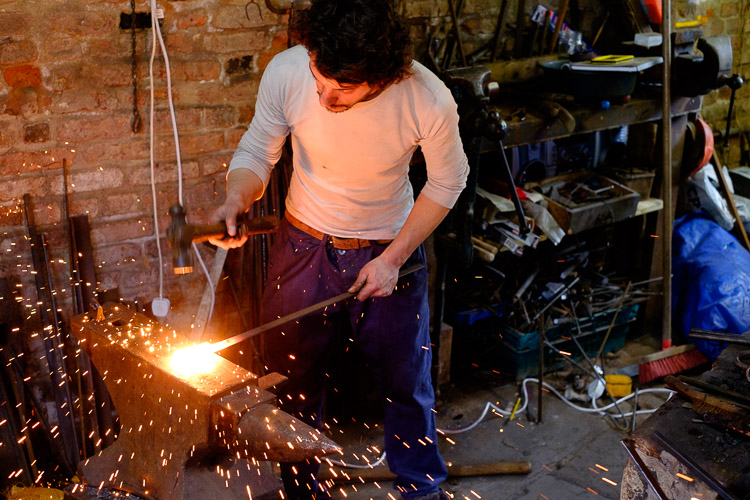
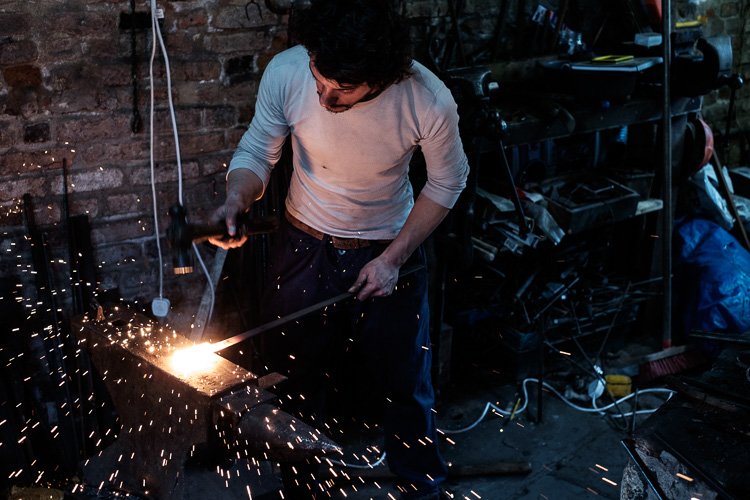
An advantage of using the Raw format is that it gives you a tremendous amount of freedom when it comes to processing. This, combined with Lightroom’s powerful processing engine, opens up lots of possibilities for the creative photographer. I’d like to show you how I processed a Raw file using only Lightroom.

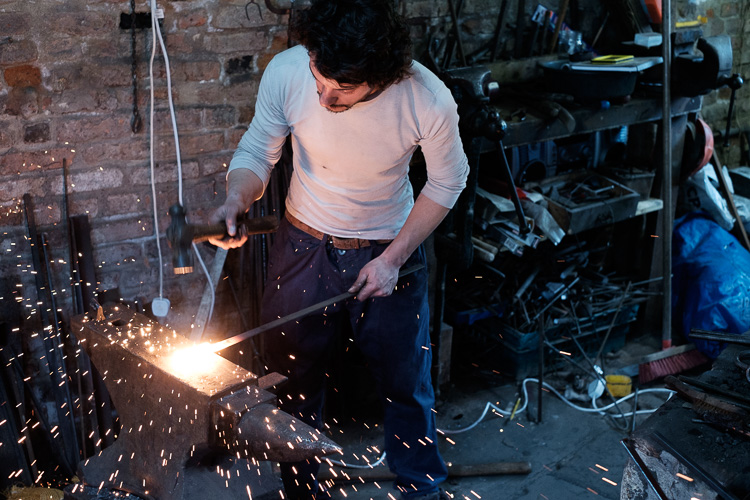
Photoshop users will also be able to follow along with most of it, as Adobe Camera Raw shares many of Lightroom’s sliders and functions. This is the original Raw file, as it came out of the camera.

Lightroom processing

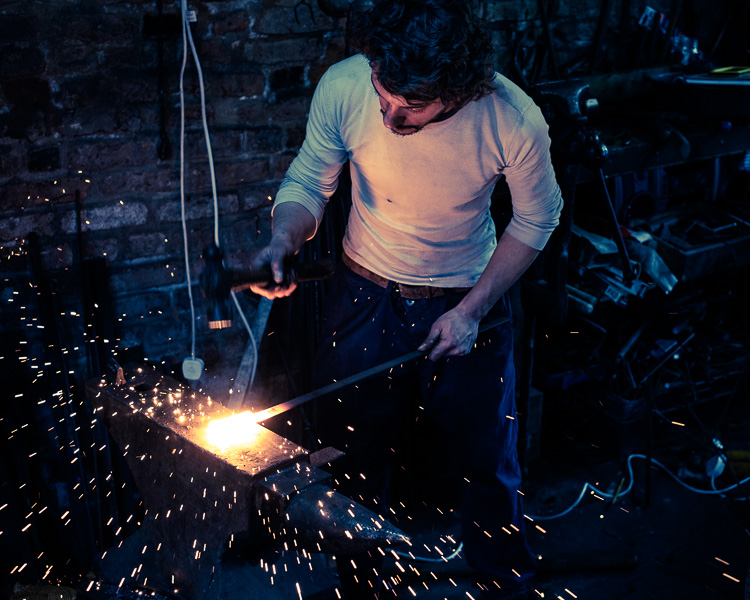
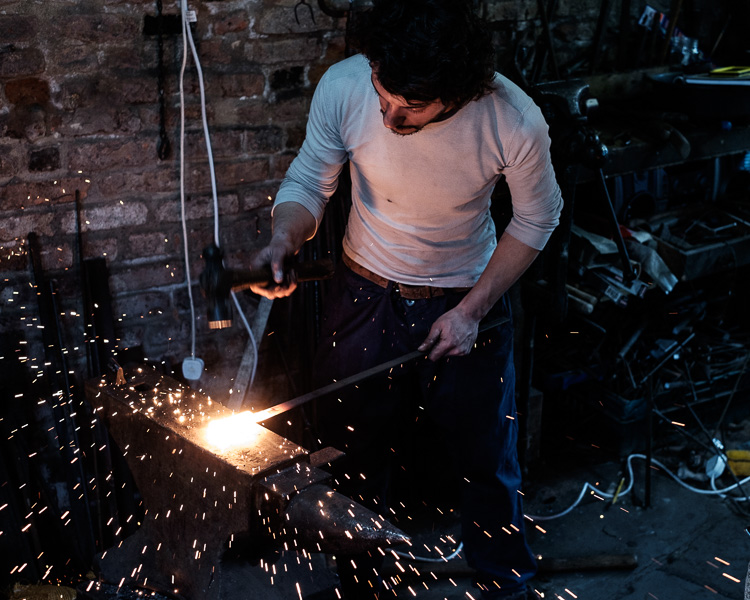
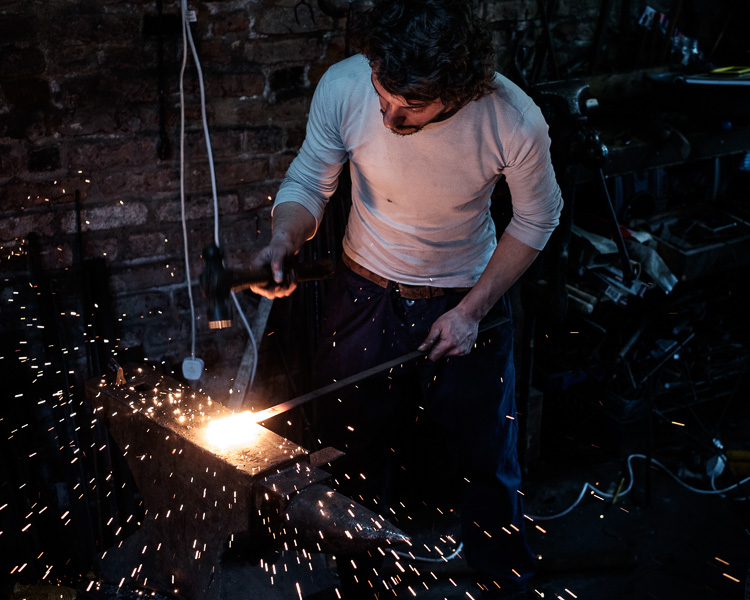
And here’s the finished result after post-processing.

Lightroom processing

The story behind the image

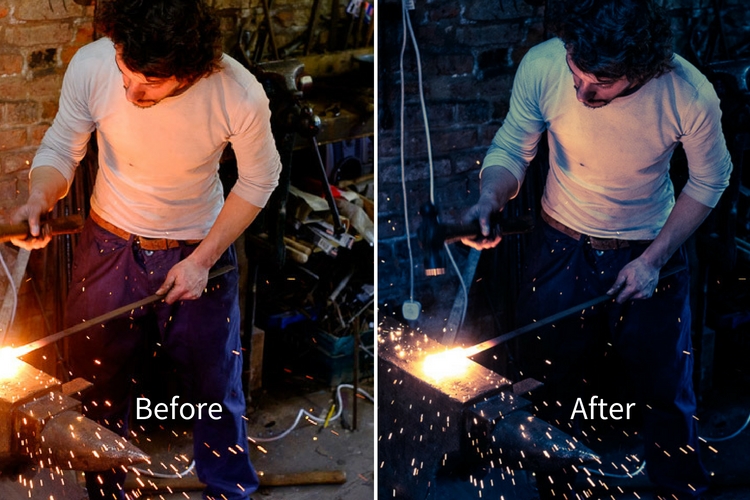
As you can see there’s quite a difference between the before and after images. But before we look at how I achieved this in Lightroom I’d like to share the back story of the photo. This is important because it guided the way that I decided to process it.

I took the photo in a blacksmith’s forge in the English town of Spalding earlier this year. The forge is remarkable because they use working practices that date back over a hundred years. It’s open to the public and they have demonstrations where you can take photos. The forge is small and you can get quite close to the blacksmith, which allows you to take intimate portraits like this one.

The light was coming from windows in front of the blacksmith and behind him, as well as from the hot piece of metal he is hammering. There was also overhead fluorescent lighting. The end result is that the light is fairly flat and boring, which is something I wanted to change in Lightroom.

A blacksmith’s forge should be lit by a combination of cool natural light and the fiery orange glow from the fires, not fluorescent light. I wanted mysterious shadows in the photo, not every detail visible. Points like these are important because they help you work with a destination in mind, rather than aimlessly pushing sliders around to see what happens.

lightroom-before-after

First steps – color corrections

The first steps involve getting the colors right, as this affects the look of the photo and everything you do from this point forward. The most important setting is in the Camera Calibration panel. A lot of people gloss over this panel as if it’s not so important. This isn’t helped by its placement at the bottom of the right-hand side in Lightroom’s Develop module.

When I took the photo I had the color profile set to Velvia, which gives high contrast and strong, saturated colors on my Fujifilm X-T1. It doesn’t matter what your color profile settings are on your camera if you’re shooting Raw as you can change them in Lightroom. I wanted softer, more subtle colors, so I changed the setting to Classic Chrome.

Note: This setting is only available on some Fujifilm cameras. The settings you see in the Camera Calibration panel depend on your camera model.

Next, I went to the Basic panel and set the White Balance to Auto. This tells Lightroom to decide how to set the color temperature to give the image neutral colors. How successful Lightroom is at this depends on the content of your photo. If you have mixed lighting sources, as this photo does, even Lightroom’s powerful algorithms aren’t going to give you anything other than an educated guess. It’s not possible to get rid of all color casts with mixed lighting.

Regardless, Auto White Balance gave me a good starting point. This is what the photo looks like so far. You can see it’s already quite different from the starting image which was quite orange.

Lightroom processing

Auto White Balance applied.

Tonal adjustments

The next step was to start making the transition from an image that is too bright to one that is dark and moody.

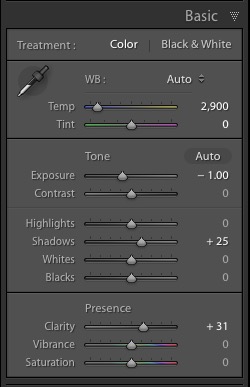
I did this by setting the Exposure slider to -1.0. This made the shadows too dark, so I brightened them by setting the Shadows slider to +25. I also set Clarity to +31 to bring out the gritty textures in the scene. See my settings below:

Lightroom processing

As you can see now that the image is darker the blacksmith’s face is lit by the glow from the hot metal he is working with. This was lost in the original.

Lightroom processing

Tonal adjustments and Clarity applied.

Cropping to remove distractions

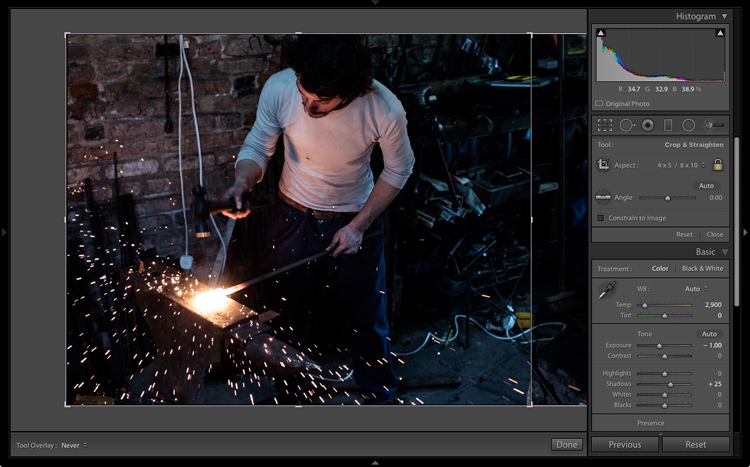
Now I can see that the photo has a major problem. There is too much empty space on the right-hand side, and the blue plastic is a major distraction. In hindsight, the composition would have been better if I had placed the blacksmith in the center of the frame. However, we can compensate for that by cropping the image.

I activated the Crop Overlay (keyboard shortcut R), set the Aspect to 4×5 / 8×10, and cropped the image. This cuts out the distractions on the right-hand side and brings the attention back to the blacksmith.

Lightroom processing

Lightroom processing

This is the result after the image has been cropped.

Refining the image with local adjustments

So far the adjustments made have all been global. That is that Lightroom applies them equally to the entire image. Now it’s time to refine the tonal values with some local adjustments.

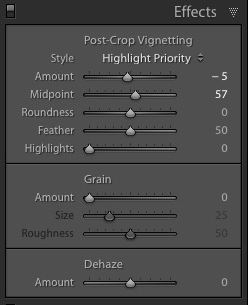
I started by adding a slight vignette using the Post-Crop Vignetting tool in the Effects panel. This darkened the corners slightly.

Lightroom processing

Next, I decided that I wanted to make the background even darker. This is going back to the earlier decision to make the image dark and moody as if the blacksmith is working in a much darker environment.

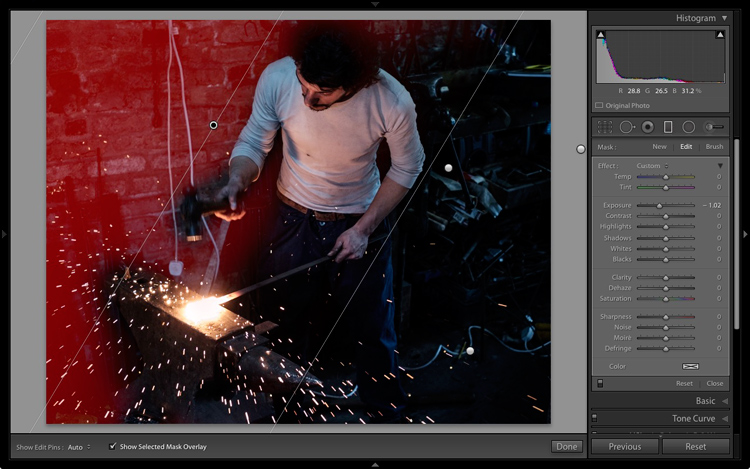
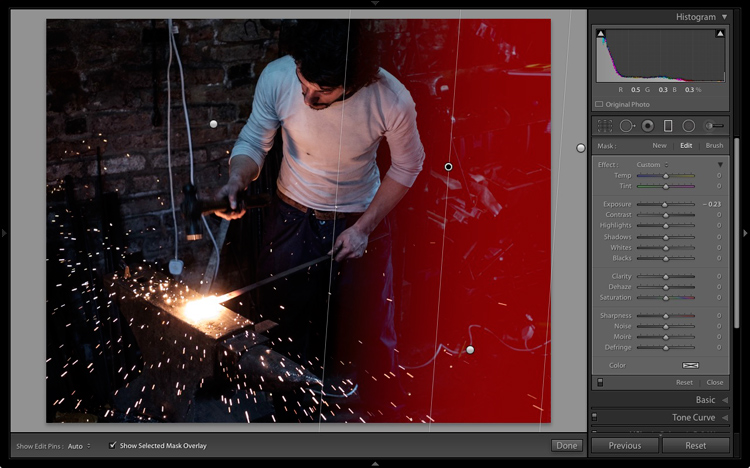
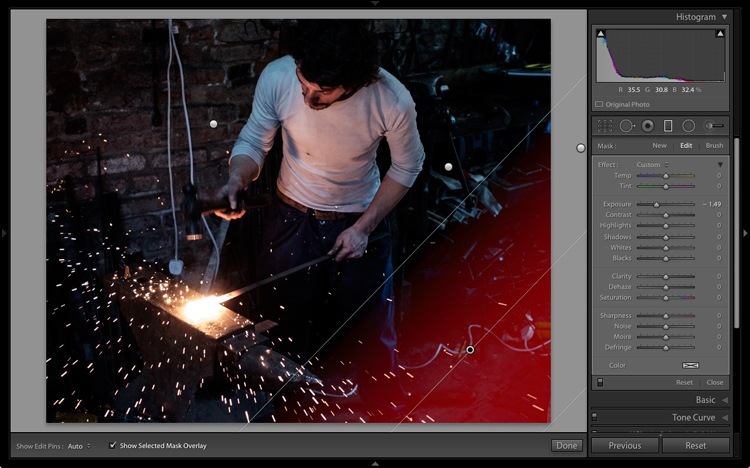
I added three Graduated filters to darken the edges. The screenshots below show the placement of the filters and the settings used.

Lightroom processing

Graduated Filter #1 applied on the upper left of the image.

Lightroom processing

Graduated Filter #2 applied on the right side of the image.

Lightroom processing

Graduated Filter #3 applied on the lower right corner of the image.

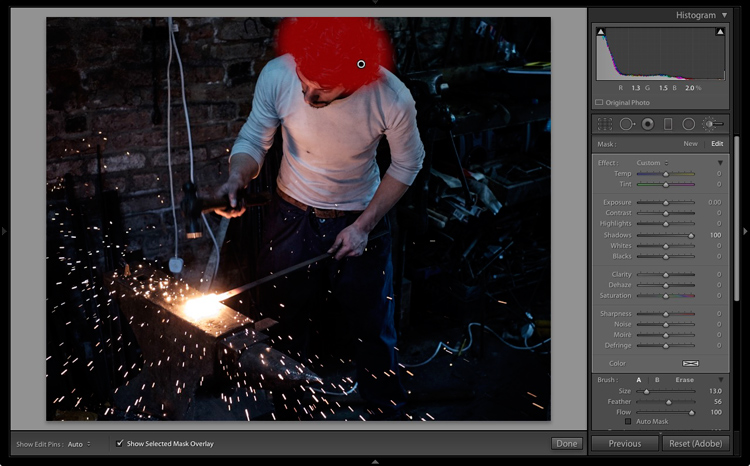
Then I used an Adjustment Brush and moved the Shadows slider right to make the blacksmith’s hair lighter and bring out the detail.

Lightroom processing

Adjustment Brush applied to his hair to bring out detail.

This is what the image looks like now with these adjustments.

Lightroom processing

After local adjustments have been applied.

Split toning for color grading

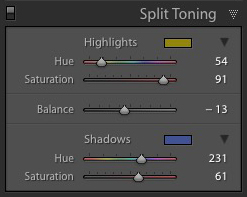
Lightroom processingFinally, I decided that the mood could be further enhanced with a split tone applied: blue to the shadows and an orange tone in the highlights.

The idea was to emphasize the difference in color temperature between the orange light from the hot metal and sparks, and the background, which in my imagination is lit by daylight (but in reality was also lit by fluorescent light). I did that in the Split Toning panel with these settings.

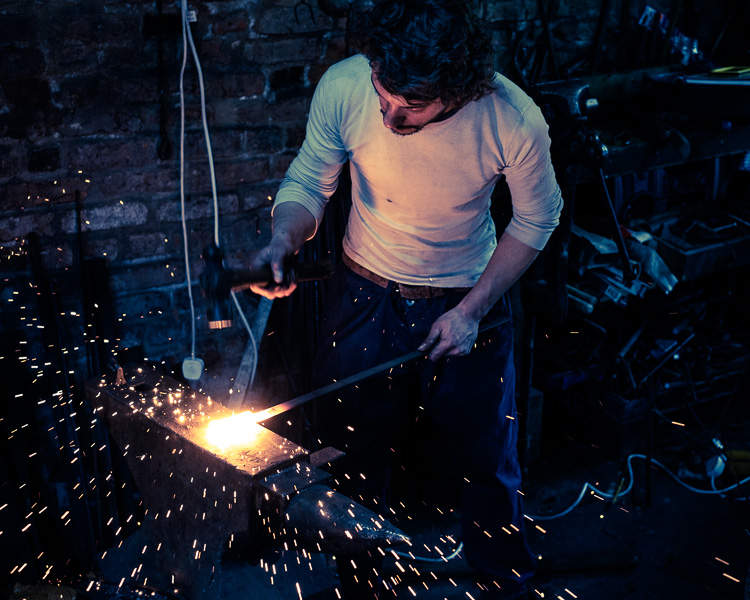
Here is the final result.

Lightroom processing

Final image after split toning applied.

Final thoughts

As you can see, even though the final image looks remarkably different from the starting Raw file, the steps involved in the processing were quite simple. It didn’t take long to get from the starting point to the end photo. This is mostly because I had a firm idea of what I wanted as the end result before I started processing the file.

If you have any questions or thoughts to share about the processing I did on this image then please let me know in the comments.


If you’d like to learn more about processing your photos in Lightroom then please check out my ebook Mastering Lightroom: Book Two – The Develop Module.

googletag.cmd.push(function() {
tablet_slots.push( googletag.defineSlot( “/1005424/_dPSv4_tab-all-article-bottom_(300×250)”, [300, 250], “pb-ad-78623” ).addService( googletag.pubads() ) ); } );

googletag.cmd.push(function() {
mobile_slots.push( googletag.defineSlot( “/1005424/_dPSv4_mob-all-article-bottom_(300×250)”, [300, 250], “pb-ad-78158” ).addService( googletag.pubads() ) ); } );

The post How I Processed This Photo Using Only Lightroom by Andrew S. Gibson appeared first on Digital Photography School.


Digital Photography School

 
Comments Off on How I Processed This Photo Using Only Lightroom

Posted in Photography


Holiday Gift Guide 2016: New This Year

21 Nov

Get over here, we found the bright side!

Eight totally great things that came out of 2016.

See the very best gifts for photographers, that we added to the Photojojo Shop this year.

(…)
Read the rest of Holiday Gift Guide 2016: New This Year (0 words)


© laurel for Photojojo, 2016. |
Permalink |
No comment |
Add to
del.icio.us

Post tags:


Photojojo

 
Comments Off on Holiday Gift Guide 2016: New This Year

Posted in Equipment


You can see Elton John’s rare print collection starting this week at Tate Modern

08 Nov

Photos from the Sir Elton John Collection at Tate Modern

Man Ray 1890-1976, Glass Tears 1932. Photograph, gelatin silver print on paper. 229 x 298 mm. The Sir Elton John Photography collection © Man Ray Trust/ADAGP, Paris and DACS, London 2016

London’s Tate Modern gallery is about to host an exhibition of ‘modernist photography’ drawn entirely from the Elton John Photography Collection that will feature only vintage prints made by the photographers themselves. The show, which comprises 150 images taken by over 60 photographers, is called The Radical Eye: Modernist Photography from the Sir Elton John Collection and will open this Thursday 10th November and will run until 7th May 2017.

The exhibition will concentrate on the ‘coming of age’ of photography which the museum says occurred between 1920 and the 1950s – a period when photography developed into a powerful tool for communicating as technology made it more flexible and convenient to use.

Visitors can expect to see works by Man Ray Kertesz, Rodchenko, Steichen, Tina Modotti, Imogen Cunningham and Margaret Bourke-White, as well as a collection of portraits of some of those photographers themselves taken by other famous artists. According to Tate Modern this will also be the first chance for the public to see an ‘incredible’ series of Man Ray portraits that John has collected and brought together over the last 25 years. Elton John has over 7000 fine art prints in a collection he started in 1991.

For more information on the exhibition, which will cost £16.50 to visit, see the Tate Modern website.

Press release

Tate Modern to exhibit unparalleled modernist photography from the collection of Sir Elton John

Tate Modern today announces a major new exhibition, The Radical Eye: Modernist Photography from the Sir Elton John Collection, opening on 10 November 2016. The show will be drawn from one of the world’s greatest private collections of photography and will present an unrivalled selection of classic modernist images from the 1920s to the 1950s.

Featuring over 150 works from more than 60 artists the exhibition will consist entirely of rare vintage prints, all created by the artists themselves. It will showcase works by seminal figures such as Man Ray, André Kertész, Berenice Abbot, Alexandr Rodchenko and Edward Steichen, offering the public a unique opportunity to see remarkable works up close. The quality and depth of the collection will allow the exhibition to tell the story of modernist photography in this way for the first time in the UK. It also marks the beginning of a long term relationship between Tate and the Sir Elton John Collection.

The exhibition introduces a crucial moment in the history of photography – an exciting rupture often referred to as the ‘coming of age’ of the medium, when artists used photography as a tool through which they could redefine and transform visions of the modern world. Technological advancements gave artists the freedom to experiment and test the limits of the medium and present the world through a new, distinctly modern visual language. This exhibition will reveal how the timeless genres of the portrait, nude and still life were reimagined through the camera, as well as exploring its unique ability to capture street life and the modern world from a new perspective.

Featuring portraits of great cultural figures of the 20th century, including Georgia O’Keeffe by Alfred Stieglitz, Edward Weston by Tina Modotti, Jean Cocteau by Berenice Abbott and Igor Stravinsky by Edward Weston, the exhibition will give insight into the relationships and inner circles of the avant-garde. An incredible group of Man Ray portraits will be exhibited together for the first time, having been brought together by Sir Elton John over the past twenty-five years, depicting key surrealist figures such as Andre Breton and Max Ernst alongside artists including Henri Matisse, Pablo Picasso and Dora Maar. Ground-breaking experimentation both in the darkroom and on the surface of the print, such as Herbert Bayer’s photomontage and Maurice Tabard’s solarisation, will examine how artists pushed the accepted conventions of portraiture.

As life underwent rapid changes in the 20th century, photography offered a new means to communicate and represent the world. Alexandr Rodchenko, László Moholy-Nagy and Margaret Bourke-White employed the ‘worm’s eye’ and ‘bird’s eye’ views to create new perspectives of the modern metropolis – techniques associated with constructivism and the Bauhaus. The move towards abstraction will also be charted, from isolated architectural elements to camera-less photography such as Man Ray’s rayographs and Harry Callahan’s light abstractions.

Further themes explored in the exhibition will include new approaches to capturing the human form, highlighted in rare masterpieces such as André Kertész’s Underwater Swimmer, Hungary 1917, while Imogen Cunningham’s Magnolia Blossom, Tower of Jewels 1925 and Tina Modotti’s Bandelier, Corn and Sickle 1927 will feature in a large presentation dedicated to the Still Life. The important role of documentary photography as a tool of mass communication will be demonstrated in Dorothea Lange’s Migrant Mother 1936 and Walker Evans’ Floyde Burroughs, Hale County, Alabama 1936, from the Farm Security Administration project.

Sir Elton John said: “It is a great honour for David and I to lend part of our collection to Tate Modern for this groundbreaking exhibition. The modernist era in photography is one of the key moments within the medium and collecting work from this period has brought me great joy over the last 25 years. Each of these photographs serves as inspiration for me in my life; they line the walls of my homes and I consider them precious gems. We are thrilled to be part of this collaboration with Tate Modern and hope that the exhibition audience experiences as much joy in seeing the works as I have had in finding them.”

Nicholas Serota, Director, Tate said: “This will be a truly unique exhibition. There are few collections of modernist photography in the UK, so we are delighted that Sir Elton John has allowed us to draw on his incredible collection and give everyone a chance to see these iconic works. Coming face-to-face with such masterpieces of photography will be a rare and rewarding experience.”

The Radical Eye: Modernist Photography from the Sir Elton John Collection at Tate Modern will run from 10 November 2016 until 7 May 2017. It is curated by Shoair Mavlian with senior curator Simon Baker and Newell Harbin, Director of the Sir Elton John Photography Collection, assisted by Emma Lewis. It will be accompanied by a major new catalogue from Tate Publishing, featuring an interview with Sir Elton John by Jane Jackson and an essay by Dawn Ades, Professor Emerita at the University of Essex.

Sir Elton John Photography Collection:

Sir Elton John began collecting photographs in 1991 and his collection is now regarded as one of the leading private photography collections in the world, distinguished by its exceptional quality and remarkable range and depth. From major vintage 20th century modernist works to cutting-edge contemporary images, the collection now holds over 7,000 fine art photographs. To make this exhibition possible Tate has worked in collaboration with Newell Harbin, Director of the Sir Elton John Photography Collection.

Photos from the Sir Elton John Collection at Tate Modern

Herbert Bayer 1900-1985, Humanly Impossible (Self-Portrait) 1932. Photomontage, bromoil gelatin silver print with gouache and airbrush on paper. 394 x 295 mm. The Sir Elton John Photography collection © DACS, 2016

Photos from the Sir Elton John Collection at Tate Modern

Dorothea Lange 1895-1965, Migrant Mother 1936. Photograph, gelatin silver print on paper. The Sir Elton John Photography collection

Photos from the Sir Elton John Collection at Tate Modern

Otto Umbehr (1902-1980), Cat 1927. Photograph, gelatin silver print on paper. The Sir Elton John Photography collection © DACS, 2016

Photos from the Sir Elton John Collection at Tate Modern

Ilse Bing 1899-1998, Dancer, Willem van Loon, Paris 1932. Photograph, gelatin silver print on paper. 276 x 184 mm. The Sir Elton John Photography collection © The Estate of Ilse Bing

Photos from the Sir Elton John Collection at Tate Modern

André Kertész (1894-1985) Mondrian’s Eyeglasses and Pipe, Paris 1926. Photograph, gelatin silver print on paper. 76 x 89 mm. The Sir Elton John Photography collection

Photos from the Sir Elton John Collection at Tate Modern

Alekandr Rodchenko 1891-1956, Shukhov Tower 1927. Photograph, gelatin silver print on paper. The Sir Elton John Photography collection © DACS, 2016

Articles: Digital Photography Review (dpreview.com)

 
Comments Off on You can see Elton John’s rare print collection starting this week at Tate Modern

Posted in Uncategorized


Rugged Luxury: Take Your Queen Bed On the Road In This Modern Camper

08 Nov

[ By SA Rogers in Technology & Vehicles & Mods. ]

tvan-mk4-trailer-main

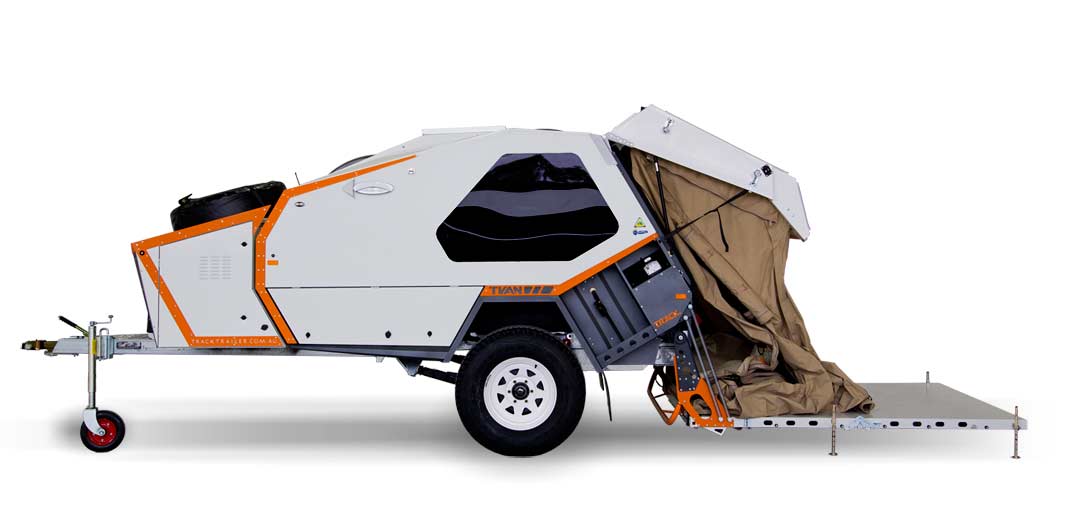
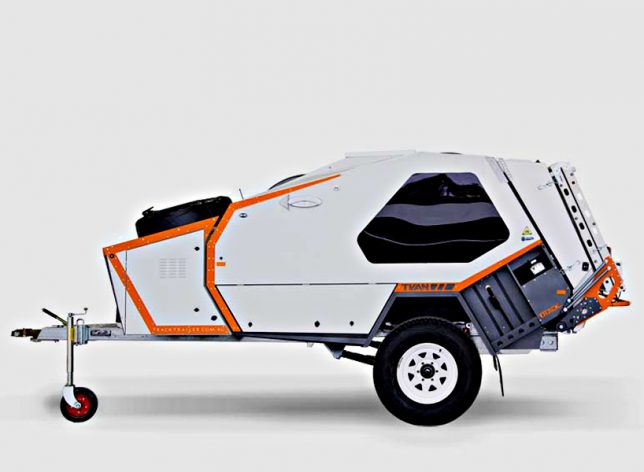
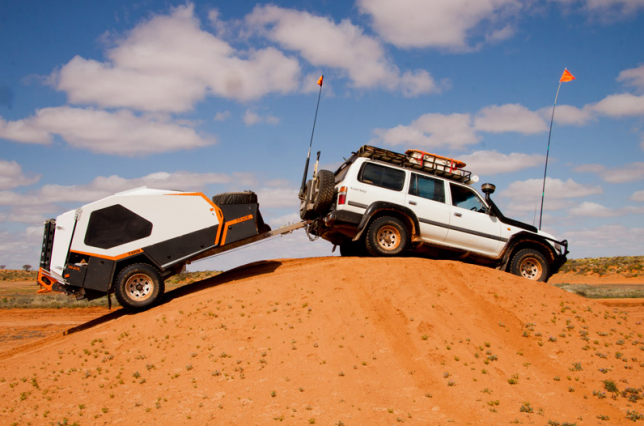
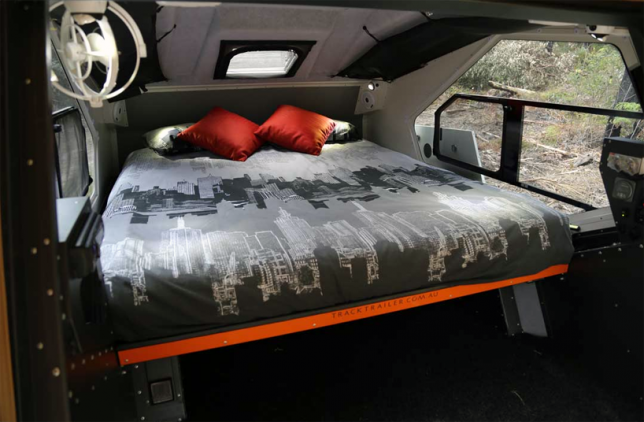
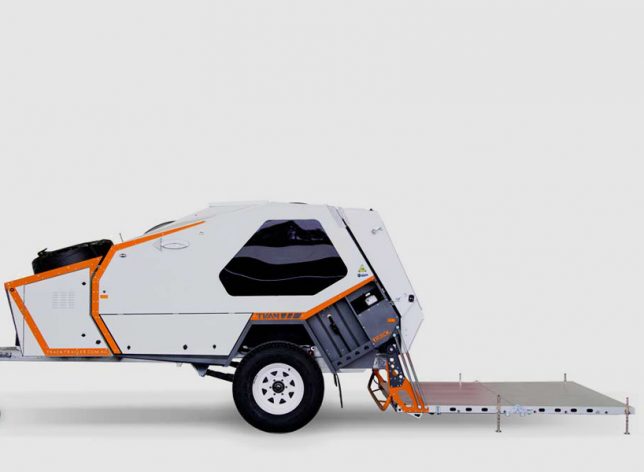
If your camping style is somewhere in between sleeping under the stars and ‘glamping’ with all the comforts of home, Track Trailer’s MK4 ‘Tvan’ camper has your number. Designed to be towed behind standard trucks and SUVs, it’s basically a hotel room on wheels, packing a queen-sized bed, two kitchen configurations, air conditioning and a quick-erect tent to multiply the available space.

tvan-trailer-3

tvan-trailer-7

The latest in a series of Tvan designs, this camper trailer enables the most rugged of adventurers to go deep into the wilderness, and it’s gotten a thumbs-up from explorers of Australia’s most punishing desert landscapes. The Tvan is manufactured in Melbourne and has been around since the early ’80s, and features MC2 suspension, a riveted steel and aluminum cabin body, hot-dipped galvanized chassis, and a rear folding platform for the tent, which stows away in its own compartment.

tvan-trailer-4

tvan-trailer-5

tvan-trailer-6

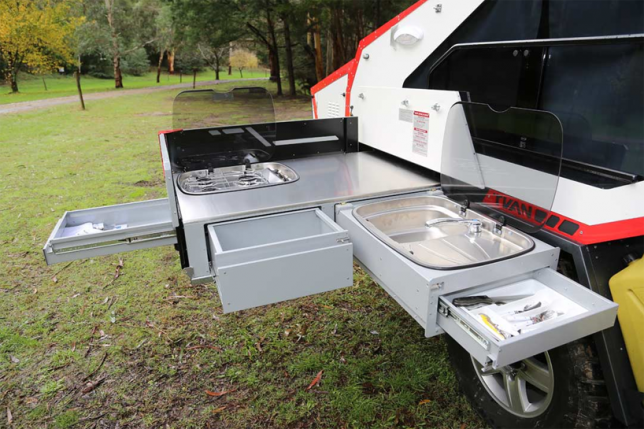
The slide-out kitchen offers a surprising number of features, including four burners, a sink, counter space and three storage drawers, and it all packs up tight for travel, remaining secure even when you’re driving over rocky terrain. There’s an integrated windshield that deploys simply by raising it into position so windy conditions don’t blow out the flames on the range.

tvan-trailer-2

tvan-trailer

tvan-trailer-8

The cabin itself is substantial enough to block out noise, sun, heat, cold and wind, and when the tent is in use, it secures to the hard fold-out floor, keeping it up off the ground. The rear hatch is assisted by gas struts to make it easy to open and close, and the whole thing is aerodynamic, making it easy to tow.

Share on Facebook


[ By SA Rogers in Technology & Vehicles & Mods. ]

[ WebUrbanist | Archives | Galleries | Privacy | TOS ]


WebUrbanist

 
Comments Off on Rugged Luxury: Take Your Queen Bed On the Road In This Modern Camper

Posted in Creativity