RSS
 

Posts Tagged ‘Thirds’

Sigma 30mm F1.4 DC DN Contemporary Micro Four Thirds Lens Review

11 Oct

The Sigma 30mm F1.4 DN DC Contemporary was announced February 2016, and sits atop Sigma’s line of DN mirrorless lenses, with a two-stop advantage over their previous 30mm F2.8 offering.

As a Micro Four Thirds lens, it is one of only several current autofocus F1.4 prime lenses available, with its closest competitor being the Panasonic Leica Summilux DG 25mm F1.4. While the Panasonic offers a field-of-view equivalent to a ‘classic’ 50mm lens, the Sigma ends up around 60mm. While that makes its focal length possibly a bit long for street shooting, it helps a little when it comes to portraiture and close-up work.

Let’s see how the basic specifications between the Panasonic Leica 25 and Sigma 30 compare:

  Panasonic Leica Summilux DG 25mm F1.4 Sigma 30mm F1.4 DC DN | C
Price $ 598 $ 339
Image Stabilization No No
Max Aperture F1.4 F1.4
Minimum Aperture F16 F16
Aperture Ring No No
Diaphragm Blades 7 9
Minimum Focus 0.30 m (11.81?) 0.30 m (11.81?)
Maximum Magnification 0.11x 0.14x
Motor Type Micromotor Stepper motor
Full Time Manual Yes No
Weight 200 g (0.34 lb) 265 g (0.58 lb)
Dimensions (DxL) 63 mm (2.48?)  X 55 mm (2.15?) 65 mm (2.56?) X 73 mm (2.87?)
Sealing None None
Filter Thread 46mm 52mm

Regardless of where it sits in terms of focal length and usability, the Sigma enters the opposite of a crowded marketplace as an autofocus F1.4 Micro Four Thirds prime. It also gets the advantage of being the cheapest autofocus F1.4 Micro Four Thirds prime available, even undercutting the price of some F1.8 options as well. 

Thankfully, the Sigma doesn’t feel entirely cheap. The barrel is well made with a satin black finish and ridges for grip when mounting or removing the lens. Sadly, the plastic hood feels a little inexpensive, and doesn’t feel like it clicks in to position with much confidence. Build quality of the lens itself is on par with the Pana-Leica, with both having smooth, sturdy focus rings with rubberized ridged grips.

The extra bit of diameter and length on the Sigma make it a bit bulky and unbalanced when mounted to some of slimmer Micro Four Thirds cameras, like the Olympus PEN series, or the E-M5 II. When mounted to a larger SLR shaped body, like the GH4, the Sigma fits nicely.

We’re assuming the extra size, relative to the Panasonic stems from it needing to be large enough to cover an APS-C sized sensor, in its E-mount incarnation.

Does the discounted price mean the Sigma comes with discount performance? Can it shake off past stigmas about third party lenses and go toe-to-toe with a lens touting one of the most revered names in the business? Let’s take a closer look at the numbers.

Articles: Digital Photography Review (dpreview.com)

 
Comments Off on Sigma 30mm F1.4 DC DN Contemporary Micro Four Thirds Lens Review

Posted in Uncategorized


Kipon introduces reducer to fit Nikon F and Leica R lenses to Micro Four Thirds bodies

13 Aug

Japanese lens and accessory maker Kipon has introduced a pair of focal length reducers that allow users to mount Nikon F and Leica R lenses to Micro Four Thirds cameras to give a 1.4x crop factor. The company says that the Kipon Baveyes NIK-m4/3 0.7x and Baveyes L/R-m4/3 0.7x reducers make a 50mm lens designed for full-frame systems act as a 70mm equivalent once the focal length doubling effect of the Micro Four Thirds system is taken into account. Kipon also claims that the reducer makes the mounted lenses a stop faster too.

Without the lenses in the reducer a 50mm Nikkor lens mounted on a Micro Four Thirds camera would behave as a 100mm due to the smaller size of the system’s sensors, so the wide-angle elements in the adapters reduce the apparent crop factor applied to the adapted lens. The company gives an example of a 35mm lens mounted via the adapter producing the angle of view one would expect from a 49mm lens on a full-frame body.

The price of the adapters has only been released in Japanese Yen, and is quoted as ¥23,000 plus tax, which is approximately $ 230/£180.

For more information see the Kipon website and a translated version the press release.

Articles: Digital Photography Review (dpreview.com)

 
Comments Off on Kipon introduces reducer to fit Nikon F and Leica R lenses to Micro Four Thirds bodies

Posted in Uncategorized


ZY Optics unveils new Lens Turbo adapters for Micro Four Thirds cameras

13 Jan

Chinese lens maker Zhongyi Optics has added M42, Canon FD and Minolta MD lens adapters to its second-generation Lens Turbo lineup for Micro Four Thirds cameras. Like Metabones’ Speedboosters, the adapters shorten the effective focal length, increasing the F-number by one stop and partially negating the crop factor. The 0.726x focal length reduction combines to give a net 1.45x focal length crop, rather than the 2x crop that you’d usually experience on a Micro Four Thirds camera.

These three adapters join ZY Optics’ existing Lens Turbo Version II adapters for Canon EF and Nikon G lenses. Among the adapters’ four optical elements is an extra-low dispersion element, and all three offer stainless steel mounts and metal bodies.

All three adapters are available directly from ZY Optics for $ 149 USD.

Articles: Digital Photography Review (dpreview.com)

 
Comments Off on ZY Optics unveils new Lens Turbo adapters for Micro Four Thirds cameras

Posted in Uncategorized


Panasonic adds Leica 100-400mm F4-6.3 tele-zoom to Micro Four Thirds lens lineup

09 Jan

$ (document).ready(function() { SampleGalleryV2({“targetContainerClass”:”sampleGalleryImageViewerContainer”,”galleryId”:”2215321511″,”isEmbeddedWidget”:true,”selectedImageIndex”:0,”startInCommentsView”:false,”isMobile”:false}) });

Panasonic is adding a high-end super telephoto zoom lens to the Micro Four Thirds lineup: the Leica DG Vario-Elmar 100-400mm F4-6.3 ASPH. This lens has the longest focal length of any MFT lens, and Panasonic promises fast autofocus thanks to its 240 fps AF drive speed.

This lens is equivalent to a whopping 200-800mm when attached to a Micro Four Thirds body and features much-needed ‘Power’ optical image stabilization to keep things steady. It has has one aspherical, one UED, and two ‘regular’ ED elements, as well as a nine-bladed circular aperture. The minimum focus distance is 1.3m, with a magnification of 0.25x. 

A cool feature of this lens is its compact tripod collar which rotates with the camera body, taking the buttons with it. The collar has a tripod screw mount built into it, into which a longer (included) ‘foot’ can be added if additional clearance is need. The zoom lock is built into the lens barrel, as is a small pull-out lens hood (a full-sized hood is available as an optional accessory). The 100-400mm is also sealed against dust and moisture.

The Leica DG Vario-Elmar 100-400 F4-6.3 will be available in early April at a price of $ 1799.99.


Press release:

Panasonic Launches LUMIX G 100-400mm Telephoto-Zoom, LEICA DG VARIO-ELMAR Lens

Las Vegas, NV (January 5, 2016) – Panasonic has today introduced a new telephoto lens for its LUMIX G range of Micro Four Thirds System cameras – the LEICA DG VARIO-ELMAR 100-400mm F4.0-6.3 ASPH. Telephoto-Zoom (H-RS100400) with Power Optical Image Stabilization (O.I.S.).

Small, light and highly durable, the latest addition to Panasonic’s range of interchangeable lenses is perfectly suited for photographing birds and other wildlife in all types of environments.

The lens is constructed of 20 elements in 13 groups and incorporates a number of aspherical and extra low dispersion elements to assure best quality and avoid flaring. The advanced construction of the new Telephoto-Zoom leads to highest quality standard earning the LEICA Logo for a LUMIX Lens once again.

Outstanding image quality and Telephoto-Zoom performance

Elegantly designed with a metallic black finish, the new 100mm-400mm LEICA DG VARIO-ELMAR lens from Panasonic provides superb image rendering across the entire zoom range. The lens’ 200-800mm focal length (35mm equivalent) and 0.5x Magnification capability provide highly detailed shots from distance, as well as stunning close up capability– ideal for subject matter regardless of shape and size.

In order to capture steady, vibration free images across the entire zoom range, the lens also incorporates Power O.I.S. to keep unwanted shaking under control and ensure pictures look crisp and clear. 

The 100mm-400mm lens is also suited to a variety of photographic styles – with nine diaphragm blades providing a circular aperture to produce a smooth and beautiful bokeh.
 
Smaller and lighter than other Telephoto-Zoom lenses

When compared with conventional super telephoto DSLR lenses, the latest addition the LUMIX G line up offers outstanding mobility – perfect if you’re travelling and don’t want to pack too much. Similarly, the lens also boasts a durable, gapless construction so you no longer have to worry about unwanted dust or light rain damaging your equipment.

In addition to the lens’ practical size and weight, a compact, two-part tripod mount has also been incorporated to enable faster conversion between landscape and portrait orientation. While conveniently and speedily turning to the 90° angle, the levers for Focus Limiting, Power O.I.S. and the manual focus switch remain right at your fingertips as they do not move when you turn the lens. 

The lens also incorporates an integrated, hide-away hood to help you capture that perfect shot, without having to worry about sun glare.

Stunning 4K video capability

Panasonic’s new LEICA Telephoto-Zoom lens is perfectly suited for 4K video recording with its construction assuring the best contrast and colors. Furthermore the Telephoto-Zoom incorporates Panasonic’s high speed and precise 240 fps AF-motor. Due to the modern design, filming can also be conducted silently, so you can get up close to the subject without drawing attention.

As well as high resolution video, the lens’ 4K capability also enables you to take photos like never before. Panasonic’s 4K Photo function – found on LUMIX G cameras including the LUMIX DMC-G7 – lets you extract an 8-megapixel still from 4K video (30fps) easily right on the camera’s screen with a simple fingertip touch.

Key features:

  • Longest focal length for Micro Four Thirds
  • Compatible with Dual Image Stabilization
  • 240fps AF Drive
  • Zoom ring lock
  • Weather Sealing
  • Integrated Quick Shifting Tripod Mount
  • Integrated shift-away lens-hood

Panasonic Leica DG 100-400mm F4.0-6.3 ASPH specifications

Principal specifications
Lens type Zoom lens
Max Format size FourThirds
Focal length 100–400 mm
Image stabilisation Yes
Lens mount Micro Four Thirds
Aperture
Maximum aperture F4.0 – F6.3
Minimum aperture F22.0
Aperture ring No
Number of diaphragm blades 9
Aperture notes Circular blades
Optics
Elements 20
Groups 13
Special elements / coatings 1 aspherical ED, 1 UED, 2 ED elements
Focus
Minimum focus 1.30 m (51.18)
Maximum magnification 0.25×
Autofocus Yes
Motor type Micromotor
Full time manual Yes
Focus method Extending front
Distance scale No
DoF scale No
Focus distance limiter Yes
Physical
Weight 985 g (2.17 lb)
Diameter 83 mm (3.27)
Length 172 mm (6.75)
Sealing Yes
Colour Black
Zoom method Rotary (extending)
Power zoom No
Zoom lock Yes
Filter thread 72.0 mm
Hood supplied Yes
Tripod collar Yes

Articles: Digital Photography Review (dpreview.com)

 
Comments Off on Panasonic adds Leica 100-400mm F4-6.3 tele-zoom to Micro Four Thirds lens lineup

Posted in Uncategorized


The Rule of Thirds – How it Can Help or Hinder Your Composition

27 Oct

How compositional rules can help or hinder your composition

Creating good photographs, and becoming a good photographer, is in general, not just about learning about your camera and all the rules of composition. These help, but while you should know your camera and have a good knowledge of technique, the biggest challenge you need to give yourself is learning to expand your perception, of the world and learn to see the world as it really is. Our minds are basically full of distractions – endless thoughts about our needs, wants, and to do lists. It’s a bit like living in a bubble which you need to break out of, so that you are fully able to see what’s happening around you, and not be distracted by your mind.

ROTAnthonyEpes 02

“It takes a lot of imagination to be a good photographer. You need less imagination to be a painter because you can invent things. But in photography everything is so ordinary; it takes a lot of looking before you learn to see the extraordinary.” – David Bailey

I think the rules of composition, and in particular the Rule of Thirds, are a great way to develop your perception. It’s not a rule you should learn and then overlay on all of your images, or your view of the world.

For me rules are a way to train your eye, so that eventually you can unleash its wild creativity. The creativity that is totally unique to you and exists in no other person.

Rules of composition:

  • Do work and help you create excellent compositions – but don’t use them all the time (don’t use anything all of the time)
  • Help you develop your perception and train your eye to see the wonders of the world
  • Create harmony between your subject and its setting

My philosophy with rules is always, “Learn the rules like a pro, so you can break them like an artist.” (Picasso said that by the way, not me).
20130116_tomi_188

Use them like a tool box

I like to think of the rules of composition as a little tool box that you can draw from in different ways, and in different variations. They aren’t always necessary, but they are super useful for helping your mind be both disciplined and focused, as well as creative, free, and wild.

So – what is the Rule of Thirds?

I love the rule of thirds because it’s a very simple, and easy concept to understand. It’s one of the key compositional rules (others include: leading lines and natural framing) that many photographers use to enhance their compositions. Although it can be tricky initially to bring it into your photos, once you start composing using the Rule of Thirds, it will immediately give your photographs a feeling of flow and depth; as well as helping them look balanced, creating an easy path for the eye of the viewer.

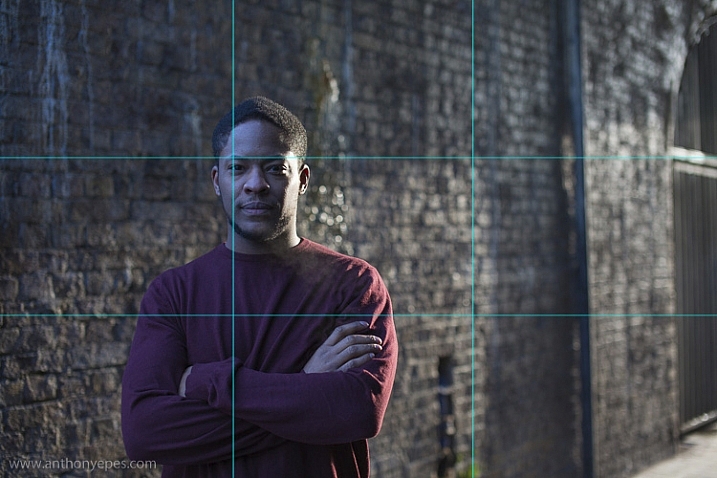
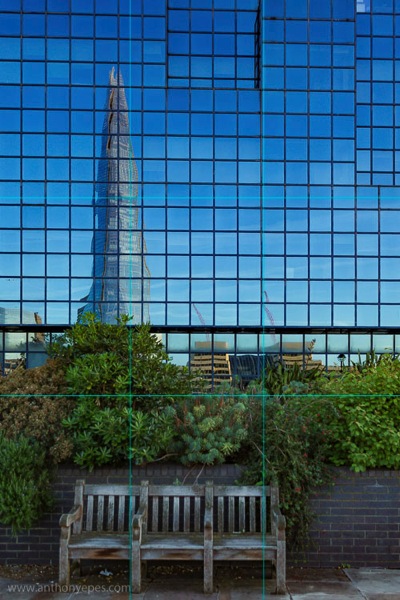
The rule of thirds breaks the image up into nine equal squares. Where the lines intersect we call these Points of Interest. The rule works by placing your subject, and other elements, along the lines and at the points of interest. Most cameras will have the option to overlay this grid on the viewing screen, so turn it on if that helps.
ROTAnthonyEpes 01

The human eye is naturally drawn to the these points of interest. It won’t generally look in the centre of an image first, unless there is a particularly arresting subject drawing the eye there.

Why use the rule of thirds?

Generally placing your subject off-balance, then using one, two or several other elements within the frame, placed at the points of interest, creates a much more visually appealing photo than having your subject dead centre. It:

  • Creates balance
  • Adds more complexity to an image than just placing your subject in the centre
  • Creates energy
  • Gives your photo a sense of depth, rather than just being a flat image

20151008_istanbul_001

What’s very important also, is that you have one or two other elements within the frame that balance or create energy, tension or harmony with your subject. It’s not enough to just have your subject off-centre. Let’s look at some examples.

Let’s start simply. Rule of thirds can be applied to your horizon line. Don’t put it in the middle, use it to run along the top or bottom third of the image:

This is more unusual to do than you imagine. Of the thousands of photos I have with a horizon line only a handful are not running along the centre of the image.

With every technique you use, there has got to be a reason for doing it. Otherwise you just see technique. I used it in the photo above (at the top of the article) because the clouds and sky were so much more interesting than the foreground, and below, because the light on the water was beautiful.

ROTAnthonyEpes 03

You can also apply the idea of having lines run along the upper or lower third of your image to things other than the horizon. Here I’ve applied it to some well organized rubbish bags. Notice that the line of bags follows the bottom horizontal line, but that it’s also emphasized by the line of the pavement and double yellow line at the bottom? These elements create energy – giving it perhaps a sense of movement and flow. Then you have the vertical lines and brickwork patterns as a contrast. All of this order of lines and patterns are very pleasing to the eye. The mind is always looking for order within the chaos of the world!

ROTAnthonyEpes 04

It’s important to say that I am not walking around looking for pictures that fit into the rule of thirds, or any of the other composition rules. But when I find a subject I’m interested in (I believe passion for your subject is the most important thing in your photography) and I am composing, looking for elements etc., then that’s when the rules are really helpful. Once you really get familiar with the rules, then you can start to adapt them to your own creative vision.

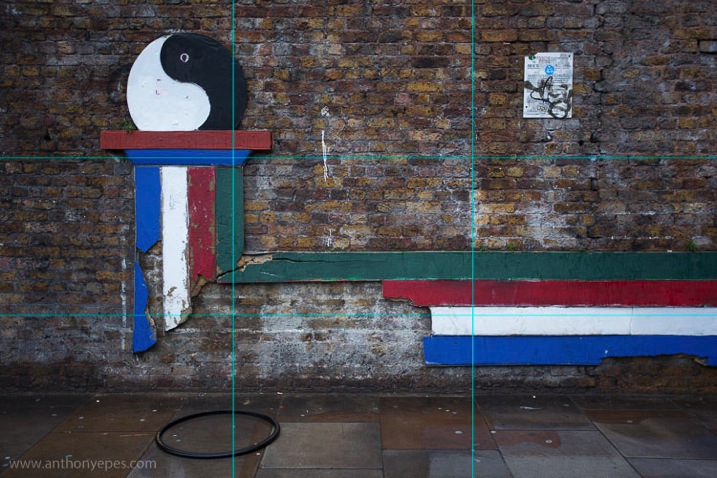
I have a passion for urban decay, you might call it. In the image below, instead of placing the ball and the column dead centre, I placed it in the left third of the frame. The other elements that are balancing it out are the ring on the floor, the lines going horizontally along the image, connecting with the points of interest lines, and then in the top third of the photo we have the notice on the wall. Take away the notice and the ring, and you’d have a much plainer, less interesting image.
ROTAnthonyEpes 05

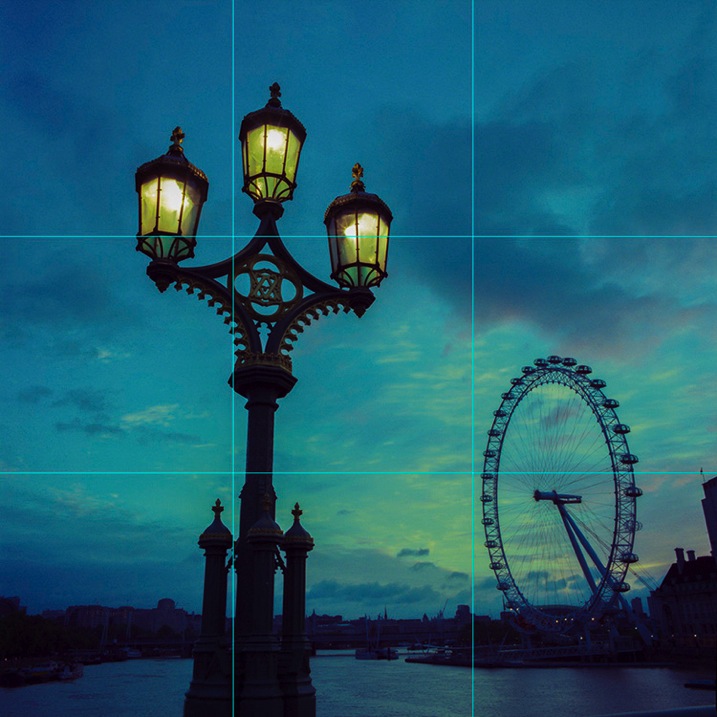
Below is one of my favourite photos of London. Here you have the old street lamp hitting the two left hand points of interest, and the wheel of the London Eye in the bottom right corner. You could say that there are only two elements in this photo – a primary and a supporting secondary in juxtaposition. The street lamp being the primary element is placed on the first third and is without a doubt the main subject. But by adding the London Eye as the secondary element we now have a sense of place, and the relationship is complete. It says, “This is London!”
ROTAnthonyEpes 06

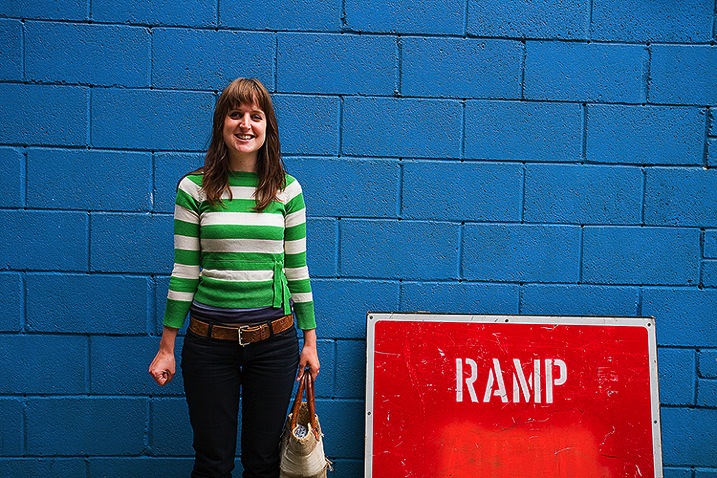
I like that the third element in the image below is the blue background, which helps the image feel clean. But because of the balancing elements of the woman and the sign, it’s not overly simple.
ROTAnthonyEpes 07

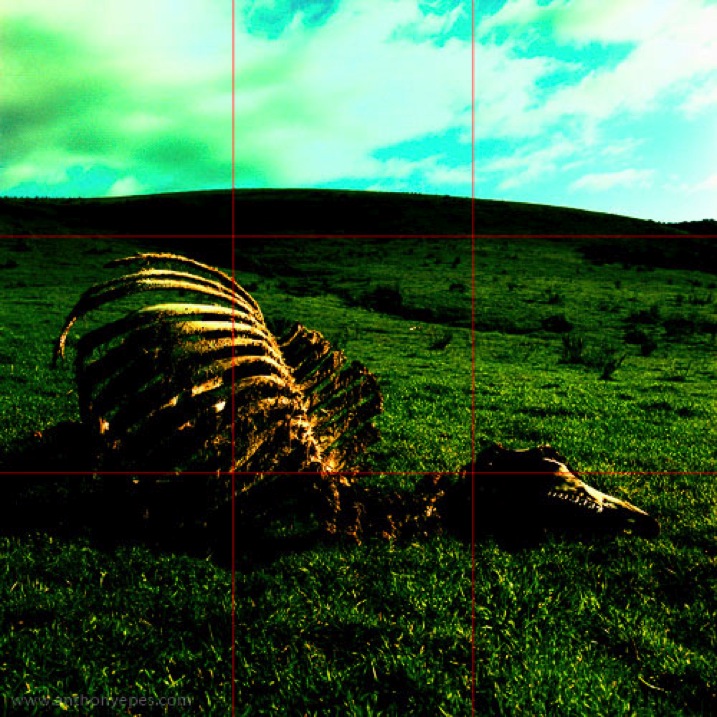
In the photo below is a rough adherence to the Rule of Thirds. Can you see where I placed the elements and why? Do you think this was the best way to compose the image? What’s important for me is that it’s not just a photo of a skeleton – it’s a photo of a skeleton in a very beautiful place. I find that lots of photographers will get absolutely mesmerized by their subject and start taking photos before absorbing the whole scene (you know that time when you get your images up on the computer and wonder why they don’t look as great as you thought they were going to, this is often due to not taking in the whole scene).
ROTAnthonyEpes 08

A very interesting skeleton it is, and unusual to come across. But there is also the element of perspective and the upper third being an almost ethereal sky. If you take away the sky the photo wouldn’t pop, would it? By placing the subject nearer the lower third I’ve created space for it to rest in.

Rule of thirds will help you capture beauty

Most people are able to appreciate, and see, the beauty and harmony of nature on a large scale – that epic view of a sunset over a beach, the vast meadow of beautiful flowers. But when you put a camera up to your eye, and reduce an image to a much smaller scale, I think most people lose that ability to see the harmony of the world, and thereby its beauty. The rule of thirds will help you see how to create harmony and balance within your photo, by helping you when you are placing your elements within your frame.

And now to Venice. This photo below is a bit more complicated, but let’s look at what elements are the most important. The man, definitely. He is bang on one of the points of interest. Now notice how the change of colour and texture of the building runs along one of the lines.

There is some of the structure of the rule of thirds but that’s not the whole story here. So you can use elements of the rule of thirds and then add in your own ideas and elements. It’s all flexible. Play with it.

ROTAnthonyEpes 09

Let the rules help you be excellent

You can sometimes use the rule of thirds to almost repair your image, by cropping. All processing programs will have the grid available, and I know that some photographers will overlay the grid and crop their image to fit these rules. I am not a fan of any kind of regular cropping. Why? Because I think in general it makes you a lazy photographer. Don’t rely on anything after the fact to make your photo better, when you can capture something in-frame now. By all means use things to enhance an already good photo, but no bad photo can be saved in post-production.

But – if you love post production, and you want that to be what defines your images, that’s fine. But become awesome at that, be excellent. What unifies all photographers who are taking consistently excellent photos is they are committed to excellence in their own way. That I can get behind.

ROTAnthonyEpes 10

We all come to rules differently. I’ve noticed in my workshops that not everyone has an affinity for absorbing rules, and putting them into practise. Maybe the idea of a more technical basis for your photography makes you squirm. But I would really encourage you to stick with it. Even if it takes a while for you to absorb this, the technical aspects of photography really give you a good grounding, so that you have the ability to take the photographs that you see in your mind’s eye.

If you are more of a technical rules-based person, my advice is to try and propel yourself away from the rules. I’ve noticed that people who get too involved in rules of composition, and their camera buttons, often find it difficult to really see what’s going on around them. So learn the rules, but then really push yourself to see beyond them.

So go explore and take the rules with you. Learn them, play with them and have fun.

googletag.cmd.push(function() {
tablet_slots.push( googletag.defineSlot( “/1005424/_dPSv4_tab-all-article-bottom_(300×250)”, [300, 250], “pb-ad-78623” ).addService( googletag.pubads() ) ); } );

googletag.cmd.push(function() {
mobile_slots.push( googletag.defineSlot( “/1005424/_dPSv4_mob-all-article-bottom_(300×250)”, [300, 250], “pb-ad-78158” ).addService( googletag.pubads() ) ); } );

The post The Rule of Thirds – How it Can Help or Hinder Your Composition by Anthony Epes appeared first on Digital Photography School.


Digital Photography School

 
Comments Off on The Rule of Thirds – How it Can Help or Hinder Your Composition

Posted in Photography


ZY Optics launches optically improved version of its Turbo Adapter for Micro Four Thirds

23 Oct

Chinese lens manufacturer Shenyang Zhongyi Optics has redesigned the optical construction of is Turbo Adapter that allows Micro Four Thirds users to mount Nikon and Canon lenses to their cameras. The details are slight, but the company says the configuration is completely different, although still using four elements, and new coatings have been applied to reduce flare and increase contrast. Read more

Articles: Digital Photography Review (dpreview.com)

 
Comments Off on ZY Optics launches optically improved version of its Turbo Adapter for Micro Four Thirds

Posted in Uncategorized


F0.95 Mitakon Speedmaster 25mm compact lens announced for Micro Four Thirds system

12 Sep

Chinese optics company Shenyang Zhongyi Optical and Electronic has announced that it is adding a super-fast standard lens to its range designed for the Micro Four Thirds system. The new 25mm lens features a maximum aperture of F0.95 but has a very small and lightweight body. Read more

Articles: Digital Photography Review (dpreview.com)

 
Comments Off on F0.95 Mitakon Speedmaster 25mm compact lens announced for Micro Four Thirds system

Posted in Uncategorized


To the skies! DJI launches Zenmuse X5 and X5R 4K Micro Four Thirds aerial cameras

11 Sep

Drone maker DJI has announced a pair of Micro Four Thirds aerial cameras including a model that can shoot lossless 4K Raw footage. The Zenmuse X5 and X5R are built around 16MP Four Thirds sensors, are compatible with a handful of small Micro Four Thirds lenses and can be flown on the company’s Inspire 1 drones. Read more

Articles: Digital Photography Review (dpreview.com)

 
Comments Off on To the skies! DJI launches Zenmuse X5 and X5R 4K Micro Four Thirds aerial cameras

Posted in Uncategorized


Z Camera launches Micro Four Thirds E1 camera with 4K video and open platform

21 Jul

Z Camera, a China-based photography startup, has introduced a connected Micro Four Thirds camera called the E1. Shaped like GoPro’s HERO action cameras, the E1 carries a 16MP Four Thirds sensor and can record video at 4K 4096×2160 resolution. It provides Wi-Fi connectivity and an open platform for developers. Read more

Articles: Digital Photography Review (dpreview.com)

 
Comments Off on Z Camera launches Micro Four Thirds E1 camera with 4K video and open platform

Posted in Uncategorized


Kipon adapter to allow AF with Canon lenses on Micro Four Thirds bodies

23 Apr

Chinese lens adapter manufacturer Kipon has announced plans to introduce the first adapter that allows AF operation when a Canon EF or EF-S lens is attached to a Micro Four Thirds camera body. Previous adapters have either been entirely manual or, more lately, offered aperture control, but the Shanghai-based company has said that its next model will allow full frame and APS-C EOS system lenses to focus automatically too. Read more

Articles: Digital Photography Review (dpreview.com)

 
Comments Off on Kipon adapter to allow AF with Canon lenses on Micro Four Thirds bodies

Posted in Uncategorized