Tamron claims that its new SP 15-30mm F2.8 Di VC USD offers prime lens quality across its focal length range, paired with a fast maximum aperture and – uniquely in its class – an optical vibration compensation system. We’ve been impressed by how this wideangle zoom performs in our studio, but that’s only half the story. Our latest video field test follows DPReview technical editor Rishi Sanyal as he uses the Tamron 15-30mm to shoot architecture, cityscapes and waterfalls. Watch the video
Tag: Test
-
What goes around: 6 mid-sized ball heads put to the test
One of the most important parts of a tripod is the head that connects the camera to the legs. Continuing where our previous ball head roundup left off, we’ve collected six ball-type heads for review that are in the medium-to-large size class. These heads are suitable for most large cameras and lenses, with only the truly gigantic or heavy devices requiring something larger. Find out which ones earn our recommendation. Read more
-
Field test: Shooting Roller Derby with the Olympus OM-D E-M5 II
James McDaniel is a self-taught photographer with a special interest in roller derby. He’s also a Micro Four Thirds shooter, so when we were looking for someone to test out the E-M5 II in the real world with us, we immediately thought of James. Watch our latest video field test to see how how the camera performed on game day, and don’t miss an opportunity to see Barney on roller skates. See video
-
Panasonic Lumix DMC-CM1 added to studio test scene comparison
It’s not often that a smartphone being added to our studio test scene warrants a mention on our homepage, but it’s not everyday we see the likes of the Panasonic Lumix DMC-CM1. It’s a photo-centric mobile device with a 1-inch 20MP sensor and an F2.8 28mm equiv. lens, capable of 4K video and Raw image output. See how it performs in our studio scene. Read more
-
Real-world test: the Sony a6000 goes surfing with Chris Burkard
Chris Burkard is a well-established adventure and surf photographer. His landscapes and cold weather surf photos have earned worldwide attention and plenty of high-profile clients. Chris joined us recently in California to take Sony’s a6000 for a spin to try out its hybrid AF system on – what else? – sun, sand and surf. See how the a6000 keeps up in our latest real-world test. See video
-
Is Your Tripod Sturdy Enough? Let’s Test it

If you are looking to take long exposure shots like this 10 second night image of downtown Marietta, Ohio, you’ll need a quality tripod to give your camera a stable base.
One of the most important pieces of equipment for a photographer to have access to is a sturdy tripod. You might be tempted to purchase just any tripod without regard to whether or not it is up to the job you are asking it to do, but a strong and stable tripod can be the difference between a great image and a blurry one.
Warning: a high-quality tripod is not cheap! If you want a really functionable tripod, be prepared to invest more than a few dollars. However, in this article we are going to look at some ways you can test the tripod you are currently using to see just how effective it is. To begin, let’s examine a couple of tips that can make any tripod a little more stable.
Tips for making your tripod stable
- Tip #1 – If you are using your tripod for a long exposure, avoid extending the center column with the mount above the fulcrum.
- Tip #2 – When setting the height of your tripod, make use of the thicker top sections of the legs before the thinner, less stable lower sections.
- Tip #3 – If your tripod has different types of feet available, use the spiked feet to secure the ground for outdoor landscape shooting. When shooting indoors, use the rubber feet to prevent skidding on smooth flooring.
- Tip#4 – When shooting outdoors on windy days, be sure to secure your camera strap. If the strap is blowing in the wind it will cause your tripod to move.
Many photographers can be observed with their cameras mounted to tripods extended beyond their intended specifications. You may have heard that your tripod should be strong enough to hold a bowling ball. While this sounds funny, it’s a good idea to have a tripod that is rated for more weight than the combined weight of your camera and largest lens. For example, a tripod having no movement with a mounted camera and a 28mm lens may allow unacceptable movement with the same camera and a 300mm or larger lens.
Regardless, even the best tripod will have some movement. Approximately 80% of the movement will most likely come from the head and the Quick Release mount, and very little actually from the tripod legs. There are many potential sources of vibrations, so let’s look at a series of tests that can help you determine if your tripod is up for the job you are giving it to do.
Test Method #1
Make a test pattern similar to the one below, or download the one I used here.
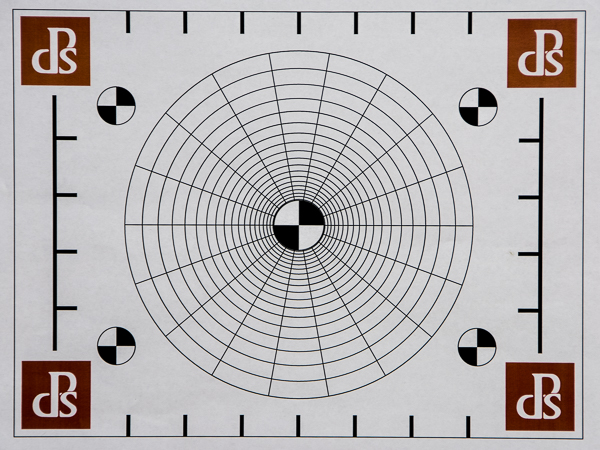
Create a test pattern similar to this one.
Mount your print on a stable object with no movement. It’s important that the print has no movement at all. Mount your camera and heaviest lens combo on your tripod. Set up your tripod close enough to the target so that it fills the frame.
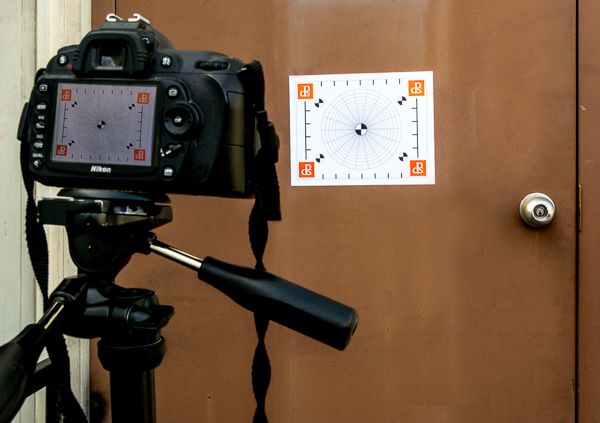
This setup has some problems. Can you spot them? Refer to the tips above.
First, take a series of shots with a variety of different exposure speeds ranging for 1/100th of a second down to 1/2 a second. Use a remote or cable release to start the exposures. It’s also a good idea to use your mirror lockup feature to remove any camera vibration from the process.
After completing this series of exposures, open the images in your choice of image software and check your target for any doubled or blurry lines which would indicate that your camera was moving during the exposures. If the faster shutter speeds are sharper than the slower ones, your tripod is not stable enough to use for shooting at slower shutter speeds.
If your images show that you are getting movement during your exposures, the next step is to determine what part of you tripod is causing the problem.
Shrink your tripod to its smallest height and repeat the test. If the results are not better, then your problem may be caused by your tripod head.
Your problem could also be caused by your tripod’s leg locks, so test again with legs extended to different lengths, extending one, two or three sections and taking the same series of test shots.
Repeat the process indoors, outdoors, and in windy conditions or with other camera and lens combinations.
Test Method #2 – Multiple Exposures
Many digital cameras have a setting for taking multiple exposures. If yours does, set your camera to take two or three exposures. Again using the test pattern, shoot a series of different shutter speeds ranging from 1/100th down to 1/2 a second.
If your camera doesn’t have the multiple exposure feature, you can still use this method by simply taking two or three different images, then layering them over top of each other in Photoshop, and adjust the blending method of each layer so that all layers are visible. If your tripod is doing its job, all three images will be right on top of each other.
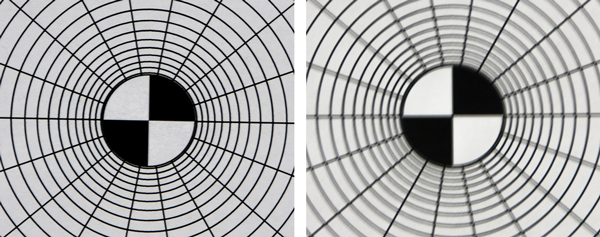
Both of these image were created with a three shot multiple exposure with a 1/2 second exposure on each. The sharp image on the left indicates that this tripod is up to the task. The image on the right was created with another tripod. If your preview looks like this, your tripod is not doing its job.
Test Method #3 – Live View
Use the same test pattern as in the ones above. Focus your camera on the center of the target. Turn on Live View and zoom the preview to show the center of the target as large as possible.
Remove your hands from the camera and tripod and see if the target remains still in your preview. If the target in your preview continues to move, your tripod is not providing a sturdy enough base for your camera to produce sharp images at a slow shutter speed.
Also in this method, try just touching and moving your camera strap. You may be surprised to see the preview move from just the slightest touch.
Test Results
If your tripod did not pass these tests, it is probably time to start looking for a better one. Be sure to check that the tripod is rated to support the weight of your camera and your largest/heaviest lens. If the tests show that your problem is in your tripod head, the solution might be as simple as replacing the head. If you have any other tips to enhance your tripod’s stability, please post in the comments below.
googletag.cmd.push(function() {
tablet_slots.push( googletag.defineSlot( “/1005424/_dPSv4_tab-all-article-bottom_(300×250)”, [300, 250], “pb-ad-78623” ).addService( googletag.pubads() ) ); } );googletag.cmd.push(function() {
mobile_slots.push( googletag.defineSlot( “/1005424/_dPSv4_mob-all-article-bottom_(300×250)”, [300, 250], “pb-ad-78158” ).addService( googletag.pubads() ) ); } );The post Is Your Tripod Sturdy Enough? Let’s Test it by Bruce Wunderlich appeared first on Digital Photography School.
-
Real-world Test: Shooting Fashion with the Fujifilm X-T1
The X-T1 is Fujifilm’s first weather-resistant interchangeable X-series camera. It is built around a 16.3 MP APS-C X-Trans CMOS II sensor housed in a die-cast magnesium body. Offering a traditional design with five physical top plate dials, two command dials, and six programmable function buttons the X-T1 also has a high resolution OLED viewfinder. In the latest in our series of real-world video tests, we took the X-T1 to a local studio, to see how it would perform in the hands of a professional fashion and portrait photographer. Click through to watch the video
-
Real-world test: Nikon D750 at the Museum of Flight
The D750 is Nikon’s enthusiast-oriented full-frame DSLR, featuring a 24MP sensor and a raft of high-end features borrowed from the D810 and D4S. These include a tweaked version of their highly capable 51-point AF system and a very solid HD video specification. We’re working on a full review of the D750 right now, and as part of that process we made a short video, highlighting some of the camera’s key features in real-world use. Click through to watch.
-
Real-world test: Going pro with the Samsung NX1
As often as we can, we like to put the cameras that we test into the hands of working photographers to find out what they think. Recently we gave the Samsung NX1 to Jordan Stead, staff photographer at SeattlePI.com, and ventured out to nearby Carkeek Park to photograph the salmon run. A seasoned shooter accustomed to pro camera bodies, Jordan gave the NX1’s hybrid AF system and 28.2MP BSI-CMOS sensor a try. See the video
-
Tamron SP 150-600mm F/5-6.3 Di VC USD lab test report
The Tamron SP 150-600mm F/5-6.3 Di VC USD is one of a select group of supertelephoto zooms for full frame SLRs that reaches or exceeds 400mm focal length, while still being reasonably portable. Its trump card over its closest competition lies in its longer focal length – at 600mm full zoom, it’ll let you get your subjects that bit larger in the frame. But does this result in an unacceptable compromise in optical quality? See the lens test data and our analysis