RSS
 

Posts Tagged ‘technology’

Tactile Technology: 13 Off-Screen Touch Input Inventions

31 Oct

[ By Steph in Conceptual & Futuristic & Technology. ]

Touch Technology Main

Touch input has already almost entirely eliminated the need for physical keyboards and mouses, but soon, it won’t even be confined to a screen. Researchers are developing systems that can register and translate hand movements in thin air, or even replicate the sensation of three-dimensional objects and textures. Here are 13 intriguing touch tech inventions.

Touch Tech for Artificial Limbs

Touch Technology Prosthetics

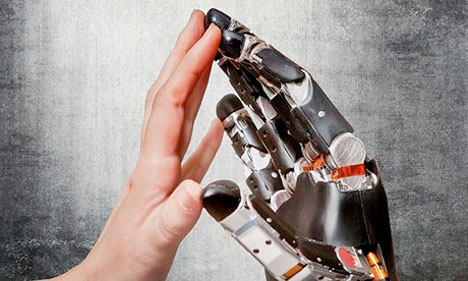
Prosthetics allow amputees to do all sorts of things they wouldn’t be able to do otherwise, but they’ve been missing one very crucial thing: the sense of touch. That could change, with experiments at the University of Chicago developing a moldable plastic material containing piezoelectric powder that can sense pressure at any point on a surface by turning it into an electric voltage. They were able to translate those electric signals to the human nervous system, so they can be interpreted by the brain as touch. The next challenge is adapting this touchscreen technology, borrowed from smartphones, to the soft and curved surfaces of prostheses.

Feeling Objects in Thin Air

Touch Technology Feeling Objects

Imagine being able to touch something that’s not really there. A new kind of touch technology being developed by the research wing of the Walt Disney Company allows users to feel textures on a touchscreen as well as touching holographic objects projected into space, as through an Xbox Kinect. Called ‘haptic technology,’ it works by blowing small rings of air at a user to simulate texture, movement or collisions with objects. It could potentially revolutionize the gaming experience, and also be useful in medical settings.

Board Transforms Touch into Sound

Touch Technology TouchBoard

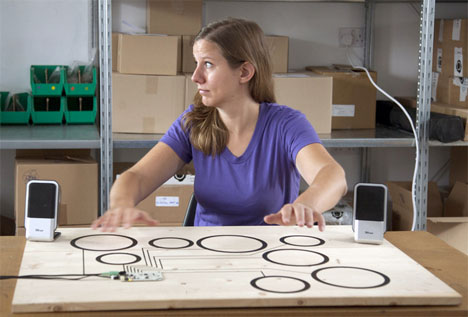
Developed by London-based studio Bare Conductive, the ‘Touch Board’ translates touch into sound. Any conductive material can be turned into an interface; in this case, electrically conductive paint is applied to a surface. You connect the touch board to a speaker, and plug it into a micro USB cable. Interaction with any of the electrodes cause an MP3 player to play an associated track from the card.

Transmit Audio Messages With the Touch of a Finger

Touch Technology Finger Messages

What if you could hear through someone’s finger? ‘Ishen-Den-Shin’ technology (named for a Japanese phrase meaning “what the mind thinks, the heart translates”) uses the human body as a sound transmitter. A handheld microphone connected to a computer records as soon as it hears a person speak and transforms it into a sound loop which is converted into a harmless high-voltage inaudible signal transmitted to the microphone’s conductive casing. That means whoever holds the microphone becomes a human sound emitter. If they touch an object or another person’s ear with their finger, the small sound vibrations can be heard.

Augmented Reality Touchscreen Interface

Touch Technology Augmented Reality

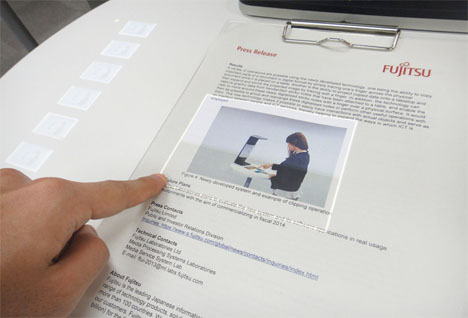
An augmented reality touchscreen interface from Fujitsu Laboratories can turn any surface into a touch screen using off-the-shelf cameras an projectors. Users can trace their fingers across a document on a table, copy it as digital data, and display it virtually. The camera measures irregularly shaped objects on a table, and automatically adjusts the coordinate systems that make it possible to match finger movements and touching of objects to the digital display projected onto physical objects.

Next Page:
Tactile Technology 13 Off Screen Touch Input Inventions

Share on Facebook


[ By Steph in Conceptual & Futuristic & Technology. ]

[ WebUrbanist | Archives | Galleries | Privacy | TOS ]


WebUrbanist

 
Comments Off on Tactile Technology: 13 Off-Screen Touch Input Inventions

Posted in Creativity


Future Present: 7 Soon-to-Be Wonders of Technology

15 May

[ By Steph in Conceptual & Futuristic & Technology. ]

Tech Predictions Main

Within five years or less, we could be chatting with the three-dimensional holograms of faraway friends, controlling our computers with mental commands, charging our phones with energy harvested from wasted ambient energy and logging into our bank accounts with facial recognition scans. These are among the technology innovations that computer giant IBM has predicted within the last few years of its annual technology forecast. Here are seven of the most intriguing prospects.

3D Hologram Chat

Tech Predictions Holographic Chat

(image via: Star Wars 20th Century Fox screen capture)

A 3D holographic chat system called “TeleHuman” is the first example of what will likely be a flood of virtual hologram technology that lets us see faraway contacts in three dimensions. TeleHuman creates a life-sized rendering of its subject using six XBox Kinect sensors, a 3D projector and a cylindrical display; the creators say it will be available for $ 5,000 within five years. A similar project called the RGB+D Toolkit is making waves in the indie filmmaking community.

Microsoft is also working on telepresence technology for Skype using holograms to literally bring conference participants to a central table, no matter where in the world they’re located.

Mind-Controlled Devices

Tech Predictions Mind Controlled Gadgets

(image via: forbes)

Wouldn’t it be nice if you didn’t have to type at all? You could simply think a command, an email, or anything else you want to do and it appears on your screen. Maybe we’re not quite there yet, but progress is encouraging. Brain-Computer Interface (BCI) technology is appearing in all kinds of experimental gadgets, from headphones that play music based on your mood to a headband that measures brain activity in real time and displays it on your smartphone or tablet. BCI devices are also being used to allow quadriplegic patients to complete previously impossible tasks.

Of course, there are drawbacks to this inevitably invasive technology. A 2012 study found that connecting minds to machines can allow sensitive private information to ‘leak out’ along with the users’ mental commands. The information revealed included the location of their homes, faces they recognized and even their credit card PINs.

Energy-Scavenging Gadgets That Don’t Need Batteries

Tech Predictions Energy Scavenging Gadgets

(image via: dennis siegel)

Power lines, data centers, televisions and even your coffee maker output waves of ambient energy that typically just dissipate in the air, going to waste. That energy could be used to power all kinds of things, including crucial wireless sensors running on batteries, which keep track of factory machinery or measure environmental pollution. MIT has developed an energy-harvesting microelectromechanical system (MEMs) that translates even tiny vibrations, light and ambient energy into a surprising amount of power, eliminating the need for batteries.

Designer Dennis Siegel shows off some of the possibilities on the consumer side of the spectrum with ‘Energy Parasite,‘ a gadget that gathers energy from home appliances and power plants, stores it in a conventional battery and allows you to use it later for cell phones, mp3 players and other devices.

Multi-Factor Biometrics Eliminate Need for Passwords

Tech Predictions Biometrics Passwords

(image via: siemens)

We’re not far from an era in which passwords are a thing of the past. Fingerprint scanners have been available for a range of devices for quite a while now, but they’re not ideal – burns, cuts, oil and other irregularities can interfere with scanning. In the future, a range of biometrics including voice, retina and face scanners could be used to verify our identities so we can access devices, personal accounts and private data.

Researchers are developing systems that ensure biometric data is secure, like taking a sample of a user’s voice, dividing it into similar samples, and then cryptographically protecting them before performing a comparison on the voice trying to gain access.

Computers That Can Smell, Taste & Replicate Touch Sensations

Tech Predictions Computers Taste Smell Hear

(image via: ntdtv)

IBM predicted that within five years, computers will be able to output and recognize smells and flavors, and even replicate textures, so we can ‘feel’ fabrics before purchasing, for example. Texture data fed into a computer’s drivers can re-create vibrations and temperature on a touch screen, similar to the way some computer game controllers shake to indicate on-screen action. Digitized taste buds breaking down flavors to their molecular components can help compare them, so users can find something that tastes like a favorite food, but is healthier, or get a sense of a recipe before trying it out. Chemical sensors that enable computers to ‘smell’ could guess health problems from changes in your breath or detect environmental toxins.

Changes in the way computers ‘hear’ sound could also lead to some major breakthroughs. Hearing the ‘whole picture’ rather than isolated voices or music could allow computers to learn more about the situations in which the sounds are produced. For example, a computer could analyze the sounds of a baby crying and identify based on past experience whether the cause is need for a diaper change or food, or more serious problem. Japanese researchers are currently integrating smell technology into humanoid robots, as well.

The End of Junk Mail

Tech Predictions No More Junk Mail

(image via: Minority Report 20th Century Fox Screen Capture)

Advances in creepily targeted advertising could mean that junk mail is no longer junk. When the ads that appear in your inbox and physical mailbox are tailored specifically to your tastes and interests, you’re going to be more likely to click on them, which is exactly what marketers want. Information assembled online, through customer loyalty cards and by other means tell advertisers more than ever about your purchasing habits, your household and your income. Of course, we’re trading the annoyance of junk mail for what could be considered a serious invasion of privacy. Many consumers have no idea how much can be learned about their lives from their surfing habits.

Finely tuned junk mail filters will also help combat the constant flood of invitations to buy black market Viagra, enlarge certain body parts and claim inheritances from long-lost relatives in Nigeria.

Harvesting Kinetic Energy

Tech Predictions Kinetic Energy

(image via: pavegen)

Just like all that ambient energy, kinetic energy from movement of all sorts is a potentially rich source of power that currently goes to waste. The movement generated by trains, cars, and our own hands and feet could provide electricity to the venues in which it’s harvested. This technology is already in place at a number of human-powered gyms, dance clubs and subway stations. Treadmills, stationary bikes, roller coasters, sidewalks and handrails absorb the energy from movements and convert it into power for lights and other electrical equipment.

Pavegen floor tiles are one example. These tiles, which capture kinetic energy from footsteps, have been installed at the Westfield Stratford City Shopping Centre in London, and were also used at the 2013 Paris Marathon.

Share on Facebook


[ By Steph in Conceptual & Futuristic & Technology. ]

[ WebUrbanist | Archives | Galleries | Privacy | TOS ]


WebUrbanist

 
Comments Off on Future Present: 7 Soon-to-Be Wonders of Technology

Posted in Creativity


Nokia investment hints at Lytro-style technology in smartphones

03 May

pi-camera.png

The Finnish smartphone manufacturer Nokia has made a $ 20 million investment in Pelican Imaging which is known for its consumer imaging technology that features a grid of lenses to allow for post-capture focusing — similar to the system used in Lytro cameras. This has spurred rumors about the technology being applied in upcoming Nokia smartphone models. Click through to Connect for more details.

News: Digital Photography Review (dpreview.com)

 
Comments Off on Nokia investment hints at Lytro-style technology in smartphones

Posted in Uncategorized


Fujifilm harnesses silver for new touch-screen technology

12 Mar

logo_2x.png

Fujifilm is looking to bring down the cost of touch-screen technology by harnessing materials and manufacturing expertise used in creating film emulsions. Touch-screens are quickly becoming the standard interface of nearly every piece of mobile technology. Currently these screens utilize the fairly rare metal, indium. Due to its rarity, indium is responsible for a significant portion in the cost of current touch-screen displays. Fujifilm hopes to use its long history with silver to bring down the cost of these displays and grab a piece of the ever expanding touch-screen market.(via Bloomberg)

News: Digital Photography Review (dpreview.com)

 
Comments Off on Fujifilm harnesses silver for new touch-screen technology

Posted in Uncategorized


FujiFilm harnesses sliver for new touch screen technology

12 Mar

logo_2x.png

Fujifilm is looking to bring down the cost of touch screen technology by harnessing materials and manufacturing expertise used in creating film emulsions. Touch screens are quickly becoming the standard interface of nearly every piece of mobile technology. Currently these screens utilize the fairly rare metal, indium. Due to its rarity, indium is responsible for a significant portion in the cost of current touch screen displays. Fujifilm hopes to use its long history with silver to bring down the cost of these displays and grab a piece of the ever expanding touch screen market.(via Bloomberg)

News: Digital Photography Review (dpreview.com)

 
Comments Off on FujiFilm harnesses sliver for new touch screen technology

Posted in Uncategorized


Smartphone photography technology on display at Mobile World Congress

26 Feb

_DXO0296.jpeg

We’re at Mobile World Congress in Barcelona, Spain, this week to cover the newest in smartphone and tablet technology. Manufacturers are making major headway to improve ‘the camera that’s always with you’ and day one of the weeklong event offered plenty to impress us. We’ve got hands-on with the latest from LG and Huawei and more MWC news at connect.dpreview.com.

News: Digital Photography Review (dpreview.com)

 
Comments Off on Smartphone photography technology on display at Mobile World Congress

Posted in Uncategorized


16×9 – Threatened Fertility – Part 2 – Technology

01 Feb

Men who can’t have children. Scientists are on the hunt to find out why on this special episode of 16X9: The Bigger Picture.

 
Comments Off on 16×9 – Threatened Fertility – Part 2 – Technology

Posted in Nikon Videos


Wheely Great Ideas: 10 Bodacious Bike Technology Concepts

12 Dec

[ By Delana in Technology & Vehicles & Mods. ]

The bicycle has been a favorite form of transportation for around two centuries, and every generation adds its own advances and accessories to the time-tested design. Living in the technology age as we do today, bike-related advances abound. These 10 concepts use high technology, advanced design skills, and plain old common sense to create some truly useful and beautiful bikes and bike-related accessories.

Samurai Sword Folding Bike

(images via: Nick Domanski)

Folding bikes are perfect for people who ride to work or school and then need to stash the bike somewhere during the day. They fold up into very small sizes, but they aren’t always easy to carry around or to fit under a desk or into a coat closet. The Odachi Folding Bike concept from design student Nick Domanski makes it a bit easier – and a lot more attractive – to carry around a folded bike. When in its smallest form, the Odachi bike can be either pulled along behind the rider or strapped onto the back like a samurai sword. Although the chain and brakes do not appear in the rendered images, the Odachi bike would work just like any other bike.

Twist Tandem Bike

(images via: Jose Hurtado)

The Twist bike doesn’t strive to break down into the smallest package possible; instead, it wants to expand. The concept from designer Jose Hurtado features a symmetrical frame and hubless wheels, one of which can connect to another frame to form a tandem bike. The freedom to ride single or double on this modern bike makes it an unusual but stylish choice for biking enthusiasts.

Revolutionary Roundtail Bike

(images via: Roundtail)

The Roundtail is a truly world-changing modification to the typical bike frame. Rather than the familiar triangular frame configuration which is full of straight lines, the Roundtail features a frame with a circle in the center. This circular frame acts as a sort of shock absorber, making riding a bike far less painful for cycling enthusiasts.

Swiss Army Knife-Inspired Folding Electric Scooter

(images via: Voltitude Switzerland)

The Voltitude V1 was invented by a Swiss father and son design team who took their inspiration from Swiss Army knives and from scooters. The folding electric bike features wide wheels to get it over the urban terrain, electric assisted pedaling and a silent, zero-emission ride. But the most notable feature of the Voltitude V1 is its ability to fold up like the famous Swiss Army knife into a small package – small enough to be stowed in a trunk or closet.

The Greencycle

(images via: Paulus Maringka)

Can a bike really change the world? The Greencycle may do just that. The lightweight but tough bicycle is built of sustainable, affordable bamboo and metal joining brackets. The bike is modular and all parts of it can be easily replaced in the event of breakage. Meant for third-world countries where bikes are the most efficient and sensible means of transportation for vendors and farmers, the Greencycle also features built-in attachment points and platforms for heavy cargo.

Expanding Wheel City Bike

(images via: Yanko Design)

The Smart City Cycle from designer Yo-Hwan Kim takes a novel approach to the concept of the cargo bike. Rather than adding a shelf or hook to the bike’s frame, the designer simply integrated a cargo compartment into the rear wheel. A regular hubless wheel takes the rider to and from work or school every day, but on those days when a stop at the grocery store is necessary a cargo wheel can be fitted to the back of the bike. The cargo wheel holds a load securely in place while increasing the bike’s wheel base to create a stable ride.

Bike Seat Tire Pump

(images via: BioLogic)

Minimizing the stuff you carry – and thus the weight of your cargo – is important for making the most of your bike ride. But there are some essentials that you need to have for longer rides, including a pump to reinflate tires. BioLogic’s clever PostPump 2.0 Seatpost is a bike pump built into a bicycle seatpost. When you need to inflate a tire, the pump easily detaches from the bike’s frame and the seat acts as a handle.

Airless Bike Tires

(images via: Energy Return Wheel)

Of course, a bike tire pump would not be necessary if the cycling world adopts the incredible Energy Return Wheel (ERW). This airless tire features a honeycomb layer of rubber where the air would normally be in a standard tire. As the ERW rides over obstacles and rough terrain in the road, the energy from those little impacts is turned into forward propulsion. This helps the rider move along with less effort – and as an added bonus, there is no need to ever worry about flat tires.

LED Handlebars

(images via: Mitchell Silva)

There are plenty of products meant to keep cyclists safe in the dark, but the Globars are a smart twist on the subject. The handlebars are lit up brightly with LEDs and function as safety lights, headlights and turn signals all in one. Because the turn signal buttons can be activated while the rider’s hands are still on the handlebars, these safety devices are truly safe.

Bike Pedal Lock

(images via: Cheng-Tsung Feng)

Keeping your bike safe while you aren’t on it is an important concern for any bike owner. The Pedal Lock is a neat concept product that would use the bike’s own pedals as security devices. You don’t have to carry a heavy lock around because it’s built right into your pedals, and thieves who try to simply take off the tire to steal your bike from the rack wouldn’t be able to ride it away thanks to the missing pedals.


Want More? Click for Great Related Content on WebUrbanist:

Riding High: 30 Outrageous Bike Mods

One way to get more people to start traveling via pedal power is to add a little creativity to an otherwise mundane form of transport.
9 Comments – Click Here to Read More »»


Bike Campers: 12 Mini Mobile Homes for Nomadic Cyclists

Who says you can’t camp in luxury when taking a bicycle tour? These 12 bike trailers
6 Comments – Click Here to Read More »»


Share on Facebook


[ By Delana in Technology & Vehicles & Mods. ]

[ WebUrbanist | Archives | Galleries | Privacy | TOS ]


WebUrbanist

 
Comments Off on Wheely Great Ideas: 10 Bodacious Bike Technology Concepts

Posted in Creativity


Click, Hum, Whir: An Orchestra of Obsolete Technology

02 Dec

[ By Delana in Technology & Vintage & Retro. ]

In the broad scheme of audio technology, cassette tapes had a rather rough go of things. Their predecessor, the vinyl record, had been around for decades before and even now continues to be a favorite of audiophiles. Compact discs came along to dethrone cassettes before the tapes had much of a life in the spotlight. But now, as is customary with most obsolete audio technologies, a feeling of nostalgia has finally begun to grip a small number of those who grew up listening to cassette tapes.

(all images via: Stephen Cornford)

Stephen Cornford, an artist/musician whose work “exists at the intersection of sculpture and music,” puts a beautifully musical spin on this nostalgia with his installation piece called Binatone Galaxy. The installation features 28 vintage cassette recorder/players mounted to the walls of a single room, each outfitted with a custom microphone-fitted tape.

The machines are interesting pieces of technological sculpture, to be sure, but Cornford has recast them into a role they have never before played: instruments in their own right. The players are all hooked up to proximity sensors which cause them to begin playing whenever a visitor steps near and to shut off when not continually activated.

These cassette players are not playing the latest Top 40 tracks, however; they are playing only themselves. The machines become instruments as their characteristic clicks, whirs and hums are showcased in the installation. Each machine makes a different set of sounds depending on its motor, materials, age and other variables. The composition changes constantly as viewers move about the room, activating different machines and causing new and unique combinations to spring up and then fade away…much like the medium itself did.


Want More? Click for Great Related Content on WebUrbanist:

20 Amazing Examples of Art from Obsolete Technology

Growing trend in the art world: turn old tech items that would be junked into masterpieces of art.
35 Comments – Click Here to Read More »»


Ghost in the Machine: Uniquely Musical Cassette Art

Subject and medium are perfectly paired in this series of portraits. Famous musicians are recreated in the unraveled tape formerly hidden in cassette cases.
4 Comments – Click Here to Read More »»


Share on Facebook


[ By Delana in Technology & Vintage & Retro. ]

[ WebUrbanist | Archives | Galleries | Privacy | TOS ]


WebUrbanist

 
Comments Off on Click, Hum, Whir: An Orchestra of Obsolete Technology

Posted in Creativity


MIT+150: FAST (Festival of Art + Science + Technology): FAST LIGHT — Man studying alone on his Macbook at the library

13 Nov

Some cool visual art images:

MIT+150: FAST (Festival of Art + Science + Technology): FAST LIGHT — Man studying alone on his Macbook at the library
visual art
Image by Chris Devers
More books than you could read in a lifetime and still the Macbook gets more attention. Typical.

• • •

This photo ran in the September/October 2011 edition of The Economist magazine’s More Intelligent Life, with Adrian Wooldridge article, Dr Dole Queue. THANK YOU!

• • •

Quoting from the official pamphlet:

FAST LIGHT • May 7 + 8, 2011, 7 pm – 10 pm

Contemporary pioneers in art, science, and technology have come together at MIT to create one of the most exhilarating and inventive spectacles metro Boston has ever seen. On May 7 and 8, 2011, visitors can interact with 20+ art and architectural installations illuminating the campus and the Charles River along Memorial Drive at MIT.

arts.mit.edu / fast

Installations scattered around campus (we didn’t quite see all of them), again pasting from the official flyer:

• aFloat
MIT Chapel • Saturday, May 7th ONLY
Inspired by water in the Saarinen Chapel’s moat, a touch releases flickers of light before serenity returns as a calm ripple.
By Otto Ng, Ben Regnier, Dena Molnar, and Arseni Zaitsev.

• Inflatables
Lobby 7, Infinite Corridor
A dodecahedron sculpture made of silver nylon resonates with gusts of air, heat from light bulbs, and the motions of passersby.
By Kyle Barker, Juan Jofre, Nick Polansky, Jorge Amaya.

• (now(now(now)))
Building 7, 4th Floor
This installation nests layers of the past into an image of the present, recursively intertwining slices of time.
By Eric Rosenbaum and Charles DeTar.

• Dis(Course)4
Building 3 Stair, Infinite Corridor
A stairwell transformed by a shummering aluminum conduit inspired by the discourse between floors and academic disciplines.
By Craig Boney, Jams Coleman and Andrew Manto.

• Maxwell’s Dream
Building 10 Community Lounge, Infinite Corridor
An interactive mural created by magnetic fields that drive patterns of light, Maxwell’s Dream is a visually expressive cybernetic loop.
By Kaustuv De Biswas and Daniel Rosenberg.

• Mood Meter
Student Center & Building 8, Infinite Corridor
Is the smile a barometer of happiness? Mood Meter playfully assesses and displays the mood of the MIT community onsite and at moodmeter.media.mit.edu
By Javier Hernandez and Ehsan Hoque.

• SOFT Rockers
Killian Court
Repose and charge your electronic devices using green solar powered technology
By Shiela Kennedy, P. Seaton, S. Rockcastle, W. Inam, A. Aolij, J. Nam, K. Bogenshutz, J. Bayless, M. Trimble.

• LightBridge
The Mass. Ave Bridge
A dynamic interactive LED array responds to pedestrians on the bridge, illustrating MIT’s ties to both sides of the river. Thanks to Philips ColorKinetics, CISCO, SparkFun Electronics.
By Sysanne Seitinger.

• Sky Event
Killian Court, Saturday, May 7th ONLY
Immense inflatable stars soar over MIT in celebration of the distinctive symbiosis among artists, scientists and engineers.
By Otto Piene.

• Liquid Archive
Charles River
A floating inflatable screen provides a backdrop for projections that highlight MIT’s history in science, technology, and art.
By Nader Tehrani and Gediminas Urbonas.

• Light Drift
Charles River
Ninety brightly glowing orbs in the river change color as they react to the presence of people along the shore.
By Meejin Yoon.

• Unflat Pavilion
Building 14 Lawn
This freestanding pavilion illuminated with LEDs flexes two dimensions into three. Flat sheets are bent and unfurl into skylights, columns, and windows.
By Nick Gelpi

• Gradated Field
Walker Memorial Lawn
A field of enticing mounts create a landscape that encourages passersby to meander through, or lounge upon the smooth plaster shapes.
By Kyle Coburn, Karina Silvester and Yihyun Lim.

• Bibliodoptera
Building 14, Hayden Library Corridor
Newly emerged from the chrysalis of MIT’s diverse library pages, a cloud of butterflies flutters above, reacting to the movement of passersby.
By Elena Jessop and Peter Torpey.

• Wind Screen
Green Building Facade, Bldg 54
A shimmering curtain of light created by micro-turbines displays a visual register of the replenishable source of wind energy.
By Meejin Yoon.

• String Tunnel
Building 18 Bridge
A diaphonous tunnel creates a sense of entry to and from the Infinite Corridor and frames the surrounding landscape.
By Yuna Kim, Kelly Shaw, and Travis Williams.

• voltaDom
Building 56-66 Connector
A vaulted passageway utilizes an innovative fabrication technique that creates complex double curved vaults through the simple rolling of a sheet of material.
By Skylar Tibbits.

• Night of Numbers
Building 66 Facade & E15 Walkway
A lighting installation enlivens MIT architectre with numbers that hold special or historical significance to the Institute. Can you decode them all?
By Praveen Subramani and Anna Kotova.

• Overliner
Building E-25 Stairwell
Taking cues from a stairwell’s spiraling geometry, Overliner transforms a familiar and busy passageway into a moment of surprise and repose.
By Joel Lamere and Cynthia Gunadi.

• Chroma District
Corner of Ames and Main Streets.
Lanterns react to visitors by passing sound and color from one to another, increasing in intensity along the way and illuminating the path to MIT’s campus.
By Eyal Shahar, Akito van Troyer, and Seung Jin Ham.

Artists on Art: Ruza Bagaric / Dumbo Arts Center: Art Under the Bridge Festival 2009 / 2009-09-26 / SML
visual art
Image by See-ming Lee ??? SML
Ruza Bagaric chats with Mac Farr (MMF) (Flickr) about her paintings and drawings during DUMBO Art Center’s annual Art Under the Bridge Festival in 2009.

Ruza Bagaric is a painter in New York City. You can check out her portfolio at ruzabagaric.com

SML Simulcast
+ Vimeo (720p high-def)
+ YouTube (720p high-def)

13th annual D.U.M.B.O. Art Under the Bridge Festival® (Sept 25 to Sept 27, 2009)
www.dumboartfestival.org/press_release.html

The three-day multi-site neighborhood-wide event is a one-of-a-kind art happening: where serendipity meets the haphazard and where the unpredictable, spontaneous and downright weird thrive. The now teenage D.U.M.B.O. Art Under the Bridge Festival® presents touchable, accessible, and interactive art, on a scale that makes it the nation’s largest urban forum for experimental art.

Art Under the Bridge is an opportunity for young artists to use any medium imaginable to create temporary projects on-the-spot everywhere and anywhere, completely transforming the Dumbo section of Brooklyn, New York, into a vibrant platform for self-expression. In addition to the 80+ projects throughout the historical post-industrial waterfront span, visitors can tour local artists’ studios or check out the indoor video_dumbo, a non-stop program of cutting-edge video art from New York City and around the world.

The Dumbo Arts Center (DAC) has been the exclusive producer of the D.U.M.B.O Art Under the Bridge Festival® since 1997. DAC is a big impact, small non-profit, that in addition to its year-round gallery exhibitions, is committed to preserving Dumbo as a site in New York City where emerging visual artists can experiment in the public domain, while having unprecedented freedom and access to normally off-limit locations.

www.dumboartscenter.org
www.dumboartfestival.org
www.video_dumbo.org

Related SML
+ SML Fine Art (Flickr Group)
+ SML Flickr Collections: Events
+ SML Flickr Sets: Dumbo Arts Center: Art Under the Bridge Festival 2009
+ SML Flickr Tags: Art
+ SML Pro Blog: Art

LiveFast presents: Mash-up Summer 2009 Custom Tees / Dumbo Arts Center: Art Under the Bridge Festival 2009 / 20090926.10D.54545.P1.L1 / SML
visual art
Image by See-ming Lee ??? SML
13th annual D.U.M.B.O. Art Under the Bridge Festival® (Sept 25 to Sept 27, 2009)
www.dumboartfestival.org/press_release.html

The three-day multi-site neighborhood-wide event is a one-of-a-kind art happening: where serendipity meets the haphazard and where the unpredictable, spontaneous and downright weird thrive. The now teenage D.U.M.B.O. Art Under the Bridge Festival® presents touchable, accessible, and interactive art, on a scale that makes it the nation’s largest urban forum for experimental art.

Art Under the Bridge is an opportunity for young artists to use any medium imaginable to create temporary projects on-the-spot everywhere and anywhere, completely transforming the Dumbo section of Brooklyn, New York, into a vibrant platform for self-expression. In addition to the 80+ projects throughout the historical post-industrial waterfront span, visitors can tour local artists’ studios or check out the indoor video_dumbo, a non-stop program of cutting-edge video art from New York City and around the world.

The Dumbo Arts Center (DAC) has been the exclusive producer of the D.U.M.B.O Art Under the Bridge Festival® since 1997. DAC is a big impact, small non-profit, that in addition to its year-round gallery exhibitions, is committed to preserving Dumbo as a site in New York City where emerging visual artists can experiment in the public domain, while having unprecedented freedom and access to normally off-limit locations.

www.dumboartscenter.org
www.dumboartfestival.org
www.video_dumbo.org

Related SML
+ SML Fine Art (Flickr Group)
+ SML Flickr Collections: Events
+ SML Flickr Sets: Dumbo Arts Center: Art Under the Bridge Festival 2009
+ SML Flickr Tags: Art
+ SML Pro Blog: Art
 
Comments Off on MIT+150: FAST (Festival of Art + Science + Technology): FAST LIGHT — Man studying alone on his Macbook at the library

Posted in Photographs