RSS
 

Posts Tagged ‘TECH’

Aptina’s Clarity+ sensor tech claims to have cracked the clear pixel puzzle

17 Jul

Logo.png

Sensor maker Aptina has given more details of its Clarity+ technology that it claims will offer a 1EV improvement in sensitivity over conventional sensors. The company believes it has found a way to use clear pixels to capture more light while retaining the image quality of a standard Bayer sensor. Although initially intended for smartphone sized sensors, the company says it could have applications in larger formats. Find out more over at connect.dpreview.com

News: Digital Photography Review (dpreview.com)

 
Comments Off on Aptina’s Clarity+ sensor tech claims to have cracked the clear pixel puzzle

Posted in Uncategorized


41MP Nokia Lumia 1020 brings PureView camera tech to Windows Phone

12 Jul

TS520x0~cms_posts-6912657967-1020presser01.jpg

After months of rumors and leaks, Finnish handset maker Nokia today officially launched its latest flagship Windows phone, the Lumia 1020, at a press event in New York City. As far as we’re concerned of course, the most interesting feature is the Lumia 1020’s 41MP imaging sensor, an iteration of the groundbreaking technology that Nokia debuted last year in the 808 PureView phone. Click through for more details and some hands-on pictures on our sister site connect.dpreview.com.

News: Digital Photography Review (dpreview.com)

 
Comments Off on 41MP Nokia Lumia 1020 brings PureView camera tech to Windows Phone

Posted in Uncategorized


Wearable Tech: Mask Gives Users Superhuman Senses

16 May

[ By Steph in Gadgets & Geekery & Technology. ]

Superhuman Senses Mask 1

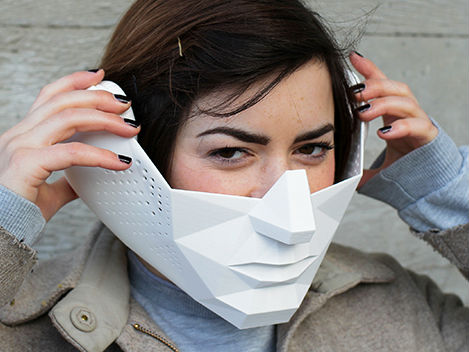
Put on a futuristic-looking, geometric white mask and you’ll suddenly have superhuman senses, hearing targeted sounds from long distances or applying effects to images in real-time. The ‘Eidos’ masks were developed by a group of students from the Royal College of Art in London, fitting over the mouth or ears to enhance sensory perception.

Superhuman Senses Mask 2

The mask that fits over the mouth and ears features a directional microphone to capture audio, which is processed by software to eliminate background noise. The sound is transmitted directly to the inner ear through bone vibrations to make it seem as if someone else’s speech is coming from inside your own head.

Superhuman Senses Mask 3

Superhuman Senses Mask 4

The second mask, which fits over the eyes, adds visual effects to the wearer’s range of vision, and can also analyze visual data. That data is sent to a computer, where software processes it and picks out patterns and movements that are invisible to the naked eye.

Superhuman Senses Mask 5

“Eidos has broad application in areas where live audio and video analysis is valuable. For example, sportspeople can visualise and improve technique in real time. Eidos also has healthcare benefits where it can be used to boost or refine sensory signals weakened by ageing or disability. In the arts, Eidos can augment live performance such as ballet, fashion or music concerts. It allows us to highlight previously invisible or inaudible details, opening up new and customisable experiences.”

Share on Facebook


[ By Steph in Gadgets & Geekery & Technology. ]

[ WebUrbanist | Archives | Galleries | Privacy | TOS ]


WebUrbanist

 
Comments Off on Wearable Tech: Mask Gives Users Superhuman Senses

Posted in Creativity


High Tech to High Fashion: Upscale 3D-Printed Designs

01 May

[ By Steph in Design & Products & Packaging. ]

3D Printed Fashion main

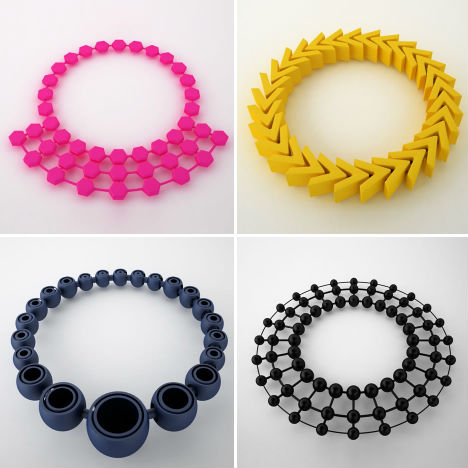
Pioneers in 3D-printed fashion are showing off the capabilities of rapid-prototyping technology with dresses, hats, shoes, swimwear and jewelry. Machines layer buildable materials like nylon or steel according to computer-generated blueprints, eliminating the need for fabric and conventional soles and fasteners. The results are delicate and architectural, but surprisingly strong. Designs are custom-printed to the wearer’s exact dimensions for a perfect fit.

N12 Bikini by Continuum Fashion

3D Printed Fashion N12 Bikini
While 3D-printed fashions have been showing up on runways for a few years now, the N12 bikini was among the first to actually be available for purchase. Every single piece of this bikini is 3D-printed including closures, and snap together without any sewing. Order through the Continuum Fashion shop.

Exoskeleton 3D Printed Shoes by Janina Alleyne

3D Printed Fashion Exoskeleton Shoes 1

3D Printed Fashion Exoskeleton Shoes

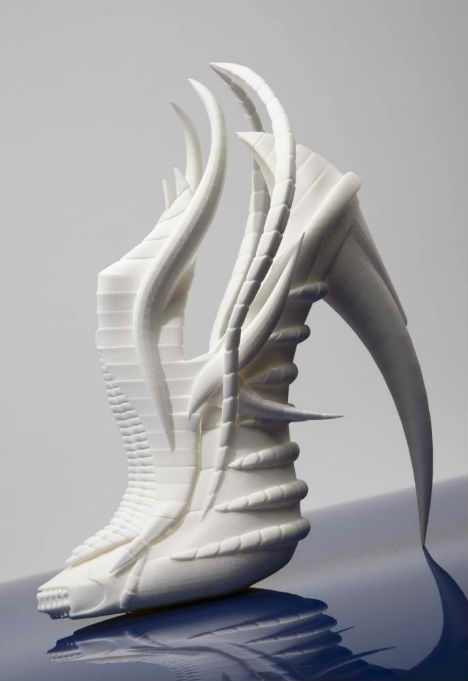
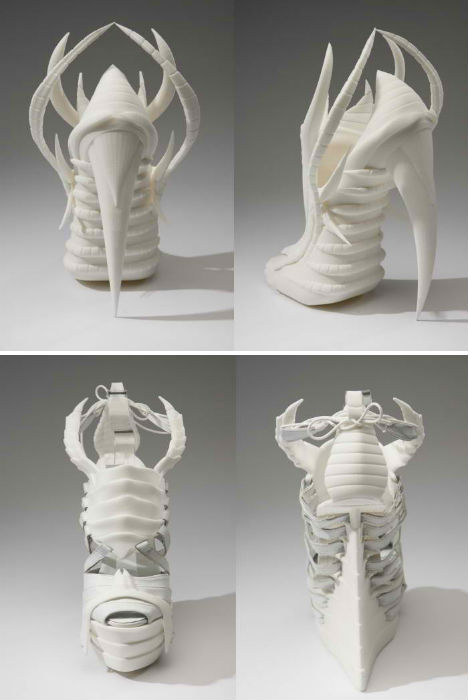
The Exoskeleton collection by Janina Alleyne is a futuristic, vaguely alien-looking series of footwear inspired by the structure and silhouettes of marine invertebrates and insects. With 3D printing, shoes and garments can be printed to the exact size of the wearer, making uncomfortable-looking designs fit like a glove.

Parasol Hat by Heidi Lee

3D Printed Fashion Cocktail Hat

Artist and milliner Heidi Lee created this parasol-inspired cocktail hat, modeled by Andrej Pejic for WILD Magazine’s Woman issue.

Invisible Shoe by Andreia Chaves

3D Printed Fashion Invisible Shoe 1

3D Printed Fashion Invisible Shoe 2

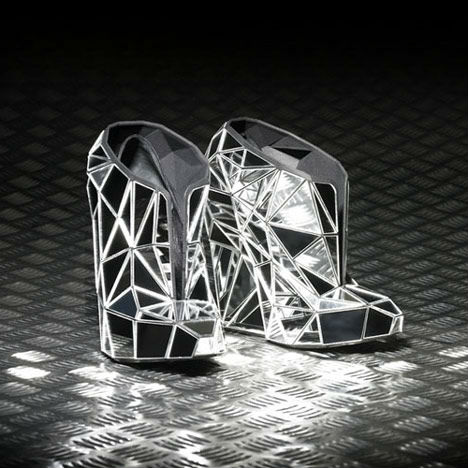
Created in collaboration with rapid prototyping studio Freedom of Creation, fashion designer Andreia Chaves’ Invisible Shoe features a 3D-printed base that is then covered in a mirrored shell. This produces an optical illusion effect, making the wearer’s feet seem to blend in with their surroundings.

Jointed Jewels by Alissia Melka-Teichroew

3D Printed Fashion Jointed JEwels

3D Printed Fashion Jointed Jewels 2

A ‘selective laser sintering process’ enables jeweler Alissia Melka-Teichroew to create a range of unusual jewelry from plastic powder, which is fused into solid form using a computer-controlled laser.

Seed of Life Corset by ThreeForm

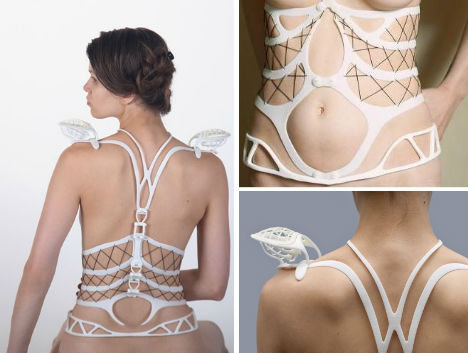
3D Printed Fashion Seed of Life Corset

This piece of wearable sculpture features a segmented design with movable joints and hinges, and it’s made to fit your body perfectly. The Seed of Life Corset from ThreeForm is available at Shapeways for $ 2,500.

Escapism Dresses by Daniel Widrig, Iris van Herpen and .MGX by Materialise

3D Printed Fashion Escapism Dress

This incredibly complex series of dresses from Dutch fashion designer Iris van Herpen was produced in collaboration with London architect Daniel Widrig and digital manufacturers .MGX by Materialise. The digitally-printed dresses are lightweight and flexible, amazingly detailed and yet easy to produce.

Biomimicry Shoe by Marieka Ratsma and Kostika Spaho

3D Printing Biomimicry Shoe

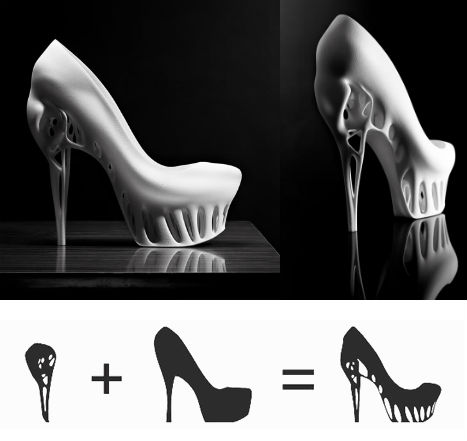
Look closely at the heel of the biomimicry shoe by Dutch fashioned designer Marieka Ratsma and American architect Kostika Spaho. It’s modeled on a bird skull. The hollow structure of the skull creates a high platform sole that is nevertheless lightweight, using less material than a solid structure.

Next Page:
High Tech To High Fashion Upscale 3d Printed Designs

Share on Facebook


[ By Steph in Design & Products & Packaging. ]

[ WebUrbanist | Archives | Galleries | Privacy | TOS ]


WebUrbanist

 
Comments Off on High Tech to High Fashion: Upscale 3D-Printed Designs

Posted in Creativity


Google shares Glass tech specs ahead of launch

16 Apr

glass.png

As Google Glass beta testers – so-called ‘Explorers’ – prepare to receive the first round of the wearable augmented reality tech, Google is also bracing the rest of us for what’s to come. The company is pushing the Glass announcements this week with the release of the MyGlass app in the Google Play store and the developer preview of the Mirror API, along with the most revealing tech specs we’ve seen yet. Click through to check out the detailed specs and more at connect.dpreview.com.

News: Digital Photography Review (dpreview.com)

 
Comments Off on Google shares Glass tech specs ahead of launch

Posted in Uncategorized


The Google Glass effect: How wearable camera tech will change everything

29 Mar

glass9.png

As Google Glass and other wearable cameras look to become the latest tech trend, some futurists are raising the red flag of caution. If everyone is wearing a constantly recording, super subtle camera, what are the implications for personal privacy, the law and our own safety? We look at some interesting implications of this new technology and the ways it could change our society at connect.dpreview.com.

News: Digital Photography Review (dpreview.com)

 
Comments Off on The Google Glass effect: How wearable camera tech will change everything

Posted in Uncategorized


High Seas Venture: SF Tech Incubator in International Waters

18 Mar

[ By WebUrbanist in Architecture & Offices & Commercial. ]

international floating seasteading incubator

Imagine heading out from San Francisco to a bustling technology hub closer than Silicon Valley … yet an entire country away. Set only a dozen miles from the coast, this incredible incubator is planned for international waters and could be the world’s most high-tech floating city.

international tech city hub

Blueseed is currently seeking investors to back this audacious play and let them set up shop a proverbial stone’s throw away from the heart of West Coast innovation. The company has founders familiar with the immigration issues of the United States – two are, respectively, from Serbia and Romania, and a third is the child of Cuban immigrants.

international venture funding model

Via ArcticStartup: “they plan to start accommodation prices off at around $ 1500 a month, and transportation will be provided to the mainland by a daily ferry. Internet connectivity will be provided via a point-to-point 40Gbps laser link with satellite link backup. They are also looking at additional backup solutions using submarine cable and potentially a series of WiMAX relay buoys. A visa is not required to earn a paycheck on Blueseed, and most residents will be able to travel back and forth to the mainland with a business/pleasure B1 Visa.”

international technology community platforms

Like other incubators, Blueseed plans to take a stake in startups that start on its shores (or rather: ships and floating platforms), something that startup schools like YCombinator and TechStars have found to be a successful business model in the past. Its fleet would include living and working vessels, daily ferries and potentially (eventually) desalination plants and other means of creating full self-sufficiency on the open seas. Who knows – perhaps it would even be mobile in the long run.

Share on Facebook


[ By WebUrbanist in Architecture & Offices & Commercial. ]

[ WebUrbanist | Archives | Galleries | Privacy | TOS ]


WebUrbanist

 
Comments Off on High Seas Venture: SF Tech Incubator in International Waters

Posted in Creativity


Rambus unveils ‘Binary Pixel’ sensor tech for expanded dynamic range

27 Feb

binarypixels-nocaps.jpg

US technology company Rambus has unveiled ‘Binary Pixel’ sensor technology, promising greatly expanded dynamic range for the small sensors used in devices such as smartphones. Current image sensors are unable to record light above a specific saturation point, which results in clipped highlights. Binary Pixel technology gets around this by recording when a pixel has received a certain amount of light, then resetting it and in effect restarting the exposure. The result is significantly expanded dynamic range from a single-shot exposure. The company has demonstrated the technology using a low resolution sensor, and says it can easily be incorporated into CMOS sensors using current manufacturing methods. 

News: Digital Photography Review (dpreview.com)

 
Comments Off on Rambus unveils ‘Binary Pixel’ sensor tech for expanded dynamic range

Posted in Uncategorized


HTC takes new approach to sensor tech in latest flagship phone

19 Feb

htc-one.jpeg

Much ado has been made about the sensor technology rumored to debut along with HTC’s newest handset launched today, the HTC One. While rumors of stacked sensors were predictably wide of the mark, HTC is taking a clever approach to improving camera phone quality by betting on fewer but larger pixels captured by a 4.0MP 1/3″ sensor, which are similar in size to those found in enthusiast compact cameras, and which HTC is calling ‘ultrapixels’. Combined with a fast F2.0 lens and optical image stabilization, the HTC One’s specs hold promise for better low-light photography – an area where mobile phones have fallen notoriously short. Click though for our detialed preview on Connect.

News: Digital Photography Review (dpreview.com)

 
Comments Off on HTC takes new approach to sensor tech in latest flagship phone

Posted in Uncategorized


Why the Instagram Debacle Just Taught Every Tech Company to Take Your Photos More Seriously

22 Dec

Why the Instagram Debacle Just Taught Every Tech Company to Take Your Photos More Seriously

“Whatever kind of victory all those protests achieved, it wasn’t one for consumer rights — if anything, Instagram is the real winner here. The company just managed to score a round of positive press for retracting an unpopular change and give itself the ability to actually use photos in ads.” — Nilay Patel, The Verge

Over at the Verge Nilay Patel makes a case that the backlash earlier this week against Instagram’s unpopular TOS update was actually a loss for consumers not a gain. He argues that Instagram’s current TOS is broader than their more explicit proposed one and so consumers are worse off, not better off. Because Instagram technically still holds the rights to sell your photos under their current TOS, and even more broadly, the consumer backlash was misguided and really did more harm than good.

I disagree with Nilay and feel that actually this week’s backlash was one of the more significant movements yet for photo sharing on the web.

It’s not that Facebook (whose TOS is equally broad) and Instagram couldn’t legally sell your photos on the web under their broad TOS in the past or in the future, it’s more that *politically* it is now far more difficult for them to begin selling your photos out from under you on the web using their broader TOS.

Who cares what the TOS says, the message that Facebook got loud and clear this week is not to f*** with your photos. Your photos are important. You care about them. They are much more personal to you than Facebook may have previously considered. They have emotional importance and significance and collectively your users will rise up and bash you in the face if you try to exercise terms of your TOS that your lawyers have allowed you to screw around with photos. Whatever your future monetization strategies might be, they will not be based on a loss of control over OUR creative efforts — even our duckface creative efforts.

No, there is no question about it. Instagram lost this week and they lost big. This is in no way a positive for Instagram. People trust them less and they had to turn around and eat crow, they gained nothing.

Flickr won big at Instagram’s expense and Google+ won a little. Flickr won more because like Instagram their site is 100% about photography. They also just released a pretty awesome new iPhone app that is in fact even slickr than what Instagram currently offers.

Flickr also went out of their way last year to really drive home the ownership rights of your photos. This old forgotten post was revived with new life as a stark contrast to what it felt like Instagram was trying to pull. Kevin Systrom eventually even had to parrot back some of that “yes, we know your photos are your photos” stuff in his awkward non-apology apology.

Dan Lyons wrote a post that talked about Google+ winning some here too. Google+ smartly has a provision in their TOS that specifically limits their rights to your photos to basic operational use. Google+ is probably the most active community of photographers on the web today and are a natural beneficiary from what Lyons’ refers to as “Facebook Greedheads.”

The biggest winner or all though was you, the photographer. Whatever Instagram’s original intention was in being more specific in their TOS, it backfired on them. The idea that they could/would profit off your emotionally significant photos without your consent, authorization or most important, sharing the dough, hit a nerve with photographers and likely won’t be tried again by anyone in a long, long time.

The thing is, this didn’t have to be such a painful learning experience for Instagram. There was/is in fact a HUGE opportunity for some smart social media property make a ton of money off of your photos, Instagram just went about it wrong.

As much as Flickr’s deal with Getty sucks (photographers get a miserly 20% payout) photographers on Flickr still went bonkers for it when Flickr released it. The idea that you could actually get PAID to post your photos on a social network, paid ANYTHING, had most users on Flickr clamoring to get into the program, not out of the site.

Even though Flickr/Getty’s call for artists group is now closed (due to overwhelming demand) almost 90,000 photographers joined this group hoping to get selected by Getty for the right to sell their photos for the paltry 20% payout.

The difference with Flickr’s deal though was that 1. you CHOOSE to opt in and 2. at least you got paid something.

What if instead of Instagram saying, “hey, we might sell your photos without your consent and pay you NOTHING,” they said, “hey, do you want to sell your Instagram photos and if we sell them for you split the money 50/50″? Instead of losing accounts and becoming the scourge of the internet for three days, they would have had photographers rushing to sign up and begin marketing their images on their site.

Although there are sites out there like 500px and SmugMug that let you sell your photos now, Flickr is the only larger social network that has a selling program. Google+, Instagram, Facebook, even Twitter, all have a major opportunity to become the first large social network to allow us to license our images through their service and share in the revenue with them. This is a multi-BILLION dollar industry dominated at present by Getty who is not paying creatives enough for their work. What the internet does best is get rid of middlemen when they are being unreasonable, and an 80/20 split with photographers is unreasonable.

Instead of stealing our work and paying us zero, how about using your significant reach in reputation, marketing and search to partner with us and empower us to sell our work together. I guarantee you that whoever comes up with the best program first has some of the best photography on the web flooding your network. Even if 99% of us never sell a single photo, simply giving us the feeling that we have the opportunity to sell a photo would be a powerful incentive to get us active and humming on your network.


Thomas Hawk Digital Connection

 
Comments Off on Why the Instagram Debacle Just Taught Every Tech Company to Take Your Photos More Seriously

Posted in Photography