RSS
 

Posts Tagged ‘System’

Rhino Arc II 4-axis robotic camera system supports 15lb camera payloads

17 Nov

Rhino has launched a Kickstarter campaign for its new Rhino Arc II, a “robotic camera assistant” designed to replace a fluid head. The Arc II features a 4-axis motorized head with support for both tripods and the Rhino Slider, as well as up to 6.8kg/15lbs of camera equipment. Users have both joystick and mobile control options.

Rhino Arc II supports LightLapse, Interview, Keyframe, and Rack modes for smooth camera movements in a variety of filming scenarios. The robotic assistant supports Rhino Focus and the High Torque & High Speed Motor as optional tools for expanded capabilities.

The system is also backwards compatible with the Rhino EVO Motor and Slider EVO. When used with an optional Rhino Power dummy battery, Arc II offers integrated power output for mirrorless and DSRL cameras. Other features include an integrated 501 plate receiver, an OLED screen, and a pan motor for motorized mounting.

Rhino is offering the Arc II to Kickstarter backers who pledge at least $ 960 USD, a $ 240 discount over the anticipated retail price. The campaign also offers other rewards for backers, including the Rhino Slider Carbon, Slider Pro, and Rhino Arc II + Slider bundles. Shipping is expected to start in May 2019. To dine out more information and to make a pledge, head over to the Kickstarter campaign.


Disclaimer: Remember to do your research with any crowdfunding project. DPReview does its best to share only the projects that look legitimate and come from reliable creators, but as with any crowdfunded campaign, there’s always the risk of the product or service never coming to fruition.

Articles: Digital Photography Review (dpreview.com)

 
Comments Off on Rhino Arc II 4-axis robotic camera system supports 15lb camera payloads

Posted in Uncategorized


DJI updates geofencing system to better protect airspace around airports

24 Oct

DJI has announced Geospatial Environment Online Version 2.0 (GEO 2.0), a geofencing update for its drones that improves their ability to avoid restricted airspace near airports. The improvements are “based on a more finely-tuned evaluation of risks associated with aircraft approaching and departing different types of airports,” according to Brendan Schulman, DJI VP of Policy & Legal Affairs.

The update will arrive in phases starting in November for airports and airspace in the US. DJI indicates similar upgrades will arrive in other regions, but doesn’t provide a timeline, saying only that they “will follow in due course.”

DJI explains that its new system enables Geospatial Environment Online to create a 3D “bowtie” safety zone around airport runway flight paths; the update also adds complex polygons for placement around non-runway facilities deemed sensitive.

The update also adds restrictions for the final approach corridor of active runways, which are designated as “runaway exclusion zones” by the FAA Reauthorization Act. DJI has dropped AirMap and selected PrecisionHawk as its new North America data provider. The company collaborated with the American Association of Airport Executives (AAAE) and the Aircraft Owners and Pilots Association (AOPA) to get guidance on GEO 2.0 from general aviation pilots and airports.

DJI drone owners will need to update their drone firmware and the DJI GO 4 flight control app to access the changes.

Articles: Digital Photography Review (dpreview.com)

 
Comments Off on DJI updates geofencing system to better protect airspace around airports

Posted in Uncategorized


Review of the SKOUT Handsfree Camera Carrying System by Cotton Carrier

01 Oct

If you want an alternative to using the regular camera strap for hiking or walking around town type of activities, then this review is just the thing for you! Read on to find out about the SKOUT Handsfree Camera Carrying System and whether it will suit your needs.

Review of the SKOUT Handsfree Camera Carrying System

A couple of weeks ago, I had the opportunity to review the SKOUT handsfree camera carrying system by Cotton Carrier during a backcountry camping family trip in Colorado’s Rocky Mountain National Park over a period of five days.

To say I was impressed with the performance and comfort of the SKOUT would really be an understatement. I was super impressed with the way Cotton Carrier’s handsfree system worked. It actually held up really well over 30 miles of hard terrain for the duration of the entire trip.

If you have ever been hiking in the mountains, especially the backcountry, you know that total weight and back comfort are very high on the list of priorities for any hiker. I have broken down my review of the Cotton Carrier in terms of the following factors.

Review of the SKOUT Handsfree Camera Carrying System

The first day of the hike was without the SKOUT carrier and just using the camera strap around my neck. I was uncomfortable and the strap was so annoying to hold especially after 2-3 hours of a tough incline hike.

Review of the SKOUT Handsfree Camera Carrying System

A much happier me with the SKOUT sling on a day hike. Being handsfree was the best part.

#1 – Ease of use

The SKOUT design is a one-size fit all solution for almost any camera and lens attachment. I used it with my Canon 5D MKIII and 16-35mm L lens as well as the 24-70mm L lens. The first setup with the 16-35mm lens was definitely lighter than with the 24-70mm lens. But with both lenses, the sling held up really well.

The side-strap provided the support needed and balanced the weight effectively. Since I was already carrying a heavy camping pack on both my shoulders, the side strap ensured the camera was well balanced on my back. I was really impressed with the SKOUT’s patented “Twist & Lock” mount that attaches and detaches the camera from the anodized aluminum hub with a simple twist.

I have to admit I was a little nervous the first few minutes after attaching the camera to the SKOUT, being completely handsfree. But my body and my back quickly adjusted to the freedom and I loved not having to constantly pull up the camera strap from my shoulders while walking and hiking in the rough terrain.

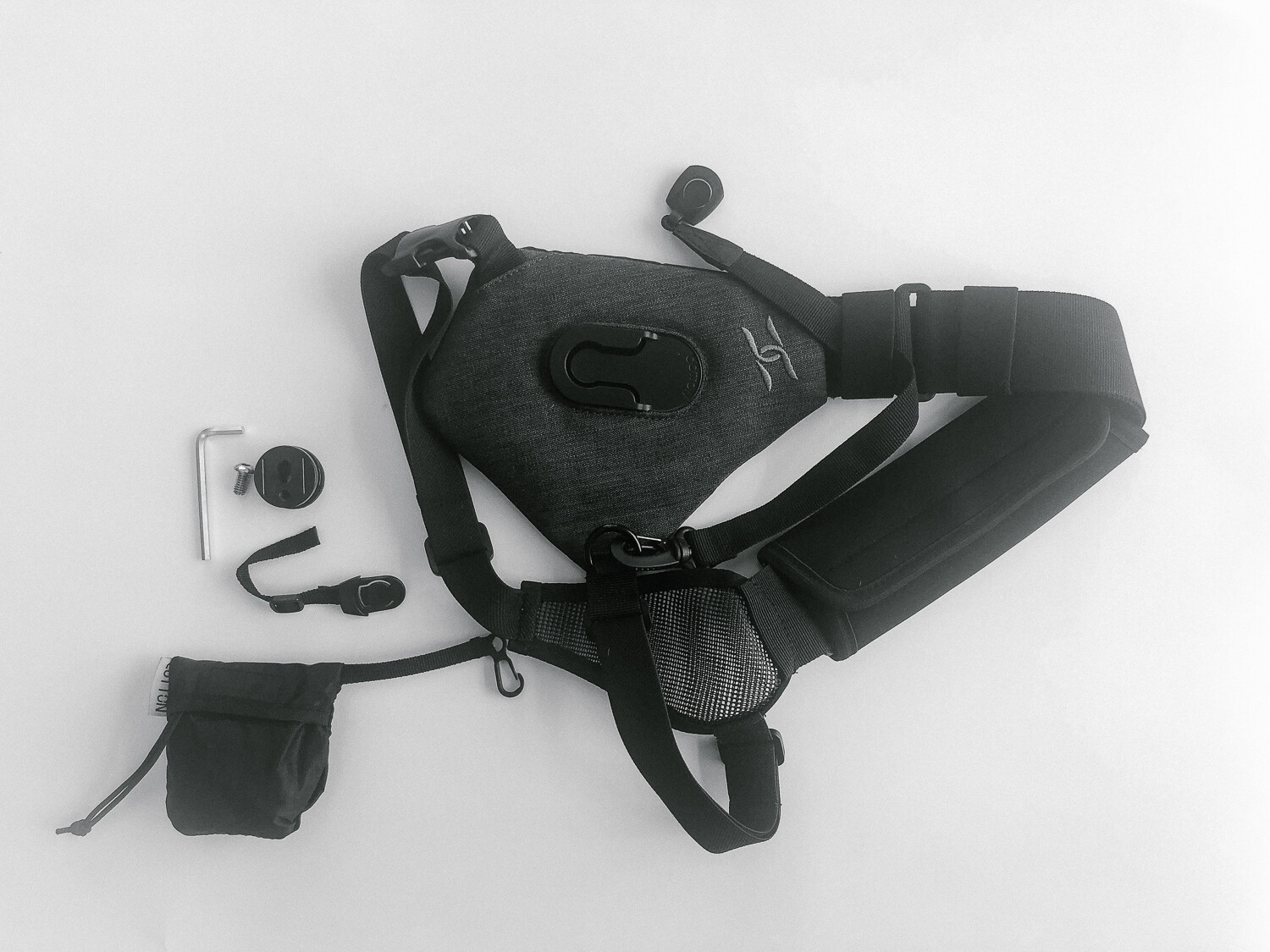
Hidden inside the system is an internal stash pocket that fits a phone or a few credit cards. There’s also a rain cover/ weather guard so the gear stays safe and dry in less than ideal environments. I actually ended up using this a couple of times during my hike when we got caught is a mild downpour in the moutnains.

#2 Comfort

Attaching the SKOUT was fairly simple. After wrapping it over one shoulder, there is a single strap that wraps around the torso and snaps into place on the front, securing the entire system. The shoulder strap is really padded well, so even heavier camera systems don’t put too much stress on the body.

Review of the SKOUT Handsfree Camera Carrying System

The bracket attaches right where you would attach your tripod insert.

Review of the SKOUT Handsfree Camera Carrying System

The bracket then connects to the sling body with a twist and turn and it is quite secure.

Review of the SKOUT Handsfree Camera Carrying System

The crossbody sling with the camera attached to it along with the rain cover.

The cotton fabric is very breathable. I was hiking for almost 5-6 hours every day on some pretty rough terrain. Yet the shoulder and body straps were soft and did not rub against my back. The padding on the shoulder straps is thick and really does support the camera weight across your shoulder nicely.

#3 Durability

Like I mentioned earlier, I used the SKOUT camera sling system over a span of 10 days in the mountains of Colorado. I used it on backcountry hiking days as well as day hikes in Rocky Mountain National Park.

After the first few minutes of figuring out how to attach the camera and secure the system in place, I really forgot it was even on my body. I absolutely enjoyed being handsfree and having the camera readily available to snap a photo when I saw a beautiful landscape or wildlife.

No more taking the camera out of the daypack and risking missing the moment. The straps, the clasp, and even the camera attachment held up really well to some rough use during my trip.

Here is a video of the SKOUT handsfree camera system in use during my trip.

?

Conclusion

All in all, I would definitely rate this product a 9/10 and highly recommend it for anyone looking to do photography on a trail or during a backcountry hiking/camping trip.

It is easy to use, comfortable to wear for extended periods of time and seems reliable even after some rough use in the outdoors.

The post Review of the SKOUT Handsfree Camera Carrying System by Cotton Carrier appeared first on Digital Photography School.


Digital Photography School

 
Comments Off on Review of the SKOUT Handsfree Camera Carrying System by Cotton Carrier

Posted in Photography


Lowepro updates ProTactic system with modular exterior attachments

22 Sep

$ (document).ready(function() { SampleGalleryV2({“containerId”:”embeddedSampleGallery_1807842727″,”galleryId”:”1807842727″,”isEmbeddedWidget”:true,”selectedImageIndex”:0,”isMobile”:false}) });

Camera bag manufacturer Lowepro has introduced mark II backpacks for its ProTactic AW range with models that are said to feature an improved handling experience as well as a collection of accessories that can be attached to the outside. The ProTactic BP 350 AW II and BP 450 AW II both have redesigned entry points to make access easier, as well as a new more adaptive interior that can be customized to fit the kit you need to carry.

The two bags use the same FormShell composite ‘armored’ outer to protect their contents as the previous versions did, as well as a removable belt. Now though the belt can be used to attach accessories from the range such as the lens pouch, water bottle holder or phone pouch.

Lowepro says that both backpacks can hold one or two DSLRs with one lens attached, up to eight lenses or flash units, a small drone and a gimbal. The difference in size of the bags means the lens attached the DSLR in the ProTactic BP 350 AW II could be a 24-70mm F2.8 size, while the BP 450 AW II has room to that lens to be a 70-200mm F2.8. The smaller bag holds a 13in laptop in its CradleFit suspended pouch, while the larger can manage a 15in model.

Both bags are available now, with the BP 350AW II costing $ 219.95/£209.95 and the BP 450 AW II costing $ 269.95/£259.95. The accessory pouches will be available in early October. See the Lowepro website for more information.

Press release

{Pressrelease}

LOWEPRO INTRODUCES NEXT GENERATION OF AWARD-WINNING PROTACTIC SERIES

Lowepro’s worldwide #1 selling professional camera bag series, ProTactic, has been enhanced for better organization, access and protection with expanded modular system and accessories.

Upper Saddle River, NJ – Lowepro, a company with a 50-year reputation in creating protective gear-carrying solutions for image makers, today announced the second generation of their worldwide #1 selling ProTactic Collection. The high-performance, tactical-inspired collection has been redesigned for better organization, access and protection, while staying true to the ProTactic promise of rugged versatility and armored protection. The new line offers the BP 350 AW II and BP 450 AW II enhanced backpacks plus an expanded modular system and accessories.

Featured ProTactic Technology

* 4-Point Access: Molded, turret-loading top, quick-grab from both sides, and full, back entry for set-up and security.
* FormShell™: Lightweight yet sturdy, composite-shell construction delivers superior impact protection.
* SlipLock™: System of compatible loops and tabs make it easy to add pouches and cases to larger bags so you can easily bring along water bottles, memory cards and more.
* CradleFit™ Laptop Storage: Cleverly constructed compartment suspends and safeguards laptop in backpacks.
* ActivZone™: Delivers targeted support at shoulder blades, lumbar and waist for comfort on the move. Structured back panel allows for ventilation with integrated trolley strap.
* All Weather AW Cover™: a raincoat for your gear, our patented cover fits snugly over a bag and can be folded away when not needed. An innovative way to protect against rain, snow, dust and sand.

“In designing carrying solutions, we always listen closely to what our image makers are telling us,” explains Tim Grimmer, Senior Director of Product for Lowepro. “They are seeking increased versatility, organization, and accessibility with the performance and protection ProTactic is known for. We’re excited to offer this enhanced line-up featuring more adaptive interiors, always-ready access and a great collection of exterior attachments and accessories.”

The updated ProTactic collection includes:

Backpacks: The exceptionally adaptive second generation of our high-performance ProTactic backpacks, the BP 350 AW II and BP 450 AW II offer a more adaptive interior, multiple access points, modular exterior attachment capabilities and convertible utility belts. Both models include utility pouch, water bottle holder, tripod cup and two Quick Straps.

* ProTactic BP 350 AW II – Fits 1-2 standard DSLRs, one with 24-70mm f/2.8 lens attached, up to 8 lenses/speed lights, small drone such as a DJI Mavic, gimbals like DJI Osmo, 360 camera, 13” laptop and small accessories
* ProTactic BP 450 AW II – Fits 1-2 Pro DSLRs, one with a 70-200mm f/2.8 lens attached, up to 8 lenses/speedlights, small drone such as a DJI Mavic, gimbals like DJI Osmo, 360 camera, 15” laptop and small accessories.

Lens Cases: Purpose-built lens cases allow you to change out a lens with one hand. Dual-compartment design expands to temporarily hold 2 lenses during exchange. Cases feature SlipLock compatible attachment tabs, all Weather AW Cover, easy-grip main handle, neoprene side pocket for lens or body caps and removable/adjustable shoulder strap.

* ProTactic Lens Exchange 100 AW – Fits a standard and ultra-wide zoom lens.
* ProTactic Lens Exchange 200 AW – Fits up to a 70-200mm f/2.8 lens.

Utility Bags: All-purpose bags designed to provide versatile storage space for photo and video gear. Featuring padded removable interior divider, SlipLock compatible tab and All Weather AW Cover.

* ProTactic Utility Bag 100 AW – Fits full frame body with portrait grip, binoculars, batteries, flash units or small drone such as DJI Mavic Air with controller.
* ProTactic Utility Bag 200 AW – Fits gimbals such as DJI Osmo, speedlights or shotgun microphone.

Additional ProTactic Accessories:

* ProTactic Bottle Pouch – Securely holds up to 1L water bottles and canteens while keeping liquids insulated. Features stretchable padded insulated construction, drawstring toggle and closure and SlipLock compatible tab.
* ProTactic Phone Pouch – Keep your communications handy with this simple and secure zip pouch. Mounts on ProTactic backpack harness, waist belt or on pack body for easy access. Features SlipLock compatible tab. Fits up to Plus size Apple or Android phone.
* ProTactic Utility Belt – Designed to operate during a variety of missions, this belt is constructed for sturdy utility carry. Reinforced “duty” belt distributes weight evenly and keeps gear close at hand. Adjusts to fit 29” – 40” waists. Holds up to 16 SlipLock compatible accessories when adjusted to 40”.
* ProTactic Quick Straps – Quick attach, quick release adjustable straps securely clip into any SlipLock attachment point. Includes two 1-inch webbing strap assemblies. Adjusts from 5 to 13.5 inches.

The Lowepro ProTactic BP 350 AW II Backpack and BP 450 AW II are available now at Lowepro.com and at select Authorized Lowepro dealers. Lowepro ProTactic Lens Exchange, Utility Bags, and other accessories will be available early October.

{/Pressrelease}

Articles: Digital Photography Review (dpreview.com)

 
Comments Off on Lowepro updates ProTactic system with modular exterior attachments

Posted in Uncategorized


Canon full-frame mirrorless system debuts with announcement of EOS R

08 Sep

$ (document).ready(function() { SampleGalleryV2({“containerId”:”embeddedSampleGallery_3915362783″,”galleryId”:”3915362783″,”isEmbeddedWidget”:true,”selectedImageIndex”:0,”isMobile”:false}) });

Just two weeks after Nikon introduced its Z-system, Canon has joined the full-frame mirrorless club with its new RF-mount system, with the first camera being the EOS R. Canon makes very clear this is merely the first in a new system.

The EOS R features a 30.3 effective Megapixel CMOS sensor and a DIGIC 8 processor. It uses RF-mount lenses – four of which will be available at launch – with support for both EF and EF-S lenses via one of three optional adapters, which it says add capability to existing lenses. Dual Pixel AF is onboard, with a whopping 5,655 selectable points with 88% vertical and 100% horizontal coverage, plus the ability to focus down to -6EV (though this is rated with an F1.2 lens, which gives a 1.5EV advantage over brands quoting figures for F2 lenses). There’s a ‘Pupil Detection’ mode for ensuring eyes are in focus but this is only available in AF-S mode.

“Being the first to market with a full-frame mirrorless system was never our goal. It was to reimagine optical excellence”

The camera has a native ISO range of 100-40,000 that expands to 50-102,400. The EOS R supports both Canon’s 14-bit CRW Raw format as well as the relatively new C-Raw, which offers much smaller file sizes. The fastest shutter speed available is 1/8000 sec, with an X-sync speed of 1/200 sec.

Design-wise, the EOS R is an SLR-style camera with a weather-sealed magnesium alloy body. It offers an electronic viewfinder with a resolution of 3.69 million dots, a magnification of 0.76x and a 23mm eyepoint. Its fully articulating 3.2″ LCD is touch-enabled and has 2.1 million dots. A customizable touchpad to the right of the viewfinder allows for quickly changing ISO, white balance, movie shooting and more. Canon users will be able to commiserate with Nikon owners as, like that company’s new Z-series cameras, the EOS R offers just one memory card slot, which supports UHS-II media. The camera has HDMI, USB-C, wired remote, headphone and microphone sockets. Wi-Fi and Bluetooth are built-in.

“Most revolutionary component isn’t camera, it’s the mount”

In terms of performance, the EOS R can shoot continuously at 8 fps in AF-S and 5 fps in AF-C ‘shooting speed priority’ mode. If you want to use ‘tracking priority’ mode in AF-C the frame rate drops to just 3 fps. The buffer is quite healthy, though, with the ability to save 47 Raw, 78 C-Raw or 100 JPEGs when shooting at full speed with a UHS-II card. It uses the familiar LP-E6N battery pack which allows for 370 shots per charge using the LCD (per CIPA standard) or 350 with the EVF. (Power save modes boost those numbers to 450 and 430, respectively.) The optional BG-E22 grip fills the battery slot but has room for two batteries: this gives you twice the battery life.

Video-wise, things are less impressive. On the plus side, you get Dual Pixel AF, even in 4K and the camera retains separate exposure and button customization settings for video. Sadly it maxes out at 4K/30p and features the same 1.7x crop that essentially reduces the camera down to sub APS-C quality and still appears to exhibit significant rolling shutter.

When it comes to capture, users can choose between ALL-I and IPB compression, with top bit rates of 420Mbps and 120Mbps, respectively. You’ll need a V60-rated SD card to get that highest bitrate but the camera can record for up to 29:59 even in 4K mode, with a large enough card. Dropping down to Full HD allows for 60 fps recording at 180 Mbps using ALL-I compression. Internal video capture is 8-bit 4:2:0. The camera can also capture Canon Log internally in 8-bit or can put out a 10-bit 4:2:2 C-Log stream over HDMI for use with an external recorder.

“You don’t switch to it, you add it to the family”

The camera can also record 120p footage at 1280 x 720 at a healthy 160Mbps bit rate. Recording time limits are 7.5 minutes for 120 fps shooting and just under 30 minutes for everything else.

The EOS R will be available in October for $ 2299 body only or $ 3399 with the 24-105mm F4L lens.

Canon EOS R initial sample images

$ (document).ready(function() { SampleGalleryV2({“containerId”:”embeddedSampleGallery_8856572449″,”galleryId”:”8856572449″,”isEmbeddedWidget”:true,”selectedImageIndex”:0,”isMobile”:false}) });

Press Release:

EVOLUTION MEETS REVOLUTION AS CANON ANNOUNCES THE ALL-NEW EOS R SYSTEM

Optical Innovation Inspires the Next Leap Forward in Imaging

MELVILLE, N.Y., September 5, 2018 – Canon U.S.A. Inc., a leader in digital imaging solutions, today announced the next revolution in the company’s long history of innovative and award-winning camera systems, the EOS R system featuring the newly designed RF mount. Recognizing the need to advance optical design, the Company sought to create a versatile and powerful new system that supports all current EF, EF-S, TS-E and MP-E lenses[i], and also provides the optical advancements and engineering flexibility to build upon for years to come.

When Canon set forth to develop a new interchangeable lens camera system, they focused on three core optical principles: high-image quality, high-specification performance, and compact design. Recognizing that optics is the foundation for any camera system, the RF mount was conceived to open new doors in optical design. Canon’s new RF mount features the same size diameter as the EF mount (54mm) and shorter back focus distance. This allows for lenses to sit closer to the sensor (the focal plane) and allowed Canon optical engineers to reimagine lens design utilizing larger rear lens elements to produce an image on the full-frame sensor. This new optical formula has paved the way for higher performing lenses. In addition, the Canon RF mount features a high-speed 12-pin communication system that provides faster and more in-depth communication between the camera and lens over existing Canon mount systems.

The EOS R system is designed for full, uninhibited compatibility with all existing EF, EF-S, TS-E and MP-E lenses through the use of mount adapters[ii]. In addition, through the use of the optional Drop-In Filter Mount Adapter or Control Ring Mount Adapter these lenses, in fact, gain functionality.

“There has never been a time in history in which visual expression has been so prolific. Imaging, both still and video, are the communication mediums of today’s society. Much in the same way we learned to type in the past, today’s youth are skilled in shooting, editing, and visual storytelling in ways that only the masters of each craft were decades ago,” said Kazuto Ogawa, president and chief operating officer, Canon U.S.A., Inc. “Knowing this, we needed to step back and design a system that delivers all the creative expression and functionality today’s youth crave, now and in the years to come.”

The First in a New System: The EOS R

The new Canon EOS R full-frame mirrorless camera features a 30.3 megapixel CMOS sensor that is powered by the Company’s latest image processor, DIGIC 8, enabling shooting at up to 8.0 frames per second[iii]. The new camera inherits a lot from Canon’s legacy in both EOS and Cinema EOS. Video storytellers can capture stunning 4K UHD video up to 30fps and record in 10-bit 4:2:2 (with an external recorder). The EOS R also comes with the ability to shoot Canon Log, providing 12 stops of dynamic range, minimal loss of detail in shadows and highlighted areas and an increased range of choices when color grading. Users with an existing collection of Canon lenses will be excited to know that all EF and EF-S lens are compatible with the camera. In order to do so, photographers and videographers can choose between using one of three new mount adapters, each uniquely designed to meet the individual needs of the user.

The new Canon EOS R camera features Dual Pixel CMOS Auto Focus with 5,655 manually selectable AF points[iv], supporting AF at up to f/11 with a 384 zone (24×16) real-time metering system. With f/1.2 lenses, the camera astonishingly boasts AF sensitivity in low light in as little as EV-6. When using the RF 24-105mm F4 L IS USM lens with the EOS R, the camera can focus in as little as 0.05 seconds with Dual Pixel CMOS AF[v], making it the fastest autofocus speed in the world[vi]. These features provide photographers and videographers with Canon’s most advanced AF system to date. The EOS R also features a silent shutter setting when shooting in single-shot mode; an important feature for those who need to capture imagery without disrupting the scene. An upcoming free firmware update will enable silent shutter in continuous shooting mode as well.

“The EOS R system is not just a new camera or a new lens mount, it is a new design that will allow us to produce visual tools that were previously impossible, and allow our customers to tell their stories with greater depth, richness of color, and creative flexibility, in optically stunning ways.” states Kazuto Ogawa

Thoughts From the First Users

“I think every camera system has its place and it’s all about having the right tool for the job,” reported acclaimed outdoor photographer and Canon Explorer of Light Jimmy Chin. “The new EOS R system for me in particular is very useful for the kind of shooting that I do in the mountains, where I need to worry about the size and weight. Having the option to use the new RF lenses or the EF lenses is really great.”

“I was instantly impressed with how quickly the EOS R was able to focus,” remarked celebrated fashion photographer and Canon Explorer of Light Lindsay Adler. “Whether my subject was moving or I was shooting in near-complete darkness, I had no problem getting tack-sharp focus in every shot. It was a relief to know my gear wasn’t going to hold me back from executing my vision, but instead it would really help me to execute this vision.”

“For us, it’s all about getting the shot no one else can get, and a lot of this has to do with the camera,” says Devin Graham, director and filmmaker behind YouTube’s DevinSuperTramp. “The new EOS R will become one of our main cameras. It has a very small footprint, yet is able to create amazing images. As for the lenses, the new RF 28-70mm F2 has just become one of my all-time favorites. I’ll be bringing it on every project.”

Conveniently placed just to the right of the EVF, Canon has introduced a new Multi-Function Bar that will allows users to more easily access their customizable settings, such as AF, ISO and White Balance. Users will have the option to either slide or tap the bar to gain access to the settings and adjust on-the-go as they deem necessary depending on each particular shooting situation.

Answering the demand for enhanced mobile editing of RAW image files, Canon is also announcing a new application, Digital Photo Professional Express (DPP Express). In combination with an updated Canon Camera Connect App, DPP Express enables users to send, view, edit and process CR3 RAW files on their iPad[vii]. A free download of the app will be available October 2018.

Additional noteworthy features of the EOS R Camera include:

  • RF Mount Compatible with RF Lenses and EF/EF-S Lenses
  • Built-in EVF with 3.69 Million Dots, Vari-angle Touchscreen LCD and Dot-matrix LCD Panel
  • ISO range of 100-40,000, expandable to 102,400
    • USB 3.1 in-camera charging support
  • Built-in Bluetooth and Wi-Fi® providing easy sharing to compatible smart devices and social media sites
  • Single UHS-II SD card slot
  • CR3(RAW/C-RAW) and Dual Pixel RAW Support
  • Dust and weather resistant

Availability and Pricing

The Canon EOS R full-frame mirrorless camera is scheduled to be available in October 2018 for an estimated retail price of $ 2299* for the body only. It will also be sold as a body-and-lens kit with the new RF 24-105mm F4 L IS USM lens for $ 3399*.

[i] When attaching an EF-S lens via any of Canon’s new R-series mount adapters, the new EOS R automatically switches to APS-C crop mode.

[ii] When attaching an EF-S lens via any of Canon’s new R-series mount adapters, the new EOS R automatically switches to APS-C crop mode.

[iii] Continuous shooting speed may vary depending on the shutter speed, the aperture, the lens being used, the battery charge and various camera settings.

[iv] Available AF points may decrease when shooting with AF cropping or in movie mode, or depending on camera settings or lens attached.

[v] Based on results of AF speed tests in accordance with CIPA guidelines. Results may vary depending on shooting conditions and lens in use. Relies on internal measurement method.

  • Brightness at time of distance measurement: EV12(regular temperature, ISO 100)
  • Shooting mode: M
  • Lens in use: RF 24-105mm F4 L IS USM, with focal distance of 24mm and live-view mode on(with manual shutter button operation
  • AF mode: Live single-point AF(central) and AF operation: One-shot AF

[vi] Among interchangeable lens digital mirrorless cameras incorporating 35mm full frame equivalent image sensors with phase-difference detection AF on the image plane and contrast detection AF, available in the market as of September 5th, 2018 (Based on Canon’s Research).

[vii] Compatible with iPad models utilizing iOS 11 or later and equipped with at least 2GB of onboard RAM—specifically, iPad Pro (all models), iPad (5th generation), iPad (6th generation), iPad mini 4 and iPad Air 2.

*Availability, prices and specifications are subject to change without notice. Actual prices are set by individual dealers and may vary.

Canon EOS R specifications

Price
MSRP $ 2299 (body only), $ 3399 (w/24-105 F4L lens)
Body type
Body type SLR-style mirrorless
Body material Magnesium alloy
Sensor
Max resolution 6720 x 4480
Other resolutions 4176 x 2784 (1.6x crop)
Image ratio w:h 1:1, 4:3, 3:2, 16:9
Effective pixels 30 megapixels
Sensor photo detectors 32 megapixels
Sensor size Full frame (36 x 24 mm)
Sensor type CMOS
Color space sRGB, Adobe RGB
Color filter array Primary color filter
Image
ISO Auto, 100-40000 (expands to 50-102400)
Boosted ISO (minimum) 50
Boosted ISO (maximum) 102400
White balance presets 6
Custom white balance Yes
Image stabilization No
Uncompressed format RAW
JPEG quality levels Fine, normal
File format
  • JPEG
  • Raw (14-bit Canon CRW)
  • C-Raw (Canon compressed Raw)
Optics & Focus
Autofocus
  • Contrast Detect (sensor)
  • Phase Detect
  • Multi-area
  • Center
  • Selective single-point
  • Tracking
  • Single
  • Continuous
  • Touch
  • Face Detection
  • Live View
Autofocus assist lamp Yes
Manual focus Yes
Number of focus points 5655
Lens mount Canon RF
Focal length multiplier 1×
Screen / viewfinder
Articulated LCD Fully articulated
Screen size 3.2
Screen dots 2,100,000
Touch screen Yes
Screen type TFT LCD
Live view Yes
Viewfinder type Electronic
Viewfinder coverage 100%
Viewfinder magnification 0.76×
Viewfinder resolution 3,690,000
Photography features
Minimum shutter speed 30 sec
Maximum shutter speed 1/8000 sec
Exposure modes
  • Program
  • Aperture priority
  • Shutter priority
  • Manual
Built-in flash No
External flash Yes (via hot shoe)
Flash X sync speed 1/200 sec
Drive modes
  • Single
  • High-speed continuous
  • Low-speed continuous
  • Self-timer
Continuous drive 8.0 fps
Self-timer Yes (2 or 10 secs)
Metering modes
  • Multi
  • Center-weighted
  • Spot
  • Partial
Exposure compensation ±3 (at 1/3 EV, 1/2 EV steps)
AE Bracketing ±3 (3 frames at 1/3 EV, 1/2 EV steps)
Videography features
Format MPEG-4, H.264
Modes
  • 3840 x 2160 @ 30p / 480 Mbps, MOV, H.264, Linear PCM
  • 3840 x 2160 @ 30p / 120 Mbps, MOV, H.264, AAC
  • 3840 x 2160 @ 24p / 480 Mbps, MOV, H.264, Linear PCM
  • 3840 x 2160 @ 24p / 120 Mbps, MOV, H.264, AAC
  • 3840 x 2160 @ 23.98p / 480 Mbps, MOV, H.264, Linear PCM
  • 3840 x 2160 @ 23.98p / 120 Mbps, MOV, H.264, AAC
  • 1920 x 1080 @ 60p / 180 Mbps, MOV, H.264, Linear PCM
  • 1920 x 1080 @ 60p / 60 Mbps, MOV, H.264, AAC
  • 1920 x 1080 @ 30p / 90 Mbps, MOV, H.264, Linear PCM
  • 1920 x 1080 @ 30p / 30 Mbps, MOV, H.264, AAC
  • 1920 x 1080 @ 24p / 90 Mbps, MOV, H.264, Linear PCM
  • 1920 x 1080 @ 24p / 30 Mbps, MOV, H.264, AAC
  • 1920 x 1080 @ 23.98p / 90 Mbps, MOV, H.264, Linear PCM
  • 1920 x 1080 @ 23.98p / 30 Mbps, MOV, H.264, AAC
  • 1280 x 720 @ 120p / 160 Mbps, MOV, H.264, Linear PCM
Microphone Stereo
Speaker Mono
Storage
Storage types SD card (UHS-II supported)
Connectivity
USB USB 3.1 Gen 1 (5 GBit/sec)
USB charging Yes (with LP-E6N only)
HDMI Yes (Mini-HDMI)
Microphone port Yes
Headphone port Yes
Wireless Built-In
Wireless notes 802.11b/g/n + Bluetooth 4.1 LE
Remote control Yes (via smartphone)
Physical
Environmentally sealed Yes
Battery Battery Pack
Battery description LP-E6N lithium-ion battery & charger
Battery Life (CIPA) 370
Weight (inc. batteries) 660 g (1.46 lb / 23.28 oz)
Dimensions 136 x 98 x 84 mm (5.35 x 3.86 x 3.31)
Other features
Orientation sensor Yes
GPS None

Articles: Digital Photography Review (dpreview.com)

 
Comments Off on Canon full-frame mirrorless system debuts with announcement of EOS R

Posted in Uncategorized


Four RF-mount lenses kick off Canon’s new full-frame mirrorless system

08 Sep

$ (document).ready(function() { SampleGalleryV2({“containerId”:”embeddedSampleGallery_8760634600″,”galleryId”:”8760634600″,”isEmbeddedWidget”:true,”selectedImageIndex”:0,”isMobile”:false}) });

Canon’s first full-frame mount in more than 30 years is here, in the shape of the RF-mount. Featuring the same diameter as the venerable EF-mount but with a much shorter flange back distance, RF is designed from the ground up for mirrorless cameras. It’s still early days, but four lenses have been unveiled alongside the consumer-grade EOS R, providing a tantalizing glimpse into Canon’s future ambitions.

Today sees the unveiling of the Canon RF 28-70mm F2L USM, RF 50mm F1.2L USM (pictured below), RF 24-105mm F4L IS USM and RF 35mm F1.8 Macro IS STM. This quartet covers common focal lengths from 24mm to 105mm and includes an exceptionally fast aperture zoom lens, a macro and – in a throwback to the early days of the EF system in the late 1980s – a flagship fast 50mm (shown below on the EOS R).

Perhaps the most interesting of the four new lenses is the 28-70mm F2, which weighs in at a very substantial 1430g (3.15lbs) – a 77% weight increase compared to the wider but slower EF 24-70mm F2.8 II. Boasting 19 elements in 13 groups, the 28-70mm F2 is a large lens, with a determinedly non-standard front filter diameter of 95mm. The RF 24-105mm F4 appears somewhat more conventional, weighing in at a much more manageable 700g (1.5lb) and featuring a standard filter thread of 77mm. It’s no surprise that this is the lens that Canon is kitting with the EOS R at launch.

The RF 24-105 F4L IS USM has been designed to be video-friendly, with minimal focus breathing, a fast, silent ‘Nano USM’ focus motor and the ability to control its aperture in 1/8th EV steps.

The RF 50mm F1.2 looks to be a pretty substantial chunk of glass, featuring 15 elements in nine groups, and weighing 950g (2.1lb). Meanwhile the lightweight (305g, 0.7lb) RF 35mm F1.8 Macro covers both a useful focal length, and offers a handy 0.5X magnification macro capability. Considering its comparatively smaller size and lighter weight, the RF 35mm F1.8 looks like it could be a very attractive walk-around prime for the small and light EOS R.

The EF-RF adapters will allow the millions of existing EF lenses in circulation to be used “without compromise”

In addition to the four new lenses, Canon has also introduced three EF to RF adapters. The most basic is a simple mount converter, with an additional two adapters which add a customizable control ring (to match the clicking, customizable control rings on native RF lenses), and a tray for drop-in filters, respectively. The drop-in filter adapter makes it possible to add a Vari ND or circular polarizer to all lenses, including the traditionally awkward super-wides.

Canon promises that the EF-RF adapters will allow the millions of existing EF lenses in circulation to be used “without compromise” on the new EOS R and future RF-mount cameras.

The RF 28-70mm F2L USM will cost $ 2,999 and will be available in December. The RF 24-105mm F4L IS USM will also be available in December for $ 1099 ($ 3399 as a kit with the EOS R). The RF 50mm F1.2L USM will cost $ 2,299 and will start shipping next month, while the RF 35mm F1.8 Macro IS STM will cost $ 499 and will be available in December. All three of the ‘L’ lenses are weather-sealed.

Press Release

BEYOND THE REALM OF TRADITIONAL POSSIBILITIES:
CANON INTRODUCES FOUR RF MOUNT LENSES

Canon Also Introduces Three RF Mount Adapters, Providing EF & EF-S Lenses with Full Compatibility and Enhanced Functionality ?with the New EOS R Camera

MELVILLE, N.Y., September 5, 2018 – Helping to rewrite the rules of visual expression, Canon U.S.A. Inc., a leader in digital imaging solutions, today introduced a variety of new RF lenses and accessories to accompany the newly announced EOS R Full-Frame Mirrorless Camera System. The four new RF lenses are built around Canon’s new RF mount, which features a large 54mm diameter and shorter back focus distance than on current EOS DSLR cameras. The new RF mount enables new possibilities in optical design and lens formulation, allowing for faster and lighter lenses with higher performing optics.

The four new lenses, the Canon RF 28-70mm F2 L USM, RF 50mm F1.2 L USM, RF 24-105mm F4 L IS USM and RF 35mm F1.8 MACRO IS STM capitalize on the robust optic foundation of Canon’s new EOS R system. The design behind Canon’s new EOS R camera and RF lens system started with the concept of the optimal rear lens element diameter and shorter distance (back focus) for a Full-Frame image sensor.

With over 130 million EF lenses in circulation since Canon launched the mount in 1987*, the Company is enhancing the possibilities for its loyal customers who own and love their EF glass. Canon is introducing three RF Lens Mount Adapters that expand the capabilities of existing EF lenses when paired with the EOS R camera. The Canon Mount Adapter EF-EOS R allows photographers to utilize the full breadth of Canon’s EF, EF-S, TS-E, and MP-E lenses on the newly introduced EOS R camera system. The Control Ring Mount Adapter adds a customizable control ring via the adapter that provides photographers with added functionality to their fingertips. The Drop-in Filter Mount Adapter now easily places circular polarizing or variable neutral density filters behind the lens, opening up new options for lenses such as the EF 11-24mm where using optical filters were previously not an option.

“Knowing exceptional optics are a vital tool in shaping the image a photographer captures, Canon designed the EOS R camera system from the ground up with optics as the starting point,” said Kazuto Ogawa, president and chief operating officer, Canon U.S.A., Inc. “Canon is very excited about the world-class optics we have developed to marry with the new RF mount. With our rich history and more than 130 million EF lenses being used across the globe, Canon optics will continue to be at the forefront of our digital imaging development now and into the future.”

New Canon RF Series Lenses

Three of the newly announced Canon RF lenses are counted among Canon’s top-of-the-line L-series optics; incorporating rugged, dust and water-resistant construction. All four new RF lenses feature a customizable control ring that allows photographers to adjust exposure compensation, shutter speed, aperture or ISO.

The Canon RF 28-70mm F2 L USM lens, the world’s first standard zoom lens with an f/2 aperture is excellent for capturing landscapes, weddings and portraits with its large aperture for stunning bokeh. Initial testing within Canon has shown this new lens to produce better optical image quality and sharpness over similar focal length EF-series lenses, including the extremely popular and highly regarded EF 24-70mm f/2.8L II USM.

A portrait photographer’s must-have, the Canon RF 50mm F1.2 L USM lens sports an ultra large-diameter f/1.2 aperture and Canon’s Air Sphere Coating (ASC) technology to dramatically reduce flares and ghosting. This amazing new lens is capable of rendering subjects life-size on the full-frame sensor with its minimum focusing distance of only 0.59 inches.

Photographers seeking an all-around utility lens for the new EOS R camera system need to look no further than the Canon RF 24-105mm F4 L IS USM lens. Coming in nine percent shorter in length than the EF 24-105mm f/4L IS II USM, this compact lens employs a CIPA standard of 5 stops of IS and is equipped with NANO USM technology, the first L-series lens with the technology. This small chip-shaped ultrasonic motor is engineered to help deliver high-speed, smooth, precise and near-silent operation, plus full-time manual focus (when using one-shot AF).

A fast, wide-angle single focus lens, the Canon RF 35mm F1.8 MACRO IS STM lens is an excellent option for photographers looking for an affordable compact lens. Featuring a maximum shooting magnification of 0.5x, the lens can easily shoot macro photography of subjects such as flowers, food and even insects. The lens also utilizes a CIPA standard of 5 stops of IS and is compatible with Hybrid IS, compensating for both angular and shift camera shake.

Enhanced Capabilities for Canon EF Lenses

Thanks to its large lens mount design, Canon’s new EOS R series camera system delivers new capabilities in both design and function, but for existing Canon lens owners it does something incredible. It enhances the capabilities of existing EF and EF-S lenses with full compatibility and in some cases, enhanced functionality when paired with one of three RF mount adapters.

Canon lenses are historically top-rated, and the Company is looking to help customers gain even more value in their investment with three new RF mount adapters.

The Canon Mount Adapter EF-EOS R is a standard adapter that provides full compatibility with EF lenses. Autofocus, metadata, and Optical Image Stabilization on EF lenses all continue to work seamlessly with the new EOS R camera through this adapter.
The Control Ring Mount Adapter EF-EOS R continues full EF lens compatibility with the addition of a customizable control ring. Functions that can be assigned and adjusted by the control ring include aperture, shutter speed, ISO speed and exposure compensation.
In addition to full EF lens compatibility, the Drop-In Filter Mount Adapter EF-EOS R allows for lens filters to be used behind any EF lens and help photographers conveniently utilize variable ND and circular polarizing filters with any EF lens.

New Speedlite Series

Canon is also introducing a new compact and lightweight Speedlite, the EL-100. Designed for photographers who are just beginning to use an external flash or are in need of a secondary unit, the new Speedlite delivers both soft and natural lighting reproduction. In addition, the EL-100 can rotate upwards and to the left and right enabling photographers to bounce the flash off of nearby ceilings, walls or surfaces.

Additional Features of the Canon Speedlite EL-100 include:

  • Maximum Guide Number of Approx. 85 ft./26m at ISO 100
  • 24mm Wide-angle Coverage
  • Optical Wireless Flash Function (Sender and Receiver)
  • Flash Exposure Control Including Support for Stroboscopic Flash and Continuous
  • Shooting Camera-linked Functions Including Interlocked External Flash Power On/Off
  • Mode Dial with AUTO Position

Availability and Pricing

The Canon RF 50mm F1.2 L USM will be available in October 2018 for an estimated retail price of $ 2299. The Canon RF 28-70mm F2 L USM, RF 24-105mm F4 L IS USM and RF 35mm F1.8 MACRO IS STM will all be available for purchase in December 2018 for an estimated retail price of $ 2999, $ 1099 and $ 499.99 respectively.

The Canon Mount Adapter EF-EOS R and Control Ring Mount Adapter EF-EOS R will be available for purchase in October 2018 for an estimated retail price of $ 99.99 and $ 199.99 respectively. The Drop-in Filter Mount Adapter EF-EOS R will all be available for purchase in February 2019 for an estimated retail price of $ 399.99 with a variable ND filter or $ 299.99 with a circular polarizing filter.

The Canon Speedlite EL-100 will be available for purchase in October 2018 for an estimated retail price of $ 199.99.

For more information on the new Canon RF lenses and accessories, please visit usa.canon.com/eosrsystem.

Canon RF 35mm F1.8 IS STM / RF 50mm F1.2L specifications

  Canon RF 35mm F1.8 IS STM Macro Canon RF 50mm F1.2L USM
Principal specifications
Lens type Prime lens
Max Format size 35mm FF
Focal length 35 mm 50 mm
Image stabilization Yes No
CIPA Image stabilization rating 5 stop(s)
Lens mount Canon RF
Aperture
Maximum aperture F1.8 F1.2
Minimum aperture F22 F16
Aperture ring No
Number of diaphragm blades 9 10
Optics
Elements 11 15
Groups 9
Special elements / coatings 1 aspherical element, Super Spectra Coating Ground aspherical + aspherical _+ UD elements, Air Sphere and fluorine coatings
Focus
Minimum focus 0.17 m (6.69) 0.40 m (15.75)
Maximum magnification 0.5× 0.19×
Autofocus Yes
Motor type Stepper motor Ring-type ultrasonic
Full time manual Yes
Focus method Internal
Distance scale No
DoF scale No
Physical
Weight 305 g (0.67 lb) 950 g (2.09 lb)
Diameter 74 mm (2.91) 90 mm (3.54)
Length 63 mm (2.48) 108 mm (4.25)
Sealing No Yes
Colour Black
Filter thread 52 mm 77 mm

Canon RF 28-70mm F2L USM / RF 24-105mm F4L IS USM specifications

  Canon RF 28-70mm F2L USM Canon RF 24-105mm F4L IS USM
Principal specifications
Lens type Zoom lens
Max Format size 35mm FF
Focal length 28–70 mm 24–105 mm
Image stabilization No Yes
CIPA Image stabilization rating 5 stop(s)
Lens mount Canon RF
Aperture
Maximum aperture F2 F4
Minimum aperture F22
Aperture ring No
Number of diaphragm blades 9
Optics
Elements 19 18
Groups 13 14
Special elements / coatings UD + aspherical elements, Air Sphere, SWC and fluorine coatings Aspherical + UD elements, Air Sphere and fluorine coatings
Focus
Minimum focus 0.39 m (15.35) 0.45 m (17.72)
Maximum magnification 0.18× 0.24×
Autofocus Yes
Motor type Ring-type ultrasonic Nano ultrasonic
Full time manual Yes
Focus method Internal Rear
Distance scale No
DoF scale No
Physical
Weight 1430 g (3.15 lb) 700 g (1.54 lb)
Diameter 104 mm (4.09) 84 mm (3.31)
Length 140 mm (5.51) 107 mm (4.21)
Sealing Yes
Colour Black
Zoom method Rotary (extending)
Power zoom No
Zoom lock No
Filter thread 95 mm 77 mm

Articles: Digital Photography Review (dpreview.com)

 
Comments Off on Four RF-mount lenses kick off Canon’s new full-frame mirrorless system

Posted in Uncategorized


Rumors point to imminent Canon full-frame mirrorless system launch

01 Sep

Over the past few days, rumor sites seem to have come to a consensus that Canon will launch a full-frame mirrorless camera in the very near future. Canon Rumors and Canon Watch point to a full-frame body called the EOS R, alongside a list of lenses published today by Japanese news and rumor site Nokishita. A list of ‘RF’ lenses rumored to be launched with the system include:

  • Canon RF 35mm F1.8 M IS
  • Canon RF 50mm F1.2L USM
  • Canon RF 28-70mm F2L USM
  • Canon RF 24-105mm F4L USM

Also rumored to be announced soon:

  • Canon EF-M 32mm F1.4 STM
  • Canon EF 400mm F2.8L IS III
  • Canon EF 600mm F4L IS III

Nokishita also suggests that a battery-grip, radio-wave receiver and an adapter (M to R, or “mount” – they say it’s unclear which) will also be announced.

Obviously, nothing is confirmed at this point and rumors are rumors. But we’d be surprised if Canon wasn’t prepping a full-frame mirrorless system amid competition from Sony and now Nikon. What’s your take on this list of lenses supposedly launching with the system? Let us know in the comments.

Articles: Digital Photography Review (dpreview.com)

 
Comments Off on Rumors point to imminent Canon full-frame mirrorless system launch

Posted in Uncategorized


The Nikon Z system: What we think, where it should go

25 Aug

Introduction

By the time you read this article, you’ll surely have absorbed most of the news, specifications and in-depth analysis related to Nikon’s new full-frame mirrorless cameras, the Z 6 and Z 7. And there’s been quite a bit of coverage, to be sure. After all, this is Nikon’s first new full-frame lens mount since 1959*.

But here in this piece, we’re hoping to convey some of our reflections of the new system; how it feels in the hand, how it responds when you’re out shooting. Not just what the customizations are, but how useful we find them. We weren’t able to perform any of our standard tests on our pre-production Z 7, but we came away with plenty of thoughts and hopes for the future. Let’s dive in.

Hits

We all agreed that the Z 7 feels great in the hand.

The build quality and hand-feel of the Z 7 were met with universal praise from the staff. Editor Dan Bracaglia, who’s been shooting with Nikon DSLRs for over a decade, said everything on the exterior of the Z 7 – grip, buttons, switches – feels built to the same level as a D850. I’m inclined to agree; the grip matches the comfort of the D850, and despite weighing less than a D750 (the lightest full-frame DSLR on the market), it feels even more solid than that camera. And your fingers don’t run off the bottom of the grip like some other mirrorless options. The top plate OLED is also much crisper and easier to read than the older LCD panels on DSLRs.

The viewfinder was likewise met with enthusiasm. The Quad VGA panel is bright and contrasty with a high refresh rate. Our Editorial Manager Wenmei Hill said that, in her opinion, it’s the closest you can currently get to an optical finder. Senior Editor Barney Britton mentioned that he started to find the viewfinder in the D850 a bit fuzzy and cool in comparison. It was important for their existing DSLR users that Nikon got this right, and it looks like they have. Unlike many competitors, the viewfinder also doesn’t drop in resolution during continuous focusing or burst shooting. That makes it a great viewfinder experience for anyone, not just users of optical viewfinders.

The viewfinder doesn’t drop in resolution during focusing or burst shooting

The touchscreen interface, even on our pre-production model, was extremely polished and responsive. That you can interact with every aspect of the camera via its touchscreen – including the customizable ‘i’ menu – is encouraging, and genuinely useful.

One rift between DSLRs and mirrorless cameras that persists even today simply concerns the cameras’ startup times. DSLRs are still nigh instantaneous; when you flip the on switch and mash the shutter, the camera will fire a shot right then and there. The Z 7 doesn’t get to quite that level of responsiveness, but it also doesn’t make you wait an age either. We’d say it’s on par with the likes of an Olympus E-M1 II or Panasonic G9, while some of Sony’s a7-series of cameras still takes noticeably longer to power on and and take an image.

Power-on time is an area where mirrorless cameras, including the Z 7, continue to lag behind DSLRs.

Lastly, we were disappointed by the CIPA rating of 330 images for the EN-EL15b battery that powers the Z 7. It’s not a woefully bad score, but it’s around the rating of Sony’s 1st and 2nd gen a7-series cameras for which we regularly recommended carrying a second battery, while Sony’s latest Z-series battery is rated for around 700 shots. All that said, Barney’s actual experience with the Z 7 put him at ease; over the course of a 12-hour shoot, he recorded 1500+ images and several 4K video clips before the battery warning kicked in at 10% remaining. He wouldn’t be opposed to venturing out for a full day in a new city with one battery for the Z 7. Not too shabby, but definitely something we’ll be looking at in detail when we get a reviewable camera.

Misses

As a team, we also agreed on a few aspects – particularly regarding autofocus – of the Z 7 that struck us as less-than-polished. And we should stress, the model we used was pre-production using non-final firmware, and there’s always a chance that some of these can be addressed via firmware updates later on.

Single point

Dynamic

The AF area modes (excluding pinpoint) that the Z 7 and Z 6 offer. One thing we really liked was how bright, red and visible the AF points were in all area modes.

The first is a lack of any form of touchpad AF, which we found strange considering how otherwise impressive the touchscreen interface is. Sure, there’s a joystick to move your AF area around, but we’d prefer Nikon give users the option to choose which method they prefer (plus, it’s already incorporated on the D5600 for that camera’s viewfinder autofocus system).

Continuing on the autofocus theme, we’re all puzzled regarding the new autofocus implementation. Considering the relatively seamless transition from, say, the D850 to the Z 7 in terms of menus and most of the direct controls, the AF system is less familiar. It’s closer to the autofocus implementation in their DSLRs’ Live View, rather than the much more familiar system through the optical viewfinder.

Barney said that he adapted to the new autofocus system quickly for his style of shooting

The autofocus tracking implementation is more cumbersome, and there’s no provision to change your AF mode with a single button press (AF Area Mode + AF-On) as there is on Nikon’s D5, D500 and D850 cameras. As our Science Editor Rishi Sanyal explains, this can make it difficult to adapt to fast-changing scenarios, like moving from a bouquet toss at a wedding to a candid portrait moments later.

Barney, on the other hand, said that he adapted to the new autofocus system quickly for his style of shooting (which didn’t include fast action), but he was a little more concerned about stop-down focusing. The pre-production Z 7 we used stops the lens down to the shooting aperture (down to a limit of F5.6) to give the user a live depth-of-field preview, but this also gives the autofocus system less light (and less phase separation) for the on-sensor PDAF system to work with. If you’re shooting in dim conditions but don’t want a paper-thin depth-of-field, you may experience slower autofocus or more hunting than you expect.

Just because you can shoot at F1.8 doesn’t mean you’ll always want to, even if the conditions are a bit dim.

In terms of handling, we miss the ease of the autofocus mode and area selector switch near the lens barrel on Nikon DSLRs, which is missing on the Z 6 and Z 7. And while we appreciate the Fn1 and Fn2 buttons between the grip and the lens mount, we do find them a bit difficult to press without shifting your hand uncomfortably.

Mixed blessings

There are also some aspects of the new Z 7 that we appreciate – with some caveats.

The first is the completely silent shutter; this is incredibly valuable in quiet or sensitive settings, and being able to fire at full burst speed in silent shutter is a welcome addition. But due to the sensor’s somewhat limited readout speed, rolling shutter is likely to be an issue, as is banding under artificial light.

While we like the move to XQD cards for the speed they offer, there’s no denying they’re more expensive and harder to find than good ‘ol SD cards.

Likewise, when shooting 4K video, Nikon’s added digital stabilization as an other method of reducing camera shake on top of in-body and lens stabilization. Unfortunately, while you might be tempted to turn it on for, say, walking while recording, it doesn’t deal well with more jarring movements. It results in soft or blurred footage during the steps themselves, and we find it less distracting to have less stabilization with the IBIS system alone.

Lastly, the Z 6 and Z 7 are only offered with single XQD cards, which promise incredible read and write speeds as well as better durability when compared to conventional SD cards. But some users will likely be turned off by the lack of dual card slots, and we found the buffer on our pre-production Z 7 to clear more slowly than we’d expect (it clears almost instantly on a D5 or D500 once you stop shooting). Additionally, XQD readers just aren’t as ubiquitous as SD, and the cards themselves are more expensive.

Looking ahead

In looking toward the future of the new Z system, we have to say we’re pleased by the lens roadmap that Nikon put out – more than one editor was hoping for a native 70-200mm lens sooner rather than later.

The combination of high resolution, expansive dynamic range, compact size, comfortable handling and great 4K video is hard to dismiss.

And most of the concerns we have – the lack of Touchpad AF, for example – we’re hoping can be addressed in firmware, or at the very least, in the next Z-camera. We’re curious whether Nikon has any plans for a D500-level APS-C interpretation for Z-mount, though the team has predicted that there’s likely going to be a D5-level mirrorless coming around in time for the 2020 Olympics in Tokyo.

Overall, the combination of high resolution, expansive dynamic range, compact size, comfortable handling and great 4K video with intuitive and decisive autofocus is hard to dismiss. We’re confident in saying that, as of now, the Z 7 is Nikon’s most well-rounded camera they’ve ever produced.


*This excludes the Nikonos mount on Nikon’s early waterproof film cameras and an F-mount variation with the Nikonos R-UW mount.

(Return to text)

Articles: Digital Photography Review (dpreview.com)

 
Comments Off on The Nikon Z system: What we think, where it should go

Posted in Uncategorized


Nikon mirrorless system beta testers share first impressions in latest teaser

20 Aug

Nikon has posted teaser number five for its full-frame mirrorless system that will be announced in just three days. In this one, early users of the camera share their first impressions, and there’s also a quick glimpse of an F-mount adapter.

You can find the rest of Nikon’s teaser videos here.

Articles: Digital Photography Review (dpreview.com)

 
Comments Off on Nikon mirrorless system beta testers share first impressions in latest teaser

Posted in Uncategorized


Apple patents correction system for smartphone accessory lenses

26 Jul

Accessory lenses for smartphones can be useful tools for expanding the photographic capabilities of your device. However, the process of physically attaching these lenses to the smartphone and centering them above the camera lens is prone to minor but important error as even a slight misalignment can result in a drop in image quality. Additionally, the accessory lens’ optical design can have a detrimental effect on the image output.

Apple has now been granted a patent that aims to fix the problem using a two-pronged approach: by using correction software and a movable built-in camera lens.

The document describes camera hardware and an analysis and processing software that can be used to analyze image quality and detect problems potentially caused by add-on lenses. By looking at certain image metrics, the system could compare image quality before and after attaching an accessory lens and then use software algorithms to correct accordingly.

Additionally, actuators would allow to change the position of the built-in camera lens on multiple axes, in order to correct for any misalignment of the accessory lens. This could include tilting the camera and varying the distance between the built-in lens and accessory lens.

The patent suggests electronics, magnets and radio sensing among other methods to detect if an accessory lens has been attached. If the smartphone knows what exact accessory is being used, additional options in the camera app could be utilized as well.

As usual, there is no way of knowing if and when this system will make it into a production device but it certainly looks like it could make the use of accessory lenses more appealing to many of us.

You can find the complete patent document on the USPTO website.

Articles: Digital Photography Review (dpreview.com)

 
Comments Off on Apple patents correction system for smartphone accessory lenses

Posted in Uncategorized