RSS
 

Posts Tagged ‘System’

Hasselblad launches 50MP CFV-50c back for legacy V system

26 Jul

Hasselblad has launched a new digital back for its V System camera bodies that it claims brings modern digital image quality to users of vintage film-era Hasselblad camera bodies. The Hasselblad CFV-50c back features a 43.8 x 32.9mm CMOS sensor that outputs images at a resolution of up to 8272 x 6200 pixels, and operates within an ISO range of 100-6400. Click through for more details.

Articles: Digital Photography Review (dpreview.com)

 
Comments Off on Hasselblad launches 50MP CFV-50c back for legacy V system

Posted in Uncategorized


Preview of the Slide and Clutch Camera Carrying System from Peak Design

10 Jul

With Peak Design launching another set of products via Kickstarter, we’re very fortunate to get our hands on the new, as yet unreleased, Slide and Clutch camera carrying system prior to launch for a little dPS preview!

You can see the Kickstarter here and pre-order if that’s your thing!

As a Peak Design pro, I’ve been using “Capture” since it was released along with Leash and Cuff. The video below of Pete and Adam will give you a great idea of what the team at Peak Design are doing with this new gear and why they’re passionate about what they do – they love this stuff we do called photography.

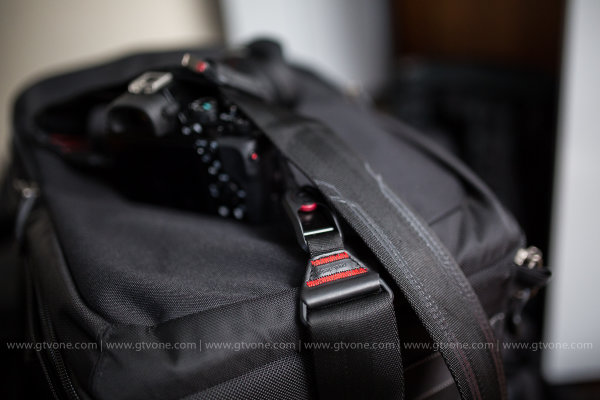
The Kickstarter is already funded, 450% funded, which says a lot about what they’ve built and the products they’ve created in the past. The new strap, Slide, is building on that, and after using it for a week (no, they don’t pay me to say this) it really is worth picking up now via the Kickstarter campaign. If you don’t, and you see it afterwards for more money, you will think to yourself “you know, Simon was right”. The strap sits really comfortably on my shoulder, it allows quick attachment to my camera through Peak Design’s unique anchor system, it literally slides around to where you want it and is so super easy when you’re wearing it, to make the strap shorter or longer as you can see in the video.

I’ve also been using Clutch, a hand strap system that keeps your camera firmly in your big greasy paw when you’re out and about shooting. I have used it with a gripped Canon 5DMK3 and without the grip – it’s quick to attach, quick to tighten and very quick to loosen off, too. When shooting portrait, I’d slide my hand out of Clutch and shoot my portrait photographs and then slide my hand back in. I didn’t really notice any loss of speed and after a few goes I was a veritable wild west camera slinger. I used Clutch on the weekend for a cycling event and loved the flexibility of being able to not worry about dropping my camera in the rain, and boy did it rain! It stayed firmly in my hand and allowed me to drop the camera into Capture to use the other body with my long lens and Slide attached – once done, I could let the long lens slide around to my hip / back and grab body number one back to continue shooting. Lots of bodies, no time to stop (over a thousand cyclists to grab a portrait of while they cycled past) and it worked perfectly (aside from when I tried to drink soup and shoot at the same time, but that’s another story).

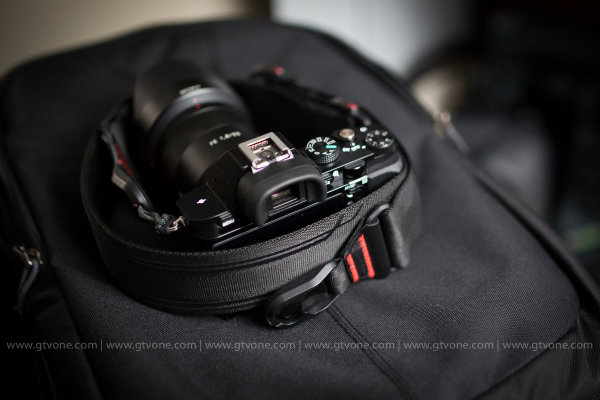
Back in my office now and this is what the Slide strap looks like attached to a Sony A7, (granted, at f/1.4 which doesn’t show you much A7 at all, but you get the picture) to give you a vague idea of scale.

peak-design-slide-preview

peak-design-slide-kickstarter-dps-preview

In conclusion, I’m super impressed with this, the next iteration of the Peak Design strap – Slide. (Leash being my first Peak Design strap) and from me, it’s highly recommended! I give it a healthy FIVE stars.

That said, I’m sure you have questions! So, as I have the Slide with me, and I’m taking it on a quick trip to China tomorrow, please feel free to ask any questions in the comments section below, I will answer as best I can. Another great product from Peak Design. Well done guys.

–Sime

The post Preview of the Slide and Clutch Camera Carrying System from Peak Design by Sime appeared first on Digital Photography School.


Digital Photography School

 
Comments Off on Preview of the Slide and Clutch Camera Carrying System from Peak Design

Posted in Photography


Lee introduces filter system for GoPro cameras

02 Jul

Camera filter and lighting gel manufacturer Lee Filters has introduced a range of filters and filter holders aimed at extreme sports fans using GoPro action cams. The Lee Bug is available in two forms – the Lee Bug 3 and the Lee Bug 3+ – which are compatible with GoPro Hero 3 and Hero 3+ cameras. Read more

related news: Digital Photography Review (dpreview.com)

 
Comments Off on Lee introduces filter system for GoPro cameras

Posted in Uncategorized


Phottix Mitros+ Review – the Best Flash System You Have Never Heard of

05 Jun
First dance

Photo taken using the Phottix Mitros+ system

As a professional wedding and portrait photographer, I would say the most important accessory in my kit bag besides my main camera and lenses would by my flashes. So when it came to making a decision on what flash system use, I did a lot of research and in the end I opted for the Phottix Mitros+/ Odin system. I don’t normally write gear reviews as I think the internet has enough top quality content. I realized however in my research that the Phottix Mitros+, although sold internationally, is comparatively less well known and not well documented on the web.
Phottix Mitros 107

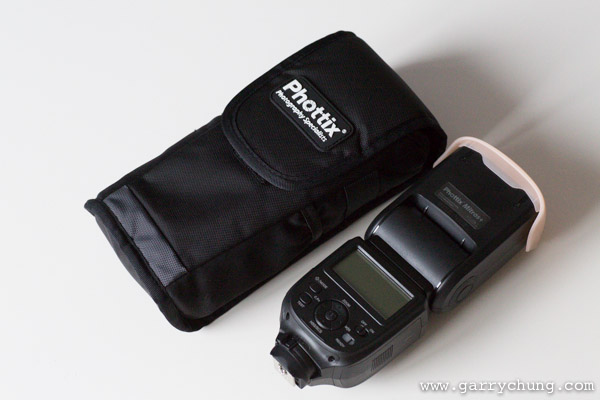
Phottix Mitros+ – comes with carrying case and accessories

I am a big fan of using off-camera flash and as a Canon shooter and have previously been using Canon 580 EX II / Pocket wizard combination for the last 4 years. The Canon 580 EX IIs in all fairness have served me well. They have been dropped many times, and rained on, but never skipped a beat. The problem occurs when I take them off camera. Using the PocketWizard Mini TT1 and TT5 trigger and receiver I have experienced a whole host of reliability problems that eventually was the catalyst for me to look for alternate solution.

I started by looking at the Phottix Odin TTL triggering system, which I have used before and has had excellent reviews. That was when I realized Phottix also sells the Mitros+ flash, that includes the wireless transceiver built into the unit. The “+” denotes that it has radio transceiver built in as they also do a non “+” version with no transceiver. The Mitros+ flash is great for a number of reasons;

  • It’s one less piece of equipment to buy and worry about
  • There is so need to carry more batteries or worry about connection issues between your radio receiver and your flash
  • The Phottix Odin trigger system is also a tried, tested, reliable market leader and so I was confident it would work well

Review – Phottix Mitros+ Flash System

First impressions when you take the Mitros+ out of the box; it comes in a nice pouch and feels solidly built to take a few bumps, which is essential as I will put it though the rigours of professional use. The first thing you notice is that it makes a beep, like studio lights, to tell you the flash is recycled and ready for use. This is especially useful if you are firing at full power, and can be turned off using the custom functions if you don’t like it. I fired off a few successive frames and it seems extremely quick to recycle. This is by no means a scientific test but I set the flash in manual mode 1/2 power and fired consecutive bursts. It seems to recycle at least as fast, if not faster, than a Canon 580 EX II. In the real world, it holds up very well; I tested it all day in different lighting situations and the ETTL worked consistently. The battery consumption seems about the same as the 580 EX II, I did a full day shoot and didn’t need to change batteries, so all in all I am very happy.

The real benefit of the unit however, is taking it off camera. It’s an absolute joy to use; no having to set up the PocketWizard receivers, and no misfires. I don’t have to do my usual five minutes of troubleshooting if the flashes aren’t firing. It just works like it is supposed to. With this system you can also control everything directly from my Odin transmitter, or using another Mitros+ flash. You can alter settings remotely such as TTL exposure compensation, manual power, high-speed sync and even flash zoom level. You can configure three groups of flashes and adjust each one individually. This basically allows you to control everything you need from the camera so no need to walk up and down making adjustments.
Phottix Mitros 101

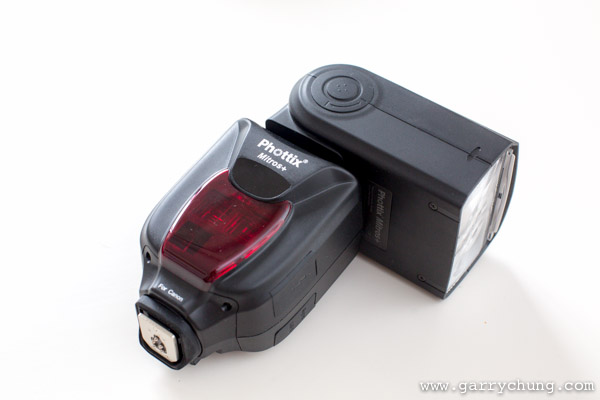
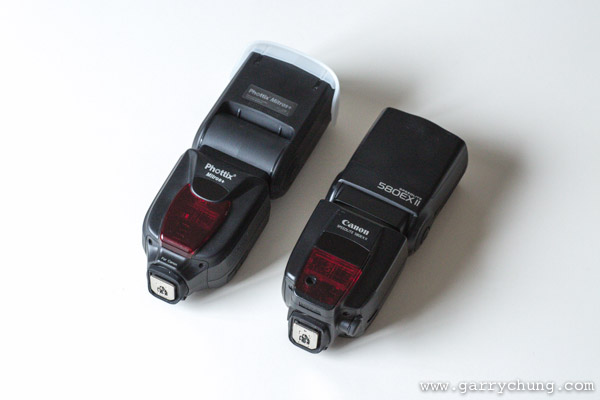
Hands on it’s a quite a large flash as you can see here next to the Canon 580EX II

Features (as listed on the Phottix website)

  • E-TTL, M, Multi (Stroboscopic) modes
  • Auto/Manual Flash Head Zoom with 180 degree rotation and 97 degree tilt
  • High Speed Sync and Rear Curtain Sync
  • Flash Exposure Compensation: Manual, Bracketed
  • Fast Flash Mode: with 0.1-2.5 sec. recharge times
  • USB port for upgrades
  • 3.5mm Sync port
  • Canon-compatible IR Wireless Triggering with Master and Slave mode
  • Optical Slave Sync Mode
  • Uses 4 AA batteries
  • Port for external battery pack
  • Compatible with Phottix Odin TTL Flash Triggers for Canon
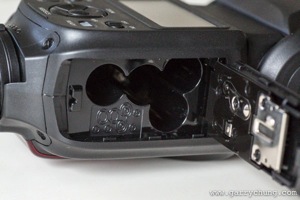
  • Battery Compartment for 4 AA batteries (below left)
    Phottix Mitros 103 Phottix Mitros 102
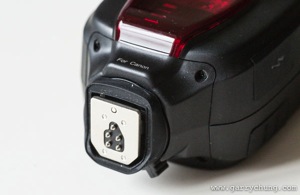
  • Rubber seals around metal hot-shoe for weather sealing (above right)
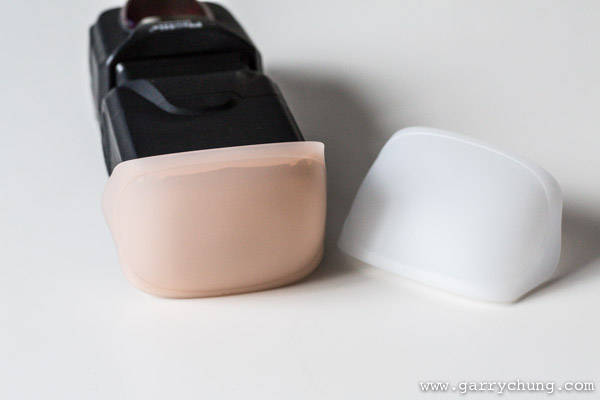
  • Mine also came with a plastic diffuser and 1/2 CTO which will come in handy (below left)
    Phottix Mitros 104 Phottix Mitros 100
  • Swivel and tilt head great for bouncing in all directions (above right)
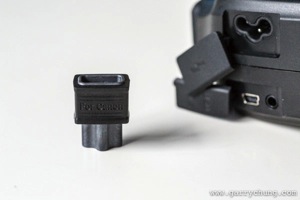
  • Connections for USB power, 3.5mm jack for sync and external power the kit also comes with an adapter to convert the head for Canon’s CP-E4
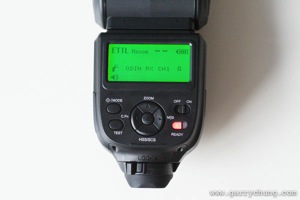
  • The display a the back is large backlit and clear
    Phottix Mitros 106 Phottix Mitros 108
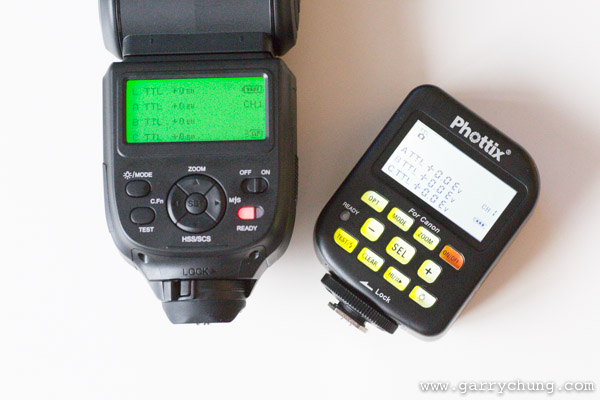
  • Menu System identical to Phottix Odin when set to Trigger Mode
Phottix Mitros 109

The litmus test for me to judge how intuitive a menu system is; if I need to read the manual, it’s probably not that intuitive. I very quickly figured out how switch from ETTL to Manual, activated high-speed sync and got the radio trigger system working. I actually think the menu system is better than the Canon 580 EX II, which took me a long time to figure out. Like the Canon speedlite, you can also control flash exposure compensation from the Canon 5D Mark III’s menu, although this is not recommended by Phottix. An advantage of the Mitros is that it has an indicator to see how much battery life left, which is absent in the Canon 580 EX II.

I recently took the Mitros+ system for an intensive four day shoot on Tinian Island and I am glad to report it has been flawless. I was asked to do a beach shoot at 1 p.m. in the blazing afternoon heat and managed to overpower the sun with three of Mitros+ flashes set up in cluster.

Mitros 100

Final image

Mitros 101

Lit with three Phottix Mitros+ flashes

The determining factors for choosing the Phottix system were twofold

Firstly, it is an open system. Odin can be used to trigger not just the Mitros+ but other studio lights as well. In comparison the latest Canon 600EX–RT flash and Canon ST-E3 trigger are only compatible with each other. I have also bought Phottix Odin receivers to bolt onto my old Canon 580s, so can use them with the Mitros+/Odin system together.

Another positive for Phottix is that it’s more backwards compatible than the Canon 600 EX-RT, which is not fully compatible with pre-2012 models, such as Canon 5D Mark II, which I also own. I read reports that you lose features like HSS, (High Speed Sync) and the sync speed is lowered to 125th/sec but I haven’t tested it myself. It seemed very odd to me that a third party company can get their flash working with older Canon cameras but Canon can’t. I have tested the Mitros+ system with both the Canon 5D Mark II and 5D Mark III. It works fine and it is even compatible using infrared with the Canon 580 EX IIs, so you can use the Mitros+ to trigger the Canon flashes and vice versa. The Mitros+ also has optical slave which is something Canon never put on the 580 EX for unknown reasons.

The final factor is the Phottix retails at $ 399 USD, which offers a significant saving to the Canon equivalent. At time of print, the Mitros+ is $ 150 USD cheaper than the Canon 600EX–RT flash.

I talked about comparisons with Canon in my review as I am a Canon user, but the Mitros+ is available for Nikon now also. It should be quite attractive to Nikon shooters as I think Nikon have yet to release a flash with a built-in radio transceiver.

Conclusion

Things really have moved on for third party flash manufacturers in the last few years. When I first researched into non-proprietary flash systems, they were generally cheaper, but vastly inferior product to the brand name equivalents. The Mitros+ is a great quality product, at a great price. It’s well built, easy to use and packed with features. Phottix as a company feels like they are selling products designed by photographers, and have really listened to their customers. Looking back at reviews of the original Mitros when it came out, customers were just saying “if only it had the Odin radio system built in that would be fantastic”, not long after the Mitros+ was released.

The Phottix Odin radio trigger system fully deserves all the praise it gets. PocketWizard, which has historically commanded such a market dominance in this sector, should be well aware of the new competition – which I think is a good thing. I remember paying nearly $ 500 USD for a PocketWizard TT1 Trigger and TT5 receiver, but had to as there was just no competition at the time. I experienced range issues, reception/connection problems, broken hot-shoe and general unreliability which is unacceptable for such a premium priced product.

The Mitros+ / Odin combination so far has been solid as a rock in terms of reliability. Time will tell if the build quality is as good as it looks but at least Phottix shipped with a two year warranty peace of mind. For those of you looking to either buy your first flash, or add to existing flash system, it’s worth keeping an eye out for products from third party manufacturers such as Phottix. Light is light at the end of the day, and I don’t care what brand name it says on the side as long as it gives me consistently good results and so far my Mitros+ has done exactly that.

Here are a few more images created with the Phottix Mitros+

Buggy 100

Food

Outdoor off camera flash

The post Phottix Mitros+ Review – the Best Flash System You Have Never Heard of by Garry Chung appeared first on Digital Photography School.


Digital Photography School
 
Comments Off on Phottix Mitros+ Review – the Best Flash System You Have Never Heard of

Posted in Photography


Rhino Slider PRO 4ft Review – Camera Rail System for Time Lapse and Video

02 Jun

If you’re into Videography or time lapse photography, chances are you’ve either already got yourself a slider or are considering making that purchase. Smooth camera movement can really add major production value to your footage and the key word here is ‘smooth’. Having your camera glide through space like it’s floating on air gives a huge boost to any kind of footage.

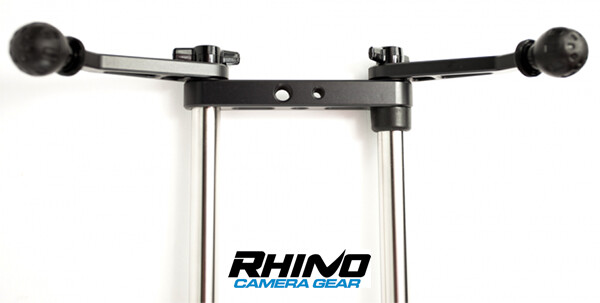
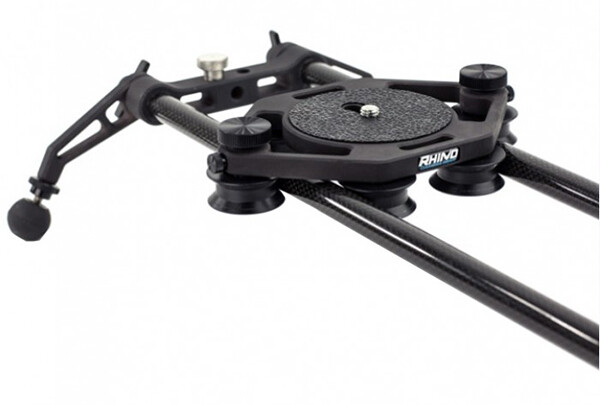
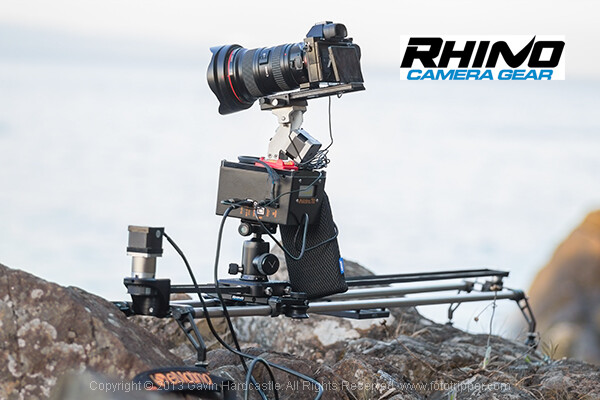
Enter the Rhino Slider Pro 4ft from Rhino Camera Gear, currently priced at $ 550. As the name suggests, this is a four foot wide slider, onto which you can attach your camera or take things a step further and add a robotic tripod head for a three axis solution of motion control awesomeness.

Rhino Slider PRO 4ft

How Smooth is the Slide?

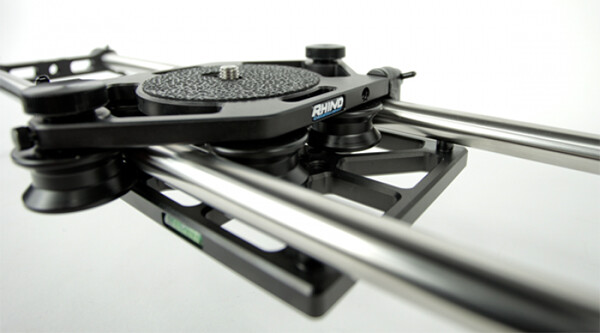
The most important thing to consider when thinking about buying a slider is the smoothness of the sliding action. This is where the Rhino slider excels. The sliding motion of the carriage on to which you place your camera is as smooth as silk. Once you’ve set the tension on the outer wheels of the carriage, you’re good to go and you can rely on a super smooth slide every time.

Rhino Slider Pro Review

Build Quality

There is a huge difference between the build quality of a sub $ 300 slider and what you’re getting with the Rhino. This is a sturdy, well built unit, that performs well in all kinds of conditions. Sliders are a bit like tripods, if you buy a really cheap one –  it’ll probably end up in the trash. Spend a little more and you’ll get a unit that delivers the goods and lasts a long time. All of the Rhino slider parts are well machined and have that solid, reliable feel to them.

Rhino Slider Review PRO 4ft - Gavin Hardcastle

Heavy is Good Right?

Of course, all of that stability comes at a cost of added weight. The product page on the Rhino Camera Gear web site says that the Rhino Pro 4FT Slider weighs around 10 pounds (4.54 kg). That might not sound like much but by the time you’ve strapped on your camera bag, tripods and any other gear, you’ll be carrying the Rhino slider in its case and holding it in your hand. Talk about a forearm workout. Turns out you can’t have your cake and eat it.

For those concerned about the weight, you might want to consider the carbon fibre rails or two foot rails to keep things more portable on long bush hikes.

Rhino Slider Carbon Legs

Rhino Slider Pro shown with Carbon fibre rails which weigh much less than the stainless steel ones.

The Rhino Gear Carry Case

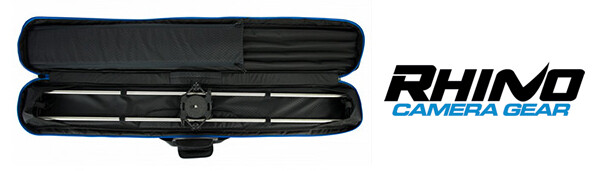
The test unit I received from Rhino Camera Gear came with the Rhino Armor – Slider Carrying Case 4ft, which is an additional $ 100. Let’s be honest, you’re not very likely to be dragging a 4ft slider into the bush without the carry case so you might as well consider it a foregone conclusion that your total cost will be $ 650. On the plus side, the carry case has space for extra rails so that you can extend the length of your slide. Having more rails means more weight, so I’d definitely opt for the carbon rails.

I found the case to be just a little too short. It was difficult and fiddly to fit the slider back in the case due to the four legs on the ends of the slider. If the case had been an inch longer I reckon this would have been much easier. I’m guessing they make it super tight so that the slider doesn’t shift in the case during transport but there’s tight, and then there’s this.

Rhino Armor Carry Case

Pros for the Rhino Slider PRO 4ft

  • Super smooth sliding action
  • Build quality
  • Value for money
  • Ease of use

Cons against the Rhino Slide PRO 4ft

  • Carry Case could be an inch longer to make it easier to pack the slider
  • Stainless steel rails are heavy – consider buying carbon rails if you are going on long hikes
  • End plates could have been taller. I found that the carriage hit my tripod plates long before it hit the rubber brakes.

Rhino Slider PRO Review

Would I Recommend It?

Having looked at the prices of similar sliders that boast the same build quality, the Rhino slider is looking like a bargain at $ 550 (+ $ 100 for the carry case). Before shelling out the dollars though I’d like to test out the carbon fibre rails to see if they perform as well. If the whole rig could be made lighter, that would eliminate my worst grumble and make this a near perfect product. If you’re not too bothered about the weight of those stainless steel rails, I think you’ll be extremely satisfied with the build quality and smooth sliding action of the Rhino Slider Pro 4ft from Rhino Camera Gear.

The post Rhino Slider PRO 4ft Review – Camera Rail System for Time Lapse and Video by Gavin Hardcastle appeared first on Digital Photography School.


Digital Photography School
 
Comments Off on Rhino Slider PRO 4ft Review – Camera Rail System for Time Lapse and Video

Posted in Photography


Accessory review: FotodioX WonderPana FreeArc Filter System

29 May

WonderPana-1.jpg

If you shoot primarily with wide-angle and ultra wide-angle lenses, you know how difficult it is to add filters. A lot of wide-angle lenses feature deep petal-style lenshoods and lack normal filter threads, making it impossible to add standard threaded filters. The FotodioX WonderPana uses a threaded ring and mount system which enables the attachment of 145mm round filters and square drop-in filters to several ultra wide-angle optics. Read our review

News: Digital Photography Review (dpreview.com)

 
Comments Off on Accessory review: FotodioX WonderPana FreeArc Filter System

Posted in Uncategorized


Apple patents 3D interactive hologram display system

28 Apr

appleholi1.png

AppleInsider has discovered another interesting Apple patent. This time the technology giant has patented a 3D-display system that projects digital images into a medium such as a non-linear crystal, using infrared lasers or similar technologies and accepts user input in the form of gestures. Learn more

News: Digital Photography Review (dpreview.com)

 
Comments Off on Apple patents 3D interactive hologram display system

Posted in Uncategorized


Nikon adds underwater housing and flash to 1 System

10 Apr

pic_140410_01_02.png

For those who want to take a swim with Nikon’s latest 1 System mirrorless camera – the J4 – the company is also releasing both an underwater housing and speedlight. The WP-N3 housing lets you take the camera up to 45m underwater and supports several 1 System kit lenses. It also has a port for connecting to a strobe, such as the new SB-N10, which has a maximum depth of 100m and works with the already waterproof AW1, as well.

News: Digital Photography Review (dpreview.com)

 
Comments Off on Nikon adds underwater housing and flash to 1 System

Posted in Uncategorized


Nikon 1 J4 sports new sensor, improved AF system, and Wi-Fi

10 Apr

nikon_j4_03.png

Nikon’s recently announced flagship V3 1 System camera gave us a look at the latest technology the company has been working on, and many of those features have trickled down to the new, less-expensive J4. The camera features an 18MP CX-format sensor, an improved Hybrid AF system with phase detect points across nearly 100% of the frame, 20 fps burst shooting with continuous AF and, of course, Wi-Fi. Learn more about the Nikon 1 J4.

News: Digital Photography Review (dpreview.com)

 
Comments Off on Nikon 1 J4 sports new sensor, improved AF system, and Wi-Fi

Posted in Uncategorized


Kinetic Facade: Awesome Adaptive Window Shading System

17 Mar

[ By WebUrbanist in Gadgets & Geekery & Technology. ]

animated-window-system

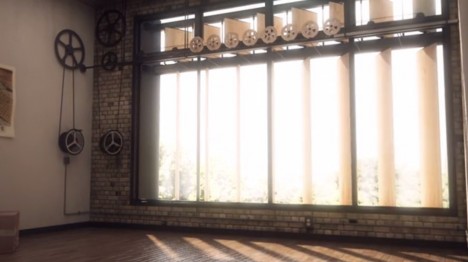
Buildings are forever in tension, being static objects in a dynamic world – light conditions in particular shift predictably yet variably throughout the day, week, season and year, in turn demanding an adaptive response.

dynamic facade shading

Thus the Penumbra system by Tyler Short, designed to offer a kinetic and mechanical solution to a problem that would otherwise be nearly impossible to solve with static architectural components: providing shading across a building facade for both low evening sun and high afternoon sun conditions.”

adaptive facade interior gears

The constituent parts can shift side to side while in their vertical orientation, then turn on a proverbial dime to form a horizontal shading solution, all creating a way to deflect (and let in) light while maintaining control over views.

kinetic shade facade system

More from the designer: “Our solution was a series of vertical shading louvers, that can independently pivot to maximize solar protection, and when the sun reaches an altitude in which vertical louvers would be ineffective, completely rotate upwards to act as a horizontal shading element and light shelf. All of the mechanical components and gear ratios were fully resolved, and the result is a hand or computer-operated system that creates a beautiful undulating form across the facade.”

Share on Facebook


[ By WebUrbanist in Gadgets & Geekery & Technology. ]

[ WebUrbanist | Archives | Galleries | Privacy | TOS ]


WebUrbanist

 
Comments Off on Kinetic Facade: Awesome Adaptive Window Shading System

Posted in Creativity