RSS
 

Posts Tagged ‘Surefire’

11 Surefire Landscape Photography Tips (+ Stunning Examples)

18 Apr

The post 11 Surefire Landscape Photography Tips (+ Stunning Examples) appeared first on Digital Photography School. It was authored by Darren Rowse.

11 surefire landscape photography tips

Want tips for stunning landscape photography? You’ve come to the right place.

In this article, I’m going to share 11 easy landscape photography tips – which are guaranteed to get you taking beautiful images, no matter your experience level. I’ve also included plenty of example photos, so you can see the tips in action (and know that they really do work!).

Let’s get started.

tree in a field landscape photography

1. Maximize your depth of field

In landscape photography, a deep depth of field is almost always the way to go.

In other words:

You want as much of your scene in focus as possible. The simplest way to do this is to choose a small aperture setting (i.e., a large f-number, such as f/11 or f/16). Because the smaller your aperture, the greater the depth of field in your shots.

landscape photography tips sand dunes

Do keep in mind that smaller apertures mean less light is hitting your image sensor. So you’ll need to compensate for the narrow aperture either by increasing your ISO or lengthening your shutter speed (or both).

PS: Of course, there are times when you can get some great results with a very shallow depth of field in a landscape setting. It’s just a tricky technique that requires a lot of finesse.

2. Use a tripod

clouds below the mountains

To maximize your depth of field, you’ll be using a small aperture – and you’ll also likely shoot with a long shutter speed.

But unless you’re careful, you’ll end up with an unusably blurry image.

That’s where a tripod comes in handy. You can use it to stabilize your camera and keep your photos tack sharp for 1-second, 5-second, and even 30-second long exposures.

In fact, even if you can shoot at a fast shutter speed, a tripod can still be beneficial. It’ll force you to slow down and consider your composition more carefully.

Also, to prevent camera shake from pressing the shutter button, consider a remote shutter release.

3. Look for a focal point

house by the ocean

Pretty much every shot needs some sort of focal point, and landscape photography is no different.

In fact, a landscape photograph without a focal point ends up looking rather empty. And it’ll leave your viewer’s eye wandering through the image with nowhere to rest.

Focal points can take many forms in landscape photos. They can range from a building or a structure (such as in the photo above) to an eye-catching tree, a boulder or rock formation, a silhouette, or something else entirely.

Also, think not only about what the focal point is, but where you should position it within the frame. The rule of thirds can be useful here.

4. Think foregrounds

landscape photography tips beach

Here’s one key tip that can make your landscape shots stand out:

Think carefully about the foreground of your composition…

…and include clear points of interest.

When you do this, you give those viewing the shot a path into the image. And you create a sense of depth, which is always a nice bonus.

5. Consider the sky

sunset colorful sky

In landscape photography, you should always think about the sky.

Most landscapes will either have a dominant foreground or a dominant sky. And unless you include one or the other, your shot will end up looking boring.

Start by observing the sky. If it’s bland and lifeless, don’t let it dominate your shot; place the horizon in the upper third of the image (though you’ll want to make sure your foreground is interesting).

But if the sky is filled with drama, interesting cloud formations, or colors, then let it shine! Place the horizon in the bottom third of the frame to emphasize the heavens.

(Also, consider enhancing skies, either in post-production or with filters. For example, you can use a polarizing filter to add color and contrast.)

6. Use lines to lead the eye

road in the desert

One of the questions you should always ask yourself as you do landscape photography is:

“How am I leading the eye of those viewing this composition?”

There are a number of ways to lead the eye (and including a clear foreground subject works well). But one of my favorite ways is to provide viewers with lines that lead them into the image (such as the road in the photo above).

Lines give an image depth and scale. Plus, they can offer a point of interest by creating patterns in your shot.

7. Capture movement

water rushing in on beach

When most people think about landscapes, they think of calm, serene, and passive environments. However, landscapes are rarely completely still – and if you can convey this movement, you’ll add drama and mood to your image. You’ll also create a point of interest.

But how can you convey movement in a landscape?

You can focus on wind in the trees, waves on a beach, water flowing over a waterfall, birds flying overhead, moving clouds, etc. Capturing this movement generally requires a longer shutter speed (sometimes a shutter speed of many seconds!).

Of course, a slow shutter speed means more light hitting your sensor, so you’ll either need a narrow aperture or an ND filter. You might also choose to shoot at the start or the end of the day when there is less light.

8. Work with the weather

mountain rainbow

A scene can change dramatically depending upon the weather, so choosing the right time to shoot is of major importance.

Many beginner photographers see a sunny day and think that it’s the best time to go out with their camera. However, an overcast day that is threatening rain might present you with a much better opportunity – you can create an image with real mood and ominous undertones.

Look for storms, wind, mist, dramatic clouds, sun shining through dark skies, rainbows, sunsets and sunrises, etc. And work with these variations in the weather rather than just waiting for the next sunny, blue sky.

9. Photograph during the golden hours

landscape photography tips snow at golden hour

I chatted with a landscape photographer recently who told me that he never shoots during the day. His only shooting times are around dawn and dusk because that’s when the light is best, and that’s when the landscape comes alive.

These golden hours, as they’re often called, offer great landscape photography for a number of reasons.

For one, you get gorgeous golden light. I also love the angle of the low sun; it creates interesting patterns, dimensions, and textures, all of which can enhance a landscape photo.

10. Think about horizons

landscape photography tips winding mountain road

This is an old tip but a good one. Before you take a landscape shot, always consider the horizon on two fronts:

  1. Is it straight? While you can always straighten images later in post-production, it’s easier if you get it right in-camera.
  2. Where is the horizon positioned in the frame? A natural spot for the horizon is along one of the rule of thirds gridlines rather than in the middle of the frame. Of course, rules are meant to be broken – but I find that, unless you’re photographing a very striking scene, the rule of thirds usually works here.

11. Change your point of view

mountain astrophotography

You drive up to the scenic lookout, get out of the car, grab your camera, turn it on, walk up to the barrier, raise the camera to your eye, rotate left and right a little, zoom a little, then take your shot – before getting back in the car and driving to the next scenic lookout.

We’ve all done it. However, this process doesn’t generally lead to the “wow” shot that many of us are looking for.

Instead, take a little more time with your landscape photos. Find a more interesting point of view.

You might start by finding a different spot to shoot from than the scenic lookout.

You can also look for new angles; this could mean getting down onto the ground to shoot from below, or heading up high to gain a nice vantage point.

Explore the environment and experiment with different viewpoints. You might find something truly unique!

Landscape photography tips: conclusion

landscape photography tips waterfall in Iceland

Now that you’ve finished this article, you’re ready to capture some stunning landscape photography!

So grab your camera, head out, and find a subject to shoot.

It’ll be a lot of fun!

Now over to you:

Which of these landscape photography tips are you going to try first? And do you have any landscape photo tips of your own? Share your thoughts (and images!) in the comments below.

The post 11 Surefire Landscape Photography Tips (+ Stunning Examples) appeared first on Digital Photography School. It was authored by Darren Rowse.
Digital Photography School

 
Comments Off on 11 Surefire Landscape Photography Tips (+ Stunning Examples)

Posted in Photography


10 Surefire Tips for Photographing Birds in Flight

08 May

Recently an internal survey in my blog revealed that photographing birds in flight is the most sought after topic.
It didn’t come as a surprise though, because that’s the specialty of birds. They defy gravity and rise up into the sky. How wonderful it is!

Here I have listed 10 surefire tips that will help you to make better photographs of birds in flight. The more you practice, the better your photographs will turn out.

1. Learn Flight Behaviour of the Birds

Birds in Flight Photography

Birds normally have the predictable flight behaviour. It requires observation. The more you observe them more you understand about their behaviour.

Why is it important to learn bird flight behaviour?

Tracking the bird as it flies is the trickiest part of birds in flight photography. If you know the flight behaviour of the bird, then you will be able to predict the next move and wait for the right moment to get best photographs.

2. Point of View Matters the Most

Generally the difference between good and bad photographs is the point of view. Photographing a bird in flight right above your head gives a different impact than a bird flying across.

A photograph of a bird flying towards you will have a greater impact than a bird flying away from you.
Taking an eye-level shot of a flying bird would yield an intimate result.

Birds in Flight Photography

3. Start with Slow Flying Birds

It can often lead to frustrating results if you choose to photograph birds in flight without really having an understanding of proper techniques.

Proper hand-holding and focusing techniques doesn’t come easy. There is no substitute to hard work when it comes to practicing these techniques. Best way to master them is to start with slow flying birds like Egrets and Herons.

Great White Egret in Flight in Bharatpur Bird Sanctuary or Keoladeo National Park in Bharatpur, Rajastan

Great White Egret in flight in Bharatpur Bird Sanctuary or Keoladeo National Park in Bharatpur, Rajastan

Egrets and herons are in abundance and it is not tough to put all 10 tips into practice, just with these birds, and become a better photographer.

4. Use the Right Camera Settings

Make your life easy with these settings:

  • Aperture Priority mode
  • Matrix/Evaluative metering
  • Auto ISO settings up to whatever ISO settings you are comfortable with for your camera
  • Shutter Speed of at least 1/500th of a second or faster
  • AF-C focus mode for Nikon users and AI-Servo mode for Canon
  • Highest frames per second burst mode setting
  • 9-point or 21-point zone focus or 3-D tracking

If you are unable to get decent shutter speeds of 1/500th of a second or more while hand-holding the lens, then wait for the proper light. No point taking high noise or poorly exposed photographs.

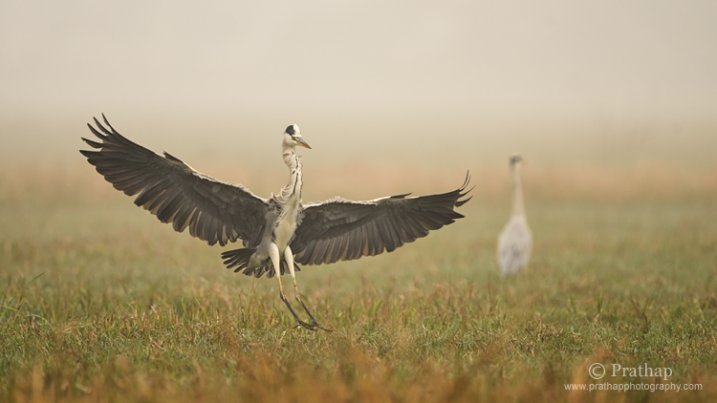
Grey Heron Landing on a Misty Morning in Bharatpur Bird Sanctuary in Bharatpur, Rajastan

Grey Heron landing on a misty morning in Bharatpur Bird Sanctuary in Bharatpur, Rajastan

If you are using a sturdy tripod and a gimbal type tripod head, then you would be able to make some creative shots like motion blur or panning shots with slower shutter speeds.

5. Choose the Proper Focus Points

Choosing the right number of focus points is critical to making successful flight photographs. Most cameras provide a selection of multiple focus points which is often referred to as zone focus.

I often select 9-point or 21-point zone focus out of 51-points. The idea is to use less, but enough auto focusing points, to make it easier for the auto focusing system and also for you to compose it in the field. If you do not have zone focusing then you might have to resort to using all focusing points. Also, with newer DSLRs, the 3-D tracking seems to have been improved considerably. You might want to try it too (consult your camera manual).

Birds in Flight Photography

6. Track Before You Photograph

Most often it is our tendency to start photographing the moment we see the bird taking off or flying away. That’s natural but wrong.

Photographing birds in flight takes patience. After waiting for a very long time you wouldn’t want to lose the opportunity. When you see a bird in flight, track the bird until the autofocusing system gets enough time to lock the focus. Once it is locked, you can fire off as many shots as you want without losing the focus.

Tip number 1 and 7 coupled with this tip will help you to make successful flight photographs.

Birds in Flight Photography

7. Wait till You Get the Best or Contrasting Background

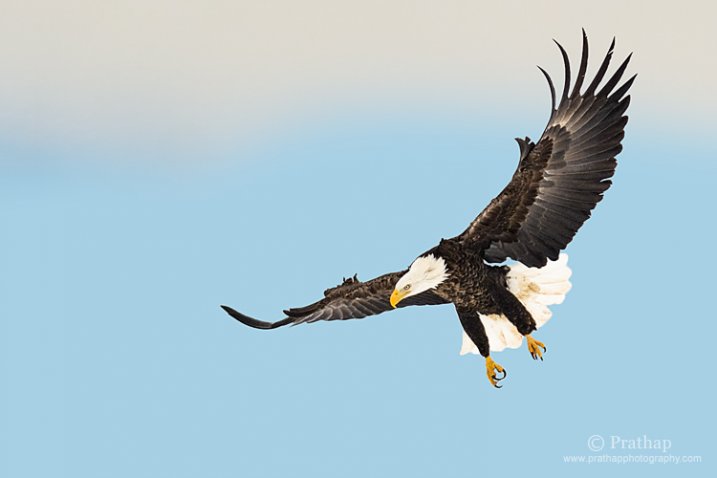
Okay, assume that you are tracking the bird to get the focus to lock, but your lens is hunting for focus. If you understand how focusing systems work, then you will have better control over your photographs. Remember that the focusing system needs good enough contrast between the subject and the background. It is generally very easy for the autofocusing system to lock the focus when the bird is flying against a clean background like a blue sky.

With practice, you will discover the capabilities of your camera’s autofocusing system which will in turn enable you to make better flight photographs.

Birds in Flight Photography

8. Take-off and Landing Shots

Most birds often defecate before they take-off to lighten their load. This is a very important clue to get fantastic take-off shots. Of course, it also depends on your position and the light direction to get the most of the situation.

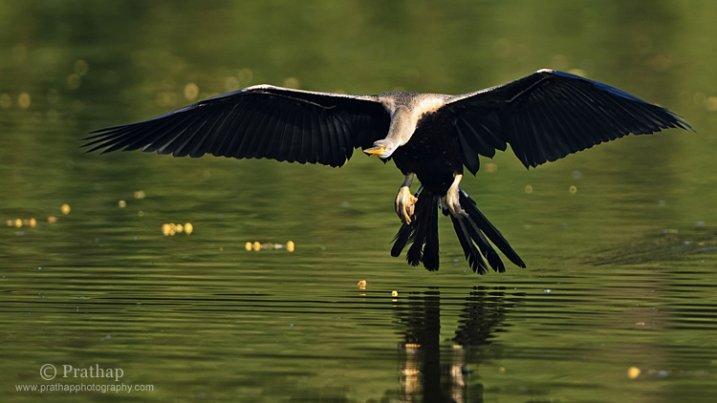
Wind direction plays a major role in getting better take-off and landing shots since birds often fly into the wind while taking off and landing. It is wise to stand with your back facing the wind, very similar to the way you would face your back to the sun.

Purple Heron Landing in Bharatpur Bird Sanctuary or Keoladeo Nationa Park in Rajastan

Purple Heron landing in Bharatpur Bird Sanctuary or Keoladeo Nationa Park in Rajastan

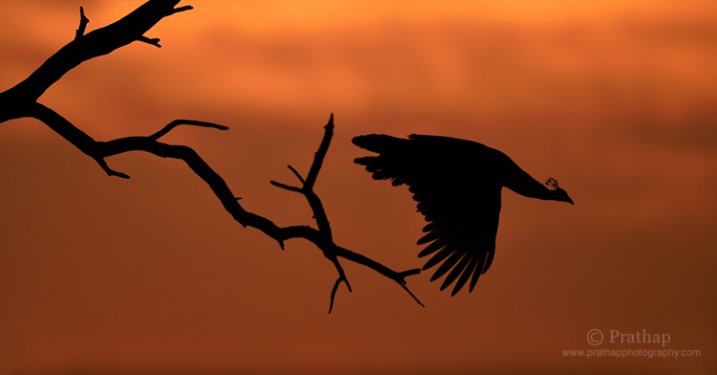
9. Get Creative with Silhouettes

Photographing silhouettes of birds in flight is much easier than you might imagine.

The brighter sky, to which you would expose, gives you a good enough shutter speed and also provides very good contrast for autofocus system to lock the focus.

What is more important in the silhouette shot is the definitive shape of the bird. Because the bird is going to be dark or featureless, you have to get the shape of the bird properly. If the shape is not defined then you won’t be able to make it work, no matter how beautiful the sky is.

Birds in Flight Photography

10. Pay Attention to the Composition

It is probably not as tough as you may think to get the decent composition in the field for birds in flight photographs. You just have to follow the Rule of Thirds guidelines so that you have enough breathing space, or room for the bird to fly in its direction.

It makes sense to use Rule of Thirds because you would want to keep the bird in the left of the frame if it is flying towards your right so that you do not clip its wings and vice versa.

Perfect Reflection of a Seagull Taking off during  Sunset in a Lake in Grayslake, IL, US. I love the reflection in this slightly frozen lake and the white plumage of the Seagull contrasting against the dark background.

Perfect reflection of a seagull taking off during sunset in a lake in Grayslake, IL, US. I love the reflection in this slightly frozen lake and the white plumage of the seagull contrasting against the dark background.

If the bird is taking off from ground level then you would want to keep the bird in the lower third position of the frame so that it takes off upwards. Keep the bird in the upper third position if it takes off downwards.

Conclusion

If you practice these 10 tips while photographing birds in flight, you will make better photographs for sure. It takes time to practice and make them your second nature, but it is worth a try.

If you like my photographs of birds in flight, they are the result of my 7+ years of photography. Very important thing to remember is, no photographer gets fantastic photographs every time he/she presses the shutter. There will be hundreds, or even thousands, of hopeless photographs before getting one photograph that is worth sharing.

You have got to have patience!

googletag.cmd.push(function() {
tablet_slots.push( googletag.defineSlot( “/1005424/_dPSv4_tab-all-article-bottom_(300×250)”, [300, 250], “pb-ad-78623” ).addService( googletag.pubads() ) ); } );

googletag.cmd.push(function() {
mobile_slots.push( googletag.defineSlot( “/1005424/_dPSv4_mob-all-article-bottom_(300×250)”, [300, 250], “pb-ad-78158” ).addService( googletag.pubads() ) ); } );

The post 10 Surefire Tips for Photographing Birds in Flight by Prathap DK appeared first on Digital Photography School.


Digital Photography School

 
Comments Off on 10 Surefire Tips for Photographing Birds in Flight

Posted in Photography