It’s our responsibility as photographers to use the interplay of light and shadow on our subjects to create the third dimension in our two-dimensional media. When the shadows are absent, we should do our best to craft the direction of natural light with tools that do this organically–tools that do not call attention to themselves.
One tool that I often see photographers using outdoors, typically in an attempt to counteract the effects of ambient light on a subject rather than simply crafting existing light, is flash fill. The problem, however, is that the use of flash fill outdoors (especially on-camera flash) frequently results in a very unnatural look and flat lighting—where all of the shadows are gone—which means that they lose the three-dimensional effect that we as artists seek to make our subjects look real. Very rarely is flash used in this manner subtle enough not to call attention to itself.
The answer is subtractive lighting
Subtractive lighting simply involves the blocking of unwanted natural light to create a natural three-dimensional quality to the lighting of people outside. The tools used to block unwanted light are called gobos or flags. Both terms are used in the world of cinematography, but are not used much the still photography world today.
A flag is generally black, opaque, flat, and refers to something you could hold by hand or mount to a stand. As shown in the images below, this tool is used when you have placed your subject in a less than desirable, very open location with flat lighting.

Image with no gobo used
This is typically the lighting you’ll see with your subject out in the open. There’s strong light on both sides of his face, even though the sun is setting behind him. This is what’s referred to as flat lighting and it’s not very interesting.
In the next image you see how this can be corrected. Kathi, my wife and partner, is holding a 42″ flag close to the subject to create a dimensional shadow on the subject’s face.
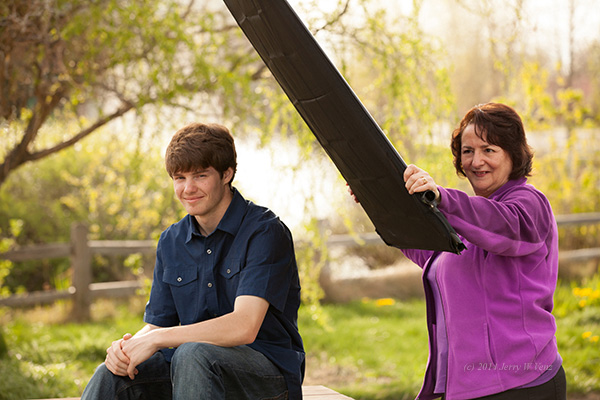
Showing how the gobo is used
As you can see, just that simple modification of the natural light creates beautiful three-dimensionality.

Image with gobo used (notice the deeper shadow on his left cheek, camera right)
In this next example, we have our high school senior model, Jasmine, in the popular “Freak Alley” in downtown Boise. The sun is setting on camera left and is reflecting off a tall, distant, mirrored building to camera right. We blocked the direct sunlight on the left with our 42″ black flag, creating a nice shadow side on her face. Removing the much brighter sunlight coming from camera left (over 2 stops brighter than the reflected light on the right) also meant that I could open up the lens and slow down the shutter enough to record the dim light in the doorway behind her.

ISO 400, F/5.0 at 1/125th
If you don’t have a flag, you can accomplish similar results using a small natural light blocker, like a tree. This is where the generic term “gobo: (from go-between) comes into use. Gobos can be man-made things like buildings, houses, or a porch and they can also be something natural like a tree, forest, or hedges. Really, just about anything used to block light can be referred to as a gobo. The nice thing about a tree is that it can be in the picture, and act as a gobo to create the same type of lighting (called short lighting, where the shadowed side of the face is nearest the camera) that we used on Jasmine above.
Nick, in the image below, is a big athletic guy so I wanted to create some short lighting to trim down his face. To accomplish this, I leaned him into a small tree for its gobo effect which created a nice shadow on his face. The key to making this work is finding a tree with a small canopy. Since he must be very close to the tree for it to make a shadow on his face, the tree can’t have a big canopy or it will block the main light (the sky) and eliminate my nice deep background bokeh (those nice de-focused specular highlights, that will be a topic for a future article).

200mm lens, f/4.5 at 1/250th, ISO 400
Group portraits using subtractive lighting – more difficult but worth the effort
The hand held flag or small tree works great on individuals, but you need a much larger light blocker when photographing groups. To this end, scout your location for any large groups of trees, hedges, buildings, etc., which could serve as your gobo and help add three-dimensionality to your group portrait.
Again, to be effective, you must place your subject fairly close to the gobo so that you can see its effect (the shadow) on your subjects’ faces. Some photographers may have difficulty seeing this rather subtle effect with the naked eye, so I suggest to my students that they meter for the highlights on the subject’s face and take a test photo. It will be very obvious, when viewing the camera’s rear screen, if you have the shadows you’re looking for. How close, you ask, should the nearest member of your group be to the gobo? Usually about ten feet works for me. If you have a really big, tall tree line, then twenty feet may work beautifully.
In this last example, which was taken about two hours before sunset, the family was placed about fifteen feet away from a large stand of trees on the right. On the left, serving as the main light, is a large patch of clear blue sky with no sun in it. The only direct impact of the sun should be in creating backlight for the background.

145mm lens, f/6.3 at 1/100th, ISO 400
Important caveat: Don’t stress if you can’t find the ideal location that will create the subtractive part of the natural lighting for groups, it’s not always possible. It’s perfectly acceptable to use soft, flat lighting when working with groups, especially large groups, one or two hours before sunset. Just make sure you have the other elements mentioned: keep the entire group in the shade, with the sun only touching the background, and that large patch of blue sky as your main light. We’ve used this technique to create many great portraits over the years.
Using true natural light, modified with the subtractive lighting technique, will produce superior portraits that will always look more natural than any flash technique. In addition, with the money you save not buying speed lights, soft-boxes, stands, weights, and radio triggers, you can invest in a really nice portrait lens. How’s that for a win-win?
If you have any other portrait lighting tips leave a comment below.
For more portrait lighting tips try out these articles:
- Lighting Ratios to Make or Break your Portrait
- 5 Reasons for Doing Natural Light Portraits
- Let’s Talk About Light – 3 Types of Lighting Conditions and how to Use Them
- Portraits – Lighting the Shot – a dPS ebook
The post How to use a Gobo to add Depth to Your Portraits with Subtractive Lighting by Jerry W Venz appeared first on Digital Photography School.

Digital Photography School