RSS
 

Posts Tagged ‘Structural’

Wearable Architecture: 29 Structural Silhouettes in Fashion

12 Nov

[ By Steph in Design & Products & Packaging. ]

 

winde rienstra 2

Textiles take the place of building materials in the dramatic swooping shapes, angular folds and oversized proportions of architecturally influenced fashion, whether on a highly wearable backpack or impractical runway couture. Fashion designers play with grids, tessellation, towering shapes, baroque details and three-dimensional forms, often making use of technology like 3D printing for unexpected results.

Baroque Architecture Backpacks by Konstantin Kofta

architectural fashion kofta 1

architectural fashion kofta 2

architectura fashion kofta 3

Designer Konstantin Kofta presents ‘arcs,’ a series of backpacks taking their shapes from baroque architectural elements like column caps and flourishes. Made of leather, the stone-gray accessories have a realistic appearance. “Natural forms and curves are applicable to human architecture,” says Kofta. “Baroque architecture inspiration – where regular designs give way to curves, dramatic shapes and decoration – was transferred to sculptural leather Kofta pieces to evoke sensual delight.”

Airplane Dress by Hussein Chalayan
architectural fashion airplane dress

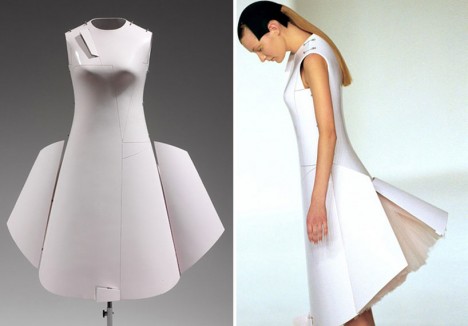
Gleaming white with semi-detached panels lifting up beneath a layer of tulle, Hussein Chalayan’s Airplane Dress is made of the same material used in aircraft construction and changes shape via remote control.

Spectacular Bridge-Like Creations by Winde Rienstra

RIENSTRA

architectural fashion winde rienstra 2

architectural fashion winde rienstra 3

architectural fashion winde rienstra 4

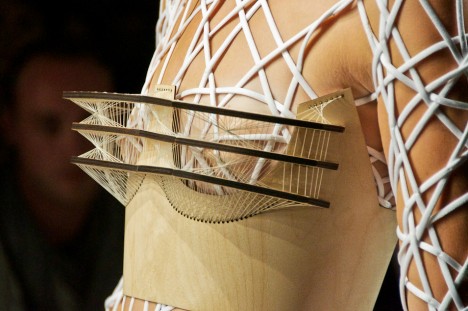
Amsterdam-based fashion designer Winde Rienstra explores structure and space with her 11:11 collection, blurring the lines between clothing and objects. Stiff as corsetry and creating a sort of cage around the body, the ribbed, angled pieces call to mind suspension bridges and the flying buttresses of Gothic cathedrals.

Iris Van Herpen’s 3D Printed Fashion Revolution

architectural fashion van herpen 3

architectural fashion iris van herpen 4

architectural fashion iris van herpen 5

An innovator in the usage of 3D printing in fashion, Iris van Herpen shakes up the status quo with exciting three-dimensional pieces of wearable sculpture characterized by rich texture and almost alien patterns that would be right at home in a sci-fi movie. Van Herpen’s creations bridge the gap between wearable technology and fashion, focusing more on the aesthetics of strange new textiles than on gadgets.

Architectural Camouflage by Snarkitecture

architectural fashion snark

architectural fashion snark 2

architectural fashion snark 3

Architecture and design duo Snarkitecture debuts ‘Architectural Camouflage,’ a collection of apparel and accessories featuring prints of white hex tile, subway tile and marble. Stand against the right urban surface, and you’ll blend right in. The pieces are available for purchase at Print All Over Me.

Next Page – Click Below to Read More:
Wearable Architecture 29 Structural Silhouettes In Fashion

Share on Facebook


[ By Steph in Design & Products & Packaging. ]

[ WebUrbanist | Archives | Galleries | Privacy | TOS ]


WebUrbanist

 
Comments Off on Wearable Architecture: 29 Structural Silhouettes in Fashion

Posted in Creativity


Ancient Engineering Fail: 12 Historic Structural Disasters

16 Apr

[ By Steph in Culture & History & Travel. ]

Engineering Fail Main
You can’t exactly fault ancient architects for building structures that were unable to withstand stone-shattering earthquakes, or simply experimental in nature – failure is part of the learning process, after all, and engineering methods were obviously less advanced back then. Big ambitions led to taking big chances, which often resulted in faulty construction and, occasionally, deadly collapses. Here are 13 examples of mistake-riddled churches, statues, lighthouses, stadiums and more from the period between 2600 BCE and the Renaissance.

Bent Pyramid of Egypt

Engineering Fail Bent Pyramid

Why does Egypt’s Bent Pyramid, an unusual example of early pyramid development created around 2600 BCE, have a sudden change in angle about halfway up? Archaeologists believe that what we see today is basically a mistake created during the learning process, in which the builders realized that the steepness of the original angle would be unstable and prone to collapse. The lower portion of the pyramid inclines at an angle of 54 degrees, while the top is a shallower 43 degrees. Another 54-degree pyramid is believed to have collapsed while this one was under construction, leading the builders to suddenly change their plans. Subsequent pyramids in the area were constructed at the 43-degree angle instead.

The Colossus of Rhodes, Greece

Engineering Fail Colossus of Rhodes

One of the seven wonders of the ancient world, the towering Colossus of Rhodes was a statue of the Greek Titan Helios that stood over 98 feet high on a pedestal in the city’s harbor. Erected by Chares of Lindos in 280 BCE to celebrate Rhodes’ victory over Antigonis I Monopthalmus of Cyprus, the statue was among the tallest of the ancient world. The statue stood for 56 years until the 226 BCE Rhodes earthquake, which brought it crashing down. After the oracle of Delphi stated that the Rhodians had offended Helios, they decided not to rebuild.

It’s certainly not surprising that seismic activity would have caused the statue to collapse, given that it was built long, long before any real understanding of earthquake-resistant engineering. But the fact that such a tall structure could have been built in the first place during that time is a wondering itself; modern engineers have speculated about the bronze plates and iron bars that would have been attached to the feet to reinforce them.

The Lighthouse of Alexandria, Egypt

Engineering Fail Lighthouse Alexandria

Another ancient wonder, the Lighthouse of Alexandria stood somewhere between 393 and 450 feet in height, making it among the tallest structures on earth for centuries. But the limestone structure, completed between 280 and 247 BCE on the island of Pharos, couldn’t stand up to three earthquakes spread out over four hundred years. It likely lost its upper tier before the first one struck in the year 956 CE, and by the third disaster in 1323, it was abandoned. What was left of it was covered with a medieval fort in 1480.

Fidenae Amphitheater Collapse, Italy

Engineering Fail Fidenae Ampthitheater

20,000 people were killed or wounded in the worst stadium disaster in history, which occurred in 27 AD at the Fidenae Ampthitheater about 8 miles north of Rome. The structure was cheaply built of wood and not up to the task of accommodating the 50,000 people who amassed to watch gladiatorial games after a ban on them was lifted. The Roman Senate decided that too many lower class people were ruining everyone’s fun, so they banned anyone with a personal worth under a certain amount from attending the events.

Circus Maximus Upper Tier Collapse, Italy

Engineering Fail Circus Maximus

Built in the 6th century BCE, the infamous Circus Maximus was an ancient Roman chariot racing stadium capable of holding 250,000 spectators who gathered to watch the Roman Games and gladiator fights, and later, the races. The oldest and largest public space in Rome, and has been in near-constant use every since, with its latest incarnation as a public park and space for events like concerts and festivals. But in 140AD, it was the site of a major disaster: the upper tier of seats collapsed under the weight of too many spectators. 1,112 people were killed in what remains the deadliest sports-related incident in history.

Next Page – Click Below to Read More:
Ancient Engineering Fail 12 Historic Structural Disasters

Share on Facebook


[ By Steph in Culture & History & Travel. ]

[ WebUrbanist | Archives | Galleries | Privacy | TOS ]


WebUrbanist

 
Comments Off on Ancient Engineering Fail: 12 Historic Structural Disasters

Posted in Creativity