RSS
 

Posts Tagged ‘Streets’

Occupy Parking Spots: 15 Projects Reclaiming the Streets

18 Sep

[ By Steph in Art & Installation & Sound. ]

Parking Spot Hacks Bikes 3
In the asphalt-covered space that would normally be occupied by a single vehicle could be a bike rack, a dance floor, an outdoor cafe, a kiddie pool or a beautifully landscaped public park. Sometimes guerrilla and sometimes officially city-sanctioned, these 15 projects occupy urban parking spots for uses that are undoubtedly a lot more fun.

Bike Parking = Superior Efficiency

Parking Spot Hacks Bike 2

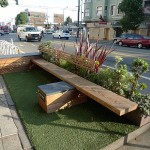
Ten bicycles can easily fit within a single parking spot, and many cities have started to take advantage of this fact with specially-sized bike racks. Buenos Aires installed a few car-shaped racks in parking spots throughout the city, an idea that caught the attention of Washington DC’s transit authority, and San Francisco’s 40th street parklet (seen top) was created by adjacent business Manifesto & Subrosa. They’re also occasionally unsanctioned, with citizens taking it upon themselves to occupy a spot with bikes for a day.

Car-Shaped Tents for Urban Camping
Parking Spot Hacks Car Shaped Tent

Designer Michael Rakowitz created a car-shaped tent made just for parking spaces, making it possible to camp in urban locations while (kind of) blending in. A similar tent used a car-shaped frame and a standard car cover for an even more convincing effect, offering affordable housing virtually anywhere in the city.

Sao Paulo’s Permanent Parklets
Parking Spot Hacks Sao Paulo 2

Parking Spot Hacks Sao Paulo 1

The city of Sao Paulo, Brazil has some of the world’s prettiest and most colorful parklets, which are parking spots transformed into mini public parks. While many parklets are temporary, this one is permanent, with the spot fully paved and heavy-duty urban furniture in a bright shade of red.

Noriega Street Parklet, San Francisco
Parking Spot Hacks Noriega 2

Parking Spot Hacks Noriega 1

Diagonal wooden benches with built-in greenery take up three parking spots in San Francisco in this design by Matarozzi Pelsinger Design + Build. The seating was designed around the awkward shape of the available space, and the rule that it had to be at least three feet away from adjacent parking spots. Says the firm, “The acute corners are embraced as areas for planting and “chaise lounge” seating, where tight plan geometry becomes an excuse to put your feet up.”

Next Page – Click Below to Read More:
Occupy Parking Spots 15 Projects Reclaiming The Streets

Share on Facebook


[ By Steph in Art & Installation & Sound. ]

[ WebUrbanist | Archives | Galleries | Privacy | TOS ]


WebUrbanist

 
Comments Off on Occupy Parking Spots: 15 Projects Reclaiming the Streets

Posted in Creativity


18 July, 2014 – Out On The Streets with a Leica M8

18 Jul

There are as many stories as there are photographers… gear we’ve bought, and how it’s changed the way we see and work. This is one photographer’s story.


Don’t forget to check out our schedule of workshops for the rest of 2014 and into 2015. There are even a few spots left on our Antarctic workshops!!


The Luminous Landscape – What’s New

 
Comments Off on 18 July, 2014 – Out On The Streets with a Leica M8

Posted in News


Urban Infill: Colorful Tile Mosaics Patch Potholed Streets

07 Jun

[ By WebUrbanist in Art & Sculpture & Craft. ]

pothole filled city street

In a city with over a half-million open potholes, one artist is helping address the problem and raising awareness by installing his own creative patches, filling them piece by piece with colorful tiles.

pothole with phone digits

pothole artist bachor studio

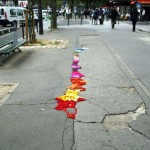
Jim Bachor has been making mosaics for years, and has turned his craft toward the pressing and persistent problem of dangerous potholes in the Chicago area, particularly bad after an especially cold winter.

pothole with hotline number

pothole fixed in context

Variations on the colors and overall design of the Chicago city flag frame text and digits, from self-titled ones (reading simply ‘POTHOLE’) to phone numbers of local car repair shops or individual identification strings.

pothole mosaic tile art

pothole patched city street

At dozens of dollars per fix, the work itself is hard to scale but does bring the broader problem to the attention of passers by, as well as the city itself as the project makes its way into the media.

Share on Facebook


[ By WebUrbanist in Art & Sculpture & Craft. ]

[ WebUrbanist | Archives | Galleries | Privacy | TOS ]


WebUrbanist

 
Comments Off on Urban Infill: Colorful Tile Mosaics Patch Potholed Streets

Posted in Creativity


Glow-in-the-Dark Highways: Free Lighting Hits the Streets

28 Apr

[ By WebUrbanist in Technology & Vehicles & Mods. ]

smart highway now reality

Proposed just two years ago, this alternative solar-powered passive streetlight system is now already a reality, deployed along motorways across the Netherlands. As one reporter put it after riding along the newly-transformed highways: “It looks like you are driving through a fairytale.”

sustainable_highway_2

smart highway changing lights

This is just the beginning of a Smart Highway approach designed to adapt surfaces to the needs of drivers. Constituent ideas include the display of relevant contextual information directly on roadways (including traffic and weather conditions) as well as direct wireless car charging.

smart highway side lights

smart highway road system

Other new ideas from Studio Roosegaarde include the possibility of turning street materials into smog attractors, reducing the spread of pollutants by pulling harmful particulates right out of the air. Despite the compelling design component, their creator describes these innovations as reforms rather than designs – ways of improving everyday life and personal safety.

Share on Facebook


[ By WebUrbanist in Technology & Vehicles & Mods. ]

[ WebUrbanist | Archives | Galleries | Privacy | TOS ]


WebUrbanist

 
Comments Off on Glow-in-the-Dark Highways: Free Lighting Hits the Streets

Posted in Creativity


City vs. Suburb: Walking One Mile in Streets or Culs-de-sac

29 Mar

[ By WebUrbanist in Architecture & Cities & Urbanism. ]

walking

A tale of two neighborhoods, these graphics (and their hybrid) stunningly illustrate how much further you can get on foot when you take a walk through an urban grid versus the suburban sprawl just a few miles away.

walking 1 mile cities

Depicted here are Phinny Ridge in Seattle, Washington (mapped above) and a section of its sibling-city across the water: Bellevue (shown below). As these images from the Sightline Institute show, the grid of streets on the Seattle side puts parks, services and shops of various sizes all within a walker’s reach. On the Bellevue side, there are a few more micro-parks but very few shops, services or large green spaces to be found in a winding one-mile range.

walking 1 mile suburbs

Of course, other examples, including many European cities, show that there is more too the equation than grid layouts. Some urban centers work well with non-rectilinear layouts (circular, for instance), and in other cases sufficient density, public transit or arterial connections make up for twisting shapes of local streets.

walking one mile overlay

Still, these side-by-side (and overlaid) graphics tell a story of surprising contrast in terms efficiency and accessibility in relatively modern contexts. Larger structural differences are shaped and reinforced by building codes, zoning laws and other details that shift from one municipality to the next. These in turn dictate everything from large-scale pedestrian accommodations to road widths, building  setbacks and other details that conspire to form tight-knit cities or allow for sprawling suburbs at both macro- and micro-scales.

suburb versus city hybrid

From SightLine: “The walkability maps and information presented in Cascadia Scorecard 2006 were developed by University of British Columbia’s Dr. Lawrence Frank, and colleagues Dr. James Sallis of San Diego State University and Dr. Brian Saelens of Cincinnati Children’s Hospital, and were funded by King County, Washington, and the National Institutes for Health.”

Share on Facebook


[ By WebUrbanist in Architecture & Cities & Urbanism. ]

[ WebUrbanist | Archives | Galleries | Privacy | TOS ]


WebUrbanist

 
Comments Off on City vs. Suburb: Walking One Mile in Streets or Culs-de-sac

Posted in Creativity


Small World: Mini Wooden Cutouts Take Over the Streets

04 Mar

[ By Steph in Art & Street Art & Graffiti. ]

Small World Joe Iurato Main

Life is an adventure for tiny wooden figures navigating the urban world in this miniature art installation series by Joe Iurato. The New Jersey-based street artist creates small spray-painted wood cutouts that tell the story of his life, from skateboarding as a kid to becoming a father himself. The little people lounge on rusting metal gates, cling precariously to the edges of overpasses, lunge to reach crosswalk buttons and spray-paint their own works of art.

Small World Joe Iurato 1

Small World Joe Iurato 3

No bigger than fifteen inches in size, the figures are created using layers of hand-cut paper and spray paint to create texture and form in a modern adaptation of an old-fashioned printing process. The artist places them around the city and leaves them for others to notice or overlook, depending on how observant they may be when they pass.

Small World Joe Iurato 2

“My art is nothing more than the exploration and documentation of personal experiences,” says Iurato. “The pieces form an abstract of my life. They are the questions I have, the conclusions drawn, the love, disgust, joy and sadness contained. Essentially, I paint what I know, or what it is I want to know, playfully or painfully.”

Small World Joe Iurato 6

Small World Joe Iurato 7

“However big or small, the works are often created in public spaces and left to interact with the environment and community. Like life itself, the nature of public art is one of transience. Each piece mirrors the unpredictability of existence and hopes to establish an intimate connection with the viewer in the here-and-now.”

Share on Facebook


[ By Steph in Art & Street Art & Graffiti. ]

[ WebUrbanist | Archives | Galleries | Privacy | TOS ]


WebUrbanist

 
Comments Off on Small World: Mini Wooden Cutouts Take Over the Streets

Posted in Creativity


Decoding Streets: Secret Symbols of the Urban Underground

28 Feb

[ By WebUrbanist in Global & Urbex & Parkour. ]

street paint language us

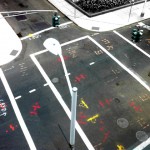
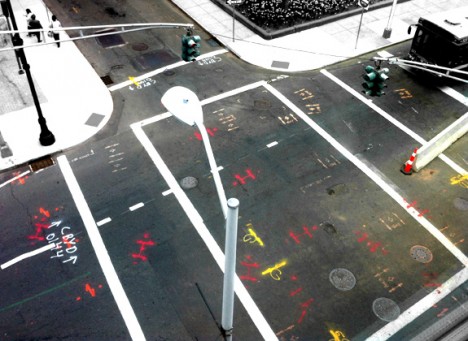
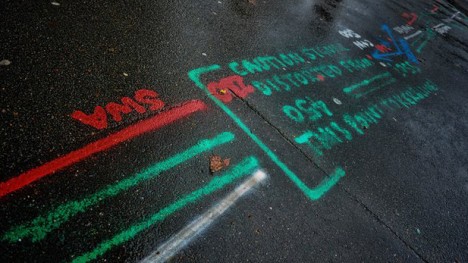
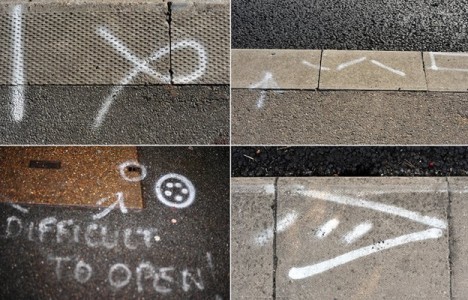
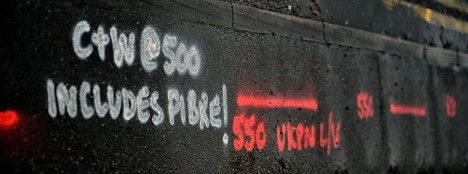
Somewhere between city signs and street graffiti lies a surprisingly rich and colorful language of secret messages, all hidden in plain sight on roads and sidewalks. This spray-painted slang we walk over and drive along every day is employed by infrastructure engineers, utility companies and other city workers.

street symbols multi colored

secret hidden street language

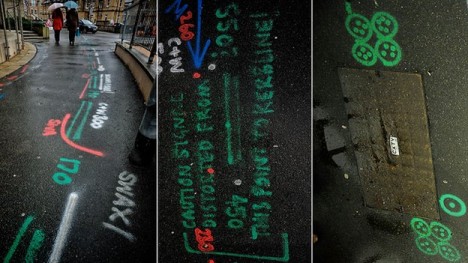
Laurence Cawley of BBC News recently explored this strange world of colorful spray-painted dots, arrows, text and more, all of which denote what lies below the surface of the city.

street symbols blue water

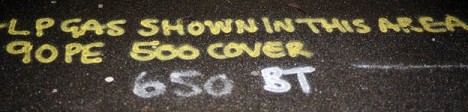
These markings may seem rushed and crude to the casual observer, but they are essential to the protection underground power lines, pipes and a maze of other potential subterranean hazards, as well as to the safety of those who work around them. There are no laws governing this mysterious language, simply conventions and colloquial shorthand that have evolved over time. As Cawley aptly summarizes: ”Its lexicon is numbers, lines and symbols. Its grammar is most definitely colour.”

street symbols white general

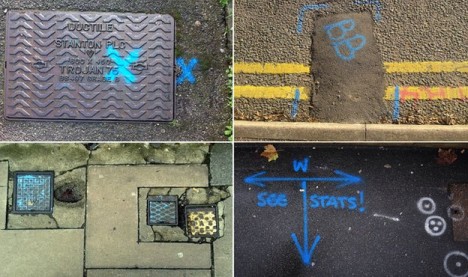
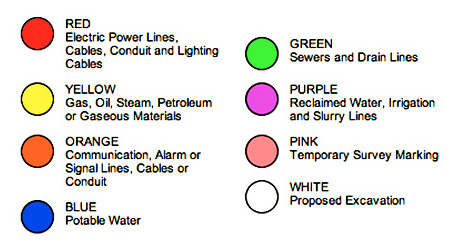
Colors are particularly critical – at least in the UK, red means electricity, blue stands for water, yellow is tied to gas, and green is used for cables (CCTV networks, television lines and fiber optics). White, meanwhile, is a kind of all-purpose color for broader communications about road and sidewalk planning. None of these are spelled out in any official manual in the UK – they are a matter of convention, and, sometimes, contention, as not all companies use the same visual dictionary.

street color decoder rings

In the United States, however, according to Smithsonian: “These ‘safety colors’–expanded to include red, orange, yellow, green, blue, purple, brown, grey, white, and black– have been formalized by the American Standards Institute (ANSI) as Safety Color Code Z535, which provides Munsell notation and Pantone color-matching information to help ensure consistency across mediums.”

street symbols green cables

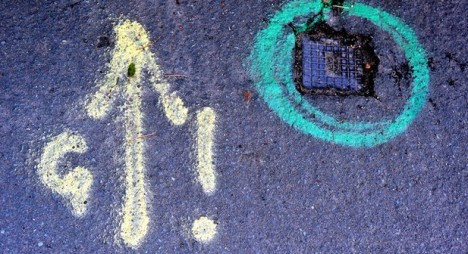
At least back in the UK, though, numbers and arrows take on different meanings due to color and context. Sometimes they refer to the depth of a water pipe, or the pressure in a gas line. Infinity symbols may mark the end of beginning of a planned street, while zig-zags communicate an intended pedestrian crossing. Many of these are mapped out by third-party contractors whose sole job it is to locate and tag potential hazards below. All are biodegradable and many designed intentionally to fade over time.

street symbols yellow gas

street symbols red electricity

If you are looking for more specifics, the BBC article goes into detail about the particular meanings of various specific marks, but keep in mind: many of these may be particular to the United Kingdom, or even just specific towns and streets. There is no Oxford English Dictionary tying them all together … at least not yet. The next time you take a walk, consider taking some notes as well and see if you can decipher the local dialects of this curious language on your own city’s streets.

weburbanist hoboglyphs examples image

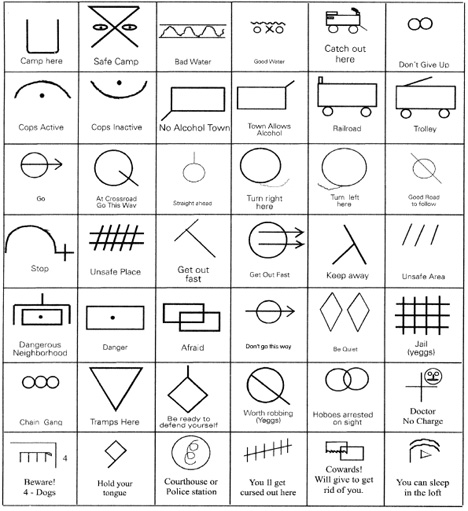
Recently popularized thanks to TV’s MadMen, hoboglyphs also come to mind – a semi-secret language of unobtrusive markings used by the homeless to note opportunities and hazards in urban environments. And one has to wonder: are there other hidden communications out there used by ancient orders, intelligence agencies or other groups hiding in plain sight? (Images via BBC and Smithsonian)

Share on Facebook


[ By WebUrbanist in Global & Urbex & Parkour. ]

[ WebUrbanist | Archives | Galleries | Privacy | TOS ]


WebUrbanist

 
Comments Off on Decoding Streets: Secret Symbols of the Urban Underground

Posted in Creativity


Fake Banksy: 40 Forgeries Sold in 1 Hour on Streets of NYC

22 Oct

[ By WebUrbanist in Art & Street Art & Graffiti. ]

fake banksy art sale

Just last week, real Banksy art was offered for sale in Central Park to an uninterested crowd, with only a few passers by unwittingly picking up signed pieces worth thousands of dollars or more. Today, a shop selling pure copies complete with a legally-notorized Certificate of Inauthenticity managed to sell forty works in less than sixty minutes to dozens of NYC buyers … they even sold the price sign. The actual Banksy sale had a dismal three customers in seven  hours.

fake banksy inauthenticity certificate

This pop-up stall was set up in the same location and offered similar works for sale at an identical price. The video above tells the story well. Crowds gathered, lines formed and people stopped to take pictures – almost an exact reversal from the bored looks and barely interested buyers of the prior sale. Some people did double-takes, not sure whether it was a hoax, or another Banksy head-fake that might net them a five-figure profit.

fake banksy central park

fake banksy artist credits

Part faux art sale, part performance art, the production made its point: the hype surrounding Banksy has bled into the public consciousness of the city, and people have gone from unaware to eager as a result. Meanwhile, at 60 dollars a canvass (times 40 sales equals $ 2,400), the creators made not just a point but a handy financial return on their time and money for future projects.

real banksy art sale

Meanwhile, for those who missed the real sale, feel free to view the frustrating footage above. Many have watched it and wished they had stopped to take a closer look. Still, who knows – perhaps with a limited run of 40,  even this run of secondary knock-off works will have some street value after the dust settles on the sidewalks.  At the very least, they will look just as good on your wall as the real thing.

Share on Facebook


[ By WebUrbanist in Art & Street Art & Graffiti. ]

[ WebUrbanist | Archives | Galleries | Privacy | TOS ]


WebUrbanist

 
Comments Off on Fake Banksy: 40 Forgeries Sold in 1 Hour on Streets of NYC

Posted in Creativity


Blickfang – State and Lake streets, 1987

27 Aug

Gary Stochl ist als Straßenfotograf noch nicht lange bekannt. Das undenkbare Gegenteil ist der Fall. Stochl fotografierte vom 17. Lebensjahr an sage und schreibe 40 (!) Jahre lange auf den Straßen von Chicago. 2004 entschied er sich, seine Fotos dem Photography Department der Columbia College Chicago zu zeigen. Heute verkauft er Vintage Prints für 1500 $ .

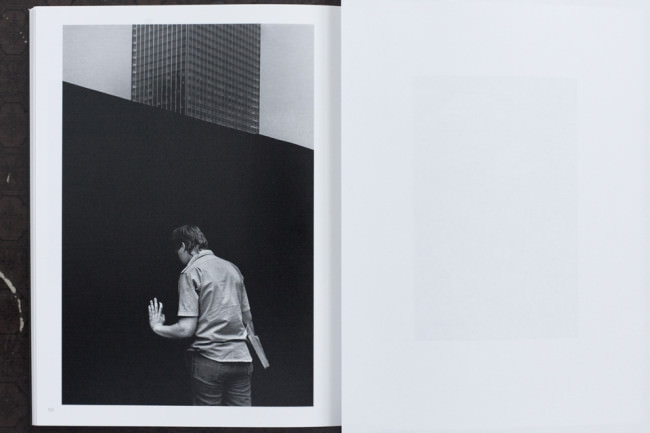
Das Bild, das ich heute vorstelle, stammt von Gary Stochl. Es bekam keinen Namen, wie alle seine Bilder. Nur Ort und Jahr sind bekannt, wie der Titel des Blickfangs beschreibt. Lassen wir erst einmal das Foto auf uns wirken.

State and Lake streets, 1987 © Gary Stochl

Das Foto ist in typischer Stochl-Manier, kein Ausreißer. Es ist düster, dunkel und hat einen faden Beigeschmack. Stochl selbst sagt, er habe nichts gegen Glücklichsein, es wäre nur einfach nicht sein Wesenszug. So sehen wir hier einen echten Stochl, mit viel Schwarz und einer Person.

Stochl hat das Bild nicht beschnitten, sonden den Wolkenkratzer im Hintergrund gelassen. So bleibt der urbane Kontext erhalten, jedoch fällt mein Blick unweigerlich auf die linke Hand des Mannes, der in der anderen Hand Bücher und Papier hält.

Ich habe dieses Foto schon einige Male überflogen, doch ich entschied mich, heute mal genauer hinzusehen und das Foto einem längeren Studium zu unterziehen. Und die grundsätzliche Frage, die dieses Bild aufwirft ist:

Hä?

In lang: Was macht dieser Mensch eigentlich? Hält er sich fest? Berührt er gar einen anderen Menschen? Oder drückt er sich nur an die Wand? Schiebt er etwas weg?

Das spannende an der Fotografie ist ja, wie Gary Winogrand (von dem Stochl beeinflusst war) sagte, dass es kein Vorher und kein Nachher gibt. Des Rätsels Lösung liegt in den Sekunden davor oder in denen danach.

Und doch ist es mir das Foto lieber als die Lösung. Denn so behält das Bild eine Magie, etwas Komisches, Unübliches. Und genau das ist es, was ich an Stochls Fotos mag, die ich allesamt im Buch „On City Streets, Chicago 1964-2004“* gefunden habe.

* Das ist ein Affiliate-Link zu Amazon. Wenn Ihr darüber etwas bestellt, erhalten wir eine kleine Provision, Ihr zahlt aber keinen Cent mehr.


kwerfeldein – Fotografie Magazin

 
Comments Off on Blickfang – State and Lake streets, 1987

Posted in Equipment


Trap Streets & Rooms: Cartographic Errors Catch Copycats

19 Feb

[ By WebUrbanist in Architecture & Cities & Urbanism. ]

trap street map fake

Phantom settlements and trap streets are faked or falsified, intentionally introduced (or materially altered) by map makers to catch those who would copy them. And the practice is not limited to towns or roads – there are trap ponds, trap parks, trap buildings and trap sidewalks, too.

trap street real example

Now imagine the same thing applied to indoor spaces being mapped by new mobile device apps: trap rooms, halls, closets and stairwells – entirely fake spaces that could at worst confuse, but at best might become targets of offbeat geo-locational games.

trap room interior navigation

BldgBlog (image above by Laura Pedrick for The New York Times) speculates about introducing false information to interior maps of places like shopping malls:

“Nothing sinister—you don’t want people fleeing toward an emergency stairway that doesn’t exist in the event of a real-life fire—but why not an innocent janitorial closet somewhere or a freight elevator that no one could ever access in the first place? Why not a mysterious door to nowhere, or a small room that somehow appears to be within the very room you’re standing in?”

trap paper street

Unlike some paper streets (example shown above), which are planned but never become a reality, trap streets and phantom settlements (like Argleton, a faux town depicted below) are fictitious creations from the start, designed to mislead copyists into revealing their own copyright infringement. Normally innocuous (like: renaming or bending a road), you think of them as equivalent to programmer’s Easter Egg or a hidden watermark  on a photograph – a buried surprise in everyday maps.

trap phantom settlement

But what are the implications of doing this on a smaller scale of pedestrian circulation, deceiving people not by square mile, but by cubic feet? Could you frustrate the janitorial staff at a school, scare someone into imagining a secret room in their apartment complex? Would it trick urban explorers into actually physically trapping themselves? We will set these open questions aside and leave you with a little fun fact: while designed to catch copiers, trap streets cannot themselves be copyright.

Share on Facebook


[ By WebUrbanist in Architecture & Cities & Urbanism. ]

[ WebUrbanist | Archives | Galleries | Privacy | TOS ]


WebUrbanist

 
Comments Off on Trap Streets & Rooms: Cartographic Errors Catch Copycats

Posted in Creativity