RSS
 

Posts Tagged ‘Speak’

Pete Souza interview: ‘I have the right to speak out when I see wrong. And I see wrong’

14 Sep

Pete Souza is one of the best-known names in photography. An experienced photojournalist, he has the distinction of having served as White House photographer for two presidents: Ronald Reagan and Barack Obama. Since leaving the White House in 2017, Pete has stepped out from behind the camera, and most recently he has been putting his images to work using Instagram to pointedly highlight the differences in style – and policy – between the last president and the current occupant of the White House.

‘The Way I See It’, a new documentary film based on Pete’s books ‘Obama: An Intimate Portrait’ and ‘Shade: A Tale of Two Presidents’ , opens soon. Ahead of its premier on September 18th, I had the chance to speak to Pete about his work in the White House, what makes a good presidential photographer and why he’s no longer content to let the pictures do the talking.

The following interview has been edited lightly for clarity and flow.


What kind of people make good White House photographers?

It’s helpful to have a background in photojournalism. And I think it’s also helpful to have the ability to disappear, if you will, in terms of going about the job with a small footprint. That’s things like not carrying loud cameras, not using motor-drive, remembering that you’re an observer, not a participant. Learning how to move about in those circumstances.

I think depending on the president, the [desired] qualities may vary a little bit, but that’s my approach anyway. It worked for me.

Do you think that photographs of an administration can help shape the way that history sees it?

For sure. To quote Michelle Obama, someone I respect a lot, she says that the presidency doesn’t change who you are, it reveals who you are. I think the same is true of the photographs. The behind the scenes photographs of a president reveal the character of that person. I think that’s pretty clear, and has been basically since we’ve had that position of White House photographer, since the Kennedy administration. We’ve had a pretty good idea of what presidents are like, and their true character, based on the behind the scenes photographs.

President Barack Obama walks along the West Colonnade of the White House with Chief White House Photographer Pete Souza Feb. 18, 2016. (Official White House Photo by Lawrence Jackson)

Photo by Lawrence Jackson / The White House

You mention LBJ’s photographer Yoichi Okamoto in the film – are there any other photographers who have been a major influence on your work?

Oh probably three or four dozen, from Bill Allard and David Allen Harvey at National Geographic, to Henri Cartier-Bresson, W. Eugene Smith, the old Life Magazine photographers, and tons of the newer-generation photographers, too. I still look at photography every day, and that’s one of the great things about Instagram for me.

I still look at photography every day, and that’s one of the great things about instagram for me

In terms of the White House photographers, David Hume Kennerly under President Ford, and Eric Draper with George W Bush. They both did a great job. One of my great memories of election night in 2008, in Grant Park, was of David Kennerly, in fact. The ultimate professional, he was in tears because he was able to witness that moment. I’ll never forget that.

Were there times in the White House where you put your camera down and opted not to take a photograph?

My job was to document what happened. But especially in family situations you certainly have to learn when you need to give the president some space. You’re trying to capture these family moments, but if he’s having a one-on-one talk with one of his daughters, you might take a few photographs and then back away. It’s just an intuitive sense of when the man needs a little space. And [with Obama] it usually involved his family.

President Barack Obama and First Lady Michelle Obama wait in the Map Room before the State Arrival ceremony to welcome President Felipe Calderon of Mexico and his wife Mrs. Margarita Zavala on the South Lawn of the White House, May 19, 2010. (Official White House Photo by Pete Souza)

Photo by Pete Souza / The White House

You say in the film that the job took a lot out of you, mentally. Can you explain how?

Look at it this way – on day one you’re issued with a Blackberry. I kept my Blackberry all eight years. It was either attached to my belt or on my nightstand, 24 hours a day, seven days a week, for eight years. That was the way I communicated with people in my office, it was how I communicated with people in the administration, and it was the way that those people communicated with me.

To have that device with you, at all times, is really mentally draining. Just the kind of ‘all-in’ reality of the job, after doing it for eight years it really does take a lot out of you.

Presumably you were also witness to some things that you had to keep confidential?

That’s the nature of the job. And some of that involves national security. There are some things I can never reveal unless they were to be declassified. But one of the things about classified information is that most of it is written down. It’s documents. And I wasn’t privy to those documents, I didn’t get copies of that material. But I was in the room when classified information was being talked about.

President Reagan meeting to receive the report of Special Review Board for the National Security Council, Tower Commission, with John Tower and Edmund Muskie in the Cabinet Room on February 26, 1987.(Official White House Photo by Pete Souza)

Photo by Pete Souza / The White House

A good example would be when we opened relations with Cuba. I probably knew about that a year in advance, because the two main negotiators would report to the president every month or two, and I would be in those meetings. Those are the kinds of things you keep in confidence – negotiations which are going on which aren’t yet public.

From your perspective as someone who has worked under two administrations as White House photographer, who were you serving? Who were you doing it for?

The people of the United States. I made almost two million photographs in the eight years of the Obama administration. And I don’t know if people realize this but every single photograph ends up at the National Archive. There will be time when everything will be made public – every single frame. On the day of the Bin Laden raid I think I made more than a thousand pictures and eventually people will be able to see every single one of them, if they want to.

Right now in fact, because a certain number of years has passed, you can see every single picture I made during the Reagan administration. You can see the proof sheets, they’re all online.

President Barack Obama and Vice President Joe Biden, along with members of the national security team, receive an update on the mission against Osama bin Laden in the Situation Room of the White House, May 1, 2011. Please note: a classified document seen in this photograph has been obscured. (Official White House Photo by Pete Souza)

Photo by Pete Souza / The White House

Ultimately, the job is to document the presidency for history. And I took that really seriously. We were talking about Okamoto earlier, and I remember I used to tell people that in fifty years time people will be able to go through all of my photographs and have a good idea of what the presidency was like, and what president Obama was like. And then I saw an old presentation by Okamoto, and he made the exact same point. Except he didn’t say fifty years he said “five hundred years”.

That really threw me, and made me realize how truly important this job is. It really is for history. Can you imagine the pictures that I made during the Obama administration, if we had a set of pictures like that taken during the Lincoln administration?

With America perhaps more divided now than ever before, what gives you hope?

The country is divided, but there have always been two sides. It’s young people that give me hope. It’s the younger generation, primarily, have been the ones out there protesting peacefully. And not just the Black Lives Matter [movement]. The fact that a bunch of high-school kids in Florida really brought the issue of gun safety to a nationwide audience – these are 16, 17-year-old kids – and one of the largest rallies ever – they did it. Young kids. That generation gives me hope. Being out there, speaking out and letting their views be known.

And even some of the congressmen and women who were elected in 2018. Alexandria Ocasio-Cortez gets a lot of attention, but I’m also thinking of people like Katie Porter (D-Calif) who has used her time in Congress in such an effective way.

President Barack Obama holds a meeting in the Oval Office to prep for a Quad Secure Video Teleconference (SVTC) in the Situation Room of the White House, Feb. 23, 2016. (Official White House Photo by Pete Souza)

Photo by Pete Souza / The White House

This may be viewed as quite a political film – how would you respond to people who say they wish you’d focused on the photography and kept the politics out of it?

I don’t think I’m bringing politics into it at all. I am not currently photographing the president of the United States. And I haven’t, other than on inauguration day [in 2017]. I’m just comparing and contrasting the two presidents that I have photographed from the inside, how they upheld the dignity of the office and comparing that to what we have today.

I have the right to speak out when I see wrong. And I see wrong, so I’m speaking out

It’s not a political thing. I wouldn’t be doing this if Jeb Bush, or John Kasich, or John McCain or Mitt Romney was president. I may still disagree with their policies, but they understand what it means to be empathetic and compassionate, and what it means to do the best job you can on behalf of all people – including the ones who didn’t vote for them.

It’s as simple as that. I’m an American citizen, and I have the right to speak out when I see wrong. And I see wrong, so I’m speaking out. I think Trump is damaging the country and its people, and to those who say I shouldn’t be speaking out, well, I think they’re wrong. I’m going to be on the right side of history and I believe in the institution of the presidency, and that the person in that office needs to uphold the dignity of the institution, and that [Trump] isn’t doing it.

Articles: Digital Photography Review (dpreview.com)

 
Comments Off on Pete Souza interview: ‘I have the right to speak out when I see wrong. And I see wrong’

Posted in Uncategorized


Canon EOS-1D X III interview: We speak to the ‘father of the EOS-1’

12 Nov

We recently had the chance to speak to two senior executives at Canon – Mr. Toshio Matsumoto, Senior Principal Engineer, and Mr. Kazuyuki Suzuki, Chief of Operations, from Canon’s Image Communication Business group. Mr. Matsumoto is known within Canon as the ‘father of the EOS-1’, and is pictured above holding the new Canon EOS-1D X Mark III.

Our conversation was conducted via an interpreter. As such, responses have been combined, and this interview has been edited lightly for clarity and flow.


How did you decide which features to update compared to the EOS-1D X Mark II?

There were a variety of factors. We get a lot of requests from our professional users, and we’re always listening to what they need. Their demands are sometimes very detailed! But we have to listen to their requests. In addition, we have to look at our technology – what kind of technology can meet those demands.

We then integrate [those pieces of information] and decide internally what we should include in the next model. In this new camera we’ve improved performance [in several areas], such as autofocus, networking and so on, which we’ll explain later in detail.

What were the main requests from users of the 1D X and 1D X II?

One important thing was the weight of the camera, and second, autofocus performance. We made sure there is no compromise in the AF performance of the new camera. And number three is network performance, which is very important [for wire services] – how fast you can put images into publication. We thought that there was room for improvement in that aspect of the camera’s performance. Lastly, image quality is of course a big thing. We worked on noise reduction, as well as high sensitivity image performance.

Also keep in mind that we have put a lot of effort into improving movie shooting performance as well as stills.


Canon EOS-1D X Mark III – key specifications (what we know so far):

  • All-new CMOS sensor
  • Dual-pixel 525-point CMOS AF with 90/100% coverage horizontally and vertically
  • New Digic Processor
  • 10-bit HEIF file capture (in addition to JPEG and Raw)
  • Max 16fps capture via viewfinder, and 20fps in live view (with AF)
  • Dual CF Express card slots
  • 10-bit, 4:2:2 4K/60 video with C-Log
  • Backlit buttons

Why did you make the decision to change the memory card type to CFexpress?

Speed. In terms of read and write speed, these cards are immensely faster than previous solutions. CFexpress is more than twice as fast as CFast. It has more development potential.

This is the first high-end camera Canon has released since the EOS R. Are your high-end and professional customers asking for a mirrorless solution?

Of course some professional photographers are asking for a mirrorless solution. But as of now, we also see a lot of demand from photographers asking for DSLRs, specifically [because of] the benefits of an OVF. So this time around we decided to go for a DSLR. Of course we understand that there are huge benefits to mirrorless, and we implemented, or combined as much of that [technology] as we could into the [EOS-1D X Mark III].

The Canon EOS R is an innovative camera in some respects, but there is a definite gap between the performance and price of most of Canon’s new RF lenses, and the EOS R and RP bodies released to support them. A truly pro-grade R body is coming, but we’ll have to wait a little while longer.

For example one of the things that we implemented from the mirrorless side was the ability to shoot at 20fps using electronic shutter. And autofocus performance, specifically subject tracking is on par with some of today’s top-notch mirrorless cameras.

Your professional users have a lot of legacy EF lenses in their collections. Do you have a target timeframe for transitioning those users to RF?

Obviously that’s a very tough question to answer. We are of course aware of this – a lot of photographers own EF lenses, and they’ve invested a lot in that system. How we look at it is when we work on mirrorless cameras, we always consider how our users can utilize the asset [provided by their] EF lenses. We always keep that in mind when developing new cameras.

That’s why we have three EF to RF adapters.

Do you have any idea of how many of your users are adapting EF lenses to EOS R cameras using those adapters?

I wish we knew that. It’s hard to say, because we do some promotional bundles with free adapters, so that affects the attachment rate. And some users [might buy multiple adapters and] put an adapter on each of their EF lenses.

In terms of the development of your DSLRs going forward, will you be focusing mostly on high-end users in future?

I can’t be specific about future plans, but we always listen to our customers to decide which direction we should go in. We don’t necessarily [think in terms of focusing] on just one area – we look at the overall picture before we decide what to focus on.

How much communication is there between the EF and RF teams within Canon? Are engineering resources shared?

We don’t have separate teams for mirrorless and DSLR cameras, it’s just one team. Some of the engineers that worked on the EOS R have worked on the EOS-1D X Mark III. And some of the engineers who worked on this camera could be working on the next mirrorless. It’s a combined organization.

One of my responsibilities is to work on the next generation of EOS cameras. I could be working on mirrorless, or DSLR, or even something else.

$ (document).ready(function() { SampleGalleryV2({“containerId”:”embeddedSampleGallery_9317094560″,”galleryId”:”9317094560″,”isEmbeddedWidget”:true,”selectedImageIndex”:0,”isMobile”:false}) });

The EOS-1D X Mark III looks and works the way it does for many reasons, but its DNA dates back to 1986, with the manual-focus T90. Canon built on the T90’s innovative ergonomics in the original EOS-1 (1989) which included a then-unique rear control dial.

The first digital EOS-1, the appropriately-named 1D, added a rear LCD screen and an integrated vertical grip, and the rest is (more recent history). Impressively, as you can see, some of the design principles laid out in the T90 are still honored by the EOS-1D X Mark III, after more than 30 years.

I know you were one of the engineers that worked on the T90 and the original EOS-1. What is your thinking on how the heritage of the EOS-1 series should evolve in future models?

Major principles for the EOS-1 series from the beginning have been durability, reliability, speed and control. A big mission of the EOS-1 series is that the cameras should never miss a shot.

Some of the controls from the original EOS-1 are still found in the same place on the EOS-1D X Mark III, thirty years later. How did you come up with the original control layout?

When we were working on the very first EOS-1 camera we made a lot of mockups, and we had a lot of professional photographers handle those mockups and we noted how quickly and smoothly they were able to operate the cameras. One of the things that was most challenging about the EOS-1 originally was the rear control dial. In the development stage, initially, we didn’t [plan on having] a dial on the back.

What we found through the development process is that when professional photographers in the field were [using our mockups] thinking about exposure control, it wasn’t as smooth without that dial on the back. So we had a number of discussions with those photographers about the design, and we spent a lot of time getting it right. We actually had to delay the launch of the camera in order to implement the perfect solution for exposure control.

How have the needs of digital photographers affected the design decisions you’ve made in subsequent EOS-1 series cameras?

One important thing we always kept in mind with the original EOS-1 was that it should work as soon as you take it out of the box. But now [with digital] there’s a monitor on the back, and as we thought about how to utilize that we had to consider various [new] factors, such as the possibility of photographers shooting using live view, and various other things.

One of the principles that we always keep in mind when designing the controls of the cameras [in this series], for example when implementing the touch-sensitive panels is that we have to make sure that there is no possibility for erroneous control inputs.

Do you think that in future, when there is a mirrorless solution for professional sports photographers, that it will still look a little like the original EOS-1?

In terms of form-factor we have no idea at this point. But one thing I can say is that our principal focus on reliability and control will always be the same.

$ (document).ready(function() { SampleGalleryV2({“containerId”:”embeddedSampleGallery_6401974860″,”galleryId”:”6401974860″,”isEmbeddedWidget”:true,”selectedImageIndex”:0,”isMobile”:false}) });

The magnesium alloy-bodied Canon EOS-1D X Mark III is a solid camera, built for use in tough conditions. An evolution of the EOS-1D X and 1D X Mark II, the Mark III does bring some new controls and new features to the table – many of which Canon has not yet publicly commented on.

Obviously one thing that mirrorless cameras allow you to do, which DSLRs do not, is through-the-viewfinder video capture. Are your professional photographers asking for more video features? Or are they mostly still focused on stills capture?

With this EOS-1D X Mark III our main focus is stills. But we understand that there are a lot of ‘hybrid’ professional photographers that shoot stills and video. One of the things we’re really focused on right now, and we’re putting in a lot of effort, is the question of how and when EVFs will go beyond the capabilities of optical viewfinders.

As a camera manufacturer making products for a professional customer, what does a DSLR allow you to provide that a mirrorless camera does not?

At this point in time the biggest difference is the finder. The fact that you can see everything in real time, without any layers in the way. That’s really big for a lot of professional sports photographers. On the other hand, we do see a lot of the younger generation of professionals favoring EVFs, because what you see is what you get. We understand that there is a demand for that benefit of mirrorless cameras. So what we always do is we strive to make a perfect solution out of these different demands.

Have you been working with photographers on the EOS-1D X Mark III ahead of the Olympics next summer?

Yes, we’ve started communicating with some of the agencies around solutions for their needs. One of the important things for major events like the Olympics is robotics, of course. When we’re communicating with those photographers and videographers we look at a total solution.


Editors’ note: Barnaby Britton

Until I got into the meeting room, I didn’t know I would be speaking to Mr. Matsumoto at PPE. It was a huge and unexpected privilege to meet the person responsible for the development of the original EOS-1, and before that the T90: unarguably two of the most important cameras in terms of modern D/SLR design, and two of my personal favorites.

As you can see, a lot of the decisions that Canon made in those 1980s models lead to ergonomic details that persist even today, more than 30 years later, and not just in the company’s own DSLR and mirrorless options. The fact that that design philosophy doesn’t look out of date after three decades is testament to just how forward-thinking Mr. Matsumoto and his team were, way back in the pre-digital era.

Unsurprisingly, Mr. Matsumoto himself was not able to speak in any great detail on-record about the precise specifications of the EOS1-D X III. What we know officially about the camera is what Canon has publicly released. That being said, you’d expect any camera that builds on the strengths of the EOS-1D X Mark III to be well-suited to the needs of Canon’s professional customer base, and I can tell you from handling the Mark III that the upgrades compared to the Mark II appear significant.

As Mr. Matsumoto says, ever since the original EOS-1 debuted 30 years ago, the focus of the 1-series has been durability, speed, reliability and control. Compared to the film-era EOS-1/1N/1V, the EOS-1D X Mark III is a complex and immeasurably more powerful machine, but its also a much tougher camera, and more usable in a range of different environments.

I expect that most people reading this are like me – we don’t need 20fps capture. But some professional sports photographers do. And the slow introduction of transformative technologies like Dual CMOS autofocus into Canon’s professional line makes each progressive model more capable, none more so than the new Mark III, which can shoot at this rate in either electronic or mechanical shutter mode.

It looks like we’ll have to wait a little longer before we see an EOS R model aimed at sports and action shooters

Mr. Matsumoto describes these autofocus and continuous shooting capabilities as ‘mirrorless’ features, probably in a nod to competitive offerings like the Sony a9 II. And there’s no doubt that they enhance the usability of the EOS-1D X Mark III in some situations. But there’s no getting away from the fact that there is a mirror, getting in the way of the Mark III ever being as versatile a camera for hybrid stills / video use as a Sony a9 II, or a Nikon Z7, or a Panasonic Lumix DC-S1, etc.

For now though, according to Mr. Matsumoto, Canon is focusing on a mainly stills photography audience with the Mark III. In other words, the kinds of photographers we’ll see on the sidelines of the 2020 Olympic games next summer in Tokyo: many of them agency photographers, shooting stills, using pool equipment. Some people (myself included) had hoped for a truly professional mirrorless camera from Canon for 2020, but it looks like we’ll have to wait a little longer before we see an EOS R model aimed at sports and action shooters.

That being said, you never know with Canon. The company has a reputation for careful and conservative product development, but it can be imaginative and decisive when it needs to be. As the EOS-1D X Mark III demonstrates, with more than 30 years of (D)SLR development behind him, Mr. Matsumoto and his team is confident that they can still ring the changes in the professional sports / photojournalism market segment, even without a mirrorless product.

Articles: Digital Photography Review (dpreview.com)

 
Comments Off on Canon EOS-1D X III interview: We speak to the ‘father of the EOS-1’

Posted in Uncategorized


Interview: Frans Lanting – ‘I speak to a lot of younger people, and that’s the generation we need to cultivate’

24 Apr
Frans Lanting, pictured at DPReview’s offices in Seattle.

Frans Lanting is one of the most recognizable names in photography. With his wife Christine Eckstrom he’s created some of the most popular and ambitious photo books of the last 30 years. Known for his distinctive approach to wildlife photography, Lanting has inspired generations of photographers and ecologists with his photography and his environmental advocacy.

Fresh from teaching a Creative Live workshop on bird photography, Frans dropped by the DPReview office recently to talk about his life and career.


Before photography, what was your background?

I’m from the Netherlands and I was an environmental economist before I was a photographer. And then I switched careers after I came to the US to do research. I was focused on ecosystem services, which was a novelty at the time, we’re talking about the late 70s. I switched to photography in about 1979-1980.

I’d always had an interest in pictures, and in the United States I connected with a very different tradition in photography – outdoor-oriented, and activism. We didn’t really have that tradition in Europe. There’s a great tradition of natural history, and a great tradition of photography, but [in Europe] the two things didn’t quite come together. Nature photography was pretty stagnant in Europe in the 70s, but it was much more of an art-form in the US at the time. The great west coast photographers led the way.

Who were those photographers?

The greats – Ansel Adams, Edward Weston, Philip Hyde was really important, too. And they all – especially Phillip and Ansel – lent their names and their work in the service of supporting changes. In partnership with the Sierra Club, Friends of the Earth and so on. And that really appealed to me.

I found my own way to make a mark in editorial publications. Storytelling in the nature and wildlife field was really underdeveloped at the time.

Frans Lanting in the field, back in the days of film. © Frans Lanting/lanting.com

How did you break into that?

By doing it! I could rattle off names of publications and editors, most of the editors are forgotten now but they were really important gatekeepers – the ‘influencers’ of their time. Editors were much more important back then than they are now. National Geographic was important – there was a day when there were magazines about more than just celebrities. Especially in Europe, the editorial universe was very rich at that time. The 1970s and 80s were a golden era for editorial photography.

There are fewer ‘gatekeepers’ now, how has that changed the industry?

Editors are gatekeepers, but they’re also curators. Curators of talent. They’re really important for nurturing talent. People who come in and they have a passion and a vision but they don’t know quite how to cultivate their talent. Editors are indispensable for that. It’s more difficult for photographers breaking into the profession now to connect with those kinds of people. In the first place, there are far fewer of them, because most of the publishing houses have been hollowed-out, and the few editors still there are so overworked they don’t have time to cultivate relationships with talent anymore. That makes it much more difficult for photographers. That vital connection is under a lot of pressure.

But it’s not just photography, the same thing is happening to journalism. The world is very different now. I don’t want to come off as nostalgic, because things weren’t perfect then either but especially now, when we’re getting more concerned about whether or not we can trust media, the role of editors is crucial. And of course the role of the writers and photographers who are out there covering things. And that’s under so much pressure. Yes you can publish on social media but there’s no much noise, and a lot of it is so self-referential it doesn’t give you a clue about what’s really happening in the world.

Lesser flamingos, Lake Nakuru National Park, Kenya. © Frans Lanting/lanting.com

So what was it about your approach to photography that made it different, at the time?

My background was different, I came from academia, so I was trained in social sciences. I had an analytical way of appreciating things that were happening in society. I knew a lot about nature and wildlife – I was passionate about it, but I think my point of view was broader than the more traditionally, more narrowly-defined perspective than most wildlife photographers had at the time.

I’ve never been [interested] in isolating nature, and ignoring the connections with human society and the environment as a bridge in between. In fact that’s one of the areas where I cultivated my interest. I came from Europe, and when I started publishing in North America what I was showing editors was different. It was a breath of fresh air. I was not schooled in photography, I didn’t know what the rules were, and I broke a lot of them. I think it made my work more intriguing.

And for editors in Europe, I brought something different back from the US. So I was able to navigate those two worlds.

What makes photography unique as a medium, in your opinion?

Pictures are perfect for this time of instant global communications. They transmit very easily and become a global language. So platforms like Instagram are meant for this era, in combination with smartphones where you can capture, share and consume images. Except for a couple of visionaries, I don’t think any of us saw that coming until pretty late in the transition.

Photography has influenced appreciation of the environment, and for examples of that you can go way back to the first photographers who started exploring the American west, with their darkroom in an oxcart. There are celebrated examples from Carlton Watkins and the rest of them, with the first glass plates showing what Yosemite looks like, which were hugely influential. They’re still iconic images and sources of inspiration.

Toco toucan face, Pantanal, Brazil. © Frans Lanting/lanting.com

I think photography has been there all along, in this process of changing how we think about the world that we’re a part of. But photography that is specifically focused on these issues, and their solutions has only come of age in the past 10, 15 maybe 20 years.

Conservation photography as a term didn’t exist until 20 years ago. For the longest time, photography that dealt with the earth was kind of a stepchild. It still is – World Press Photo, for example, it took forever to get recognition for ‘concern’ photography – hardcore photojournalism and pictures of nature. It wasn’t considered important. In the world of museums, and fine art, there is finally recognition that this is a legitimate genre, but it’s still late in getting recognition.

Can photography make a difference to how people view the world, and their environmental consciousness?

Sure, but only in connection with other activities. The brilliant relationship that I was really inspired by was the one between Ansel Adams and David Brower. David Brower was the chairman of the Sierra Club and the chief of this landmark series of publications, which launched the genre of the coffee table book that celebrated nature. He hand-picked places that were under [environmental] pressure, and he got his friends, Ansel, Phillip Hyde and others to contribute.

The whole idea of coffee table books didn’t exist until David Brower decided to use them as a way to communicate. It was hugely influential – and successful. Those books were not intended to sell a lot of copies, they were made to influence the political conversation.

During the course of your career, you must have been able to return to some parts of the world a few times…

Yes, I have been doing that more deliberately over the past couple of years. It’s really interesting to see changes, and when they’re positive change and negative change, and what makes the difference locally.

The first time I became aware of your work as a young photographer was ‘Jungles’. There’s less jungle now than there was then – compared to 20, 25 years ago, when you look at the world now, are you worried about the direction we’re going in?

Of course. But let me talk a little about that book. The concept behind ‘Jungles’ was to look at them as a whole, rather than focus on a rainforest here, a rainforest there, which is the more common approach. Now we’re realizing, in this era of climate change, that jungles are the green belt around the world which helps do the heavy lifting. They’re the lungs of the planet. The book isn’t focused on conservation solutions, but that is mentioned. I serve on the advisory council of an organization called Conservation International and we’re very concerned, and very focused on providing solutions to climate change. Very smart scientists are calculating that it’s unequivocal that the most cost-effective solutions are to conserve nature and let the trees and the jungles do the heavy lifting for us, because they can absorb Co2. Better than any of our human engineered solutions. Which means stemming deforestation, not burning trees, and elevating more forests to protected status.

Is it happening? Yes. Is it happening fast enough? No. Have we lost a lot? Yes. And are we going to get there in time? I don’t know. The latest reports indicate that we have maybe 11 years to turn things around, and when you look at how stuck we are politically, I don’t know. I don’t see how we can get through the bottleneck.

Dead camelthorn trees, Namibia. © Frans Lanting/lanting.com

What do you feel is your particular mission, or responsibility as a photographer?

From the very beginning my mission has been to use my personal sense of wonder and create images that can help other people see what we have and what is at stake. And sometimes the sense of wonder is paramount, and that’s definitely the case in ‘Jungles’ and also our ‘LIFE’ project, which is an imaginary journey from the big bang to the present. Our books and our exhibitions and the events that we do are really intended to be celebrations. For the cause-oriented activities for many years I’ve focused on magazines. Those editorial platforms are uniquely suited to getting a focused set of images out there with a strong message. With magazines you can absorb things quickly. But magazines are being replaced by other media, consumed on smartphones. Magazines are now considered long-form content!

I’m very active on social media. My Instagram account reaches more than a million people around the world, and I’m now using Instagram in the way that I used to use magazines. Our stories are really substantive, and it’s not just a picture of an animal, I really want to educate people. They may stumble across my Instagram account because they love animals, but it’s really incredible how people just start connecting with the stories and the issues behind the pictures. There’s a real hunger for it. I have 25,000 followers in Indonesia alone, and that’s a crucial country. When I speak there I speak to a lot of younger people, and that’s the generation we need to cultivate when it comes to influencing voices locally.

‘Jungles’ came out in 2000, just on the cusp of the digital revolution – how has digital technology changed the way you work?

It’s changed everything. Everything except the subject matter. I did an assignment back in the 90s in the Amazonian part of Peru, where we spent months in an upper tributary of the Amazon – very remote, very tough. I would bury film in canisters in the ground to keep them cool. I would periodically dig up some film, and bury the exposed film. It was cooler below the ground than in a Pelican case above. I don’t have to do that anymore!

For me, worrying about whether I had actually captured what I was there to do, and not seeing the results for months at a time, compared to now when I can get instant feedback, that’s changed everything. Especially if you’re trying to push the boundaries of what’s technically possible.

Chinstrap penguins on an iceberg, Antarctica. © Frans Lanting/lanting.com

It’s much easier to get in and out of those locations now too, because travel has evolved. Gear has also changed, it’s much more compact and more sophisticated, but it’s also become much more difficult to fix.

I can’t fix a Nikon D5 or any of its Canon or Sony equivalents on location, but I remember in the old days I was in Turkey, and my camera failed. I went into a watch repair shop. There was a guy there with no expertise in working on cameras, but he was able to fix it because it was a mechanical thing. You can’t do that these days.

I was talking about this during my recent Creative Live class: the unimaginable revolution when it comes to the sensitivity of our capture medium. Film ISO sensitivity used to be ISO 25 or 64. And you can’t do much in the jungle when you’re limited to film stock rated at 64. If I could have had modern tools back in those days… you know, ISO 100,000 – the sky is the limit. That alone has completely transformed everything.

I remember you were using slow sync flash for some of the photos in ‘Jungles’…

Yeah, fill flash and all kinds of other things. We were taking big risks.It was partly a creative response, but in part it was a response to the technical limitations. but I was trying to push things far out into times of the day when we otherwise couldn’t work. I’m using fill flash less and less now because you don’t have to anymore, and it almost looks and feels like an intrusion. That’s a big change.

I loved that book.

So did I. It’s a classic. I’m so proud of all of these books, because we approached books [at the time] very differently to most of my colleagues, and Benedict Taschen was supportive of that. And he validated his instincts and our intuition.

Red-and-green Macaws in flight, Buraco das Araras, Brazil. © Frans Lanting/lanting.com

You have a long association with National Geographic. What’s it like to shoot for Nat Geo?

Things have changed considerably since I first started working there. The number of editors has shrunk, budgets are under pressure, everything has to be turned around faster. It used to be a very closed world, with photographers and writers coming up with stories but things are determined much more now by editors and publishers, and decided by executives.

The editorial world has long been a nursery for talent. A place where you could prove yourself, and you were given creative freedom. You weren’t being paid a lot, but you were given opportunities to develop as a photographer, and start communicating with editors and photographers, and then the world at large. It’s very different these days. Photographers are hired to do this picture, that picture, and that picture – ‘this is what we need’. Editorial photography has become more like commercial photography, but it used to be very different.

How long would you get to work on a particular project?

It would depend, for the Geographic it would be measured in months. For other publications, weeks.

What are you working on right now?

I just did a Creative Live class on bird photography, which is very popular around the world. But many people interested in birds practice bird photography in pretty narrow parameters. It was very gratifying to hear people saying that ‘I never thought you could do this’ or they didn’t know you could think about birds in that way, that you could start looking at birds as metaphors, as symbols for environmental change, or examples of design, and so on and so on. That inspires me. I’m at a stage of my career where I get a lot of gratification from nurturing new talent.

If someone came to you and just wanted to improve their bird photography, do you have any quick tips?

Think of birds differently, as a rich subject for photographic expression. Rather than just sitting on a branch doing nothing. Whether you want to challenge yourself technically, by capturing them in flight, or challenge yourself with intricate compositions of birds in flocks, which really becomes a search for patterns. Or whether you look at them as vehicles for visual storytelling about what we’re doing to the planet. That’s a very different approach to bird photography to what most people practice.

There’s nothing wrong with frame-filling portraits of birds, but I want people to think about the character within the bird, so to speak. People should check out the course! And if they really want to learn, they can join me for a workshop.

Green-crowned brilliant hummingbird feeding on ginger torch, Costa Rica. © Frans Lanting/lanting.coms

What’s next for Frans Lanting?

Documenting the process of environmental change is something i’m working on, in some specific locations. Environmental change as triggered by economic and cultural changes. I did that in Madagascar last year, I went back to a couple of places I worked 30 years ago, and that was astonishing, to reconnect with individuals and their children and grandchildren and tell stories through their life experience. I also did that recently in the Congo, where I went to go back and worked with bonobos, which I did for the first time 25 years ago.

So that’s one thing I’m working on. I’m also working on a longer format publication about my way of practicing photography.

There’s a lot of bad news in the world – what gives you hope?

The next generation. People are saying ‘No, we’re not going to accept incremental change’. This Swedish schoolgirl Greta Thunberg who started lecturing the adults in the room at the Global Economic Forum. Saying ‘no we’re not going to accept this’. She went on strike, in Sweden. ‘I’m going to give up going to school – there are more important things to do’. Hopefully she can rally millions of others around that cause, and the people in their 20s and 30s who are causing huge economic upheaval and technological disruption should rally around the cause of creating a more sustainable planet [too]. Instead of just tinkering with new apps. You know?

You’re one half of a creative partnership, with your wife, Christine Eckstrom. How does that influence how you work?

We met at the Geographic. She was a staff writer there. She taught me how to write, how to use words. I’ve always liked to write, and I started early on because I found that it was a parallel way to express a story. But after we met, we became a unique team. There are other examples of husband and wife symbiotic relationships in the world of photography – Helmut and June Newton, for instance. Very few people realize how important June was for Helmut and vis-versa. Sebastião Salgado, and his wife Lélia – Lélia was hugely important for Sebastião, she gave him a voice and channeled his creativity.

Frans Lanting and editor and filmmaker Christine Eckstrom have worked together since they met at National Geographic after Frans moved to the US in the late 1970s. © Frans Lanting/lanting.com

I think what makes Chris and me unique together is that we developed a vocabulary together that married images and words together in a different way. ‘Jungles’ is a good example of that. It’s very conceptual, and the way we chose the dualities of water and light, order and chaos, form and evolution. It’s like poetry. The ‘Life’ project is another good example. We worked on that for seven years. At the end of it we knew way too much about the evolution of life on earth and we had all these facts and figures, but you bore people to death with that. That’s what scientists do.

We found our way back to the essence of it by writing what is essentially an extended poem about life on earth. It was triggered by a Ted Talk I was invited to deliver. I knew I had to describe the project and all the ideas behind it in 18 minutes. I managed to do it, and after we did that – I say ‘we’ because I was on stage, but Chris and I shaped it together – we knew how to package it for the book.

Now we have a complete toolkit – she taught herself how to use video, so we write, we edit, we produce video, mixed-media and social media. We do all of those things. We have a really good support staff and they help us create things that we believe in.

Looking back over your career, what are you most proud of?

Oh gosh, to distill it to one thing… when I think of all of the photographers, and also scientists who are now active in conservation; that I’ve been able to inspire other people, and validate for them the idea that there are ways to give expression to things in ways that they might not have thought of previously… that’s more important than awards and publications. It’s ultimately about making a difference in the lives of other people.


Frans Lanting is a world-renowned photographer and environmentalist. The Collector’s edition of his book ‘Into Africa’ is available now, and for information on Frans’ range of online courses, photo workshops and tours, click here. To access Frans’ complete collection of Creative Live courses, click here.

Articles: Digital Photography Review (dpreview.com)

 
Comments Off on Interview: Frans Lanting – ‘I speak to a lot of younger people, and that’s the generation we need to cultivate’

Posted in Uncategorized


Tips to speak english fluently pdf

28 Aug

When I moved to Seattle from the tribal areas of northwest Pakistan to study journalism through the State Department’s Northwest Community College Initiative — In a nutshell, I won’tips to speak english fluently pdf be able to do as you wish. I want to speak like americans; I am Nigerian and love to speak American […]
BooksChantcdCom

 
Comments Off on Tips to speak english fluently pdf

Posted in Equipment


26 Images of Light and Dark that Speak to the Soul

13 Mar

In case you hadn’t noticed, this past week we had a theme to a lot of the articles – light!

In keeping with that topic here are some images that feature light and dark. You can’t have contrast without both of them, and you can’t have light without dark. It’s sort of a symbiotic relationship.

Photograph Cloisters by Michael Sinat on 500px

Cloisters by Michael Sinat on 500px

Photograph Sunlight shining through a green leaf by A_Kiggal on 500px

Sunlight shining through a green leaf by A_Kiggal on 500px

Photograph Deadly Beauty 2 by Rick Priest on 500px

Deadly Beauty 2 by Rick Priest on 500px

Photograph ~collar by chinh n on 500px

~collar by chinh n on 500px

Photograph ~abstract leaf (I) by chinh n on 500px

~abstract leaf (I) by chinh n on 500px

Photograph Fragility by Noelle Buske on 500px

Fragility by Noelle Buske on 500px

Photograph Old carriage interior with light intruding by Anna Váczi on 500px

Old carriage interior with light intruding by Anna Váczi on 500px

Photograph The lonely light by Karthik babu on 500px

The lonely light by Karthik babu on 500px

Photograph The Light of the Night by Joerg Bonner on 500px

The Light of the Night by Joerg Bonner on 500px

Photograph Ajar by Tony Antoniou on 500px

Ajar by Tony Antoniou on 500px

Photograph crazy lights by Adriano Saccio on 500px

crazy lights by Adriano Saccio on 500px

Photograph Beautiful city II. by Petr Kubát on 500px

Beautiful city II. by Petr Kubát on 500px

Photograph Light Path by Abdulmajeed  Aljuhani on 500px

Light Path by Abdulmajeed Aljuhani on 500px

Photograph Path of life II by Janek Sedlar on 500px

Path of life II by Janek Sedlar on 500px

Photograph Right Light by Daniel Bosma on 500px

Right Light by Daniel Bosma on 500px

Photograph Foggy path by Jose Ramon Santos Mosquera on 500px

Foggy path by Jose Ramon Santos Mosquera on 500px

Photograph Owl can smile by Drak ? Spirit  on 500px

Owl can smile by Drak ? Spirit on 500px

Photograph The essence of night by Liban Yusuf B&W on 500px

The essence of night by Liban Yusuf B&W on 500px

Photograph Walking in the dark by Carles Carreras on 500px

Walking in the dark by Carles Carreras on 500px

Photograph Black & White Flower by Alecia Groth on 500px

Black & White Flower by Alecia Groth on 500px

Photograph Oak and Winter Fog by Jeff Reindl on 500px

Oak and Winter Fog by Jeff Reindl on 500px

Photograph Geng by Bry Manaloto on 500px

Geng by Bry Manaloto on 500px

Photograph Silence by Ztd125 on 500px

Silence by Ztd125 on 500px

Photograph Stage Light on Queen Anne by Jocelyn Ball on 500px

Stage Light on Queen Anne by Jocelyn Ball on 500px

Photograph Abadoned by Luke Rooney on 500px

Abadoned by Luke Rooney on 500px

Photograph The Bird by Mark Horvath on 500px

The Bird by Mark Horvath on 500px

googletag.cmd.push(function() {
tablet_slots.push( googletag.defineSlot( “/1005424/_dPSv4_tab-all-article-bottom_(300×250)”, [300, 250], “pb-ad-78623” ).addService( googletag.pubads() ) ); googletag.pubads().enableSingleRequest();
googletag.pubads().disableInitialLoad();
googletag.pubads().collapseEmptyDivs( true );
googletag.enableServices();
} );

googletag.cmd.push( function() { googletag.display( ‘pb-ad-78623’ ); } );

googletag.cmd.push(function() {
mobile_slots.push( googletag.defineSlot( “/1005424/_dPSv4_mob-all-article-bottom_(300×250)”, [300, 250], “pb-ad-78158” ).addService( googletag.pubads() ) ); googletag.pubads().enableSingleRequest();
googletag.pubads().disableInitialLoad();
googletag.pubads().collapseEmptyDivs( true );
googletag.enableServices();
} );

googletag.cmd.push( function() { googletag.display( ‘pb-ad-78158’ ); } );

The post 26 Images of Light and Dark that Speak to the Soul by Darlene Hildebrandt appeared first on Digital Photography School.


Digital Photography School

 
Comments Off on 26 Images of Light and Dark that Speak to the Soul

Posted in Photography


Deciphering Photo Jargon – Learn to Speak “Photographer”

08 Feb

If you’ve ever been a little lost while reading your camera’s manual, or a photography magazine it could be that you just need to learn to speak “photographer” language. In this article I’ll go over some of the most common technical terms, as well as some less common slang or photographer jargon. By the end I promise you will have a better grasp on the language and be able to have a conversation with a seasoned pro and hold your own!

Speaking “Photographer” – the Basics

These are the terms you’ll find in your camera’s manual and in most beginner tutorials on how to use it. Hopefully this will help you get a better grasp on them so the manual isn’t quite so foreign.

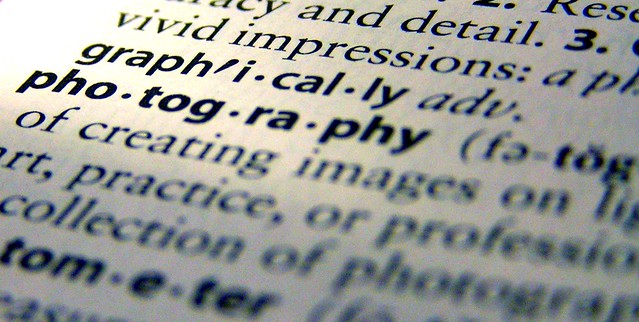
  • Photography – the word photography comes from two old Greek words “phos” meaning light and “graph” meaning to draw.  So photograph literally means to draw with light, or a drawing made with light.  So photography is the art of drawing with light.
  • Aperture – the variable opening in the lens through which light passes to the film or digital sensor.  Measured in  f-stops. I like to compare it to your pupil which opens and closes to allow more or less light to enter your eye depending on the brightness level of the room.
  • Bracketing – taking a series of images at different exposures or EV. You may see a setting on your camera that says AEB (auto exposure bracketing). This is often used when creating HDR images or in difficult lighting situations where you may want to have a range of exposures from light to dark.
  • Bulb – the “B” setting on your camera where the shutter remains opened as long as the button or cable release (remote trigger) is pressed. On a Canon it may be on your mode dial on top of the camera, or at the low end of the shutter speed settings (also where it is on a Nikon)
  • DSLR – digital single lens reflex camera. Any digital camera with interchangeable lenses where the image is viewed using a mirror and prism, and the image is taken directly through that lens. What you see in your viewfinder is what the lens sees.
  • EV – Exposure Value is a number that represents the various different combinations of aperture and shutter speed that can create the same exposure effect.
  • Exposure compensation – modifying the shutter speed or aperture from the camera’s recommended exposure to create a certain effect (over or under exposing) – usually used in the Shutter Priority or Aperture Priority modes. Represented by a little +/- button on your camera. Your camera reads light bouncing off your subject and is designed to expose for medium grey. So when photographing a subject that is lighter or darker than 18% grey, you can use this setting to tell the camera the proper exposure (- or + respectfully)
  • Exposure – the total amount of light reaching the digital sensor. It is controlled by setting the aperture, shutter speed and ISO.
  • F-stop – is a measure of the aperture opening in the lens defined by dividing the focal length of the lens by the aperture diameter. Sequence of f-stops are multiples of the square root of 2 (1.414…): 1, 1.4, 2, 2.8, 4, 5.6, 8, 11, 16, 22, etc. Even though these numbers are rather cryptic, just remember that each step is double the amount of light. Know that and it’s half the battle.
  • ISO – stands for International Standards Organization and represents the sensitivity of your camera’s digital sensor to light. The lower the number (ISO 100), the less sensitive, the higher the number (ISO 3200) the more sensitive. A higher ISO allows you to shoot in low light conditions.
  • Shutter speed – the amount of time the shutter is opened during an exposure. The shutter speed controls motion. Use a fast speed (like 1/2000th of a second) to freeze motion, or a slow one (1/4 of a second or longer) to blur moving objects.
  • Zoom lens – any lens that has variable focal lengths such as a 24-70mm or 18-55mm. You zoom in or out by rotating the barrel of the lens.
  • Prime or fixed lens – any lens that does not zoom and is a set focal length such as a 50mm lens.
  • Remote trigger or digital cable release – a device that allows the camera to be fired without pressing the button or touching the camera. Helps eliminate movement of the camera during long exposures.
  • Macro lens – one that focuses very close to the subject allowing for 1:1 reproduction size of the object or larger.
  • “Normal” lens – generally a 50mm lens (on a full frame sensor camera) is considered to be a “normal” lens because it is closest to what the human eye sees.  If you have a cropped sensor that will be closer to 35mm.
  • Telephoto lens – simply stated a telephoto lens is one that is longer than a normal lens, eg., 70-300mm. The dictionary says: a lens with a longer focal length than standard, giving a narrow field of view and a magnified image.  Super telephoto is usually 300mm and longer lenses.
  • Wide angle lens – again simple answer is a lens that shows a wider field of view than a normal lens, which allows more to be fit into the frame. Depending on the degree of wide angle there may also be edge distortion (super wide angle), and if you get wide enough the image will become a circle (fish-eye).
  • Tilt shift lens – a lens that attempts to recreate the movements available when using a view camera. Being able to tilt the front lens element allows for realignment of the plane of focus. Shift allows adjusting the placement of the subject within the frame without angling the camera, thus keep parallel lines from converging. This is a popular lens for architectural and landscape photographers, and is becoming more widely used by portrait photographers for creating a unique stylized look.
  • Camera resolution – expressed in megapixels is the dimensions your camera’s sensor is capable of capturing. For example Canon’s new 6D has a resolution of 5472 x 3648 which equals 19,961,856, which they’ve rounded off to 20 megapixels. This is not the only factor in image quality, but generally the large the number, the larger prints you can produce from it without loss of quality.
  • File format jpg versus RAW – most DSLR’s have the ability to shoot both formats. If you choose JPG, the camera will shoot a RAW file, process it using the picture style you’ve selected in your menu, save it as a JPG and discard the RAW version. If shot in RAW the resulting file will be larger, carry more information (but the same pixel resolution, see above) and require software to process. It gives you the photographer more control over the final look of your image. For more on the subject see this article
  • Full frame vs cropped sensor – I get asked about this in my classes all the time. A full frame sensor is roughly the size as the “old” 35mm frame of film. Lenses are made to create a circle of light just large enough to cover that area (covering power). In a cropped sensor camera the physical size of the sensor is smaller so it only captures a portion of the entire image the lens is projecting, effectively cropping part of the image out. For more information on this see “Crop factor explained“. Common crop factors are 1.5 or 1.6x so if you put on a 50mm lens it is more like a 75mm with a 1.5x crop factor.
  • Camera modes – manual: full manual the user is setting the ISO, shutter speed and aperture. Shutter priority (Tv on a Canon or S on a Nikon) the user is selecting ISO and shutter speed, the camera is then choosing the aperture to make a correct exposure. Aperture priority (Av for Canon users, A for Nikon) the photographer selects the ISO and aperture and the camera picks the shutter speed.

Lighting and Portrait Photography Terms

  • Ambient light – also referred to as available light, is the light that is occurring in the scene without adding any flash or light modifiers. This could be daylight, or man made light such as tungsten or fluorescent bulbs.
  • Main light or key light: is the main light source for a photograph. It could be the sun, a studio strobe, a flash, a reflector or something else. But it is the source of light that is producing the pattern of light on the subject with the most intensity.
  • Fill light: is the light source that is secondary to the mail light. It is used to “fill” in the shadows to a desired degree. It can be produced by using a flash, a reflector, or a studio strobe.
  • Lighting pattern: this is the way the light falls on the subjects face. A particular pattern of light and shadow that is created.
  • Lighting ratio:  is a comparison between the intensity (brightness) of the main light and the fill light and thus the difference of the lit and shadow sides of the subject’s face.
  • Incident light meter: is a handheld device separate from your camera that measures the amount of light falling on a subject (as opposed to the reflective reading your camera takes which is light bouncing off the subject back to the camera). The incident meter is not fooled by the brightness range of the subject, where as in camera reflective meters can be fooled.
  • Speedlight (speedlite for Canon users): small portable flash which can attach to your camera’s hot shoe, or stand alone if activated remotely.
  • Reflector – a device that is used to reflect light, generally back towards the subject. It can be a specialized factory made reflector (I recommend getting a 5-in-1 if you get one) or as simple as a piece of white cardboard.
  • Light meter – a device that measures the amount of light in a scene. Your DSLR has one built in, it uses reflective readings (light bouncing off the subject coming back through the lens [TTL])
  • Remote flash trigger – a device used to fire speedlights off camera. Pocket Wizard is a popular brand.
  • Subtractive lighting – as the name implies it is the taking away of light to create a desired affect. Commonly it involves holding a reflector or opaque panel over the subject’s head to block light from above and open up deep eye shadows cause by overhead lighting. It can also mean holding a black reflector opposite your main light to create a deeper shadow, in essence reflecting black onto the subject instead of light.
  • Hard light – harsh or undiffused light such as produced by bright sunlight, a small speedlight, or an on-camera flash. It produces harsh shadows with well defined edges (edge transfer), contrast, and texture (if used at an angle to the subject). Emphasizes texture, lines and wrinkles, and used to create a more dramatic type of portrait (character study).
  • Soft light – diffused light such as from an overcast sky, north facing window with no direct light, or a large studio softbox. This type of light produces soft shadows with soft edges, lower contrast, and less texture. Generally preferred by most wedding and portrait photographers as it flatter the subject more.
  • Edge transfer – where the light turns into the shadow, the edge transfer is how quickly it goes from dark to light. If using harsh light the edge transfer is very defined and sudden, almost a clear line. When using soft lighting the edge transfer will be much more subtle, almost imperceptible as it gradually changes from light to dark.
  • Flash sync – simply put is the synchronization of the firing of an electronic flash and the shutter speed. You need to know what shutter speed your camera syncs at, otherwise if you shoot too fast a shutter speed you may get a partially illuminated image. For most cameras that is around 1/200th of a second, but it can be adjusted if you have a flash that can be set for fast speeds.

Slang and Photography Jargon

Here’s a few other terms that are a bit more advanced, and even completely made up jargon. Become familiar with them so you can walk among the pros with confidence!

  • Fast glass – refers to a lens with a very large maximum aperture such as f1.8 or f1.2. “Fast” as in, it allows you to shoot at a fast shutter speed due to the large aperture.
  • Chimping – slang term meaning looking at the back of the camera after every image. Spending too much time reviewing images on camera, not enough time shooting.
  • Bokeh – often mispronounced “bow-kay” or “bow-kuh” it is correctly pronounced as “bo-ke” like the ke in kettle. It is used to described the out of focus blurred bits in the background when “fast glass” is used. Most often bokeh occurs where small light sources are in the background, far in the distance.
  • Depth of Field (DOF or DoF)- the distance between the nearest and farthest objects in your scene that appear in focus.  It is controlled by many factors including the aperture, lens focal length, distance to subject, film or digital sensor size, and camera format. Read about how to use aperture to adjust depth of field.
  • Circles of confusion – closely related to the above bokeh, the textbook definition is:  the largest blur spot that is indistinguishable from the point source that is being rendered. Objects outside the depth of field of an image that the human eye can determine as “out of focus”.
  • Hyperfocal distance – often used by landscape photographers, it is the focus distance providing the the maximum amount of depth of field. Older prime lenses for film cameras usually had hyperfocal distance marks to aid in finding this magic sweet spot. With today’s lenses it is possible to calculate, just takes a bit more work and a hyperfocal distance calculator.
  • Gobo – something used to block unwanted or stray light from falling onto the subject. Often a reflector (using the black side) can serve a dual purpose and act as a gobo as well.
  • Scrim – a translucent device used to diffuse and soften the light, could be a reflector with a translucent panel or option. Also used on movie sets scrims can be made extremely large, several feet across, and clamped in place to create shade where these is direct sun without it.
  • Shutter lag – every camera has a slight delay from the time you press the shutter button to the time it actually fires and opens. In DSLR’s it is minimal and almost unnoticeable. In smaller point and shoot cameras the delay is more pronounced such that it may actually cause a missed shot of a fast moving subject.
  • Chromatic aberration – in terms of lens optics it is the failure of the lens to focus all colours (RGB) at the same point. It shows up as colour fringes in areas of the image where dark meet light (think edge of a building against the sky). It is more common in wide angle lenses, and those of inferior optics (kit lenses). It is correctable, to some degree, using Photoshop, Lightroom or software of your choice.
  • Rear shutter curtain sync – by default most cameras are set to front curtain sync which means that if the flash fires, it does so at the beginning of the exposure time. By setting to rear shutter curtain sync it fires the flash at the end of the exposure time. The difference in some cases me be negligible, but in shooting a moving subject front sync will put any motion blur in front of the subject, where as rear sync will place the blur behind the subject. Neither is wrong, just preference.
  • Camera shake – this is a blurry image which has resulted from an insufficiently fast enough shutter speed, while hand holding the camera. So how slow is too slow? Many teachers will say that 1/60th of a second is the rule of thumb. I tend to recommend 1 over the focal lens of your lens instead, as the longer the lens the more amplified any shake will become.
  • Lens flare – occurs when the light source hits the lens directly, it can manifest as a hazy looking image or artifacts such as circles of light. Some photographers actually desire lens flare and position their camera to create it and use it as a compositional element.
  • Kelvin – is the absolute measurement of colour temperature. On your camera under the White Balance settings you make see a “K” setting. This allows you to adjust the colour manually by degrees kelvin. The lower numbers represent warmer colours like orange (tungsten light) and the higher numbers are cooler (blues). Play with this scale to create different affects.
  • ND filter – stands for neutral density filter which is a filter designed to go in front of the lens to block out some of the light entering the camera. Often used by landscape photographers to be able to get slow shutter speeds when photographing waterfalls and streams in full daylight.
  • Panning – the act of using a slow shutter speed, and moving the camera in the same direction as a moving subject, during the exposure to create a blurred background. See panning tips here.
  • Stopping down – the act of closing down the aperture to a smaller opening.  EI going from f5.6 to f8.
  • TTL and ETTL – stands for Through The Lens, refers to the metering system in regards to flash exposure. The flash emits light until it is turned off by the camera sensor. ETTL is evaluative through the lens metering and fires a “preflash” to evaluate and calculate for lost light then compensates and fires the main flash. It happens so fast you do not see two flashes.
  • Photog – short for photographers, something pros often call each other
  • Glass – lens, as is “what glass do you own?”
  • Golden hour – also called “magic hour” is the hour right before sunset or right after sunrise. The sun is low on the horizon and it is an optimal time for photography.
  • Spray and pray – shoot as many images as possible and that hope and pray you got something good. Not a philosophy I personally recommend.
  • Blown out – having highlights that are off the chart on the right side of the histogram, having no detail in the white areas.  Eg: “the bride’s dress is blown out”
  • Clipped – similar to blown out being off the histogram, but it can also apply to shadow or blacks areas of the image.
  • Grip and grin – often used to describe a quick photoshoot at an event or set up with two people shaking hands. Most photographers have had to shoot these during their career.
  • Selfie – a self portrait
  • SOOC  – straight out of camera, no post processing or editing done
  • Dust bunnies – dark spots that appear on the image, caused by bits of dust on the digital sensor
  • Pixel peeper – someone that spends too much time looking at images at 100% size in Photoshop
  • Nifty 50 – an old school prime 50mm lens, great to have
  • ACR – Adobe Camera Raw
  • Flash and drag – the method of using a slow shutter speed combined to flash to capture more of the ambient light in proportion to the flash
  • Wide open – using your lens with the aperture at the widest setting (f1.8 for example)

Enjoy and get out there and start practicing your Photographer Speak. This list is not exhaustive by any means, and if there’s any I missed please mention them in the comments section below.


Post originally from: Digital Photography Tips.

Check out our more Photography Tips at Photography Tips for Beginners, Portrait Photography Tips and Wedding Photography Tips.

Deciphering Photo Jargon – Learn to Speak “Photographer”


Digital Photography School

 
Comments Off on Deciphering Photo Jargon – Learn to Speak “Photographer”

Posted in Photography


Sea Otters: See No Evil, Hear No Evil, Speak No Evil

12 Apr

Few would argue that one of the cutest sea mammals around are Sea Otters. Whether they’re grooming, using tools to crack open shellfish to eat or just warming themselves in the sun Sea Otters seem to have an eternally cute appearance. As Sea Otters rest in rafts you never know what pose they might take. The rare combination is the “see no evil, hear no evil, speak no evil” pose between neighboring otters. I happened to get luck one morning witnessing and seeing this classic pose. I do wonder if I’ll catch this pose again… I hope so.

In the news: Sea otter numbers take a turn for the worse

Raft of Sea Otters (Enhydra lutris) - Monterey, California

Raft of Sea Otters (Enhydra lutris) – Monterey, California

Technorati Tags: , , , , , ,

Copyright Jim M. Goldstein, All Rights Reserved

Sea Otters: See No Evil, Hear No Evil, Speak No Evil


JMG-Galleries – Jim M. Goldstein Photography

 
Comments Off on Sea Otters: See No Evil, Hear No Evil, Speak No Evil

Posted in Equipment