RSS
 

Posts Tagged ‘space’

Driverless Living Space: Future Car Envisioned as Mobile Room

14 Jan

[ By WebUrbanist in Conceptual & Futuristic & Technology. ]

driverless car in city

Blending elements of rigorous automotive and interior design, this concept car may look like a streamlined vehicle but is more akin to a communal living room on wheels on the inside.

driverless car conversing commuitng

driverless car dash board

driverless car test model

Unveiled  by Mercedes-Benz at the Consumer Electronics Show in Las Vegas, features include swiveling seats for conversing and viewing, individual touchscreen displays and interactive gesture-based interfaces for driving and recreating alike.

driverless car sitting relaxing

driverless car seating interface

driverless car exterior view

The exterior presents as a classy and aerodynamic sports car  with carbon fiber-reinforced plastic, aluminium and steel. Within, walnut, leather and glass make for a a likewise-luxurious but human-oriented set of materials and finishes.

driverless car interior view

driverless car doors open

Of the design and its direction, Dieter Zetsche notes that “Anyone who focuses solely on the technology has not yet grasped how autonomous driving will change our society. The car is growing beyond its role as a mere means of transport and will ultimately become a mobile living space.”

driverless car sleek look

futuristic driveress car design

The open question remains: how much will cars of the future even look like cars on the outside? As platooning and other hive-like concepts are further explored, we may find vehicles look far different down the line than we might imagine.

Share on Facebook


[ By WebUrbanist in Conceptual & Futuristic & Technology. ]

[ WebUrbanist | Archives | Galleries | Privacy | TOS ]


WebUrbanist

 
Comments Off on Driverless Living Space: Future Car Envisioned as Mobile Room

Posted in Creativity


Shop in a Swimming Pool: Neglected Space Turned into a Store

13 Dec

[ By Steph in Architecture & Offices & Commercial. ]

swimming pool store aoyama 1

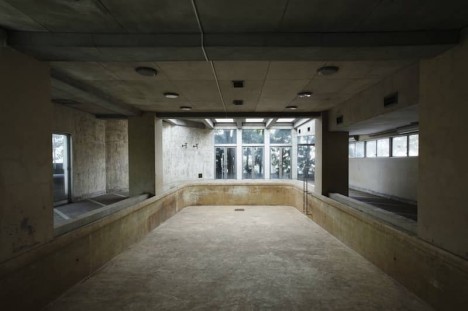
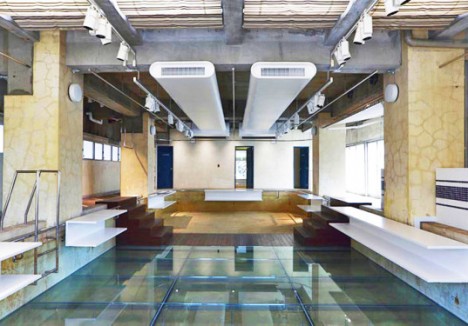
Until recently, this indoor swimming pool on the vacant ground floor of a 1970s apartment building in Tokyo was just an empty space, dry and disused for years. Now it’s a pop-up shop by Nobuo Araki known as ‘The Pool Aoyama‘ hawking clothing, accessories and swim-themed promotional items. The designers left the pool almost entirely intact, installing a glass floor that mimics the look of water.

swimming pool aoyama 5

swimming pool store aoyama 8

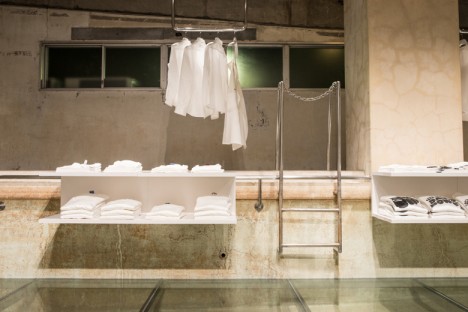
The shell of the abandoned pool and its steel ladder have become key elements of the final design, with the pool walls defining the space of the shop. Wooden stairs on either side of the pool meet to create a sort of bridge across the glass. White shelving units are mounted along the edges to display goods, and U-shaped stainless steel clothing racks hanging from the ceiling echo the look of pool hand rails.

swimming pool store aoyama 2

swimming pool store aoyama 3

The designers were drawn to the soft light, charm and quirkiness of the space, and the shallow depth of the pool lends itself well for adaptation into a showroom. A newly installed glass ceiling floods the room with natural light, and the bathrooms were turned into fitting rooms.

swimming pool aoyama 4

swimming pool store aoyama 6

swimming pool store aoyama 10

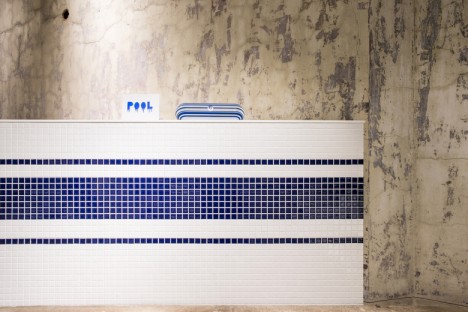
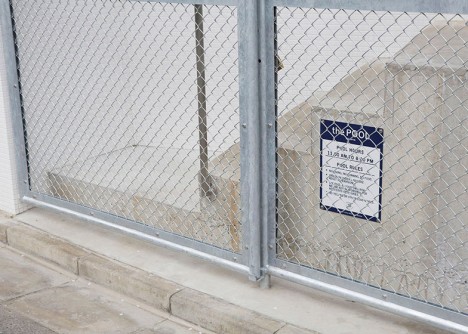
Entering the shop feels a bit like gaining access to a secret underground space that few are savvy to, as the door is simply marked with an inconspicuous sign reading ‘The Pool.’

Share on Facebook


[ By Steph in Architecture & Offices & Commercial. ]

[ WebUrbanist | Archives | Galleries | Privacy | TOS ]


WebUrbanist

 
Comments Off on Shop in a Swimming Pool: Neglected Space Turned into a Store

Posted in Creativity


Deserted Space: Photos Document NASA’s Abandoned Launch Pads

20 Nov

[ By WebUrbanist in Abandoned Places & Architecture. ]

abandoned space graveyard photos

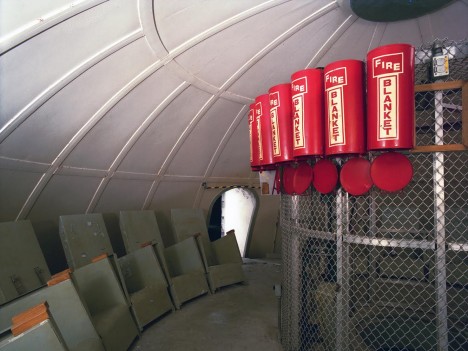
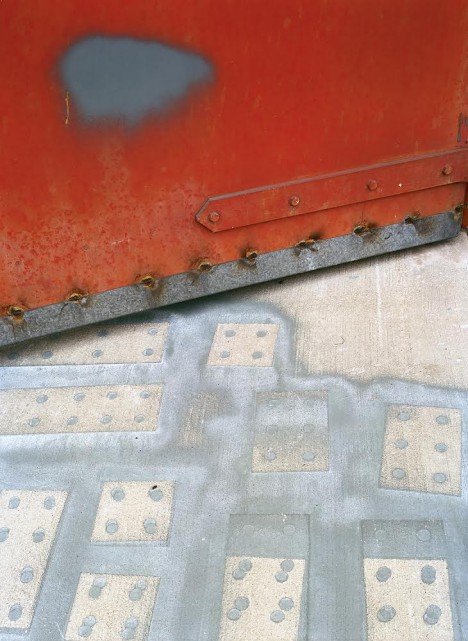
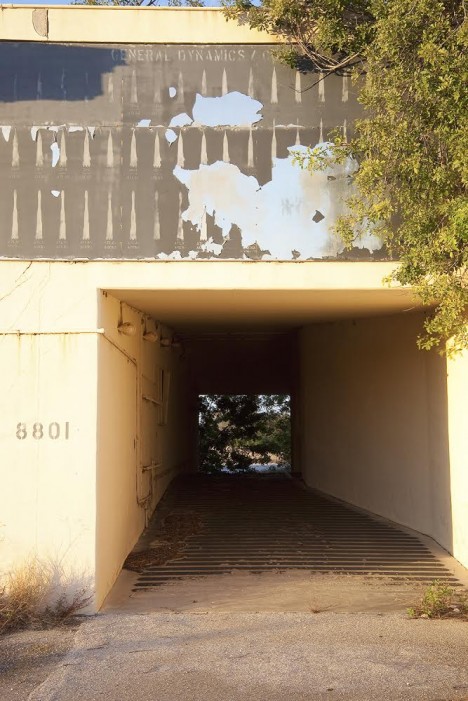
The race for space has shifted gears in recent years with the rise of private programs, leaving a series of amazing space-related graveyards around the United States, which this photographer has spent 25 years exploring and documenting.

abandoned nasa building sign

abandoned rocket room

abandoned flight ring rocket

In his upcoming book, Abandoned in Place, Roland Miller takes readers on a “photographic exploration of the American space launch and research facilities that played a crucial role in the early period of space exploration. The goals of this project are to preserve and portray these abandoned, deactivated, and repurposed sites through photography that surpasses the official government approach to documentation and to lend historical and artistic insight to the subject.”

abandoned secret nasa complex

abandoned space program complexes

abandoned space program facilities

With special permission (and an escort every time), Roland has managed to visit locations including the Marshall Space Flight Center in California, the Stennis Space Center in Mississippi and the Kennedy Space Center as well as Cape Canaveral in Florida. His book features 100 full-color photos – the best and brightest of his extension decade-spanning collection.

abandoned nasa deserted spaces

abandoned nasa crane gantry

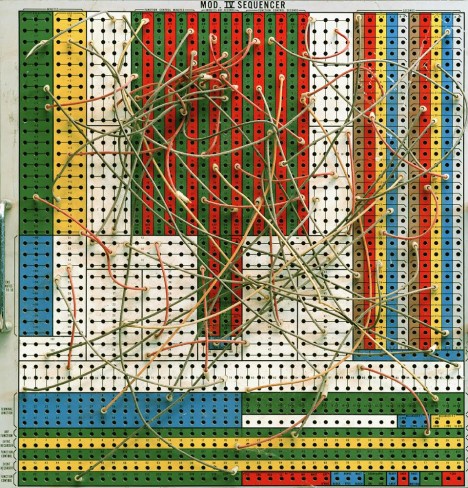
The photographs cover all kinds of incredible objects and details, from cranes and gantries to blast doors, flame deflector tracks, launch rings and even lunar modules. The book will be released by the University of New Mexico Press and contain poems and essays alongside its rich imagery.

abandoned control panel switchboard

Superstructure,Navaho Complex 9, Cape Canaveral Air Force Station, Florida1990

abandoned observatory dome exterior

This project is part guide book and part historical document – it “serves not only as a documentary body of work, but also as an artistic interpretation of these historic sites. The blockhouses, launch towers, tunnels, test stands, and control rooms featured in Abandoned In Place are rapidly giving way to the elements and demolition. By my estimates, fully half of the facilities I have photographed no longer exist. The costs involved in restoring, maintaining, and securing these sites are enormous. Most of these historic facilities are located on secure military or NASA facilities, which drastically limits access by the public. Therefore, photography is the only practical method to preserve and portray these historic locations.”

Share on Facebook


[ By WebUrbanist in Abandoned Places & Architecture. ]

[ WebUrbanist | Archives | Galleries | Privacy | TOS ]


WebUrbanist

 
Comments Off on Deserted Space: Photos Document NASA’s Abandoned Launch Pads

Posted in Creativity


Split & Slide: Modular Dividers Make 3 Rooms in Single Space

12 Nov

[ By WebUrbanist in Design & Fixtures & Interiors. ]

modular room system design

Complimenting a flexible open area on one side of this apartment are a series of suspended separators that provide storage but also move along rails, opening up a variety of additional functions on demand. If the system looks familiar: it is based on the sliding stacks often used to save space in libraries.

modular-osb-oriented-board

modular space kitchen view

modular space bedroom

modular bedroom configuration open

Designed by PKMN Architectures in Madrid, Spain (with images by Javier de Paz García), this cost-and-space-saving solution employs relatively cheap materials including engineered particle wood boards (composed of glued wooden flakes) and a ceiling-hung system of industrial rails.

modular living room space

modular room shuffle sliding

modular room system

modular osb oriented board

The three suspended sections offer shelves and cabinets and variously create a kitchen, dining or living room depending on how they are configured and positioned relative to the room and one another.

modular murphy folding bed

modular living room blackboard

modular apartment sliding rooms

modular cooking kitchen closeup

Fold-down tables and a fold-out bed are able to be accessed as needed while the walls are variously occupied by storage, openings or unique decorative, fun and functional touches (like a blackboard for sketching ideas during meetings).

modular room changing gif

Sliding panels can also provide privacy when desired, separating the more open space from the modular-room side of the apartment. The fixed-in-place spaces are reserved for open living and dining areas as well as a bathroom in one corner of the unit.

Share on Facebook


[ By WebUrbanist in Design & Fixtures & Interiors. ]

[ WebUrbanist | Archives | Galleries | Privacy | TOS ]


WebUrbanist

 
Comments Off on Split & Slide: Modular Dividers Make 3 Rooms in Single Space

Posted in Creativity


First Hasselblad in space goes to auction next month

30 Oct

The first Zeiss lens and Hasselblad 500C camera to visit space will be going up for auction on November 13 via RR Auction in Boston. The unit is a piece of history, having joined Wally Schirra during the Mercury-Atlas 8 mission and, later on, Gordon Cooper during the Mercury-Atlas 9 mission. Read more

Articles: Digital Photography Review (dpreview.com)

 
Comments Off on First Hasselblad in space goes to auction next month

Posted in Uncategorized


Cyclists Wear Car Skeletons to Prove that Bikes Save Space

14 Oct

[ By Steph in Design & Guerilla Ads & Marketing. ]

car skeletons 1

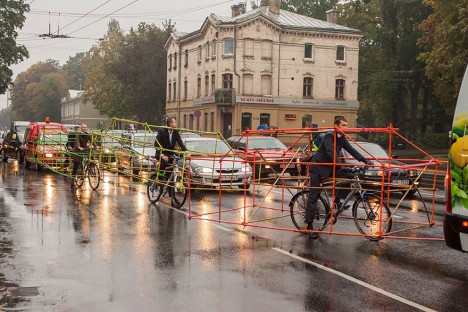
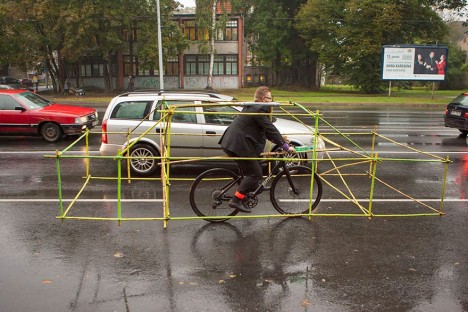
The absurdity of single drivers taking up so much space on the road was vividly highlighted when a group of Latvian cyclists went for a ride wearing car-sized frames made of bamboo. In celebration of International No Car Day on September 22nd, the cyclists gave their bikes a temporary makeover that forces actual automobiles driving alongside them to treat them like they would another car.

car skeletons 2

Car Skeletons 3

They look ridiculous, and that’s the point. Standing out in the transparent structures, it’s clear how little space each person actually takes up within that space. The frames are easily three times the width and length of the individual cyclist.

car skeletons 4

car skeletons 5

The protest, held by members of Let’s Bike It, highlights how much congestion could be eased on the roads if more people commuted by bike instead of cars, not to mention all of the other benefits.

Share on Facebook


[ By Steph in Design & Guerilla Ads & Marketing. ]

[ WebUrbanist | Archives | Galleries | Privacy | TOS ]


WebUrbanist

 
Comments Off on Cyclists Wear Car Skeletons to Prove that Bikes Save Space

Posted in Creativity


Never Run Out of Photo Space on Your Phone Again

09 Oct
Extra photos for bloggers: 1, 2, 3

At the very moment your dog FINALLY is balancing a banana on its nose, your phone camera roll is full. The banana falls, the moment is gone. Boo.

It stinks to lose these special moments when you don’t have enough room on your phone. So, we set out to find the best way for you to have (almost) infinite space.

Eureka! Carousel is a gallery app that connects to Dropbox (which saves your photos on the cloud, so they don’t take up space on your phone). You can delete photos from your camera roll, but still have access to them whenever you want. Sounds almost as magical as a real carousel, right?

It’s easy to set up, then you’re worry free FOREVER!

Never Run Out of Camera Space on Your Phone

(…)
Read the rest of Never Run Out of Photo Space on Your Phone Again (466 words)


© Lauren for Photojojo, 2014. |
Permalink |
No comment |
Add to
del.icio.us

Post tags:


Photojojo

 
Comments Off on Never Run Out of Photo Space on Your Phone Again

Posted in Equipment


When Every Inch Counts: 14 More Clever Small Space Hacks

22 Sep

[ By Steph in Design & Furniture & Decor. ]

Small Space Hacks Compact Kitchen 3

Making a tiny living space comfortable and practical means integrating multi-purpose furniture, custom built-ins and lots of other clever space-saving tricks. These 14 (more) small space hacks include a few DIY projects that can be achieved with components purchased at Ikea.

Incredibly Compact Kitchen
Small Space Hacks Compact Kitchen 1

Small Space Hacks Compact Kitchen 2

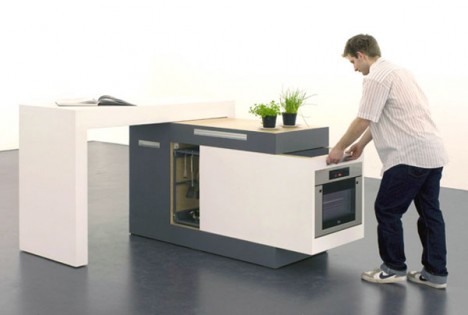
Starting as a narrow dining table, this ultra-compact kitchen swings open to reveal an induction cooktop, oven, refrigerator and storage space with a sink and a work surface. Slide it under the white table unit when not in use or pull it out into its own little island – perfect for the minimalist cook working in a small space. Check out 15 more modular & multipurpose kitchens for small spaces.

Spaceflavor Mobile Cube: Office/Tea House in One
Small Space Hacks Spaceflavor Cube 1

Small Space Hacks Spaceflavor Cube 2

Feng Shui expert Liu Ming created the Mobile Cube to compartmentalize his personal space in a live/work apartment that has to accommodate over 30 students during classes. The entire cube is on wheels, with a lower portion that can contain a bedroom or an office, and a loft that functions as meditation space, a sleeping area or a tea room (as he uses it.) It measures just eight feet square and has hidden stairs that double as drawers, as well as cabinets, closet space and translucent roller shades.

Fold-Out Picnic Table
Small Space Hacks Fold Out Table 1

Small Space Hacks Fold Out Table 2

This picnic table offered by a Brazilian furniture store has enough seating for six people, yet folds completely flat against the wall when not in use, opening up the floor for other purposes.

IKEA Closet Makeover
Small Space Hacks Closet 1

Small Space Hacks Closet 2

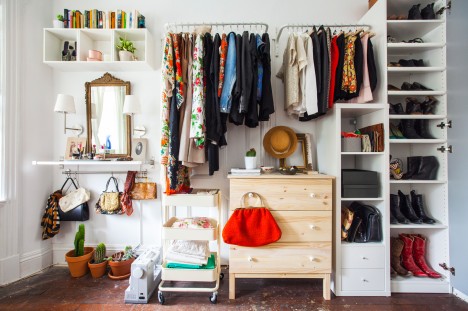
A cluttered closet in a small Brooklyn apartment now has a dedicated space for everything from shoes to handbags courtesy of an IKEA makeover. While the overall size of this closet would be luxurious in most small spaces, the setup could easily be customized to your own needs while maintaining organization.

DIY Murphy Bed
Small Space Hacks DIY Murphy Bed 1

Small Space Hacks DIY Murphy Bed 2

If you’re an ambitious DIYer, you can attempt your own murphy bed, like this one at a sustainability camp in Maryland. DIY Network has plans for a simpler version, or you can try an Ikea hack with sliding doors over at Instructables.

Next Page – Click Below to Read More:
When Every Inch Counts 14 More Clever Small Space Hacks

Share on Facebook


[ By Steph in Design & Furniture & Decor. ]

[ WebUrbanist | Archives | Galleries | Privacy | TOS ]


WebUrbanist

 
Comments Off on When Every Inch Counts: 14 More Clever Small Space Hacks

Posted in Creativity


Everything You Need to Know About Lightroom and Colour Space

03 Sep
Lightroom and colour space

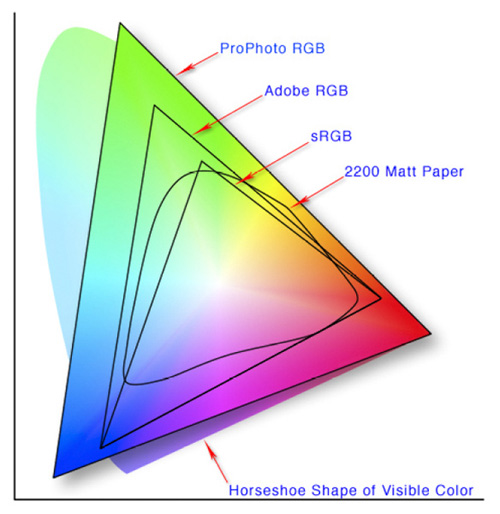
This diagram shows the three colour spaces that Lightroom works with. Photo from Wikipedia

One of the key differences between Lightroom and Photoshop is their approach to colour management. In Photoshop, once out of Adobe Camera Raw, you can go to the Colour Settings menu option and tell Photoshop in which colour space you want it to work.

How Lightroom works

Lightroom works differently. When processing Raw files, Lightroom uses the ProPhotoRGB colour space the whole time, and there’s nothing you can do to change it. The benefits of this method are:

  • Less colour information is lost during the processing stage. ProPhotoRGB is the largest colour space, so it is the optimum one to work in.
  • You can export multiple versions of the same photo, each with a different colour space, if you have need to do so.
  • If future output devices (monitors, printers etc.) support ProPhotoRGB (they don’t at the moment) then your photos will be ready for them.
  • Colour management is greatly simplified. You don’t have to make any decisions about what colour space to work in until you export your photos. This is the biggest advantage of all.

How Lightroom manages colour

When processing Raw files, Lightroom (and Adobe Camera Raw in Photoshop) uses its own colour space based on ProPhoto RGB. It provides a large colour gamut to work with the wide range of colours that digital sensors are capable of recording.

Note: Gamut is the term used to describe the range of colour values that fit in a colour space.

Exporting photos in Lightroom

When you export a photo in Lightroom it gives you the choice of three colour spaces.

ProPhotoRGB: ProPhoto RGB is the largest of the three. It roughly matches the range of colours that a digital camera sensor can capture.

Adobe RGB (1998): Adobe RGB (1998) is smaller than ProPhoto RGB, but larger than the next choice, sRGB. It roughly matches the colour gamut of CMYK printers used to print books and magazines.

sRGB: sRGB is the smallest colour space of the three. It represents the colour space that most monitors are able to display.

Comparing colour spaces

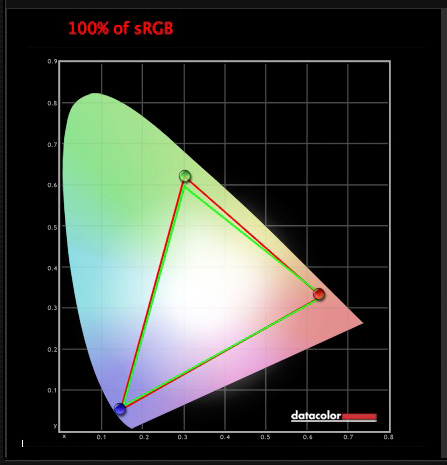
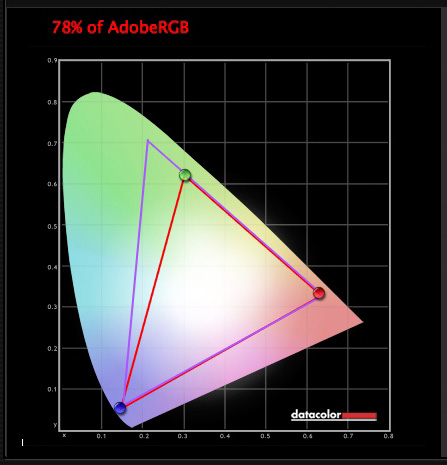
These two graphs show how the colours my monitor is capable of displaying, compared to the sRGB and Adobe RGB colour spaces.
Lightroom and colour space

The green triangle shows the sRGB colour space, the red one shows my monitor’s colour gamut. The two are nearly identical.
Lightroom and colour space

The purple triangle shows the Adobe RGB (1998) colour space, the red one shows my monitor’s colour gamut. My monitor can’t display all the colours within this colour space. Only a select few high end monitors can display all the colours within the Adobe RGB (1998) colour space.

This diagram compares the ProPhoto RGB, Adobe RGB (1998) and sRGB colour spaces. You can see that ProPhoto RGB is the largest.

Lightroom and colour space

Photo from Wikipedia 

Keeping it simple

Armed with this knowledge, here’s a guide to which colour space you should select when exporting your photos:

sRGB: Use when exporting photos to be displayed online, printed at most commercial labs, or printed with most inkjet printers. In short, if in doubt, use sRGB.

Note: Lightroom’s Web module automatically sets the colour space of exported files to sRGB.

Adobe RGB (1998): Use only if requested. If you’re not sure, ask. If you’ve been asked to submit photos to a magazine, for example, then ask them which colour space is required. It will probably be Adobe RGB (1998). Submitting photos to a stock library? Again, it will probably be Adobe RGB (1998). It’s the colour space most likely to be used for commercial purposes.

You would also use this colour space if you have an inkjet printer that utilizes the Adobe RGB (1998) colour space, or you are using a lab that accepts and prints photos with that profile.

ProPhoto RGB: Use when exporting a photo file to be edited in another program such as Photoshop or a plug-in. The file should be exported as a 16-bit TIFF or PSD file. There is little point in using the ProPhoto RGB colour space with 8 bit files, as they don’t contain enough bit depth to utilize the full colour range.

Note: If you import a JPEG or TIFF file into Lightroom, it uses the file’s embedded colour profile. If there is no colour profile attached, it assumes that it’s an sRGB file. If you choose an alternate colour space when you export the file, Lightroom converts it.

Colour spaces and compression

The reason that Lightroom uses a version of the ProPhoto RGB colour space, is that it is doesn’t compress the colours captured by your camera’s sensor.

When you export a photo, if you select either the Adobe RGB (1998) or sRGB colour space, Lightroom compresses the photo’s colours to match the chosen profile. That’s why selecting colour space is best left for as close to the end of the post-processing workflow as possible.

While Lightroom does its work within its version of the ProPhoto RGB colour space, your monitor isn’t capable of displaying all those colours. Instead, your computer’s operating system uses the monitor profile to convert the colours to ones that your monitor is capable of displaying.

Note: All monitors have a colour profile, regardless of whether they have been calibrated. But your monitor will only display colour accurately if it has been properly calibrated. You can learn more about the calibration process in my article How to Calibrate Your Monitor With the Spyder 4 Express.

Exporting photos with Lightroom

To export a photo in Lightroom, select the photo (or photos) you want to export, then go to File > Export. You can do this from any module (use the Film Strip to select multiple photos if you are not in the Library module’s Grid View).

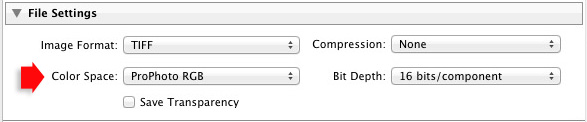
Go to the File Settings section of the Export window and set the required colour space. If you select the ProPhoto RGB colour space set Bit Depth to 16 bits/component.
Lightroom and colour space

Transferring photos to Photoshop

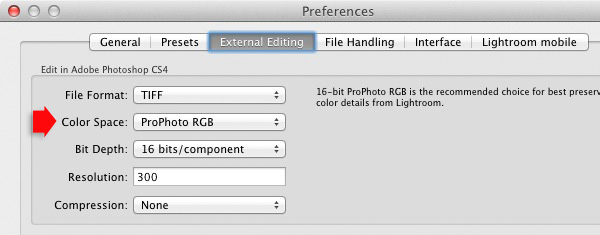
To open a photo in Photoshop, right-click on the photo and select Edit In > Edit In Adobe Photoshop. Photoshop opens the photo using the colour space indicated in Lightroom’s preferences.

To adjust this setting, go to the External Editing tab in preferences, and set Color Space to ProPhoto RGB. You can choose another colour space if you wish, but ProPhoto RGB is definitely the best one to use.
Lightroom and colour space

Opening photos in plug-ins

To export a photo to a plug-in, right-click on the photo, go to Edit In and select the plug-in you want to use to open the photo.

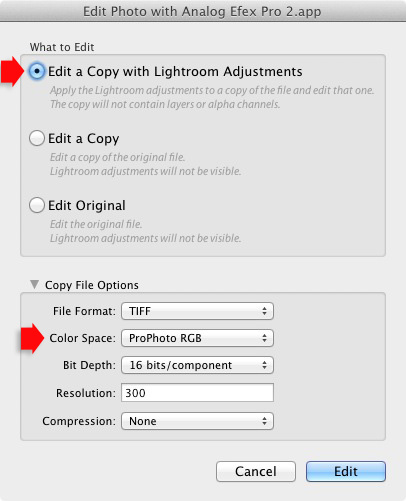
In the Edit Photo window, if you select Edit a Copy with Lightroom Adjustments (the only option available if you are exporting a Raw file) you will be able to select which colour space you want to use. Again, go with ProPhoto RGB for the best results.
Lightroom and colour space

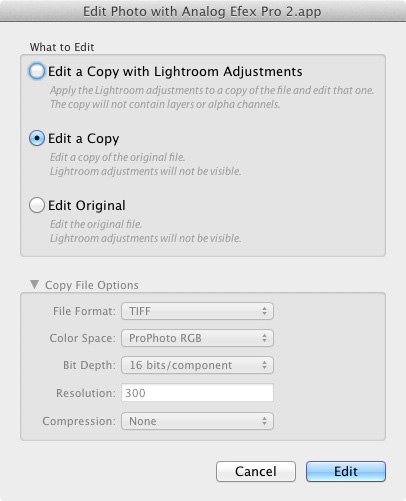
If you are exporting a JPEG or TIFF file, Lightroom gives you the option of selecting Edit a Copy or Edit Original in the Edit Photo window. If you do so, the option to select a colour space is greyed out and Lightroom opens the photo in the plug-in using the embedded colour profile.
Lightroom and colour space

But if you select Edit a Copy with Lightroom Adjustments, you can select any colour space and Lightroom will convert the photo to that colour space when it opens the photo in the plug-in.

Conclusion

Confused? I hope not, because colour management in Lightroom is really very simple. It’s essential to calibrate your monitor, but after you’ve done that Lightroom takes care of all colour related issues for you until you export your photos. Then, it’s just a matter of selecting the appropriate colour space.

If you have anything to add to the article, or any questions, please post it in the comments.


Mastering Lightroom: Book Four – The Photos ebookMastering Lightroom: Book Four – The Photos

My new ebook Mastering Lightroom: Book Four – The Photos takes you through ten beautiful examples of photography and shows you how I processed them step-by-step in Lightroom. It explores some of my favourite Develop Presets and plug-ins as well as the techniques I use in Lightroom itself. Click the link to learn more.

The post Everything You Need to Know About Lightroom and Colour Space by Andrew S. Gibson appeared first on Digital Photography School.


Digital Photography School

 
Comments Off on Everything You Need to Know About Lightroom and Colour Space

Posted in Photography


Portfolio: Michel Lamoller’s space and time-bending tautochronos project

03 Aug

In his series ‘tautochronos’, Berlin-based artist and photographer Michel Lamoller takes multiple pictures of the same scene at different times, before physically combining the prints and using a scalpel to cut through the layers. In doing so, Lamoller’s ‘layerscapes’ offer a vision of time and space that would be impossible in a conventional single exposure. His work is hard to describe in words – click through to read our Q&A and take a look at his work. 

Articles: Digital Photography Review (dpreview.com)

 
Comments Off on Portfolio: Michel Lamoller’s space and time-bending tautochronos project

Posted in Uncategorized