RSS
 

Posts Tagged ‘Sony’

Sony removes a7/R III firmware version 2.0 from its website, says it’s ‘working on the issue’

09 Dec

Two months after releasing firmware version 2.0 for its a7 III (Windows, MacOS) and a7R III (Windows, MacOS) mirrorless cameras, Sony has removed the firmware update from its website.

At the top of the download pages for Sony’s a7 III and a7R III firmware, an update read:

IMPORTANT: We apologize for the inconvenience, but the release of this software update has been delayed. We are working on the issue and will release the update as soon as possible. (Added on 12-07-2018)

DPReview contacted Sony Friday, December 7th, 2018 asking for more detail on why the update was removed. As of publishing this article on Saturday, December 8th, 2018 DPReview has not received a response. This article will updated accordingly if and when DPReview gets a response from Sony.

Articles: Digital Photography Review (dpreview.com)

 
Comments Off on Sony removes a7/R III firmware version 2.0 from its website, says it’s ‘working on the issue’

Posted in Uncategorized


The (Almost) Perfect Autofocus of the Sony a7R III: a Hands-On Review

02 Dec

The post The (Almost) Perfect Autofocus of the Sony a7R III: a Hands-On Review appeared first on Digital Photography School. It was authored by Anabel DFlux.

Focus is one of the most important concepts for a photographer. It can make or break an image. Whether you’re a pixel peeper like me who always looks for technical critical focus or an image maker who uses specific focus points to tell a story,  how the camera focuses is everything.

That’s why the newest addition to the Sony Alpha series is so conversation-worthy. With the 399 focus points on the Sony a7R III, and its ability to track focus like no other, the company touts it’s hard to get a shot that’s out of focus. This camera is like an artificially intelligent robot – it can predict and figure out exactly what you want in focus on.

With the thumb joystick on the back of the camera, you can quickly and easily change your focus point. And its AI Servo is out of this world. It could figure out the entire outline of a subject and hold on to it for dear life.

I take varying images – shooting animal action sports, live concerts, and everything in between. So I took all the boasting I’ve heard about this camera and put it to the ultimate test.

About the Sony a7R III

The a7R III is one of Sony’s newest and flashiest addition to its impressive mirrorless line of cameras. According to its website, the Sony a7R III sports the following drool-worthy perks:

  • 42.4 MP 35mm full-frame Exmor R™ CMOS and enhanced processing system
  • Standard ISO 100-32000 range (upper limit expandable to 1024005, with a lower limit of 50)
  • Fast Hybrid AF with 399-point focal-plane phase-detection AF and 425-point contrast-detection AF. The focus modes include:
    • AF-A (Automatic AF)
    • AF-S (Single-shot AF)
    • AF-C ( Continuous AF)
    • DMF (Direct Manual Focus)
    • Manual Focus
  • Face detection, with Modes:
    • Face Priority in AF (On/Off)
    • Face Priority in Multi Metering (On/Off)
    • Regist. Faces Priority (On/Off)
    • Face registration (max. number detectable: 8)
  • High-speed continuous shooting of up to 10fps (12fps with AF/AE tracking)
  • 5-axis image stabilization with 5.5-stop exposure advantage
  • 4K video recording
  • Dual card slots with simultaneous or consecutive recording
  • Silent Shooting Mode

The camera is compatible solely with Sony E-mount lenses, including G-Master and Zeiss lenses (sought after in the Sony world). The aspect ratio is 3:2, and the camera can record still images in JPEG, (DCF Ver. 2.0, Exif Ver.2.31, MPF Baseline compliant) and RAW (Sony ARW 2.3 format). The images are quite large: a 35mm full-frame image is 42MP (7,952 x 5,304 pixels), which in uncompressed RAW format takes up about 80MB of storage.

The camera also has built-in noise reduction software you can turn on or off as needed.

But what really set this camera apart (and why I fell in love with it) is the autofocus.

The Sony a7R III Autofocus Features

The a7R III allows for silent shooting at up to 10fps with AF/AE tracking – great for those who do wildlife photography. Shooting at 10 FPS yields up to 76 images at a time (when shooting JPEG).

Its phase-detect points cover around 47% of the sensor area. When you combine that with the contrast-detect sensor areas, the total AF coverage is nearly 68% of the frame.

Advanced algorithms provide high AF precision down to light levels as low as -3 EV for more reliable autofocus in dark scenes. The enhanced Fast Hybrid AF speeds up AF approximately two times faster under dim lighting conditions. The camera’s infrared technology allows it to autofocus even in extremely low or difficult lighting situations.

The camera also has an ‘eye autofocus’ setting. You read that right: it can find eyes on your subject and lock focus on them with the push of a button. This is photographic witchcraft and I love it. The a7R III’s Eye AF evolves with twice the effective eye detection and tracking, even when shooting a moving portrait subject. It’s touted by the company to work when:

  • the subject’s face is partially hidden
  • the subject is looking down or wearing glasses
  • the subject is backlit
  • the lighting is dim or low
  • the subject is far away.

The a7R III includes a touchscreen that provides touch AF, focus point dragging and focus racking features. The AF-C (continuous autofocus) option feature is extraordinary. The camera can keep tracking the subject even if it’s changing direction erratically or an object gets in the way.

Tip: The ‘Expand Flexible Spot’ mode is a good one to start from, and works well with the AF joystick for quick adjustments to the preferred focus area.

Real Life Use

This camera is fast and accurate. With my DSLRs, I usually have to refocus multiple times. But I didn’t have to do it once on the Sony a7R III. I think mirrorless cameras really outshine most DSLRs in the autofocus department.

Here’s how it did in various scenarios:

Action and Sports

I photograph a lot of action, and when I first bought this camera I took it to a Frisbee dog competition to test it out. I was absolutely blown away by the autofocus. The camera even recognized a dog’s face with its facial tracking autofocus and maintained focus on the dog’s face throughout its trick-induced performance. When the dog moved further away the focus changed to the animal’s entire body, which I appreciated.

Regardless of how spontaneously the dog moved, the focus remained locked.

I typically use my Canon 7D Mark II for animal sports photography due to its speed and the fact the body is intended for action. But I now prefer the a7R III due to its superb tracking. The 7D tends to get lost when there isn’t much contrast between the subject and the other objects in the frame, such as photographing in the fog. (Many of these dog sporting events happen around 7am when the fog rolls onto the field.)

The Sony mirrorless clearly identified the subject despite the lack of contrast. It can even refocus on dogs running at me without needing any prompting or additional technique.

Portraits

Portraits are an absolute breeze with this camera. From face tracking to eye tracking, it’s almost impossible to take an out-of-focus image unless you have your settings wrong. As I mentioned earlier, the eye tracking feature is said to work in problematic scenarios (the face is partially hidden, the subject is looking down, etc.)

Well, I can confirm that what Sony promises is true. It works in all of those scenarios. Even when I shot a model wearing unnatural contacts and bright glittery makeup, the camera had no issue.

Dimly-Lit and Golden Hour Portraits

Much like the camera’s success with well-lit portraits, the Sony a7R III can focus on portraits in dim light as if they were lit to perfection. I’m happy to say there was absolutely no difference between the two. Night portraits were a breeze.

The golden hour portraits were just as easy (not to mention exquisite). My other cameras have focusing issues when the sun is low and hitting the lens at an angle. But the a7R III breezed through and held focus on the subject no matter how the sun was hitting the lens glass.

Live Concerts

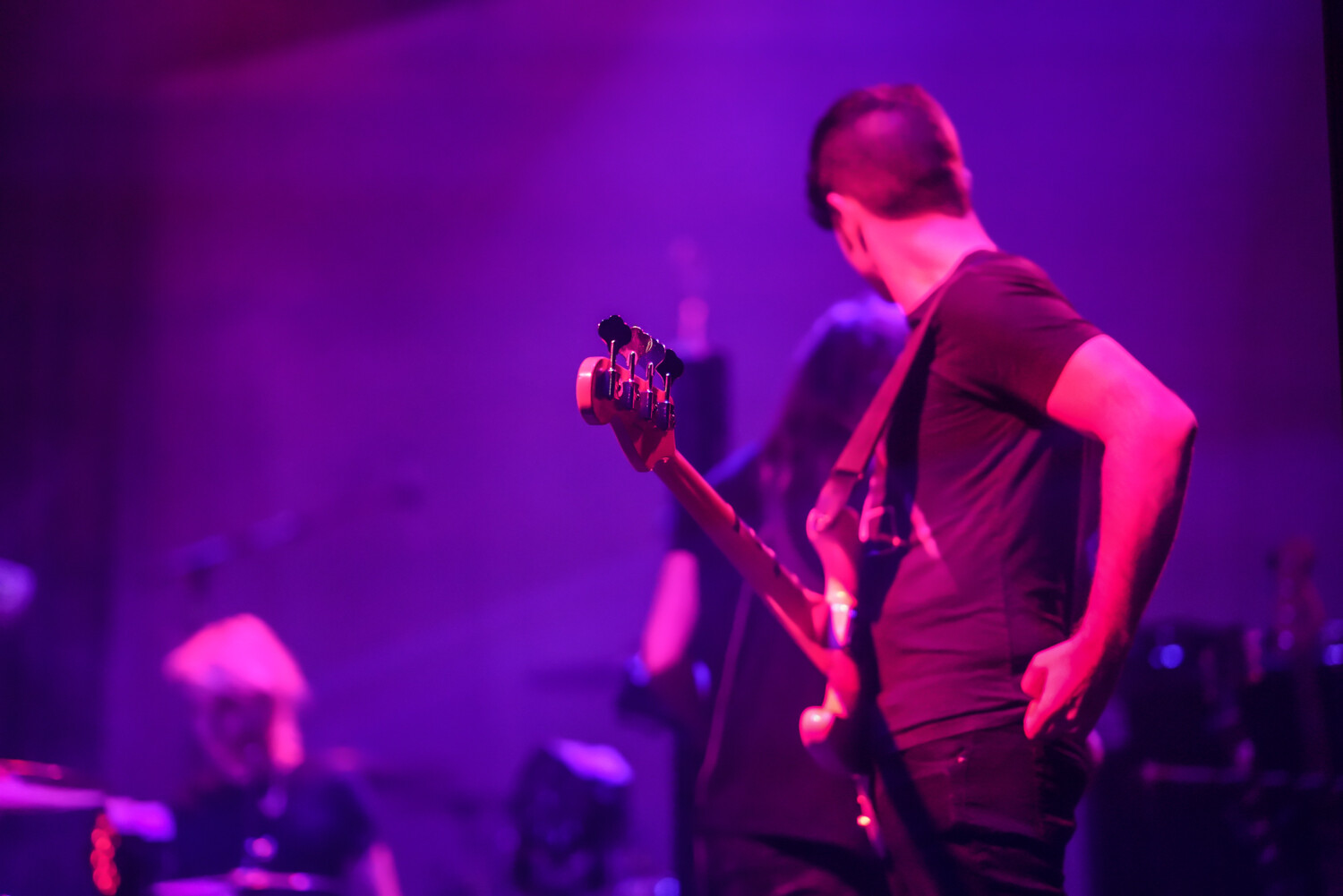
Dogs may wake me up in the mornings, but it’s the rock stars who keep me awake at night. In the evenings you’ll probably find me shooting a live concert with an arsenal of camera equipment to get me through the job.

Live concerts are extremely difficult focusing situations. In fact, they’re like a low-light sports situation. For the most part, you’ll have limited lighting, and have to deal with colored bulbs that can paint the subject with a very saturated color (such as the dreaded red hue).

Live concerts are also high-energy and filled with action as the guitarists swing their guitars and the drummer pounds away. You may not always have enough contrast to work with, and plenty of annoying obstacles to get in the way of whatever musicians you’re photographing.

Much like I found success in dog sports photography, the Sony a7R III does mighty well at maintaining focus on the subject despite erratic movement or instruments getting in the way. If the light is low but even, the camera does a splendid job of finding the subject thanks to its Advanced AF algorithms.


Unfortunately, live concerts are also where we hit a bit of a snag. As venue goers know, most music venues (especially small indie ones) don’t have consistent lighting on the stage. It can be uneven, sporadic, and wild. Some genres of music (e.g. metal and rock) really love using strobe lights on the stage as well.

And this is where the Sony a7R III flops terribly.

The moment strobes are used, the camera completely loses its ability to focus or find the subject. It’s a negative I haven’t seen covered in other reviews and one that keeps me from bringing this camera to a live concert (after having a particularly bad experience at a recent show).

When strobes were involved, none of the autofocus settings or adjustments worked. The camera began to hunt and then failed to focus at all. This happened with other native and non-native lenses. My guess is the infrared technology is affected by the strobing effects, but that’s just an assumption.

Non-Native Lens with an Adapter

As an avid 16-year Canon user with an army of L lenses, I have no plans on switching brands anytime soon. When I added the Sony a7R III to my kit, I immediately looked for ways to adapt my L glass to the Sony camera. (That way I’d need to buy only buy one native lens for the Sony and use the rest of my existing kit.)

After testing out several adapters I found that the Metabones Smart Adapter worked best.

Now it was time to test the autofocus on a non-native lens.

Although some of the autofocus features (e.g. eye-tracking) are disabled on non-native lenses, the facial recognition and AF-C (continuous autofocus) features worked like a charm. Once I’d calibrated the adapter to my lenses I didn’t experience any lag, searching or loss of focus. And despite certain features being unavailable, the camera was just as fast with non-native lenses as it was with native ones – even in low light. (I took this set up out for a spin during a club event.)

But the strobing issue was still there, which is why I’m convinced it’s a camera issue rather than a lens issue.

Final Thoughts

I have no regrets investing top dollar in this mirrorless camera. I find myself using it as much as my DSLRs, and I have three of them. I’ll often pick the mirrorless for more complex shoots simply because of its exquisite face tracking with autofocus.

Have I got you salivating? Think the Sony a7R III might be your next camera? Let’s talk about it in the comments.

The post The (Almost) Perfect Autofocus of the Sony a7R III: a Hands-On Review appeared first on Digital Photography School. It was authored by Anabel DFlux.


Digital Photography School

 
Comments Off on The (Almost) Perfect Autofocus of the Sony a7R III: a Hands-On Review

Posted in Photography


Sony a7/R III firmware 2.0 unlocks all AF modes with adapted lenses

01 Dec

Sony has released a significant firmware update for its a7 III (Mac | Windows) and a7R III (Mac | Windows) cameras that brings new features, updated support and improved performance to the full-frame mirrorless cameras.

The big deal here is that firmware 2.0 unlocks all autofocus modes for adapted lenses adapted with the Sony LA-EA3 mount adapter. This includes the subject-tracking Lock-on AF modes on the a7 III and a7R III, as well as Zone and Expand Flexible Spot. Sony specifically mentions its Sony Alpha A-mount lenses in its press release, but we’ve tested it with adapted Canon mount lenses as well and can confirm it works with EF lenses via a Sigma or Metabones adapter. Since Eye AF also works with adapted lenses, we’re really starting to see less and less of a downside to using third-party lenses on Sony cameras, save for a drop in performance at longer telephoto focal lengths.

Another stand-out feature added in the updated firmware is ‘Aperture Drive in AF’. This offers two options for aperture behavior during focusing in AF-S: ‘Standard’ opens the aperture up (up to F2) for focus acquisition, while ‘Silent Priority’ always forces the camera to focus at your shooting aperture to minimize the sound of the aperture opening during focus acquisition.

Sony warns though that ‘Auto Focus may become slower when Silent Priority is selected’ – precisely the reason why we’ve been asking Sony to add a mode where the camera always focuses wide open in AF-C, at the very least until shutter actuation. This new setting adds the option to do the exact opposite in AF-S, and doesn’t change behavior in AF-C (where newer Sony cameras always focus at the shooting aperture). We urge Sony to add a ‘Focus Priority’ mode that always forces the camera to focus wide open in AF-C, as DSLRs do.

Firmware version 2.0 for the Sony a7 III and a7R III also improves the overall performance and stability of the cameras, fixes exposure issues when using flash alongside flickering light sources, and better handles continuously shot photos as groups when browsing in playback.

Articles: Digital Photography Review (dpreview.com)

 
Comments Off on Sony a7/R III firmware 2.0 unlocks all AF modes with adapted lenses

Posted in Uncategorized


Rumored 8K multi-aspect sensor could point to 4K super camera (Sony a7S III?)

28 Nov
There’s been a lot of speculation about what an a7S III would look like, perhaps this rumored sensor from Sony Semiconductor provides some clues.

We’ve been speculating for a while about what a Sony a7S III would need to offer to filmmakers to offer a compelling advantage over the a7R III and a7 III. Rumors of a new sensor from Sony Semiconductor could make even our wildest speculation look rather unambitious.

With the $ 2000 a7 III able to shoot 4K footage from a 6K region of its sensor (capturing more detail than the a7S II can), Sony would have to do something clever to make an a7S III look attractive. The office was split down the middle between ‘more resolution,’ perhaps using an a9-style stacked chip to give a7 III-esque resolution but perhaps at 60p and with minimal rolling shutter, or possibly a move to 10-bit recording, to give more flexible files, particularly for anyone shooting Log or HDR video.

In a recent interview, Sony’s Kenji Tanaka told us the a7S II successor would be “more than [a7S II users] expect.”

Rumored specification of sensor capable of 36MP stills and 8K Ultra HD capture
Pixel Size (µm) 4.88
Aspect ratios
  • 3:2
  • 16:9
Pixel Resolutions
  • 7380 x 4932 (3:2)
  • 7730 x 4352 (16:9)
Active sensor area
  • 36 x 24mm
  • 37.1 x 20.9mm*
Rumored readout rates
  • 10FPS @ 16-bit
  • 60FPS @ 10-bit**

*Although the 16:9 region is wider than the 3:2 area, its diagonal length is smaller, so would be guaranteed to fit within the standard image circle of full frame lenses.
**10-bit capture would limit the camera to around 10EV of dynamic range. Video is more likely to be made from 12 or 14-bit capture, the rates for which are unspecified.

However, Sony Alpha Rumors is reporting a fairly plausible chip spec that would blow such cameras out of the water: an oversized Full Frame sensor that could shoot 36MP stills or 8K video while maintaining the same diagonal field of view (so the scope of wide-angle lenses isn’t reduced by cropping a 16:9 image out of the middle of a 3:2 sensor).

This could give a camera that makes no apparent compromise between stills shooting and video capture.

It’s possible to use a 16:9 crop (yellow) that’s wider than the standard 36 x 24mm dimensions of a full frame sensor (pink), so long as the diagonal is the same. This maintains the same diagonal angle of view: a trick Panasonic and Canon have made use of in the past.

This sensor could form the basis of one hell of a stills/video camera. Details of the chip are hazy to the point where they could be downright inaccurate, but a camera that can shoot both high-res stills and high-res video would make sense as an a7S III, since it would cost more than an a7 III but offer a lot more to videographers than the a7R III can.

Don’t get side-tracked by talk of the a7S cameras being great for low light stills: it’s no better than the a7R III

And let’s not get side-tracked by talk of the a7S cameras being great for low light stills. I’d happily put money on that being a marketing angle decided as the camera was being launched: the a7S II is no better in low light than the a7R III if you scale files down to the same size. The only reason it ever looked good in low light was that it’s the first time we’d seen ‘Dual Gain’ technology appear in a Sony sensor, and didn’t initially recognize its significance.

Does 8K capture mean 8K output?

Just because a sensor can capture 8K doesn’t mean that it would necessarily output 8K footage. Every manufacturer we’ve spoken to has told us how difficult it is to process and compress 4K footage in a camera with a small, stills-style body with no fans, because too much heat builds up. It seems unlikely that Sony could go straight from 4K stills/video cameras that have some heat buildup limitations straight to one that can process and compress four times as much data.

And that’s before you question how many people have computers or software that can edit the footage.

Could we be looking at perfectly oversampled 4K output, rather than 8K

But the question is: would it have to? There’s very little call for 8K footage yet, given that 4K is only starting to find its way into people’s homes. Sony’s current cameras can downsample 6K capture into 4K output, so could we be looking at perfectly oversampled 4K output, rather than 8K? After all, the math is likely to be easier.

The Sony a7S used 3840 x 2160 capture to produce 1920 x 1080 video with no aliasing, since this 2x oversampling let it perfectly capture all the frequencies that can be included in 1080 footage.

There’s a precedent for this, of course. The original Sony a7S captured 3840 x 2160 pixels, not to create 4K footage but as the basis for excellent 1080 video. This has a number of advantages: 2160 is the fewest pixels you need to capture to accurately represent all the frequencies you can include in an image 1080 pixels tall (This article explains why). So the a7S captured 4K, filtered-out (blurred) everything that couldn’t be conveyed in a 1920 x 1080 video, and then downsampled to produce some of the best 1080 footage we’ve ever seen.

An ‘8K’ camera could output cleaner, more detailed 4K footage than anything we’ve yet seen

A camera sampling 8K could output cleaner, more detailed 4K footage than anything we’ve yet seen. Better still, creating one output pixel from four capture pixels means you’re capturing all three primary colors at every location, so you could potentially output a 4:4:4 color signal over HDMI if you wanted. Though it’s noticeable that the a7S didn’t do this with its oversampled 1080, and most consumer recorders will only cope with 4:2:2 signals.

Does 10-bit capture mean 10-bit output?

And, just as 8K capture shouldn’t be taken to mean 8K output, 60 frame-per-second readout shouldn’t be assumed to mean 60p recording. The specs of the chip are rumored and hence hazy but if it’s true that it can only shoot 60FPS with 10-bit readout, then I’d expect a camera that records 30p (or whatever rate the sensor can maintain in 12-bit mode). This is down to the difference between capture bit-depth (which is linear and can limit the system’s dynamic range), and output bit-depth (which can contain any amount of DR). 10-bit output is pretty flexible, but 10-bit capture (with a maximum of around 10 EV of DR) is pretty limiting. So I’d expect video to come from 12-bit capture and then, ideally, be recorded and output as 10-bit files.

Venice-series/anamorphic

Of course this could all be wrong. The rumors might be completely incorrect or the idea of an a7S III (or a9S if componentry or the desire not to overshadow the a7R III saw it sold at a higher price point) could be wide-of-the-mark.

Maybe this chip could be destined for something in Sony’s CineAlta range, with the 3:2 region used for anamorphic shooting. We doubt it, though.

For instance, the expensive, Stacked CMOS sensor used in the Sony a9 (or one very closely related to it) is almost certainly the one also used in Sony’s pro-video Venice camera that costs tens of thousands of dollars. This new chip could be for a sister model for that range, with the 3:2 aspect ratio used to capture footage with anamorphic lenses, for instance.

Or maybe it’ll be a different camera maker than ends up making use of the chip.

But, whether this 36MP still/8K video sensor turns up in a Sony a7/a9 series camera or not, it seems fair to say it could be the basis of one hell of a stills/video camera.

Articles: Digital Photography Review (dpreview.com)

 
Comments Off on Rumored 8K multi-aspect sensor could point to 4K super camera (Sony a7S III?)

Posted in Uncategorized


DPReview TV: Nikon Z6, Sony a7 III and Canon EOS R compared

24 Nov

For several years Sony had the full frame mirrorless camera market all to itself, but recent introductions from Canon and Nikon have changed the landscape. This week, Chris and Jordan compare the current generation of entry-level full frame mirrorless models from each company: the Nikon Z6, Sony a7 III and Canon EOS R. Watch their analysis to find out where they think each model excels or has room to grow.

Also, make sure to read our in-depth written reviews of the Canon EOS R and the Sony a7 III. (Our Nikon Z6 review is coming soon – we promise!)

Get new episodes of DPReview TV every week by subscribing to our YouTube channel!

Click links below to jump to a specific topic:

  • Introduction
  • Image Stabilization
  • Lens Selection
  • Autofocus
  • Video Performance
  • Ergonomics and Handling
  • Image Quality
  • Conclusions

Canon EOS R review

Sony a7 III review

Articles: Digital Photography Review (dpreview.com)

 
Comments Off on DPReview TV: Nikon Z6, Sony a7 III and Canon EOS R compared

Posted in Uncategorized


DPReview Buying Guide: Best lenses for Canon, Nikon and Sony

24 Nov

New this year, we’ve added lens recommendations to our range of buying guides. Take a look through this guide for our advice on the best lenses to pair with Canon, Nikon and Sony cameras.

Articles: Digital Photography Review (dpreview.com)

 
Comments Off on DPReview Buying Guide: Best lenses for Canon, Nikon and Sony

Posted in Uncategorized


Nikon Z6’s 4K video footage outshines Z7’s, is similar to Sony a7 III’s

15 Nov

You can download our sample video right here.

The Nikon Z6 is a supremely capable video camera that comes with a 24MP full-frame sensor and captures oversampled 4K footage with no crop. It can also shoot 1080/120p footage for slow motion clips. The above sample footage was all shot hand-held with in-body IS turned on using the Auto AF area mode and Fulltime autofocus (AF-F).

Clips were recorded in-camera using Nikon’s Flat Picture profile. While not quite as workable as 10-bit N-log footage available over HDMI, a little time spent tweaking Flat Picture footage can lead to very nice results. This footage was edited in Final Cut 10.4.

Video still

Below please find our video still for comparing the Z6’s various video modes to those of its peers, including its most direct competitor, the Sony a7 III.

$ (document).ready(function() { ImageComparisonWidget({“containerId”:”reviewImageComparisonWidget-53236343″,”widgetId”:644,”initialStateId”:null}) })

4K

The Z6 and a7 III are taking different approaches to their oversampled 4K output with the Sony doing a better job capturing fine detail$ (document).ready(function() { $ (“#icl-4310-731235669”).click(function() { ImageComparisonWidgetLink(4310); }); }). The Z6 on the other hand looks to be using larger-radius sharpening$ (document).ready(function() { $ (“#icl-4311–410966151”).click(function() { ImageComparisonWidgetLink(4311); }); }) (by default) which results in a punchier look$ (document).ready(function() { $ (“#icl-4312-553981737”).click(function() { ImageComparisonWidgetLink(4312); }); }) out of camera. As expected, the Z6’s full-frame 4K looks better than the Z7’s full-frame 4K$ (document).ready(function() { $ (“#icl-4309-910283880”).click(function() { ImageComparisonWidgetLink(4309); }); }), which doesn’t use all its pixel rows, reducing both resolution and low-light performance.

The Z6’s cropped 4K$ (document).ready(function() { $ (“#icl-4319-1546915030”).click(function() { ImageComparisonWidgetLink(4319); }); }) also appears to use larger-radius sharpening than the Sony’s and looks similar (but still slightly better) when compared to the Z7’s$ (document).ready(function() { $ (“#icl-4313–2140375960”).click(function() { ImageComparisonWidgetLink(4313); }); }). Interestingly the Z6’s 4K full-frame footage looks very similar$ (document).ready(function() { $ (“#icl-4314–395951683”).click(function() { ImageComparisonWidgetLink(4314); }); }) to its 4K APS-C cropped footage. There may be a bit of a noise penalty $ (document).ready(function() { $ (“#icl-4315-911523642”).click(function() { ImageComparisonWidgetLink(4315); }); }) using the later, but detail is broadly similar.

1080p

The Z6’s full-frame 1080/24p looks better both than the Z7’s full-frame 1080/24p$ (document).ready(function() { $ (“#icl-4316–282793192”).click(function() { ImageComparisonWidgetLink(4316); }); }) and than the a7 III’s 1080/24p$ (document).ready(function() { $ (“#icl-4317–2139838496”).click(function() { ImageComparisonWidgetLink(4317); }); }). As a whole, the Z6’s HD footage has much more sharpening applied than the a7 III’s, but it doesn’t necessarily show much more tangible detail. This is also the case when comparing the Z6’s 1080/120p$ (document).ready(function() { $ (“#icl-4318–805046091”).click(function() { ImageComparisonWidgetLink(4318); }); }) to the a7 III’s.

Articles: Digital Photography Review (dpreview.com)

 
Comments Off on Nikon Z6’s 4K video footage outshines Z7’s, is similar to Sony a7 III’s

Posted in Uncategorized


DPReview picks the best lenses for Canon, Nikon and Sony

09 Nov

We’ve published the first three of our new Lens Buying Guides, covering Canon and Nikon DSLRs, as well as Sony mirrorless cameras. We’ve started with these three as they’re the most sought-after, and we hope to expand it to other systems soon.

In each guide we’ve chosen the best standard zoom, prime, macro, telephoto, wide-angle and travel zoom lenses – there’s a quick primer on these lens types at the bottom of this page if you’re not familiar with them. The winner is what we consider the best overall value and, in most cases, we’ve provided ‘bargain’ and ‘money is no object’ options as well.

Don’t agree with our picks? Please leave comments in the guides and we’ll take your suggestions into account.


Best lenses for Canon DSLRs

Best lenses for Nikon DSLRs

Best lenses for Sony mirrorless cameras


Lens primer:

Standard zooms are just what they sound like – versatile, general-purpose lenses that start with a fairly wide angle of view and allow you to zoom in to a focal length traditionally used for portraits.

Prime lenses are just a single focal length; removing the complexity of a zoom often allows for these lenses to be smaller, lighter and sharper, while letting more light through and being more useful in dimly lit situations.

Macro lenses allow you to focus very close to small subjects, which is very handy for photographing flowers or bugs.

Telephoto lenses start out being fairly zoomed-in, and allow you to zoom in further so you can fill your frame with more distant subjects.

Wide-angle lenses are often useful for taking photos of interiors, landscapes and architecture.

Lastly, travel zooms are like your kit zoom lens but taken to the extreme. You still start out with a fairly wide field of view, but you can zoom in almost as much as many telephoto lenses. This is convenient, but these lenses tend to let less light through them, so aren’t as useful in dimly lit situations, and they may not always give you the sharpest results.

Articles: Digital Photography Review (dpreview.com)

 
Comments Off on DPReview picks the best lenses for Canon, Nikon and Sony

Posted in Uncategorized


Gear Review: Sony FE 85mm f/1.4 GM Lens

28 Oct

Gear review: Sony FE 85mm f/1.4 GM Lens 1


Sony has very quickly risen to be a photography power horse in the professional world. With their collection of impressive mirrorless cameras and fantastic cinema products, Sony has carved a name for themselves among the photography legends such as Canon, Nikon, and Leica. As such, it is of no wonder that the company has released a version of their own of the famous 85mm f/1.4 lens (Sony FE 85mm f/1.4 GM Lens) – a fixed millimeter that features a beautifully creamy bokeh.

Gear review: Sony FE 85mm f/1.4 GM Lens 2

I am a very versatile photographer. My work spans a variety of niches in the field, from live concerts to portraiture, action photography to animals. I have found a use for the Sony FE 85mm f/1.4 GM lens in all of these situations, and the wide aperture is a fantastic bonus for the work that I do.

I use this lens in low light situations, aiding in isolating the subject in busy locations, and creating a precise depth-of-field-look for my clients.

Gear review: Sony FE 85mm f/1.4 GM Lens 3

Lens build

My frame of reference is the Canon L lenses of which this is meant to be an equivalent. I find the build of those lenses to be very high quality and durable. Upon opening the box to unveil the Sony FE 85mm f/1.4 GM lens, I was actually rather impressed at the build quality. The camera weighs about 825g – almost 2lbs – a significant weight.

Gear review: Sony FE 85mm f/1.4 GM Lens 4

The outer casing of this lens is high-quality polycarbonate, and all markings are engraved and filled with paint. The physical feel of the lens in your hand is solid and sturdy. The rubberized focus ring was quite comfortable to the touch and was very smooth to turn.

Gear review: Sony FE 85mm f/1.4 GM Lens 5

The lens features a rubberized focus ring, an aperture ring, an AF/MF switch, and on the left side of the lens, there is a programmable button that you can set to work as most anything. An excellent idea for a lens!

Gear review: Sony FE 85mm f/1.4 GM Lens 6

The hood that comes with the camera is also high quality in build. The hood sports a rubberized front bumper and felt on the inside to counteract stray light. Furthermore, there is also a button which you have to press to remove the hood, which ensures the hood stays in place.

Gear review: Sony FE 85mm f/1.4 GM Lens 7

Aperture ring

As an avid Canon DSLR and EF lens user who had recently added a Sony mirrorless to the collection, the aperture ring was something a bit new to me.

Intended to be very beneficial during cinema work, instead of adjusting the aperture on the camera body, you have the option of adjusting its width on the lens. This ring can be adjusted to either be silent or make little clicks to indicate it is turning – very useful for silent shooting.

Gear review: Sony FE 85mm f/1.4 GM Lens 8

For those that prefer to adjust the aperture on the camera body itself, you can set the dial ring to ‘A’ for automatic. My one gripe would be the location of the ‘A’ option- it sits on the f/16 side rather than the f/1.4. It seems more logical to me to place this option on the side of the widest aperture. I found myself accidentally shifting the ring over to f/16 during shooting.

Gear review: Sony FE 85mm f/1.4 GM Lens 9

Focus

The focus on this lens is very accurate if I do say so myself. Although in these types of camera combinations, much of the autofocus relies on the camera- but the speed is very much the lens. The close focusing distance is approximately 0.8m.

Gear review: Sony FE 85mm f/1.4 GM Lens 10

I have read reviews of others who have had focus issues with this model, but I have not. I was able to record an entire sequence of a dog running directly at me from start to finish in perfect tack sharpness. The body I am pairing the lens with is the Sony a7r III, which can make a significant difference.

Gear review: Sony FE 85mm f/1.4 GM Lens 11

Keep in mind that shooting at f/1.4 has its challenges- wide apertures tend to be difficult if you aren’t used to them. To quickly refresh you of the basics, when you focus your camera on a subject, it establishes a focal plane. To get your subject in focus, it has to be on the focal plane. Focal planes happen on an x (horizontal) and y (vertical) axis.

Anything along either of those axes will be in focus, and anything not on them will be out of focus. With wide apertures like f/1.4, your focal plane is quite narrow. Quick trick? Step further back to widen the plane!

Gear review: Sony FE 85mm f/1.4 GM Lens 12

Sharpness

Talking about the focus naturally leads to sharpness. This lens is tremendously sharp. I was very impressed with the amount of detail that this lens can capture. There is absolutely no reason to add sharpening in post-processing.

One of the first sessions I did with the Sony FE 85mm f/1.4 GM lens was action portraits at the beach, and the final result managed to pick up all of the detail including specks of sand flying up.

Gear review: Sony FE 85mm f/1.4 GM Lens 13

I was also very impressed with the clarity and colors when using this lens- the glass was superb. Though I still find a significant advantage in Canon L glass (reminding that I am an avid Canon user), in regards to raw-off-of-the-camera quality. This lens is a close second best.

Gear review: Sony FE 85mm f/1.4 GM Lens 14

Depth of field

The bokeh produced from this lens is where the difference is quite noticeable to the trained eye. The depth of field (DOF) at f/1.4 looks somewhat different from that of its competitors, such as Canon’s equivalent.

I find the depth of field looks more dreamy and a bit artificial from other similar lenses, but it has an authenticity and liveliness to it. The shallow DOF has quite a bit of a subtle, calmer rotation that creates a very natural look to the images (or in the least, as natural as this shallow of a field can be).

Gear review: Sony FE 85mm f/1.4 GM Lens 15

That said, there is a vignetting that occurs at f/1.4. Some people like this, others don’t. I enjoy the natural vignetting that is contrary to popular opinion, but for those that find it a nuisance, keep in mind that this issue does occur with this lens.

Gear review: Sony FE 85mm f/1.4 GM Lens 16

Flare resistance

A big bonus that sets this lens apart from others is its impressive flare resistance. Most of the time you can just shoot directly into the sun and you will neither have problems with a huge loss of contrast nor ghosting. This is brilliant for natural light photographers, especially during the beloved golden hour.

For me, as a concert photographer, I found this to be a significant perk as the stage lights didn’t flare too badly.

Gear review: Sony FE 85mm f/1.4 GM Lens 17

Chromatic aberration

Chromatic aberration, also known as ‘color fringing’ or ‘purple fringing,’ is a common optical problem that occurs when a lens is either unable to bring all wavelengths of color to the same focal plane, or when wavelengths of color are focused at different positions in the focal plane.

Gear review: Sony FE 85mm f/1.4 GM Lens 18

Unfortunately, where I lose a bit of love for this lens is the chromatic aberration issue it suffers. Though I have read reviews in which others claim that the chromatic aberration is minimal, I have experienced the contrary and consider the chromatic aberration to be rather severe.

I have used several high-quality fast lenses that have little to no aberration, and this is not one of them. I have experienced a slew of colors coming out in quite contrasted images, ranging from the purple fringe to aqua or bright green fringing. Although this can be removed in post-processing (especially in a program such as Lightroom), that is an extra step.

Gear review: Sony FE 85mm f/1.4 GM Lens 19

Pros and cons of the Sony FE 85mm f/1.4 GM Lens

Pros

  • Very fast lens – focusing is a breeze.
  • The build quality is quite solid and durable.
  • Very sharp and clear images.
  • The depth of field is more natural rather than dreamy, which I find to be positive.
  • This is a full-frame lens intended for full-frame cameras – always a massive perk.
  • Excellent flare resistance.

Cons

  • Very noticeable chromatic aberration in high contrast situations.
  • Visible vignetting at wide apertures.
  • The ‘A’ option on the aperture ring is located in an inconvenient spot (in my opinion).
  • The lens has a significant weight.
  • The price is a bit steep at around $ 1700 USD.

Gear review: Sony FE 85mm f/1.4 GM Lens 20

Conclusion

For those rocking Sony E-mount cameras, this lens is dreamy. An excellent and high-quality choice as a native Sony mount. I find it to be rather worth it for those sporting this brand’s camera body.

Have you used the  Sony FE 85mm f/1.4 GM lens? What are your experiences with it? Let us know in the comments below.


The post Gear Review: Sony FE 85mm f/1.4 GM Lens appeared first on Digital Photography School.


Digital Photography School

 
Comments Off on Gear Review: Sony FE 85mm f/1.4 GM Lens

Posted in Photography


New Sony sensor specs resemble chips found inside Fujifilm X-T3, Panasonic GH5S, others

21 Oct

Sony has updated its sensor page and shared the details of a number of new image sensors it’s made. Sure enough, a few of them bear a striking resemblance to sensors inside other manufacturers cameras.

One sensor in particular, a 26-megapixel backside-illuminated (BSI) APS-C chip nicknamed IMX571, bears an uncanny resemblance to the sensor used inside Fujifilm’s X-T3 camera. While Fujifilm hasn’t confirmed it’s a Sony sensor inside the X-T3, General Manager of Fujifilm UK, Theo Georgiades, did say it wasn’t a Samsung sensor used inside the camera, as some believed to be the case, leaving little doubt that it was Sony who manufactured the sensor. The specs listed under this image sensor on Sony’s website all but confirm that speculation.

It’s also worth noting that there’s a good chance we’ll see Sony build something around this sensor as well. The a6300 and a6500 both use the same sensor as Fujifilm’s X-T2, so it’s not a stretch to imagine Sony will be releasing one or two A600-series cameras using the 26-megapixel BSI image sensor found inside the X-T3.

The BSI IMX461 sensor has been in the works for a long time and based on Fujifilm’s announcement that it is currently developing a 100-megapixel medium format camera, it’s likely this is the sensor that will be inside of it. The sensor has 3.76 micron pixels and features a maximum frame-rate of up to six frames per second.

The IMX299 is a bit harder to hit on the head, but based on it being 11-megapixls, having 4.63 micron pixels, and a 60 frames per second readout, it’s almost certainly the sensor found inside the Panasonic GH5S.

Last but not least is the IMX272. This 20-megapixel Four Thirds-type sensor has 3.3 micron pixels and a maximum readout of 60 frames per second. We don’t have any reason to believe this is currently in any camera, but it seems like an incredibly capable sensor that could show up in a very high-performing Four Thirds camera in the future.

Articles: Digital Photography Review (dpreview.com)

 
Comments Off on New Sony sensor specs resemble chips found inside Fujifilm X-T3, Panasonic GH5S, others

Posted in Uncategorized