RSS
 

Posts Tagged ‘Sony’

Sony Cyber-shot DSC-RX100 VII Review

23 Aug

$ (document).ready(function() { SampleGalleryStripV2({“galleryId”:”9588852492″,”isMobile”:false}) })

Sample photoSample photoSample photoSample photoSample photo
Gold Award

85%
Overall score

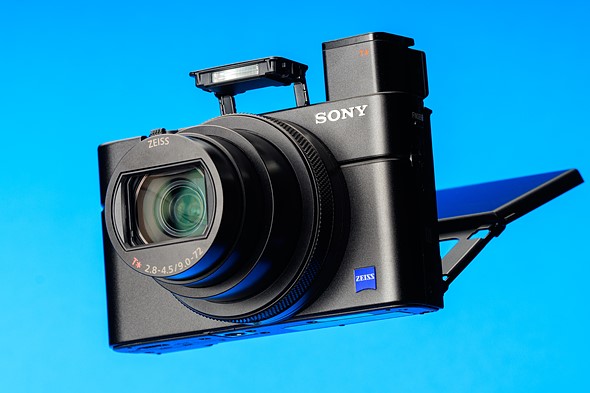
The Sony RX100 VII is the company’s latest pocketable 1″ sensor compact. It uses the same 24-200mm equivalent F2.8-4.5 lens as its predecessor but features a more capable, easier-to-use autofocus system.

This comes in addition to the already impressive capabilities we saw in the Mark VI, including very fast continuous shooting and high-quality 4K video capture. And, for the first time in the series, the Mark VII has a mic socket for improved audio recording.

The Mark VII can shoot at up to 20 frames per second with no viewfinder blackout: specs that are a match for the company’s flagship a9 sports camera. And it’s this capability, along with the enhanced AF, that prompts Sony to talk about ‘the power of an a9 in your pocket.’ To be clear, though, it does not share its hardware with that model.

Key Specifications

  • 20MP 1″-type stacked-CMOS sensor with phase detection and built-in DRAM
  • 24-200mm equivalent F2.8-4.5 zoom
  • 20 fps continuous shooting with full autofocus and auto-exposure, and no blackout
  • Seven frame, 90 fps ‘single burst’ mode
  • Retractable 2.36M-dot EVF with 0.59x equiv. magnification
  • 3″ touchscreen LCD (flips up 180° or down by 90°)
  • Oversampled UHD 4K video (up to 5 min clips in standard temperature mode)
  • Combined lens and digital ‘Active’ stabilization mode in video
  • High speed video at up to 1000 fps
  • Intervalometer
  • Wi-Fi with Bluetooth and NFC

The RX100 VII will be available in August 2019 at a recommended price of $ 1200. It’ll sell for around €1300 in Europe and £1200 in the UK, with both figures including tax. These are around the same prices as its predecessor was launched at, so we expect to see the Mark VI get re-positioned, to make room.


What’s new and how it compares

The RX100 VII looks like its predecessor but borrows know-how (though not hardware) from the pro-sports a9 model.

Click here to read more

Body and handling

The RX100 VII is an evolutionary product but somehow finds room for a mic socket, as well as that massive lens.

Click here to read more

Operation and controls

The control layout and logic is unchanged from previous models (for better or worse). There’s a good degree of customization available.

Click here to read more

AF and video performance

The RX100 VII offers one of the best autofocus implementations of any compact on the market, video impresses too.

Click here to read more

Image quality

Image quality from the RX100 VII is slightly improved over the VI. Check out our studio test scene to see how it compares to the competition.

Click here to read more.

Conclusion

The RX100 VII receives our gold award and recommendation. Here’s why.

Click here to read more.

Sample gallery

We’ve been shooting with a pre-production RX100 VII for a few days now. Have a look at what the new sensor can do.

Click here to see the gallery.

Articles: Digital Photography Review (dpreview.com)

 
Comments Off on Sony Cyber-shot DSC-RX100 VII Review

Posted in Uncategorized


Tamron teases four new lenses for Sony E mount cameras

23 Aug

Tamron USA has shared the above video on Facebook teasing four new lenses for Sony E mount camera systems.

In the 18-second video, which is accompanied by the description ‘Tamron Thrives on Challenging the Limits,’ Tamron shows off the silhouette of four new lenses alongside its currently-available 17-28mm F2.8 Di III RXD and 28-75mm f/2.8 Di III RXD lenses.

No additional details are given, but based on the sizing of the lenses, it appears as though the tallest of the four lenses will be a telephoto zoom (note the focus and zoom rings on the edge of the silhouette) and the remaining three lenses will be more compact primes.

In a follow-up post, Tamron says the lenses will be ‘Coming Soon,’ but leaves it at that. Sony Alpha Rumors is reporting the new lenses being shown off at PhotoPlus in October, but that’s far from confirmed at this point.

Articles: Digital Photography Review (dpreview.com)

 
Comments Off on Tamron teases four new lenses for Sony E mount cameras

Posted in Uncategorized


Viltrox APS-C lenses for Fujifilm, Sony and Leica detailed ahead of launch

23 Aug

Chinese camera gear brand Viltrox is planning to release three autofocus lenses for Fujifilm X-mount, Sony E-mount, and Leica M-mount, according to FujiRumors, which initially spied the upcoming products back in May.

In a new report published this week, FujiRumors detailed the alleged specs for the three lenses, product images for which it found published on Viltrox’s official profile on Chinese social media website Sina Weibo. Below are images of the lenses and a breakdown of the specifications based on the charts provided by Viltrox:

$ (document).ready(function() { SampleGalleryV2({“containerId”:”embeddedSampleGallery_2165464926″,”galleryId”:”2165464926″,”isEmbeddedWidget”:true,”selectedImageIndex”:0,”isMobile”:false}) });

Viltrox 23mm F1.4:

  • Aperture range: 1.4 – 16
  • Aperture blades: 9
  • 10 Groups, 11 elements
  • Filter size: 52mm
  • Weight: 250g (8.8oz)

Viltrox 33mm F1.4:

  • Aperture range: 1.4 – 16
  • Aperture blades: 9
  • 9 Groups, 10 elements
  • Filter size: 52mm
  • Weight: 270g (9.5oz)

Viltrox 56mm F1.4:

  • Aperture range: 1.4 – 16
  • Aperture blades: 9
  • 9 Groups, 10 elements
  • Filter size: 52mm
  • Weight: 290g (10.2oz)

It’s unclear when the new lenses will launch. The initial report in May claimed on behalf of a source that the new models may launch in October, but the latest report points toward ‘around November’ as the official release time frame. Prices haven’t been revealed at this time. These three lenses will join Viltrox’s previously launched 85mm F1.8 autofocus APS-C lens.

Articles: Digital Photography Review (dpreview.com)

 
Comments Off on Viltrox APS-C lenses for Fujifilm, Sony and Leica detailed ahead of launch

Posted in Uncategorized


Sony FE 35mm F1.8 Review

21 Aug

$ (document).ready(function() { SampleGalleryStripV2({“galleryId”:”7486847777″,”isMobile”:false}) })

Sample photoSample photoSample photoSample photoSample photo
Silver Award

88%
Overall score

As Sony’s full-frame mirrorless lens lineup has grown, there is a certain irony that as the company started on churning out some really, really good lenses, like the 12-24mm F4, the 24mm F1.4 and the eye-searingly sharp 135mm F1.8, a large portion of Sony’s customer base was yearning for something much simpler. And much smaller. And cheaper. For a couple of years, “I just want a 35mm F1.8!” was one of the most oft-posted comments underneath our Sony lens coverage.

Finally, on July 9th in the year of our Lord 2019, Sony answered those users’ prayers and released the FE 35mm F1.8. And peace did fall across the land, and there was much rejoicing – for about five minutes until we all found something else to complain about.

Product images by Dan Bracaglia, all other photographs by Rishi Sanyal unless otherwise noted.

Key specifications:

  • Compatibility: Sony E-mount (full-frame and APS-C)
  • Focal length: 35mm (52mm equiv. on APS-C bodies)
  • Maximum aperture: F1.8
  • Minimum focus: 22cm (8.7″ – max magnification 0.24X)
  • Construction: 11 elements in nine groups (incl., one aspherical)
  • Weight: 280g (10 oz)
  • Dust and weather-resistant
  • Diameter / Length: 66mm x 73mm (2.6″ x 2.9″)

The FE 35mm F1.8 joins the FE 20mm F2 and FE 85mm F1.8 in the non-GM, non-G lineup, and shares some similarities with both earlier lenses. You won’t find any fancy exotic glass inside the 35mm F1.8, and Sony doesn’t claim that these lenses are up to the GM standard of durability when it comes to weather-sealing, but they’re sharp, small-ish and relatively affordable primes, all coming in at under $ 800 MSRP.

You’ll find just one unconventional piece of glass inside the FE 35mm F1.8 – an aspherical element, towards the rear of the lens.

Placing the focusing optics at the rear of the lens allows optical designers to greatly reduce focus breathing.

The FE 35mm F1.8 is the priciest of the bunch, at $ 750. This is noticeably more expensive than the film-era 35mm F1.8 lenses of yore, but as we’ll see, just like the recently-reviewed Nikon Z 35mm F1.8 S, it belongs to a new generation in more ways than just one.

The Sony FE 35mm’s size, weight and cost make it a perfect companion to the A7 III, but it’s equally at home on the higher-resolution sensor of the A7R III and A7R IV. In fact, – spoiler alert – we’d recommend it over the costlier Sony Distagon T* FE 35mm F1.4 ZA for almost every use-case.

Articles: Digital Photography Review (dpreview.com)

 
Comments Off on Sony FE 35mm F1.8 Review

Posted in Uncategorized


Sony 35mm 1.8 FE Lens Review [video]

18 Aug

The post Sony 35mm 1.8 FE Lens Review appeared first on Digital Photography School. It was authored by Caz Nowaczyk.

In this video, Chris Turner reviews the Sony 35mm 1.8 FE lens.

?

Sony 35mm 1.8 FE

This is what Chris thinks of the lens:

Build quality

  • While the build quality is quite good, it feels a step behind the 55mm 1.8 Zeiss lens. It’s about the same as the 85mm 1.8. It doesn’t feel high-end.
  • Has the function button on the lens which you can use to focus hold or eye focus. You can program it to a heap of different stuff.
  • It also has the AF/MF switch to change from auto to manual focus easily.
  • It is small – just slightly smaller than the 55mm 1.8 – with about the same thickness. It’s compact for travel unit.
  • Focus is speedy and performs flawlessly. It also works well in low-light and backlight situations. The video focus is also fast and accurate.
  • The lens isn’t weather sealed.

Image quality

  • The Sony 35mm 1.8 takes high-quality images. While the 55mm 1.8 has some really weird flaring in certain situations, the flaring in the 35mm is well controlled with a nice glow. If you’re backlighting an image, it’s going to look really nice with this lens.
  • Chromatic aberration is definitely present. It’s not great in terms of aberration control. It’s quite bad at f/1.8
  • The lens is incredibly sharp. It is easily sharper than the 35mm 1.4 zeiss, especially wide open. If you stop it down, it just gets better and better. If you are putting something in the edge of the frame, it still is quite sharp.
  • The colors are very nice and have plenty of contrast.

Overall, the 35mm 1.8 is an impressive lens.

Chris says while the 35mm is a great lens, it won’t replace his favorite lens, the 24mm G-master.


You may also like:

  • The Sony 100-400mm Lens Thoughts and Field Test
  • Sony Announces New Compact Camera With Amazing Features
  • Sony Announces Incredible 61-Megapixel Full-Frame Camera: The A7R IV
  • Sony FE 135mm F/1.8 GM Lens Review
  • Gear Review: Sony FE 85mm f/1.4 GM Lens
  • Camera Comparison – The Fujifilm X-H1 Versus the Sony a7R III


The post Sony 35mm 1.8 FE Lens Review appeared first on Digital Photography School. It was authored by Caz Nowaczyk.


Digital Photography School

 
Comments Off on Sony 35mm 1.8 FE Lens Review [video]

Posted in Photography


DPReview TV: Sony RX100 VII review

17 Aug
Sony’s RX100 VII has landed, but after seven(!) iterations you may be asking, “Is there anything left to add to this camera?” It turns out the answer is a resounding ‘yes’. Watch Chris and Jordan’s video review to learn what’s new and why it matters.
What do you think of the RX100 VII? Tell us in the comments!

Get new episodes of DPReview TV every week by subscribing to our YouTube channel!

  • Introduction
  • New sensor
  • High speed shooting
  • The zoom lens
  • Macro photography
  • Single burst shooting
  • Battery life
  • Rolling shutter
  • Real-time AF tracking
  • LCD screen and EVF
  • Video capabilities
  • Compared to smartphones
  • Compared to Canon G7 X III and G5 X II
  • Wrap-up

Sample images from this week’s episode

$ (document).ready(function() { SampleGalleryV2({“containerId”:”embeddedSampleGallery_5355715028″,”galleryId”:”5355715028″,”isEmbeddedWidget”:true,”selectedImageIndex”:0,”isMobile”:false}) });
Articles: Digital Photography Review (dpreview.com)

 
Comments Off on DPReview TV: Sony RX100 VII review

Posted in Uncategorized


Nitecore announces ‘world’s first’ smart battery for Sony full-frame mirrorless cameras

15 Aug

Nitecore has announced the NFZ100, the world’s first ‘smart battery’ for Sony full-frame mirrorless cameras, including the a7 III, a7R III and a9 systems.

Like most ‘smart’ electronics, the unique feature of the NFZ100 is the ability to manage and monitor the battery with an accompanying smartphone app. Nitecore NNERGY, as it’s called, is available to download for free on both Android and iOS devices.

Once installed and connected to the NFZ100, the NNERGY app will let you monitor the battery health, battery level, battery voltage and other real-time battery information. Nitecore even offers a dedicated ‘Storage Mode’ within the app that will discharge the battery to 70% to help maximize its lifespan if it won’t be in use for some time.

Individual batteries can be labelled with three-digit identifiers to ensure you can tell them apart inside the app. There is even an option to upgrade the firmware of the batteries as Nitecore further develops its technology. Yes, you read that right, you might soon need to update the firmware of your camera batteries, not unlike you do your camera itself.

The NFZ100 batteries feature 2,280 mAh capacity, which Nitecore estimates is good for 500 still photos when shooting with the Sony a9. Voltage is 7.2V, giving it a power rating of 16.4Wh.

Other features include overcharge protection, over-discharge protection, overcurrent protection, over voltage protection and short-circuit protection. The batteries weigh 82.5g (2.91oz) and measure 52 x 38.7 x 22.5mm (2.05 x 1.52 x 0.89in).

The Nitecore NFZ100 doesn’t appear to be available to purchase through any online retailers as of now and no current pricing information is available. DPReview has contacted Nitecore and will update this article with more information if we get a response.

In the meantime, you can find out more information on Nitecore’s website.

Articles: Digital Photography Review (dpreview.com)

 
Comments Off on Nitecore announces ‘world’s first’ smart battery for Sony full-frame mirrorless cameras

Posted in Uncategorized


Video: Sony Tough SD cards torture tested with blender, washer, freezer and more

08 Aug

Photographer Steve Huff has published a new video in which he subjects Sony’s Tough SD cards to a variety of durability tests involving everything from a washing machine to a blender. According to Sony, it engineered this SD card model ‘for toughness,’ stating on its website that the Tough cards are ‘dust, dirt, water, mud, and grime-proof.’

The Sony Tough SD card has an IP68 dustproof and waterproof rating, as well as a rib-less and switchless design, which Sony says eliminates ‘risks of breakage.’ Ultimately, the company claims its Tough cards at shock- and crush-proof.

Of course, this doesn’t mean the cards are indestructible, as demonstrated by Huff. The SD cards were no match for the blender, which immediately rendered them into small bits of plastic and metal. The Sony Tough cards were able to withstand the other tests, however, including cycles through a washer and dryer, being frozen in water, submerged in a pool and left out in sunlight.

Articles: Digital Photography Review (dpreview.com)

 
Comments Off on Video: Sony Tough SD cards torture tested with blender, washer, freezer and more

Posted in Uncategorized


The Sony 100-400mm Lens Thoughts and Field Test

05 Aug

The post The Sony 100-400mm Lens Thoughts and Field Test appeared first on Digital Photography School. It was authored by Suzi Pratt.

The Sony 100-400mm f/4.5-5.6 lens was announced in 2017 along with the Sony A9. Both the camera and lens were highly anticipated by many professional photographers because they offer features that were long lacking in the Sony E-mount lineup. In particular, this lens with its far-reaching focal length appeals to sports and wildlife photographers. But with a price tag of just $ 2,500, this lens is pretty accessible to amateur and hobby photographers as well. In this post, I’ll give an overview of specs for this lens plus my thoughts after using it to photograph birds.

Sony-100-400mm-lens-with-Sony-A7rIII

Lens Specs

The Sony 100-400mm lens is a variable aperture lens for Sony full-frame cameras. You can use it on Sony crop-sensor cameras, but its physical size might make it awkward to shoot with, especially if used on a tiny camera like the Sony a6000. There is optical image stabilization (OIS) that provides a degree of stability when shooting handheld photos and videos with this lens.

Size-wise, it has a diameter of 3.7 inches and a length of 8.07 inches. The lens weighs approximately 49.2 ounces or 1395 grams. If those numbers don’t mean much to you, the 100-400mm is a very similar size and weight to the Sony 70-200mm f/2.8. Some might consider this lens to be big and bulky, but for the focal range, I think its size is reasonable and comparable to similar lenses made by other manufacturers.

One thing is for sure: you’ll get the best quality if you use a monopod with this lens.

In terms of physical buttons, there are two that are particularly helpful. One button is a focus range limiter that restricts the range of distances the camera will attempt to lock focus on. This boosts the speed of focus as well as focus accuracy, preventing focus hunting. The other feature is the ability to adjust zoom smoothness to prevent the lens from sliding out when carried.

Sony 100-400mm Lens

Best uses

With a variable aperture of f/4.5-5.6, this isn’t a particularly fast lens, so it is best used in ample lighting conditions. Think broad daylight scenarios such as sports, nature, and wildlife. Portraiture may even work well with this lens, although most swear by the 70-200mm f/2.8 for people shots.

For the field test, I paired the 100-400mm with the Sony A7rIII. Using a camera with more resolution (42.4 megapixels) is especially beneficial as the extra megapixels allow you to crop in. You can also take advantage of shooting in APS-C mode on the camera, which effectively doubles your focal range. The A7RIII can also shoot at up to 10 frames per second, and has the newly added animal eye autofocus tracking, making this camera very ideal for wildlife photography. Both the camera and lens have weather sealing. However, I did not test this feature on this shoot.

Sony-100-400mm-lens-with-Sony-A7rIII

Size comparison of the Sony 100-400mm to the Fujifilm 100-400mm.

Lens alternatives

If you plan to shoot in low lighting, the Sony 300mm f/2.8 or 400mm f/2.8 lens will be more appropriate. However, those lenses are $ 5,800 and $ 12,000 respectively, so you’ll need deep pockets. Considering these prices, $ 2,500 for the 100-400mm is quite reasonable. You may even want to consider the newly announced 200mm-600mm f/5.6-6.3 lens, which is just $ 2,000, but considerably larger in size.

So how was it?

I took the 100-400mm on a weekend trip to go birding in Eastern Washington.

Birds were aplenty, and this lens excelled at shooting them in daylight conditions at every focal length. Its size and weight made it possible to shoot handheld. But for extended periods of time and for optimal performance, it was best used when mounted on a monopod.

Performance-wise, autofocus was fast and accurate. Animal eye autofocus (new to the Sony A7RIII and several other camera bodies) was hit or miss for birds, but I’ve heard that it currently works best on dogs and cats.

Would I buy this lens?

If I was an avid wildlife and birding photographer, I absolutely would. The price of $ 2,500 is more than reasonable for a lens with this focal range. Although, third-party lens makers such as Sigma and Tamron are producing some stellar pieces of glass lately and I would love to see them make a version of this lens for Sony E-mount.

Sample images

Image: 1/1000 sec, f/5.6, ISO 320 at 400mm (in 35mm: 600mm)

1/1000 sec, f/5.6, ISO 320 at 400mm (in 35mm: 600mm)

Sony 100-400mm on Sony a7riii

1/1000 sec, f/5.6, ISO 400 at 400mm (in 35mm: 600mm)

Sony-100-400mm-lens-on-Sony a7riii

1/1000 sec, f/5.6, ISO 400 at 400mm (in 35mm: 600mm)

Image: 1/160 sec, f/6.3, ISO 800 at 139mm (in 35mm: 208mm)

1/160 sec, f/6.3, ISO 800 at 139mm (in 35mm: 208mm)

Image: 1/250 sec, f/7.1, ISO 500 at 400mm (in 35mm: 600mm)

1/250 sec, f/7.1, ISO 500 at 400mm (in 35mm: 600mm)

Sony 100-400mm on Sony a7riii

1/2500 sec, f/5.6, ISO 320 at 100mm

Have you used this lens? If so, what are your thoughts? Please share with us in the comments below.


Sony-100-400mm-Lens-review

The post The Sony 100-400mm Lens Thoughts and Field Test appeared first on Digital Photography School. It was authored by Suzi Pratt.


Digital Photography School

 
Comments Off on The Sony 100-400mm Lens Thoughts and Field Test

Posted in Photography


Sony Announces New Compact Camera With Amazing Features

01 Aug

The post Sony Announces New Compact Camera With Amazing Features appeared first on Digital Photography School. It was authored by Jaymes Dempsey.

Are you searching for a pocket-sized camera that packs a big punch?

Look no further than the just-announced Sony Cybershot RX100 VII, which is an all-around amazing camera, from its small size to its impressive zoom to its powerful optics.

First, take a look at its lengthy zoom lens, which goes from 24mm to 200mm in moments. This is perfect for capturing wider landscapes, then zooming in to emphasize a few compelling details.

The Sony RX100 VII also promises stellar image quality, with a ZEISS lens and a 20.1-megapixel sensor.

But where the Sony RX100 VII really shines is in the thick of the action. The RX100 VII shoots at 20 frames-per-second, which is far faster than most competitors on the market. And the autofocus is especially notable, with 357 AF points.

Sony-RX100-VII

If you’ve worked with mirrorless or DSLR cameras before, then you’ll appreciate the electronic viewfinder on the RX100 VII. This is useful for shooting in bright conditions, or when you’re struggling to see the (touchscreen!) LCD.

Oh, and did I mention the 4K video capabilities? If you want a camera that will get you good images and beautiful videos while remaining nicely compact, the RX100 VII may be the way to go.

Who is the Sony RX100 VII for?

The RX100 VII should appeal to a few groups of people.

First, the RX100 VII is a good camera for beginner photographers looking to buy something a bit more long-term, but who doesn’t want to deal with the complexities or price of a DSLR or mirrorless camera.

And for those of you who have been using your smartphones as a primary camera, the RX100 VII will take your photos up a notch – without requiring much in the way of advanced settings or know-how.

Finally, the Sony RX100 VII is ideal for more serious photographers who want a second, more portable camera body. If you often get frustrated carrying around a DSLR or mirrorless camera/lens combo while traveling, then the Sony RX100 VII may be exactly what you need.

Are you excited about the release of the Sony RX100 VII? What is your favorite new feature? Let me know in the comments!

You may also find the following helpful:

  • Which Crop Sensor Sony a6000 Series Camera Should You Buy?
  • Hands-On with the new Sony RX100 VI Compact Camera
  • Why This Pro is (sort of) Switching from Canon to Sony
  • Sony a6300 Mirrorless Camera – Thoughts and Field Test

The post Sony Announces New Compact Camera With Amazing Features appeared first on Digital Photography School. It was authored by Jaymes Dempsey.


Digital Photography School

 
Comments Off on Sony Announces New Compact Camera With Amazing Features

Posted in Photography