RSS
 

Posts Tagged ‘Seriously’

Sigma 14-24mm F2.8 DG HSM Art will cost just $1,300, seriously undercuts Nikon

23 Feb

When Sigma announced the 14-24mm F2.8 DG HSM Art lens, the company held off on sharing pricing or availability. Fortunately, Sigma didn’t make us wait long, revealing today that the ultra-wide angle zoom will ship in mid-March for the very reasonable price of $ 1,300.

Sigma is not being bashful about this lens. The press release announcing the price and availability of the new Art lens reads:

Designed for 50-megapixel plus cameras, the 14-24mm F2.8 DG HSM Art achieves the legendary Art lens sharpness with three FLD glass elements, three SLD glass elements, and three aspherical lens elements, including one 80mm high precision molded glass aspherical element. With near zero distortion (less than 1%) and minimal transverse chromatic aberration, flare and ghosting, the new Sigma 14-24mm offers constant F2.8 brightness throughout the zoom range and delivers optimal image quality at every focal length and shooting distance. The high-speed, high-accuracy autofocus allows photographers to capture incredible, in-the-moment images that set a new standard in the era of outstanding high-resolution.

Here are a few sample images from Sigma that purport to show off this optical prowess:

$ (document).ready(function() { SampleGalleryV2({“containerId”:”embeddedSampleGallery_8359783627″,”galleryId”:”8359783627″,”isEmbeddedWidget”:true,”selectedImageIndex”:0,”isMobile”:false}) });

The lens is available in Canon, Nikon, and Sigma mounts, with the Canon version boasting compatibility with Canon’s Lens Aberration Correction function and the Nikon version featuring a brand new electromagnetic diaphragm. All mount options also feature Sigma’s “Sport line level dust- and splash-proof design.”

It seems Canon users have a new ultra-wide zoom option, while Nikon users have been handed 600 very good reasons to consider the brand-new Sigma over Nikon’s own 11-year-old AF-S Nikkor 14-24mm F2.8G ED that goes for $ 1,900.

Press Release

Sigma Announces Pricing & Availability for Its New 14-24mm F2.8 DG HSM Art Lens

The ultra-wide angle zoom will begin shipping in mid-March for a retail price of $ 1,299.00 USD

Ronkonkoma, NY – February 23, 2018 – Sigma Corporation of America, a leading still photo and cinema lens, camera, flash and accessory manufacturer, today announced that the latest addition to its Sigma Global Vision lens offerings, the 14-24mm F2.8 DG HSM Art, will be available in mid-March for $ 1,299.00 USD through authorized US retailers. Designed for 50-megapixel plus cameras, the 14-24mm F2.8 DG HSM Art achieves the legendary Art lens sharpness with three FLD glass elements, three SLD glass elements, and three aspherical lens elements, including one 80mm high precision molded glass aspherical element. With near zero distortion (less than 1%) and minimal transverse chromatic aberration, flare and ghosting, the new Sigma 14-24mm offers constant F2.8 brightness throughout the zoom range and delivers optimal image quality at every focal length and shooting distance. The high-speed, high-accuracy autofocus allows photographers to capture incredible, in-the-moment images that set a new standard in the era of outstanding high-resolution.

In addition to outstanding optical performance, the 14-24mm F2.8 DG HSM Art features the Sports line level dust- and splash-proof design with special sealing at the mount connection, manual focus ring, zoom ring and cover connection, allowing for the lens to be used during varying weather conditions.

The new Sigma 14-24mm F2.8 DG HSM Art lens supports Canon, Nikon and Sigma mounts and works with Sigma’s MC-11 Sony E-mount converter. The Nikon mount features brand new electromagnetic diaphragm, whereas the Canon mount is compatible with the Canon Lens Aberration Correction function.

Full technical specifications can be found on the Sigma website at: https://www.sigmaphoto.com/14-24mm-f2-8-dg-hsm-a.

Articles: Digital Photography Review (dpreview.com)

 
Comments Off on Sigma 14-24mm F2.8 DG HSM Art will cost just $1,300, seriously undercuts Nikon

Posted in Uncategorized


Video: How to make an HDR image using Microsoft Excel… seriously

22 Jan

Photographers have many different kinds of software for producing high dynamic range images, but Microsoft Excel probably doesn’t make your list of photo editing apps. Well… be prepared to change your mind.

On the off chance you don’t know what Microsoft Excel is, it’s a spreadsheet application that’s primarily used for business application. But in May of last year, Columbia University computer science student Kevin Chen showed that is was also capable of producing an HDR photo using some complicated math and a couple dozen GBs of RAM.

Before coming to Columbia, Chen worked as an intern at Apple, working on camera technology. It was that experience—understanding the math behind digital photography in general and high dynamic range imagery specifically—that allowed him to implement the “system of linear equations” that is typically used in HDR imaging.

After turning the original photo grayscale, and using each cell in Excel as a different “pixel”, he was able to implement this math (and zoom way out) to reveal his final product. Here is the color before and grayscale after:

Sure, you probably don’t want to make Excel your primary HDR processing software. But Chen’s presentation reveals something that is easy to lose sight of when you’re processing digital files and working with photographs: as far as your computer is concerned, it’s all pixel values and math.

Check out the full presentation up top, and then head over to Chen’s website if you want to know more about the young computer scientist.

Articles: Digital Photography Review (dpreview.com)

 
Comments Off on Video: How to make an HDR image using Microsoft Excel… seriously

Posted in Uncategorized


Seriously sharp: Sony FE 85mm F1.4 GM samples

11 Mar

We knew Sony’s FE 85mm F1.4 G Master lens was sharp. After all, we had the chance to shoot with it briefly back in February at the Sony a6300 launch event in New York City. But last week we got better acquainted with the lens, putting it through its paces in different shooting scenarios throughout Miami. And simply put, this lens is seriously sharp. All of the samples in the gallery were shot using the Sony a7R II. Please note, we’ve included Raw files for download for a selection of the images.

Note: This sample gallery was shot while on a Sony-sponsored shooting event in Miami. Part of the excursion included photographing models in scenes that call back to famous Miami-based TV shows and movies including Scarface, Miami Vice and CSI Miami. No actual gangsters or cops were photographed during the making of this gallery.

Articles: Digital Photography Review (dpreview.com)

 
Comments Off on Seriously sharp: Sony FE 85mm F1.4 GM samples

Posted in Uncategorized


Opinion: Does the arrival of the EOS M3 mean Canon is finally taking mirrorless seriously?

11 Feb

The Canon EOS M3 has 24 million pixels, an APS-C sensor, DSLR features and it looks like a camera. So, does this mean Canon is now taking the mirrorless market seriously? Senior DPR contributor Damien Demolder weighs in. Read more

Articles: Digital Photography Review (dpreview.com)

 
Comments Off on Opinion: Does the arrival of the EOS M3 mean Canon is finally taking mirrorless seriously?

Posted in Uncategorized


5 Tips to Seriously Improve Your Food Photography Techniques

15 May

11 Tip05 Neutral BG

Food photography is arguably one of the most challenging types of photography out there. Like painting, you start with a blank canvas and build. Layer upon layer, you construct the photo until you reach the perfect balance of reality and art.

Everything in the photo is a decision. Every piece is perfectly placed by the photographer.

Starting out is frustrating, I know. You’re the chef, stylist, and the photographer. Once you reach technical proficiency with the camera, what’s next? I have been, and in a lot of ways still am, in that position. So, how do you improve your food photography beyond the basics? You work on the story.

Whether it is an after-party from the perfect cocktail, or the homemade roasted chicken recipe on the farm, like all photography, you’re telling stories.

Some shoots are more complicated stories than others, and it may sound like a lot of work, but it’s really not. Here are five quick tips you can use to seriously improve your food photography and tell better stories.

#1 – CHOOSE YOUR ANGLE

There are really only a few camera angles in food photography that you see again and again, but you need to make the one you choose, a conscious decision. Where you place the camera will affect the type of story you’re trying to tell.

Think of the food beforehand. Its size, shape, height and what is unique about it. Then place the camera where you think best highlights these qualities. Some dishes look great when you shoot from right in front of the food, and others are best suited when the you are looking down from directly above the table. Take a look at the cupcakes below; their spiralled and delicate toppings really stand out when shot from in front, yet the viewer doesn’t even see the size or shape when photographed from above.

01 Tip01 45 vs 90 Cupcakes

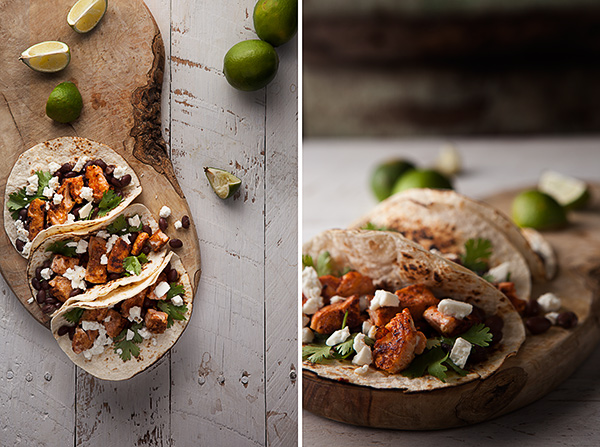
On the other hand, it’s difficult to see all the ingredients and beautiful shape of these salmon tacos when shot from the front, so the shot from above was definitely the way to tell this story.

02 Tip01 45 vs 90 Tacos

#2 – SURROUND YOUR HERO

When shooting from the front of the food try to keep a great foreground and background to play with. Use these empty spaces to tell more of a story. Surround your main dish with ingredients and props that relate to the food. Ingredients, sauces, oils, and cooking utensils could indicate how the dish was made.

Tins, jars, herbs, glasses, fabrics and linens could speak about the origin of the dish or the season in which it is served. Placing a few of these in the foreground and background will definitely elevate your story and give it depth.

03 Tip02 Props

The props in this image of baklava bring more to the story. The viewer has a sense of place that describes the Arabic origins of this delicious sweet.

#3 – NATURAL IS BEST MODIFIED

Light is king, and acquiring a few tools to help you control it will bring your food photography up to the next level. Poor use of light will ruin your story and immediately turn off your audience. So making sure light doesn’t distract will help out your food photos big time.

04 Tip03 Natural vs Diffused

Direct natural light can give really hard and defined shadows like beneath the lemon cake on the left. Where those shadows are softened in the image to the right, with a little help from a cheap diffusor.

Placing a diffusor between the window and your table is first on the list. When working with direct sunlight, a diffusor (or even a thin white bed sheet) will greatly improve the quality of light. Softening those hard, dark shadows and bright highlights caused by direct sun light.

05 Tip03 White vs BlackCard

Using white and black cards really gives you control over the shadow areas. A white card was used to brighten up that lemon frosting on the left, but if you prefer more contrast than grab a black card and you’ll get an image like the one on the right.

Next up are white and black cards. You can make these yourself using foam core boards, bought at any craft store. Size them to fit your needs, using white cards to bounce light into shadow areas, revealing important details, or black cards to make shadows stronger for more contrast.

06 Tip03 BG Blocked vs Unblocked

Nothing really changes between these two images except for a black card that was used to stop light from hitting the background, making sure the cake was the brightest area of the photograph.

Here is a little secret, when working with natural light. I call it, blocking (sometimes also called “gobos”). Sometimes that pesky natural light will fall on your background or props, causing them to be as bright or even brighter than your subject.

Since the viewer will always look at the brightest spot in your photo first, if it’s not your subject, it can harm your story. You can use your black cards to block light from hitting areas that will compete with your subject. This is also a very important technique for creating darker, low-key styled images.

07 Tip03 Final Image

Here is the final image, with a diffusor softening the window light, a white card to fill in the shadow on the lemon frosting and a black card to block the light on the background.

#4 – OUR OLD FRIENDS LINES AND LAYERS

With all these props and ingredients in the frame, how will we ever get the audience to look at our subject? Well, bring on the trusty techniques of composing with lines and layers. You can use props or ingredients to create lines and layered effects in your images. This is a compositional technique used by photographers to lead their audience’s eyes to the main subject.

You can use various props to create lines. Like this spoon, which forms a nice line, directing the viewer straight to the bowl of baked peaches and ice cream.

08 Tip04 Lines

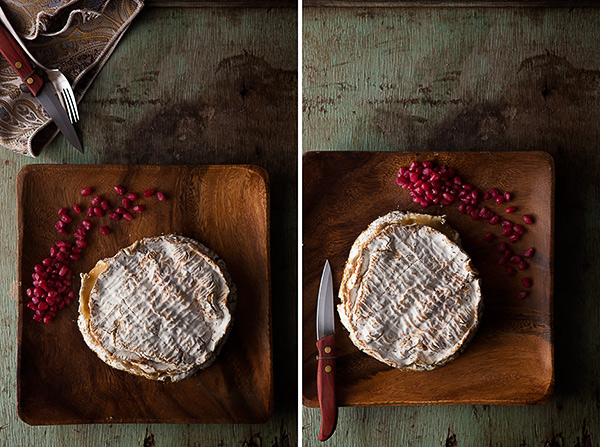
Since shooting from above always gets you more graphic images, there are plenty of chances to create some great lines here as well. Some could be quite literal like this cutlery leading to the round of Brie – or more abstract, like how the knife and pomegranate seeds create lines, framing our subject.

09 Tip04 LeadingLines vs FramingLines

Composing images with layers is always a winner. This Brie, shot from the front, is set in the middle of various props and two large out of focus areas. This creates a layered effect, sending your eyes straight to the star.

10 Tip04 Layers

#5 – HOLD THE COLOR

11 Tip05 Neutral BG

This is my personal favorite. I love hunting for props, backgrounds and tableware to put in my images. This little tip was also the first big mistake I was making when I was starting out. It’s great to have props that are colorful, but if you’re not careful that colorful prop can easily upstage your food, and grab all the attention.

When placing items into your food images, try selecting neutral tones, something that makes the food really pop against it. Selecting a neutral background like this black metal tray and baking paper, amplifies the bright red strawberries and rhubarb inside these Crostatas, making them really steal the show.

Do you photograph food? Do you have any additional tips to share with us? Please add your comments below.

For more food photography tips, try these articles:

  • 8 Steps to Create Mouth Watering Food Photography
  • 11 Quick Food Photography Tips to Make Mouth Watering Images
  • The Ultimate Guide to Food Photography
  • SnapnGuide on Food Photography

The post 5 Tips to Seriously Improve Your Food Photography Techniques by Skyler Burt appeared first on Digital Photography School.


Digital Photography School

 
Comments Off on 5 Tips to Seriously Improve Your Food Photography Techniques

Posted in Photography


Why the Instagram Debacle Just Taught Every Tech Company to Take Your Photos More Seriously

22 Dec

Why the Instagram Debacle Just Taught Every Tech Company to Take Your Photos More Seriously

“Whatever kind of victory all those protests achieved, it wasn’t one for consumer rights — if anything, Instagram is the real winner here. The company just managed to score a round of positive press for retracting an unpopular change and give itself the ability to actually use photos in ads.” — Nilay Patel, The Verge

Over at the Verge Nilay Patel makes a case that the backlash earlier this week against Instagram’s unpopular TOS update was actually a loss for consumers not a gain. He argues that Instagram’s current TOS is broader than their more explicit proposed one and so consumers are worse off, not better off. Because Instagram technically still holds the rights to sell your photos under their current TOS, and even more broadly, the consumer backlash was misguided and really did more harm than good.

I disagree with Nilay and feel that actually this week’s backlash was one of the more significant movements yet for photo sharing on the web.

It’s not that Facebook (whose TOS is equally broad) and Instagram couldn’t legally sell your photos on the web under their broad TOS in the past or in the future, it’s more that *politically* it is now far more difficult for them to begin selling your photos out from under you on the web using their broader TOS.

Who cares what the TOS says, the message that Facebook got loud and clear this week is not to f*** with your photos. Your photos are important. You care about them. They are much more personal to you than Facebook may have previously considered. They have emotional importance and significance and collectively your users will rise up and bash you in the face if you try to exercise terms of your TOS that your lawyers have allowed you to screw around with photos. Whatever your future monetization strategies might be, they will not be based on a loss of control over OUR creative efforts — even our duckface creative efforts.

No, there is no question about it. Instagram lost this week and they lost big. This is in no way a positive for Instagram. People trust them less and they had to turn around and eat crow, they gained nothing.

Flickr won big at Instagram’s expense and Google+ won a little. Flickr won more because like Instagram their site is 100% about photography. They also just released a pretty awesome new iPhone app that is in fact even slickr than what Instagram currently offers.

Flickr also went out of their way last year to really drive home the ownership rights of your photos. This old forgotten post was revived with new life as a stark contrast to what it felt like Instagram was trying to pull. Kevin Systrom eventually even had to parrot back some of that “yes, we know your photos are your photos” stuff in his awkward non-apology apology.

Dan Lyons wrote a post that talked about Google+ winning some here too. Google+ smartly has a provision in their TOS that specifically limits their rights to your photos to basic operational use. Google+ is probably the most active community of photographers on the web today and are a natural beneficiary from what Lyons’ refers to as “Facebook Greedheads.”

The biggest winner or all though was you, the photographer. Whatever Instagram’s original intention was in being more specific in their TOS, it backfired on them. The idea that they could/would profit off your emotionally significant photos without your consent, authorization or most important, sharing the dough, hit a nerve with photographers and likely won’t be tried again by anyone in a long, long time.

The thing is, this didn’t have to be such a painful learning experience for Instagram. There was/is in fact a HUGE opportunity for some smart social media property make a ton of money off of your photos, Instagram just went about it wrong.

As much as Flickr’s deal with Getty sucks (photographers get a miserly 20% payout) photographers on Flickr still went bonkers for it when Flickr released it. The idea that you could actually get PAID to post your photos on a social network, paid ANYTHING, had most users on Flickr clamoring to get into the program, not out of the site.

Even though Flickr/Getty’s call for artists group is now closed (due to overwhelming demand) almost 90,000 photographers joined this group hoping to get selected by Getty for the right to sell their photos for the paltry 20% payout.

The difference with Flickr’s deal though was that 1. you CHOOSE to opt in and 2. at least you got paid something.

What if instead of Instagram saying, “hey, we might sell your photos without your consent and pay you NOTHING,” they said, “hey, do you want to sell your Instagram photos and if we sell them for you split the money 50/50″? Instead of losing accounts and becoming the scourge of the internet for three days, they would have had photographers rushing to sign up and begin marketing their images on their site.

Although there are sites out there like 500px and SmugMug that let you sell your photos now, Flickr is the only larger social network that has a selling program. Google+, Instagram, Facebook, even Twitter, all have a major opportunity to become the first large social network to allow us to license our images through their service and share in the revenue with them. This is a multi-BILLION dollar industry dominated at present by Getty who is not paying creatives enough for their work. What the internet does best is get rid of middlemen when they are being unreasonable, and an 80/20 split with photographers is unreasonable.

Instead of stealing our work and paying us zero, how about using your significant reach in reputation, marketing and search to partner with us and empower us to sell our work together. I guarantee you that whoever comes up with the best program first has some of the best photography on the web flooding your network. Even if 99% of us never sell a single photo, simply giving us the feeling that we have the opportunity to sell a photo would be a powerful incentive to get us active and humming on your network.


Thomas Hawk Digital Connection

 
Comments Off on Why the Instagram Debacle Just Taught Every Tech Company to Take Your Photos More Seriously

Posted in Photography