RSS
 

Posts Tagged ‘science’

Science City: Futuristic Research Complex to Vitalize Egyptian Desert

12 Sep

[ By WebUrbanist in Architecture & Public & Institutional. ]

science city egypt

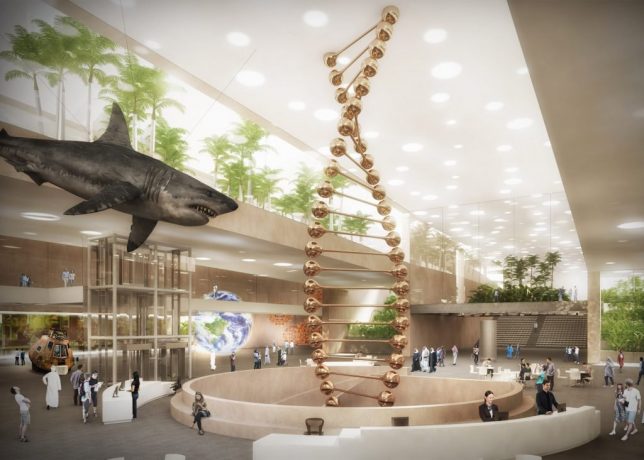
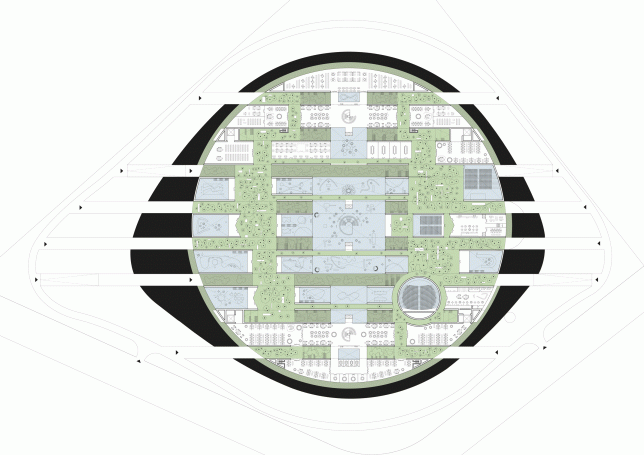
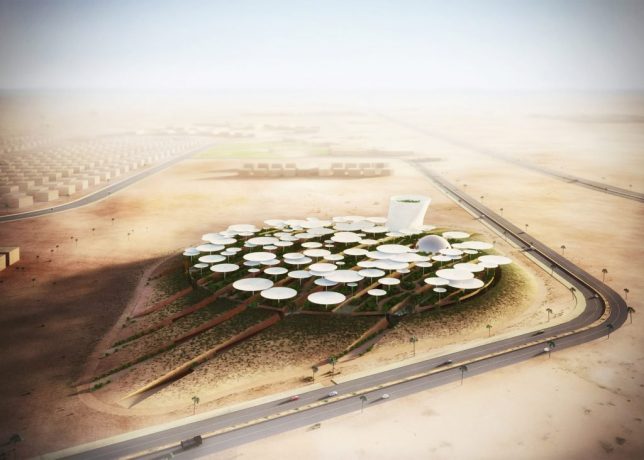
A new 125,000-square-foot science complex to be built outside Cairo will combine research, learning and museum facilities in a future-focused structure designed by competition-winning architects.

science side view

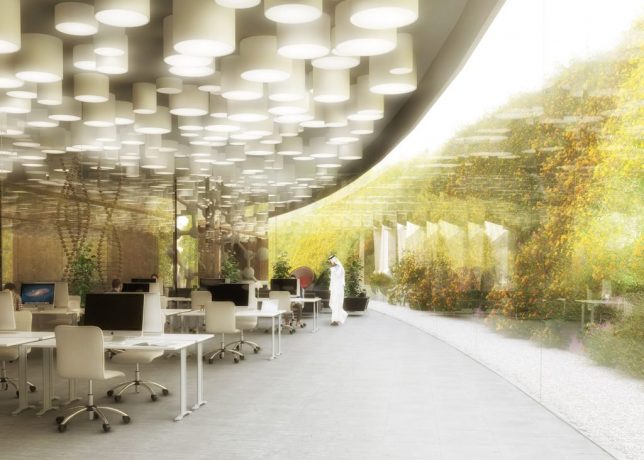
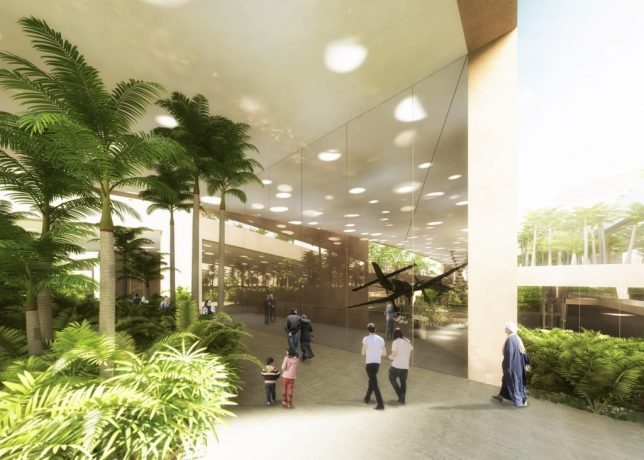
Architects Weston Williamson+Partners beat Zaha Hadid Architects to secure the role of lead designer on this forward-thinking Science City complex. Their plans include a planetarium, observation tower, workshop rooms and conference facilities in addition to spaces dedicated to scientific research and development.

science city displays

science center interior

The competition brief called for a future-oriented, state-of-the-art interactive science museum for the new century, and “a set of buildings and spaces that must be inspiring on the outside and motivating and exciting on the inside to visitors and employees alike” – it attracted nearly 500 submissions from architects around the world.

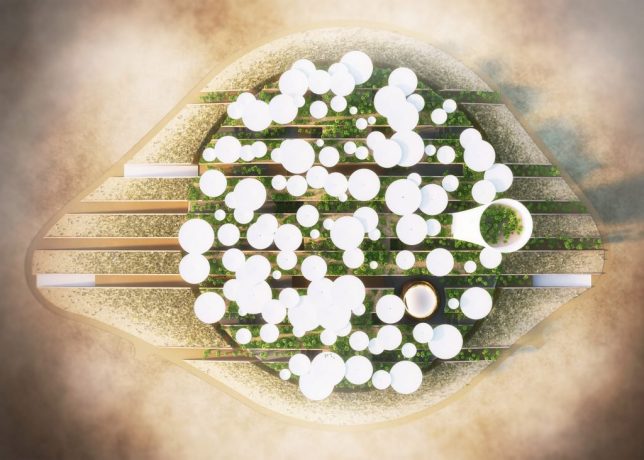
science plan view

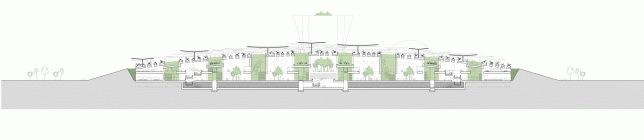
science city section

science master plan

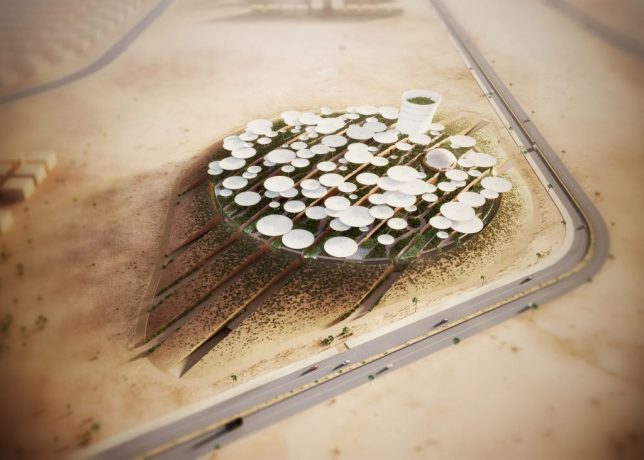
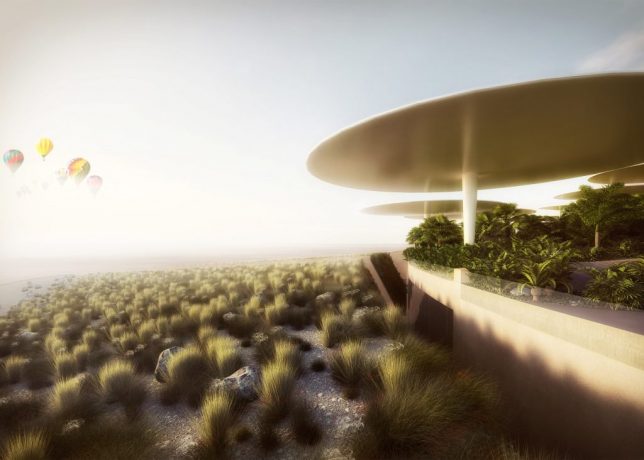
The circular footprint is filled with umbrella-shaped protrusions serving to define spaces and paths while providing shelter from the Egyptian heat. While currently located in a semi-remote location, the design is intended to form part of a larger regional master plan for redefining and expanding Egypt’s capital city.

science exterior

futuristic science complex

Of their victory, the architects said: “We are proud to have won. Needless to say that Egypt has a unique cultural heritage, but we were also attracted by the ambition of the project, clearly expressed through the brief. We look forward to developing the design and creating something worthy for Egypt’s future generations.”

Share on Facebook


[ By WebUrbanist in Architecture & Public & Institutional. ]

[ WebUrbanist | Archives | Galleries | Privacy | TOS ]


WebUrbanist

 
Comments Off on Science City: Futuristic Research Complex to Vitalize Egyptian Desert

Posted in Creativity


MIT Museum exhibition ‘Images of Discovery’ highlights science photography

25 Jun

$ (document).ready(function() { SampleGalleryV2({“containerId”:”embeddedSampleGallery_3889188396″,”galleryId”:”3889188396″,”isEmbeddedWidget”:true,”standalone”:false,”selectedImageIndex”:0,”startInCommentsView”:false,”isMobile”:false}) });

MIT Museum has opened a photography exhibition called ‘Images of Discovery: Communicating Science through Photography,’ running through January 2017. The exhibition showcases photographs from Berenice Abbott, Felice Frankel and Harold ‘Doc’ Edgerton, all three of whom ‘explored a range of scientific questions’ through their photography while working at the university.

All three aforementioned photographers spent time working at MIT; Frankel is a research scientist and science photographer in the MIT Center for Materials Science and Engineering; Edgerton was an MIT Professor of Electrical Engineering and is known, among other things, for his Milk Drop photograph; and Abbot worked for MIT in the late 1950s, contributing images for a physics curriculum.

Speaking about the exhibition, MIT Museum Director John Durant said:

“Wherever you look in science, you see the historical importance of finding new ways of visualizing things, leading to greater understanding of the world. From Galileo’s use of his own hand-built telescope to explain the movements of the earth and other planets, to the latest imaging technologies in everything from nanotechnology to neuroscience, the making of images remains central to our ability to make new discoveries.”

The exhibition includes half a dozen ‘Image Making Stations’ that give visitors the opportunity to better understand and make their own similar science photographs. Image Making Stations including ‘Water Drop,’ ‘Capture Movement,’ ‘A Bouncing Ball,’ ‘Water Waves in a Ripple Tank,’ ‘Photographing Ferrofluid,’ and ‘Zoom Scanner.’

The MIT Museum is located at 265 Massachusetts Ave, Building N51, Cambridge, MA 02139.

Via: wbur

Articles: Digital Photography Review (dpreview.com)

 
Comments Off on MIT Museum exhibition ‘Images of Discovery’ highlights science photography

Posted in Uncategorized


Mystery science theater: A look inside the Samsung NX3000

19 Jun

A peek inside the Samsung NX3000

When it was introduced in May 2014, the Samsung NX3000 didn’t exactly make waves in the camera industry. But it did provide an attractive 20MP sensor, articulated 3″ LCD and plenty of connectivity for a reasonable $ 520 all wrapped up in a super slim rangefinder-style ILC. Being curious about these kinds of things, we wanted to see how Samsung managed to wedge all of that tech into such a slender frame, and thanks to iFixit we can sit back at a safe distance and see how it’s made.

A peek inside the Samsung NX3000

Before proceeding with the disassembly, the camera battery must be taken out.

A peek inside the Samsung NX3000

If iFixit’s disassembly guides have taught us anything, it’s that cameras are held together with a metric ton of tiny screws. Not surprisingly, there are considerably fewer on the NX3000. Disassembly of the lens mount starts with the removal of four 7.3mm Phillips screws.

A peek inside the Samsung NX3000

With a few screws on the bottom, sides and hotshoe removed, the back panel can be eased away from the body…

A peek inside the Samsung NX3000

…And with a ribbon cable disconnected, the panel can be completely removed to reveal a cool blue motherboard.

A peek inside the Samsung NX3000

A pair of tweezers can be used to pluck the tripod mount right out of the camera.

A peek inside the Samsung NX3000

There are several ribbon cables to be removed before the sensor is free, but we think this is the coolest looking one.

A peek inside the Samsung NX3000

…And here’s the sensor module.

A peek inside the Samsung NX3000

With a couple more ribbon cables removed, the motherboard is ready to go too.

A peek inside the Samsung NX3000

The top panel can be freed with only a few more pieces to go.

A peek inside the Samsung NX3000

The button panel is one of the last pieces to be removed from the shell of the camera, also a striking blue color.

A peek inside the Samsung NX3000

And there you have it, the Samsung NX3000 inside and out.

Articles: Digital Photography Review (dpreview.com)

 
Comments Off on Mystery science theater: A look inside the Samsung NX3000

Posted in Uncategorized


Take Photos, for Science!

05 Aug

You’re usually out snapping away at flora and fauna, so why not use those photos to help document our world?

Add your nature shots to iNaturalist and help increase the already huge online database of plants, furry creatures and creepy crawlies.

Upload your photo, tag the location and name the organism if you can. No worries if you don’t know the name, iNaturalist is teeming with people eager to help classify.

It’s a cool way to connect with other nature-lovers, learn about the life around you and add your talent to scientific research!

Photo by RJAdams55


© Erin for Photojojo, 2015. |
Permalink |
No comment |
Add to
del.icio.us

Post tags:


Photojojo

 
Comments Off on Take Photos, for Science!

Posted in Equipment


Weird Science: Olympus BioScapes 2014 winners

29 Dec

Each year Olympus hosts an international competition for images captured through light microscopes. Entries come in from around 70 countries and number in the thousands, revealing the weird and wonderful microscopic world otherwise hidden from the human eye. See this year’s winning entries

Articles: Digital Photography Review (dpreview.com)

 
Comments Off on Weird Science: Olympus BioScapes 2014 winners

Posted in Uncategorized


Weird and wonderful: International science photography competition open for entries

06 Dec

Organizers of a worldwide competition for scientific photography are calling for entries for the International Images for Science competition. Photographers are encouraged to submit visually exciting and revealing pictures of objects and concepts relating to all areas of science. The competition, which is run by the Royal Photographic Society (RPS), is free to enter, and this year will be accepting work from members and non-members alike for the first time. Read more

Articles: Digital Photography Review (dpreview.com)

 
Comments Off on Weird and wonderful: International science photography competition open for entries

Posted in Uncategorized


Lighting Tutorial: The Science Behind Light

05 Jul

Alana Tyler Slutsky image from Surrealia series as featured on Fashion Photography Blog (FashionPhotograpyBlog.com)

Light : The Science of it All

Hey FashionPhotographyBlog.com readers. Happy Independence Day!

Today we are going to be talking about:

Light. Learn to understand it, learn to see it and the better you’ll be able to manipulate it. After all, the whole science behind photography is based on the principles of light. Stick it out through these next three days and things will get a lot more interesting. Before you can learn to manipulate light (or if you’re a curious person like me,) it’s good to understand the “how” and “why” behind it.

So, welcome to the science of light.

(I know this is the boring part, just stick with me…)

Light and Color Science:

The human eye is only sensitive to the visible spectrum of the electromagnetic spectrum.  White light contains all colors.  We learned this when Newton split white light with a prism.

Electromagnetic Spectrum Chart

Electromagnetic Spectrum

Color Prism By Pink Floyd

(Thanks Pink Floyd)

Additive Primaries – Red, Green, Blue

When you add equal parts of the additive primaries together (Red, Green, and Blue), you create white light.  RGB is the color method used in today’s digital world.  Mixing just two of the additive primaries will result with one of the subtractive primaries.

RGB Color Light Chart

Subtractive Primaries – Cyan, Magenta, Yellow

The subtractive primaries absorb their compliments (RGB) and subtract them from white light.  CMYK is the color model for printing (K referring to Black).  When subtractive primaries are mixed, they subtract brightness from white, resulting in Black.

CMYK Color Light Chart

Each additive color has a subtractive color that is its compliment.

Red – Cyan

Green – Magenta

Blue – Yellow

Before you can learn to modify and use light, you need to understand how it works! The first things to be conscious of are the qualities of light which include direction, contrast, color, brightness, diffused, and specular.

Direction is where the light is coming from.  This controls the relationship between light and shadow.  Direction can also be understood as the position or placement of the light.

Contrast is the relationship between light and shade.

Color is the color temperature or actual color of the light source.  (We’ll get into this in a minute.)

Brightness is the intensity of the light.

Diffused light is a softer light typically produced by a larger light source.

Specular light, in short, is light from a source that is not modified. Most of you guys will refer to this as “harsh” or “hard” light.

How can you tell if something is diffused or specular?  Look where the shadow meets the lighted areas.  If the transition is gradual, it is diffused. If the transition is knife edge its specular.  Aka – Does the shadow end very abruptly? Think of high noon light and how the shadows cast by the sun are very crisp.  This is specular light.

Shadow Transition Examples

Pay attention to the transitions at the edge of the shadows

Source

The size of a light source (as relative to your subject) will greatly effect the type of light produced.  A small source will produce hard light, hard edges and harder shadows.  A large light source will produce a shadowless or softer light with softer shadows.

Distance also effects your light.  A light close to your subject will create a softer light, whereas the same light when placed farther away will create a harder light.  Think of the sun!  It’s far away, appears quite small but produces an extremely harsh light/shade relationship unless there are clouds to diffuse the light.  When the sky is overcast, it acts as a giant soft box for the sun.

We’ll dive a little further into distance and light tomorrow.

Until then –

Alana

IMAGE SOURCE:

Feature image & image 1: photography by Alana Tyler Slutsky from her Surrealia series. To view the rest of the photos from this series visit her website.

Image 2, 3, 4 & 5: Alana Tyler Slutsky

Image 6:  150m.com


Fashion Photography Blog

 
Comments Off on Lighting Tutorial: The Science Behind Light

Posted in Uncategorized


The Science of Selecting Photos

06 Nov

By Annie Tao

The business of photography is a complicated matter. I spend hours after each photo shoot culling, processing and sorting the photos to tell the story of the day.

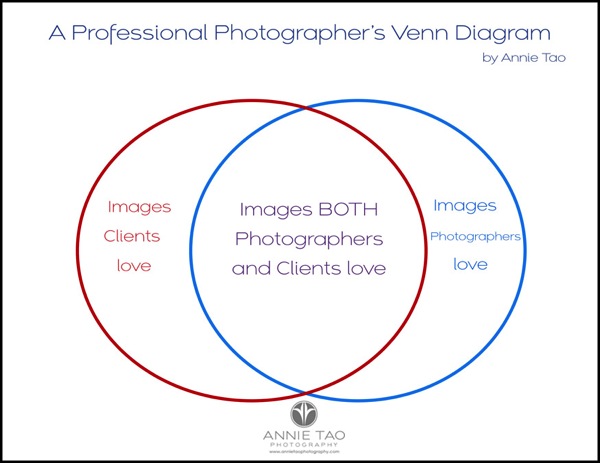
From a recent session of one of my own children, I realized that choosing the final photos can be described as a Venn Diagram! One circle represents images photographers love and the other circle represents images clients love. Some images overlap and some don’t.

To be successful, you want the largest area to be the one that overlaps: images both photographers and clients love. It is important, however, to be aware of what images may fall into the other areas.

Here is an example.

Professional Photographers Venn Diagram by Annie Ta bg

I had a photo shoot of my son just last week. He recently turned 6 years old, so this mini shoot was to capture how he loves reading, loves playing with Legos, and still has hints of having a baby face.

After the shoot, I went through the images as though this was a regular client gallery, but found myself saving a few images that I know would NOT have made it into a client gallery!

That got me thinking.

Are there photos that I’ve left out of a client gallery that should have been in it?

Below are examples of photos from this recent shoot that would make it into a client gallery…

Annie Tao Photography The Science of Selecting Photos article image that would make it into client gallery 2

Annie Tao Photography The Science of Selecting Photos article image that would make it into client gallery 1

Annie Tao Photography The Science of Selecting Photos article image that would make it into client gallery 3

Below are examples of photos that would NOT have made it into a client gallery, but I love…

Annie Tao Photography The Science of Selecting Photos article image that would NOT make it into client gallery 2

Above: he is playing with his hands and arms, which he does when he’s nervous.

Annie Tao Photography The Science of Selecting Photos article image that would NOT make it into client gallery 1

Above: he is chewing gum (I can even see it in his mouth – Oy!), which is his favorite treat.

What does this mean?

Note: I am writing this for Children and Family Photography, but this can apply to any portrait session.

  1. During the session, pay attention to the children’s behavior. What are the little things they do when they’re happy, nervous or excited?
  2. Have an open dialogue with the parents. If they feel comfortable with you, they will share details about what they love or the little quirks that represent their child. It could be something you wouldn’t have guessed.
  3. Remember your client when selecting your final images. Think about what images your clients may like that perhaps didn’t make it into your selection. There may be something you’d want to include in the final images that may bring a tear to their eyes or make them laugh, but isn’t “perfect” in your eyes.

In terms of photo selection, your job as a Photographer is to choose photos that represent your artistic style. You are also a Service Provider whose ultimate goal is to make your clients happy.

Annie Tao is a Professional Lifestyle Photographer in the San Francisco Bay Area who is best known for capturing genuine smiles, emotions and stories of her subjects. You can visit annietaophotography.com for more tips or inspiration and stay connected with her at facebook.com/annietaophotography.

Post originally from: Digital Photography Tips.

Check out our more Photography Tips at Photography Tips for Beginners, Portrait Photography Tips and Wedding Photography Tips.

The Science of Selecting Photos

The post The Science of Selecting Photos by Guest Contributor appeared first on Digital Photography School.


Digital Photography School

 
Comments Off on The Science of Selecting Photos

Posted in Photography


MIT+150: FAST (Festival of Art + Science + Technology): FAST LIGHT — Man studying alone on his Macbook at the library

13 Nov

Some cool visual art images:

MIT+150: FAST (Festival of Art + Science + Technology): FAST LIGHT — Man studying alone on his Macbook at the library
visual art
Image by Chris Devers
More books than you could read in a lifetime and still the Macbook gets more attention. Typical.

• • •

This photo ran in the September/October 2011 edition of The Economist magazine’s More Intelligent Life, with Adrian Wooldridge article, Dr Dole Queue. THANK YOU!

• • •

Quoting from the official pamphlet:

FAST LIGHT • May 7 + 8, 2011, 7 pm – 10 pm

Contemporary pioneers in art, science, and technology have come together at MIT to create one of the most exhilarating and inventive spectacles metro Boston has ever seen. On May 7 and 8, 2011, visitors can interact with 20+ art and architectural installations illuminating the campus and the Charles River along Memorial Drive at MIT.

arts.mit.edu / fast

Installations scattered around campus (we didn’t quite see all of them), again pasting from the official flyer:

• aFloat
MIT Chapel • Saturday, May 7th ONLY
Inspired by water in the Saarinen Chapel’s moat, a touch releases flickers of light before serenity returns as a calm ripple.
By Otto Ng, Ben Regnier, Dena Molnar, and Arseni Zaitsev.

• Inflatables
Lobby 7, Infinite Corridor
A dodecahedron sculpture made of silver nylon resonates with gusts of air, heat from light bulbs, and the motions of passersby.
By Kyle Barker, Juan Jofre, Nick Polansky, Jorge Amaya.

• (now(now(now)))
Building 7, 4th Floor
This installation nests layers of the past into an image of the present, recursively intertwining slices of time.
By Eric Rosenbaum and Charles DeTar.

• Dis(Course)4
Building 3 Stair, Infinite Corridor
A stairwell transformed by a shummering aluminum conduit inspired by the discourse between floors and academic disciplines.
By Craig Boney, Jams Coleman and Andrew Manto.

• Maxwell’s Dream
Building 10 Community Lounge, Infinite Corridor
An interactive mural created by magnetic fields that drive patterns of light, Maxwell’s Dream is a visually expressive cybernetic loop.
By Kaustuv De Biswas and Daniel Rosenberg.

• Mood Meter
Student Center & Building 8, Infinite Corridor
Is the smile a barometer of happiness? Mood Meter playfully assesses and displays the mood of the MIT community onsite and at moodmeter.media.mit.edu
By Javier Hernandez and Ehsan Hoque.

• SOFT Rockers
Killian Court
Repose and charge your electronic devices using green solar powered technology
By Shiela Kennedy, P. Seaton, S. Rockcastle, W. Inam, A. Aolij, J. Nam, K. Bogenshutz, J. Bayless, M. Trimble.

• LightBridge
The Mass. Ave Bridge
A dynamic interactive LED array responds to pedestrians on the bridge, illustrating MIT’s ties to both sides of the river. Thanks to Philips ColorKinetics, CISCO, SparkFun Electronics.
By Sysanne Seitinger.

• Sky Event
Killian Court, Saturday, May 7th ONLY
Immense inflatable stars soar over MIT in celebration of the distinctive symbiosis among artists, scientists and engineers.
By Otto Piene.

• Liquid Archive
Charles River
A floating inflatable screen provides a backdrop for projections that highlight MIT’s history in science, technology, and art.
By Nader Tehrani and Gediminas Urbonas.

• Light Drift
Charles River
Ninety brightly glowing orbs in the river change color as they react to the presence of people along the shore.
By Meejin Yoon.

• Unflat Pavilion
Building 14 Lawn
This freestanding pavilion illuminated with LEDs flexes two dimensions into three. Flat sheets are bent and unfurl into skylights, columns, and windows.
By Nick Gelpi

• Gradated Field
Walker Memorial Lawn
A field of enticing mounts create a landscape that encourages passersby to meander through, or lounge upon the smooth plaster shapes.
By Kyle Coburn, Karina Silvester and Yihyun Lim.

• Bibliodoptera
Building 14, Hayden Library Corridor
Newly emerged from the chrysalis of MIT’s diverse library pages, a cloud of butterflies flutters above, reacting to the movement of passersby.
By Elena Jessop and Peter Torpey.

• Wind Screen
Green Building Facade, Bldg 54
A shimmering curtain of light created by micro-turbines displays a visual register of the replenishable source of wind energy.
By Meejin Yoon.

• String Tunnel
Building 18 Bridge
A diaphonous tunnel creates a sense of entry to and from the Infinite Corridor and frames the surrounding landscape.
By Yuna Kim, Kelly Shaw, and Travis Williams.

• voltaDom
Building 56-66 Connector
A vaulted passageway utilizes an innovative fabrication technique that creates complex double curved vaults through the simple rolling of a sheet of material.
By Skylar Tibbits.

• Night of Numbers
Building 66 Facade & E15 Walkway
A lighting installation enlivens MIT architectre with numbers that hold special or historical significance to the Institute. Can you decode them all?
By Praveen Subramani and Anna Kotova.

• Overliner
Building E-25 Stairwell
Taking cues from a stairwell’s spiraling geometry, Overliner transforms a familiar and busy passageway into a moment of surprise and repose.
By Joel Lamere and Cynthia Gunadi.

• Chroma District
Corner of Ames and Main Streets.
Lanterns react to visitors by passing sound and color from one to another, increasing in intensity along the way and illuminating the path to MIT’s campus.
By Eyal Shahar, Akito van Troyer, and Seung Jin Ham.

Artists on Art: Ruza Bagaric / Dumbo Arts Center: Art Under the Bridge Festival 2009 / 2009-09-26 / SML
visual art
Image by See-ming Lee ??? SML
Ruza Bagaric chats with Mac Farr (MMF) (Flickr) about her paintings and drawings during DUMBO Art Center’s annual Art Under the Bridge Festival in 2009.

Ruza Bagaric is a painter in New York City. You can check out her portfolio at ruzabagaric.com

SML Simulcast
+ Vimeo (720p high-def)
+ YouTube (720p high-def)

13th annual D.U.M.B.O. Art Under the Bridge Festival® (Sept 25 to Sept 27, 2009)
www.dumboartfestival.org/press_release.html

The three-day multi-site neighborhood-wide event is a one-of-a-kind art happening: where serendipity meets the haphazard and where the unpredictable, spontaneous and downright weird thrive. The now teenage D.U.M.B.O. Art Under the Bridge Festival® presents touchable, accessible, and interactive art, on a scale that makes it the nation’s largest urban forum for experimental art.

Art Under the Bridge is an opportunity for young artists to use any medium imaginable to create temporary projects on-the-spot everywhere and anywhere, completely transforming the Dumbo section of Brooklyn, New York, into a vibrant platform for self-expression. In addition to the 80+ projects throughout the historical post-industrial waterfront span, visitors can tour local artists’ studios or check out the indoor video_dumbo, a non-stop program of cutting-edge video art from New York City and around the world.

The Dumbo Arts Center (DAC) has been the exclusive producer of the D.U.M.B.O Art Under the Bridge Festival® since 1997. DAC is a big impact, small non-profit, that in addition to its year-round gallery exhibitions, is committed to preserving Dumbo as a site in New York City where emerging visual artists can experiment in the public domain, while having unprecedented freedom and access to normally off-limit locations.

www.dumboartscenter.org
www.dumboartfestival.org
www.video_dumbo.org

Related SML
+ SML Fine Art (Flickr Group)
+ SML Flickr Collections: Events
+ SML Flickr Sets: Dumbo Arts Center: Art Under the Bridge Festival 2009
+ SML Flickr Tags: Art
+ SML Pro Blog: Art

LiveFast presents: Mash-up Summer 2009 Custom Tees / Dumbo Arts Center: Art Under the Bridge Festival 2009 / 20090926.10D.54545.P1.L1 / SML
visual art
Image by See-ming Lee ??? SML
13th annual D.U.M.B.O. Art Under the Bridge Festival® (Sept 25 to Sept 27, 2009)
www.dumboartfestival.org/press_release.html

The three-day multi-site neighborhood-wide event is a one-of-a-kind art happening: where serendipity meets the haphazard and where the unpredictable, spontaneous and downright weird thrive. The now teenage D.U.M.B.O. Art Under the Bridge Festival® presents touchable, accessible, and interactive art, on a scale that makes it the nation’s largest urban forum for experimental art.

Art Under the Bridge is an opportunity for young artists to use any medium imaginable to create temporary projects on-the-spot everywhere and anywhere, completely transforming the Dumbo section of Brooklyn, New York, into a vibrant platform for self-expression. In addition to the 80+ projects throughout the historical post-industrial waterfront span, visitors can tour local artists’ studios or check out the indoor video_dumbo, a non-stop program of cutting-edge video art from New York City and around the world.

The Dumbo Arts Center (DAC) has been the exclusive producer of the D.U.M.B.O Art Under the Bridge Festival® since 1997. DAC is a big impact, small non-profit, that in addition to its year-round gallery exhibitions, is committed to preserving Dumbo as a site in New York City where emerging visual artists can experiment in the public domain, while having unprecedented freedom and access to normally off-limit locations.

www.dumboartscenter.org
www.dumboartfestival.org
www.video_dumbo.org

Related SML
+ SML Fine Art (Flickr Group)
+ SML Flickr Collections: Events
+ SML Flickr Sets: Dumbo Arts Center: Art Under the Bridge Festival 2009
+ SML Flickr Tags: Art
+ SML Pro Blog: Art

 
Comments Off on MIT+150: FAST (Festival of Art + Science + Technology): FAST LIGHT — Man studying alone on his Macbook at the library

Posted in Photographs


MIT+150: FAST (Festival of Art + Science + Technology): FAST LIGHT — “INCEPTION OF MARTIN LUTHER KING JUNIOR”

12 Nov

Some cool visual art images:

MIT+150: FAST (Festival of Art + Science + Technology): FAST LIGHT — “INCEPTION OF MARTIN LUTHER KING JUNIOR”
visual art
Image by Chris Devers
I have no idea what this was about. It’s clearly a reference to the movie "Inception", with the spinning top there next to Abraham Lincoln, and the briefcase they used in the movie to induce a shared dream state. But why is MLK in an Inception parody with Lincoln and Mahatma Gandhi? Baffling.

Anyway.

• • •

Quoting from the official pamphlet:

FAST LIGHT • May 7 + 8, 2011, 7 pm – 10 pm

Contemporary pioneers in art, science, and technology have come together at MIT to create one of the most exhilarating and inventive spectacles metro Boston has ever seen. On May 7 and 8, 2011, visitors can interact with 20+ art and architectural installations illuminating the campus and the Charles River along Memorial Drive at MIT.

arts.mit.edu / fast

Installations scattered around campus (we didn’t quite see all of them), again pasting from the official flyer:

• aFloat
MIT Chapel • Saturday, May 7th ONLY
Inspired by water in the Saarinen Chapel’s moat, a touch releases flickers of light before serenity returns as a calm ripple.
By Otto Ng, Ben Regnier, Dena Molnar, and Arseni Zaitsev.

• Inflatables
Lobby 7, Infinite Corridor
A dodecahedron sculpture made of silver nylon resonates with gusts of air, heat from light bulbs, and the motions of passersby.
By Kyle Barker, Juan Jofre, Nick Polansky, Jorge Amaya.

• (now(now(now)))
Building 7, 4th Floor
This installation nests layers of the past into an image of the present, recursively intertwining slices of time.
By Eric Rosenbaum and Charles DeTar.

• Dis(Course)4
Building 3 Stair, Infinite Corridor
A stairwell transformed by a shummering aluminum conduit inspired by the discourse between floors and academic disciplines.
By Craig Boney, Jams Coleman and Andrew Manto.

• Maxwell’s Dream
Building 10 Community Lounge, Infinite Corridor
An interactive mural created by magnetic fields that drive patterns of light, Maxwell’s Dream is a visually expressive cybernetic loop.
By Kaustuv De Biswas and Daniel Rosenberg.

• Mood Meter
Student Center & Building 8, Infinite Corridor
Is the smile a barometer of happiness? Mood Meter playfully assesses and displays the mood of the MIT community onsite and at moodmeter.media.mit.edu
By Javier Hernandez and Ehsan Hoque.

• SOFT Rockers
Killian Court
Repose and charge your electronic devices using green solar powered technology
By Shiela Kennedy, P. Seaton, S. Rockcastle, W. Inam, A. Aolij, J. Nam, K. Bogenshutz, J. Bayless, M. Trimble.

• LightBridge
The Mass. Ave Bridge
A dynamic interactive LED array responds to pedestrians on the bridge, illustrating MIT’s ties to both sides of the river. Thanks to Philips ColorKinetics, CISCO, SparkFun Electronics.
By Sysanne Seitinger.

• Sky Event
Killian Court, Saturday, May 7th ONLY
Immense inflatable stars soar over MIT in celebration of the distinctive symbiosis among artists, scientists and engineers.
By Otto Piene.

• Liquid Archive
Charles River
A floating inflatable screen provides a backdrop for projections that highlight MIT’s history in science, technology, and art.
By Nader Tehrani and Gediminas Urbonas.

• Light Drift
Charles River
Ninety brightly glowing orbs in the river change color as they react to the presence of people along the shore.
By Meejin Yoon.

• Unflat Pavilion
Building 14 Lawn
This freestanding pavilion illuminated with LEDs flexes two dimensions into three. Flat sheets are bent and unfurl into skylights, columns, and windows.
By Nick Gelpi

• Gradated Field
Walker Memorial Lawn
A field of enticing mounts create a landscape that encourages passersby to meander through, or lounge upon the smooth plaster shapes.
By Kyle Coburn, Karina Silvester and Yihyun Lim.

• Bibliodoptera
Building 14, Hayden Library Corridor
Newly emerged from the chrysalis of MIT’s diverse library pages, a cloud of butterflies flutters above, reacting to the movement of passersby.
By Elena Jessop and Peter Torpey.

• Wind Screen
Green Building Facade, Bldg 54
A shimmering curtain of light created by micro-turbines displays a visual register of the replenishable source of wind energy.
By Meejin Yoon.

• String Tunnel
Building 18 Bridge
A diaphonous tunnel creates a sense of entry to and from the Infinite Corridor and frames the surrounding landscape.
By Yuna Kim, Kelly Shaw, and Travis Williams.

• voltaDom
Building 56-66 Connector
A vaulted passageway utilizes an innovative fabrication technique that creates complex double curved vaults through the simple rolling of a sheet of material.
By Skylar Tibbits.

• Night of Numbers
Building 66 Facade & E15 Walkway
A lighting installation enlivens MIT architectre with numbers that hold special or historical significance to the Institute. Can you decode them all?
By Praveen Subramani and Anna Kotova.

• Overliner
Building E-25 Stairwell
Taking cues from a stairwell’s spiraling geometry, Overliner transforms a familiar and busy passageway into a moment of surprise and repose.
By Joel Lamere and Cynthia Gunadi.

• Chroma District
Corner of Ames and Main Streets.
Lanterns react to visitors by passing sound and color from one to another, increasing in intensity along the way and illuminating the path to MIT’s campus.
By Eyal Shahar, Akito van Troyer, and Seung Jin Ham.

Artist Studio: James Cospito / Dumbo Arts Center: Art Under the Bridge Festival 2009 / 20090926.10D.54626.P1.L2.SQ / SML
visual art
Image by See-ming Lee ??? SML
Artist toolbox, seen at the Brooklyn Art Project HQ (Flickr Group) during the Dumbo Art Festival 2009.

See also
+ Artits on Art: James Cospito talks about his NYC Subway series (Flickr HD video)
+ Art + Artists: James Cospito talks about Brooklyn Art Project (Flickr HD video)

13th annual D.U.M.B.O. Art Under the Bridge Festival® (Sept 25 to Sept 27, 2009)
www.dumboartfestival.org/press_release.html

The three-day multi-site neighborhood-wide event is a one-of-a-kind art happening: where serendipity meets the haphazard and where the unpredictable, spontaneous and downright weird thrive. The now teenage D.U.M.B.O. Art Under the Bridge Festival® presents touchable, accessible, and interactive art, on a scale that makes it the nation’s largest urban forum for experimental art.

Art Under the Bridge is an opportunity for young artists to use any medium imaginable to create temporary projects on-the-spot everywhere and anywhere, completely transforming the Dumbo section of Brooklyn, New York, into a vibrant platform for self-expression. In addition to the 80+ projects throughout the historical post-industrial waterfront span, visitors can tour local artists’ studios or check out the indoor video_dumbo, a non-stop program of cutting-edge video art from New York City and around the world.

The Dumbo Arts Center (DAC) has been the exclusive producer of the D.U.M.B.O Art Under the Bridge Festival® since 1997. DAC is a big impact, small non-profit, that in addition to its year-round gallery exhibitions, is committed to preserving Dumbo as a site in New York City where emerging visual artists can experiment in the public domain, while having unprecedented freedom and access to normally off-limit locations.

www.dumboartscenter.org
www.dumboartfestival.org
www.video_dumbo.org

Related SML
+ SML Fine Art (Flickr Group)
+ SML Flickr Collections: Events
+ SML Flickr Sets: Dumbo Arts Center: Art Under the Bridge Festival 2009
+ SML Flickr Tags: Art
+ SML Pro Blog: Art

Still Life Drawing (Detail) by James Cospito, Brooklyn Art Project HQ / Dumbo Arts Center: Art Under the Bridge Festival 2009 / 20090926.10D.54607.P1.L2.SQ / SML
visual art
Image by See-ming Lee ??? SML
Drawing, seen at the Brooklyn Art Project headquarter in Dumbo, during the Art Under the Bridge Festival organized by Dumbo Arts Center in New York city, 2009.

James Cospito (Brooklyn Art Project / Facebook / Flickr / LinkedIn / SML Flickr / Twitter) is an artist, painter, photographer, illustrator, designer in New York City. He is also the co-founder of Brooklyn Art Project.

You can check out James Cospito’s portfolio at brooklynartproject.ning.com/profile/jcospito

See also the 720p high-def video of James Cospito talking about BAP on Flickr.

Brooklyn Art Project (FriendFeed / Twitter) is a free online social network that connects 5500+ artists, collectors, and art enthusiasts from over 44 countries featuring over 44,000 artworks and 800+ short films and videos.

Members can participate in collaborative exhibits in Brooklyn and beyond while enjoying unlimited online gallery space, blogs, forums, chat, and tools to share / promote their artwork across the web.

BrooklynArtProject.com

See also
+ Artits on Art: James Cospito talks about his NYC Subway series (Flickr HD video)
+ Art + Artists: James Cospito talks about Brooklyn Art Project (Flickr HD video)

13th annual D.U.M.B.O. Art Under the Bridge Festival® (Sept 25 to Sept 27, 2009)
www.dumboartfestival.org/press_release.html

The three-day multi-site neighborhood-wide event is a one-of-a-kind art happening: where serendipity meets the haphazard and where the unpredictable, spontaneous and downright weird thrive. The now teenage D.U.M.B.O. Art Under the Bridge Festival® presents touchable, accessible, and interactive art, on a scale that makes it the nation’s largest urban forum for experimental art.

Art Under the Bridge is an opportunity for young artists to use any medium imaginable to create temporary projects on-the-spot everywhere and anywhere, completely transforming the Dumbo section of Brooklyn, New York, into a vibrant platform for self-expression. In addition to the 80+ projects throughout the historical post-industrial waterfront span, visitors can tour local artists’ studios or check out the indoor video_dumbo, a non-stop program of cutting-edge video art from New York City and around the world.

The Dumbo Arts Center (DAC) has been the exclusive producer of the D.U.M.B.O Art Under the Bridge Festival® since 1997. DAC is a big impact, small non-profit, that in addition to its year-round gallery exhibitions, is committed to preserving Dumbo as a site in New York City where emerging visual artists can experiment in the public domain, while having unprecedented freedom and access to normally off-limit locations.

www.dumboartscenter.org
www.dumboartfestival.org
www.video_dumbo.org

Related SML
+ SML Fine Art (Flickr Group)
+ SML Flickr Collections: Events
+ SML Flickr Sets: Dumbo Arts Center: Art Under the Bridge Festival 2009
+ SML Flickr Tags: Art
+ SML Pro Blog: Art
 
Comments Off on MIT+150: FAST (Festival of Art + Science + Technology): FAST LIGHT — “INCEPTION OF MARTIN LUTHER KING JUNIOR”
Posted in Photographs